
Événement Journée mondiale
Journée internationale pour la réduction des risques de catastrophe 2024

On 13 October, the global community celebrates the International Day for Disaster Risk Reduction, an opportunity to acknowledge the progress being made toward reducing disaster risk and losses in lives, livelihoods and health, while reminding the world that disaster risk is man-made.
About
The International Day for Disaster Risk Reduction was started in 1989, after a call by the United Nations General Assembly for a day to promote a global culture of risk-awareness and disaster reduction. Held every 13 October, the day celebrates how people and communities around the world are reducing their exposure to disasters and raising awareness about the importance of reining in the risks that they face.
In 2015 at the Third UN World Conference on Disaster Risk Reduction in Sendai, Japan, the international community was reminded that disasters hit hardest at the local level with the potential to cause loss of life and great social and economic upheaval. Sudden onset disasters displace millions of people every year. Disasters, many of which are exacerbated by climate change, have a negative impact on investment in sustainable development and the desired outcomes.
It is also at the local level that capacities need to be strengthened urgently. The Sendai Framework for Disaster Risk Reduction is people-focussed and action-oriented in its approach to disaster risk reduction and applies to the risk of small-scale and large-scale disasters caused by man-made, or natural hazards, as well as related environmental, technological and biological hazards and risks.
2024 Theme: Empowering The Next Generations for a Resilient Future
Increasing disasters, many of them driven and exacerbated by climate change, threaten the well-being of children and youth. According to UNICEF, approximately one billion children worldwide are at extremely high risk due to climate impacts, including climate-related disasters. Beyond the risk of death and injury, children in the aftermath of a disaster face cascading impacts such as disruptions in schooling, nutrition, and healthcare and protection issues. To protect children from disasters, countries must consider their vulnerabilities and needs when designing national and local disaster risk reduction strategies. It is equally important that children and youth be empowered and provided “the space and modalities to contribute to disaster risk reduction,” as called for in the Sendai Framework for Disaster Risk Reduction 2015-2030.
To achieve the goal of the Sendai Framework of reducing global disaster risks and losses, the theme of the International Day for Disaster Risk Reduction (IDDRR) 2024 will be the role of education in protecting and empowering youth for a disaster-free future. The theme is aligned with the recent Summit of the Future held in September 2024, with ‘youth and future generations’ as one of the five priorities.
IDDRR 2024 calls on countries to harness the education sector to reduce the disaster risks of school-aged children, especially by investing in two key areas:
- Protect children and youth through safe schools and education facilities: children are entitled to be safe in their schools and this starts with ensuring schools are disaster-resilient and are part of disaster early warning systems.
- Empower children and youth to be safe through age-appropriate education to understand and act on the risks they face. This includes building their preparedness to take early action in response to early warnings. Empowered children become agents of change for more resilient communities.
- Endorse and implement the Comprehensive School Safety Framework 2022-20303, developed by the Global Alliance for Disaster Risk Reduction and Resilience in the Education Sector (GADRRRES), which is chaired by UNESCO and UNICEF.
Key Messages
Young people must be equipped with skills and knowledge to shape a cleaner, greener, more climate resilient future.”
– United Nations Secretary-General Antonio Guterres
“Decisions made today shape the disasters of tomorrow. We owe it to future generations to empower them to reduce their disaster risks”
– Paola Albrito, Acting Special Representative of the Secretary-General and Director of the United Nations Office for Disaster Risk Reduction
Environmental Disaster Risk Reduction
Disasters do not occur by accident – they are a result of the combined effects of hazards and vulnerable conditions. Disasters undermine hard-earned development gains and limit development achievements for future generations, with climate change expected to exacerbate the impacts of disasters globally. The Sendai Framework for Disaster Risk Reduction 2015-2030 (Sendai Framework) is the first major agreement of the post-2015 development agenda and provides Member States with concrete actions to protect development gains from the risk of disaster.
In the last decade, the role of ecosystems in disaster risk reduction (DRR) has received increased global attention. Sustainable ecosystem management for DRR is now recognized as a priority measure in the Sendai Framework for Disaster Risk Reduction. Learn more about environmental disaster risk reduction (Eco-DRR), the Sendai Framework and the Geneva-based organizations active in this field in our update below.
Events

SDG Lounge | Early Warning Systems for All
23 September 2024 | Summit of the Future
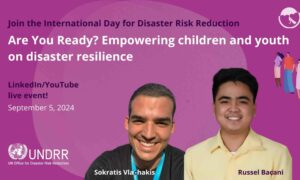
IDDRR 2024: Are You Ready? Empowering children and youth on disaster resilience
5 September 2024 | Online
Learning

Health Emergency and Disaster Risk Management for Resilient Cities
World Health Organization
MOOC | Nature-based Solutions for Disaster and Climate Resilience
Partnership for Environment and Disaster Risk Reduction (PEDRR)

Stop Disasters Game
United Nations Office for Disasters Reduction
Disaster Risk Reduction Challenge Badge
YUNGA & FAO

Sendai Framework for Disaster Risk Reduction: For children
Children in a Changing Climate Coalition
Latest News
- Call for applications: 2025 RISK Award “Children and youths as agents of change for DRR” | UNDRR | 11 September 2024
- Empowering Central Asia’s next generation with safer, disaster-resilient schools | UNDRR, Regional Office for Europe & Central Asia | 20 September 2024