Événement Conférence
Youth Briefing on the 2025 UN Chemicals, Waste and Pollution Negotiations
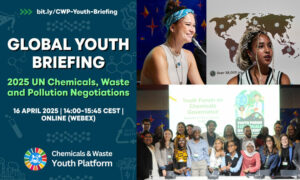
The Youth Briefing, organized by the Chemicals & Waste Youth Platform, brought more youth voices into globally-coordinated efforts to find solutions to pollution. With multiple UN negotiations scheduled in 2025 on chemicals and waste, this session provided youth with foundational knowledge of how policies are developed, the key issues of concern, the different actors driving progress, and where youth fit in the process.
About this Event
Young people are staring down an uncertain future as pollution – alongside climate change and biodiversity loss – wreak havoc on our communities. Scientists conclude chemical pollution has crossed a « planetary boundary, » pollution is believed to be responsible for 1 in 6 premature deaths worldwide, and the institutional capacity to manage chemicals continues to be a widening gap between high-income and low-income countries.
Children and youth are among the groups at highest risk from the unsound management of chemicals and waste. Developing bodies of infants, children and adolescents are more sensitive to disruption and irreparable damage by hazardous agents, with more years of life ahead to contend with the effects. Children breathe more air and consume more food and water proportional to their body weight than adults, resulting in greater exposures. Certain classes of chemicals have been found to alter genetic material in cells or pass from mother to fetus during pregnancy. The “pre-polluted” fate of future generations determined before they are born raises clear intergenerational concerns. Moreover, developing countries with the least capacity to manage chemicals and waste also tend to have a large proportion of youth in their population.
While the full scope of implications to the health and well-being of children and youth remains to be studied, effective chemicals and waste governance is a clear priority for young people. It is the young advocates, scientists, health workers, and storytellers that are going to be at the forefront of shaping the solutions in their communities, industry and government in the years to come. Meaningful youth engagement is therefore vital to the success and longevity of policy instruments on chemicals, waste and pollution.
The Youth Briefing aims to bring more youth voices into globally-coordinated efforts to find solutions to pollution. With multiple UN negotiations scheduled in 2025 on chemicals and waste, the vision for this session is to provide youth with foundational knowledge of how policies are developed, the key issues of concern, the different actors driving progress, and where youth fit in the process.
Speakers
By order of intervention.

Shannon LISA
Chemicals and Waste Youth Platform Global Focal Point
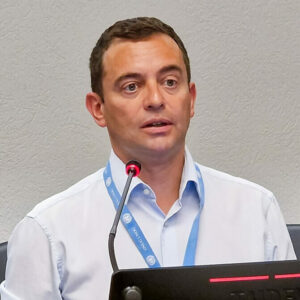
Ludovic BERNAUDAT
Head, Knowledge and Risk Unit, Chemicals and Health Branch, UNEP
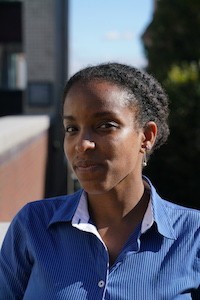
Leselle VINCENT
Chemicals and Waste Youth Platform Community-Building and Outreach Lead

Maria Cristina CARDENAS
Head of Unit & Senior Policy Advisor, Policy and Strategy Unit, BRS Secretariat
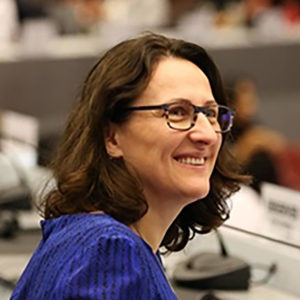
Monika STANKIEWICZ
Executive Secretary, Minamata Convention Secretariat

Anpotowin JENSEN
Chemicals and Waste Youth Platform member and Indigenous scientist (Oglala Lakota Nation, USA)
Nicole O. CAESAR
Global Framework on Chemicals Secretariat

Marinda Imakulata TAGIILIMA
Chemicals and Waste Youth Platform member (Samoa)

Mathilde COURROYE
Secretariat of the Intergovernmental Negotiating Committee on Plastic Pollution

Zhanyun WANG
Secretariat of the OEWG on a Science-Policy Panel on Chemicals, Waste and Prevention of Pollution
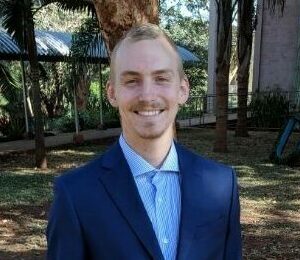
Richard MIESEN
Secretariat of the OEWG on a Science-Policy Panel on Chemicals, Waste and Prevention of Pollution

Rafael FERREIRA
Chemicals and Waste Youth Platform member (Brazil)

Joshua PRENTICE
Chemicals and Waste Youth Platform Plastic Pollution Thematic Focal Point
Highlights
Video
Live on Webex.