Nouvelle
Sustainable Transportation and the Role of Geneva

Mise à jour: 22 Nov 2026
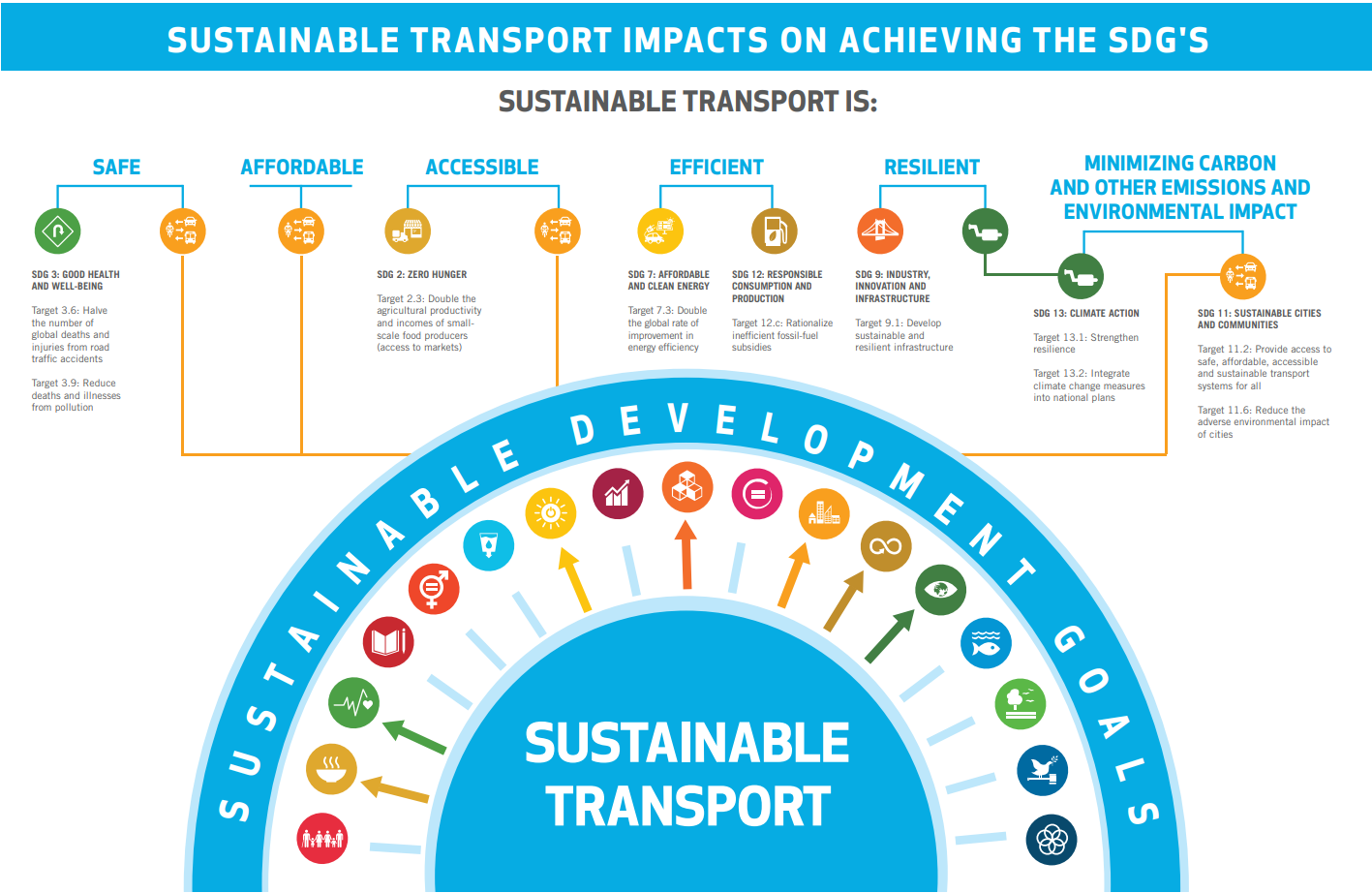
Sustainable transport can be defined as “the provision of services and infrastructure for the mobility of people and goods—advancing economic and social development to benefit today’s and future generations— in a manner that is safe, affordable, accessible, efficient, and resilient, while minimizing carbon and other emissions and environmental impacts.” This page gathers relevant information, data and resources from leading institutions and partners in Geneva and across the globe.
About Sustainable Transportation
Transport is an enabler for global connection and international exchanges, yet it shapes personal lives on a daily basis. While the choice of the means of transport can be multiple, in many cases it is limited by factors such as poverty, social exclusion and national, regional, or local circumstances. At the same time, transport is an enabler of economic development, allowing goods and people to flow. Against the background of the Agenda 2030, the Sustainable Development Goals (SDGs) and the Paris Agreement adopted in 2015, tackling climate change while promoting sustainable development and eradicating poverty are deeply intertwined and sustainable transportation is an important factor to its successful achievement.
According to the Secretary-General’s High-level Advisory Group, sustainable transport can be defined as “the provision of services and infrastructure for the mobility of people and goods—advancing economic and social development to benefit today’s and future generations— in a manner that is safe, affordable, accessible, efficient, and resilient, while minimizing carbon and other emissions and environmental impacts.” Sustainable transport is therefore not an end in itself, but a means to achieve sustainable development, improving people’s life quality and supporting the achievement of the 2030 Agenda and the Paris Agreement’s goals.
The Climate Imperative for Sustainable Transportation
The transport sector is deeply intertwined with climate change both as a contributor to GHG emissions and for its vulnerability to climate-related extreme weather and disasters. Sustainable transportation must be climate neutral and resilient to climate impacts.
IPCC Sixth Assessment Report Working Group III on Mitigation of Climate Change dedicated Transportation Chapter finds that in 2019, direct greenhouse gas (GHG) emissions from the transport sector were 8.7 GtCO2-eq (up from 5.0 GtCO2-eq in 1990) and accounted for 23% of global energy-related CO2 emissions. 70% of direct transport emissions came from road vehicles, while 1%, 11%, and 12% came from rail, shipping, and aviation, respectively. Therefore, mitigating its impacts on climate is essential. While a lot of the efforts to mitigate GHG emissions from the transport sector over the past decades have focused on engine and fuel technologies, the IPCC points out that population dynamics, finance and economic systems, urban form, culture, and policy also drive emissions from the sector. Thus, systemic change requires innovations in these components. These systemic changes offer the opportunity to decouple transport emissions from economic growth. In turn, such decoupling allows environmental improvements like reduced GHG emissions without loss of economic activity (UNEP 2011; UNEP 2013; Newman et al. 2017; IPCC 2018).
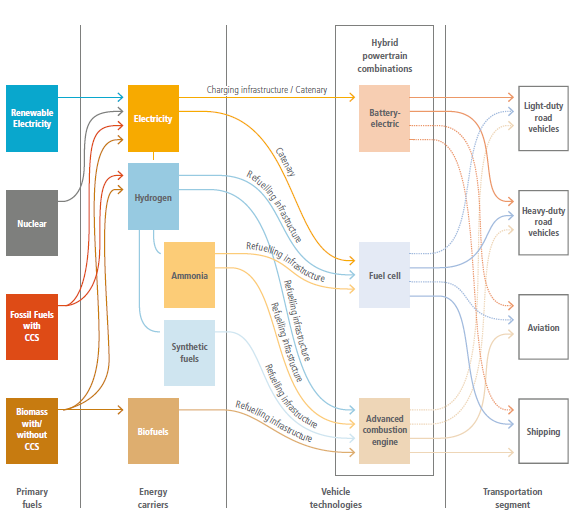
Transport Technology Innovations for Decarbonization
Additional Resources:
- UN | Your guide to climate action: Transport
- UNEP | Transport
- UN DESA | The importance of sustainable transport for the 2030 Agenda and the Paris Agreement
- Mobilizing Sustainable Transport for Development | United Nations Secretary-General’s High-Level Advisory Group on Sustainable Transport | 2016
International Governance for Sustainable Transport
Sustainable transport has been recognized as a fundamental component in sustainable development for decades.
- The outcome document of the 1992 United Nations’ Earth Summit – Agenda 21, dedicated a chapter to promoting sustainable energy and transport systems in human settlements. In undertaking the five-year review of the implementation of Agenda 21 during its nineteenth Special Session in 1997, the UN General Assembly further noted that, over the next twenty years, transportation would be expected to be the major driving force behind a growing world demand for energy (Indeed, it is now the largest end-use of energy in developed countries and the fastest growing one in most developing countries). Further, at the 2002 World Summit on Sustainable Development, the role of transport was once again captured in the outcome document – the Johannesburg Plan of Implementation (JPOI). JPOI provided multiple anchor points for sustainable transport, including infrastructure, public transport systems, goods delivery networks, affordability, efficiency and convenience of transportation, improving urban air quality and health, and reducing greenhouse gas emissions.
- World leaders recognized unanimously at the 2012 United Nations Conference on Sustainable Development (Rio +20) that transportation and mobility are central to sustainable development. Sustainable transportation can enhance economic growth and improve accessibility and support the achievement of better integration of the economy while respecting the environment, improving social equity, health, resilience of cities, urban-rural linkages and productivity of rural areas
UN Secretary-General High Level Advisory Group on Sustainable Transport (HLAG-ST)
The then UN Secretary-General Ban Ki-moon established the High Level Advisory Group on Sustainable Transport (HLAG-ST) for three years on 8 August 2014. Chaired by Olof Persson, CEO of the Volvo Group, and Carolina Tohá, the Mayor of Santiago, Chile, its 12 members were to work with governments, transport providers (aviation, marine, ferry, rail, road and urban public transport), private businesses, financial institutions, civil society and other stakeholders to make recommendations at all levels to promote sustainable transport systems and protect the environment against climate change. It produced the report entitled Mobilizing Sustainable Transport for Development.
Global Sustainable Transport Conference
Recognizing the fundamental role of sustainable transport in fighting climate change and achieving sustainable development, Secretary-General Ban Ki-moon launched the Global Sustainable Transport Conference.
- The First Global Sustainable Transport Conference was held on 26 and 27 November 2016 in Ashgabat, Turkmenistan. Around 1,500 participants, including Heads of State and Government, private sector CEOs, civil society leaders and UN officials will discuss all modes of transport – road, rail, air, and waterborne.
- The Second United Nations Global Sustainable Transport Conference took place from 14 to 16 October 2021, in Beijing, China, providing an opportunity to focus attention on the opportunities, challenges and solutions towards achieving sustainable transport worldwide. It concluded with a call to accelerate progress towards achieving sustainable transport that would result in major reductions in greenhouse gas emissions and in improving the lives of millions of people.
- UN General Assembly A/RES/78/148 adopted in December 2023 invites the Secretary-General to consider convening the third United Nations Global Sustainable Transport Conference, to ensure the implementation of the objectives of the first and second United Nations Global Sustainable Transport Conferences.
Partnership on Sustainable, Low Carbon Transport (SLoCaT)
SLOCAT accelerates the transformation of transport systems and services towards inclusive, healthy, green and resilient solutions for people and the planet. SLOCAT enables collaborative knowledge and action for sustainable, low-carbon transport, and brings the voice of the movement into international climate change and sustainability processes.
Global Partnership for Sustainable Transport
Together with the United Nations, IRU has co-created the Global Partnership for Sustainable Transport (GPST) – a community dedicated to bringing environmental issues to the fore, launched on the sidelines of the 70th UNGA. The GPST focuses on promoting best practice – giving businesses the tools and information needed to make their day-to-day trading more sustainable, encouraging governments and businesses to talk about sustainability and come up with concrete solutions, and working in partnership.
SDG 11 – Sustainable Cities and Communities
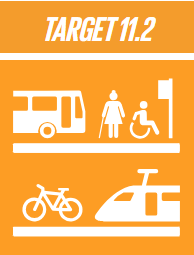 Under Sustainable Development Goal 11 – Sustainable Cities and Communities – Target 11.2, Affordable and Sustainble Transport Systems, aims to « by 2030, provide access to safe, affordable, accessible and sustainable transport systems for all, improving road safety, notably by expanding public transport, with special attention to the needs of those in vulnerable situations, women, children, persons with disabilities and older persons. »
World Sustainable Transport Day
Recognizing the important role of safe, affordable, accessible, and sustainable transport systems for all in supporting sustainable economic growth, improving the social welfare of people, and enhancing international cooperation and trade among countries, at its 77th Session in May 2023, the UN General Assembly, in its resolution A/RES/77/286, declared 26 November as World Sustainable Transport Day. Transport touches every part of our lives, from clothing to food, raw materials, stocks, and more. Transport makes jobs accessible and allows commerce. Therefore, making transport as safe, accessible, and sustainable as possible is one of the keys to a brighter and more sustainable future.
UN Decade of Sustainable Transport 2026 – 2035
In 2023, the General Assembly declared the first-ever United Nations Decade of Sustainable Transport, starting in 2026.
While there is no single dedicated Sustainable Development Goal for transport, it is reflected in several SDG targets and recognized as an enabler for achieving many of the goals. Both the political appreciation of sustainable transport as well as our scientific understanding of transport’s linkages, both synergies and trade-offs, with issues such as resilient infrastructure development, food security, economic growth, trade, global supply chains, promotion of health, energy efficiency and tackling of climate change have greatly improved in recent years.
The United Nations Decade of Sustainable Transport will be an opportunity to further raise awareness of transport’s crucial role in advancing the Sustainable Development Goals and to gather and rally new solutions, resources and partnerships to advance sustainable transport globally.
Through the resolution A/78/148 titled “Strengthening the links between all modes of transport to achieve the Sustainable Development Goals” the Member States also requested the United Nations Department of Economic and Social Affairs to develop an Implementation Plan for the UN Decade of Sustainable Transport, in collaboration with the UN Regional Commissions and in consultation with the Member States, the United Nations system and all other relevant stakeholders.
The Implementation Plan for the United Nations Decade of Sustainable Transport will be a critical tool in steering global efforts towards sustainable, inclusive, and resilient transportation systems. By fostering collaboration, mobilizing resources, and ensuring effective monitoring, the plan can shine a light on the critical importance of sustainable transport, contribute significantly to its achievement and to the attainment of several of the SDGs.
The Implementation Plan of the UN Decade of Sustainable Transport is expected to serve as a strategic framework to coordinate actions, mobilize resources, and monitor progress towards sustainable transport worldwide. The Implementation Plan is expected to be global and non-binding in nature, allowing for more detailed regional, national and local plans, strategies and ways of collaboration, as suitable.
At best, the Implementation Plan can provide a roadmap for accelerating the steps towards sustainable transport during the Decade, enhance coordination and collaboration among member States and other stakeholders, mobilize resources for sustainable transport projects at all levels, and increase awareness and capacity building on sustainable transport practices. The Implementation Plan can also provide global visibility for sustainable transport in SDG discussions and allow for improved monitoring and evaluation of progress towards sustainable transport goals and on transport’s contributions towards the SDGs.

World Bicycle Day
World Bicycle Day – celebrated each year on 3 June since 2018 (UNGA Resolution A/RES/72/272) – aims to advance the use of the bicycle as a means of fostering sustainable development, strengthening education, promoting health, preventing disease, promoting tolerance, mutual understanding and respect and facilitating social inclusion and a culture of peace. To spread awareness about its many benefits, the UN encourages Member States to develop a culture of cycling and organize initiatives like national and local bike rides, while promoting pedestrian safety and cycling mobility.
Local Action | Geneva Advancing Sustainable Transportation
The City of Geneva is engaged to making everyday travel easier, safer and less polluting, while preserving quality of life. As part of its Climate Strategy, the City encourages its staff to opt for sustainable modes of transport and is undertaking key measures undertaken by the City of Geneva to lower the environmental impact of its mobility by 2030 include:
- Speed reduction to improve safety and reduce noise pollution.
- Creation of safe cycling facilities to encourage people to get around by bike and encouraging the use of bikes through easily available bike rentals and repair stations.
- Promotion of public transport to limit the use of individual motorized vehicles in the city center, including by granting subsidies to younger and senior people.
- Universal accessibility to enable everyone to move around easily, including those with reduced mobility.
- Designing cities to encourage walking and create welcoming spaces for people of all ages, whether active or sedentary. They incorporate measures from the Climate Strategy, particularly to combat heat islands, by removing soil impermeability or increasing tree cover where possible.
- Greener vehicles | The city is electrifying its vehicle fleet. It is purchasing low-CO2 vehicles, with the aim of having 50% of its fleet electric by 2030.
To engage the population of Geneva to reduce the environmental footprint of their mobility, various challenges are regularly held:
- Bike to work challenge | Organized by ProVélo, the campaign promotes health in companies. Every year in May and June, over 100,000 commuters ride to work by bike on as many work days as possible and win attractive prizes. Through Bike to Work, about 4000 companies strengthen their staff’s team spirit and fitness, while supporting sustainable mobility practices.
- Déclic mobilité | Organized by the Modus Foundation, this challenge invites all to spend a month without a car or a motorcycle and offers anyone living in the canton of Geneva the opportunity to try out other ways of getting around.
Role of Geneva
International Institute for Sustainable Development | IISD
The International Institute for Sustainable Development (IISD) is an award-winning independent think tank working to create a world where people and the planet thrive. Through its work on infrastructure, IISD supports the advancement of investments that consider carbon and environmental footprints, social cohesion, stewardship of natural ecosystems, and the financial viability of projects.
International Road Transport Union | IRU
IRU is the world road transport organisation. It represents the entire industry – bus, coach, truck and taxi, and drives the sustainable mobility of people and goods across the planet. IRU members are primarily national associations for passenger or goods transport. They include associations of truck, bus, coach and taxi operators, associations for a specific category of road transport, chambers of commerce and automobile clubs. IRU also has associate members who are national and international not-for profit associations and companies.
United Nations Economic Commission for Europe | UNECE
The Transport, Health, and Environment Pan-european Programme (THE PEP) works at the nexus of transport, health and the environment to implement the goals of the Paris Declaration “City in Motion – People First!”. THE PEP’s projects focus on promoting sustainable urban transport, including by developing safe conditions for people to walk and cycle in cities.
The first-ever Pan-European Master Plan for Cycling Promotion was adopted in 2021, at the Fifth High-Level Meeting of THE PEP.
Since 2018, UNECE has been hosting the UN Road Safety Fund (UNRSF), which aims to help low- and middle-income countries to put in place effective national road safety systems with a focus on preventing traffic-related injuries.
Inland Transport Committee
United Nations Environment Programme Financial Initiative | UNEP FI
UNEP FI (the United Nations Environment Programme Finance Initiative) works with the financial sector to support a shift toward sustainable transportation. Through thematic briefs for financial institutions such as Climate Risks in the Transportation Sector on the physical and transition climate risks and opportunities tied to transportation, it supports banks and other financial institutions manage the risks in their own transportation financing, and the risks faced by their clients. The aim is a smooth and just transition toward a sustainable, net-zero economy.
World Business Council for Sustainable Development | WBCSD
WBCSD’s Transport & Mobility Pathway aims to abate global transport emissions in line with a +1,5°C scenario by helping businesses achieve their net-zero carbon commitments and accelerating the adoption of zero-emission vehicles and technologies.
It supports companies in managing their sustainability transition and finding new revenue sources through circularity and data-driven mobility solutions by convening companies from the extended transport value chain and leading organizations from the transport space in action-oriented projects and collective advocacy.
World Intellectual Property Organization | WIPO
WIPO GREEN is an online platform for technology exchange. It supports global efforts to address climate change by connecting providers and seekers of environmentally friendly technologies, including those related to sustianable transportation. Through its database, network and acceleration projects, it brings together key players to catalyze green technology innovation and diffusion.
Local Geneva
Association Transport et Environnement (ATE) Genève
ATE is a nationwide association working in favor of sustainable mobility. The Geneva hub develops and supports initiatives to create the necessary conditions for sustainable transportation in the region. Aside from the significant work on public transport, ATE Genève is supporting more extensive and safer bicycle infrastructure.
Canton of Geneva
The Canton of Geneva is encouraging the uptake of cycling by optimizing connections with public transport, creating of new, safe and unbroken bike paths and increasing bicycle parking spaces. In order to encourage this further, a financial support programme for purchasing electrically-assisted bicycles has been in place since 2010.
City of Geneva
The City of Geneva lends its full support to cycling. While its cycling policy primarily focuses on the extension of the network and the safety of cyclists, it also aims to promote cycling as a means of daily transport and a leisure activity. In 2023 it released a new edition of the “Geneva centre” cycle map. This new cycle map is intended for both regular cyclists and newcomers to this mode of transport.
Genèveroule
Genèveroule is a non-profit association which pursues the double mission of promoting the use of bicycles and offering jobs for socio-professional integration. Genèveroule offers bicycle rentals around the city, repair shops and workshops, as well as support for companies to integrate cycling in their daily business.
ProVélo Geneva
ProVélo Geneva is an association that defends the interests of cyclists. It encourages the use of the bicycle as an environmentally friendly, healthy, silent and inexpensive means of transportation in the city and in the canton of Geneva. Its activities comprise various events, including guided bike tours, bike lessons and repair workshops.
Taupenivo
Taupenivo is a Geneva-based tandem bicycle association for visually impaired people. Its goal is to offer people of all ages with visual impairments in Geneva and the surrounding area the possibility and pleasure of riding a tandem bike.
Union Vélocipédique Genevoise (UVG)
The UVG is a cantonal cycling association, affiliated to the Swiss Cycling Federation. It operated as the umbrella organization of the Geneva cycling clubs, the Velodrome Commission and various sports structures such as the Geneva Cycling Club (TSP Genève).