
Événement Conférence
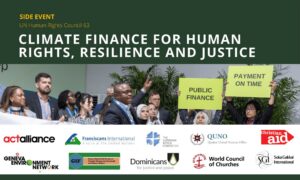
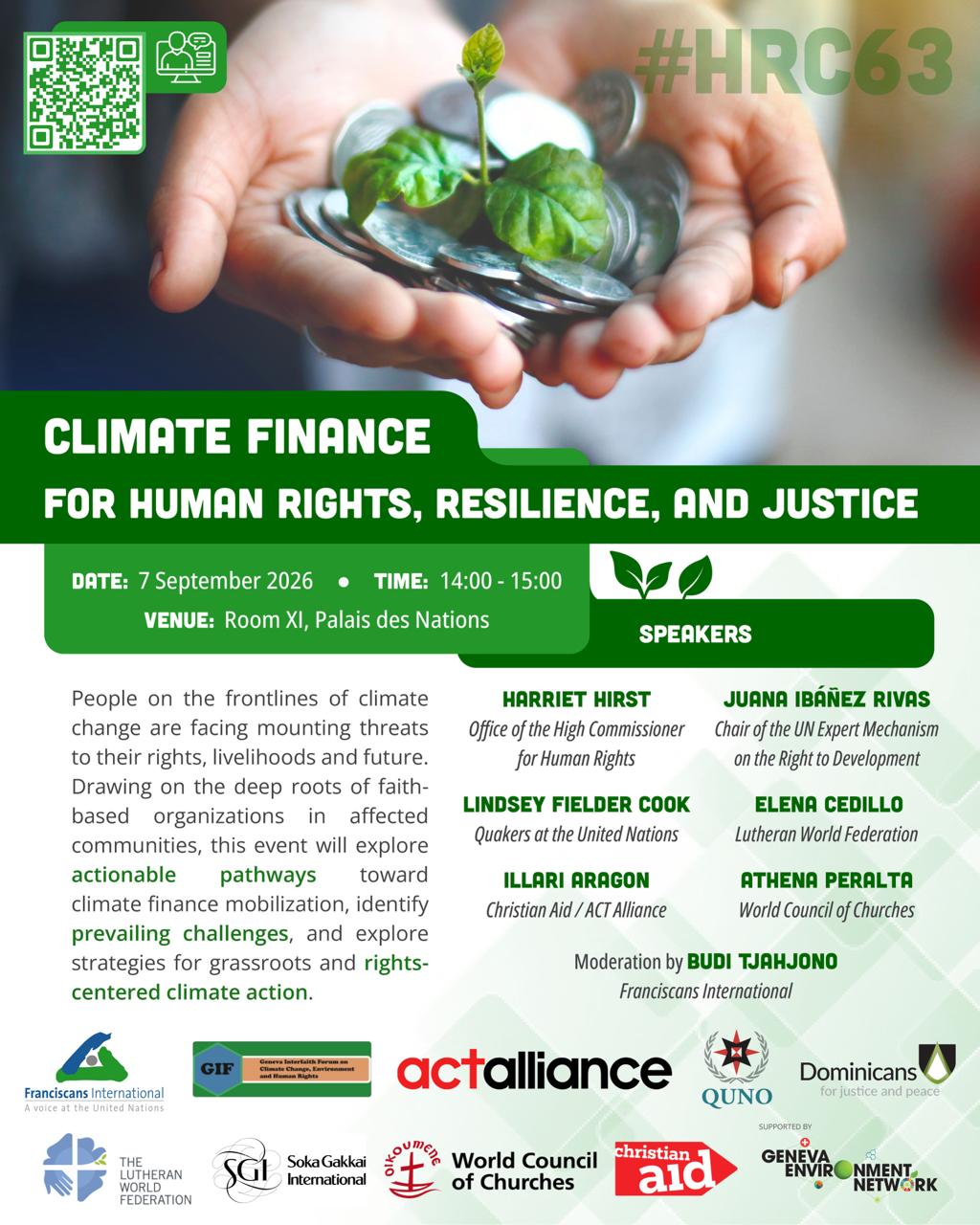
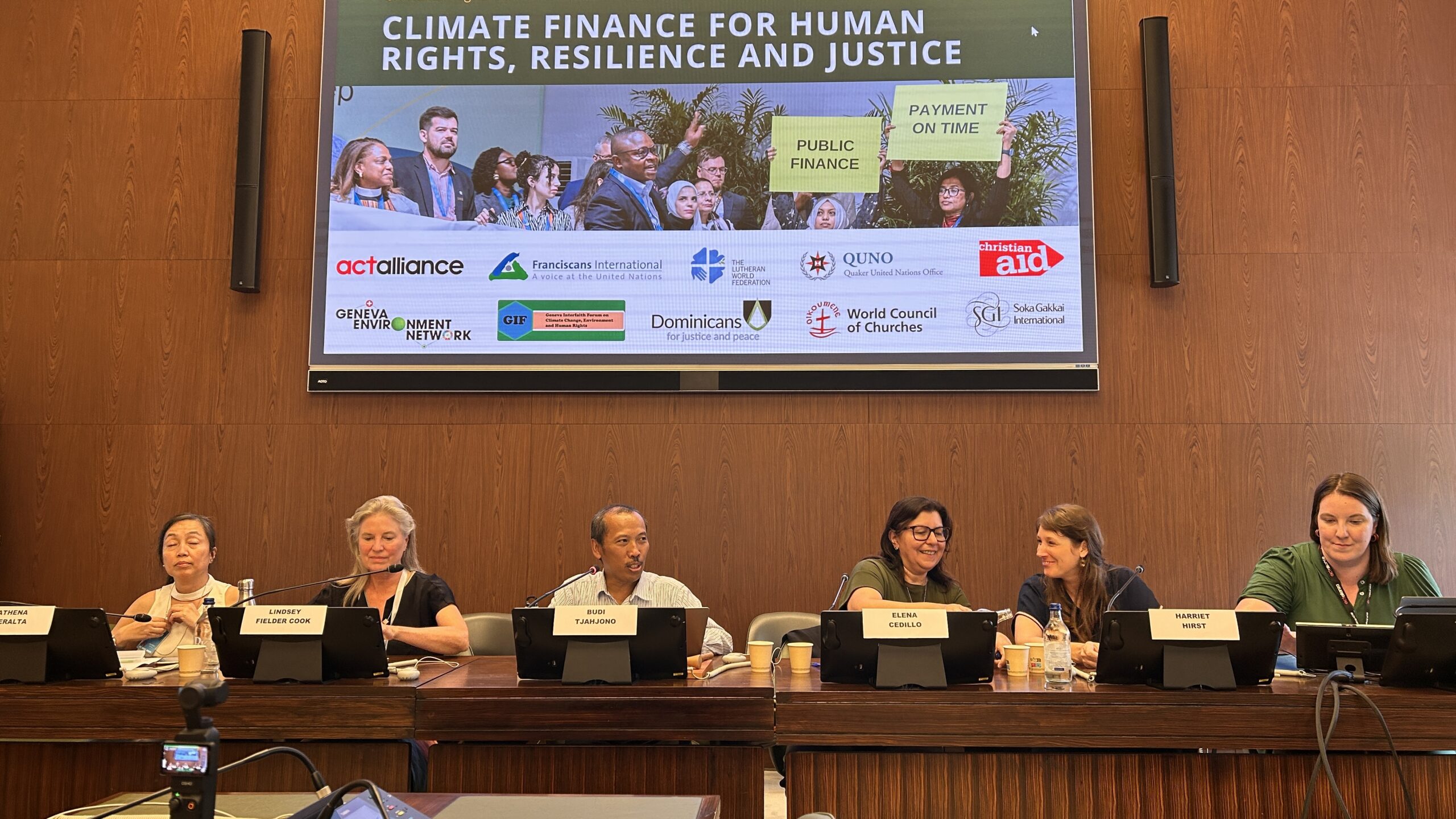
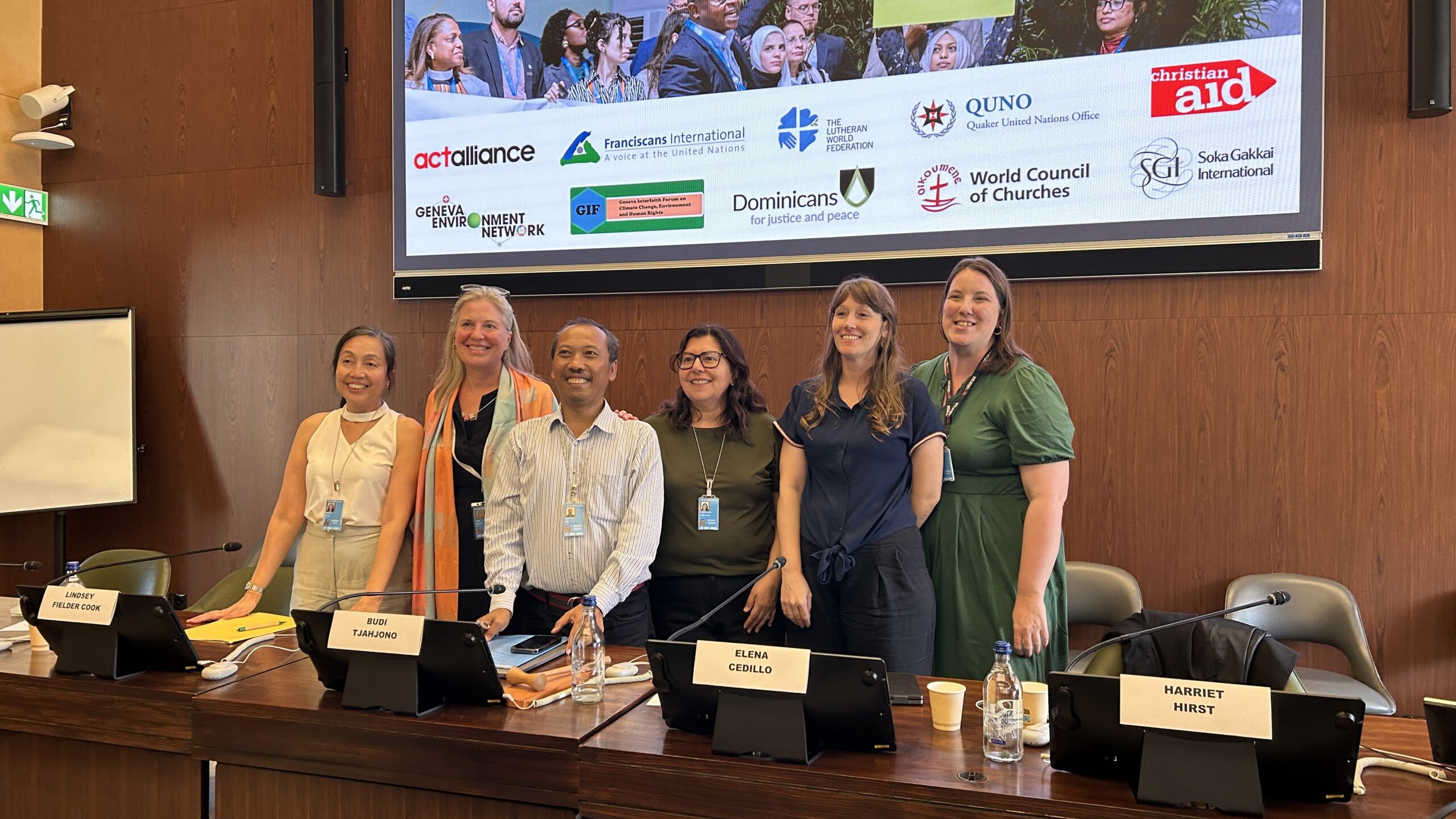
Climate Finance for Human Rights, Resilience and Justice | HRC63 Side Event
07 Sep 2026
14:00 – 15:00
Lieu: Palais des Nations, Room XI
Organisation: Franciscans International, Geneva Interfaith Forum on Climate Change, Environment and Human Rights, Quaker United Nations Office, Dominicans for Justice and Peace, Soka Gakkai International, Conseil œcuménique des Eglises, Lutheran World Federation, Christian Aid
This side event to the 63rd session session of the Human Rights Council (HRC63) explored actionable pathways for climate finance mobilization and how this must support adaptation, address loss and damage, and strengthen resilience.

About this Event
As climate impacts intensify, communities on the front lines are facing mounting threats to their rights, livelihoods, and futures, with many experiencing forced displacement and climate-related human mobility.
The Human Rights Council, in its resolution 59/25 of 8 July 2025 entitled “Human rights and climate change” (para. 24), has requested the Secretary-General to consult Member States and other relevant stakeholders in order to prepare and submit to its sixty-third session a synthesis report (A/HRC/63/54) on actionable pathways in mobilizing sufficient climate financing and associated challenges and opportunities in the pursuit of the full realization of human rights for all people. At HRC63, the UN Expert Mechanism on the Right to Development (EMRD) is also going to present the report (A/HRC/63/39), “Climate Finance: Vulnerability and Responsibility”
Building on faith-rooted action and lived community experiences, this event explored actionable pathways for climate finance mobilization and how this must support adaptation, address loss and damage, and strengthen resilience. The discussion highlighted the need for fair, predictable, accessible, and rights-based financing that prioritizes those most affected, enables meaningful participation, and advances climate justice at all levels. It further unpacked current mobilization mechanisms and assess their relevance to rights-based climate action.
Environment @ HRC63
The 63rd regular session of the UN Human Rights Council (HRC63) will take place in Geneva from 7 September to 7 October 2026. Consult this regularly-updated page that highlighted the environmental-related activities of this session.

Speakers
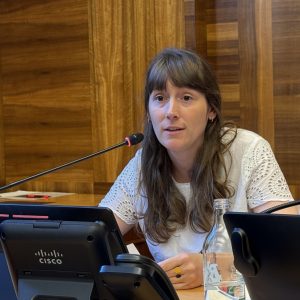
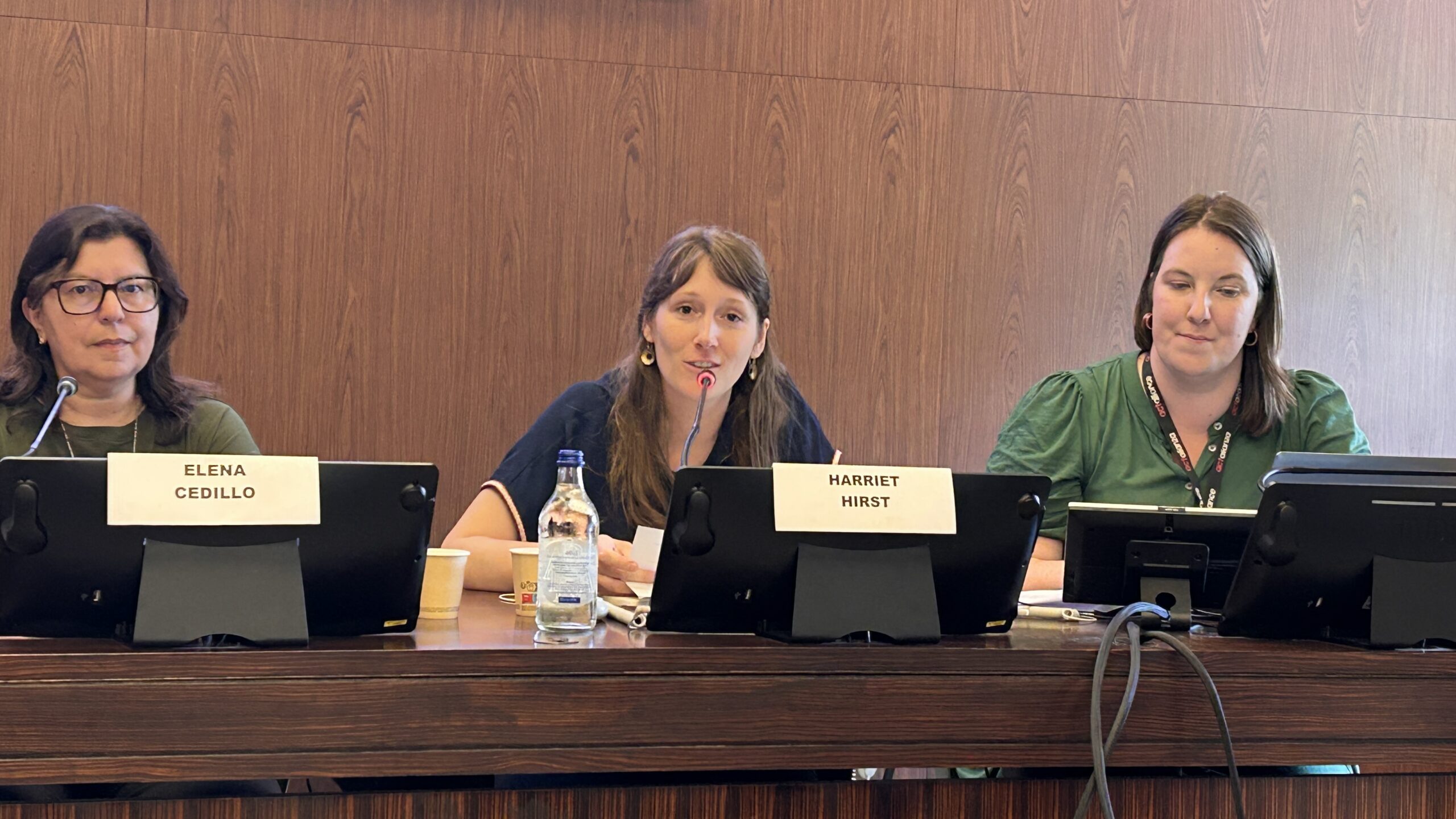
Harriet HIRST
Human Rights Officer, Environment and Climate Change Unit, UN Office of the High Commissioner for Human Rights

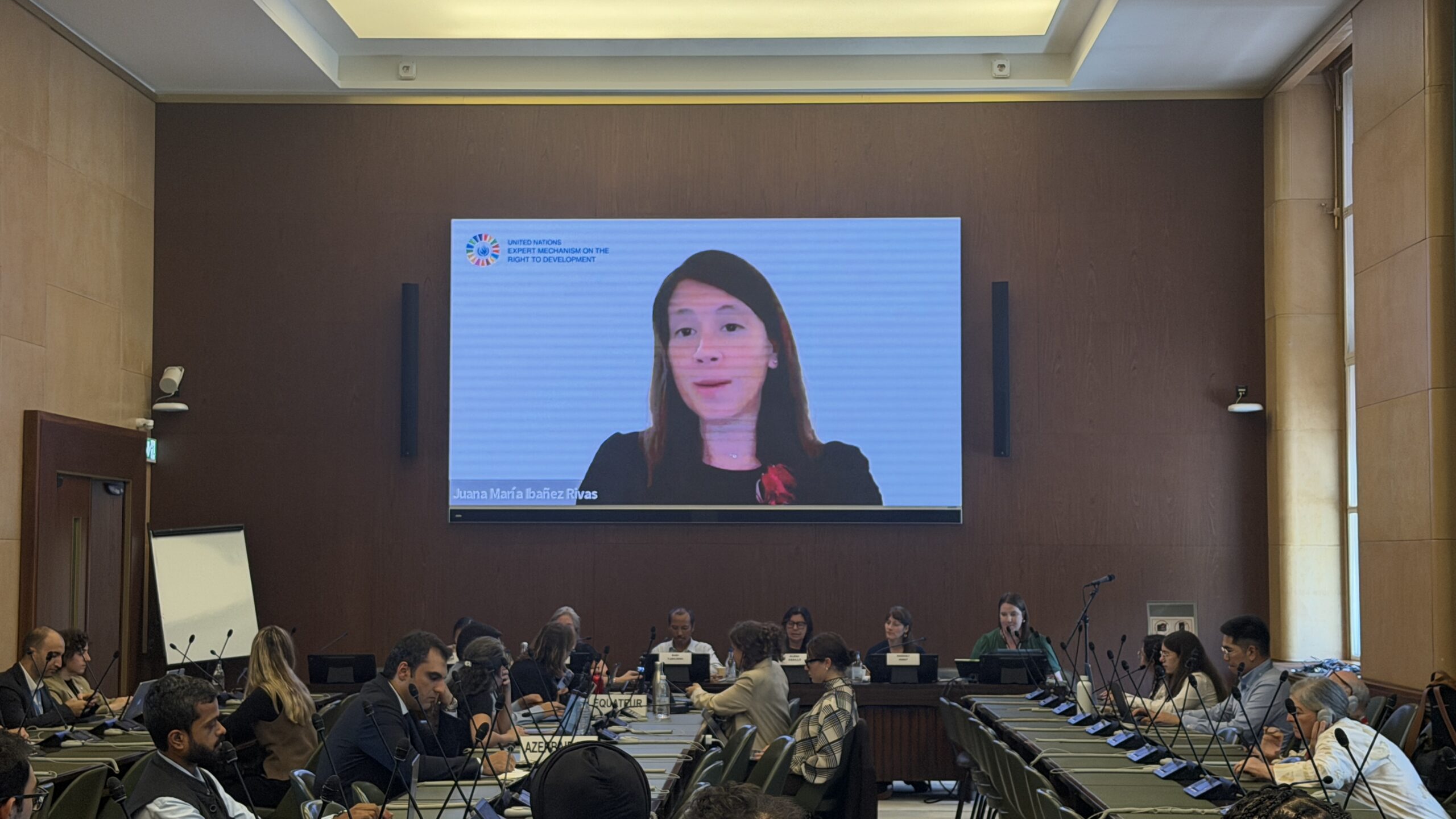
Juana IBAÑEZ RIVAS
Chair, UN Expert Mechanism on the Right to Development (video)
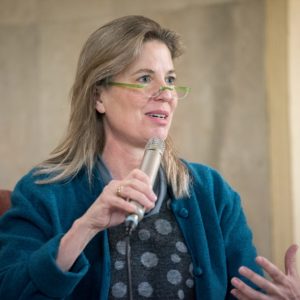
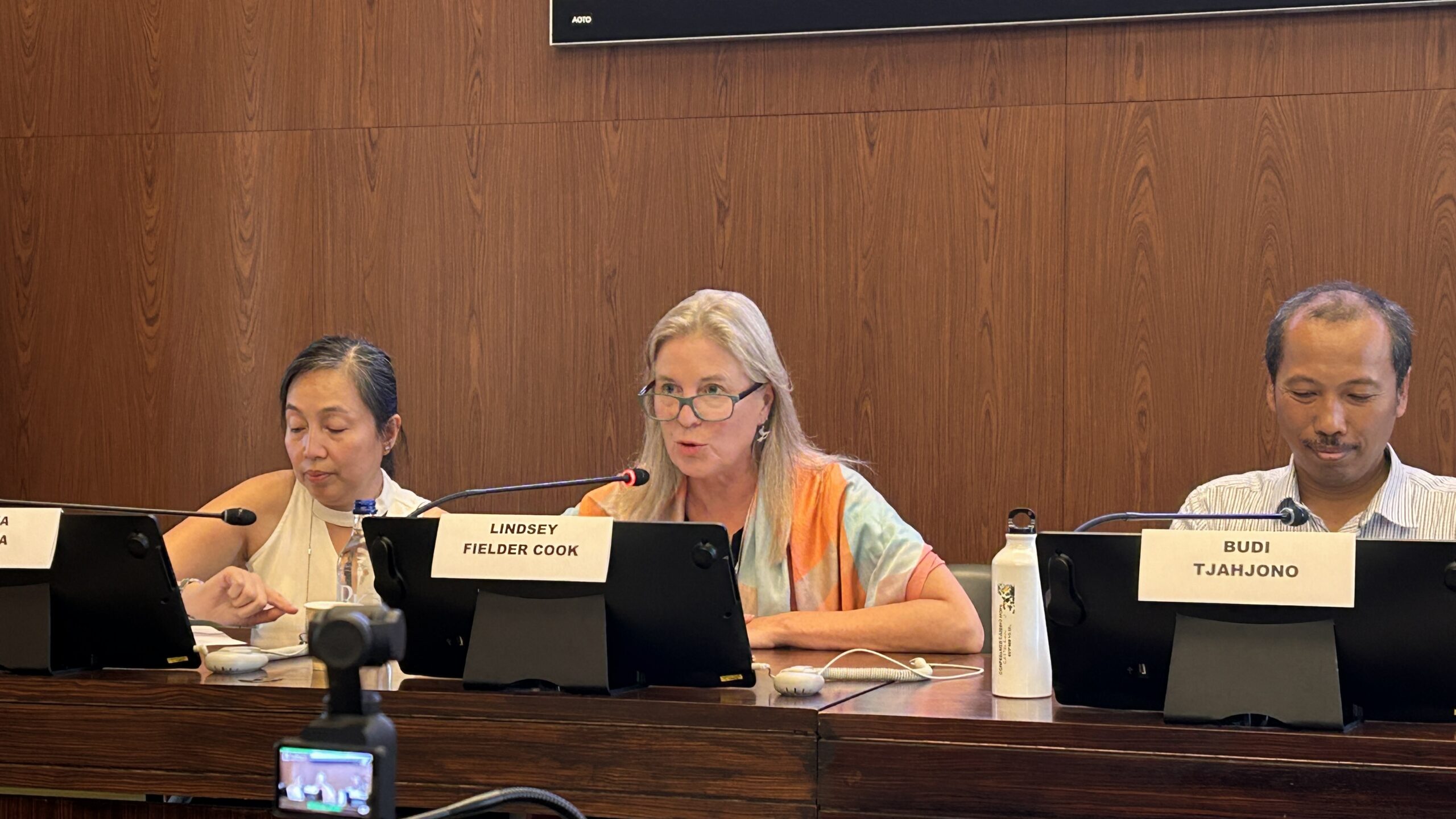
Lindsey FIELDER COOK
Interim Deputy Director and Representative for Climate Change, Quaker United Nations Office

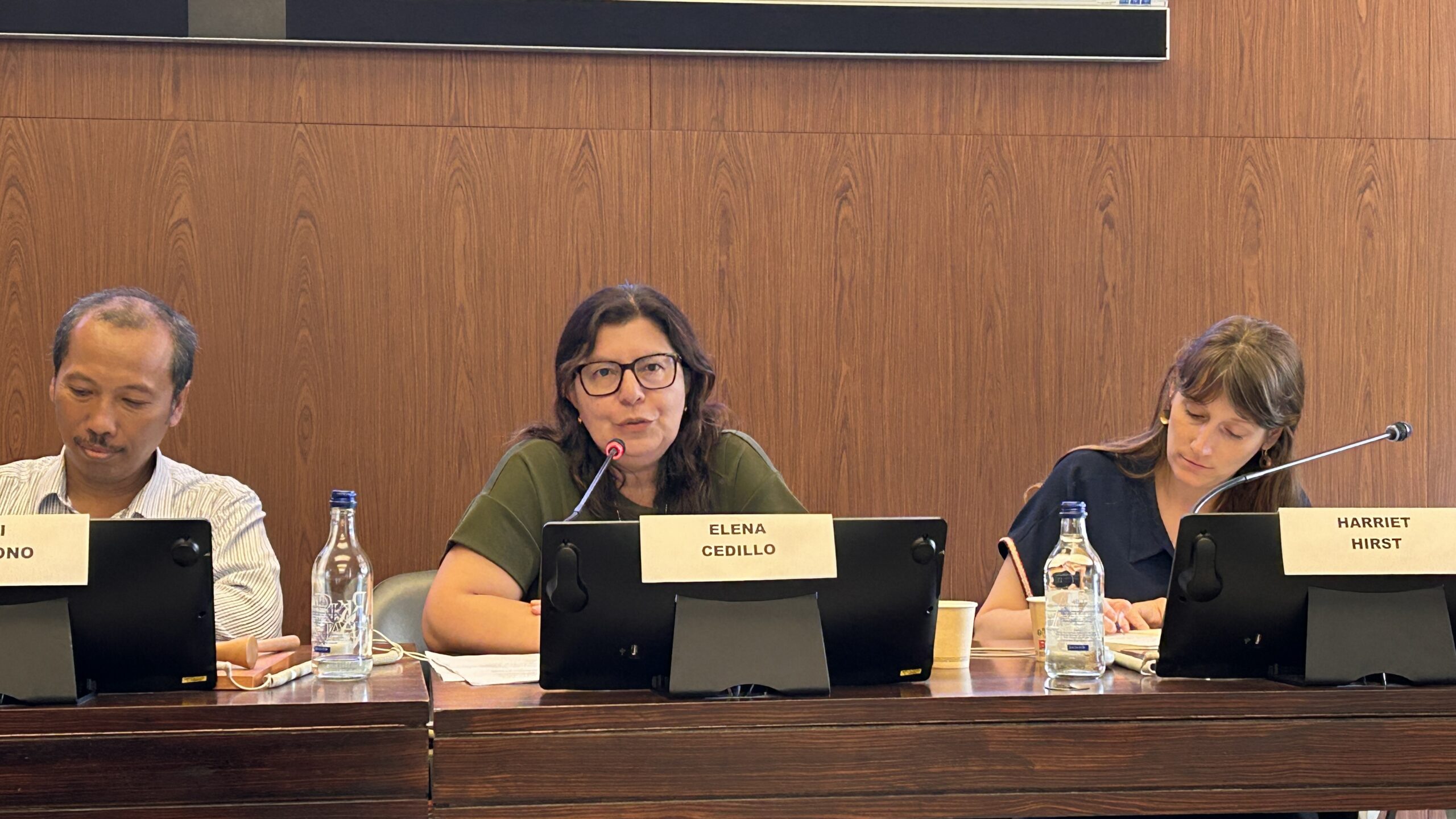
Elena CEDILLO
Programme Executive for Climate Justice, Lutheran World Federation

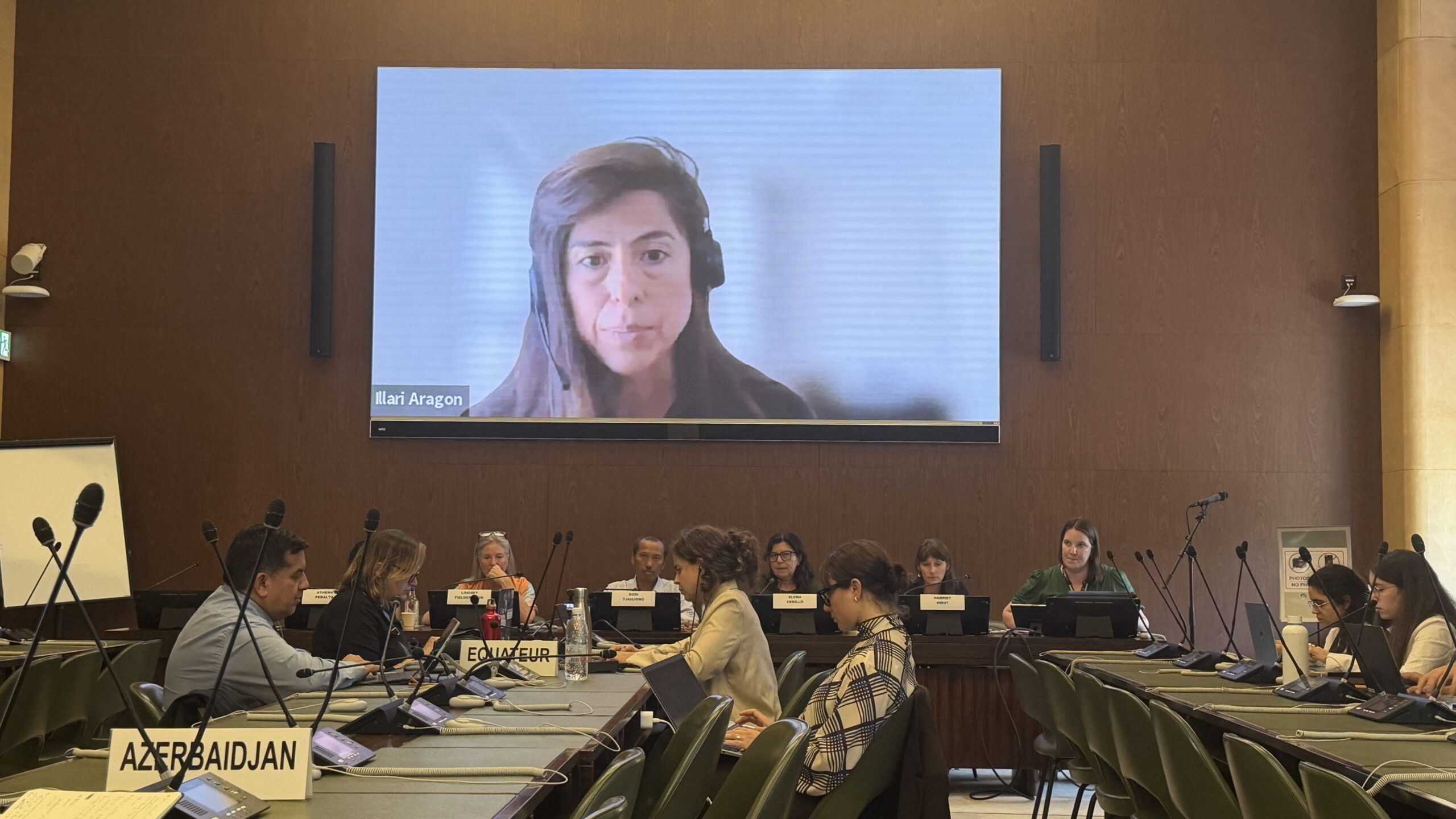
Illari ARAGON
Climate Justice Policy Lead, Christian Aid | ACT Alliance (video)

Athena PERALTA
Programme Executive for Economic and Ecological Justice, World Council of Churches (WCC)
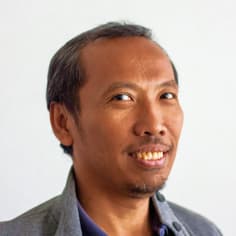
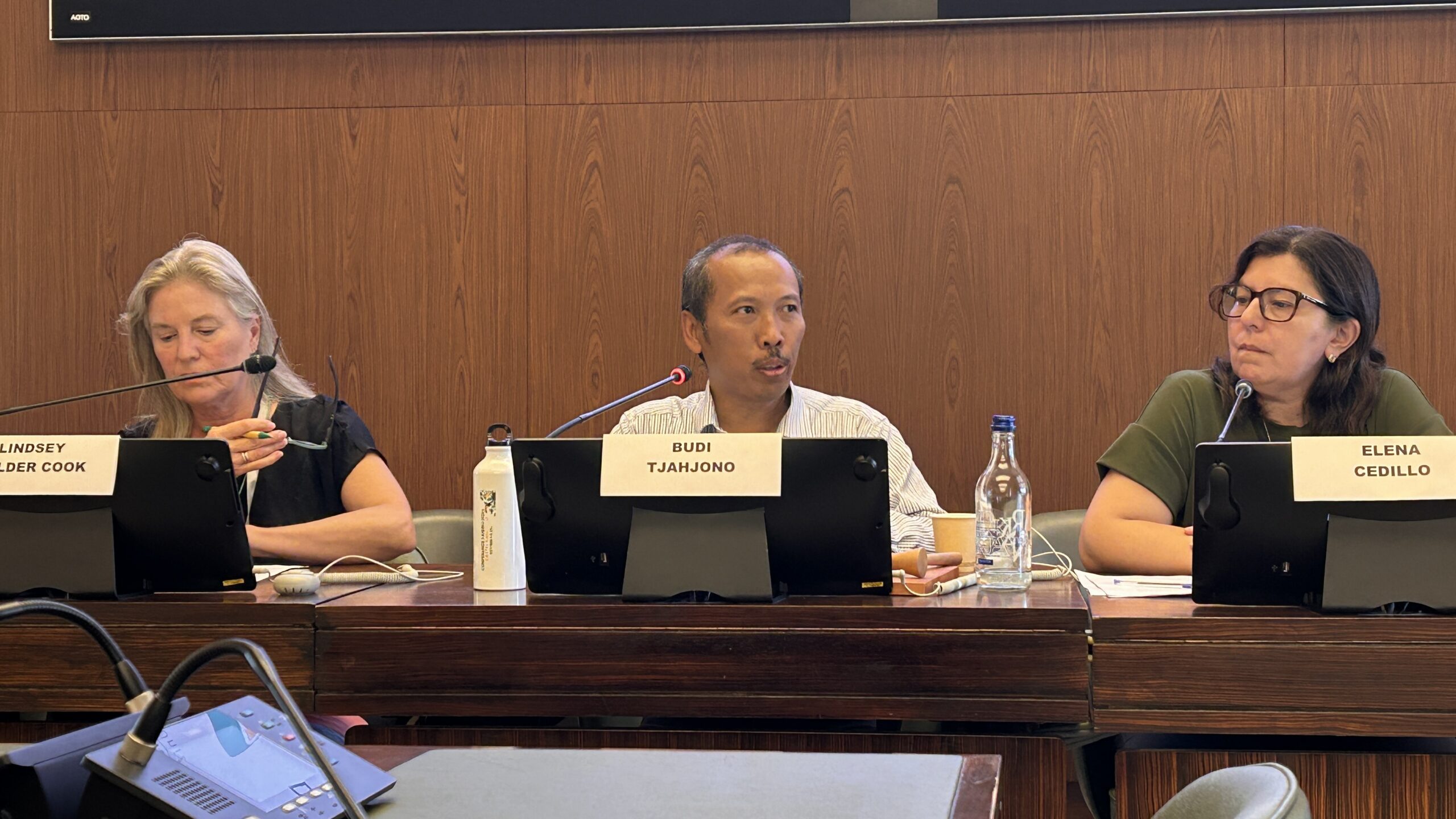
Budi TJAHJONO
International Advocacy Director, Franciscans International | Moderator
Highlights
Video
Live from Palais des Nations.
Summary
Harriet HIRST | Human Rights Officer, Environment and Climate Change Unit, UN Office of the High Commissioner for Human Rights
- As climate impacts intensify across the world, there is an increasing need for climate finance.
- The scale of the needs is really enormous. Developing countries need about 3.2 trillion annually by 2035. Yet climate finance provided and mobilized by developed countries only reached about 136.7 billion in 2024.
- Finance for adaptation and for loss and damage is particularly inadequate. Adaptation needs in developing countries are estimated between 310 and 365 billion per year by 2035. But current adaptation finance stands at only 26 billion. The Fund for Responding to Loss and Damage has received only approximately 455 million against estimated needs of 724 billion.
- Countries facing the greatest climate risk are often those receiving the least support. Least developed countries account for 45% of identified climate finance needs but only received about 7% of finance flows, whilst small island developing states account for 25% of the needs but only received about 3%.
- From a human rights perspective, the challenge is not simply in terms of the volume of the finance available, but it is also about how finance is mobilized, distributed, and delivered.
- There are also qualitative challenges that we have with current financial flows from a human rights perspective:
- The continued reliance on debt-creating forms of finance. In 2024, around two-thirds of public finance from developed countries took the form of loans. When countries are forced to spend resources servicing debt rather than on disaster preparedness, climate resilience, social protection, health, or education, it has a direct impact on human rights.
- Access. Climate finance mechanisms are often really complex, highly technical, and difficult to navigate. Complex application procedures, strict eligibility requirements, co-financing obligations, and reliance on intermediaries frequently prevent local actors, grassroots organizations, Indigenous peoples, women, and other communities who are on the front lines of climate change from accessing resources.
- Weak human rights safeguards and accountability when it comes to climate finance. Climate finance can generate significant benefits, but if poorly designed, projects can also result in exclusion and violations. Too often, people who are affected by projects financed by climate finance have limited access to effective remedies and to grievance mechanisms.
- Policy coherence. Continued investment in activities that drive climate change, such as fossil fuel subsidies and expansion, undermines progress and reduces the effectiveness of climate action while also undermining the enjoyment of human rights, including the right to a healthy environment.
- In 2024 alone, governments provided about 916 billion in fossil fuel support.
- How can these barriers and challenges be addressed through a human rights-based approach?
- A human rights-based approach to climate finance places people at the center of it. It recognizes that climate finance should contribute to advancing equality, protecting those in vulnerable situations, and ensuring that no one is left behind.
- This means increasing the availability of public resources and public finance, particularly for adaptation and loss and damage, which are essential for human rights.
- This also entails expanding fiscal space and mobilizing additional public resources through certain measures. For instance, the progressive and equitable phase-out of fossil fuel subsidies, fair international tax cooperation, taxation of windfall profits from fossil fuel industries, and other sources of finance capable of generating predictable and non-debt-creating finance.
- It also means addressing structural inequalities within the international financial system that limit the ability of developing countries to respond effectively to climate change. This will also imply increasing grant-based finance, reforming debt sustainability frameworks and multilateral development banks, and ensuring that debt burdens do not crowd out investments to realize human rights.
- A human rights-based approach also requires more direct, accessible, and inclusive financing, as well as meaningful participation. Communities affected by climate change must have a genuine voice in decisions about how climate finance is prioritized, allocated, and monitored.
- Particular attention should be given to the rights, knowledge, and leadership of Indigenous peoples, women, youth, persons with disabilities, displaced persons, and others in vulnerable situations.
- Climate finance governance must be improved. Stronger transparency, accountability, human rights due diligence, and effective safeguards must be embedded across public and private climate finance alike. These are really essential to ensuring that climate action is effective, equitable, and sustainable.
- So, climate finance is not simply a financial issue. It is really fundamentally a question of climate justice, equity, and human rights.
- Mobilizing greater resources is essential, but it is not enough. We must ensure that these resources are accessible, distributed fairly, responsive to the needs of affected communities, and aligned with human rights.
Juana IBAÑEZ RIVAS | Chair, UN Expert Mechanism on the Right to Development
- This event leads important discussions on climate finance for human rights, resilience, and justice.
- The discussion comes at a timely moment, as it is organized around the Expert Mechanism’s thematic study, Climate Finance, Vulnerability and Responsibility.
- The study finds that despite growing commitments, the delivery of public climate funds remains inadequate and that current allocations are heavily toward mitigation rather than adaptation.
- In reaching this conclusion, the study takes stock of recent advisory opinions of the Inter-American Court of Human Rights and the International Court of Justice on climate change, which have clarified and strengthened the legal understanding of State obligations on climate finance.
- States must pursue both mitigation and adaptation as complementary obligations, not alternatives. The study finds that channeling the bulk of resources toward mitigation while leaving adaptation needs underfunded poses in itself an obstacle to the right to development.
- It also recalls the duty of parties to the Paris Agreement to act with due diligence and in line with the principle of common but differentiated responsibilities and respective capabilities, including an obligation of adaptation and cooperation through technology and financial transfer undertaken in good faith.
- The nature of climate finance itself. The study recalls that climate finance can never substitute for development finance and official development assistance. It must be new and additional, not a replacement for it, and it must be directed toward the groups, communities, and regions in the most vulnerable situations, which are disproportionately affected by climate change.
- The study also stresses that climate finance should incorporate right to development principles, including mechanisms for the meaningful consultation and participation of local communities.
- On the instruments themselves, carbon markets feature prominently in the study, given their growing role in mobilizing climate finance. The study recognizes their potential but also raises significant concerns: overstated emission reductions, integrity and credibility challenges, and an equal sharing of benefits with local communities and Indigenous peoples.
- It also examines clean cooking initiatives, which offer a further pathway to climate mitigation with direct health and gender benefits.
- The potential of critical minerals to generate revenue for developing countries is also examined, navigating the energy transition while cautioning against repeating the human rights abuses and dispossession that have too often accompanied mining.
- The repetition of illicit financial flows represents resources that could otherwise support climate adaptation and transition in developing countries.
- On what this means in practice, the study calls on governments to put in place clear, stable regulatory frameworks for carbon markets with robust safeguards and fair pricing, tailored to national contexts, rolled out in phases, and supported by international cooperation to strengthen the position of least developed countries in carbon markets.
- It calls on carbon market suppliers to scale up high-integrity credits while sharing revenue equitably with local communities. It also calls on carbon market buyers to back their net-zero commitments with real decarbonization efforts.
- On critical minerals, it calls for applying a right to development lens to mineral policy and for stronger South-South cooperation among mineral-rich developing countries in the face of recent disruptions to critical mineral supply chains and illicit financial flows.
- It calls for strengthening government capacity and international information sharing to track these flows and enable their repatriation to support climate transition.
- Across these areas, the study reaches a consistent conclusion: equitable benefit-sharing and the active, free, and meaningful participation of Indigenous peoples, local communities, and women are not optional. They are preconditions for climate finance to genuinely serve the right to development.
- It calls for embedding these principles across climate governance and finance frameworks so that climate finance reflects both current vulnerabilities and the historical responsibility of States for greenhouse gas emissions.
Athena PERALTA | Programme Executive for Economic and Ecological Justice, World Council of Churches (WCC)
- From a faith perspective, climate finance is not simply about finding more money for climate action. We also want to look at the questions of who pays, who benefits, and who bears the risks.
- Climate finance must enable people and communities, and of course especially those who are most vulnerable to climate change. We believe that climate finance must enable these communities to ensure that their rights are protected, to ensure that climate finance builds resilience, and that climate finance helps to really shape a future where both people and planet can flourish.
- In response to your question, the short answer is yes. We need a different approach to mobilizing climate finance. There are three aspects to this different approach.
- The first point is that private finance cannot be the main answer to raising climate finance. There is an increasing, and there has already been, but it continues to grow, enthusiasm for mobilizing private finance to close the climate finance gap. This is not to say that private finance does not have a role to play. It does, but it has limitations.
- Private finance by its nature is oriented towards financial returns. It follows profitability and therefore tends to flow towards projects, countries, and communities where investors see manageable risks or where investors see some returns.
- Climate vulnerability does not follow the same logic. The places that most urgently need investment in adaptation, for instance, would be small island states, fragile economies, poor rural communities, and other climate-vulnerable communities and regions. These are often the communities and the regions that are perceived as too risky or insufficiently profitable by private investors.
- Another problem is that private climate finance is frequently provided through loans rather than grants. Again, this means that countries that are already struggling with debt have to take on additional financial obligations to respond to a crisis that they did little to create.
- Private finance also tends to have difficulty with adaptation and with public goods. For instance, flood defense or early warning systems can generate enormous social value without necessarily providing an attractive financial return for private investors.
- We cannot expect or ask private finance to do what it is structurally not designed to do.
- The second point is about the need to reclaim the role of public finance. This really has to be at the center of the climate finance architecture because public finance is not necessarily driven by profit, and it can be directed towards what our societies need, even if there is no immediate financial return.
- It can finance public goods. It can invest for the long term. It can reach communities and countries that private investors would tend to avoid. And critically, it can also provide reliable and predictable resources for adaptation and resilience.
- But there is also a deeper reason for really underscoring the role of public finance, and this has to do with accountability.
- States have obligations under international human rights law. Recently, some landmark international rulings, including the recent ICJ ruling, which was affirmed by the UN General Assembly. That confirmed that climate finance is not just an aspirational commitment. It is a binding obligation.
- States have a responsibility to protect people from foreseeable harm and to ensure that climate action does not deepen inequality or undermine human rights. Public finance then has to be aligned with these obligations.
- Climate finance is not just a market transaction. It has to be understood as part of a broader commitment to human rights, to social justice, and to intergenerational responsibility.
- For developing countries in particular, climate finance has to be adequate, accessible, and predictable. A substantial part of it, as already underlined by previous speakers, must come as grants rather than loans, and this is especially so for adaptation and for addressing loss and damage.
- There has been a lot of focus on how much private capital can be mobilized, but the main question really is what level of public finance is necessary to guarantee a just and resilient transition.
- This now brings me also to the third point, which is that we need to connect the dots between climate finance, debt, and tax. We need a holistic approach.
- The upcoming report will speak about this holistic approach because climate finance cannot be discussed in isolation from sovereign debt and from issues of taxation.
- Many developing countries are facing what we call a triple squeeze. They need to invest urgently in climate resilience and development. But at the same time, they are spending enormous amounts on debt servicing.
- Moreover, their ability to raise domestic revenue continues to be constrained by tax avoidance, illicit financial flows, and unfair international tax arrangements that allow wealth to leave countries that need it the most.
- Climate finance, debt, and tax must be seen as part of the same system. This means considering debt restructuring and cancellation as an important way of creating the fiscal space for climate investment.
- This also calls for fairer and more effective taxation following the polluter pays principle as a way of mobilizing domestic resources for public services and resilience.
- This could include carbon taxes, but also wealth taxes, such as the 2% tax on billionaires that is being proposed in the Global Justice Report authored by Thomas Piketty and others.
- This must also consider addressing illicit financial flows, which the previous speaker has also spoken about.
- This is not just about raising revenues. This is also about redistribution, redistributing the resources, but also redistributing the risks. But, this is about reparations.
- The three points have to do with the need to move beyond private capital as the solution to the climate finance gap.
- We need to reclaim the role of public finance as the foundation of this climate finance architecture, and we need to connect climate finance to wider questions of debt justice and tax justice.
- From a faith perspective, we are really bringing a more holistic perspective that links climate finance, debt, and tax. We are advocating for climate, debt, and tax justice together, not just at the Human Rights Council, but also at the climate COPs, as well as the Financing for Development and other United Nations processes, from a faith orientation.
- Climate justice is much more than mobilizing the resources needed, but it really is about transforming the financial system so that resources flow towards life, dignity, resilience, and justice.
Lindsey FIELDER COOK | Interim Deputy Director and Representative for Climate Change, Quaker United Nations Office
- A number of us here are from faith-based organizations. At the Quaker United Nations Office, known as QUNO, we understand the climate and Earth crisis as a peace and justice concern and even as a spiritual crisis. QUNO has been involved in the climate change UN climate negotiations, the Human Rights Council, both of those for over 15 years, alongside the climate science, what we call the Intergovernmental Panel on Climate Change, or the IPCC, for over 10 years.
- I am going to speak today through a focus of value-based multilateralism and why support for sufficient climate finance is essential for global progress in these spaces. I will finish with some courageous finance approaches heard in multilateral spaces.
- To start our grounding on human rights, because human rights define what is at stake in our efforts to avert catastrophic global warming and related planetary crisis. They are the right to life, to food, to shelter, to clean water, to education, the very essence of our existence. Human rights that many of us in this room probably take for granted. And the list goes on. Human rights which, when protected and promoted, create safe, fair, and peaceful societies.
- In our multilateral work, we continually witness how support for sufficient climate finance is key to progress, and declining support is seriously affecting trust and therefore progress, not only in the UNFCCC negotiations but also in the IPCC.
- When we speak of finance, we first speak of the finance and mitigation obligations of developed countries as laid down in the Paris Agreement. Trust builds through sustained integrity and delivery of action. However, the years of repeated delays in delivering the hundred billion dollars by 2020, then to see a reliance on loans rather than grants, has fed a deep frustration, and the bruising finance negotiations in COP29 in Baku was humiliating and set alongside the withdrawal of the highest-emitting developed country from the Paris Agreement and the Convention.
- In addition to this reliance on loans, the emphasis on the private sector and carbon credits intensifies not only choosing ineffective climate options, but also intensifies, as we have heard today, the global debt crisis, where many countries spend more in debt repayment than on education and health combined.
- Climate finance is critical to progress in both the UNFCCC and the IPCC and here at the Human Rights Council, because these negotiations, at least in those spaces, are primarily about strengthening standards, exchanging information, and climate action implementation policies for healthy and equitable transformation in our unsustainable energy, our unsustainable production and consumption.
- I am quoting the IPCC here: unsustainable fossil fuel-based economic growth and, of course, unsustainable food and agricultural systems.
- But the question for many struggling countries is: how do we implement it? Yet talking about money is painful in these rooms, just as it is painful within our families. It can create reaction. It can create pushback.
- I am going to ask you to reimagine how we understand and communicate the meaning of climate finance. Imagine that climate finance is as important to the health of your family as it is to the health of the receiving family around the world, and critical for the full realization of human rights for all people, while restoring an Earth and climate on which all children and our future generations can live.
- Courageous voices in the multilateral spaces are encouraging innovative and additional fair sources of climate finance that could be game changers. Courageous voices across developed and developing countries, as we saw in the Santa Marta conference, created a shared voice not witnessed in my experience since the Paris Agreement in 2015.
- When we hear those voices describing additional financial options, these options integrate human rights-based approaches which support the common good.
- Here are some examples requiring multilateral support from all States.
- Increased calls for debt relief and debt cancellation, as we have heard in this space across speakers. A polluter-pay or climate damages tax to provide an ongoing source of climate finance during transitions away from fossil fuels. A redirecting of fossil fuel subsidies. This continues to come up, but it is still not sufficient in political will.
- A common-good wealth tax, recognizing IPCC conclusions that 10% of the highest incomes are responsible for up to 45% of greenhouse gas emissions. And these kinds of wealth taxes, for example, in aviation, you can do luxury taxes like first-class tickets or private jets. You will not see people protesting in the streets if you have taxation on luxury or on wealth. This is felt as fair because extreme wealth is what is part of the crippling financial transaction tax, like a Robin Hood tax, being a small levy in place on monetary transactions or trade of financial instruments such as bonds, stocks, options, and foreign currency.
- Fair distribution of Special Drawing Rights.
- Finally, redefining what really makes our societies safe: shifting military budgets to finance real resilience, that being a healthy climate and planet.
- World military expenditure rose 2.9% and, in real terms, reached 2 trillion 880 billion in 2025, the 11th consecutive year of growth in military spending. And this is at a time when States are reducing finance for humanitarian, for climate finance, for multilateralism.
- So while our forests burn, our crops die, our glaciers collapse, people die of heat, and people die in war, we ask ourselves: what really makes us safe?
- These examples of additional climate finance come with a moral compass promoting the full realization of human rights for all people and human solidarity.
Illari ARAGON | Climate Justice Policy Lead, Christian Aid | ACT Alliance (video)
- COP31 this year will take place in Türkiye and, as with every COP, climate finance is likely to be one of the most challenging and contentious issues in the negotiations.
- Two issues that are going to be critical of COP31 are adaptation finance.
- Adaptation action is critical because it helps countries, communities, and ecosystems prepare for and respond to the impacts of climate change that are already being felt today. Not in the future, nor in 10 or 5 years, but impacts are being felt right now.
- For example, adaptation is needed to protect communities and cities from floods or to implement measures in cities to protect people from extreme heat. We have seen plenty of that this year.
- Last year, at COP30 in Brazil, countries agreed to something really good. Basically, they agreed to triple adaptation finance by 2035. This was a very important achievement for the most vulnerable countries, which for a long time have been calling for increased finance for adaptation.
- COP30 in Brazil acknowledged as well the significant adaptation finance gap that we currently have, and this was really vital because adaptation action, as we probably all know, is heavily underfunded.
- Current levels of international public adaptation finance stand at only 26 billion per year, when, in fact, when it is really needed, it is more than 300 billion by 2035. So the gap is really huge.
- At the same time, COP30 in Brazil did not specify the amount or the specific baseline for which the tripling target will be calculated. So, in other words, COP30 agreed that adaptation finance will be increased, so it will be tripled. But it really failed to agree on the most basic details to understand how to calculate this tripling and how this target will be delivered.
- Those essential elements have led to confusion about this target. That was COP30 in Brazil.
- So, building on that, COP31 this year is really an opportunity for countries to show that they care about adaptation, that they care about the people who are already suffering the impacts of climate change, and they really must come together to agree on the outstanding details to really operationalize this target.
- Without adaptation and without climate finance for adaptation, many countries will fail to implement the necessary measures they need to put in place.
- The quality of adaptation finance is as important as quantity, as it should not come in the form of loans that increase the vulnerability of already vulnerable countries.
- We need adaptation finance to be grant-based, to be accessible, and to be predictable. So the quality of climate finance for adaptation is really as important as quantity.
- A second point that I would like to highlight in the context of COP31 is the issue of loss and damage finance.
- We have all seen the devastating events that have recently unfolded in Nepal. We have seen these images everywhere. It has been really, really devastating, and this event is really another reminder of the growing human and economic costs of climate change-related disasters.
- Efforts right now are obviously focused on the humanitarian response and on saving lives. But a separate question is really what happens after. How will Nepal rebuild, recover, and rehabilitate from this catastrophic event?
- This will require undoubtedly considerable financial resources, and let us not forget that Nepal is a poor country. It is a least developed country, an LDC, that has contributed very, very minimal emissions.
- So it is really not responsible at all for the economic crisis we are in.
- The government of Nepal has already begun assessing the scale of losses and damages, and the cost obviously is still being determined. But this disaster illustrates the reality of the challenge that countries already face and the magnitude that these kinds of events can really have.
- So as emissions continue to rise globally, these kinds of events can become more frequent and much more devastating.
- The Loss and Damage Fund was set up and it is already up and running, but the Fund needs more funding, and that is also something that COP31 should really highlight.
- COP31 should really continue to raise the profile of adaptation finance and the significance of the Fund for responding to Loss and Damage.
- Without a significant increase in resources in this Fund, the Fund will really struggle to meet the scale of the need that countries already face and will be facing ahead of us.
Budi TJAHJONO | International Advocacy Director, Franciscans International
- You emphasized the importance of adaptation finance and the fact that the funding for responding to loss and damage is really much below the real need.
- The examples coming from Nepal are important for us to keep in mind, that the impact is very sudden and visible, as we could almost see through different social media but also the mainstream media how the impact of the natural disasters in Nepal is very much linked to climate change.
- Let us hope that COP31 will be able also to provide some direct response to the real catastrophe that happens in Nepal, but it might also happen in many other countries in the coming years.
- From the experience of faith-based organizations working very closely with the communities on the front lines of climate change, what changes are needed in the way climate finance is designed and delivered to ensure that it reaches those most affected and strengthens their rights, resilience, and dignity?
Elena CEDILLO | Programme Executive for Climate Justice, Lutheran World Federation
- From a faith-based perspective, we emphasize that climate finance should be understood not only as an economic instrument but as an instrument of justice and solidarity.
- Insufficient climate finance is putting millions of people, particularly those living in the most vulnerable countries, at increasing risk. While climate impacts are becoming more severe, the resources available to help communities adapt, recover, and rebuild remain far below what is needed.
- The funding for loss and damage were also mentioned. The funding for responding to loss and damage provides an example, because the Fund also illustrates this gap clearly.
- Under the Barbados implementation modalities, the Fund received 198 project proposals. Of them, 1,676 funding requests from 19 countries met the criteria, with total financial needs estimated at around $2.8 billion.
- However, the Fund initially allocated $250 million. Subsequently, this amount was increased to $342 million at its ninth board meeting. Even with this increase, the available funding covers only around 12% of the total amount requested through the initial pipeline.
- So this gap is not simply a matter of numbers. Behind every funding request are communities already experiencing the consequences of climate change, losing homes, livelihoods, ecosystems, cultural heritage, and, in some cases, the possibility of remaining in their own territories.
- The initial deadline for funding decisions was June, but the decision has now been delayed until December 2026.
- For communities facing climate-related loss and damage, this delay is not neutral. Communities cannot simply put climate impacts on hold. They continue to live with these losses and risks while waiting for the support.
- This is why the question is not only how much climate finance is available, but how it is designed, who can access it, and who has a voice in deciding how it is used.
- There is no doubt that we need more climate finance, but we also need finance that is more accessible, faster, predictable, locally led, and rights-based. It must be responsive to the reality of the communities on the ground, in the field.
- This means, first, putting human rights at the center. Every intervention should consider gender equity, non-discrimination, participation, access to information, land rights, and the rights of Indigenous peoples.
- Communities should also have accessible mechanisms to raise concerns and seek effective remedy.
- Second, climate finance must be more transparent, accountable and grant-based, to avoid adding to the debt burden of vulnerable countries.
- People affected by climate change should be able to know where resources come from, where they go, who implements them, and whether they are actually reaching those most in need.
- Climate-vulnerable countries and communities should not have to borrow money to recover from a crisis that they did little to cause. Grants should therefore be prioritized, particularly for adaptation and loss and damage, rather than relying on loans that can deepen existing debt.
- And third, climate finance should have three pillars. Loss and damage, adaptation, and mitigation. We should push for more and do more advocacy to recognize loss and damage as a third pillar, because loss and damage is more than infrastructure and economic assets.
- It is also about people’s homes, culture, livelihoods, ecosystems, social cohesion, and dignity. We should also highlight that non-economic losses should be included, because they cannot simply be measured through conventional cost-benefit approaches.
- Ultimately, climate finance should be more than transferring money. It should help people regain security, strengthen their voice and agency, and live with dignity when facing climate change impacts.
QUESTION 1
- It is true that the availability of adequate and predictable climate finance remains one of the key conditions for advancing meaningful climate action, particularly in developing countries. As pointed out by one of the panelists, many countries and communities face increasing climate-related challenges while at the same time having limited fiscal space to invest in adaptation.
- In this regard, we believe that international cooperation and solidarity are essential, and climate finance should be scaled up, while efforts should also be made to improve access to existing financial resources.
- Azerbaijan has been actively engaged in climate discussions, including through our COP 29 presidency in Baku, where climate finance was among the central issues on the international agenda.
- The agreement reached at COP 29 on the new climate finance goal represents a significant step forward, and the Baku breakthrough as a COP presidency legacy delivered historic decisions and demonstrated that constructive engagement can generate progress even in a complex geopolitical environment.
- At the same time, we should continue looking for practical and innovative approaches to mobilizing additional resources, including through partnerships and new financial instruments.
- We believe that no single country or institution can address the financing needs associated with the climate. We are therefore welcoming this opportunity to exchange views on this issue.
QUESTION 2
- I fully agree with the reflections about the gap that exists between what is available out there and what the needs are.
- I sit on the board of the FLDR, and we had to take a very difficult decision in the last session in Manila because we already had four funding proposals put to us as board members, and yet we have 179 countries that had presented and a huge pipeline of requests. So, with what criteria should you put some of them first and not others? How to be in the middle of that?
- The decision was to try to have a full picture from the Secretariat of all the technical reviews, so that we can try to deal with what we have, which is a very little amount of resources, around $320 million.
- Indeed, in the middle of that, there was the situation in Nepal. Now we have a formal request from Nepal that the co-chairs are considering, of course with all the solidarity from all the members representing all the countries represented on the board. The decision will be taken, but there is a technical and legal complexity about the distinction between what is emergency and humanitarian assistance versus what is really the economic analysis and picture.
- All of that is in the overall complexity of less resources, particularly from countries that are not only one of the big emitters, as [he] was our largest emitter, but also from countries that in the past were championing and were leading climate action and climate support, and now they have put more resources into security.
- There is really a transformation of the whole financial architecture to avoid the competition between funds, to avoid the competition between resources within each fund, and really reach full engagement to achieve the objectives that we have.
Interventions from the Floor
- The availability of adequate and predictable climate finance remains one of the key conditions for advancing meaningful climate action, particularly in developing countries. As pointed out by one of the panelists, many countries and communities face increasing climate-related challenges while at the same time having limited fiscal space to invest in adaptation.
- In this regard, we believe that international cooperation and solidarity are essential, and climate finance should be scaled up, while efforts should also be made to improve access to existing financial resources.
- Azerbaijan has been actively engaged in climate discussions, including through our COP 29 presidency in Baku, where climate finance was among the central issues on the international agenda.
- The agreement reached at COP 29 on the new climate finance goal represents a significant step forward, and the Baku breakthrough as a COP presidency legacy delivered historic decisions and demonstrated that constructive engagement can generate progress even in a complex geopolitical environment.
- At the same time, we should continue looking for practical and innovative approaches to mobilizing additional resources, including through partnerships and new financial instruments.
- We believe that no single country or institution can address the financing needs associated with the climate. We are therefore welcoming this opportunity to exchange views on this issue.
Interventions from the Floor
- I fully agree with the reflections on the existing gap between what is available out there and what the needs are.
- I sit on the board of the Fund for responding to Loss and Damage, and we had to make a very difficult decision in the last session in Manila because we already had four funding proposals put to us as board members, and yet we have 179 countries that had presented and a huge pipeline of requests. So, with what criteria should you put some of them first and not others? How to be in the middle of that?
- The decision was to try to have a full picture from the Secretariat of all the technical reviews, so that we can try to deal with what we have, which is a very small amount of resources, around $320 million.
- Indeed, in the middle of that, there was the situation in Nepal. Now we have a formal request from Nepal that the co-chairs are considering, of course, with all the solidarity from all the members representing all the countries represented on the board. The decision will be taken, but there is a technical and legal complexity about the distinction between what is emergency and humanitarian assistance versus what is really the economic analysis and picture.
- All of that is in the overall complexity of fewer resources, particularly from countries that are not only one of the big emitters, as [he] was our largest emitter, but also from countries that in the past were championing and were leading climate action and climate support, and now they have put more resources into security.
- There is really a transformation of the whole financial architecture to avoid the competition between funds, to avoid the competition between resources within each fund, and really reach full engagement to achieve the objectives that we have.
Photo Gallery
Links
- Environment @ 63rd Session of the UN Human Rights Council
- Human Rights, Climate Change, and the Role of Geneva
Read More
- Faith groups carry a grants-not-loans demand toward COP31 | World Council of Churches | 9 September 2026
Climate finance, the money that helps countries cut emissions and cope with impacts, should come as grants, not debt-creating loans, demanded faith-based organizations at the UN Human Rights Council as COP31 in Antalya, Turkey approaches. « Climate Finance for Human Rights, Resilience, and Justice », held in Geneva on 7 September, was convened by Franciscans International, the World Council of Churches (WCC) and six other partners.