
Événement Conférence
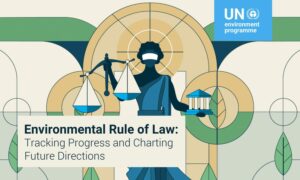
Environmental Rule of Law: Tracking Progress and Charting Future Directions | Global Report Launch
12 Mar 2024
10:00 – 11:30
Lieu: International Environment House I | Room 2 & Online | Webex
Organisation: Programme des Nations Unies pour l'Environnement, Geneva Environment Network
The global launch of the report "Environmental Rule of Law: Tracking Progress and Charting Future Directions", organized by the UN Environment Programme and the Geneva Environment Network,l introduced its findings and recommendations and facilitate discussions aimed at promoting and strengthening environmental rule of law.
About this Session
The world is facing the triple existential threats of climate change, catastrophic loss of biodiversity, and growing chemical contamination. In the face of this triple planetary crisis, environmental rule of law has never been more important or relevant. Environmental rule of law provides an essential toolbox of approaches for strengthening the implementation and enforcement of, and compliance with, environmental law. It empowers us to fortify the application, strengthen enforcement, and ensure better environmental actions for the planet for both present and future generations.
With an aim to support the promotion and strengthening of environmental rule of law, the UN Environment Programme (UNEP) published the second environmental rule of law report, Environmental Rule of Law: Tracking Progress and Charting Future Directions in November 2023. Building on the first Global Report, this Report expands the initial findings to provide a comprehensive data-informed assessment of global trends, gaps and opportunities related to environmental rule of law. The Report also provides a range of good practices. By presenting good practices, UNEP aims to deepen understanding of environmental rule of law through case studies and inspire states and other stakeholders to replicate good practices whenever possible.
In addition, UNEP, in collaboration with its partners, developed and collected data on a series of questions related to each of the key components of environmental rule of law: laws, institutions, civic engagement, rights and justice. By analysing data on these indicators, UNEP has created a global snapshot of environmental rule of law to identify which aspects of environmental rule of law are most prevalent across countries, and to track progress over time.
This global launch of the Report introduced its findings and recommendations and facilitated discussions aimed at promoting and strengthening environmental rule of law. This event is the first of a series of regional and thematic seminars organized by UNEP that will convene leading experts on environmental rule of law, including contributors to the Report, to encourage information sharing and in-depth discussions.
Speakers
By order of intervention.

Arnold KREILHUBER
Director, Europe Office, UN Environment Programme

Lydia SLOBODIAN
Director, Environmental Law and Policy Program, Georgetown University

Ana Maria SUAREZ FRANCO
Accountability Coordinator & Representative in Geneva, FIAN International
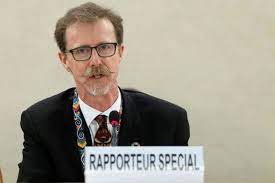
David BOYD
UN Special Rapporteur on human rights and the environment

Nambitha DAMBUZA
Judge, Supreme Court of Appeal, South Africa

H.E. Amb. Toleafoa Nella TAVITA-LEVY
Permanent Representative of Samoa to the UN and other international organizations in Geneva

H.E. Amb. Carlos SORRETA
Permanent Representative of the Philippines to the UN and other international organizations in Geneva

Yves LADOR
Representative of Earthjustice to the United Nations in Geneva | Moderator
Highlights
Video
Live from the International Environment House 1
Live on Facebook
Summary
Opening
Arnold KREILHUBER | Director, Europe Office, UN Environment Programme
- This event is intended to incentivize information sharing and in-depth discussions on environmental rule of law with some of the world’s leading experts on the topic to delve a little bit deeper into the findings of the second report and what they mean for environmental law and the Global Environmental challenges the world faces.
- Environmental rule of law is generally understood as applying the principles of the rule of law in an environmental context. I always underline that when this definition is made, there are perhaps two distinct aspects of environmental rule of law as compared to the general rule of law. Number one is what may be described as the precautionary approach, this element of scientific uncertainty and the second aspect would be the intergenerational aspect, the rights of future generations.
- Why environmental rule of law is important may seem obvious but environmental rule of law has helped to shine a light on the importance of strong environmental laws and institutions. These are essential to achieving environmental goals and developing effective responses to pressing environmental crisis.
- Laws provide the requirements, the standards, the procedures, and the rights necessary to achieve environmental objectives. Strong institutions are necessary to give force to those environmental laws and these environmental rights and this is even more important now that we have the universal recognition of the right to a clean, healthy, and sustainable environment.
- In addition to environmental benefits, environmental rule of law provides economic and social benefits by providing the protection of the natural environment. Environmental rule of law protects public health, and economically valuable natural resources.
- By increasing transparency and reducing corruption, environmental rule of law can attract investment support, sustainable economic growth, and ensure that resulting benefits to nature are shared.
- Environmental rule of law not only operates in a vacuum, but it is really a crosscutting objective that needs many more stakeholders than just those that have been traditionally involved in environmental law, it needs to really bring together many other actors, a whole-of-society approach to really deliver the benefits that are intended through all the laws and multilateral environmental agreements that have been adopted up until now.
- If there is an absence of environmental rule of law, it would undermine good governance and that again beyond the environmental sector. A consistent, fair, and effective implementation of environmental law strengthens the perceived legitimacy of government action and builds public confidence in institutions.
- Despite the global proliferation of national laws and institutions over the past 50 years, the implementation and enforcement have lagged behind other sectors resulting in a crisis of pollution, biodiversity loss and climate change. We need to increase efforts to close this implementation gap with extreme urgency to avoid dire consequences of environmental problems.
- The second report underlines that effective legal frameworks and capable institutions are the foundation of environmental rule of law especially when they are unambiguous informed by reliable data fair and gender and culture sensitive considerations. The report also shows that technology can revolutionize environmental policy making and enforcement however questions of transparency, bias, and privacy might undermine its effectiveness and jeopardize people’s rights therefore highlighting the need for broad public participation in its implementation.
- Civic engagement is another critical aspect of environmental rule of law, and it is very pleasing to see that a growing number of countries have enacted legislation on access to information, rights of public participation, and access to justice. Despite this progress there is still a need for stronger laws and policies to protect especially environmental defenders against arbitrary arrests, violence, and death.
- During and before COVID-19, racial and social justice movements and protests around the world have also driven the engagement on environmental justice issues across the world. At the same time environmental groups have increasingly incorporated racial and social justice issues into their agenda.
- Because the implementation of these environmental rights is still uneven, many countries continue to struggle with the inequitable access to both natural resources and justice. The report clearly shows that the international community needs to make increased efforts to equip countries and stakeholders with the required tools to improve justice.
- Due to the transboundary nature of many environmental issues, justices and judges are becoming also more open to granting remedies to plaintiffs who have suffered environmental damage caused by foreign entities domiciled within their jurisdiction.
- UNEP will continue to provide support to governments, to institutions, to civil society, to the legal community and other key actors in the pursuit of our common objective to improve environmental rule of law and really make sure that environmental law delivers for people in the planet as we address the global environmental challenges.
Panel Discussion | Cross-cutting Issues
Lydia SLOBODIAN | Director, Environmental Law and Policy Program, Georgetown University
We identified four cross-cutting themes.
COVID-19 Pandemic | The first one is the pandemic because we drafted the report while we were living through the pandemic. It was a daily factor in our lives, but it also really showed the impact on environmental rule of law.
- Covid-19 had an unprecedented social, economic, and health impact, that had a direct impact on the environment. The decrease in economic activity has led to a global decrease in emissions of greenhouse gases as well as a decrease in ocean noise. It has also led to an increase in plastic pollution such as single use medical supplies and led to an economic downturn creating pressures on natural resources and disproportionate impacts on most vulnerable communities through cumulative impacts. The environmental and health effects increased mortality rates.
- Countries responded in different ways. In some cases, countries adopted new laws that were intended to strengthen environmental rule of law in the face of the pandemic while others relaxed regulations and enforcement, for example social distancing rules may have made it harder or impractical for companies to meet some of their environmental reporting obligations or for inspectors to reach firms to evaluate their environmental performance.
- Covid also affected civic engagement. It limited opportunities for in-person attendance at public hearings, in person judicial adjudications. However, it also may have led to innovation in virtual engagement and judicial proceedings that in some ways can increase access to justice and increase civic engagement.
- Despite the impacts on human lives, we must see opportunities coming out of this global catastrophe. One big lesson is that an investment in environmental rule of law is an investment in health. Whether or not this pandemic was caused by something related to illegal wildlife trade, it is certain that there is a link between environmental degradation and human health. We know that environmental degradation can increase incidence of zoonotic disease and that environmental degradation can create these cumulative factors that make a pandemic more serious. We have a chance to consider these and build more inclusive and accessible systems and processes using the innovative ideas we had to create to survive the Covid pandemic and take them forward as new best practices.
Technology | The second one is technology, the role of emerging technology in implementing environmental rule of law in realizing environmental rule of law even in developing laws.
- There is a huge surge in technology, not just the technology that is available but also the ways we use this technology in environmental monitoring and enforcement. Earth observation and satellite imagery has been used to detect illegal activity from deforestation to illegal mining, machine learning and AI that provide opportunities to process this monitoring and enforcement data. AI mechanisms allow much more precise and, in some cases, quasi real-time enforcement data.
- We are seeing a use of technology in citizen engagement through for example citizen science or using social media in organizing civic engagement.
- This creates virtual opportunities to access justice and to participate in rule making processes. There is also more reliance on reporting of citizens such as identifying rules, violations, like idling in the city or littering or pollution. We are seeing the use of technology in drafting and interpreting law, and we mostly drafted this report prior to the explosion of AI tools like chat GPT, that are being used by lawyers and lawmakers to conduct legal research to develop legal documents.
- The dangers of overreliance on technology are this idea of garbage in, garbage out. This is the idea that what you put into your computing systems can also have human biases. Hence, there is a danger of getting a biased system if you are putting in incorrect or misleading information.
- A second danger is the growing digital divide. Even if there are civic engagement processes and justice processes online, those can increase access but only for those who have a strong internet connection, which is not everyone in the world.
- Life privacy and digital security are also rights concerns because exposed to malicious use of the internet platforms.
Connection Between Movements | The third one is this connection between movements for racial and social justice and environmental justice.
- The racial and social justice issues became so salient that they were impossible to ignore even in a global health crisis.
- The disproportionate environmental impacts on racial minorities and disadvantaged social groups were already a theme in social justice movements. This includes cumulative impacts or what have been called sacrifice zones.
- We saw both the environmental community taking recognition of the social justice and racial justice impacts of environmental decision-making and social justice groups including Black Lives Matter recognizing the importance of environmental factors and environmental justice.
- Similarly, we saw growing global recognition of connection between environmental rights and human rights and this manifests as the recognition of the importance to defend the defenders, to protect their rights and make connections between race and environmental enforcement.
- Social justice groups and environmental justice groups are at the forefront of civic engagement and lawmaking to recognize vulnerable communities and racial and social minorities as victims and for the recognition of the importance of diversity and inclusion in environmental institutions based on the idea that more diverse groups, more diverse perspectives will make better decisions because will bring in different views and different ways of thinking about problems. For example, women, indigenous peoples, racial minorities, and youth can really take the lead as environmental champions.
Climate Change | The final one was climate change, and we went back and forth on including that as a cross-cutting theme linked to the triple crisis. There are a lot of movements on environmental law around climate change from the laws and institutions to civic engagement, to rights, to justice.
- There has been an explosion in awareness of the climate problem including public awareness and awareness among policy makers.
- At least 34 countries have declared climate emergencies at the time the report was written and over 2,300 climate change cases filed in 55 countries.
- These cases demonstrate a human rights approach to climate litigation and a connection to future generations and the current youth.
- Finally, the UN resolutions on climate change and human rights recognize the importance of this issue.
Ana María SUÁREZ FRANCO | Accountability Coordinator & Representative in Geneva, FIAN International
- Taking a holistic approach is very important as recognizing the importance of the rule of law because we are in very difficult times for civil society, where the elaboration of laws is especially challenging in the context of corporate interference and corporate capture.
- The consideration of human rights is an important part of environmental governance, a key tool for the rights to information and meaningful participation together with the principle of accountability to ensure that environmental laws are just. This is especially important for marginalized groups, affected communities, and representatives of future generations.
- The principles made to take jurisprudence, which are the obligations of a state and examples of violations in the framework of the triple planetary crisis, are very relevant for civil society and not only for social corporate responsibility.
- Inter- and intragenerational justice is very relevant and we cannot think about future generations without considering both the precautionary principle and the principle of common but differentiated responsibilities and capabilities which is more about intragenerational justice.
- We must also look at how digital technologies are connected to financialization causing digital land grabbing in different countries like Brazil, India, Rwanda, Georgia, and others. It is also relevant to consider the technological developments that are in the hands of private corporations. We must be rethinking what digital means and looking into the regulatory needs of digital technologies, also concerning the environment and beyond.
- In Maria’s opinion, peasants, fishers, pastoralists, and other persons living in rural areas are missing in the report.
David BOYD | UN Special Rapporteur on human rights and the environment
- Unless we strengthen the environmental rule of law, we will not successfully tackle the planetary environment crisis.
- The right to a healthy environment includes a group of procedural elements including access to information, public participation, and access to justice as well as a group of substantive elements including clean air, safe and sufficient water, healthy and sustainably produced food, non-toxic environments, where people can live, work, study and play in healthy ecosystems and biodiversity and of course a safe livable climate. Each of these elements depends on the environmental rule of law.
- It is important that we have inclusive and comprehensive public participation in all climate and environmental decision-making.
- Although we have 161 states that recognize these rights, we still have dozens of states where there has never been a single case brought by people asserting their right to healthy environment not because it has not been violated or abused by businesses but because access to the judicial system is blocked by costs, lack of trained lawyers with environmental and human rights expertise.
- There are still dozens of states that do not have air quality standards and measures in air quality.
- Concerning water, many states do not have the resources, personnel, or expertise to test for contaminants in drinking water such as heavy metals or toxic chemicals.
- Turning to food, there have been many states making progress in phasing out highly hazardous pesticides, but we do not have mechanisms to dispose of the existing stocks of those pesticides that require a degree of expertise and institutional capacity.
- We need institutions with the capacity, the personnel, the resources, and the expertise to investigate, prosecute, and convict environmental criminals.
- It is over a trillion dollars every year that continues to flow from states to businesses in terms of subsidies for the use of fossil fuels. These actions, during a climate emergency means there must be some corruption involved, greenwashing by fossil fuel companies that undermines climate action and biodiversity.
- The States that have the Amazon forest within their boundaries lack the capacity to stop deforestation in those remote regions.
- These examples across the world show the whole spectrum of procedural and substantive elements required for the right to a healthy environment and particularly the need to strengthen the environmental rule of law, the institutions, and the laws. It requires also to provide more resources and expertise to those government agencies ensuring their independence meaning having independent courts and tribunals, and eradicating corruption which are important prerequisites to the full enjoyment of the right to a clean, healthy, and sustainable environment.
Panel Discussion | Judiciary and Increase in Litigation
Nambitha DAMBUZA | Judge, Supreme Court of Appeal, South Africa
In the African continent, there is now a bit of movement in the climate change sphere. There are three states whose climate change legislation specific act was passed during this period of the report.
- Kenya had a climate change act of 2016 but during this period it has been revised and amended and it seems that the aim was to give guidance to implementation of carbon markets in anticipation of what’s to come.
- Uganda also passed a climate change act in 2021.
- My country, South Africa, the National Climate Change bill was passed in Parliament, was approved in the general assembly in October 2023 so it still has another hoop to pass in the other chamber of parliament.
Some judgement citations:
- Cote d’Ivoire
- This case is about the offloading of toxic waste. The court affirmed the conventions on human rights and the right to a healthy environment but does not have appellate jurisdiction to receive appeals from the domestic courts, this does not include the examining relevant proceedings in the National courts in order to determine whether they are in accordance with the standards set out in the charter of any Human Rights instruments ratified by the state consent.
- Load of highly toxic waste, dumped in various sites, resulted in the death of 17 people from toxic gas inhalations and 100 000 people affected.
- The court ordered legislative reforms to be implemented within a year to enforce a ban on importation and dumping of toxic waste, in accordance with international conventions.
- If toxic waste enters a country, the state has an obligation to limit and repair harmful effects on human life.
- Ivory Coast was ordered to establish, in consultation with the victims, a compensation fund.
- Ivory Coast set up an independent and impartial investigation into the “alleged facts” to establish the criminal and individual liability of the perpetrators, and then prosecute them.
- Seychelles
- The government raised that it is not obliged to clean up where there has been pollution by private entities, because the domestic legislation says it may choose to clean up but cannot be obliged. That peace of obligation should be interpreted by a “shall”.
- Kenya
- Provisional interdict was granted against the government which wanted to lift a moratorium that had been placed on logging in 2018.
- The court applied the precautionary approach. It issued a temporary interdict and then said a task team report should be filed in court or and then depending on what the task team had recommended.
- The government ordered to comply with orders issued 3 months prior to judgment date. A task force report on forest resource management to be upheld and implemented by the government for protection of the environment.
- The use of technology has opened the courts up to prospective litigants and it has served as an educational tool especially in these communities where resources are scarce, and people are interested in matters that might affect them. African cases that received worldwide coverage sustaining the wild coast and others increase the right to participation, notably because indigenous communities around the ocean for example, were never consulted.
- There is the affirmation of the commitments that the South African government made at the cop 26 in 2021 in sustaining the wild coast.
H.E. Amb. Toleafoa Nella TAVITA-LEVY | Permanent Representative of Samoa to the UN and other international organizations in Geneva
- Today, there are designated government representatives in the Village Council whose role is to bridge communication between the government and the village and to enhance cooperation.
- Samoa does very much recognize the integral role of customary law and practices and additional knowledge in environmental protection and natural resource management.
- In the 80s, we recognized the important role of the Village Council that could play in the management of inshore fisheries the 1988 Fisheries act that recognized fisheries village by laws which were set up by the Village Council to monitor illegal activities moratorium periods on fishing and fines set out by the Village Council.
- In many communities, including in the Pacific and all around the world many community-based environmental initiatives exist partnering with National Police for enforcement.
- The government of Samoa remains committed to maintain a safe environment and to promote the sustainable economic use of our natural resources. As such the pathway to the development of Samoa prioritizes having in place effective environmental protection and management frameworks through a cross sectoral approach.
- There are at least 14 acts relating to the environment and administered across several ministries. Collaboration between ministries through the ministry of natural resources and environment is therefore essential to ensure sustainable management of the resources.
- Through collaboration and consultation of the business community the waste management regulations of 2018 enable the ban of single-use plastic products as referred in the report to protect the marine environment, the Pacific Ocean and contributes to global efforts.
- The second report is useful and should inform countries in their efforts to develop and strengthen legislative frameworks and improve on international environmental rule of law. It is important to continue to hold these discussions and exchanges to further build awareness, advance exchanges on environmental rule of law, and make the connections and the linkages between the environment, between human rights and the realities that take place at home.
- In April last year, a high-level dialogue was held between the government of Samoan agencies, Samoan civil and regional partners on advancing a human rights-based approach to climate action. This discussion included the right to a clean, healthy, and sustainable environment connecting the human rights council in Geneva and the work that has been undertaken in Samoa.
H.E. Amb. Carlos SORRETA | Permanent Representative of the Philippines to the UN and other international organizations in Geneva
- It is important to developing countries and the most vulnerable one to climate change to discuss whether we are doing just transitions. We need the courts and judicial remedies to guide it, to push it forward, to see if we do not go over our natural resources or whether we are dealing with bilateral or international financial institutions in terms of loss and damage funds.
- They must look at our mechanisms, our frameworks and of course our environmental rule of law.
- The problem of climate change cannot be solved by filing cases in victim countries; we are a carbon sink, so it can only be solved by filing cases in countries which cause climate change.
- Strengthening the rule of law in every other country is very important for countries like us and pacific island states that are the most impacted.
- Together with the association of island developing states we have been able to arrive at resolutions that allowed us to file requests for advisory opinions, the first one is in September in the International Tribunal of the Sea where we appeared together with about 30 other countries.
- The advisory opinion on international law and climate change in the ICJ is coming up. We are going to interpret existing conventional norms as constituent instruments, as living documents where the intent and object of the parties was to prevent certain harm.
- Philippines is using some creative arguments particularly on the UN Charter. Climate change was not in the context when the charter was discussed, but it was intended to maintain the peace and security of mankind, and climate change is affecting its peace and security. Conflict can come out of competition for diminishing resources, conflict can come from shifting maritime domains caused by loss of low water marks territory and of course climate change takes territory away and there is no defense against it. It neglects the right of self-defense.
Open Discussion
Oleksandr Kapustin | Deputy Permanent Representative of the Ukrainian Mission in Geneva
- Ukraine is deeply familiar with the vitality of the environmental rule of law discourse as it has been combating Russian aggression for the past 10 years, the war which is cruel and merciless to our environment.
- One of the most terrible cases is the breach of Kakhovka Dam and we appreciate the efforts of UNEP to issue the respective report on the case but Russia’s invasion of Ukraine resulted among other things in almost 3,600 cases of environmental damage that have already been recorded with the office of the prosecutor general of Ukraine investigating nearly 280 cases of war crimes that have damaged the environment.
- We strive to achieve justice which means bringing Russia as a state to account and receiving compensation as well as bringing to justice those involved in crimes against the environment both from the command-and-control staff and the executors.
- There is a huge amount of work ahead and Ukraine is determined to be one of the first countries in the world to bring the aggressor to justice precisely for the damage caused to the environment.
- Ukraine’s strong leadership in this area and our joint efforts may well change the way that the environment is viewed in it conflicts everywhere, namely UNEA-6 has successfully adopted by consensus the resolution on environmental assistance and recovery in areas affected by armed conflict initiated by Ukraine.
- The resolution, we believe, will contribute to improving UN’s operational activities in assistance to governments overcoming the negative consequences of armed conflicts for the environment. We also welcome the efforts of the high-level working group on the environmental consequences of the war in Ukraine comprising of the Ukrainian officials and international experts given life to the environmental compact for Ukraine on ensuring accountability and green reconstruction following the destruction of Russia’s war on Ukraine.
- This document includes profound recommendations to the government of Ukraine, includes an international community on how to address this challenge, and may serve as a toning point that environmental damage in war was fully recognized, understood, and appropriately addressed.
- Ukraine is also working on the environmental declaration, a fundamental document aimed at creating truly effective mechanisms for the protection and restoration of the environment from the impact of wars or other conflicts regardless of the continent and we welcome support of all interested parties of this initiative.
Marina Yanos | UNECE Secretariat of Aarhus Convention
- This report is particularly important this year when the sustainable development goal 16 on peace, justice, and strong institutions undergoes in depth review and the goal has very specific Targets on access to information, public participation in decision making, and access to justice for all and of course many findings of the report are very important and relevant to the work of the Arhus convention and I would like just to highlight maybe three areas of work that we hope will be then updated and reflected in the next report on the environmental rule of law.
- The first priority area relates to the protection of the right of every person of present and future generations to live in a healthy environment. this right is embedded in the preamble and article one of the convention and parties have reiterated its strong commitment to empower people with this right and of course in the light of the recognition of the this right by the United Nations General Assembly as a human right this work will be strengthened and continued.
- The second area of work is related to the protection of environmental defenders. This obligation was initially embedded in the convention through Article 38 and currently is strengthened with a rapid response mechanism established under the convention.
- The third area of work relates to the functioning of the convention. The convention is open for accession by any United Nations member state, so the convention continues provide a valuable platform for interested States members of judiciary environmental NGOs and other stakeholders in this matter and we look forward to continuing our successful cooperation with the colleagues from UNEP and other partner organization and all interested parties in advancing the implementation and application of the Convention.
Raphael Pangalangan | Environment and climate change team of the OHCHR
- The mandate I support is on the new clear legacy in the Marshall Islands where we are applying a transitional justice framework, to its impacts on areas of rights, one of which being is the right to a healthy environment and having reviewed the contents of the environmental rule of law publication.
- I am interested to know whether transitional justice was considered in the drafting of this resource and whether it is conceived and how it is conceived to have a place in the right to a healthy environment advocacy?
- The report mentions new developments in international environmental law such as rights of Nature and ecocide laws, could you comment on what you see as the impact and significance of these developments on international environmental rule of law?
Lydia Slobodian
- We did not consider transitional justice in the report’s drafting, but I have noted it as something to think about in the future and maybe incorporate in a future report. Rights of nature and ecocides are not necessarily international environmental law developments and Ukraine is one of the few countries in the world that has ecocides in its national criminal code already so as environmental law concepts at both the national and the international level I think these are very interesting for environmental rule of law and its future. I think they both provide mechanisms for furthering environmental protection and protection of human interests in the environmental context. I think rights of nature is very interesting because it has both a kind of ethical and moral component and it has a very practical component when you talk about legal personhood, non-human species I think this can be quite interesting for its potential and then ecocide also in letting bring different types of causes of action. I think it could be very transformational in how we can use the law to protect the environment.
Closing
David Boyd
- I would just really encourage everyone to recognize that the best way to strengthen the environmental rule of law is through a human rights-based approach to all climate and environmental actions. A human rights-based approach clarifies the obligations and responsibilities of states and businesses, it focuses our attention on those people who are currently being left furthest behind, it provides institutions, and processes for accountability. it catalyzes accelerated action and ensures the mobilization of maximum available resources. Therefore, if we want to strengthen the environmental rule of law our best path forward is a human rights-based approach.
Arnold Kreilhuber
- Environmental rule of law lives and breathes, it is not static. It increasingly incorporates societal considerations; it is increasingly visible nationally and internationally as a concept that merits greater attention and so the tracking of progress. We have heard of the importance of environmental rule of law for different stakeholders, for different ambitions, and the importance for civil society. We have heard that we still have a little bit of a path to walk together to really make sure that that every aspect is fully included, and environmental rule of law really delivers for the whole of society. We have heard that environmental rule of law is critical for the realization of the human right to a clean, healthy, and sustainable environment and what an importance a human rights-based approach has in return also for making sure environmental rule of law is established and delivers. We have heard from the progress that is being made in the judiciary across judiciaries, progress that is being made on the African continent, from the global judicial Institute on the environment, which is an Institute by judges, for judges to enable this information exchange across different judiciaries. It is very important that the different stakeholders have also the tools and resources to meaningfully engage and get information and the right to participate in practice, the right to access justice.
- Governments are reacting, coming with the increasing importance of environmental rule of law and even seeing it as a as a reflection of broader societal and economic priorities.
Environment @ HRC55
The 55th regular session of the Human Rights Council (HRC55) is taking place in Geneva and online from 26 February to 5 April 2024. This regularly updated page highlights the environmental-related activities of this session.
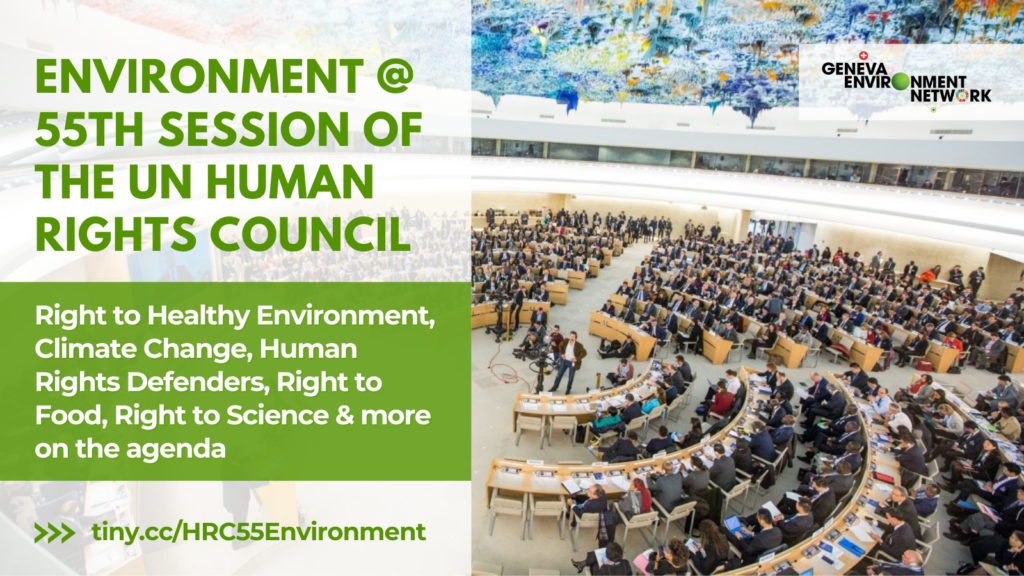
Photo Gallery


