
Événement Conférence
Plastics & Health: What We’re Not Talking About | Health Diplomacy House

21 Mai 2026
12:30
Lieu: Résidence Rothschild, Salle Dunant | Rue Rothschild 28, 1202 Genève
Organisation: Health Diplomacy Alliance, Geneva Environment Network
This event was included in the official programme of the Health Diplomacy House, hosted on the sidelines of the 79th World Health Assembly. The event featured a series of short lightning talks, and was organized in the framework of the Beat Plastic Pollution Dialogues.

About the Health Diplomacy House
On the sidelines of the 79th World Health Assembly (WHA79), the Health Diplomacy Alliance hosted the Health Diplomacy House on Thursday, 21 May 2026. The House was an informal working space where organizations can convene sessions, hold discussions, and collaborate on practical health policy issues. Part of the “Predictable Uncertainty” series, it brings together policymakers, diplomats, academia, civil society, philanthropic organizations, and patient groups.
The programme consisted of roundtables, small group discussions, and space for bilateral meetings and media engagement, with a flexible agenda expected to cover topics such as One Health, antimicrobial resistance, climate and health, health financing, and global health governance.
About this Event
The world is facing a growing plastics crisis. Plastic pollution is now found across the globe – from the deepest oceans to the air we breathe. At every stage of their lifecycle, plastics negatively affect both people and the environment: from production, through manufacturing and use, to recycling, disposal, and environmental degradation. These impacts are wide‑ranging, with increasingly clear consequences for human health.
As noted by Dr Tedros Adhanom Ghebreyesus, Director General of WHO, in the margins of the World Economic Forum Annual Meeting in January 2023, the link between plastic pollution and health has not received the attention it deserves. He emphasized that while research gaps remain, existing evidence already demonstrates that plastics affect human health throughout their entire lifecycle. Dr Tedros underscored the urgent need to review available studies, communicate their findings more effectively, and support the development of a legally binding international plastics treaty.
“We cannot wait until we have more research. While doing more research, we should also make use of what we have — which already indicates problems throughout the lifecycle of plastics. A toothbrush can break down in 500 years, if at all. It’s not about us, it’s about the many generations to come.”
This growing recognition was reflected at the Seventy-sixth World Health Assembly (WHA76), held in Geneva in May 2023, where Member States adopted a resolution on the impacts of chemicals, waste, and pollution on human health. Initially tabled by Peru, Canada, Colombia, Ecuador, El Salvador, Mexico, Monaco, Switzerland, Uruguay, and the European Union and its Member States, the resolution calls for scaling up work on plastics and health. It also encourages contributions to the Intergovernmental Negotiating Committee (INC) mandated UNEA Resolution 5/14 to develop a legally binding instrument on plastic pollution, including in the marine environment. The resolution further acknowledges related multilateral processes, including those under the Human Rights Council.
Since then, WHO has called for the highest attainable standard of human and environmental health to be a core objective of the plastics treaty. WHO has highlighted the need to address both known and anticipated health risks associated with plastics, including chemicals and additives, as well as microplastics and nanoplastics, across all stages of the plastics lifecycle.
This event featured Lightning Talks by diplomats, scientists, policymakers, and other experts. These talks will highlight why it is essential to communicate more clearly, consistently, and effectively about the health impacts of plastic pollution, and why health must be placed at the centre of global action on plastics.
Lightning Talks
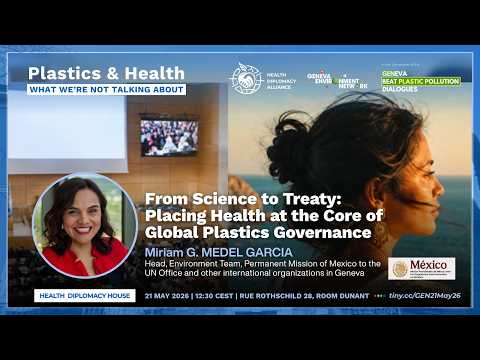
From Science to Treaty: Placing Health at the Core of Global Plastics Governance
Miriam G. MEDEL GARCIA | Head, Environment Team, Permanent Mission of Mexico to the United Nations Office and other international organizations in Geneva
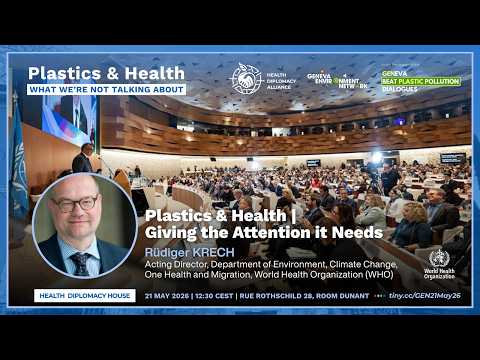
Plastics & Health | Giving the Attention it Needs
Rüdiger KRECH | Acting Director, Department of Environment, Climate Change, One Health and Migration, World Health Organization
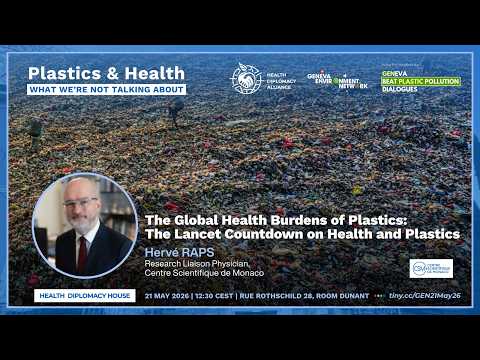
The Global Health Burdens of Plastics: The Lancet Countdown on Health and Plastics
Hervé RAPS | Research Liaison Physician, Centre Scientifique de Monaco
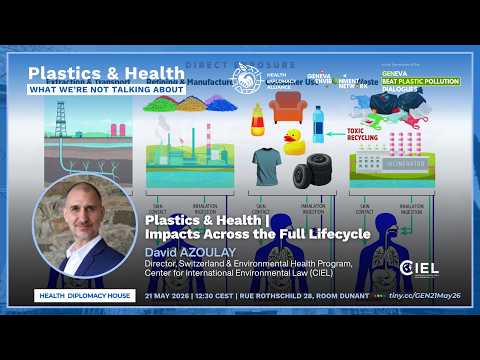
Plastics & Health | Impacts Across the Full Lifecycle
David AZOULAY | Director, Switzerland & Environmental Health Program, Center for International Environmental Law

Food‑contact Chemical Regulation Ineffective for Health Protection
Etienne CABANE | Engagement Director, Food Packaging Forum
Plastic & Health | Mainstreaming Scientific Knowledge
Roman LEHNER | SNF SPARK Grant Holder, Department of Chemistry, Biochemistry, and Pharmaceutical Sciences, University of Bern
Considering Key Elements for the Protection of Human Health in the Future Treaty on Plastic Pollution
Carolyn DEERE BIRKBECK | Executive Director, Forum on Trade, Environment & the SDGs (TESS), Geneva Graduate Institute
Plastic & Health | Scaling Proven Solutions
María Alejandra GONZÁLEZ | Global Plastics Advocacy Manager, WWF Norway
Sports for Nature | Swimming 191km to Raise Awareness for Global Ocean and Health Protection against Plastic Pollution
Noam YARON | Record-Breaking Swiss Ultra-Endurance Athlete Advocating for Ocean Protection
Highlights
Video
Live from the Résidence Rothschild
Photo Gallery


