Nouvelle
UN80 Initiative and the Environmental Pillar Dimension
This update was launched at the request of members of the Geneva Environment Network and Permanent Missions in Geneva to list resources on the UN80 initiative and the environmental pillar dimension.

About UN80
The UN80 initiative – the United Nations’ system-wide reform – was launched by UN Secretary-General António Guterres in March 2025, marking the 80th anniversary of the United Nations.
At the core of UN80 lie three major workstreams:
- The first is dedicated to enhancing internal efficiency and effectiveness by streamlining processes, and optimizing the UN’s global footprint through the relocation of certain functions to lower-cost duty stations.
- The second is a mandate implementation review, which involves examining 4,000 mandate documents that define the UN Secretariat’s work. mandate refers to a task or responsibility assigned to the organisation by the Member States, usually through resolutions adopted by UN organs such as the General Assembly or the Security Council.
- The third explores whether structural changes and programme realignment are needed across the UN System.
Through resolution 79/318, the General Assembly welcomed the Secretary-General’s efforts and expressed its anticipation of receiving detailed proposals. Subsequently, in decision 79/571, the Assembly established an informal ad hoc working group, open to all Member States and observers, to consider the Secretary-General’s proposals under Workstream 2 of the UN80 Initiative. The group was tasked with identifying guiding principles and follow-up actions to strengthen the creation, delivery, and review of mandates. The Co-Chairs of the Informal Ad Hoc Working Group are H.E.Amb. Carolyn Schwalger, Permanent Representative of New Zealand to the United Nations and H.E. Amb. Brian Wallace, Permanent Representative of Jamaica to the United Nations.
In September 2025, UN Secretary-General António Guterres shared a progress report on structural reforms and programme realignments under Workstream 3 the UN80 Initiative. The report, Shifting Paradigms: United to Deliver, developed through system-wide consultations, outlines possible adjustments in how the UN is structured, how its entities collaborate, and how it operates. It is the third major output of the Initiative, following earlier reports on efficiency measures and on mandate implementation review. Issued just before the General Assembly’s High-Level Week, the document was intended to inform Member States’ deliberations. Art. 47 of this report refers to environmental issues:
“Environmental issues are growing in importance, and environmental responsibilities are dispersed across UN entities. We will undertake a thorough assessment of current arrangements and make proposals on possible structural changes and programme realignments on environmental issues.”
The UN General Assembly adopted on 31 March 2026 a resolution introducing a more structured approach across the full mandate lifecycle, to strengthen how mandates for UN organizations are created, implemented and reviewed. The resolution (A/RES/80/251) builds on the work of the General Assembly’s Informal Ad Hoc Working Group on the Mandate Implementation Review, co-chaired by Ambassador Brian Wallace of Jamaica and Ambassador Carolyn Schwalger of New Zealand.
For the UN system, the initiative is coordinated by the UN80 Task Force, chaired by Guy Ryder, Under-Secretary-General for Policy, ensuring coherence and strategic direction across the organization.
UN80 Action Plan and the Environment
The UN Secretary-General has shared the finalized Action Plan for UN80 with UN Member States in November 2025. Bringing together proposals from across the UN80 Initiative’s three workstreams, the plan creates a single, coordinated framework to strengthen alignment and accountability « under one roof ». A new Steering Committee was set to provide strategic guidance, and a reconfigured Task Force will drive implementation, ensuring progress is consistent, collaborative, and results-driven.
A Dashboard, developed as an annexe to the UN80 Initiative Action Plan, presents the detailed work packages across the three UN80 Initiative workstreams in a single reference. The Dashboard also lists designated leads for each work package, along with their individual action items.
Work package 27 of the Action Plan, led by Inger Anderson, the United Nations Environment Programme (UNEP) Executive Director, and Simon Stiell, Executive Secretary of the UN Framework Convention on Climate Change (UNFCCC), is to “undertake a thorough assessment of current arrangements and make proposals on possible structural changes and programme realignments on environmental issues”. The vision of WP 27 is to highlight the importance of health and stability of the environment for the three pillars of the UN charter; advance system wide action to deliver faster and improve support to address environmental challenges at all levels; maximise positive impact through shared knowledge and skills, review possible structural changes with a view to enhance efficiencies, effectiveness and impact and to reduce fragmentation; and incentivise collaboration to make the existing system deliver better. The members of WP27 include: DPPA/PBSO, IFAD/UN Water, OHCHR, UNCTAD, UNDP, UNDRR, UNESCO, UN Habitat, WHO, WMO, Regional Economic Commissions, UNCCD, CBD, BRS, Minamata Convention, MLF, DOS, DOALOS/UN Ocean, UNU. The Working Package maintain an open-door policy to other agencies wishing to contribute.
Other relevant UN80 Work Packages for the environment include UNCT reconfiguration (WP5), Regional Reset (WP6), joint knowledge hubs (WP7), expertise on demand (WP8), human rights group (WP9), technology accelerator platforms (WP15), data commons (WP16), training and research (WP17), and funding mechanisms (WP18).
Findings of the Assessments of Current Arrangements under WP27
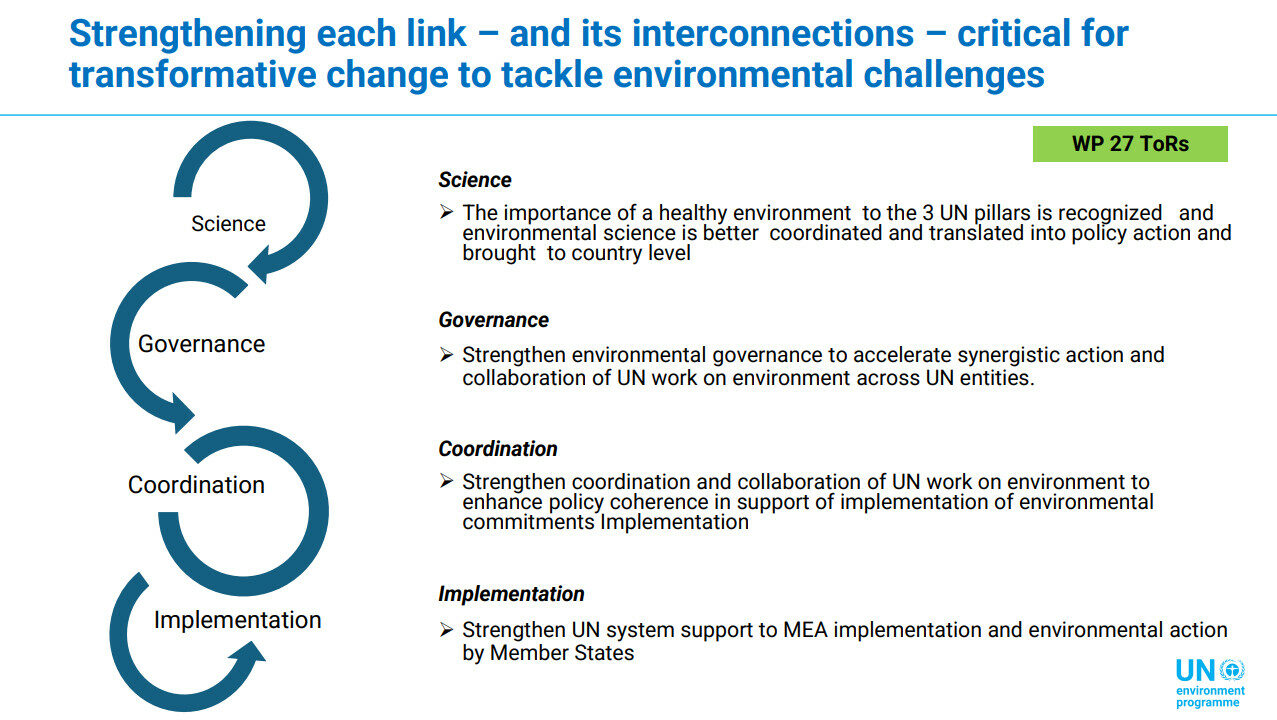
Multiple methods were used in the assessments of current arrangements. As of 23 April 2026, the findings across the four issues areas assessed included:
Science
- The health and stability of the environment sit at the core of all three pillars of the United Nations Charter. A stable and healthy environment underpins social and economic systems, while its degradation acts as a multiplier of risk, exacerbating conflict, displacement and inequality.
- Environmental science is therefore a vital component of the UN system’s ability to address these challenges. Environmental science is also central to realizing the right to a healthy environment and the right to benefit from scientific progress and its applications.
- Environmental science is often produced/used in parallel, with limited systematic reliance on each other’s outputs, leading to duplication, inefficiencies, and missed opportunities for collaboration.
- Although scientific production processes are broadly similar across entities and often rely on external expertise, this can result in underutilization of in-house UN capacities and limited collaboration.
- The translation of global scientific outputs into actionable insights at the country level is lacking.
- Limited engagement across entities in the development of environmental benchmarks, despite their importance for mainstreaming environmental considerations.
- Overall, the UN system does not require major structural reforms in environmental science. Instead, the greatest gains lie in better connecting, aligning, and leveraging existing capacities.
Governance
- The MEA landscape is complex, with both overlap and gaps across processes, support structures, mandates, memberships and policy agendas.
- Reporting demands across multiple MEAs impose a significant burden on Member States.
- MEAs have catalyzed focused action, results and systemic changes
- Successful processes (Party-led and Secretariat-driven) have enabled greater administrative and programmatic synergies across MEAs.
- Diversity of initiatives remains, ranging from stakeholder engagement to capacity building and fundraising, knowledge management and digital tools. This can create competition instead of mutual supportiveness. Efficiencies and co-benefits can be strengthened in how the UN system supports national-level implementation.
- UNEA’s system-wide convening potential remains underutilized
- UNEA has yet to fully realize its potential to act as the highest-level convening platform for coherent, system-wide environmental action, including through
- reinforcing its institutional linkages with other intergovernmental processes; and,
- strengthening its engagement with MEAs and their governing bodies, to promote greater coherence and synergies in implementation
- UNEA has yet to fully realize its potential to act as the highest-level convening platform for coherent, system-wide environmental action, including through
- Clear opportunities to advance greater coherence and strengthen global environmental governance through a system-wide outlook.
Coordination and collaboration
- The 51 UN EMG Members are active across environmental and other SDGs
- The UN system engagement on the environment shows high concentration on climate and biodiversity actions; less so on pollution actions
- The UN EMG holds greater potential than it is currently able to deliver
- Can benefit from better and higher-level institutional anchoring in the UN system.
- Needs more structured collaboration with coordination mechanisms and system wide platforms.
- Its global approaches need to bring stronger science-policy coherence and to be designed for implementation at the global-regional-country levels to ensure science-policy-action continuum.
- Strengthening connections between science-policy is essential to translate global priorities into coordinated support for Member States, via the regional level, and to enable feedback from country actions back to global level
- Diverse case studies of successful actions suggest that the integration of environment in the work of UN agencies is more successful when global norms and guidance are translated into action via region and country-specific thematic entry points and feedback from country and region is reflected upon at global level
- The financing architecture can at times drive coordination, however fragmented funding often undermines system collaboration, regardless of good intentions.
- Vertical funds often drive competitive behavior among agencies
Implementation
- Assessments around complexity, information, capacity, aligning country needs and global commitments, transaction costs
- Member states are required to navigate increasingly complex, multiple, often connected, MEA commitments.
- Access to information and technical support to identify and implement cross-cutting solutions often insufficient.
- As MEAs move into implementation, engagement and support from real economy actors is often lacking, particularly around collaboration and practical solutions.
- Duplication and transaction costs in the support provided by UN at global, regional and national levels impact implementation delivery.
- National implementation capacity for connected MEA commitments not always benefiting from aligned and coordinated UN support.
- Assessments around financing needs
- MEAs increasingly require large-scale transformation of economic systems to address growing risks from climate change, biodiversity loss and pollution.
- While governments remain responsible for implementing MEA commitments, achieving the scale of transformation required will depend heavily on private sector investment and action across key sectors of the economy.
- The financing needs associated with some of MEAs (UNFCCC, Kunming-Montreal Protocol, and BRS conventions) is expected to require at least $5–7 trillion per year in redirected and new investment globally.
- Public finance alone cannot meet this demand. Most analyses indicate that the majority of
required capital must come from private sector investment, with public finance playing a catalytic role in reducing risk and enabling new markets. - Despite this reality, engagement between MEAs and the private sector remains limited and fragmented. Many MEA processes focus primarily on intergovernmental negotiation and reporting structures, while the actors responsible for delivering many of the required transformations – companies, investors, and supply chains – are not systematically engaged.
Draft Goals and Recommendations Under Work Package 27
In June 2026, Member States were briefed in Nairobi and New York by UNEP Executive Director Inger Andersen on recommendations being put forward under Work Package 27 of the UN80 Initiative, which she co-chairs alongside the UNFCCC Executive Secretary. It was announced that the group had identified three goals and ten recommendations, while the recommendations remain under review and are expected to be finalized by August, when the UN Secretary-General is expected to present an Information Brief on work package 27:
- A. Elevate the environment in the multilateral system
1. Recognize that a healthy environment undergirds all three UN Charter pillars
2. Enable UNEA to achieve its potential as the UN universal body serving as the convening platform for coherent, system-wide environmental action.
3. Reposition environmental science as a shared UN asset
4. Elevate the environmental coordination function: EMG 2.0 - B. Strengthen multilateral environmental governance
5. Explore consolidation options where feasible
6. Strengthen Programmatic Synergies Across MEAs
7. Advance Administrative Synergies Across MEAs and harmonized reporting - C. Scale implementation of country commitments and priorities.
8. Establish a coordination architecture for UN system wide policy coherence and
delivery
9. Create AI-enabled Support Centres, starting with a pilot through a Climate Support Centre, as “one-stop shops” that make implementation support easier for Member States to access
10. Institutionalize direct engagement with real-economy actors to accelerate
implementation and shift private capital toward sustainable outcomes
Resources on UN80 and the Environment
Statements and reports on coordination on environmental matters referring to UN80 include:
- In the second part of her report to the 7th session of the UN Environment Assembly (UNEA-7) “Priorities for advancing sustainable solutions for a resilient planet“, released in September 2025, UNEP Executive Director Inger Andersen refers to the discussions ongoing under the UN80 Initiative reform banner, suggesting for example that Member States consider ways to enhance synergies among multilateral environmental agreements. She pointed to the example of the joint secretariat for the Basel, Rotterdam and Stockholm conventions, which continue to operate as separate conventions while holding their conferences of the parties in parallel, and being managed by that single secretariat. → Read the report
- The Stakeholder Forum for a Sustainable Future (SF) released on 24 September 2025 the report “UN80: Reform of the Multilateral Environmental Agreements – Around the Triple Planetary Crisis of Pollution, Biodiversity, and Climate Change“, focusing on the opportunity for “clustering” the UN treaties on pollution. It also examines how the relevant science bodies for these three clusters can cooperate more effectively and proposes that the Global Environment Ministers Forum be re-established to meet in the year the UN Environment Assembly does not convene.
- In a statement delivered 0n 21 October 2025 at the Committee of Permanent Representatives Subcommittee, UNEP Executive Director, Inger Andersen, stressed that the upcoming UN Environment Assembly, to be held in Nairobi in December 2025, will convene amid ongoing UN80 reform, offering Member States the opportunity to shape the future of environmental action within a reformed system. The Executive Director mentioned that UNEP has actively contributed to this process under the Secretary‑General’s leadership. She emphasized the environment as a cross‑pillar of the UN, underlining its role in development, peace, security, and human rights. Highlighting the UN80 workstreams — efficiencies, mandate review, and structural realignments — she encouraged Member States to strengthen UNEP’s coordination functions, broaden the Environmental Management Group’s scope, and improve efficiencies in servicing conventions to keep environmental governance central to the UN80 reform. → Read the statement
- At the High-Level Conference on the Role of Civil Society in the UN at 80 on the occasion of the 2025 International Human Rights Defenders and International Human Rights Day on 11 December 2025, panellists — including H.E. Amb. Doreen De Brum of the Marshall Islands — emphasized civil society’s role in amplifying frontline voices, advancing the right to a healthy environment, and supporting the UN Special Rapporteur on Climate Change. FES and ICJ presented findings on UN reforms, highlighting civil society’s importance in protecting democracy, rule of law, and human rights. A report will be released for the 61st Human Rights Council Session.
- In her closing speech of the 7th session of the UN Environment Assembly (UNEA-7), UNEP Executive Director Inger Andersen mentioned, « You, the Member States, have handed UNEP new mandates, on top of existing mandates, amidst a restructuring of the organization and the wider UN through the UN80 initiative. We therefore need a strong contribution to UNEP’s Environment Fund ».
- Following the launch of the UN80 Initiative, 17 civil society organizations sent to the UN Secretary General and the High Commissioner for Human Rights a joint letter on 17 July 2025 underscoring that UN80 deliberations must ensure that decisions for reform are in line with the expectations, needs and demands of human rights defenders, victims and survivors. The letter provides a set of principles, criteria and concrete proposals that should guide the reform process. The International Service for Human Rights (ISHR) has launched a campaign, « Reforming the UN human rights system: defenders’ voices matter! » underscoring that UN80 must be a turning point that strengthens the UN’s capacity to respond effectively to injustice, elevate the voices of the marginalized, and ensure that human rights are not sidelined, but centered, in global governance. Webinars explaining what the UN80 reform process means, its implications, and how it may affect NGOs and human rights defenders engaging with UN human rights mechanisms have also been organized on 24 and 26 March 2026. A quick guide for CSOs engagement has also been published.
- On 20 April 2026, at the 173rd meeting of the Committee of Permanent Representatives (CPR) to the United Nations Environment Programme in Nairobi, UNEP Executive Director Inger Andersen highlighted that UNEP continues to play a central role in UN80 Initiative – alongside UNFCCC – by leading Work Package 27, which assesses current environmental governance arrangements and explores possible structural and programmatic realignments.
- On 22 April 2026, at the UN General Assembly in New York, Member States gathered for an interactive dialogue on “The Pact for the Future and the UN80 Initiative: From Commitments to Delivery”. The discussion provided an opportunity to exchange views and share experiences on advancing implementation of the Pact for the Future, while reinforcing the shared narrative linking the Pact and the UN80 Initiative. → Watch on UNWebTV
- A UNEP Secretariat briefing on the environment in the UN80 Initiative was held on 23 April 2026, and presented key findings of the assessments of current arrangements.
- Related discussions will also feature prominently at the Berlin Climate and Security Conference in New York, on 29 April 2026, as one of the key topics of discussion is making the UN system fit for purpose in addressing climate, peace, and security challenges in line with UN80 objectives.
- In June 2026, Member States were briefed in Nairobi and New York by UNEP Executive Director Inger Andersen on recommendations being put forward under Work Package 27 of the UN80 Initiative, which she co-chairs alongside the UNFCCC Executive Secretary. It was announced that the group had identified three goals and ten recommendations, while the recommendations remain under review and are expected to be finalized by August, when the UN Secretary-General is expected to present an Information Brief on work package 27.