Update
Environmental Sustainability in the Fashion Industry
Last updated: 17 Sep 2026
Fast fashion comes at an astonishing environmental and social cost. While the impacts of the fashion industry in terms of pollution, water use, carbon emissions, human rights, and gender inequality are increasing, the need for a shift to sustainable fashion is evident. Organizations in Geneva and beyond are joining efforts to shift the fashion economy and foster international cooperation on the issue.
The Environmental Cost of Fashion
The clothing industry represents an important part of our economies, with a value of USD 1.3 trillion and employing over 300 million people along the value chain (Ellen MacArthur Foundation). In the last 20 years, global fibre production has almost doubled from 58 million tonnes in 2000 to 116 million tonnes in 2022, and is expected to continue to grow to 147 million tonnes in 2030 if business as usual continues (Textile Exchange 2023). While people bought 60% more garments in 2014 than in 2000, they only kept the clothes for half as long (McKinsey & Company, 2016).
While the fashion sector is booming, increasing attention has been brought to the impressive range of negative environmental impacts that the industry is responsible for. The fashion industry is the second-biggest consumer of water and is responsible for 2-8 % of global carbon emissions.
What’s more, 85% of all textiles go to the dump each year (UNECE, 2018), and washing some types of clothes sends significant amount of microplastics into the ocean.
The Environmental Footprint of Fast Fashion
- The equivalent of one garbage truck full of clothes is burned or dumped in a landfill every second (Ellen MacArthur Foundation, 2017)
- Approximately 60% of all materials used by the fashion industry are made from plastic (UNEP, 2019)
- 500,000 tons of microfibers are released into the ocean each year from washing clothes — the equivalent of 50 billion plastic bottles (Ellen MacArthur Foundation, 2017)
- The fashion industry is responsible for 2-8 % of global carbon emissions. If the fashion sector continues on its current trajectory, that share of the carbon budget could jump to 26% by 2050 (Ellen MacArthur Foundation, 2017)
- Each year, the textile value chain uses 215 trillion litres of water per year (the equivalent of 86 million Olympic-sized swimming pools ) (Quantis, 2018)
- Around 20% of industrial wastewater pollution worldwide originates from the fashion industry (Word Bank, 2020)
- Less than 1% of material used to produce clothing is recycled into new clothing, resulting in over $100 billion in material value loss (Ellen MacArthur Foundation, 2017). The Circularity Gap Report Textiles (2024) finds that only 0.3% of 3.25 billion tonnes of resources each year to produce items from the global textile industry comes from recycled resources
- An extra $20-30 billion annually is needed to make the textile value chain more sustainable, with 60% focused on energy, water, and waste issues alone (Ellen MacArthur Foundation, 2017)
More facts and sources on Business Insider
Fast fashion also has a human cost: textile workers, primarly women in developing countries, are often paid derisory wages and forced to work long hours in appalling conditions (UNEP, 2018; WRI, 2019). In many places, these conditions create infringements on human rights (Human Rights Watch). Use of chemicals in clothes production also raise serious health concerns, both for the workers in the industry and consumers. Additional impacts on health also arise from the pollution described previously.
The environmental and social cost of the fashion industry forces us to rethink fast fashion, and stresses the need for more sustainable business models and practices. Resources hereunder provide additional information on the environmental impacts of fashion, and potential pathways for change.
Plastic in Textile
After the Second World War, the development of synthetic textiles, such as polyester and nylon, transformed the fashion industry. From only a few thousand tonnes in 1940, global consumption of synthetic fibres rose to more than 60 million tonnes in 2018. Since the late 1990s, polyester is the most commonly used fibre in textiles. The production of chemical fibers surpassed cotton production in the mid-1990s and has more than doubled in the last 20 years. In 2020, synthetic fibers accounted for approximately 64 percent of global fiber production.Today, an estimated 60% of clothing and 70 % of household textiles are made of synthetic fibres.
These plastic-based textiles have a significant impact on the environment and climate throughout their life cycle due to emissions of greenhouse gases and pollutants. The textile sector is a growing contributor to the climate crisis, with about 1% of crude oil production used to produce synthetic fibres (European Environment Agency).
The fashion sector is also an important source of plastic leakage into the environment. The textile value chain is responsible for 9% of annual microfibre pollution to oceans (UNEP, 2021).
Consideration of the textile sector will thus be important for tackling the ongoing plastic crisis. Plastic pollution is one of the major environmental crises of our times, and efforts from various actors are underway to address it. This includes negotiations towards an international legally-binding agreement on plastic pollution, initiated by the resolution adopted at the UN Environment Assembly in March 2022. Learn more about the plastic pollution crisis, governance processes to address it and the work of Geneva-based organizations on the matter in our Plastics and the Environment series.
- Spinning Greenwash: How the fashion industry’s shift to recycled polyester is worsening microplastic pollution | Changing Markets Foundation | December 2025
- The hidden plastics in our clothes – and how to avoid them | The Guardian | 12 February 2024
- Toxics in Our Clothing | IPEN | 28 November 2023
- Your clothes are harming the planet. Here’s how a new washing machine could stop it | Toronto Star | 30 May 2023
- How do you tackle microplastics? Start with your washing machine. | Girst | 19 April 2023
- Filtration as an effective and near-term solution to reduce the release of microplastics in the environment | A Plastic Planet, Matter, Planet Care, Xerox, 5 Gyres | 18 April 2023
- Dow said it was recycling our shoes. We found them at an Indonesian flea market | Reuters | 25 February 2023
- Trashion: The stealth export of waste plastic clothes to Kenya | Report | Changing Markets Foundations, Clean Up Kenya, Wildlight & Les Amis de la Terre France | 16 February 2023
- Tackling Microfibers at Source: Investigating opportunities to reduce microfiber pollution from the fashion industry | Forum for the Future | 1 February 2023
- “Do clothes make us sick? Fashion, fibers and human health” | Plastic Soup Foundation | 2022
- A review on microplastic emission from textile materials and its reduction techniques | Aravin Prince Periyasamy & Ali Tehrani-Bagha | Polymer Degradation and Stability | May 2022
- Microplastics from textiles: towards a circular economy for textiles in Europe | EEA | 10 February 2022
- Your Clothes Are Probably Made Of Plastic: What Fabrics To Avoid | Sustainable Rookie | 18 January 2022
- Plastic microfibres illustrate the challenges of fighting marine litter | GRID-Arendal | 4 March 2021
- The invisible threat: microplastics from your clothes | Plastic Soup Foundation | 3 March 2021
- Plastic in textiles: towards a circular economy for synthetic textiles in Europe | EEA | 28 January 2021
- More than ever, our clothes are made of plastic. Just washing them can pollute the oceans | Vox | 11 January 2019
International Cooperation on Sustainable Fashion
As fashion value chains are globalized and the industry has a significant impact on the achievement of the UN Sustainable Development Goals (SDGs), international cooperation is important to foster sustainable fashion.
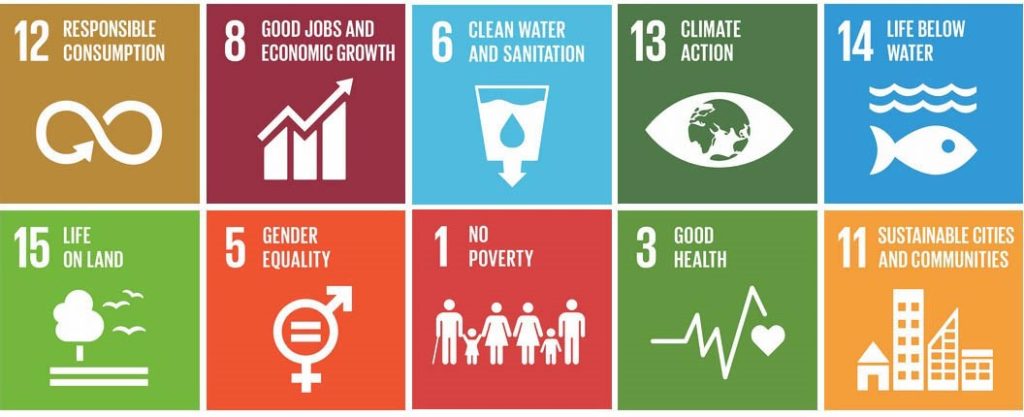
Impact of the fashion industry on the SDGs (UNECE, 2018)
Launched at the fourth UN Environment Assembly (UNEA-4), the UN Alliance for Sustainable Fashion is seeking to halt the environmentally and socially destructive practices of fashion. The Alliance is improving collaboration among UN agencies by analyzing their efforts in making fashion sustainable, identifying solutions and gaps in their actions, and presenting these findings to governments to trigger policy. Additionally, the Forests for Fashion Initiative, led by UNECE, FAO, and partners, supports innovative solutions in fashion through sustainable forests-based materials. Several other international organizations are working on global efforts to foster more sustainable fashion. Additional information on these initiatives can be found in the links below.
- The UN Alliance for sustainable fashion
- Traceability for Sustainable Garment and Footwear | UNECE
- Ethical Fashion Initiative | ITC
- UNEP Toolbox for Policymakers from High Textile Consumption Countries | UNEP | 2025
- UNEP Toolbox for Policymakers from High Textile Production Countries | UNEP | 2025
- UNECE and ECLAC propose measures to reduce environmental and health impacts of global trade of second-hand clothes| UNECE | 15 July 2024
- UNECE calls on fashion industry to fully embrace sustainability | UNECE | 27 October 2023
- The Sustainable Fashion Communication Playbook | UNEP and UN Climate Change | 19 June 2023
- Sustainability and Circularity in the Textile Value Chain: A Global Roadmap | UNEP | 30 May 2023
- CNMI and EFI announce launch of joint ESG Framework for fashion and 2022 Sustainable Fashion Awards | ITC EFI | 26 September 2021
- UNECE launches ‘The Sustainability Pledge’ for measurable and verifiable sustainability in the garment and footwear sector | UNECE | 20 May 2021
- Call to Action for Traceability, Transparency, Sustainability and Circularity of Value Chains in the Garment and Footwear Sector | UNECE | 11 March 2021
- Enhancing Traceability and Transparency of Sustainable Value Chains in the Garment and Footwear Sector | UNECE | 8 February 2021
- Sustainability and Circularity in the Textile Value Chain | UNEP | October 2020
- Transparency and Traceability can support the fashion industry’s post-COVID recovery toward resilient and sustainable value chains | UNCTAD | 21 September 2020
- On trend: sustainable fashion in the wake of COVID-19 | UNEP | 16 June 2020
- UNECE traceability initiative can accelerate fashion industry’s shift to more sustainable and circular model | UNECE | 21 February 2020
- SAICM details efforts to reduce chemicals of concern in textiles, toys, building materials and electronics | IISD | 6 January 2020
- Building Circularity in the Textile Value Chain | One Planet Network | 1 August 2019
- UN launches drive to highlight environmental cost of staying fashionable | UN News | 25 March 2019
- Forests for Fashion initiative sets new trends | UNECE | 15 March 2019
- UN Alliance For Sustainable Fashion addresses damage of ‘fast fashion’ | UNEP | 14 March 2019
- The future of work in textiles, clothing, leather and footwear | ILO | 2019
- Made in Forests | UN with Goodwill Ambassador Michelle Yeoh | 16 July 2018
- A new textiles economy : redesigning fashion’s future | Ellen MacArthur Foundation | 2017
- UNCTAD establishes three partnerships to boost fashion industry´s support of biodiversity | UNCTAD | 1 June 2011
- Subscribe to UNEP’s textiles newsletter
The Fashion Industry Charter for Climate Action
Launched at COP24 in 2021, the Fashion Industry Charter for Climate Change serves as a roadmap to achieve net-zero emissions by 2050 within the textile, clothing and fashion industries.
Signatories and Supporting Organizations under the Charter work within Working Groups aiming to identify and amplify best practices, strengthen existing efforts, identify and address gaps, facilitate and strengthen collaboration among relevant stakeholders join resources and share tools to enable the sector to achieve its climate targets. More resources on Charter and related activities can be found here.
UNEP Circularity Platform | Global Textile Policy Dialogues: Driving action for a sustainable and circular textile sector
Alongside the sixth session of the United Nations Environment Assembly (UNEA-6) in February 2024, governments recognised the urgent need for a policy coordination mechanism to build coherence in the policy response to address the adverse effects of the textile value chain on nature, people and economies. To do so, governments called for a global policy dialogue on textiles. At UNEA-6, governments agreed that the dialogue series should be government-led, inclusive and address various aspects of circularity in textiles, including: shifting consumption patterns, addressing production pollution, and discussing the role of trade in promoting textile circularity.
International Day of Zero Waste 2025
International Day of Zero Waste 2025 emphasizes the need for action in the fashion and textile sector to reduce waste and advance circular solutions. Towards zero waste in fashion and textiles.
The fashion and textile sector’s linear business model is fueling overproduction and overconsumption, contributing to the global waste pollution crisis. Textile production and consumption volumes are rapidly rising and increasing the impact of the sector, outpacing the progress made towards the sustainability of its products and practices. Globally, consumers lose about US$460 billion of value each year by throwing away clothes that could continue to be worn, and some garments are estimated to be discarded after just seven to 10 uses. Eleven per cent of plastic waste comes from clothing and textiles, making it third in line after packaging and consumer goods. Only 8 per cent of textile fibres in 2023 were made from recycled sources, with less than 1 per cent of the total fibre market coming from textile-to-textile recycling. A lack of fibre recycling practices is estimated to equate to an annual material value loss of more than US$100 billion. The fashion and textiles sector relies heavily on synthetic fibers produced from fossil fuels, which are shed into microplastics. Discarded clothing often ends up in the Global South, where inadequate waste management leads to dumping, burning, and severe environmental and social consequences. Poor communities bear the brunt, facing pollution and declining quality of life.
To celebrate the 2025 edition of International Day of Zero Waste, leading voices from Geneva and beyond who are joined the panel of this event highlighted steps taken to move forward the zero-waste agenda and key initiatives to reduce the waste impact from the fashion and textile sector, promoting sustainability and circularity. Geneva is a major global hub for the governance of hazardous substances and home to numerous international intergovernmental, non-governmental and business organizations aiming at reaching the zero-waste goal including in the fashion and textile sector.
World Cotton Day
Cotton is one of the most common fabrics used for clothes. Producing cotton sustains the livelihood of 28.67 million people and provides benefits to over 100 million families across the globe (WTO, 2020). Recognizing the critical role of cotton for economic development, international trade, and poverty alleviation, the UN General Assembly decided to proclaim World Cotton Day on 7 October (A/RES/75/318).
Cotton production can have consequent impacts on the planet due to the use of pesticides, high water consumption, and the conversion of habitat to agricultural use. Conventional production practices can result in soil erosion and degradation, water contamination, and other forms of pollution. Therefore, supporting sustainable models of cotton production is essential if we are to achieve the SDGs. Learn more about environmental sustainability in the cotton sector through the resources below.
- World Cotton Day | UN
- Why cotton? Facts & figures | WTO
- WTO, ITC and UNCTAD initiative on cotton by-products | WTO
- Cotton: Impacts & Action | WWF
- Better Cotton Initiative
- Measuring Sustainability in Cotton Farming Systems | FAO & ICAC | 2015
2026 Celebration | Cotton for Good: Building Prosperity Through Trade, Transformation and Partnership
World Cotton Day 2026 will be held on 7 October 2026 at the Hyatt Regency Hotel in Tashkent, Uzbekistan, under the theme “Cotton for Good: Building Prosperity Through Trade, Transformation and Partnership“. It is jointly organized by the Government of the Republic of Uzbekistan and the International Cotton Advisory Committee (ICAC), with the participation of the Food and Agriculture Organization of the United Nations (FAO), the World Trade Organization (WTO), the United Nations Industrial Development Organization (UNIDO), the International Trade Centre (ITC) and the United Nations Conference on Trade and Development (UNCTAD).
This year’s conference brings together governments, international organizations, financial institutions and private sector partners to recognize cotton as a driver of prosperity and to reaffirm the sector’s place in the multilateral trading system. International leaders will explore avenues for strengthening the global cotton-textile value chain through coordination, partnership and source-centred value addition, with particular emphasis on advancing the Partenariat pour le coton in order to attract investment and open up new opportunities for developing countries and least-developed countries (LDCs) alike.
On 8 October 2026, participants will take part in a technical tour organized by the Government of Uzbekistan.
The Role in Geneva
By alphabetical order
Better Cotton Initiative (BCI)
The Better Cotton Initiative (BCI), the largest cotton sustainability programme in the world, aims to make global cotton production better for the people who produce it, better for the environment it grows in and better for the sector’s future.
Basel, Rotterdam and Stockholm Convention (BRS)
Through a Global Environmental Facility (GEF) Project, “Reducing uses and releases of chemicals of concern, including POPs, in the textiles sector” the Basel Convention is aiming to stir significant and documented reductions in use, releases, and exposure to chemicals of concern (CoCs) including POPs in the textiles sector in selected countries.
Impact Hub Geneva
As a start-up incubator, Impact Hub Geneva facilitates the connection in a creative space, supports entrepreneurs and intrapreneurs projects, advices and guides companies from various sectors, to accelerate the achievement of the Sustainable Development Goals (SDGs) by 2030. As part of its work to raise awareness on the possibility of relying on more sustainable fashion and textiles and shopping resources, Impact Hub Geneva organized in November 2024 Circular Safaris on Fashion and Textile, guided tours across Geneva to rediscover sustainable solutions
International Labour Organization (ILO)
ILO promotes decent work in the textiles, clothing, leather and footwear sector through social dialogue, knowledge sharing, international labour standards, capacity building, partnerships and policy support.
International Trade Centre (ITC)
Through its Fibres, Textiles and Clothing team, the International Trade Centre (ITC) encourages small businesses to grow through sustainable practices. By providing training, coaching and research, ITC drives competitiveness while ensuring social and environmental responsibility. ITC therefore supports companies in ensuring their social and environmental performance.
ITC Ethical Fashion Initiative
EFI is a flagship programme of the International Trade Centre, which connects marginalized artisans from the developing world – the majority of them women – to international fashion houses for mutual benefit. EFI also hosts the Secretariat of the UN Alliance for Sustainable Fashion.
United Nations Economic Commission for Europe (UNECE)
UNECE’s work on trade in the textile and leather sector focuses on improving transparency and traceability in order to identify and address labor and human rights violations and environmental impacts while embracing more sustainable production and consumption patterns. UNECE also promotes sustainable innovation in the fashion sector through its work on sustainable forest products. As a global convening platform to support policy coherence and alignment across sectors, UNECE has a key role to play to support sustainability and traceability. Through consultation with hundreds of industry insiders and experts, UNECE has developed a UN-brokered toolbox to help garment and footwear makers to ensure the transparency and traceability of their value chain. The resulting initiative, called The Sustainability Pledge, encourages companies across the sector to announce their commitments to transparency and traceability.
UNECE also convenes the Forests4Fashion initiative, launched in 2014 to promote sustainable forest management beyond the forestry sector and encourage sustainable production and consumption in support of Sustainable Development Goal 12.
United Nations Environment Programme (UNEP)
The UN Environment Programme’s work on sustainable and circular textiles applies a value-chain approach, which leads to changes at each stage in the value chain while involving players of all sizes and from all market segments. In order to develop a roadmap, UNEP conducted a Global Stocktaking. Updates on UNEP’s activities on this fastly-evolving topic are published and accessible on the One Planet Network platform.
United Nations Trade and Development
UN Trade and Development engages with circular economy and sustainable trade in the textile industry through research work and support to developing countries. Through its Global Second-Hand Clothes Trade Monitor, it allows users to see trade flows and major importing and exporting countries.
World Business Council on Sustainable Development (WBCSD)
The WBCSD supports business initiatives for circular economy and sustainable consumption and production, including in the fashion industry. The CTI Fashion Initiative brings together industry players to establish harmonized standards, metrics and best practices for circularity. Working together, we seek to unlock new avenues for value creation and operationalize circularity throughout the fashion and textile value chain.
World Intellectual Property Organization (WIPO)
Intellectual property (IP) rights form the foundation of the fashion industry’s creative and commercial ecosystem. These rights help designers protect their original work, support brand recognition, and enable fair competition. WIPO’s work on sustainable fashion showcases how innovative green technologies can help the global fashion industry to manage and reduce environmental damage. As the industry evolves, from sustainable fashion to tech-integrated garments, IP plays a vital role in securing investment, fostering innovation, and driving global growth. Fashion not only fuels cultural trends but also makes a significant contribution to the global economy by supporting millions of jobs and enabling a diverse range of creative enterprises.
World Trade Organization (WTO)
WTO conducted important work that changed the way in which textile and fashion is traded via the Agreement on Textiles and Clothing (ATC), which ten-year transition period of implementation eliminated quotas on trade in textile and clothing products. Cotton is discussed at the WTO under two complementary tracks: 1) trade aspects, around the multilateral negotiations to address distorting subsidies and trade barriers for cotton; and 2) development assistance provided to cotton production and its value chain. These two tracks reflect the clear linkages and possible synergies between cotton trade and development assistance in a number of developing and least-developed countries (LDCs) Members, impacting millions of people worldwide.
UN system’s engagement is larger than the Geneva-based organizations presented here. Members of the UN Alliance for Sustainable Fashion also include UNDP, UNEP, UN Global Compact, UNFCCC and UNOPS.
What Can I Do?
While international organizations, governments and businesses work on solutions to shift the fashion industry toward a more sustainable pathway, consumers can also play a role with their daily actions. This section provides resources on the actions individuals can take to support sustainability in their apparel choices.
- Consomm’action | City of Geneva
- Responsible purchasing | City of Geneva
- Ge-reutilise – Directory of second hand and rental shops | City of Geneva
- Sustainable Fashion for Geneva? | University of Geneva
- Labels and norms in Fashion | Public Eye
- Where to find information on fairer fashion | Public Eye
- Guide du shopping éthique (in French) | Nice Future
- Où s’habiller de manière locale et durable à Genève? | City of Geneva
GEN Events
Links
Further resources and events to learn about environmental sustainability in the fashion industry are provided below. This page is regularly updated.
- Ban on destruction of unsold clothes and shoes enters into application | Directorate-General for Environment, European Commission | 17 July 2026
- Trade in Second Hand Clothing | UN Trade and Development | April 2026
- Progress report on the 10-Year Framework of Programmes on Sustainable Consumption and Production Patterns | UNEP | 5 May 2025
- Fashion and land | UNCCD | November 2024
- Circular Transition Indicators (CTI) | WBCSD | 2024
- Kicking circular fashion into high gear | World Business Council on Sustainable Development | 5 July 2023
- The Sustainable Fashion Communication Playbook | UNEP and UN Climate Change | 2023
- Sustainability and Circularity in the Textile Value Chain – A Global Roadmap | UNEP | May 2023
- The Clothes We Wear | Wednesdays for the Planet | Geneva Environment Network | 17 March 2021
- Public Eye resources on Fashion
Resources by UNEP
- With onion peels and sage dyes, designers hope to make fashion more sustainable | UNEP | 27 Mar 2025
- The Sustainable Fashion Communication Playbook | 2023
- Global Textiles Policy Dialogue
- Innovative Business Practices and Economic Models in the Textile Value Chain (InTex ) project
- Accelerating the Transition of the Indian Textile Sector towards Circularity (InTex India) project
- Circularity and Used Textile Trade Project
- Reducing uses and releases of chemicals of concern, including persistent organic pollutants (POPs), in the textiles sector
- UNEP’s Textile Expert Community
- UNEP Sustainable fashion communication activities
- UNEP Circularity Platform – Textiles sector
- The United Nations Alliance for Sustainable Fashion
- Engaging the Textile Industry as a Key Sector in SAICM – A review of PFAS as a Chemical Class in the Textile Sector