
Event Conference
Advancing a Just Transition: How Human Rights Can Underpin International Processes to Phase Out Fossil Fuels | HRC61 Side Event
10 Mar 2026
14:00 – 15:00
Venue: Palais des Nations | Room IX
Organization: Center for International Environmental Law
This side event to the 61st session of the Human Rights Council, organized by the Center for International Environmental Law, with the support of the Geneva Environment Network, will discuss the multifaceted human rights impacts of the fossil fuel industry across the supply chain and the critical role of human rights law and institutions in the transition to a fossil-free future

About this Event
Fossil fuels are the root cause of the triple planetary crisis – climate change, pollution, and biodiversity loss – as underscored by the landmark report Fossil Fuel-based Economy and Human Rights by the UN Special Rapporteur on human rights and climate change and the 2023 Joint Statement by six Special Procedures of the Human Rights Council. The fossil fuel industry has significant impacts on a broad spectrum of human rights.
The pollution and climate disruption generated by fossil fuels throughout their extraction, processing, transport and use adversely affect economic, social, and cultural rights. Civil and political rights are also undermined, as evidenced by instances of criminalization, repression, and reprisals against individuals and communities protesting fossil fuel extraction projects, and the instability and conflict often associated with dependence on extractive industries.
States have clear human rights obligations to prevent and address these harms, including extraterritorially, by pursuing a just transition away from fossil fuels that is rights-based, inclusive, and equitable. This includes phasing out fossil fuels, regulating private actors, ensuring access to information, participation and justice, and providing effective remedies. Increasingly, international and regional legal and human rights mechanisms are clarifying the scope and minimum content of these obligations. In its Advisory Opinion, the International Court of Justice took a firm stance on the role of fossil fuels as a primary driver of climate harm, stating that a State’s failure to take appropriate action on climate change — “including through fossil fuel production, fossil fuel consumption, the granting of fossil fuel exploration licenses or the provision of fossil fuel subsidies” — may constitute a breach of its international obligations.
The First International Conference on Transitioning away from Fossil Fuels, taking place in Santa Marta, Colombia, in April 2026, and co-hosted by Colombia and the Kingdom of the Netherlands, will contribute to advancing global action on fossil fuel phase-out, just transition pathways, and international cooperation.
This side event will discuss the multifaceted human rights impacts of the fossil fuel industry across the supply chain and the critical role of human rights law and institutions in the transition to a fossil-free future. Panelists will discuss how the Human Rights Council, Special Procedures, Treaty Bodies, and international courts can further advance accountability and guidance in this area; and explore how human rights obligations, standards and mechanisms can inform the Santa Marta conference and subsequent dedicated processes for international cooperation on fossil fuel phaseout, strengthen States’ commitments, and ensure that just transition strategies are grounded in binding human rights obligations rather than voluntary or market-driven approaches alone.
Environment @ HRC61
The 61st Regular Session of the Human Rights Council (HRC61) is taking place in Geneva from 23 February to 31 March 2026. Consult this regularly-updated page that highlighted the environmental-related activities of this session.

Speakers

H.E. Amb. Alvaro AYALA
Deputy Permanent Representative of Colombia to the UN Office and other international organizations in Geneva

Samuel K. Jr. LANWI
Deputy Permanent Representative of the Republic of the Marshall Islands to the UN Office and other international organizations in Geneva
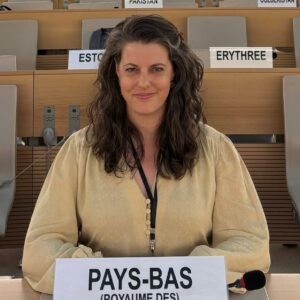
Simone VAN DER POST
Head of Human Rights, Counsellor, Permanent Mission of the Kingdom of the Netherlands to the UN Office and other international organizations in Geneva
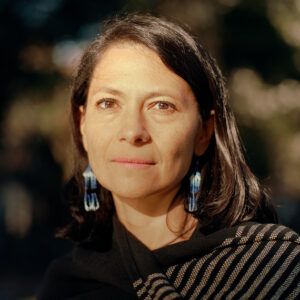
Astrid PUENTES RIAÑO
UN Special Rapporteur on the right to a clean, healthy and sustainable environment

Elisa MORGERA
UN Special Rapporteur on human rights and climate change

Francesca MINGRONE
Senior Attorney, Center for International Environmental Law | Moderator
Video
Live from Palais des Nations
Highlights
Summary
Part 1
Samuel K. Jr. LANWI | Deputy Permanent Representative of the Republic of the Marshall Islands to the UN Office and other international organizations in Geneva
Can you please remind us of the main findings of the advisory opinion on climate change by the International Court of Justice, specifically with regard to fossil fuels? Why does this issue matter even more following that judgment?
The court spoke about sea level rise for SIDS in the Pacific and Caribbean, have been adding that sea-level rise cannot take away our territory, and the court agreed. The court also affirmed that the temperature limit of 1.5°C for lowland nations like the Marshall Islands already handling king tides and saltwater inundation, every centimeter of sea level rise matters. Thanks in part to Pacific leadership, the Paris Agreement included, for the first time, the confirmation that the previous temperature goal of 2°C was insufficient and we should be pursuing efforts to limit warming to 1.5°C. And now, more than 10 years later, we have heard the worldwide report confirm that 1.5°C has become a timely based target.
For years, we have been saying that emissions pledges are just voluntary offerings made for charity and indeed the court agreed these are legal obligations under international law.
We turn to fossil fuels specifically, the Court gave important clarity on what obligation States have to protect climate from harm. The court concluded that countries are obligated to protect the climate system from the harm caused by greenhouse gas emissions both because of commitments made under UNFCCC and other agreements but also through customary international law. Indeed, the court concluded and I quote that “States have a duty to use all means at their disposal to prevent activities carried out under their jurisdiction or control from causing signs or due to the climate system”. The court went on to say, “Where a State acts or fails to act in a way that significantly causes harm to the climate system, that is a breach of its international obligations and it could form a role.”
Given that we know that fossil fuels are driving the vast majority of climate harm, it is not surprising that fossil fuels in particular were featured in the judgement. Specifically the court said that continuing to extract, use and subsidize fossil fuels may all constitute international wrongful acts. And importantly the court concluded that States are not only responsible for its own actions but how private businesses operate in its jurisdiction. The court explains States may be responsible if they fail to bring the regulation and legislation that is needed to limit damages brought by private sector actors.
Finally, the Court gave priority to those States who have been injured by climate harms. It explained that just because climate change has been caused by more than one State does not mean that individual States cannot be held responsible for their part causing climate harm and that States breaking international law are not only obliged to stop those climate harms but provide remedy [incomprehensible] to injured States. These findings leave no doubt about the obligation of States and the risks that States may face if they continue to invest in fossil fuel despite these clear legal warnings. No longer can countries be in denial about the urgency of this transition away from fossil fuels. It is not just a moral issue but one that has the legal certainty of the world’s highest court.
H.E. Amb. Alvaro AYALA | Deputy Permanent Representative of Colombia to the UN Office and other international organizations in Geneva
What are the expectations for the Santa Marta conference, and how will human rights be featured there?
My expectations for Santa Marta is to move from the global discussion on commitments to practical pathways for the implementation of those commitments of the transition away from fossil fuels in a just orderly and equitable manner consistent with the agreement at COP28. This requires more detailed conversations, more detailed discussion that we have not been able to have in the framework of the COP. We need to discuss what alternative pathway we have in order to materialize our commitments.
The scientific evidence is unequivocal; the continued expansion of fossil fuels production and investment in this industry is a threat to the planet and to all of us, it affects human rights. At the same time, a just transition presents opportunities for innovation, economic diversification, corrected inequalities and more to be able to achieve more resilient energy systems. The Santa Marta Conference therefore seeks to create a space for States and stakeholders that are ready to move forward without being constrained by those who are not.
We seek to align our political will and coordinate concrete actions to transform energy systems and economic models in the short term when we most need action. Human rights are central to this effort. Colombia strongly believes that a just transition must be a people centered transition. This means ensuring that the transformation of our economies protects work, protects the rights of workers and the communities, promotes social and intergenerational justice and guarantees meaningful participation of those most affected by both climate change and the transition process.
This is precisely why Santa Marta Conference has been designed as a multi stakeholder process, which brings together governments, national authorities, civil society, organizations, academia, private sector, trading unions and financial institutions. In recognition of the central role of persons and communities in vulnerable situations, the conference will also provide a space for people’s assembly dedicated to Indigenous Peoples, people of African descent, peasants, joint people and social movements.
These dialogues will help ensure that the transition pathways discussing it are not only technical but also with a social perspective, to guarantee that the persons are involved in these decisions. Issues such as energy access, production, reconversion, decent work and the avoidance of new forms of extractivism and colonialism are key elements of the discussions.
At the conference, we will be sharing a cohost’s report consolidating and enabling pathways identified during the process as well as a starting point to build a constructive coalition of states and stakeholders committed to urgently advancing a just transition. It is our hope that this coalition will also help inform the ongoing climate process including the road map toward COP30.
The role of Geneva: Geneva is the multilateral capital for human rights, the center of the system for human rights. The fossil fuels have not been present in the agenda of the Council. It has been very hard even though Colombia alongside other states have tried to bring the matter to the attention of the Council. It has been difficult but we are going to persist because we consider that the concept could not remain silent about fossil fuels and the need for transition to other sources of energy.
Simone VAN DER POST | Head of Human Rights, Counsellor, Permanent Mission of the Kingdom of the Netherlands to the UN Office and other international organizations in Geneva
As the co-convener of the Santa Marta conference, what are the Netherlands’ expectations for it?
For the Netherlands, climate policy and green growth are very clear priorities. We have a recently new government who has upheld the Ministry of Climate Policy and Green Growth. We have a Prime Minister that in Dutch politics is known for being a climate radical, a Dutch term that he is really taken as his name to go to war with.
So for us, climate change is and remains a big issue and priority. And for us, green growth means talking about the transition away of fossil fuels. This is something that we look at a national level where we are also currently trying to make an analysis of what the role of fossil fuels is in our own economy and how can we transition away from coal, oil and gas. The Netherlands is up to a certain degree a gas producing country but we also see that producing gas brings difficulties to our own population so we are trying to figure out ways to move away from these types of fuel sources.
The COP30 clearly shows that. We have a shared understanding that we must accelerate this transition away from fossil fuels. So we are very happy to be able to co-organize this very important conference with Colombia in Santa Marta. As my Colombian colleague already said, we try to make this conference about practical things – how do we transition away from fossil fuels? It’s building on a momentum that we saw at COP30, and there is a recognition to really address this phase out and its part of the collective commitment that we undertook already in Dubai in the COP28. And it’s this collectivity that we think is extremely important.
The Marshall Islands colleague already mentioned the ICJ ruling where this collective action is also strongly underlined and where we as a government of the Netherlands are also strongly supportive of and are trying to make that into reality. For us, it’s really also about just, orderly and equitable transition away from fossil fuels.
We hope that in Santa Marta we can really focus on the implementation, action and solutions rather than have another round of diagnosis or negotiation, and that we can bring together countries, people and organizations that are able and willing to demonstrate that this transition is possible right now — be it big, be it small — and that it is being implemented by governments and all other kinds of relevant actors on ground already. We hope that we can look at practical experience that we can share and look at the best practices so we can continue transitioning away.
Astrid PUENTES RIAÑO | UN Special Rapporteur on the right to a clean, healthy and sustainable environment
How can we ensure that processes like the Santa Marta conference can foster the participation of CSOs and Indigenous Peoples, and better center science in the law?
It’s interesting to know that the Conference is not only in Colombia, but specifically in Santa Marta. That is key because Santa Marta is the port where the coal the export from in Colombia goes out, and I think that’s very important that the government has decided and has been actually having the strength to decide to have it there as opposed to the capital in Bogota.
I’m saying this because process matters of course and these symbols in Santa Marta, in addition to the port also being very close to the Sierra Nevada, Santa Marta there is an area where four very important Indigenous Peoples are based and have, for a long time, been impacted by the coal and fossil fuels. The fact is that, in addition to the Indigenous People, there is a very active community of union workers. We have conversations with the Colombian government, this is what we need.
We know that it’s going to be difficult conversations, but we cannot continue avoiding the difficult conversations and embracing seriously the elephants in the room. Fossil fuels unfortunately have been already an elephant in the room, and we saw that in climate negotiations. So as a Special Rapporteur, I think that it’s going to be a very important opportunity to have open participation from Indigenous People, afrodescendant communities, costal communities, peasants, youth because we already have the ICJ advisory opinion which is very rich in obligations and clarity. We need to use it.
I also have to share with you that I was disappointed to see that COP30 states did not use the tools that they have. The consensus requested the ICJ advisory opinion, we already have it and now we are not using it. It’s a very important message in the whole process because as we know also at the ICJ advisory opinion and other advisory opinion, it’s very clear as you will also have heard that climate change is a quintessential risk to all states but also is linked to human rights and specifically to the human right to a healthy environment.
We also heard from this Council, the General Assembly and ICJ have all agreed that the right to a healthy environment is a fundamental right. The ICJ was very clear to conclude that the right to a healthy environment is essential and a precondition for the enjoyment of all other human rights. When we talk about the right to a healthy environment, we talk about the access to information, public participation and access to justice and remedy which must be in the center of the conference.
What I’m saying is not only because it’s the obligation of states and the rights of people. but it’s also important, effective and helps to have better, more effective and efficient processes. We need stakeholders that are multiple in order to advance this transition. The IPCC has mentioned for a few years now that solving the climate crisis requires profound and transformational changes and this is what we are not seeing.
We need to advance and I think that it will be a great opportunity for the Conference to be able to receive the information and find ways to incorporate that information and that participation as well in the climate negotiations.
Elisa MORGERA | UN Special Rapporteur on human rights and climate change (video statement)
In my report to the Human Rights Council in 2025 on the human rights imperative of defossilizing our economies, I recommended that, in the absence of an explicit and sufficiently detailed decision at COP 30 on the phase‑out of fossil fuels, we would have needed to start a new multilateral process to advance international cooperation on defossilization. I think that the decision to hold the Santa Marta Conference under the leadership of Colombia and the Netherlands, supported by many states from all regions of the world, can be seen as an implementation of that recommendation.
It can also be understood in light of the language used in the advisory opinion of the International Court of Justice regarding states’ duty to cooperate to prevent significant harm to the environment and the climate system. This provides a legal standard for determining whether existing forms of cooperation still serve their purpose and whether further collective action must be undertaken. This rationale was shared during the press conference announcing the Santa Marta Conference, where several countries expressed their views about the current limitations of the UN climate process in advancing significant, appropriate, and proportionate action supported by international cooperation for defossilizing our economies.
In particular, the ICJ recognized that discretion under the duty to cooperate cannot be used as an excuse to refrain from cooperating with the required level of stringent due diligence necessary to prevent further climate harm and further human rights violations. In this connection, the legitimacy of the Santa Marta Conference is based on the ICJ advisory opinion and the underlying sources of international law, both customary and treaty‑based. It should therefore be informed by further clarifications found in the advisory opinion.
First, there is the need to support good‑faith efforts to arrive at appropriate forms of collective action that represent sustained and continuous cooperation based on the interdependence of states and solidarity among peoples, taking into account the situations of different states.
Second, this process should contribute to the effective implementation of all applicable international law, particularly the multilateral environmental treaties that the ICJ has recognized as applicable to climate action but that continue to lag behind in UN climate negotiations. This is particularly true for international biodiversity law and the law against desertification. Chemicals MEAs are also important for understanding safe ways to defossilize our economies and to prioritize the phase‑out of fossil fuels, given their contribution to all the planetary environmental crises we face.
Finally, the Santa Marta Conference must be grounded in human rights, including the priorities and key findings made clear by international human rights monitoring bodies, special procedures, and the advice of the Office of the High Commissioner for Human Rights. This should support the unity of international law and rely on health science to fully understand the impacts on human rights across all dimensions of human well‑being protected by international human rights law, both in the context of fossil‑fuel‑based economies and in the context of defossilizing our economies. The process must clearly be human‑rights‑based and inclusive of the views, needs, and distinctive knowledge systems of all human rights holders, particularly those most affected by climate change and by other negative impacts of fossil fuel operations.
Part 2
H.E. Amb. Alvaro AYALA
How do you see the role of Geneva in building on the outcomes of the Santa Marta conference?
We think that Geneva is a platform that we could use in order to give more impulse to [incomprehensible] what we could identify in Santa Marta as the pathways. Colombia and other delegations have sought for years to integrate this issue into the work at the Council and we are committed to continue doing so with renewed strength. The advisory opinions of ICJ that have been mentioned here and also the opinion of the Interamerican Court of Human Rights have highlighted that a just transition away from fossil fuels is not only a commitment, it’s a moral and legal imperative. This matter has legal consequences for the States and it’s important to highlight that.
Geneva provides a platform to continue multilateral engagement, especially with those states that are not engaged in the process and that say that climate change does not exist. We have to keep open the channel in order to engage them and Geneva is a good platform to do so.
Simone VAN DER POST
The Netherlands is leading on the phase-out of fossil fuel subsidies – can you tell us more about this and, in general, how strengthened international cooperation can accelerate collective progress toward a just transition?
We have a fossil fuel economy, and part of that is that fossil fuels are in many places being subsidized for use. We are talking about USD 1 trillion every year that is spent on fossil fuels subsidies, of which one third comes from high-income countries. To be able to redirect national flows from fossil fuels to clean energy, it’s really important to look at subsidies and make sure that taking them out of the equation gives the opportunity to do a just, orderly and equitable transition away from fossil fuels.
These subsidies are also part of having an unequal playing field for everyone to actually make this transition. We currently see with the developments in the Middle East that dependence on fossil fuels is also very complicated: there is a very volatile market. These weeks are a very clear example of that. Getting these subsidies out of the system will free up fiscal space for other priorities. Moreover, these subsidies are often unfairly distributed and inefficient at addressing cost of living issues, so there are more effective ways to support people in vulnerable situations in the energy transition.
Reform is very difficult. Also in our country, it is not something easily taken out of our system. That is why at COP28 in Dubai, the Netherlands launched a Coalition on Phasing Out Fossil Fuel Incentives, including Subsidies (COFFIS) to close the gap between international commitments and actual implementation. Under COFFIS, a set of 17 countries have committed to the creation of transparent domestic subsidy inventory – looking at how this works in your own country and then looking at what we can do about this. Year one was the inventory, year two of joining the coalition is doing action plans. COFFIS is really fostering a community of policy makers where you can share experiences, best practices in regular sessions to see how to practically do this.
Together with our members and other initiatives, we work to promote ambition on reform in different international fora. We will also carve out some time for these important conversations at the conference in Santa Marta. The coalition is open for new members.
About the location on the Santa Marta Conference, the Netherlands currently has a project in this area where there is a Dutch company doing solar panels. They worked very closely with the Indigenous Peoples whose territory is where these solar panels are standing on to make sure that they are part of the process of making this land usable for renewable energy sources, that they are part of the business plan. Energy is in the end a business but it can be an equitable business. Making sure that the people who own land are involved is one of the things that we can do and this might be one of these practical things that we can showcase in the Santa Marta Conference.
Samuel K. Jr. LANWI
What would Pacific islands and SIDS like the Marshall Islands like to see happen after the Santa Marta conference?
We know that this moment is well overdue and it is a path that we have been charting now for nearly a decade. It was in 2017 that the prime minister of Fiji as COP23 president first noted that meeting the 1.5°C target would require the countries to work together to manage a phase out from fossil fuels. Six years later, in Dubai, all countries committed to transition away from fossil fuels in energy systems, but we are not in practice closer to seeing this happening.
This is not a journey that will be done in a single step and now we have not one, but two important steps forward this year: the Santa Marta Conference and the Roadmap being coordinated by Brazil.
For us, the priority is making sure that this process helps all governments whether purchasers of fossil fuels or consumers, spend time facing the reality of transitioning away from these fuels means. Each country will need its own path, its own plan for this transition and no two of these will be identical, but countries don’t need to be alone in making this or tackling it.
Thanks to the Santa Marta Conference and these new roadmap discussions, countries can come together and look at these issues region by region, field by field, sector by sector. We can learn from one another in how we transition our workforces, how we roll out clean alternatives to fossil fuels, how we engage indigenous groups and global communities. We are going to look at the global economics and global technologies uniting these transitions. Working together gives us the best chances of approaching these transitions with shared principles.
How can we make sure that transition is just, equitable and rooted in international law, including human rights law? How can we ensure the cost, benefits and opportunities are distributed fairly, including among present and future generations? We know there is potential for these transitions to bring great benefits supporting energy, universal energy access, reducing energy poverty, enhancing decent work opportunities, improving public health, gender equality, and conserving biodiversity.
So we would like to see countries commit now to approaching these discussions openly and continuing them after the Santa Marta Conference. We would also like to see this reflected back in the UNFCCC eventually and perhaps it is helpful to clarify this: we are not saying we will let this process be held up, if some parties want to block consensus on it. We have a coalition of countries as was mentioned and we want to see them take it forward regardless, but we remain committed to the important work happening in the UNFCCC. The pathways, plans and policies that countries explore through this roadmap and bring new energy to our NDCs and the commitments parties have made in COP. This work can build countries’ capacity to implement their promises and raise ambition over time can also help collectively track progress ahead of the second global stop taking. So the precise next steps will depend on how far parties can progress these questions in Santa Marta.
We do not expect to solve all these issues in one meeting, but as long as parties emerge from that meeting with new commitment to working together at pace to make these transitions a reality, we are confident we can say it will have been a valuable step on the path.
Astrid PUENTES RIAÑO
States have a human rights imperative to dismantle the barriers to a just transition. Can you help us identify some of these and what States should do to remove such obstacles?
I think one of the key aspects for using human rights, is that, as we heard Geneva is the capital of human rights and is where the Council is, is the need to advance them in other spaces, from the advancements, the obligations and the clarity. One of the challenges that I’ve seen and highlighted in my report on the right to healthy environment is the economic model and unsustainable development that we have.
I’m not saying anything that is necessary new at all… but I want to specifically also mention that in the economic model we have, we have the undue influence of some businesses and sectors. Santa Marta has this possibility to identify how this can be incorporated and dealt with, so that States are focusing on complying with obligations based on best available science, especially because there are many ways in which such influence is reflected, including through investors state settlement mechanisms.
The Netherlands and other states have been moving forward on identifying that trade has to be aligned with climate and human rights and that it’s important to take steps forwards. For example, the Energy Charter wherein several European countries have gone backwards or decided to withdraw, and make sure that these dispute settlement mechanisms are not going to continue building a chilling effect or the compliance of climate actions and actions that will be protecting human rights.
I want to close thinking about science. It will be very important and give the possibility to overcome the challenges. There are many opportunities, there are many projects. Using human rights and identifying how to advance in the conference can also be a good opportunity to think about the opportunities and solutions. We should focus on how much there is to do. There is a lot of available science from Western science, but also from Indigenous People and ancestral knowledge. The Pacific definitely has a lot to contribute and again from Indigenous People including the people in Santa Marta.