
Event Conference
Geneva Panel: Environmental Rights and the ICJ Advisory Opinion in ASEAN: Global and Regional Developments
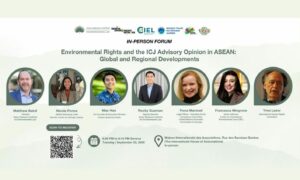
23 Sep 2025
18:30 – 20:15
Venue: Maison International des Associations
Organization: Asian Research Institute for Environmental Law, Earthjustice, Center for International Environmental Law, World's Youth for Climate Justice, ASEAN Youth Forum, Youths United for Earth
Providing a platform for dialogue on advancing environmental rights in ASEAN within the context of global legal and policy developments, this Forum explored the future of environmental rights following the forthcoming ICJ Advisory Opinion, with particular attention to ASEAN’s progress and the draft ASEAN Declaration on the Right to a Safe, Clean, Healthy, and Sustainable Environment.
About this Event
The recognition of the human right to a clean, healthy, and sustainable environment by the UN General Assembly in 2022 marked a milestone for global environmental governance. The International Court of Justice Advisory Opinion (ICJ AO) on climate change also provides further guidance on the scope and obligations of states under international law, with implications for environmental rights across regions.
In Southeast Asia, the ASEAN Declaration on the Right to a Safe, Clean, Healthy and Sustainable Environment is anticipated to be signed by ASEAN leaders at the October 2025 Summit in Kuala Lumpur. The Declaration builds on years of work by ASEAN Member States, supported by a network of civil society organizations (CSOs) and experts. Its adoption presents both opportunities and challenges for strengthening rights-based environmental governance and advancing implementation at the national and regional levels.
Against this backdrop, organizers convened a panel in Geneva to provide a platform for dialogue on advancing environmental rights in ASEAN within the context of global legal and policy developments. The Forum explored the future of environmental rights following the forthcoming ICJ Advisory Opinion, with particular attention to ASEAN’s progress and the draft ASEAN Declaration on the Right to a Safe, Clean, Healthy, and Sustainable Environment.
This Forum followed an earlier conversation “Environmental Rights and the ICJ Advisory Opinion: Southeast Asia in Focus” that took place on 22 September 2025, from 14:00 – 15:00 CEST.
Video
Live from Maison des Associations
Highlights
Summary
Opening
Matthew BAIRD | Director, Asian Research Institute for Environmental Law (ARIEL) | Moderator
- The development of the Asian Environmental Rights Declaration raises interesting and challenging perspectives. The recent International Court of Justice advisory opinion on states’ obligations and rights regarding climate change also creates opportunities, as a fast-track for progress in this area.
- The ICJ’s decision, along with other recent judicial rulings—such as those from the International Tribunal for the Law of the Sea, the European Court of Human Rights, and the Inter-American Court of Human Rights—has produced a significant body of jurisprudence over the past year. This jurisprudence provides both procedural and substantive frameworks to drive real change for communities, Indigenous peoples, and individuals affected by climate change.
- The ICJ made it clear that climate science is settled and emphasized state liability, which could influence the behavior of polluting countries. While the practical application in domestic or international law will take years to develop, the foundation for accountability is now established.
- The session will focus on the Asian context, particularly the draft Asian Environmental Rights Declaration on the right to a clean, safe, healthy, and sustainable environment.
Introducing the Draft ASEAN Declaration
Rocky GUZMAN | Deputy Director, Asian Research Institute for Environmental Law (ARIEL)
- In Southeast Asia, the first ASEAN Declaration on the Right to a Safe, Clean, Healthy, and Sustainable Environment is being developed, with the ASEAN Environmental Rights Working Group working on the draft for five years. The declaration is expected to be signed by ASEAN leaders in October 2025 at the summit in Kuala Lumpur.
- Southeast Asia is a hotspot for attacks on environmental human rights defenders (EHRDs). Data from Global Witness shows about 18% of killings happen in the region, especially in the Philippines but also in Indonesia, Thailand, and Cambodia, along with enforced disappearances, harassment, and violence against Indigenous peoples. This situation is why a regional framework for environmental rights is needed.
- The process started in 2022 under the ASEAN Intergovernmental Commission on Human Rights. The group drew from international and regional experiences: the UNGA and UNHRC resolutions, ASEAN’s 2012 Human Rights Declaration, and rights such as clean air, safe climate, healthy ecosystems, water, sustainable food, and oceans. For procedural rights, they looked at Principle 10 of the Rio Declaration, the Aarhus Convention, the Escazú Agreement, and other instruments covering access to information, public participation, justice, and protection of EHRDs.
- The working group met five times before disbanding in July 2024, when the draft—still full of brackets and disagreements—was handed to ASEAN bodies. Since then, consultations have been happening, and the leaders are expected to sign the declaration soon, though the final content is not known.
- They faced three key challenges: disagreements over content (like references to Indigenous peoples, EHRDs, and environmental impact assessments); lack of transparency and weak consultations, with drafts not shared publicly; and lack of representation, since civil society has no formal role now that the working group is disbanded.
- Despite these challenges, the declaration will be a landmark. It could push reforms in national policies, regulation, and judicial procedures to protect environmental rights and defenders. ASEAN will hopefully ensure participation and engagement in the next steps.
Lessons from the ASEAN ICHR Process
Max HAN | Co-Founder & Executive Director, Youths United for Earth
- While policy spaces often focus on reaching the mind, stories reach the heart—and both are necessary when discussing human rights.
- The Good. The ASEAN environmental rights declaration is significant because it addresses both substantive rights (clean air, safe water, healthy ecosystems, sustainable food, and a safe, clean, healthy environment) and procedural rights (access to information, public participation, access to justice). It also draws from progressive agreements like Aarhus and Escazú. This is crucial in Southeast Asia, a resource-rich region where demand for forests, minerals, and renewable energy creates tension with the rights of local communities.
- The Bad. However, policy processes often fail to reflect the realities of communities. The two following bullet points are stories of environmental defenders:
- Alab Mirasol from the Philippines, whose father, a peasant activist, was forcibly disappeared 22 years ago. She continues his work, reminding us that defenders are not just “activists” but also parents, children, and family members.
- Selen Lim from Sarawak, Malaysia, who faced a $1 million lawsuit from a logging company after her indigenous group reported land rights violations. Such “SLAPP suits” aim to silence defenders.
- Southeast Asia is one of the most dangerous regions in the world for environmental defenders, with states and corporations using lawsuits, harassment, terrorism charges, and other tactics against activists. A shift in perspective is needed: by protecting those who protect the environment, we are in fact protecting the environment itself.
- The Ugly. The drafting process itself was plagued by lack of transparency, poor consultation support, and dismissals of key issues like indigenous rights. The draft shrank from 19 pages to just 4, and much of the substantive content may have been removed. Indigenous rights were especially contentious—despite being recognized internationally, some policymakers rejected the term “indigenous peoples.” Activists in the working group faced verbal abuse, intimidation, and harassment. Even as they worked on a framework to protect defenders, some defenders in Cambodia were jailed.
- Nonetheless, civil society responded with creativity and persistence. They brought in Indigenous elders, mobilized coalitions, produced their own civil society declaration, and used international and local media to push for transparency. Young people and grassroots groups carried much of the burden of consultations, often with minimal funding.
- The lessons learned are the following: Decolonization is not just rhetoric—it’s a lived struggle, especially for indigenous peoples. Policymakers need empathy and accountability, but so do advocates themselves. For Southeast Asia’s youth, this declaration is not just a policy document—it’s a generational struggle that will outlast political cycles.
- There is a need to call for solidarity: remember to defend the defenders.
Lessons from the ICJ Advisory Opinion
Nicole PONCE | Global Advocacy Lead, World’s Youth for Climate Justice
- On 23 July 2025, the Global Youth Movement and the ICJ Advisory Opinion Alliance led by the World Youth for Climate Justice and the Pacific Island students fighting climate change secured the unanimous decision from the International Court of Justice in response to their request for an advisory opinion on climate change and human rights.
- Following this historic ruling, Nicole Ponce is determined to use the advisory opinion of the ICJ and the Interamerican Court of Human Rights to advance ambitious climate action at both the regional and domestic levels through negotiations, litigation, and advocacy.
- Since 2019, when World Youth for Climate Justice first worked from the Pacific on calling for an advisory opinion from the International Court of Justice, this moment feels like a high point. Back then, there was a consensus that decisions being made were robbing us of our future. The organization wanted to make clear that they refuse to be on the sidelines, and they refuse to be reduced to victims. While communities drown and are displaced, those most responsible and profiting continue to act as if basic human rights are optional. The message is that climate justice is not optional—it is a legal obligation. The Court reaffirmed that in its opinion.
- The question posed to the ICJ was essentially: what are the obligations and duties of states in response to the climate crisis, and what are the legal consequences? The Court gave a lot to work with:
- It affirmed the use of best available science from the IPCC, confirmed 1.5°C as the primary temperature goal, and recognized evolving responsibilities that must factor in historical contributions and national circumstances under common but differentiated responsibilities.
- It was strong on NDCs: they are not voluntary pledges but legal obligations. States must prepare, register, and account for them, and each must reflect the highest possible ambition and contribute adequately to achieving 1.5°C.
- State compliance is assessed under both treaty and customary international law, covering fossil fuel production, subsidies, licensing, and impact assessments. Some failures may amount to internationally wrongful acts.
- The Court also reaffirmed existing customary duties—preventing significant harm, due diligence, precaution, regulation of both public and private sectors, and cooperation. These obligations apply to all states, even those outside climate treaties.
- Equally important, the Court emphasized that the environment is the foundation for human life, and protecting it is a precondition for the enjoyment of human rights. That really captured what communities were saying: that these aren’t abstract legal questions but existential problems.
- Youth was not separate from the process. The Youth Climate Justice Handbook was launched, which was cited in state submissions, and voices from frontline communities into the Hague were brought through witness videos. If the Court couldn’t be brought to communities, communities were brought to the Court. That was powerful and helped the judges see the human reality behind the case.
- What does this mean for Southeast Asia? The opinion is not a silver bullet, but it strengthens the work communities and civil society are already doing. It gives leverage, an authoritative reference to demand more ambitious climate action—in policy, in litigation, in advocacy and campaigns.
- There is a need to keep unpacking the implications and figure out how to use them. But it’s already clear: the Court has said that ambition is the benchmark, and that climate justice is a legal obligation. And as we head toward COP, we should remember the Court’s reminder that COP decisions may also carry legal consequences.
Panel Discussion
Fiona Marshall | Legal Officer and the Secretary to the Compliance Committee at the Aarhus Convention of the UNECE
- When we talk about visionaries, now we get to live in a time where the vision Yves had as a youth in Europe is actually becoming reality. Today, with the ASEAN declaration about to come into being in just a month, which is an incredible achievement, it’s worth thinking about what the next stages could look like, how to make this declaration live and breathe.
- The four following bullet points underlines four ideas drawn from the Aarhus Convention, which would need to be adapted for the Asian context, but which may be useful going forward:
- A reporting mechanism: under Aarhus, states report on a cycle, and crucially, reports must be prepared in a participatory and transparent way. Civil society must be involved in drafting. There are discussions, joint meetings between government and civil society, and the draft must be made public.
- An advisory and assistance mechanism: because the ASEAN declaration is not binding, this could be framed in advisory terms. Interestingly, under Aarhus the compliance committee started as a compliance mechanism, but over time has increasingly functioned as advisory and assistance. For example, Ukraine was recently advised on how to maintain Aarhus rights even under military attack. States now proactively reach out for this kind of support.
- A rapid response mechanism for environmental defenders: this is a life-and-death mechanism. It must function differently—able to respond quickly, take urgent action, and protect people at risk. Aarhus only introduced this recently: Belarusian civil society pushed in 2019, it was adopted in 2021, and the first Special Rapporteur was elected in 2022. Already there are 97 cases, including in the Philippines. Importantly, Aarhus rights are not limited by citizenship, so defenders across borders can seek protection.
- Rules of engagement for civil society: from the very beginning, Aarhus adopted rules of procedure to ensure meaningful participation. For example, speaking rights aren’t limited to governments speaking first while civil society waits. Instead, in principle, speakers are called in the order they raise their flag. That means civil society can intervene at the right moment in the discussion. Having clear rules of engagement from the start ensures transparency and participation.
Francesca MINGRONE | Senior Attorney, Center for International Environmental Law
- Some questions to consider, especially since the event is held in Geneva-based institutions as well as with colleagues working on the ground in ASEAN.
- How can we, on one hand, make Geneva more aware of what’s happening in ASEAN? We often work in silos. Here in Geneva—especially at the Human Rights Council—we tend to focus only on council processes and aren’t always open to external developments. It’s encouraging that there’s now more attention being paid to the ICJ advisory opinion, but how do we ensure that regional developments also enter this space?
- And vice versa, how do we make sure that Geneva processes—like the Council or the Special Procedures—can have a concrete influence on what’s happening in ASEAN? It is interesting to see the letter that Special Procedures sent to the working group. How initiatives like that are actually received in the region, and what kinds of approaches are most effective.
- The Universal Periodic Review, as a peer-to-peer process led by states, could integrate guiding questions that explicitly address environmental rights. Similarly, treaty bodies reviewing state parties to various conventions—many of which ASEAN members belong to—could consider how their recommendations more directly strengthen environmental rights in the region.
- There are different pathways, but the panelists’ expertise—especially in understanding how international processes are perceived at the regional level, and in being mindful of ASEAN’s way of working—would be very helpful.
Matthew BAIRD
- He went to a Human Rights Council meeting a few years ago with Justine Nolan from the Australian Human Rights Institute and attended many sessions that were heavily focused on Africa and Latin America, but there was very little on Southeast Asia or ASEAN—even though it is about a region of 689 million people.
- The event is an exciting opportunity to reflect on how we can build more collaborations and carry some of these ideas forward. For example, Edmund Bon has spoken about the possibility of a rapid response mechanism or a complaints mechanism under AICHR. Another shift noticed in the four or five years working on the declaration is a growing interest in a legally binding treaty. In ARIEL’s consultations, 98% of civil society wanted legally binding obligations, but UN bodies just said no. That demand was ignored. What was learned is that the discussion itself is gaining traction.
- Some ASEAN countries are now even considering whether to join the Aarhus Convention. And just recently, both Indonesia and Thailand announced their intention to join the OECD—which, of course, requires them to accept the grievance mechanism. This example shows that if they’re prepared to accept obligations in the economic sphere, there’s also space to think about environmental and human rights obligations.
- One of the strongest debates in the declaration process was around due diligence and risk assessment. Some delegates argued these were “European constructs.” But these are not foreign ideas—they’re in ASEAN’s own documents. For example, the ASEAN taxonomy on sustainable finance, signed by ASEAN member states and developed by ASEAN financial and central bank teams, explicitly includes due diligence, risk assessment, and even the phaseout of fossil fuels. Yet some still dismissed it as a European idea. That disconnect between what ASEAN itself produces and what some representatives claim is “foreign” is striking. But the positive side is that because of these debates, there’s now much more movement and discussion. The key is: keep talking about it.
Yves LADOR | Representative to the United Nations in Geneva, Earthjustice
- We really need to think about how to develop a dynamic where we reinforce each other’s work—what is done in Geneva can support what is done in Asia, and vice versa. There is still a lot of work to break out of silos.
- Concretely, one example is coming in just two weeks: OHCHR is organizing a regular seminar—mandated by the Human Rights Council—between the UN and regional mechanisms. This time, it will focus on the right to a healthy and sustainable environment where we will hear updates from different regions.
- Another opportunity was the Geneva Roadmap process linked to HRC resolution 40/11, which recognized the importance of environmental defenders and was adopted without a vote—a remarkable outcome. That resolution now has a follow-up mechanism, and last year we held discussions under it, including one at Geneva University where Leah from the Philippines gave an excellent presentation on the ASEAN declaration.
- There are channels to build on, but they need to be reinforced. The reality is that the ASEAN declaration will likely be a disappointing document. Civil society is already frustrated, and understandably so—the process began with promise but has been watered down step by step. Given the region’s importance, we need to think creatively about next steps.
- For example, linking to the Universal Periodic Review could be one way forward. All ASEAN states already undergo the UPR, but perhaps civil society could develop a regional process to prepare joint inputs, creating a sort of “Asian UPR” dynamic. That would strengthen participatory reporting, which could later be integrated into formal mechanisms.
- Advisory and assistance mechanisms are another area. Part of why the Aarhus compliance committee has worked so well is because it built credibility through strong, rigorous findings. States saw this, and many began seeking advice proactively before problems escalated. Could ASEAN develop something similar, maybe through networks of national institutions and universities, or experts providing advisory opinions before issues reach crisis point?
- The rapid response mechanism is also crucial. Belarus was the case that triggered its creation under Aarhus—where civil society organizations were dismantled, but because they had already submitted communications, the compliance committee could act. Without that, there would have been no way to respond. That gap led to the creation of the rapid response procedure, with a special rapporteur-like role. It’s an innovation drawn directly from human rights law, showing how environmental and human rights systems can learn from one another. So could ASEAN develop something similar? Maybe through the declaration process, or if not, through alliances of NHRIs or civil society coalitions creating their own mechanism. The point is not to stop with a weak declaration, but to build the next steps—participatory reporting, advisory assistance, rapid response, and civil society engagement.
- Even if the official outcome is disappointing, the dynamic and networks built through the declaration process shouldn’t be lost. They can be the foundation for stronger mechanisms moving forward.
Matthew BAIRD
- The crucial point is about expecting disappointment but figuring out how to use what we have and build on those experiences going forward.
- There are also opportunities to strengthen the access to Geneva-based bodies, but equally, advice on how to get ESCAP to play a role are welcomed more like ECLAC in Latin America. One of our biggest disappointments was that after we had strong support from one individual, her successor had a very different approach—and that really slowed the process. When ESCAP actively resisted public participation and civil society engagement—even going against a state engagement plan that had already been approved by the working group—it stood in complete contrast to ECLAC’s role in advancing the Escazú Agreement. That was a difficult experience. What became clear toward the end of the process was that the UN, in practice, reverted to being a state-based institution, rather than supporting civil society. That was surprising, even shocking at times, especially since principles rooted in UN standards were advancing but weren’t supported by UN delegates at the table.
- Looking ahead, the exciting challenge is to find ways forward. Part of that means learning from institutions and approaches that worked elsewhere, and part of it means leveraging existing institutions. The Universal Periodic Review, for instance—across most Southeast Asian countries, there is no real public participation component. Cambodia, for example, has never consulted anyone on its human rights issues for the UPR.
- However, there may be opportunities for parallel processes that can strengthen these mechanisms. In Thailand, because of concerns about the official EIA process, academics developed a “public EIA”—a parallel track to provide input. Perhaps similar approaches could support the UPR or the Human Rights Council, offering civil society a channel to provide input even when the formal structures don’t.
Fiona MARSHALL
- Another component to think through is how this can become a sustainable system. Even in Europe, with all its resources, institutions are under strain—the European Court of Human Rights, for example, was just reported as being completely under-resourced and struggling. The same is true for the Compliance Committee and the Special Rapporteur, who both urgently need more resources. So from the start, it’s important to build resilient and sustainable financing.
Max HAN
- ASEAN has a deep wariness toward the UN, especially on human rights, and also from its own people—and that’s really at the crux of the problem, tying into a broader question of decolonization. To navigate this, we need to look seriously at alternative mechanisms and funding that go directly to the people—not just policymakers, but those living with the consequences and feeling the pain most acutely.