
Event Conference
Implementing the Climate Advisory Opinions in New York and Geneva – A Human Rights Approach | HRC60 Side Event
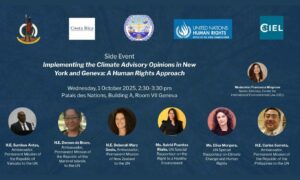
01 Oct 2025
14:30 – 15:30
Venue: Palais des Nations | Room VII
Organization: Vanuatu, Costa Rica, Republic of the Marshall Islands, Office of the High Commissioner for Human Rights, Center for International Environmental Law
This side event to the 60th session of the Human Rights Council (HRC60) provided a platform for dialogue on how to integrate human rights-based approaches into implementing the advisory opinions, focusing on opportunities for collaboration between States, UN Special Rapporteurs, and civil society as part of UN processes in New York and in Geneva. The side event was co-organized by the Permanent Mission of the Republic of Vanuatu, the Permanent Mission of the Republic of the Marshall Islands and the Permanent Mission of Costa Rica, with the support of the Office of the High Commissioner of Human Rights (OHCHR), and co-sponsored by the Center for International Environmental Law (CIEL).

About this Event
The recent climate advisory opinions delivered by the International Court of Justice (ICJ), the International Tribunal for the Law of the Sea (ITLOS), and the InterAmerican Court of Human Rights (IACtHR) have clarified the minimum legal content of climate obligations, including the protection of human rights, notably the human right to a clean, healthy, and sustainable environment.
These opinions represent a milestone in advancing environmental and climate justice. The critical next step is ensuring their implementation and operationalization, with states, UN mandate-holders, and civil society working together to strengthen accountability and translate legal clarifications into concrete action.
This side event provided a platform for dialogue on how to integrate human rights-based approaches into implementing the advisory opinions, focusing on opportunities for collaboration between States, UN Special Rapporteurs, and civil society as part of UN processes in New York and in Geneva.
This side event highlighted the human rights implications of the climate advisory opinions and to share State perspectives and initiatives on advancing implementation in New York and in Geneva. The side event also identified opportunities for collaborative action at the UN General Assembly and potential synergies with Geneva UN processes and to explore how UN Special Rapporteurs can leverage their mandates to support operationalization between New York and Geneva.
Speakers
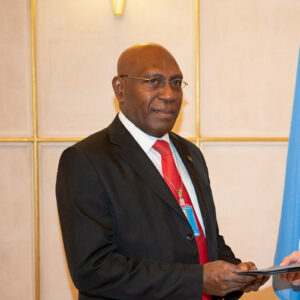
H.E. Amb. Sumbue ANTAS
Permanent Representative of the Republic of Vanuatu to the UN and other international organizations in Geneva

H.E. Amb. Doreen DE BRUM
Permanent Representative of the Republic of the Marshall Islands to the UN and other international organizations in Geneva

H.E. Amb. Deborah Mary GEELS
Permanent Representative of New Zealand to the UN and other international organizations in Geneva
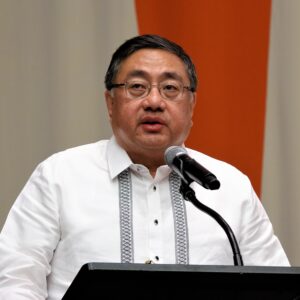
H.E. Amb. Carlos SORRETA
Permanent Representative of the Philippines to the UN and other international organizations in Geneva

Astrid PUENTES RIAÑO
UN Special Rapporteur on the right to a healthy environment

Elisa MORGERA
UN Special Rapporteur on climate change and human rights

Francesca MINGRONE
Senior Attorney, Center for International Environmental Law (CIEL)
Highlights
Video
Live from Palais des Nations
Summary
H.E. Amb. Sumbue ANTAS | Permanent Representative of the Republic of Vanuatu to the UN and other international organizations in Geneva
This side event will be the first of many in the coming years. The ICJ ruling plus other rulings (ITLOS and IACtHR) have transformed the landscape of international law and climate change. Together they affirm that states have clear legal duties to prevent climate harm, to protect human rights and regulate private sectors.
Failure to act, whether through licensing, subsidies or weak regulations, can amount to international wrongful act. These opinions are not abstract, they speak directly to the lived reality of people. Accountability is at the heart of today’s discussion.
Francesca MINGRONE | Senior Attorney, Center for International Environmental Law (CIEL) | Moderator
The ICJ has applied a harmonious interpretation approach and claimed that obligations extend beyond climate change treaties. Duty to prevent transboundary environmental harm must be performed under a stringent due diligence standard. This is guided by the principles of equity, common but differentiated responsibilities (CBDR), and respective capabilities. Informed by best available silence. Importantly, it recognised the the right to a clean, healthy and sustainable environment (R2HE) is a binding norm of international law.
Mitigation: temperature above 1.5 degrees is not safe when states define their determined contributions, they have to exercise due diligence and ensure that the NDCs when taken together are capable of achieving the temperature limit of 1.5 degrees. Fossil fuel is a driver of climate change. States also have a duty to regulate private actors. On sea-level rise, when the territorial integrity is affected, this does not affect maritime boundaries (even if the effects of climate change result in the complete loss of territory and the displacement of its population); construct of continued statehood. The consequences of violating legal obligations: any breach of legal obligations triggers consequences under international law of state responsibility.
How do we turn the AO into action, specifically from small island states, what would you like to see now that we have this AO?
H.E. Amb. Doreen DE BRUM | Permanent Representative of the Republic of the Marshall Islands to the UN and other international organizations in Geneva
She congratulates the youth for “bringing the world’s biggest problem to the world’s highest court” [referring to the campaign led by the World’s Youth for Climate Justice].
We need to turn into action and time is tight. But we are not starting with nothing. We have powerful tools of consensus like the UN Framework Convention on Climate Change (UNFCCC), tools of science, also we have the Paris Agreement. These are instruments of great power.
Small islands have been frustrated by small progress so we need this AO to stress the urgency. Starting with the nationally-determined contribution (NDCs): the ICJ said these are not voluntary: they have legal requirements to submit pledges that reflect their possible ambition and ensure that they are compatible with the 1.5 degree pathway. We need to see the highest ambition reflected at COP.
Continuing to extract, use, and subsidize fossil fuel can amount to an international wrongful act. The other priority is climate finance: the ICJ says this isn’t charity; Countries who have caused harm are required to make good on their actions. So it’s vital to see rich countries coming forward with accessible and fit for purpose climate finance including for loss and damage at a much greater scale.
We have to work in the Human Rights Council (HRC) as well: we need to read the AO. For many islands and coastal communities, the enjoyment of human rights is tied and linked to climate change and it was important for us to hear the ICJ to confirm it too. I am confident we can see the HRC reach new levels of ambition.
What are New Zealand’s reactions to the AO?
H.E. Amb. Deborah Mary GEELS | Permanent Representative of New Zealand to the UN and other international organizations in Geneva
What’s at stake? Climate change is the single threat to security and wellbeing (includes loss of land, displacement and impacts of food security and maritime zones). The existential threat is recognized in a number of regional agreements (e.g. Boe Declaration on Regional Security and the 2050 Blue Pacific Strategy).
How do we get to AO? NZ supported from the beginning and was part of the core group that requested AO. The consensus adoption of the resolution I think speaks volumes to the crucial importance of the issue but also the very hard work by the core group.
What does it mean? The AO provided valuable contributions, highlighting the actions that states need to take in fulfillment of their legal obligations. Particularly significant is the human rights obligations in relation to climate change. The ICJ also recognized that statehood and sovereignty will continue despite sea level rise (consistent with the Pacific Island foreign leaders declarations in 2021 and 2023). The AO is not the end, is the beginning. It will require international cooperation and constructive engagement. International cooperation is crucial (here in Geneva and also in New York), and we ask everyone to engage constructively.
Can we hear your perspective on the key human rights dimensions of the advisor opinion and also how do we foster synergy between UN institutions for multilateral action on the AO?
This case is not abstract. I was the lead in the ITLOS.
I will talk now about where the Court is now in its judicial philosophy and attitude. When the Court started, it relied heavily on customary international law (CIL), subsidiary sources of international law, the writings of publicists and decisions of Permanent Court of International Justice (PCIJ).
Today, the court is more positivist and relies on conventional law. Since 1946, there have been more than 560 multilateral treaties and many bilateral agreements. There are a lot of norms that the Court can use (since 80 years).
So why is that important? Because if you look at the decision of the court, the primary sources that they cited for authority are conventions, decisions of the court, issuances of bodies of the United Nations and they have stayed away from citing experts. This tell us tactically that these are the areas where we need to work on because these are are the sources of law that the court is using. We look beyond the decision, and we see that’s where we should be going. One of that is human rights and particularly how it interacts with the other norms.
It seems that the court has kind of determined that there is some hierarchy in terms of norms as listed in Article 38 of the statute. The first of which is conventional law. That’s where they start off: with the charter and then the climate change agreements. They took away silos and not give in to lex specialis (self-contained regime and everything should be resolved within Paris Agreement, i.e., HR as not supposed to be part of climate change). If the objective harm continues then it violates actions and then has state responsibility.
The problem with the conventional framework is that it is essentially regulatory. It’s not prohibitive. Meaning, it did not say you must cease this harmful activity. You must cease this internationally wrongful act → No, it did not. It’s like the nonproliferation treaty in essence where we have a treaty that does not prohibit but allows certain countries to continue to have nuclear weapons.
We have this situation and the solution is really to go to human rights and to customary international law to strengthen that. As such, the next steps are really important. We have to handle this very carefully because we need to prevent states from using it as a platform to be persistent objectors to the development of the customary norm, or to have developments on R2HE: states always try to use platforms to project that that they don’t agree that this is developing as a norm.
There are far reaching implications. For example, on territoriality: HR conventions said they had obligations within territories because of sovereign responsibility (Art 2(7)) of Charter), but the court said no, HR are not limited by territory and harms created in one state. The other implication is that it widens application of HR to other conventions → By saying that climate change conventions are informed by other conventions, then disarmament, migration and others can also be informed by the human rights perspective.
How to move forward and ensure a concrete follow-up on the AO?
H.E. Amb. Sumbue ANTAS
We are driven by a sense of urgency. It is a lived reality that inspires us to champion request for ICJ AO. Today, we lead efforts at the General Assembly (GA) resolution to endorse and operationalize the Court’s findings while recognizing complementary contributions of ITLOS and IACtHR. That’s a very important and complementary part of the work we need to do ahead of us.
But accountability cannot stop at international level → implementation must be shielded at home. In Vanuatu, we are implementing the clarifications from this AO into the domestic climate policy and updating our NDCs. We are advancing the recognition of R2HE through a constitutional amendment that is now before the Council and ensuring legal principles of AO are translated into real and possible commitments. This is how we can uphold the rule of law and ensure that no states can turn away from its responsibilities.
The GA resolution can strengthen the responsibility framework and wrongful acts include failing to regulate emission of fossil fuel and mandating reporting and ensuring remedies to affected communities. We want to push this as part of HR work here in Geneva. Accountability is not to punish but to protect. New York and Geneva are critical political partners in implementation of the AO. In New York, we will work on the resolution to endorse AO. But in Geneva, HRC have complementary things, human rights approaches to implementation. We need to make sure that the obligations are embedded in national implementation.
In your perspective as Special Rapporteur, how can civil societies work better together in New York and Geneva especially in the scene of the COP?
Elisa MORGERA | UN Special Rapporteur on climate change and human rights
Harmonious interpretation of international law is work that contributed over time. As Special Rapporteur, we started to include indications from ITLOS, which we have seen flourishing in ICJ AO. Our advice can show our alignment of sources, best available science, lived experiences, and HR evidence that all point to the same direction that can further HR impact. It is important that we have engagement with understanding of international law, in negotiations and others – understanding of priorities for international cooperation and meaningful proportionate amounts.
Also climate finance: there is more work to there. There is more work to build understanding and implement it in Geneva. My next two thematic reports will be looking at food systems and climate technologies from the perspective of better understanding harmonious interpretation of international law, the best available science, and clarify what should be priorities in terms of domestic action and international cooperation of climate change. In particular following up on AO, there is now crystal clear clarification from the ICJ that fossil fuel expansion, consumption, subsidies may be in violation of international law. How do we then bring different states into a more aligned with that clarifications of international law in the context of very specific national circumstances respective capabilities?
There is more to do: understanding of where should we go? The participation of SR and civil societies and submissions (feedbacks also) to clarify where international cooperation is not quite supportive, such as in moving away from fossil fuel and go into most effective protection of HR; aspect of remedies has been clarified; looking at that for opportunity for compliance – primary obligations – and making sure that we are prioritizing climate action that is meaningful and adequate.
What mandates can we request to GA resolution that can give rise to more focused processes? There is a need to address investment law. I think particularly under the aegis of the HRC that has been a transformative force to advance that systemic integration of international law in the light of science and lived experiences. We need to have meaningful conversation about defossilization, and supporting any pilot initiative at every level, maximizing learning. Finally, the question of remedies: looking at how again we can look at that as an area of transformation learning and enhanced compliance with what are already primary obligations.
We have heard need to implement AO, we would be happy to hear about implementation of this AO in relation to R2HE.
Astrid PUENTES RIAÑO | UN Special Rapporteur on the right to a healthy environment
One opportunity and lesson from ICJ AO to remind the world of state obligation: about the R2HE, where its recognition is the fruit of 50 years of work, and that it recognizes crystal clear the impacts on states. The other key aspect that from the ICJ is the recognition of breaking the silos even in international law and this is the whole thing both about procedural but also in the decision that international law or addressing climate change is not about one treaty or another on it’s not about one region or another because it’s multilevel and that’s one of the key things. Recognizing the importance of not only applicable law that can be applicable, it’s all international aw that existed that should be applicable → there is interrelation and indivisibility of actions and rights.
One of the key very clear conclusions of the ICJ was that the obligation of the states to prevent significant harm to the environment including to the climate system. They also concluded that this obligation is urgent, so it’s included in several treaties that they analyzed but it’s also urgently sending a very clear message to the international community that it’s not only about the sovereignty of ratifying and maintaining an international space; even without that ratification it’s an obligation of all states.
The other side of the same coin is the recognition of the R2HE. We have from states the obligation to prevent significant environmental harms including climate to the climate system. In terms of people, it’s the R2HE. The ICJ was very clear to conclude that the R2HE exists and that it’s essential and it’s vital for the enjoyment of all human rights → R2HE is essential for states to guarantee all other HR.
For the court, it is difficult to see how these obligations (talking about state obligations to guarantee human rights) can be fulfilled without at the same time ensuring the protection of the R2HE as a human right. This conclusion is absolutely key because we can conclude that the R2HE is customary international law because we have the state practice and we also have the opinion juris, but it’s not a procedural conversation.
The R2HE and the obligation that states have are tools for states to make better decisions. Linked to these obligations is the obligation to regulate control and monitor activities that can cause significant environmental harms including conducting environmental impact assessments. They’re seeing a deregulation, and that is very dangerous on environmental impact assessments and other spaces.
Additionally, I’m significantly receiving constantly from all regions requests to intervene because of harassments or criminalization or attacks to environmental human rights offenders, and specifically of course, impacts to people that are in more marginalized situations. But we also need to break the silos. It’s not that one human right more important than the other one or one AO is more important than the other one: all the body of international law that needs to be implemented effectively.
Q&A
Australia: Condolences to the Philippines from the earthquake. Australia welcomes AO which is a landmark opinion which made contributions to all states. We want to strengthen global climate action. We want to cohost COP31. Climate change is an existential threat. There is a need to implement and uphold HR.
Samoa: The AO is timely and welcome. At this moment we are experiencing at first hand the worsening of climate change. We are glad to have this space to reflect on implementation with a HR perspective. It’s really to emphasize putting paper into action: we are reinforcing scientific evidence and phase out fossil fuel and we call members to uphold this efforts.