Event Conference
Our Seeds, Our Rights, Our Future: Resisting the Criminalization of Peasant Seeds | HRC63 Side Event
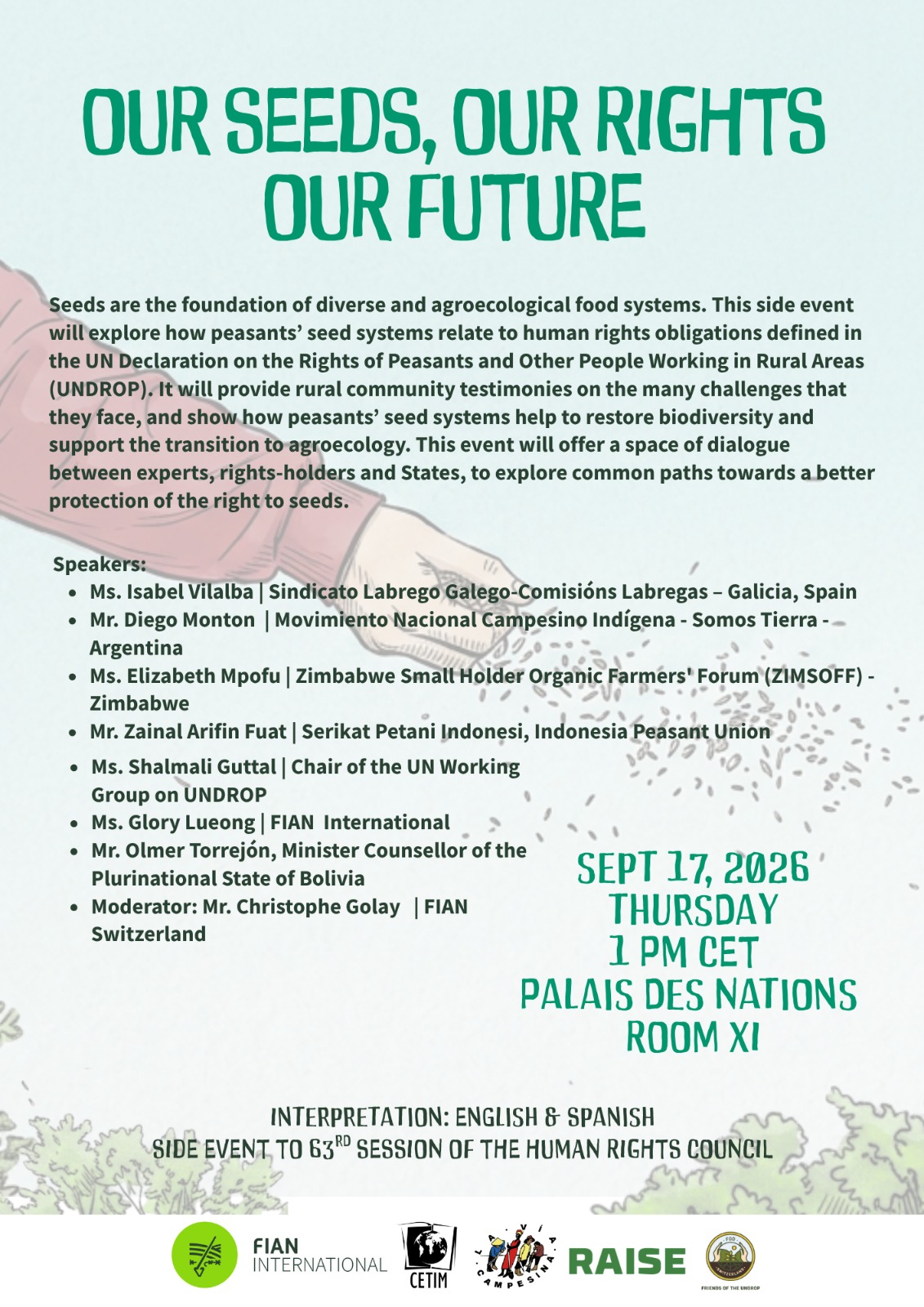
17 Sep 2026
13:00 – 14:00
Venue: Palais des Nations | Room XI
Organization: FIAN International, CETIM, La Via Campesina, Rights-Based and Agroecological Initiatives for Sustainability and Equity Initiative, Friends of the Declaration
This side event to the 63rd session of the Human Rights Council (HRC63) will explore how peasants’ seed systems relate to human rights obligations defined in the UN Declaration on the Rights of Peasants and Other People Working in Rural Areas (UNDROP). This side event is organized by FIAN International, CETIM, La Via Campesina, RAISE and the Friends of the UNDROP.
About this Event
Seeds are the foundation of diverse and agroecological food systems. This side event will explore how peasants’ seed systems relate to human rights obligations defined in the UN Declaration on the Rights of Peasants and Other People Working in Rural Areas (UNDROP). It will provide rural community testimonies on the many challenges that they face, and show how peasants’ seed systems help to restore biodiversity and support the transition to agroecology. This event will offer a space for dialogue between experts, rights-holders and States, to explore common paths towards a better protection of the right to seeds.
Interpretation in English and Spanish will be available.
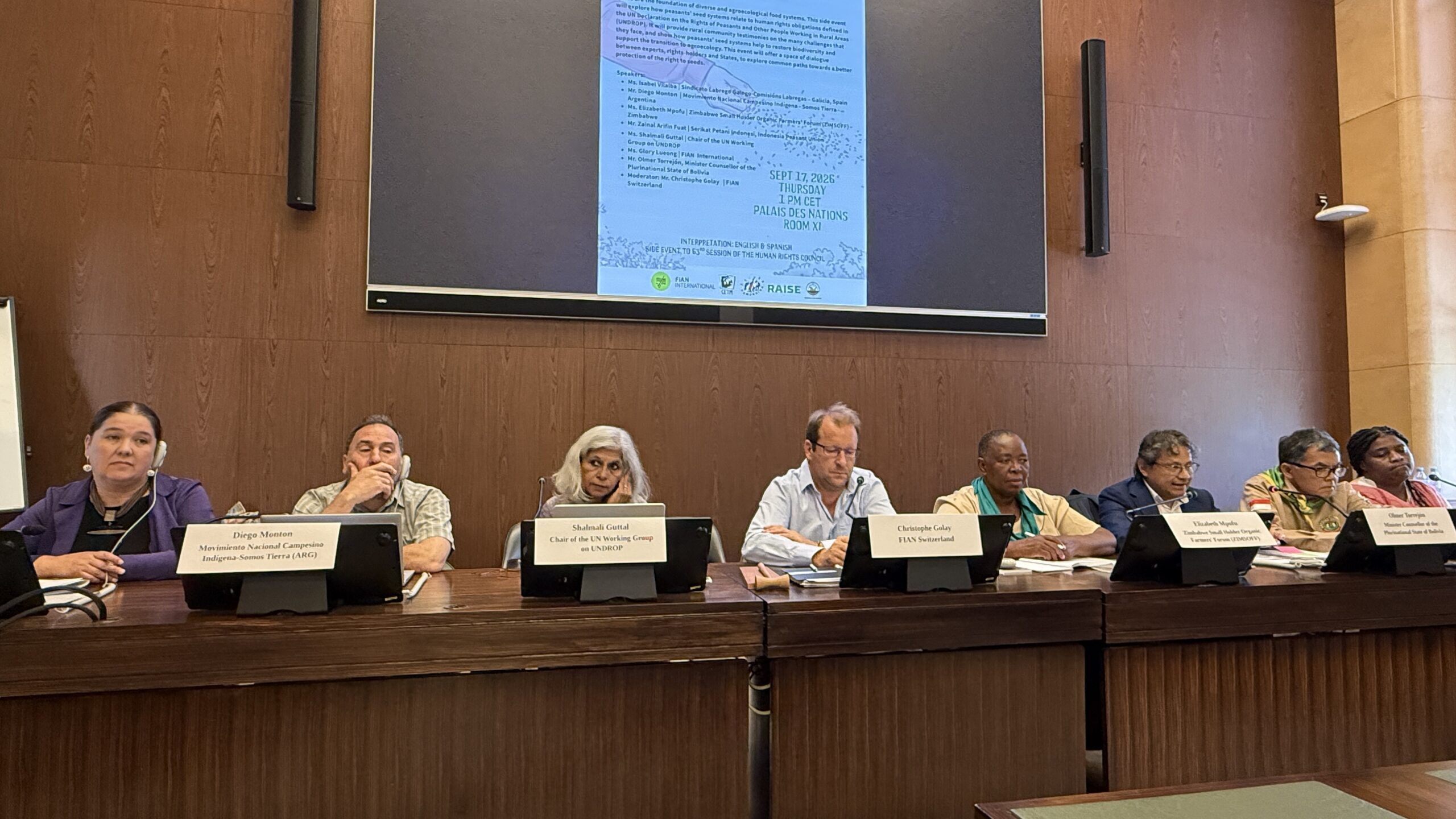
Speakers
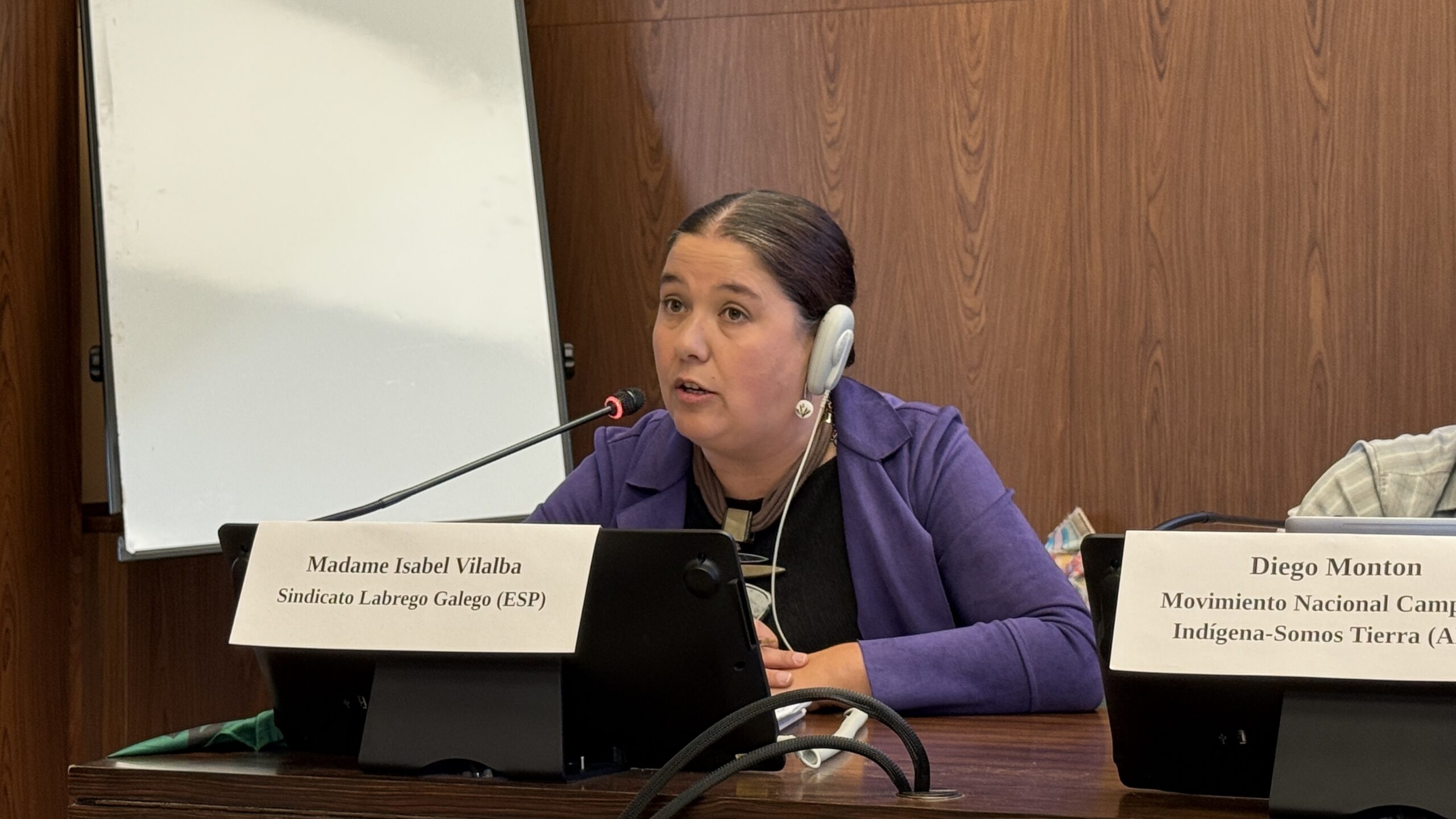
- Ms. Isabel Villalba | Sindicato Labrego Galego-Comisións Labregas – Galicia, Spain
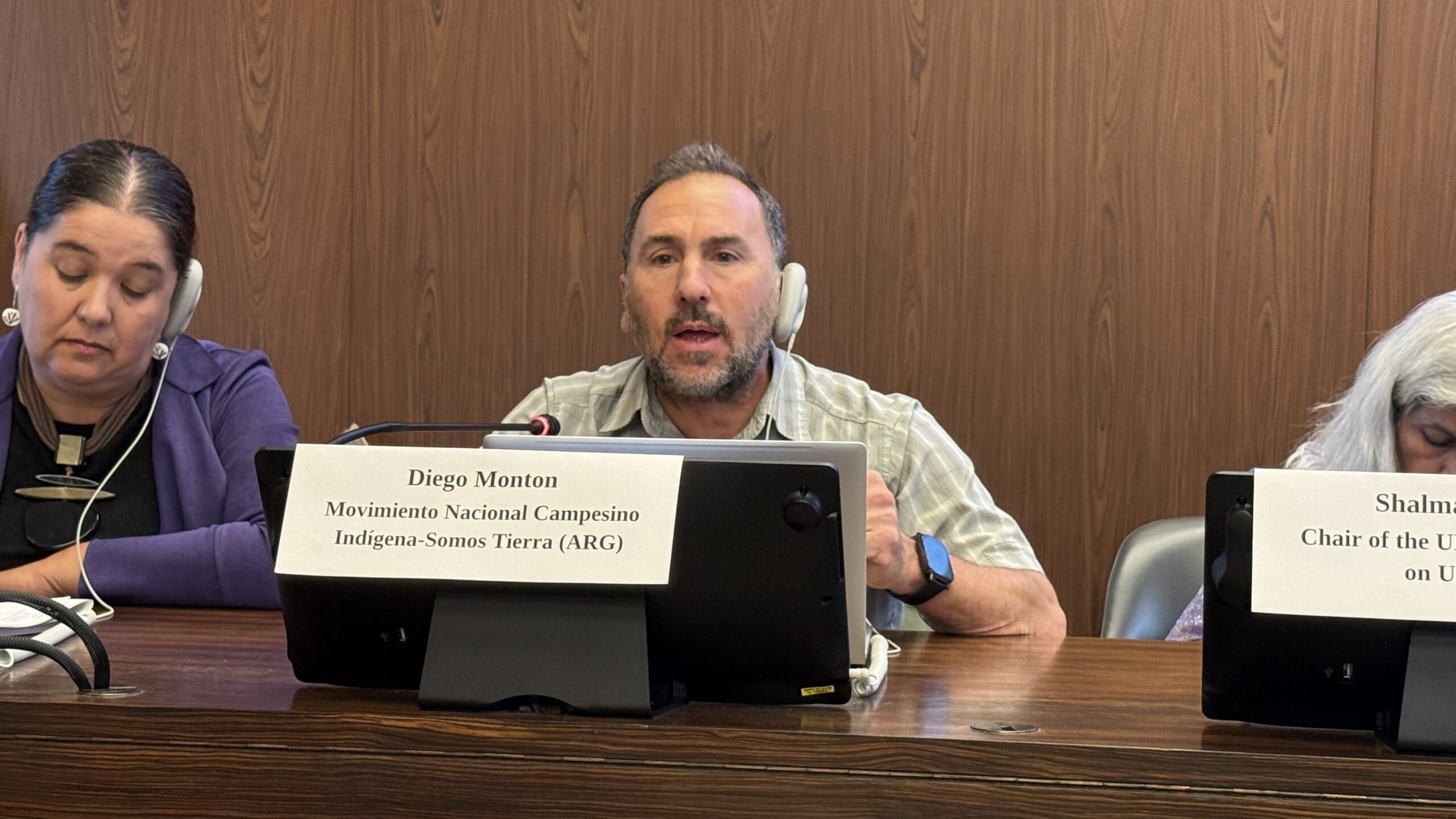
- Mr. Diego Monton | Movimiento Nacional Campesino Indígena – Somos Tierra – Argentina
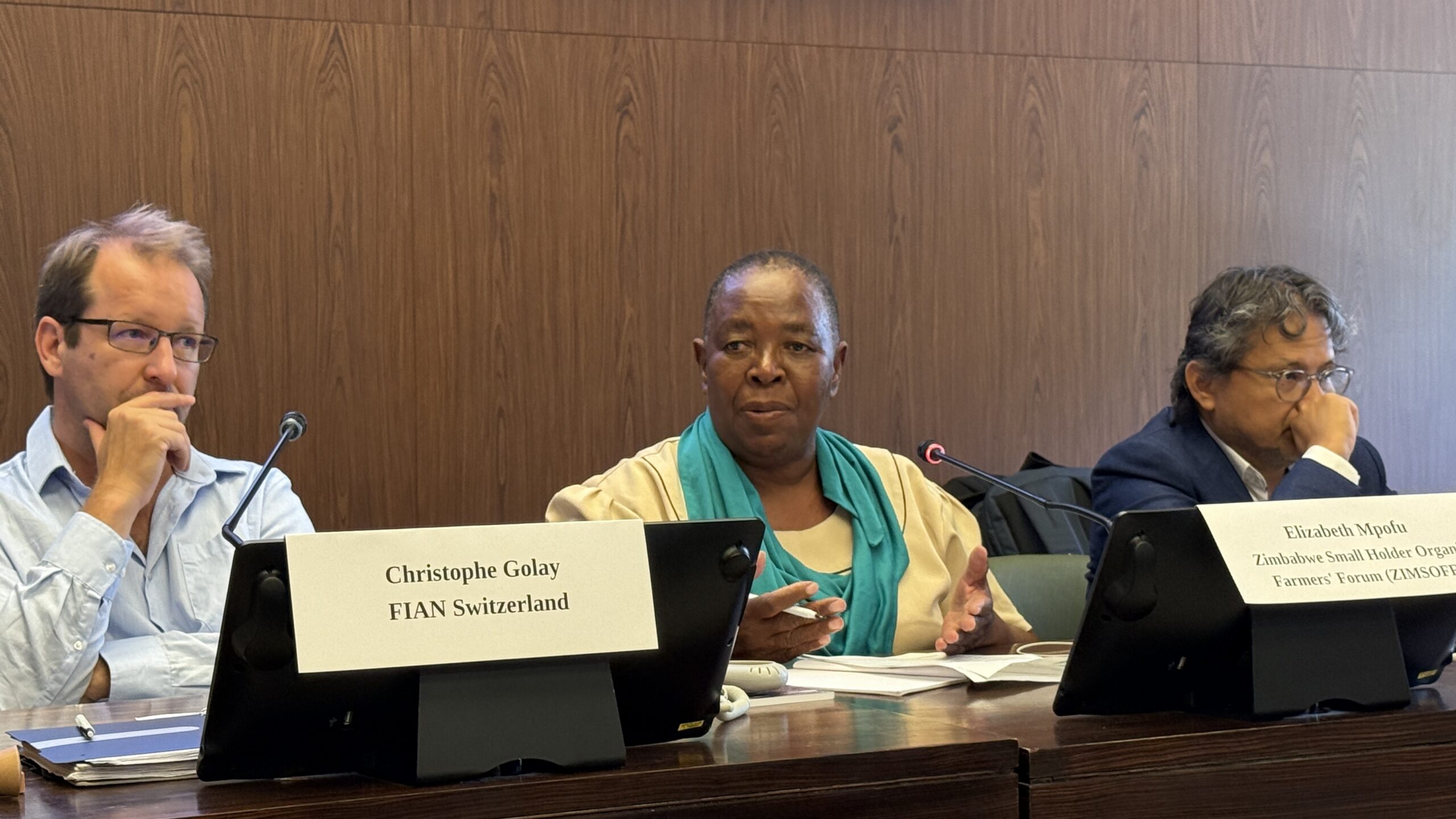
- Ms. Elizabeth Mpofu | Zimbabwe Small Holder Organic Farmers’ Forum (ZIMSOFF) – Zimbabwe
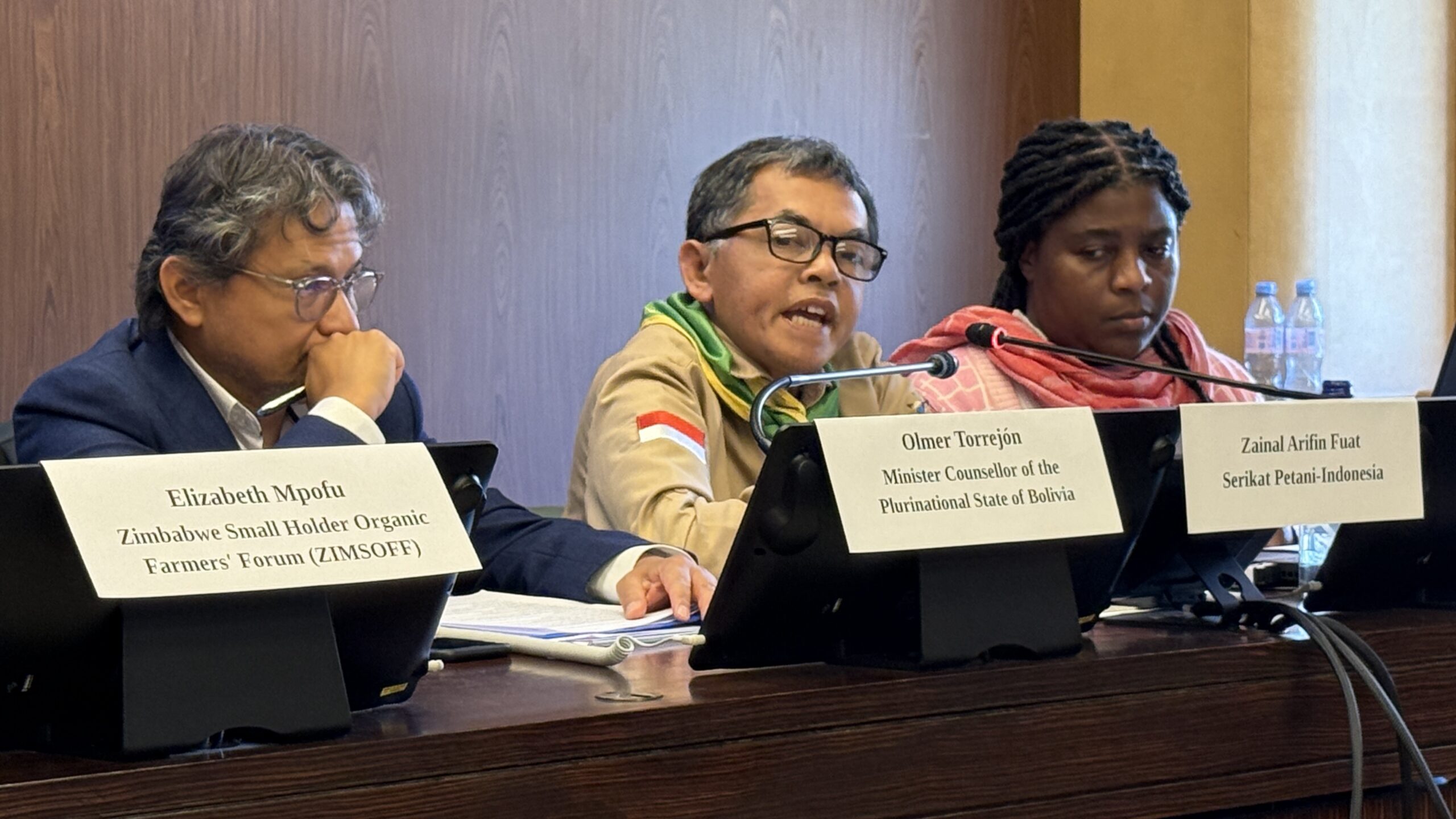
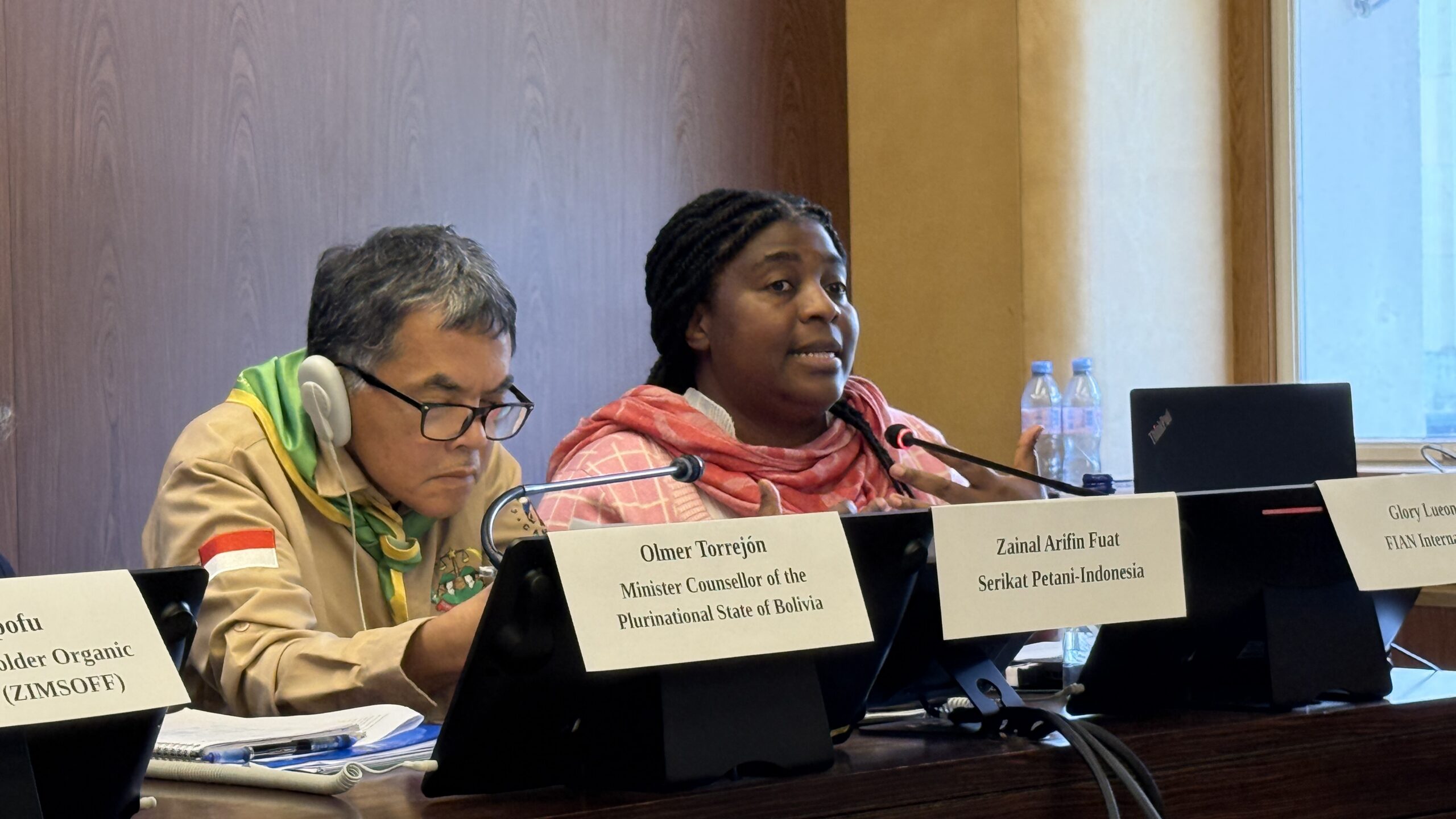
- Mr. Zainal Arifin Fuat | Serikat Petani Indonesi, Indonesia Peasant Union
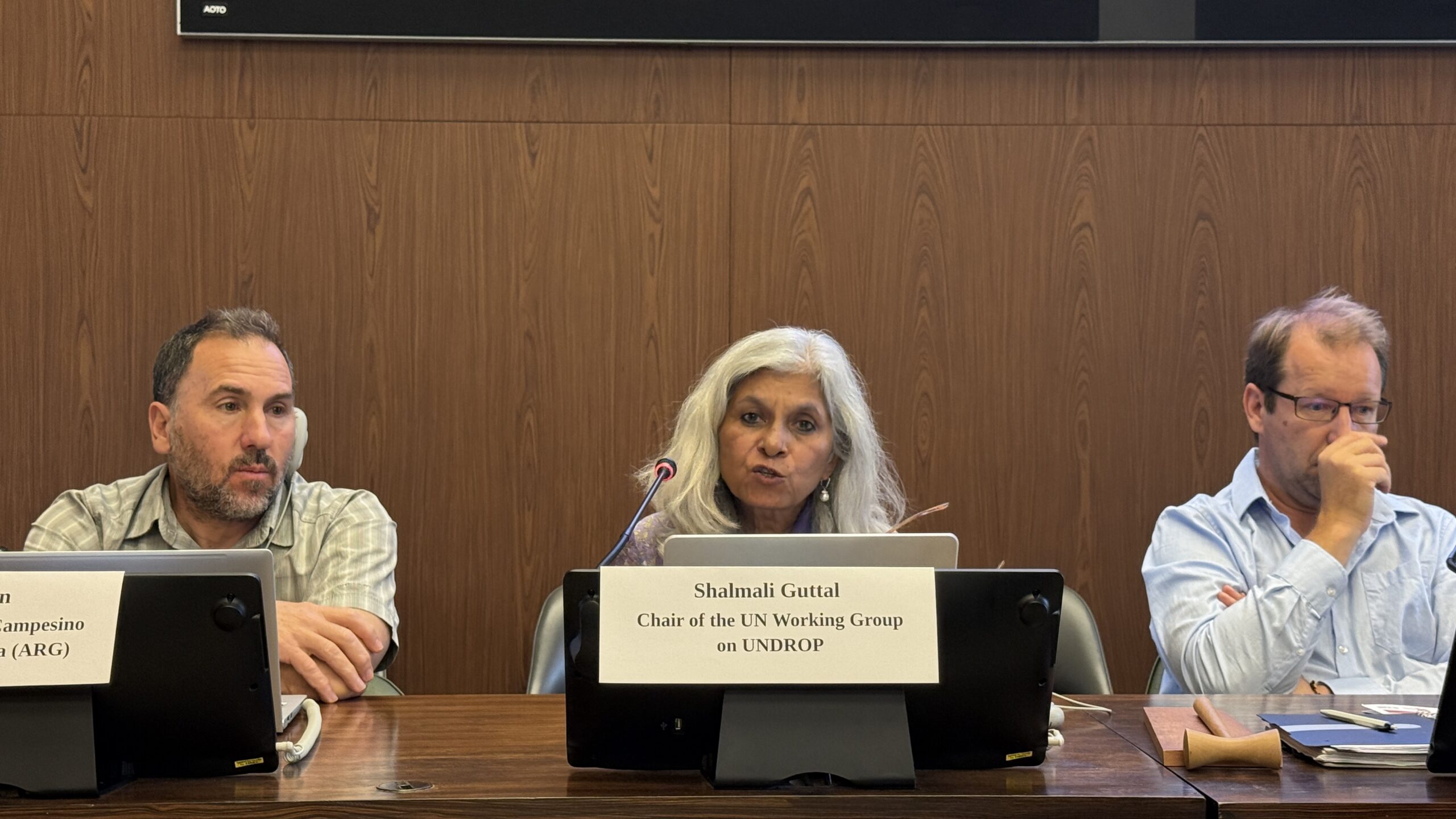
- Ms. Shalmali Guttal | Chair of the UN Working Group on UNDROP
- Ms. Glory Lueong | FIAN International
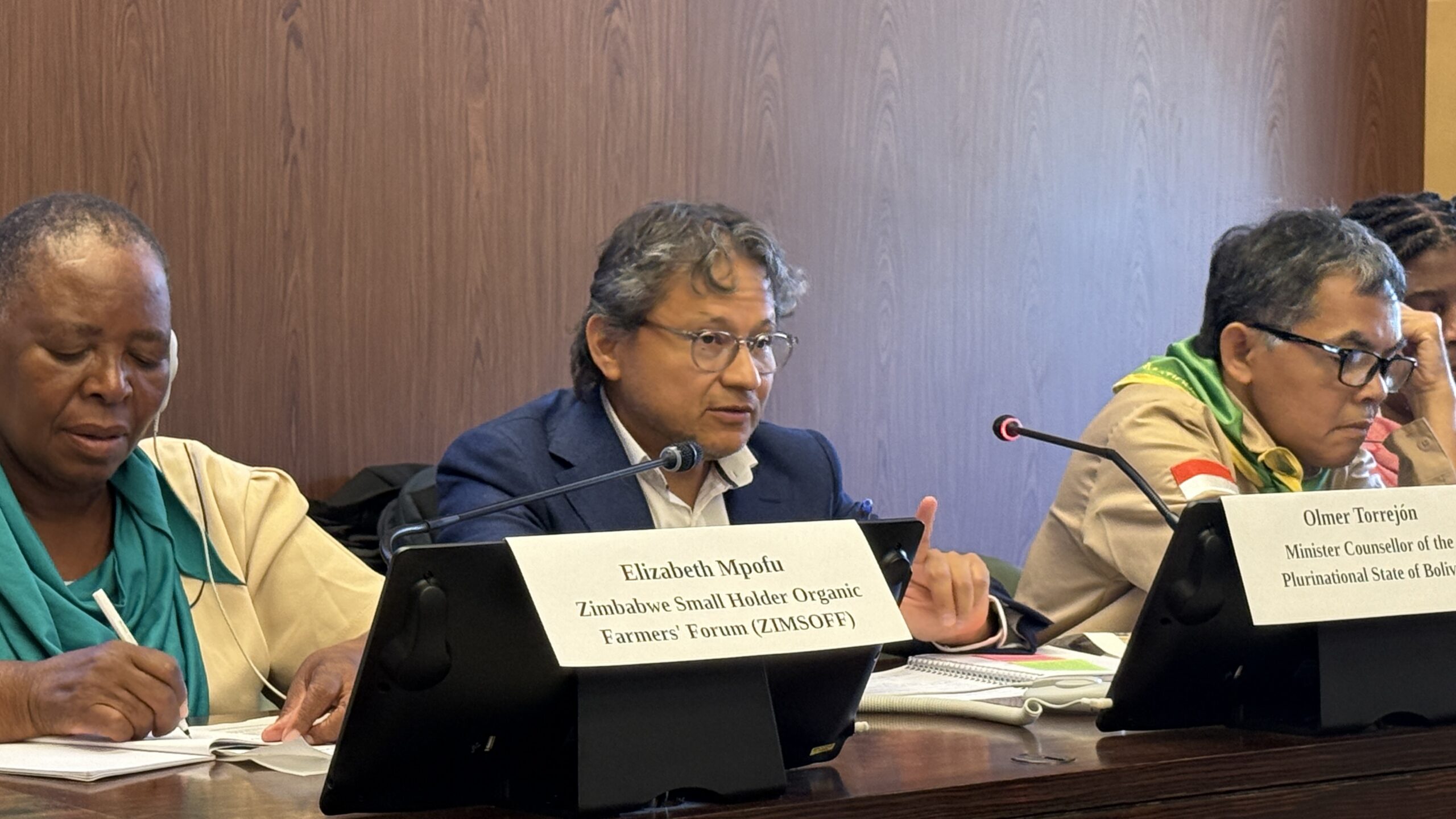
- Mr. Olmer Torrejón, Minister Counsellor of the Plurinational State of Bolivia
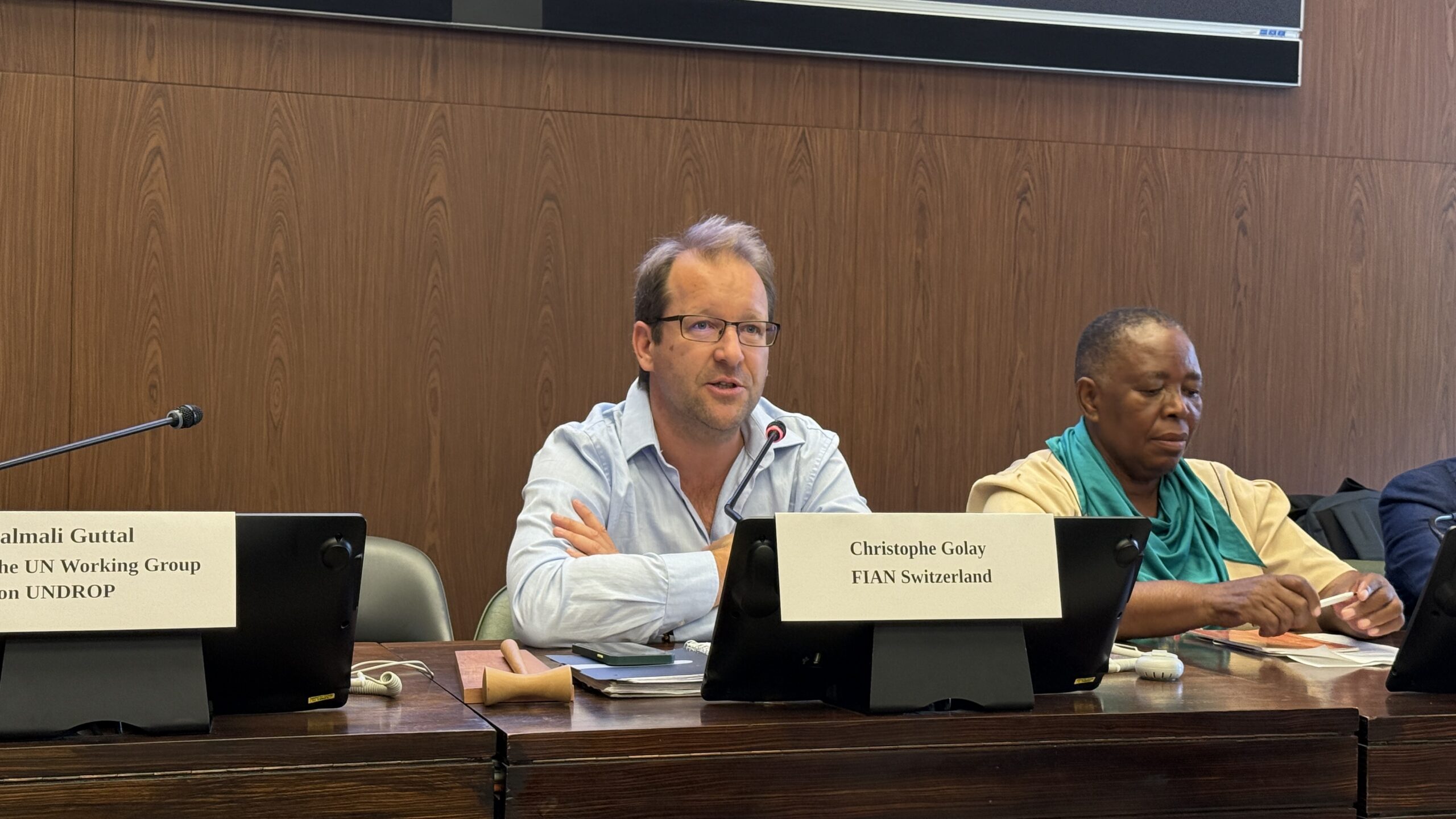
- Moderator: Mr. Christophe Golay | FIAN Switzerland
Environment @ HRC63
The 63rd regular session of the UN Human Rights Council (HRC63) will take place in Geneva from 7 September to 7 October 2026. Consult this regularly-updated page that highlighted the environmental-related activities of this session.

Highlights
Video
Live from Palais des Nations. Language will be from the original from the floor.
Summary
Welcome and Opening
Olmer TORREJON | Minister Counsellor of the Plurinational State of Bolivia
- The report prepared by the Working Group sets out, in section VII, its conclusions and recommendations.
- The focus is on what we do with those conclusions and with those recommendations.
- It contains conclusions and recommendations for States, for United Nations entities, for businesses and for civil society.
- The core of the recommendations of a report that comes from a Working Group has to be situated in the relevance of this institutional framework.
- Why does this Working Group exist? The question, which applies to all of us, is: what do we do with these conclusions?
- And not only with those of this report. There is already a body of reports from this Working Group, and that is why its continuity becomes relevant.
- We need to know what will happen with these conclusions and recommendations. But this question is not only for the Working Group, but for the entire human rights system: what is done with these conclusions and with these recommendations?
- In our case, for the strengthening of agroecological food systems and for the systems of production and reproduction of the family and peasant economy.
- There are 12 recommendations for States, five for United Nations entities and three recommendations for businesses.
- How do we convey these recommendations? How do these companies, the food and agricultural technology sector, receive these recommendations?
- The relevance to share with you is how this is grounded in the Charter of the United Nations.
- This Working Group is a consequence of, and a demonstration of, the vitality of the Charter, in Article 1, paragraph 3, which calls for international cooperation in solving problems.
- Consequently, Chapter IX of the Charter opens up the space for international economic and social cooperation.
- Here, I want to find a revitalization of the reasons for the existence of our Working Group. The approach to these conclusions, these recommendations and this report as an instrument should be understood in terms of its potential to foster, strengthen and promote cooperation.
- Cooperation: how can this cooperation be reflected within States?
- How can they receive these conclusions, as I was saying earlier, as a source of law for strengthening their programmes, their products and their planning?
- Finally, we have looked at this from the perspective of the Charter. There is also another perspective: the place of the Working Group within a broader ecosystem, within a broader network of subsidiary bodies of the system.
- Imagine the Working Group at the centre. You can find an entire map of treaty bodies and subsidiary bodies, such as the Social Forum, the permanent forums and the working groups.
- Its relationship is not only with the special procedures and the Special Rapporteurs, but with all of these bodies.
- And therein lies the strength and the raison d’être of this Working Group.
Panel Discussion
Shalmali GUTTAL | Chair of the UN Working Group on UNDROP
- Our report this year on the right to seeds is titled “Custodianship, Enclosure, Resistance.” Let me say a few words about enclosure and particularly the kind of criminalization that enclosure is fostering and perpetuating.
- When we were doing the research for our study, one of the things we learned was that intellectual property rights, plant variety protection, certification regimes and different legal and regulatory frameworks that favor commercial breeders, combined with aggressive enforcement that is led by the seed industry and by the agribusiness industry, which includes on-the-ground technological and digital surveillance and a lot of regulatory pressures, are increasingly criminalizing traditional seed practices with penalties that include heavy fines and imprisonment.
- On top of this list of systems that are encouraging this kind of criminalization are what are coming out of UPOV, which is the International Convention for the Protection of New Varieties of Plants, particularly the 1991 version. And this largely confines farmers’ privilege to on-farm saving, replanting, exchange and sale of seeds, and it protects the rights and the interests of those commercial plant breeders who are members of UPOV.
- Peasants who have been nurturing and developing biodiversity and seeds for millennia, whose own seeds are often the source of a number of these contemporary modern plant breeders’ seeds, are being fined and are being, one way or another, restricted from using their own seed.
- But the restriction is one thing. This goes much further now into turning what might be considered a civil offense into a criminal offense. And the plant breeding industry is pushing for stronger laws and actually aggressive criminal enforcement to protect plant breeders’ economic interests, even in countries that are not party to UPOV 1991.
- One issue the Working Group has been facing is that we have received requests from governments negotiating trade agreements, where wealthier parties insist on accession to UPOV. And if not full accession to UPOV, at least that the country that is less powerful and does not yet have UPOV-style regulation should then put in place regulation that offers patent protection of one kind or another, or legal patent protection, to commercial plant breeders.
- Research that has been done by some of our close friends who are here on the panel showed that there are actually specialized bodies, such as the Anti-Infringement Bureau for Intellectual Property Rights on Plant Material, Defensa Giva, and then the Farmers Yield Initiative. There are actually bodies, agencies that have been created by the plant breeding industry and by the agribusiness companies to use digital technology and other forms of surveillance to be able to see where their patented seeds are being used without permission, and then making that into a criminal activity and insisting that the government in question brings criminal cases against those people.
- And what is also scary here is that there are advanced technological tools. There are molecular markers, they are using drones and satellite imagery to monitor crops and detect unauthorized use of their so-called protected seeds.
- Companies continue to use digital sequence information to patent traits that are coming from peasant seeds. But somehow this kind of biopiracy is not being taken up. There is no legal action against this kind of biopiracy, and digital technologies are being used in favor of agribusiness industries and the large seed breeders.
- National certification requirements are also putting requirements of quality on peasant innovators and peasant breeders.
- Many peasant movements across Asia have told us that actually the national certification laws, even though they enable and they are supposed to allow certification of the seeds of peasants themselves, the system itself and the requirements are so difficult and so onerous that peasants are not able to use those systems, and there is no administrative support for them.
- We are seeing a chilling effect. Peasants, peasant communities are being intimidated by agribusiness companies and plant breeders, and by a legal regime of patent protection and intellectual property protection that is resulting in the privatization and commodification of seeds.
- And this privatization and commodification is aided and abetted by laws and regulations that are criminalizing what peasants have been doing for generations.
- And if we allow this criminalization, this kind of intimidation of peasants and this marginalization of peasant seed systems to continue, we will have a future where we will be beholden to corporations and to seed companies. We will eat what they decide to put in the markets.
- Criminalization has impacts beyond what is already being done to Indigenous people, peasant communities and peasant farmers. This has ramifications of a much longer and multigenerational nature in terms of what kind of biodiversity, what kind of food, what kind of crops will be available in the future.
Elizabeth MPOFU | Zimbabwe Small Holder Organic Farmers’ Forum (ZIMSOFF) – Zimbabwe
- For me and my family, seeds are at the center of everything. Every day of my life, we grow and we eat the food from the seeds. I also grow about 18 crops on my farm.
- Among these crops, a smaller portion is maize. Why? Because I cannot afford to buy maize every time. Maize has been said to be the staple food for us in Zimbabwe and other African countries, which is not the case. Look at how many crops I grow, 18 of them.
- And all these seeds, I do the selection, I save and I am able to exchange with other farmers. This is very important when we talk about seeds.
- So this process has already shaped my understanding of seed sovereignty. Others might say seed security because I really want to own the seeds on my own.
- When we talk about seed security or seed sovereignty, it is not just that we really talk about certified seeds or they are available on the market, but we are saying: do the farmers have access to quality seeds? Can they afford the seeds? Are they able to make choices on what seed they want to grow?
- No one should tell me what crop to grow. I should be in the position to choose what seeds I grow and how to produce the seeds.
- We have these farmer-managed seed systems. They are saying they are outdated. But to me, we do not really need the farmer-managed system to disappear, because this is my livelihood. I should be able to manage my own seeds.
- We know very well that these are living systems which have been contributing to the biodiversity, the nutrition and also the livelihood and the resilience which we are talking day and night.
- We do this selection, and we maintain varieties according to the soils, the climates and the farming conditions, and also the preferences on food. What do I want to grow? What do I want to eat? And all of that is also at the heart of agroecology.
- We are practicing agroecological farming systems so that we achieve food sovereignty. All the crops do not need any additional external inputs, such as fertilizers or herbicides. They grow naturally in whatever climate conditions.
- This experience shows that I am able to have more than enough seeds on my farm and also to assist my rural communities.
- Just a few of the good practices we have implemented as women through the collaborative. We know that there are research institutions, but for us as women, we have managed to do our own research with assistance of other consultants. But the research has been based right on the women themselves who are doing farming on the ground.
- We selected about 10 crops which we thought could be important in each country and took them to the laboratories so that we know what we are growing, how it can benefit the people, the communities, our children at schools.
- But one important thing is, if we look at what they are introducing right now as we speak, we know very well there are those policies with their implication of UPOV 91. For whose benefit? And what happens with our farmer-managed systems that already exist? What will happen?
- And the only way we are saying is that we are also saying the United Nations Declaration on the Rights of Peasants and Other People Working in Rural Areas recognizes the importance of peasants’ right to seeds and other productive resources.
- We must protect and advance the right to seeds.
Zainal Arifin FUAT | Serikat Petani Indonesi, Indonesia Peasant Union
- We have challenges linked with the corporate system, corporate technology and, finally, the private side monopoly access through intellectual property, like under the WTO, under TRIPS, and also other agreements.
- While seeds are our daily struggle, daily life is linked with how we select, save, produce and exchange seeds between us. So, of course, we have to defend our right to seeds to achieve agroecology.
- Of course, if we take into consideration the pillars of food sovereignty, the first pillar is about how we have access to and control over access to land and other agricultural resources. The second is about how to produce food. That means we have to have the right to seeds.
- So that is why we have the right to food production, not the control that you have to produce this, this, this. This is our right to fulfill our food needs.
- Of course, at the same time, we face many challenges, like the number of population increases and climate change, and also obstacles linked to how to access food in terms of distance, in terms of price, especially under the geopolitical situation. It is part of our challenges.
- So that is why here I want to share about our effort to fulfill our food needs. For SPI, Indonesian-based, we have already improved our seed varieties. We have what we call the SPI 21st variety, because after quality selection, in 2021 we improved the SPI 21st seed, and now we improve until SPI 2028.
- It is also our effort to adapt to climate change. In Indonesia, we have a long dry season and then hot seasons, and even big winds. So this is part of how we challenge the outcome of those challenges.
- I would also like to share about our members in Korea. They have the sister garden. They say, “One family, one seed,” to make sure our seeds are still accessible by now.
- We also have seed banks, like in Sri Lanka, in the Philippines and Nepal. This is part of our struggle for the right to seeds.
- That is why it is more relevant to link with UNDROP, to continue our culture to produce seeds for us to achieve food sovereignty.
Isabel VILLALBA | Sindicato Labrego Galego-Comisións Labregas – Galicia, Spain
- In a context of accumulated crises – food, energy, climate and biodiversity crises – we are facing a highly vulnerable situation in terms of agricultural production at the global level and the ability to meet basic needs such as food. UNDROP is becoming, more than ever, a fundamental tool for promoting the food sovereignty of peoples.
- International cooperation based on solidarity and respect for fundamental rights, placing the protection of the planet and respect for its limits at the centre.
- As a livestock farmer and producer of legumes, I know well the effects of drought, floods and diseases that threaten our crops and our ability to continue producing the food that society needs in Europe.
- Successive pieces of legislation have contributed to a drastic reduction in plant varieties by establishing that only varieties registered in official catalogues could be sold. The loss of agrobiodiversity and monocultures have gone hand in hand with an increase in health problems and crop diseases.
- The presence of agrotoxins in food has become one of the major public health and food security concerns. The European Green Deal initially proposed halving pesticide use by 2030, although these initial objectives have ultimately been weakened due to pressure from the sector.
- However, the solution is not more agrotoxins – carcinogens, mutagens, endocrine disruptors – and more pollution. The solution is more agroecological production, more biodiversity and a greater number of varieties. Traditional seeds are fundamental to this.
- We must defend the right to health and the right to live in a healthy environment.
- Crop diversity and traditional, better-adapted seeds are also our greatest allies in ensuring food security in a context of climate change, as they allow us to use cultural practices that make us more resilient, such as having different growing and harvesting periods.
- States must adapt national legislation in accordance with the provisions of UNDROP, and in particular ensure the right of peasant people to use, sell, conserve and exchange seeds, as established in Article 19.
- The requirement to use registered industrial varieties must be stopped, as must the penalisation of peasant people for safeguarding traditional seeds, which are essential to feeding our peoples.
- We are not criminals; we are guardians of biodiversity.
- In June 2026, the European Union approved the regulation on GMOs produced using new genomic techniques, promoting deregulation and patents. This represents a concentration of market operators and a further reduction in agrobiodiversity.
- This legislation will also have global effects through trade agreements. We are concerned that guarantees that should be adopted in accordance with the precautionary principle may be reduced.
- We are also concerned that there could be traceability problems and cross-contamination affecting our crops, and that we, as peasant people, could even end up being sued if patented organisms contaminate our crops and we try to reuse our seeds in the future, as has happened in the past with other genetically modified organisms.
- UNDROP is a major reference tool for shaping intellectual property and seed laws that do not undermine the rights of peasant people, or even the sovereignty of peoples.
- Finally, the focus is on the rights of women, as the main guardians of seeds, and on generational renewal.
- In many of our countries, more than 70% of farmers will be over 65 within the next ten years, leaving the majority of them unable to continue producing food.
- What can we do to ensure the food we need and the care of our rural areas?
- What can we do to ensure the conservation of traditional seeds in a situation where family and community transmission is also at risk?
- Peasant seeds feed the world today and are our best tool for feeding ourselves in the future.
Diego MONTON | Movimiento Nacional Campesino Indígena – Somos Tierra – Argentina
- I will briefly comment on some particular situations in South America, and particularly in Argentina, which illustrate the risks facing humanity as corporations expand their control over seeds. We should remember that currently only three transnational corporations control more than 60% of global seed trade.
- These corporations have acquired disproportionate power and significant lobbying power.
- Through this power, they managed to include in the Mercosur–European Union Free Trade Agreement a gradual accession to UPOV 91, which has brought the issue back onto the agenda in the South American region. The Parliaments of Chile and Argentina have already begun discussing how to adapt their legislation to UPOV 91. And this is, of course, beginning to have an impact on our realities.
- In this regard, a senior Argentine official stated to the media a few months ago that in Argentina, 70% of the seed trade is illegal under what is being proposed by the European Union–Mercosur Agreement. This has led to a series of threats in connection with what they call “normalising” the seed trade.
- Of course, there is a tradition and a practice surrounding the use of seeds, fundamentally involving the right to save and reuse one’s own seeds – the ability of a farmer to obtain seeds from their own farm – which greatly supports food production.
- Pressure on this right to save and reuse seeds, and even the criminalisation of seed exchange, means that the only seeds – or approximately 80% of the seeds – that would comply with these UPOV standards are imported into Argentina.
- This entails a dollar-denominated cost. What used to be a seed that farmers could obtain through their own work, without having to use money, now has to be purchased, and its cost is always tied to the situation of the national currency and the dollar.
- Part of this cost is absorbed by farmers, but part of it is passed on to food prices.
- Therefore, UPOV 91 clearly affects the rights of peasants, but also the right to food of the Argentine people, who are currently facing a serious situation regarding access to healthy food.
- It is important that we put this issue up for debate because, on average, a plant species and an agricultural species contain between 25,000 and 45,000 genes. Corporations seek to be able to modify only one gene and then patent the entirety of a plant species.
- This is clearly a form of theft that neither States nor the United Nations should allow.
- The other issue I wanted to make clear today is that it is not appropriate to say that innovation and research can only be carried out by corporations.
- Innovation and research in relation to seeds have historically been developed in the countryside. That is how humanity came to have the great diversity of seeds and varieties that exist today.
- And precisely since the research methods promoted by corporations have been imposed, we have been losing biodiversity in a drastic and serious way, in a context of climate change in which biodiversity is precisely humanity’s main tool for survival.
- That is why I wanted to conclude by insisting that it is possible to promote and support technological innovation and research in cooperation with peasant communities.
- For this, States must promote links between research centres and universities and peasant farmers, making use of technological advances, so that we can continue developing seeds that are adapted locally.
- Seeds adapted to the times in which we live, but fundamentally also adapted to the food needs that we have in our countries.
- The Working Group is an important tool for all those States that need it to be able to draw on the many positive experiences that exist in different countries in developing seeds with human rights in mind.
- The scenario that we are being led towards does not benefit European, South American, African or Asian peasants.
Glory LUEONG | FIAN International
- My intervention focuses on defending and protecting peasant seed systems in situations of overlapping crises. This is built on the work that we are doing with 13 partner organizations in Africa, Lebanon, and Palestine.
- FIAN strongly agrees with the Working Group’s report’s affirmation that seeds are not commodities, but living systems embedded in territories, knowledge, cultures, relationships, and ecosystems.
- Our analysis shows why this matters amid overlapping crises. In Nigeria, for example, conflict, displacement, climate shocks, economic pressures, and restrictive seed regulations reinforce one another.
- Nigerian peasants, for example, tell us how, in the context of insecurity, they are not able to access their lands. Seeds that are stored in homes get destroyed, and they also lose them in the process of displacement. Community seed-saving facilities or infrastructure get closed, and then they are not able to lend a helping hand to peasants who lost their seeds from one place or the other.
- We therefore see that crises destroy more than seeds and harvests.
- They fracture relationships between communities and their territories, weaken solidarity networks, and interrupt intergenerational knowledge.
- Peasant seed systems must therefore be recognized as critical civilian infrastructure and thus must be protected, especially in conflict settings. Protecting community seed banks, local markets, and women’s seed networks protects their capacity to eat today and rebuild food systems for tomorrow.
- However, these systems can be outlawed and even face criminalization due to gray areas in legislation. In Nigeria, for example, Law No. 2014, Part 67, recognizes traditional varieties of seeds as national heritage. However, Article 16 of the same law provides for three months to two years’ imprisonment, fines from 20,000 to 1 million naira, or either penalty for producing seeds without professional cards, commercializing them without authorization, or producing, introducing, or commercializing plant genetic materials absent from the official catalogue.
- The law does not declare peasant seeds themselves as illegal. Nevertheless, legal requirements designed to formally commercialize operators can inadvertently criminalize customary practices when peasants exchange and evolve varieties without professional authorization and catalogue systems.
- Partner organizations so far have not yet documented prosecutions on these grounds. However, they report insecurity and self-censorship, as peasant producers fear seeking institutional markets.
- Fear of criminalization prevents them from exercising their rights to seed and excludes them from opportunities that are available to commercial seed producers.
- The consequences are more gendered. Nigerian women, for example, select and conserve a variety of seeds, including cowpeas, groundnuts, and sesame, which carry nutritional, culinary, and ecological knowledge.
- Conflict and climate shocks intensify their agricultural, household, and care responsibilities, while unequal access to land, water, finance, and public support restricts their autonomy.
- Women are rights holders, seed custodians, knowledge producers and transmitters, organizers, and peacebuilders. States must therefore guarantee women’s rights, redistribute care responsibilities, and ensure women’s leadership in seed governance.
- Peasants’ agency and their resilience cannot substitute for state action to respect their human rights obligations, including under Article 19 of UNDROP.
- On these grounds, we call on States to repeal legal provisions restricting and even criminalizing peasant practices, to exempt peasant seed systems from industrial certification rules, and to recognize community seed institutions.
Q&A
Intervention #1
- I want to highlight two successful case laws showing how UNDROP is becoming a reference in national judicial processes, helping interpret national legislation and support favorable decisions for peasants’ rights and the implementation of UNDROP.
- Two case laws in Honduras and Kenya where national tribunals and judges used UNDROP to argue in favor of repealing laws that were criminalizing traditional peasant seeds. Those are very interesting and important case laws, and I would like to ask questions about these two case laws and concrete examples of how national tribunals are using UNDROP to interpret national legislation and take favorable decisions in favor of peasants’ rights.
- How could the Working Group and other relevant United Nations protection mechanisms make good use of and shed light on these good practices at the national level, to promote them and try to also technically accompany other States and other institutions to follow this good practice and this path?
Intervention #2
- A question about seeds in conflict: have you researched the impact of humanitarian aid on peasant seeds, and what is this impact?
Glory LUEONG | FIAN International
- We have been engaging in multiple countries in West Africa, Central Africa, and also Palestine, but most recently in Sudan.
- We see that there is one thing that is not said enough: peasants and their organizations and their communities build resilience before, during, and after crises and conflict.
- Often, we feel that shocks are things that happen momentarily, and then we have seed aid and the rest that comes in to have resilience as something external. But peasant seed systems and communities have internal dynamics that they build over time to face these multiple and interacting shocks.
- What we have realized is that often these seed systems, these seeds that are given as seed aid, especially, for example, now in the case of Sudan, are most often the commercial seeds that are not very much anchored in local peasant seed systems and are very external.
- We are not saying it is bad from our experiences. It is not something that is bad per se, because in these emergencies, sometimes we do not have enough of those seeds. But the issue is that they have the risk of creating dependency, and the package technologies that come with these hybrid seeds and seeds that are external to the local environment sometimes tend, in some situations, to inadvertently, particularly in Sudan, erase the local dynamics, the peasant seeds that are existing.
Shalmali GUTTAL | Chair of the UN Working Group on UNDROP
- The Working Group has been receiving requests for support from civil society and social movements, but also from governments about what to do about UPOV 91. There are free trade negotiations happening, economic partnership agreement negotiations happening, and they are being pressured to implement UPOV 91 and so on.
- Our position is very clear: refrain. Do not implement UPOV 91. Reject UPOV 91. Do not implement or adopt any laws that arise from UPOV 91 or that are going to allow this kind of patenting of seeds. It is not acceptable.
- Instead, put in place your own sovereign seed systems, with the full participation of the rights holders, of the peasants who have been generating these seeds.
- This is one thing. This message really needs to go out because our own take is that, in many countries, governments take positions for various reasons. They are compelled by various forces, but it is eventually the people of that country, the rights holders, who can come together and show that there is a benefit in not being part of exactly what our comrade Diego said.
- What is a country getting from allowing companies to patent their seeds? Why? This is theft. Criminalization of peasant seed is theft. It is a way of legalizing theft, putting it in the legal system, and this has to be opposed.
- There are a number of arguments that social movements, civil society, researchers, academics, and elected representatives at the municipal level, at the village level, and at the national level need to make to oppose this kind of patenting.
- Secondly, take the case law where courts and legal systems have passed progressive judgments. Take them to other human rights commissions. Take them to regional mechanisms. Take them and show them to other governments and say, look, such a progressive judgment like this is not an anti-State or anti-government judgment. It is a pro-people judgment.
- We need to shift that discourse. Trade is not the preserve of multinational corporations. Commerce and markets cannot be owned only by businesses. Markets and commerce are built by people. Originally, innovation is from people themselves.
- We have to really shift this discourse and use whatever positive cases have happened, and use the experiences that we have of social movements all over the world, to convince the governments and to insist that this kind of patenting, this kind of criminalization, this kind of theft, this kind of biopiracy cannot continue anymore.
- That is one thing from what the Working Group is going to do. We will continue to present the report. We are taking the report to the Committee on World Food Security. We are going to take the report to COP 17 on biodiversity, COP 17 in Yerevan, and we are ready to work with you in all different fora and platforms and bring up the different ways in which the power of these transnational corporations and agribusinesses is affecting the lives and livelihoods of people from the point of view of health, environmental contamination, toxics, and the destruction of livelihoods.
Photo Gallery