
Event Conference
Rethinking UN Financing in the UN80 Context: A Spotlight on Pollution
14 Oct 2026
12:30 – 14:00
Venue: International Environment House I | Room 1 & Online | Webex
Organization: Basel, Rotterdam and Stockholm Conventions, United Nations University Centre for Policy Research, Geneva Environment Network
This event aimed to introduce the emerging UN-system discussion on innovative resource mobilization in the context of the UN80 Initiative, while showcasing practical examples from across the United Nations and the wider multilateral system. It explored both the opportunities and challenges associated with applying innovative financing approaches to environmental protection and pollution management, highlighting the Transforming to Cleaner and Greener Strategy as a concrete example of an innovation currently under development, with a spotlight on pollution. The event is convened by the Secretariat of the Basel, Rotterdam and Stockholm Conventions (BRS Secretariat) and United Nations University Centre for Policy Research (UNU-CPR), in collaboration with the Geneva Environment Network.

Targeted audience: UN agencies, international organizations and other interested stakeholders from across International Geneva, as well as a wider audience through online participation and recording
About this Event
The United Nations is currently facing significant financial pressures that extend beyond a short-term liquidity challenge. These pressures underscore the need to strengthen the Organization’s financial sustainability and its ability to deliver on increasingly complex mandates in a rapidly evolving global financing landscape.
The UN80 Initiative provides a timely opportunity to look beyond efficiencies and cost reductions and examine how the UN system can diversify and strengthen its funding base, improve the predictability and reliability of resources, make more strategic use of limited public funds, and develop innovative approaches to financing its work.
Taking advantage of the visit to Geneva of Michael Franczak, Senior Researcher at the United Nations University Centre for Policy Research and lead of the Global Governance Innovation Platform’s Hub for Innovative Resource Mobilization, this session will bring the ongoing UN-wide discussion to International Geneva. Designed as an accessible awareness-raising and exchange event rather than a technical workshop, it aims to engage colleagues interested in understanding how innovative resource mobilization can support the work of the United Nations in practice.
Particular attention will be given to environment and pollution financing, including the Transforming to Cleaner and Greener (TCG) Strategy of the Basel, Rotterdam and Stockholm Conventions Secretariat as an example of an innovative financing approach currently under development.
Speakers
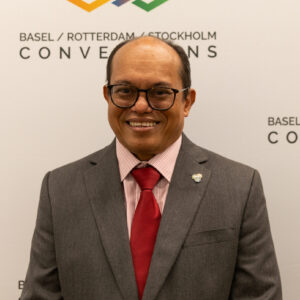
Rolph PAYET
Executive Secretary, Basel, Rotterdam and Stockholm Conventions
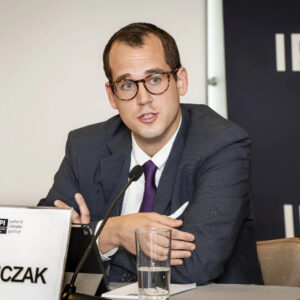
Michael FRANCZAK
Senior Researcher, United Nations University Centre for Policy Research

Liesel VAN AST
Deputy Head, UN Environment Programme Finance Initiative
Frank MOSER
Head, Programme Resources and Oversight Unit, Basel, Rotterdam and Stockholm Conventions Secretariat

Pilar PEDRINELLI
REP Fund Lead, United Nations High Commissioner for Refugees
Lucretia LANDMANN
Senior Policy Adviser Environmental Finance, Federal Office for the Environment, Switzerland
Marijana TODOROVIC
Associate Programme Officer, Basel, Rotterdam and Stockholm Conventions Secretariat | Moderator
Highlights
Video
Summary
Marijana TODOROVIC | Associate Programme Officer, Basel, Rotterdam and Stockholm Conventions Secretariat | Moderator
- The idea behind today’s session is simple. As the UN reflects on the reform under UN80, we also need to talk about how we finance the delivery of our mandates and not only how we reduce the cost. This is a question we have been grappling with for several years now at the BRS Secretariat, particularly in the context of PCBs. You will hear more about this later from my colleagues.
- What we have realized is that grant funding alone is not enough, and it will not be sufficient to meet the challenges we are facing. The Conferences of the Parties to the BRS Conventions have also recognized this issue and given us a mandate to work on it and explore new approaches.
- I would like to thank specifically the European Union for financing this work in recent years and giving us the chance to develop the proposals. Since then, we have been working with a growing number of partners, including multilateral development banks, the World Bank, and of course the Global Environment Facility. We are also in touch with institutions such as GIS to mobilize approaches for financing.
- We are increasingly seeing that the challenges we are facing are not only on pollution but also on other topics. I am also happy that we have UNHCR here today, as there are common approaches that we can explore across sectors, which is why we want to join forces. Today we want to hear practical examples and exchange ideas and views.
Welcome and Opening Remarks
Rolph PAYET | Executive Secretary, Basel, Rotterdam and Stockholm Conventions
- Having been involved in pioneering initiatives such as the blue bond, for me, it was the easiest compared to developing anything in pollution. That is the irony of it all, because I thought trying to sell a piece of ocean and trying to monetize it would be more challenging to visualize compared to pollution, where you can see the impacts, you can see the effects. I thought pollution would be an easier challenge, but it is far more difficult to address pollution issues from a monetary perspective, because the priority nowadays is on climate change and biodiversity.
- Climate change itself is a result of pollutants emitted into the atmosphere. We seem to disregard the fact that CO2, methane, really all the major greenhouse gases come out as pollutants from energy production. This is also true for the chemicals in the Montreal Protocol, which are also emitted when the refrigeration equipment breaks down.
- There are a lot of issues around taking responsibility for pollution, because of the environment we live in. People, business models, and financial models all tend to prefer valuing a leopard, a fish, a whale, a piece of the ocean, compared to assigning responsibility to something that they might be responsible for. Of course, this has huge health costs, huge remediation costs when it comes to soil pollution and water pollution. And as a result, we need to think about how we look at- I will not say monetizing pollution, but mobilizing resources in the financial landscape of pollution.
- The other specific characteristic of pollution is that we have a tendency to deal with the issue at the end of the pipe, rather than looking at its prevention. It is the same dilemma as with health: how do you allocate resources for the prevention of health issues compared to resources to deal with a health issue that has already happened? We must consider that there are important ethical challenges, human rights challenges, so when we start thinking about the costs of depolluting, we enter a very complex environment.
- The perspective I had before was that it was more difficult to sell a piece of the ocean than to sell the pollution project. Now, at the BRS Conventions, it has been four or five years that, under the Stockholm Convention, we have been trying to develop a financial framework for eliminating PCBs (polychlorinated biphenyls).
- For me, that is a test case, because we have a lot more persistent organic pollutants currently in our environment. We have PFAS, which is currently becoming an issue of importance because PFAS is found in most of the water bodies and other environmental media. Of course, plastics have been on the radar for a long time. All of these are linked not only to climate change financing but also to biodiversity financing in so many ways.
- We cannot look at pollution as a single environmental issue. It must be contextualized within the entire climate change and biodiversity financing framework as well. For example, when you reduce the amount of plastic waste, you also have a positive environmental cost which reduces flooding, which is a consequence of changes in the climate, of heavy rainfall.
- By not tackling pollution, adverse health outcomes occur because water retention increases due to plastic bottles everywhere, leading to increased numbers of vectors such as mosquitoes, which propagate, and you end up with problems such as dengue fever, which is an increasing global problem, especially in the Global South. In that short sentence, I have connected the issue of pollution with climate and with biodiversity. Increasingly, we need to think in that way, so that we can then reframe our thinking around how we finance pollution elimination, but also depollution, to use a better word.
- PCBs, or polychlorinated biphenyls, were listed at the beginning of the Stockholm Convention 20 years ago as one of the dirty dozen. Our traditional financing strategy is that we raise money through the GEF and then use it to collect PCBs in various countries and then destroy them in a suitable facility. For me that is what I call burning money to address an environmental issue.
- In the last five years, billions of dollars have been invested in energy transition. However, we need to talk about grid upgrades, because the grids that we have, especially in the Global South but also in the Global North, are not designed to absorb renewable energy. They have been designed around the fossil fuel paradigms. Moving towards renewable energy, we need to consider the fluctuations, both in terms of the renewable energy technologies, and also since we now have individuals with their own houses also adding energy to the grid.
- This creates a number of technical and operational issues for utility companies. And as a result, you have to change the transformers. What we found out is that we have a number of poorly performing utilities around the world. Here I want to note that many cities have frequent blackouts because their grids are overloaded. They have not planned future investments in the grids. We saw that as an opportunity to combine investments in energy with elimination of PCBs at the same time, and we have been working with the GEF, the World Bank and other development banks to see how we can put this together.
- It is not easy, because it means entering into a financial framework that facilitates the removal of a pollution liability, or externality, if you want to take it from an economics perspective, while at the same time making new investments.
- Another example is replacing lead pipes. Lead is a very poisonous metal, and we have been laying pipes made of lead all over the world, maybe in places you do not know about, and we need to replace them. So how do we finance the replacement of those lead pipes? In construction, we have different types of materials that are known to have an impact on health. How do we solve this when we have major reconstruction or refurbishment or upgrading? I am singling out these examples because they relate to energy, they relate to water, and they are the basic development SDGs that we are all working towards. My call for this event today is for us to put our heads together.
- Just this morning I was talking with the ambassador from Kazakhstan, who has an initiative to improve coordination on water because his country will face serious water issues in the future. We realize that it is not only about the amount of water but the quality of water. I have raised the issue of PFAS pollution, which is now found in our waters because most and many of our products have had this chemical added for 30 to 50 years now, and it is listed under the Stockholm Convention.
- When it comes to an investment portfolio, we need to see how we can also address not only legacy pollution but also future pollution. That brings me, for example, to the serious investments in the mobility sector, where we are looking at transforming the fuel-based cars into electric cars. The thinking has to come in on what to do with those batteries, lithium-ion, currently being used in electric cars once their time has reached an end.
- Just to paint a picture of how complex this can be: one car that starts to lose its recharge capacity is not immediately disposed of. It is sold on the secondhand market, and it crosses borders into another country, and then as it goes along, it reduces its discharge capacity; its price goes down. It may go from a second country to a third country to a fourth country, and usually the fourth country is the poorest country, because they are the ones who are least able to afford a brand new electric car. This last country may not even have the capacity to deal with that waste battery once it has reached its end of life. We are actually exporting the pollution cost to countries that do not have the capacity to deal with this kind of waste.
- This brings me to the Basel Convention, which is looking at transboundary movement of hazardous waste. When those cars are shipped, they are not hazardous waste. However, when they change hands and they change countries, eventually the waste becomes the responsibility of the poor country. I am just giving some examples of how we need to rethink both the financial and also the environmental responsibility of the transitions that are happening within the energy sector, which is very much linked to climate change, and within the development sector, which is linked to energy, food security, water, and biodiversity.
- We cannot think in financial terms now, only funds to deal with the pollution at the end of the pipe. The financial framework needs to first anticipate future pollution and where it will be. Secondly, it needs to build in, when we are doing new financing, how we can deal with legacy pollution issues and the work that we need to continue there. We will need to continue working together to unpack those complex issues, especially as we start looking at circular approaches, the circular economy.
- The Secretary-General is very much engaged in that process, inviting all organizations to stop thinking within our little sector and start looking at how we can address global environmental issues, how this fits within the billions that are flowing today for development investment, especially in the Global South, and how we can leverage those resources to address pollution.
Innovative Resource Mobilization in the Context of UN80
Michael FRANCZAK I Senior Researcher, United Nations University Centre for Policy Research
- 23.1% is how much official development assistance fell last year. That puts us in real terms at 2015 levels. In real terms, this is a collapse. It is not just a crash. It is a fundamental shift. It is not 1945, as many have said. It is also not 2022. The money will not be coming back in the way that we might hope, and I think we can reasonably hope for stabilization.
- That means for the UN is many things, but one is, of course, funding. The highest ODA cuts were to the multilateral system. Core contributions are down almost across the map. We can expect even more earmarking, and this is coming at a time when mandates and needs are multiplying due to new, more complex, more interdependent challenges.
- The UN has advanced quite a bit on innovative finance in the last two decades. It created the ideas and then the markets for it. But now it seems the risk is that the rug will be pulled out from under it. The innovative finance architecture depends on a certain amount of public finance, both directly, to derisk investments, and indirectly, through the enabling environment it creates.
- The work that the UN has learned to do in the last decade or two- the thematic bonds, the carbon markets, the blended finance.
- The conditions for success generally require two things. One is a relatively stable core; you need to pay your people. And the second is entities leveraging the system by working together, allowing them to access new and larger pots of money or new markets. This can deliver a lot of value for countries, but it also leaves the system vulnerable to changes in markets and also politics, as we have seen with climate and migration and a couple other issues.
- When funding leaves an entity, you lose capacity; you lose people. When funding leaves a system, you lose cooperation. Suddenly, you are competing for funding. And without these two elements, there is no doing more with less. It would be less across the board.
- Last year we were in a liquidity crisis due to the cuts, plus a very old rule around member state arrears and returning unspent funds. That changed in late June. There was a decision by member states to change this rule, and that has apparently put the UN on a sounder footing. We have heard a lot less about the liquidity crisis. Our Secretary-General pushed very hard for this change. That is one of his legacies. Another is that the current Secretary-General has also borne the political cost of UN80 cuts. And I do not mean to be indelicate by this, but what I mean is that anytime money is leaving a system, it is painful. The new leader coming in will be arriving into a more stable, more certain system. So they are arriving without that burden.
- With that opportunity of being out of a liquidity crisis and having more stable finances, the UN is innovating. It has been innovating for decades and especially in the last few years. However, what tends to happen is that it innovates on islands of innovation. We are all familiar with one or two or three success stories in our own areas that we can point to, to say they really figured it out. What we are not familiar with are success stories outside of our areas, outside of our islands. Those examples are when an institution really understood its strengths and did something bold and it paid off. And few know that these examples actually exist across the system. Some can even be replicated or adapted and scaled across entities or across challenges.
- Our dialogues, our publications, our partners like BRS and UNHCR, and the work of our hub for innovative resource mobilization have proven that this evidence base exists, as does the enthusiasm for elucidating its lessons clearly and persuasively.
- There are no silver bullets for core funding. This will remain a problem as long as member states do not pay the bills. Whatever low-hanging fruit exists, I think, has been picked. We should not be looking to foundations to “fill the gap” or to take the place of member states. We have seen it, and it comes not at the scale needed and with certain trade-offs. Instead of tilting at windmills, we need to learn from what the UN has done right and is doing right, and that includes the obvious and the less obvious.
- We have done cross-system learning before. We have all seen the reports of best practices and scalable models. But the difference this time is that we are inserting here a hierarchy of what has worked under what conditions. Can it work elsewhere, and at what scale? And is it attuned to our present politics and constraints? It is innovative resource mobilization in context, not in a vacuum. We need to understand what can work today and for which problems.
- Another difference is how we understand resource mobilization, which is very different from what it was in the past. Today we need to understand it in a larger sense, including new contributors in the private sector, institutional investors, cities, and foundations. I mean contributors not paying the bills for the core funding, but paying into, harnessing their capacity for your mandate.
- An example is cities. The United Nations Human Settlements Programme has a great thing called the Cities Investment Facility. Now, it does not bring cities on as equal partners with member states, but it brings them on as co-investors in projects, and that is tapping into a huge enthusiasm from municipalities for the United Nations and for multilateral finance. It is a place where cities have a lot to gain and can punch above their weight, and we need to learn from examples like that. I think it is hugely untapped. We need new kinds of contributions and ways to contribute.
- Advance market commitments: the United Nations, in some ways, can be a market maker or price maker, not a price taker. There are examples of levies, industry levies like the International Oil Pollution Compensation Funds, which you are all familiar with, though less so in New York. These examples are not as commonly known.
- There are also new applications of comparative advantage, and new partnerships and collaborations. We have heard for years how the United Nations needs to collaborate more with the multilateral development banks. Now is the time. There are concrete examples of where this is working.
- New sources of economic value. We are thinking in sectors that you know are hugely profitable. We should not be putting scarce grant dollars toward that. We need to use those very carefully to leverage, to derisk, and for problems that cannot be financed.
- We also need to think about new economic tools for beneficiaries, things that we can provide. These are things that can reduce future costs and generate savings. I will give an example. This is from High-Level Week. I was speaking at an event on a new study coming out from OCHA and the Inter-American Development Bank. It is on the fiscal benefits of anticipatory action. What the study shows is that in certain circumstances, not only does anticipatory action save governments money, it can actually pay for itself. It can generate a return. What that means is a possibility for new anticipatory action financing instruments that could make anticipatory action work at a much larger scale. It also means that other entities beyond the United Nations Office for the Coordination of Humanitarian Affairs (OCHA) have a big role to play in making that happen. These are opportunities that can only work through collaboration.
- Another example is the comparative advantage one. This is maybe unglamorous, but potentially very important. The UN performs a lot of functions that have huge economic value. The International Telecommunication Union (ITU) satellite registration system is one of them, a foundation of the digital economy. These things, like standards, registries, certification, specialized technical systems, and services, are things that MEAs (Multilateral Environmental Agreements) provide. WIPO, the World Intellectual Property Organization, is another example: 95% of its income comes from the Patent Cooperation Treaty. In ITU’s case, I think 5% comes from the satellite system. But these are real funds coming in. And we might need to ask then where the UN possesses a genuine comparative advantage that creates economic value or that saves countries.
- UNCTAD’s debt and financial management assistance software is another one. This is not a big money earner. It is a cost recovery project, and it works through small subsidies to some countries. It saves countries millions in fees and potentially billions in their actual debt. Not everything should be monetized, but we should be willing to ask the question, especially as AI companies are harvesting UN data and seeking UN legitimacy. It is a hugely important opportunity.
- To close out, I want to just mention some very important limits, because we all live in the world of trade-offs. To reiterate, innovative resource mobilization cannot replace, indeed it requires, a stable core of member state contributions. It is also the case that very few financial innovations are portable right away. You cannot just replicate it that easily. There is attention to context, but a common mindset can lead us to the prizes, and that mindset is in the characteristics that I suggested earlier.
- All innovations require enabling conditions, and this is the hard work that the entities must do: the political, economic, and legal conditions that need to exist for your entity to move forward. As Rolph was saying, for the five years that they have been looking at this and developing this mechanism, it takes time. Our example is similar. You need investment in people and expertise. IRM requires investment of money, of time, of people. It also requires confidence in a shared future, so we all have to believe that we will get somewhere together, but also confidence in oneself and in the entity itself.
- The goal is not to pretend that we can finance the UN without member states. It is to make the resources we do have go further, to broaden the resource base where we can, and there are ways we can do this with core resources, and get much better at mobilizing the resources that international cooperation actually requires.
- My final point would be a view from New York. My view from New York, not to mix metaphors too much, because here what we do not want to do is tilt at windmills, right? And the windmills here are that anyone is going to replace member states as the primary funders of the UN. Not to mix metaphors, but in New York we have been holding our breath. A year, a year and a half ago, we started holding our breath for UN80, waiting for the UN80 process to shake out and see where your agency is at and what you end up with. Now we are holding our breath for a new Secretary-General to take over, because you really cannot do any big initiatives until they come into office and see where the priorities are. Then we have been holding our breath for the US midterms, and when the new Secretary-General is in office, we will probably be holding our breath for the US presidential election. My point is we need to stop holding our breath. We can exhale, and we need to act, because the window is really short.
Perspectives from International Organizations
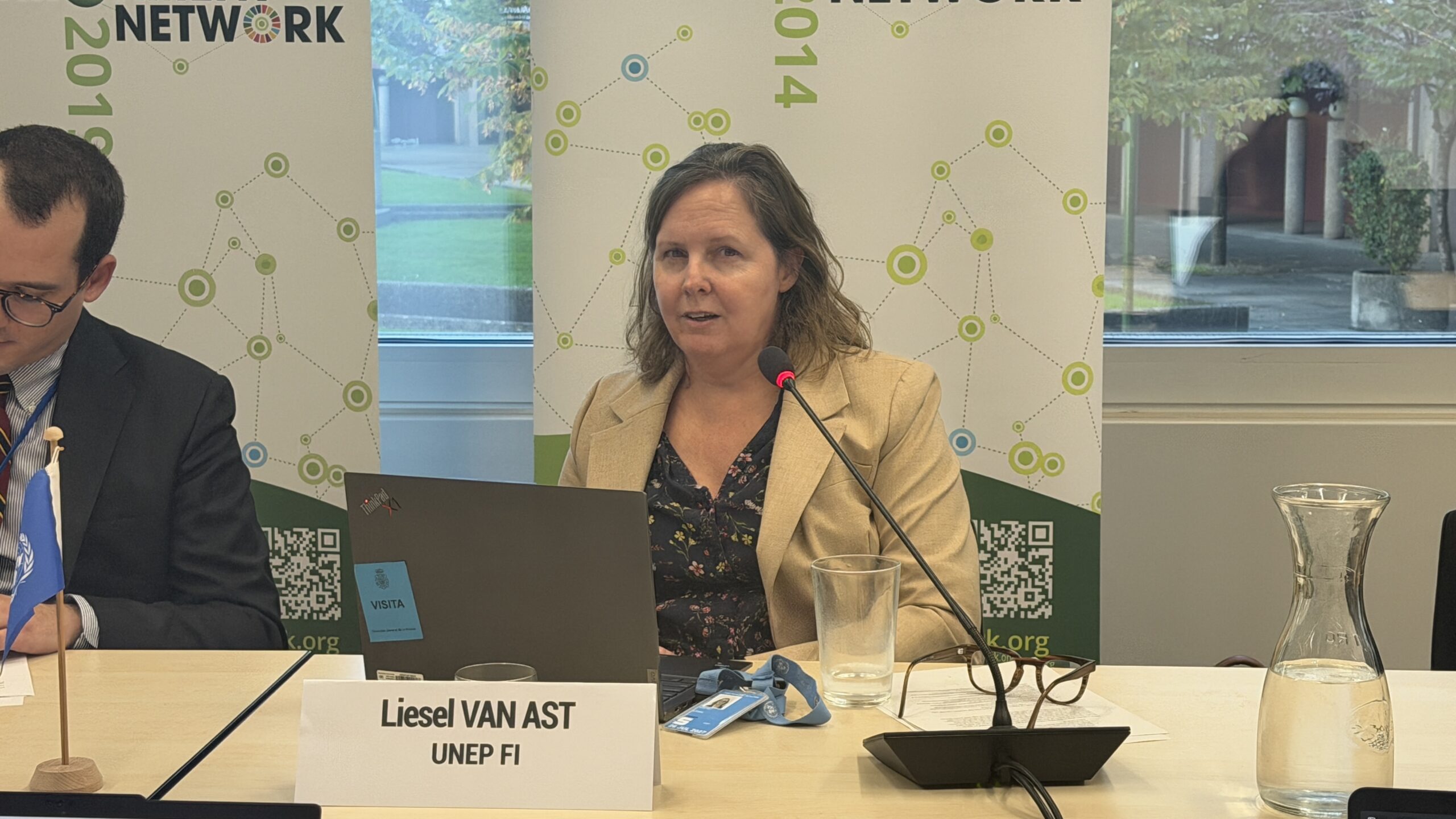
Liesel VANAST | Deputy Head, UN Environment Programme Finance Initiative
- Rather than focusing on how we secure resources that enable UN institutions themselves to deliver their mandates, I will focus on the part of UN80 that deals with how we mobilize finance for the outcomes of the mandates that UNEP is supporting, particularly multilateral environmental agreements.
- UNEP’s report on the state of finance for nature 2026 found that for every dollar invested in protecting nature, $30 is spent on destroying it.
- In 2023, 7 or over 7 trillion went to nature-negative activities in the economy, from fossil fuel subsidies to investments in high-impact sectors. That is the starting point of the way that we are working with the financial sector.
- There are more than $400 trillion in the global financial system, and much of this is going to real economy sectors such as energy, utilities, agriculture and mining. UNEP, through UNEP FI, has a partnership with the financial sector to influence financial sector decisions to achieve environmental objectives through the real economy they are financing. UNEP FI works with over 350 banks and over 150 insurers to help implement principles for responsible banking and sustainable insurance.
- We work to mobilize and align financing through these institutions with environmental objectives so that the decisions of banks, investors and insurers can integrate environmental objectives into their decisions.
- This comes alongside specific environmental funding that they can mobilize. For example, some of the financial institutions have targets of a trillion in sustainable finance mobilization.
- On top of that, we have been looking at how you can embed pollution prevention and reduction as part of mainstream financing and through those business decisions.
- This approach differs because it not specifically about new financial instruments. It is more about bringing environmental expertise, technical knowledge and expertise and financial in sector engagement together so that pollution and related factors, other sustainability factors, can be integrated into financing to contribute to the changes that we want to achieve.
- At the crux of that is that the majority of the changes need to come through the real economy companies that are drivers of the majority of pollution. So the work that we do involves several connected elements.
- Part of this is first of all is having the public resources to enable our work, having the people to deliver the activities to drive results. International frameworks that establish the shared objectives, such as the Paris Agreement on Climate Change, the Global Biodiversity Framework, the Global Framework on Chemicals and others, are cultivating the leadership to shape good practice.
- Solving some of the issues that need to be resolved to actually drive the change, developing the practical guidance and partnerships that will help all financial institutions translate these objectives into decisions and fostering wider culture change and knowledge sharing and engaging stakeholders so that we’re establishing new norms and cultivating and fostering enabling policy, regulatory, and market conditions.
- This can really happen on a scale and not just individual instruments or individual institutions. This approach is complementary to traditional public funding, not a replacement for it.
- The aim is really to use that funding strategically while addressing the conditions that enable the wider um financial flows to align with environmental objectives.
- UNEP FI work on pollution focuses on how we mobilize finance for the outcomes of pollution mandates. The expertise, guidance and partnerships that we need to engage the financial institutions need the resources to deliver that.
- One of the examples is our work through a program called the Financing Agrochemical Reduction and Management Program (FARM), a 5-year GEF-funded initiative led by UNEP to advance sustainable finance to really transform agri-food value chains through regenerative nature positive practices that can reduce chemical and plastic pollution, protect ecosystems and human health.
- It brings together policy, industry and finance across agri-food value chains. Together, FARM and FARM+ represent around 1 billion US dollars in GEF-backed programming and associated co-financing to support the transition towards more sustainable and resilient agriculture, reducing reliance on harmful agrochemicals and agricultural plastics.
- FARM alone includes 379 million; the program FARM+ builds on this with about another 66 million in GEF funding and then over 500 million is there co-financing. The opportunity really lies in using this public and development funding not only to support individual interventions but to really create the conditions for wider private sector investment.
- This means addressing the technical, financial and institutional barriers that prevent safer agricultural practices from becoming commercially viable and scalable. One example is that we developed principles for responsible banking guidance on the reduction and management of pollution in agriculture and farming.
- What this does is give banks the know-how to then integrate agricultural pollution considerations into their lending policies and risk assessments. Engaging agri-businesses in their financing decisions.
- It provides banks with a practical framework to address agricultural pollution issues through four action areas: through their policies, through their processes, through culture change within the banks, through client engagement, and through the composition of their portfolios and of their loan books. It also involves stakeholder partnerships and stakeholder engagement to drive wider change. For instance, banks can use the guidance to engage agricultural clients on reducing their pollution from pesticides and fertilizer runoff, and also to identify opportunities to improve nutrient management to improve precision application and other pollution reduction measures.
- With this, they can really work hand in hand with their clients to strengthen practices on the ground. However, there are some barriers. There is limited client-level data.
- The guidance then helps banks identify and address the barriers. It also provides additional technical assistance, incentives, and risk-sharing mechanisms, which could be needed to help translate these opportunities into actual lending.
- Public funding remains essential, but its impact can be scalable, and it can extend beyond directly funded activities if it helps financial assistance financial institutions and wider private sector incorporate environmental um objectives into financing and business decisions.
- Another example is the GFC. UNEP FI is working to collect global environmental priorities under GFC with financial sector action.
- We are doing this through a private finance and investment workstream. We are bringing together investors, banks, and other stakeholders to identify and address the barriers to mobilizing finance, private sector finance, for safer and more sustainable chemicals management.
- A key challenge is the gap between financial sector exposure and action. We found that financial institutions are beginning to address chemical pollution through investment policies, through risk assessments, through restrictions on hazardous substances such as PAS, through corporate engagement, and through investments in safer alternatives.
- But these efforts are really fragmented. Our role is to help address some of the barriers and make it more common practice within the financial sector. We are looking at addressing limited chemical-related data, standardized metrics, and technical expertise to reduce these barriers that make it difficult for financial institutions to systematically address the risks and finance the opportunities.
- So we are developing practical briefing notes on hazardous chemicals and safer alternatives and convening knowledge sessions to strengthen financial sector awareness and capacity.
- I can go into more challenges, but ultimately, through our work on financial flows and needs. We’re looking at how to really help address some of the challenges through specific value chains, such as cotton textile value chains, to identify the types of interventions that make sense for a financial institution to make sure that they can really help drive change and also to ensure that there’s a replicable approach that can help drive financing to the changes that are needed.
- It is not about withdrawing finance; it’s about using that finance to shift corporate practices in the direction needed to solve environmental challenges. Ultimately, this is a challenge around translating environmental opportunities into financing decisions.
- Identifying the risks and investment needs is not enough. We really need viable investment opportunities and appropriate financing mechanisms and supportive policy conditions.
- Our work really looks at how public, private and blended finance can be mobilized, what incentives and partnerships and enabling conditions are needed to unlock investment.
- The broader lesson for resource mobilization is that attracting private capital needs more than identifying funding gaps. It needs targeted public resources that can help build the data, the technical capacity, the tools, the partnerships to enable financial institutions to translate environmental objectives into investment decisions. This can extend the impact of public funding beyond individual projects.
- It also needs the enabling policy conditions and help to help governments understand what those conditions are, where finance is flowing, and what the market and policy enabling conditions are that enable that.
- Another example is on plastics. A finance leadership group on plastics is really working to help bring financial institutions into the international policy conversation while building the finance sector’s readiness to act on plastic pollution.
- It really works on connecting environmental policy development with financial sector implementation. Helping policy makers understand what conditions are needed for the finance sector to redirect flows to help shift away from past plastic pollution.
- The finance leadership group on plastics produced a study on redirecting financial flows to end plastic pollution and this sets out the role and requirements of the financial sector and how it can support this transition to plastic-free economies.
- UNEP FI is convening and translating environmental objectives and policy. Rather than translating it into just a dedicated funding mechanism, which can also be important, it is going beyond that to look at how to help build it into the financial system and therefore into the real economy.
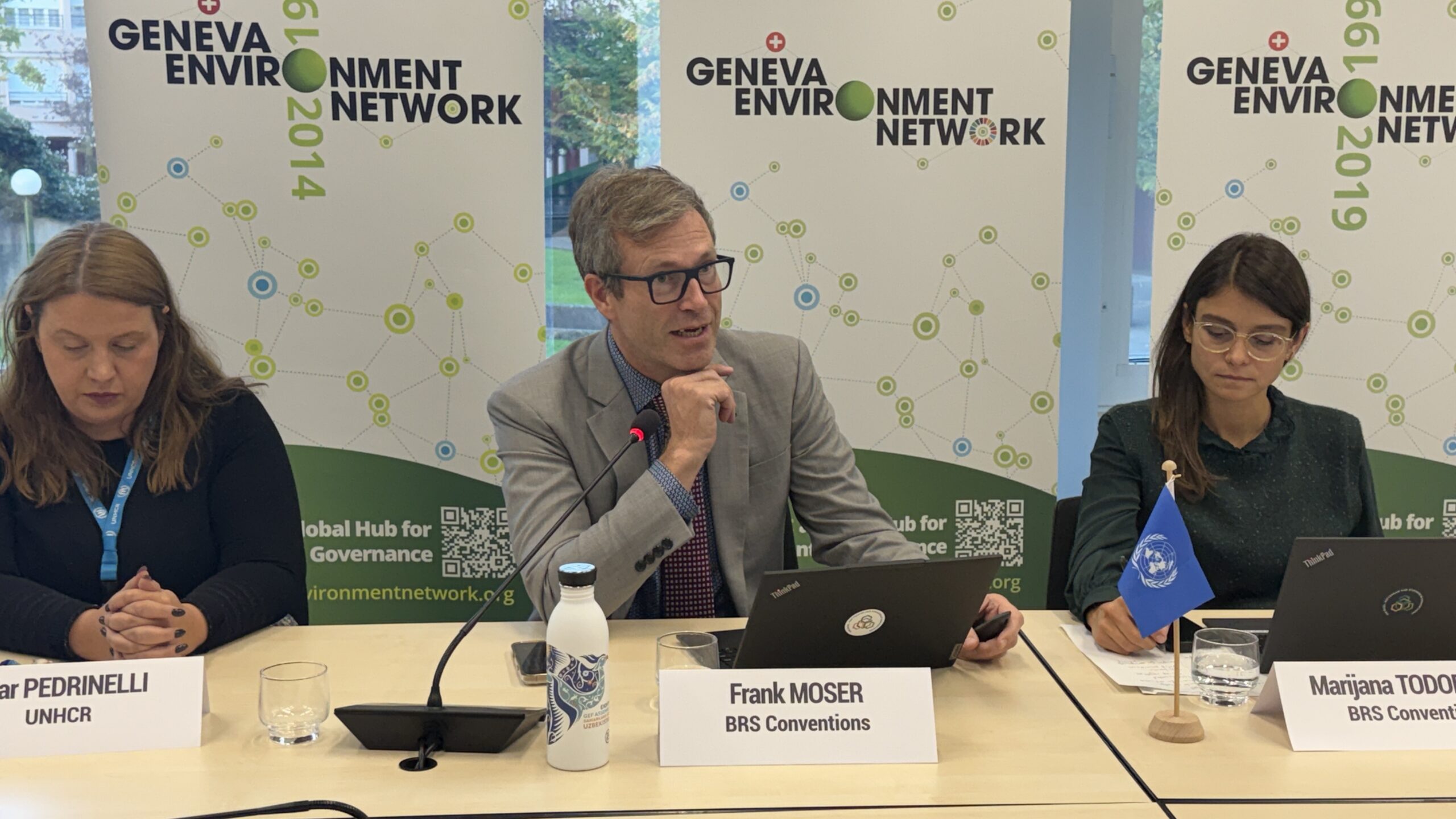
Frank MOSER | Head, Programme Resources and Oversight Unit, Basel, Rotterdam and Stockholm Conventions Secretariat
- What we hear today is that efficiency is necessary, but it’s not sufficient. We also heard a lot about the missing part of the UN80 conversation, which is mobilization and partnerships. And we heard, in particular with the MDBs, that I think that is a key moment.
- This presentation aims to show what it looks like when you try it on one very concrete pollution problem: PCBs, focusing on what is new about the approach, what has been hard, what we have learned, and whether it travels. This is an innovation in progress: some of it is already built, some of it is being tested as we speak, and some of it we have not yet solved.
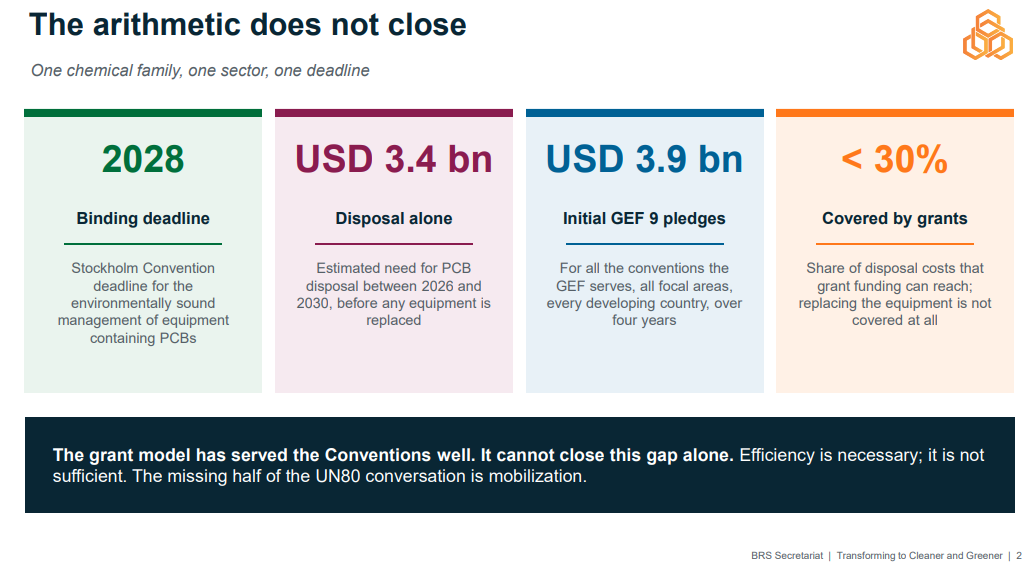
- PCBs sit inside electrical transformers, mostly in the grids of developing and emerging economies. Under the Stockholm Convention, parties have until 2028 to deal with them. That is a binding deadline and not an aspiration. The disposal bill is estimated at $3.4 billion between now and 2030. The GEF, which has done really more for this agenda than anyone, secured initial pledges of $3.9 billion for its next four years. We heard this might be a little bit more, which is great news. But this is for everything: all conventions, all focal areas, all countries. And grants reach less than a third of the disposal bill and none of the cost of replacing the equipment.
- [So at the end, this is not a question of asking the same funding partners a little harder, which we tended to do. The grant model has done its job. That is the message that we wanted to give today. It cannot close this gap on its own, and this is our version of the unity problem.
- So what is new? It is mostly a change in our view of how we look at the problem. For 20 years we have treated PCB equipment as a waste problem. Waste is a cost. Costs are paid by grants, and the owner of the equipment has every reason not to declare it. But look at the same transformer from the energy side and it is something completely different. It is old grid equipment that has to be replaced anyway. Many grids lose 15 to 20 percent of the electricity they generate before it reaches any consumer, and modern transformers cut those losses. So saved electricity is money, and money can repay a loan, and the 2028 deadline gives the whole thing a date, which is exactly what an investor needs.
- So we split the problem in two. Grants pay only for the part that has no return: destroying the PCBs and storing them safely until then. Investment finance carries the part that is an asset: the new equipment and a more efficient grid.
- This has not happened already because of four ordinary market failures that stand in the way, and none of them is specific to pollution alone.
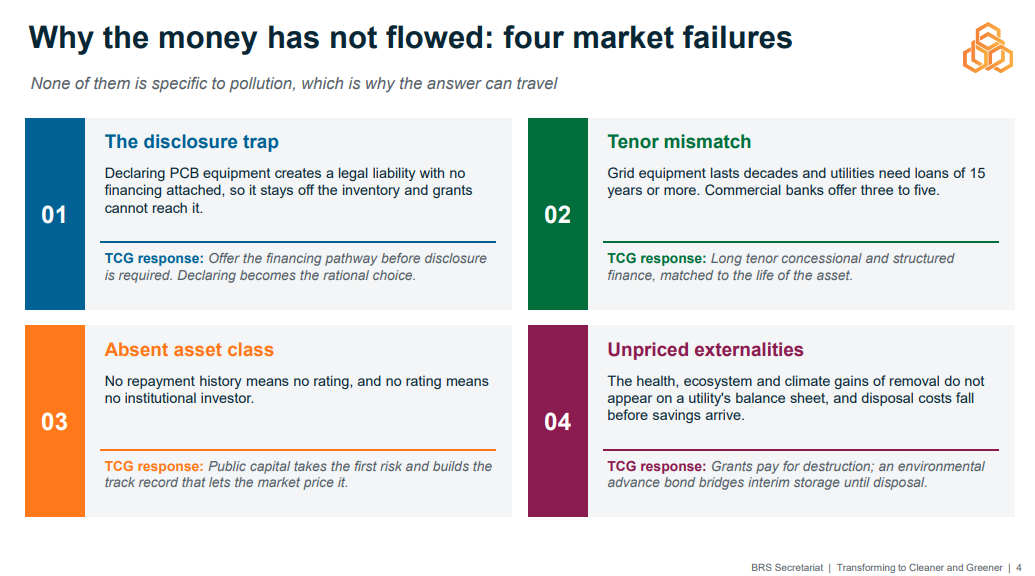
- These four failures appear in every infrastructure market. That is good news, because it also means the toolbox already exists.
- So here, in broad strokes, this is the architecture: two pillars, one logic.
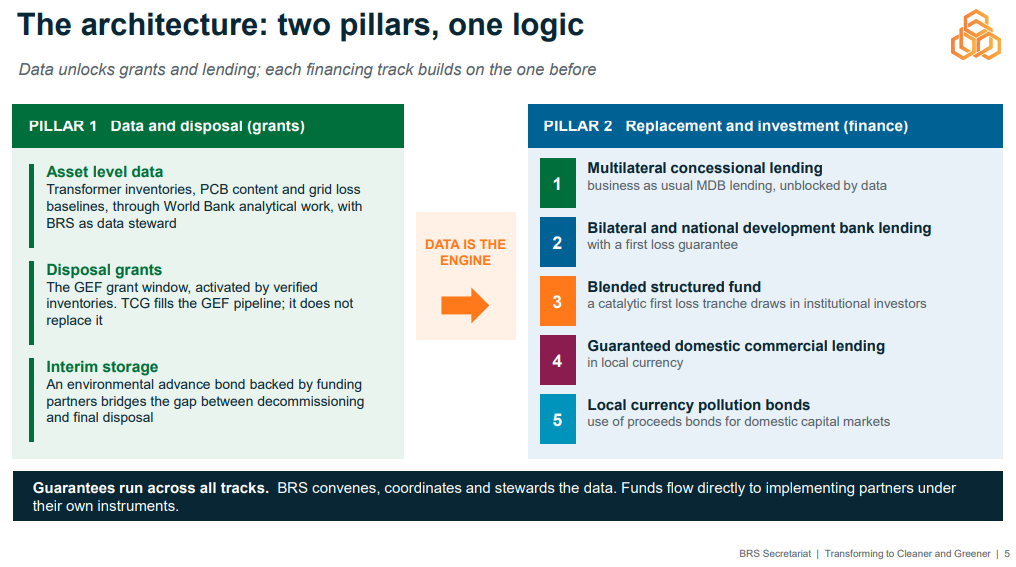
- The first pillar is data, and data is really the engine: asset-level inventories, PCB content, grid loss baselines. We mostly have this data but what we need to do is overlay these data sets. The data does three things: it lets the GEF fund disposal on the basis of verified inventories, so it’s a secure investment for the financial mechanism. It clears the safeguard barrier that today stops many development banks from lending. And it gives investors something to price. Interim storage is bridged, and we’re looking into the funding for this bridging, but it’s necessary; otherwise, we’re just creating a further liability for investors, which we do not want to do.
- The second pillar is the finance in five tracks.
- I think one point that really matters in a UN80 conversation is that we’re not building a fund to sit on. We, as a secretariat, convene, coordinate, and look after the data, because that’s the important message that we want to provide to our parties. The money flows directly to the institutions that lend under their own rules.
- Here the word that matters on this slide is “sequenced.” We do not try to launch five instruments at once. Track one is the easy entry and this is why it’s so important to work with the MDBs that the banks already lend to these utilities. Once the data clears the safeguard barrier, they can simply do what they do. Each later track adds a little bit more complexity.
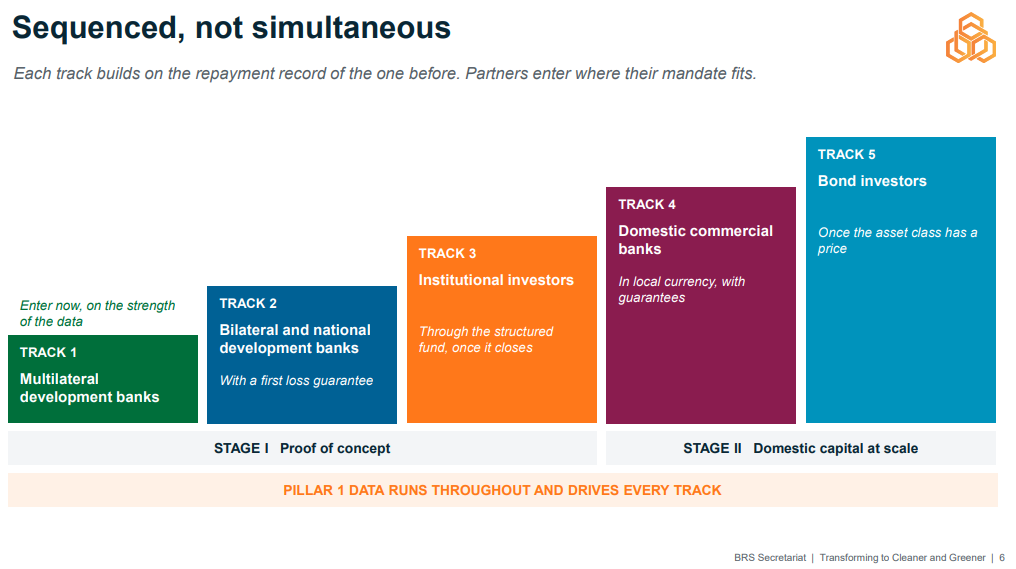
- The first three tracks are the proof of concept. The domestic tracks, local banks and the local bond market, depend on that proof, and we think this is where the real scale is, because that is domestic money that does not depend on any aid budget. And for a room full of resource mobilization colleagues, this is the practical point: every partner can enter at a step that fits its own mandate and risk appetite. Nobody has to buy the whole staircase.
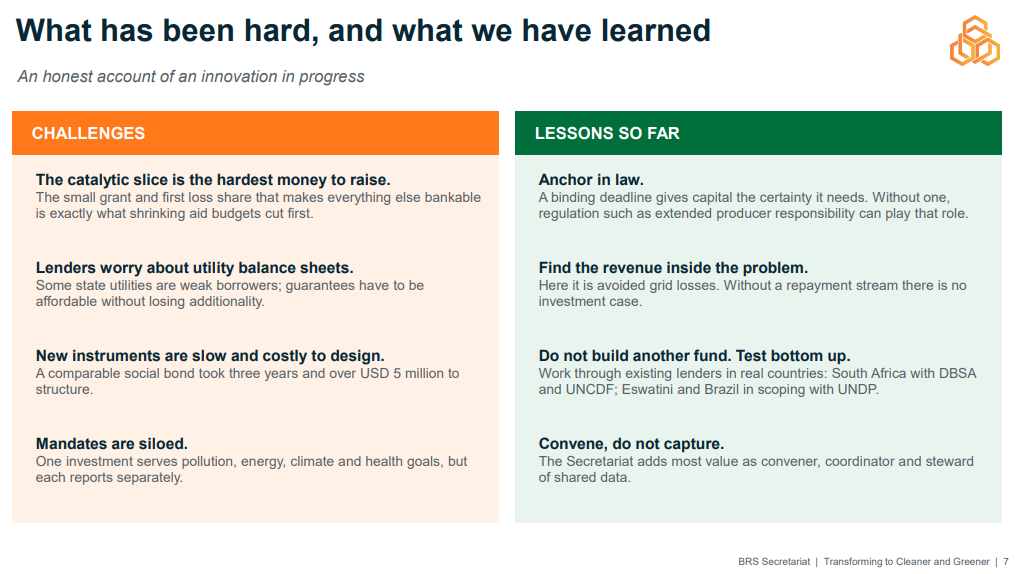
- We know that a comparable social bond took three years and more than $5 million. We did some horizon scanning. And fourth, our mandates are siloed. One transformer replacement serves pollution, energy, climate, and health goals at once. Others have made this point before, but each of us reports on it separately.
- So what have we learned? Anchor in law. Find the revenue inside a problem. Do not build another fund. Test bottom-up in real countries with real lenders. We are doing a first trial in South Africa with the DBSA, the development bank, and with UNCDF, who have been enormously helpful, with our colleagues, to structure that. We are looking also into other country projects in Africa and GRULAC, and please stay tuned.
- So you may ask yourself, does it travel? We think it does travel, under three conditions. First, the pollutant, and we heard PFAS before, has to sit inside something that earns money, so that replacing it produces cash flows. Second, there has to be a legal obligation that sets a date. Where there is no convention deadline, national regulations such as EPR schemes can do the same job, and that is how we see plastics, with the Basel Convention as the anchor also. And third, the replacement has to produce gains we can measure.
- Where those three hold, the same staircase applies: other persistent organic pollutants, mercury, PFAS, plastics, water infrastructure, lead, as Rolph pointed out. You will hear something similar from Pilar in a moment. The REP Fund finds its revenue in carbon credits. We find ours in electricity that is no longer lost. The instruments differ. The logic is the same. Find the revenue inside a problem. Let public money take the first risk and let other capital flow.
- Let me close here, with where this room comes in, because international Geneva has almost every piece we need. We need catalytic grant partners for the small slice. We need development lenders and guarantee providers, each entering where their mandates fit. We need the agencies working on energy, health, trade, and labor to design these investments with us, so that one transformer replacement counts for several mandates instead of one. And we need pilot countries and utilities willing to share the data.
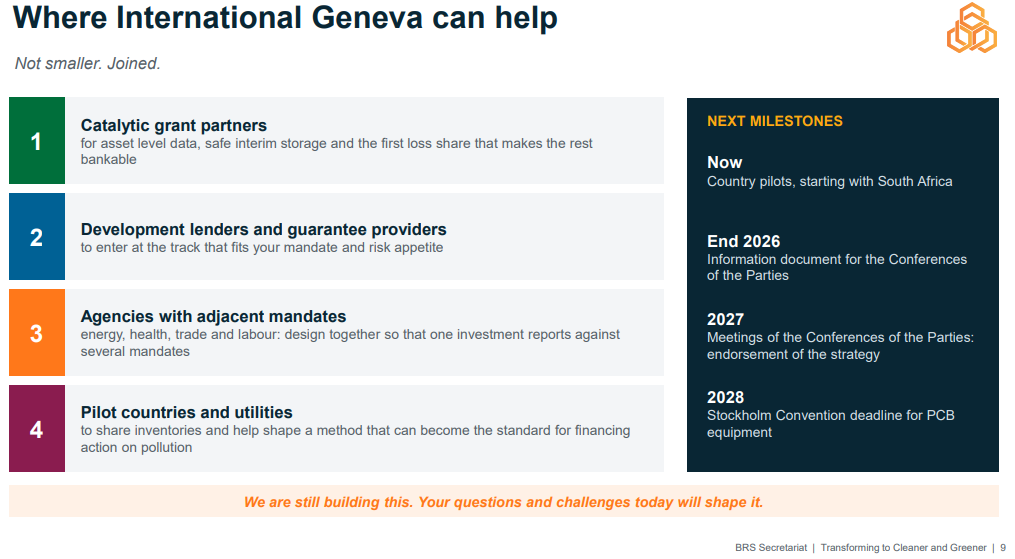
- Our next steps: country pilots now, an information document to the Conference of the Parties at the end of this year, and hopefully endorsement in 2027, one year before the deadline. And Rolph put it in three words at the opening: “not smaller, joined.” That is what we are trying to build.
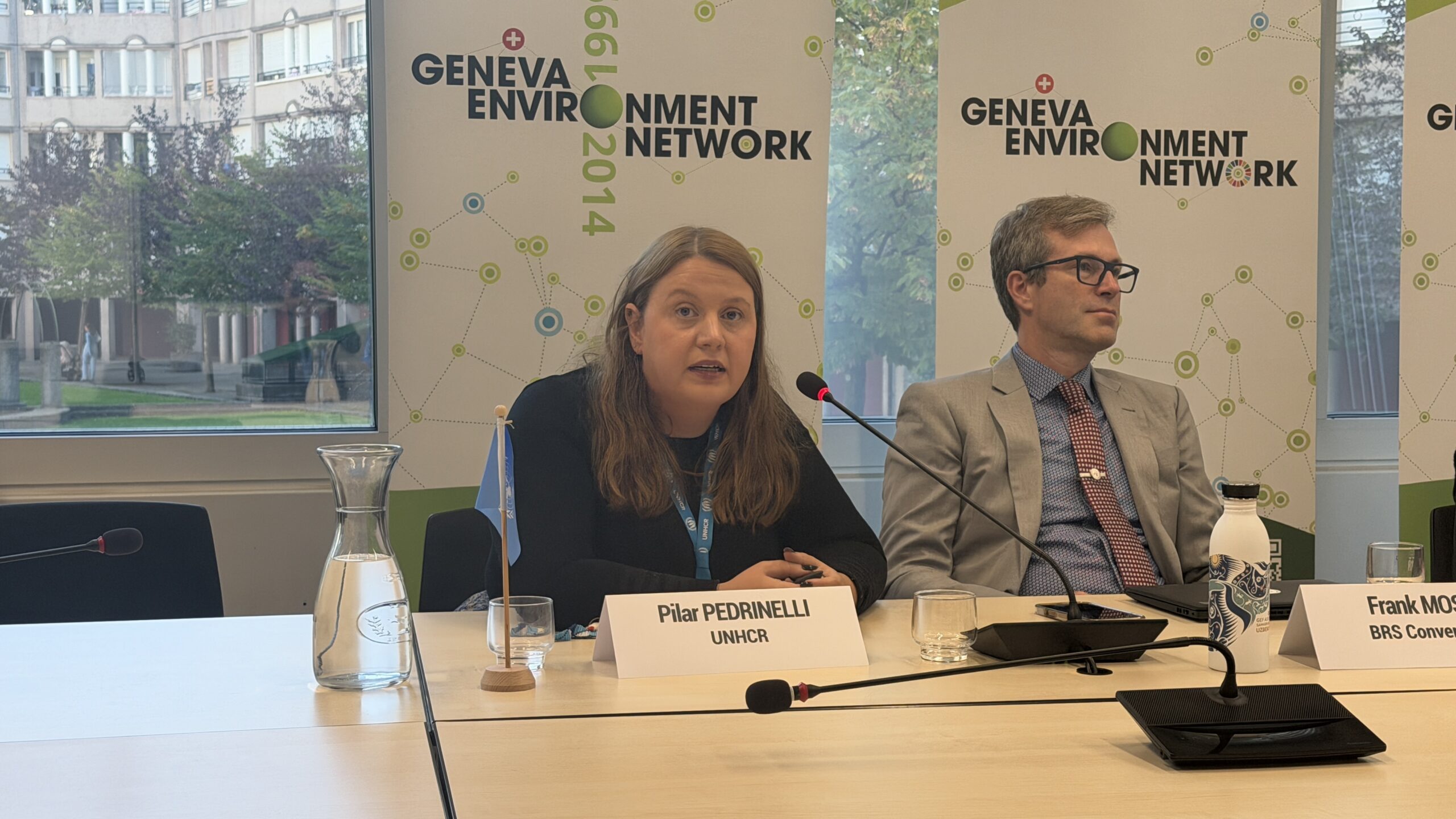
Pilar PEDRINELLI | REP Fund Lead, United Nations High Commissioner for Refugees
- We’re islands and this island would like to be visited. In terms of message to Geneva, we do need to bridge several gaps. We talk a lot about the climate financing gap. There is one, so I want to be very, very clear. But I think the bigger one is even the allocation gap.
- When you are working with vulnerable communities, you cannot talk about one single metric at a time. When we are talking about silos, that is what I have noticed and experienced throughout my whole career.
- There is a lot of siloed conversation happening across the board, especially, and one of the topics today is pollution. We have a huge carbon tunnel vision and we only look at one metric first.
- When you talk about environment, you cannot talk just about pollution. There are lots of tree species, for instance, so if you maximize just carbon removals, you might actually destroy biodiversity. This is just a very simple example to say we do need to think more laterally and broadly, not just within environment but also with social.
- REP Fund stands for Refugee Environmental Protection Fund. It was born out of a challenge of what we see in vulnerable groups, such as refugee settlements and host communities, where there are two major issues. On one end, you have vulnerable groups over-relying on firewood for cooking, and so you have to have a solution to how to reduce that and improve the situation. At the same time, a challenge that is obviously very interconnected, which is deforestation as a result of that. Obviously, when you imagine you are one person in that situation, you want to do your best, but you are sometimes not being granted the solutions that you actually need.
- That is something that you do need to take into consideration whenever you’re developing a program in these settings, which means that you do need long-term solutions. You cannot afford to go to these places with band-aids which are solving for problems of one year or two years. If you go to one of these areas, you see a lot of great initiatives also, but they are either overlapping or short-term, and, as you know, a vulnerable community then has to face the consequences when these initiatives leave. It’s a very important point that I wanted to address up front, because we are not afforded the opportunity to think short-term and in grant cycles, frankly. So you do need to have access to longer-term financing, which is very rare in the humanitarian sector.
- We are the first fund of its kind. We are the first in the humanitarian sector, which means challenges left, right, up, and center. When we say innovative financing is losing, it is true, and at the same time it feels right now that somehow we are to be solving a lot of gaps, not necessarily by innovative financing.
- One of the things that you need to do, and I promise I will talk about the fund in a second, is to also have systemic change. In terms of how we were able to do this, every single process we went through to do a lot of the things that I am about to explain had a special approval process. This means that it cannot be scaled or translated to other realities, so it cannot be actually helpful on that front. And this is something that I am actively involved in trying to change, because we do need to have a system change that then allows other organizations to come in or to help with the scaling.
- Long story short, we focus on two interventions: reforestation and clean cooking. Reforestation is intended as ecosystem restoration, so a lot of the initiatives that we focus on are more about biodiversity than a traditional mitigation program in reforestation. And then clean cooking: we are actually not focused on a specific technology, because whatever solutions we focus on in clean cooking need to be scalable and need to be used by communities. As my colleague already mentioned, we do this primarily through carbon credits.
- Everything essentially is new about this fund besides the financing mechanism, because carbon credits obviously are very established, very set markets. There are new developments, and there’s also very strong regulation right now, which is obviously something that is deeply appreciated, unlike, unfortunately, with biodiversity markets, where we are also interested in going at some point. And the way you build all of this has to have a very strong governance structure, which is honestly not dependent on the financing mechanisms.
- The pipeline that we have now is over 17 countries, and we have the first projects in Uganda and Rwanda, as well as one which is about to be implemented in Bangladesh and one that we’re hoping to kick off at the beginning of next year in Brazil, on indigenous land. The next wave of countries where it will be active are Kenya, Mozambique, and Tanzania. So, as you can see, this cannot just be a standalone island. We encourage others to come talk to me. We learn from one another. Let us see how we can make it work for other UN agencies, but also the broader humanitarian sector.
- What is unique about the fund is exactly this. We are very open in terms of whatever type of funding source we can get. What is interesting is that typically this is used to subsidize all program activities. In our case, It is not. It is just to subsidize, if you want, the upfront capital and the upfront cost of running a program, which is long-term, because with carbon credits you typically have to have a 30-year timeline for development. And this is to attract additional investors and additional capital from the private sector.
- Actually, one of the key aspects of the fund is that there is a positive internal rate of return. So it is a commercial setup, which again is very unique.
- I also want to be very clear that it is not going to be the same in every single setting. For instance, the 17 countries in the pipeline do not include Sudan and South Sudan, where we also ran feasibility assessment studies, and unfortunately the commercial aspect was not there, and so we were not able to implement projects in those areas just yet, with “yet” being the number one keyword, I would say, because we do need to get to those settings at some point as well, and that’s again why the fund was also built.
- One important point also, personally: when you hear “carbon credits,” and I’ve heard it my whole career, you think that, again, pollution or mitigation, removal, avoidance, whatever type of activities you have, is the number one goal. It is, frankly, when it comes to metrics. But for us, what we typically call co-benefits, which are some of the activities you see in this area, are actually core benefits. As a matter of fact, carbon is actually the co-benefit in our projects. There are three main areas of focus here. Obviously, we also love SDGs. I could have actually put all 17 here, because indeed we are not siloed, and so I think that is a very important point.
- The primary reason why we created a fund is protection and risk reduction. Obviously, we are of service to these communities, both refugees and host communities. That is a very important point, because a lot of the initiatives are also sometimes, not obviously, voluntary, creating a bit of a gap between the two communities. So it is very important that we address both, and we focus on several activities that foster protection and risk reduction.
- The second point is livelihoods, inclusion, and local ownership. If you know a bit about carbon credits, and unfortunately I do not have a lot of time to explain the nitty-gritty and also the, I would say, negative side of carbon credits, when it comes to benefit sharing, for instance, the benefits that are shared with the communities, you see them down the line. So why would you, as a person, get involved in a carbon credit project if you are in a vulnerable community if you do not see the benefits right away? This is something that we needed to address. So many of the aspects, for instance, of how the project works is actually investing in green jobs up front. A lot of people are directly employed to make sure that the activities are developed the way they need to be developed, and so they see the benefits immediately.
- It is not just about planting trees; it is about ecosystem restoration, and I would say also looking at mitigation with adaptation at the same time, because I also feel that’s another huge gap, frankly, that we have in this sector. So that’s what we are trying to do is to support initiatives that are supporting communities for adaptation, because some of these vulnerable settings are clearly already affected by everything that you, as UNEP, also put in the overshoot report. But there’s still a potential, obviously, for mitigation, and that again, carbon credits.
Q&A
Q: Could you please explain in which context you see that the IOPC precedent can allow for inspiration to be drawn?
Q: What is the UN decision on arrears?
Michael FRANCZAK I Senior Researcher, United Nations University Centre for Policy Research
- For the International Oil Pollution Compensation Funds (IOPC) example, is important to look at the DNA of the cooperation challenge. It worked for three reasons:
- An industry with a big externality that was growing: late 1960s, more oil transported by sea, more oil spills.
- Public pressure, so a big outcry, governments feeling the heat and industry feeling the heat.
- The industry being worried about getting sued, and they are aligned that they need to do something about it.
- I do not know if all those conditions are present in the example that I will give, but I think it is a useful precedent for thinking about something like the proposed global mining legacy fund from the Secretary-General’s Panel on Critical Energy Transition Minerals. This is an opportunity where it is essentially an insurance mechanism for the industry. There are trade-offs involved in terms of future liability and compensation, but it is something that functions successfully.
- The decision on arrears: there is a 70-plus-year-old rule that required the UN to return unspent funds even when member states did not pay. This created what the Secretary-General called a Kafkaesque scenario, where member states did not pay, but the UN had to return unspent funds as if they did pay. So that became a huge problem when you had $6.5 billion in arrears across the system. That’s how it contributed to the liquidity crisis.
Closing Reflections
Lucretia LANDMANN | Senior Policy Adviser Environmental Finance, Federal Office for the Environment, Switzerland
- As you may know, Switzerland has been ranked the most innovative country for 16 consecutive years, and in part this is because we lead in patent filings per capita.
- When I was preparing for these closing remarks, I actually learned about how the World Intellectual Property Organization turned global patent registration into a fee-based service as a way of mobilizing resources at a time of financial constraints.
- Today we have learned about different approaches to mobilizing resources in innovative ways to address both financial and pollution and other crises, ways of not letting a good crisis go to waste, to paraphrase Winston Churchill.
- What they show is that there are different, complementary, and actually often mutually reinforcing ways of mobilizing resources. I can only support and reinforce the message of different speakers today of mutual learning, of joining forces, and of leveraging different approaches and efforts. In summary, to generate and mobilize the necessary resources to address pollution, we need to broaden the contributor base and use both innovative regulatory, fiscal, and financial policies to create the right enabling environment, but also, of course, use innovative financial instruments to mobilize funds.
- We heard about innovative ways of creating enabling environments as well as innovative financial instruments. I have two examples from my work, or even just close to home. I just came across it recently in my municipality, where I live outside of Bern. They recently introduced a plastic recycling system, and this meant that municipal waste could be reduced significantly: 20 tons, which is a small percentage in terms of weight, but in terms of volume it is very significant. It meant that the municipality now only comes to collect the waste once a week instead of twice, which has saved on collection services and has freed or mobilized resources. I thought that was an interesting way of mobilizing resources, or using resource mobilization, in the context of plastic, or municipal waste and plastic pollution.
- The other example, and I think we have heard similar approaches today, comes from our work with and support for the GEF, which, as you may have heard, has structured and supported interesting blended finance instruments, more for biodiversity. But the World Bank has also, two years ago already, issued the Waste Reduction-Linked Bond, which uses plastic waste collection credits, so plastic waste recycling credits, like plastic credits, as well as carbon credits, to repay the investor and provide a financial return. T
- his happens in two projects, in Ghana and Indonesia. It is an instrument that enables, through these credits, to attract investors, normal investors, while also reducing and recycling plastic waste and thereby helping to reduce the plastic problem in nature and oceans.
Photo Gallery
Documents
Links
- UN80 Initiative and the Environmental Pillar Dimension
- The UN is reinventing its finances — and it’s a better bet than you think | David Passarelli and Michael Franczak | UNU CPR | 28 August 2026
Photo Credits
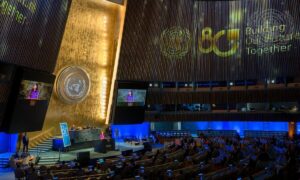
The U.N. General Assembly hall during a ceremony to commemorate United Nations Charter Day, as the organization advances its UN80 reform and works to strengthen its financial future. UN Photo / Mark Garten