
Event Virtual
Road to OEWG 3 | Introduction to the Documentation Prepared for the Ad Hoc Open-Ended Working Group on the Science-Policy Panel to Contribute Further to the Sound Management of Chemicals and Waste and to Prevent Pollution
07 May 2024
14:00 – 15:30
Venue: Online | Webex
Organization: Ad hoc open-ended working group on a science-policy panel on chemicals, waste and pollution prevention, Geneva Environment Network
This online event is part of the "Road to OEWG 3 Series", co-organized by the Secretariat of the ad hoc open-ended working group (OEWG) on a Science-Policy Panel to Contribute Further to the Sound Management of Chemicals and Waste and to Prevent Pollution and the Geneva Environment Network.

About this Session
The OEWG, at its second session, requested the secretariat to prepare, in consultation with the Bureau, a webinar on the documentation prepared by the secretariat for the third session of the ad hoc open-ended working group, to take place from 17 to 21 June 2024 in Geneva.
This online event provided an overview of the documents for OEWG 3, including the compilation of proposals as it stands following the conclusion of OEWG 2 (UNEP/SPP-CWP/OEWG.3/2) and draft text proposals related to this document (Addenda 1-5). The event also introduced the proposals on the establishment of the Panel to be considered by the intergovernmental meeting, and proposals to give effect to arrangements to be considered by the intergovernmental meeting.
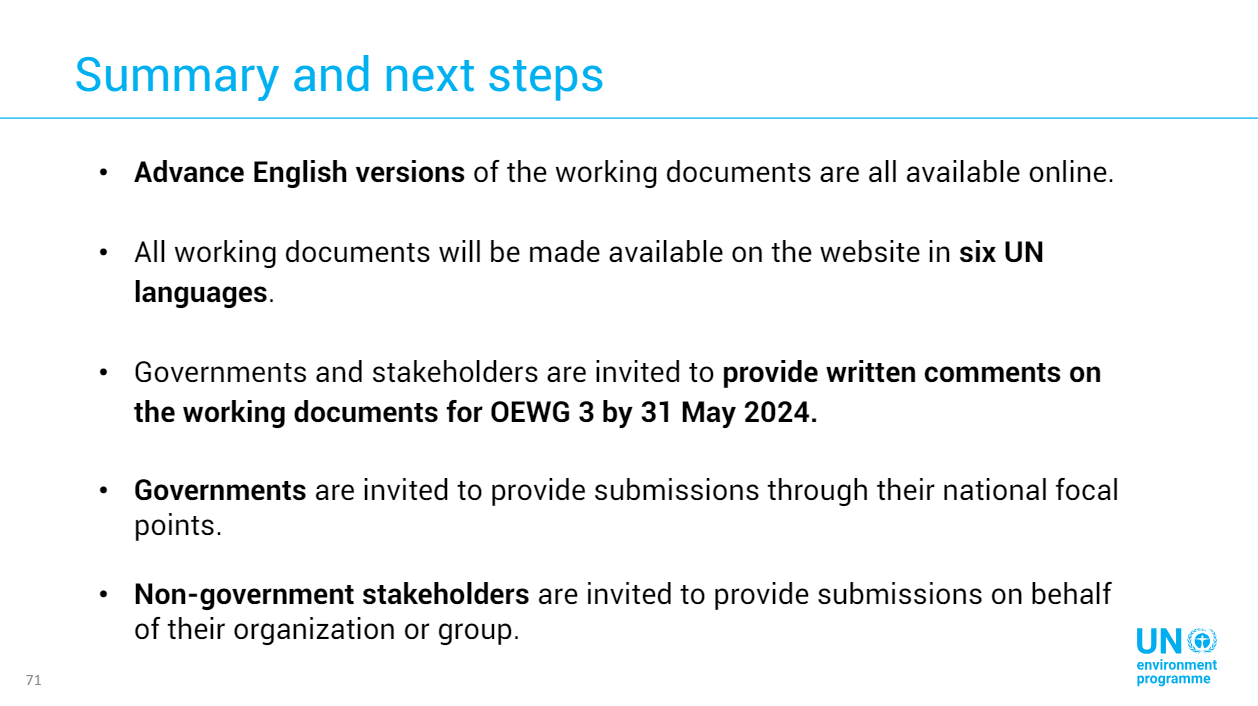
Government, observer and stakeholder representatives who wish to do so are invited to submit their views on the documents no later than 31 May 2024 to the secretariat through their respective national focal points or on behalf of their organization or group.
Road to OEWG 3 Series
In March 2022, the United Nations Environment Assembly at its resumed fifth session (UNEA-5.2) agreed to establish an independent, intergovernmental science-policy panel to contribute further to the sound management of chemicals and waste and to prevent pollution. The OEWG process has been initiated to prepare proposals for the panel.
As set out in UNEA resolution 5/8, the panel will support countries to take action on chemicals, waste and pollution, including to implement various international instruments such as multilateral environmental agreements (MEAs), by providing policy-relevant scientific advice. The Panel will also further support relevant MEAs, other international instruments and intergovernmental bodies, and other relevant stakeholders in their work.
The OEWG convened for the first part of the session (OEWG 1.1) in Nairobi, with online participation, on 6 October 2022, for the resumed first session (OEWG 1.2) in Bangkok from 30 January until 3 February 2023, and for the second session (OEWG 2) in Nairobi on 11 to 15 December 2023. The OEWG will convene for its third session (OEWG 3) in Geneva on 17 to 21 June 2024.
In preparation for the third session, the Road to OEWG 3 | Science-Policy Panel to Contribute Further to the Sound Management of Chemicals and Waste and to Prevent Pollution webinar and event series, co-organized by the OEWG Secretariat and Geneva Environment Network aims to build bridges between and among stakeholders, and promote collaboration and knowledge sharing in preparation for OEWG 3, taking place in Geneva, in June 2024.
Speakers
By order of intervention.

Gudi ALKEMADE
Chair, OEWG on a Science-Policy Panel on Chemicals, Waste and Prevention of Pollution | Deputy Permanent Representative to UNEP, Kingdom of the Netherlands
Tessa GOVERSE
Head, Secretariat of the OEWG on a Science-Policy Panel on Chemicals, Waste and Prevention of Pollution

Didier SALZMANN
Secretariat of the OEWG on a Science-Policy Panel on Chemicals, Waste and Prevention of Pollution

Pia KOHLER
Secretariat of the OEWG on a Science-Policy Panel on Chemicals, Waste and Prevention of Pollution

Alvin John GACHIE
Secretariat of the OEWG on a Science-Policy Panel on Chemicals, Waste and Prevention of Pollution

Nalini SHARMA
Secretariat of the OEWG on a Science-Policy Panel on Chemicals, Waste and Prevention of Pollution | Moderator
Summary
Opening
Gudi ALKEMADE | Chair, OEWG on a Science-Policy Panel on Chemicals, Waste and Prevention of Pollution | Deputy Permanent Representative to UNEP, Kingdom of the Netherlands
- The mandate of the ad hoc open-ended working group on a science-policy panel on chemicals, waste, and pollution prevention is based on UNEA resolution 5/8, which decided that the science-policy panel should be established to contribute to the sound management of chemicals and waste and to prevent pollution. That same resolution also mandated the ad hoc OEWG to develop proposals to be considered by an intergovernmental meeting to decide on its establishment.
- We are now preparing for the third session of the ad hoc working group, building on the outcomes of the previous sessions. The second session discussed key topics that will characterize the future science-policy panel, including its scope, objectives, functions, operating principles, institutional arrangements, and evaluation of the panel’s impact.
- The second session also discussed relevant procedures and processes for the panel’s functioning. The outcome of these discussions was a compilation of proposals based on an agreed outline, which will be the basis for ongoing discussions in the third session and will be presented today as part of the documentation for the preparation of the third session.
- The OEWG requested the Secretariat to present draft text on several topics, particularly relevant to the procedures and processes for the panel’s functioning, including the rules of procedure, financial procedures, the process for determining the work program, the procedures for the panel’s deliverables, and an updated conflict of interest form to be annexed to the conflict of interest policy that the second session also started to discuss.
- The working group also requested the Secretariat to develop draft proposals to be considered by the intergovernmental meeting for the establishment of the science-policy panel, as well as draft proposals on interim arrangements to be considered in the third session for possible approval at the intergovernmental meeting.
- The third session of the ad hoc working group should finalize the proposals for the future science-policy panel. Lot of work needs to be done to deliver on our mandate, including the proposals for the panel and relevant decisions to be made at the intergovernmental meeting to allow the panel to commence its work as soon as possible.
- I hope that this webinar, the third in a total of five webinars, contributes to good preparations by both member states and stakeholders, allowing them to come well-prepared to focus on what needs to be delivered in our meetings.
Presentation of Working Documents for OEWG 3 | Introduction and Overview
Tessa GOVERSE | Head, Secretariat of the OEWG on a Science-Policy Panel on Chemicals, Waste and Prevention of Pollution
- OEWG-3 will take place in Geneva at the invitation of the government of Switzerland from 17 to 21 June 2024. The session will be preceded by informal meetings on Sunday, 16 June 2024.
Development of Proposals for the science-policy panel
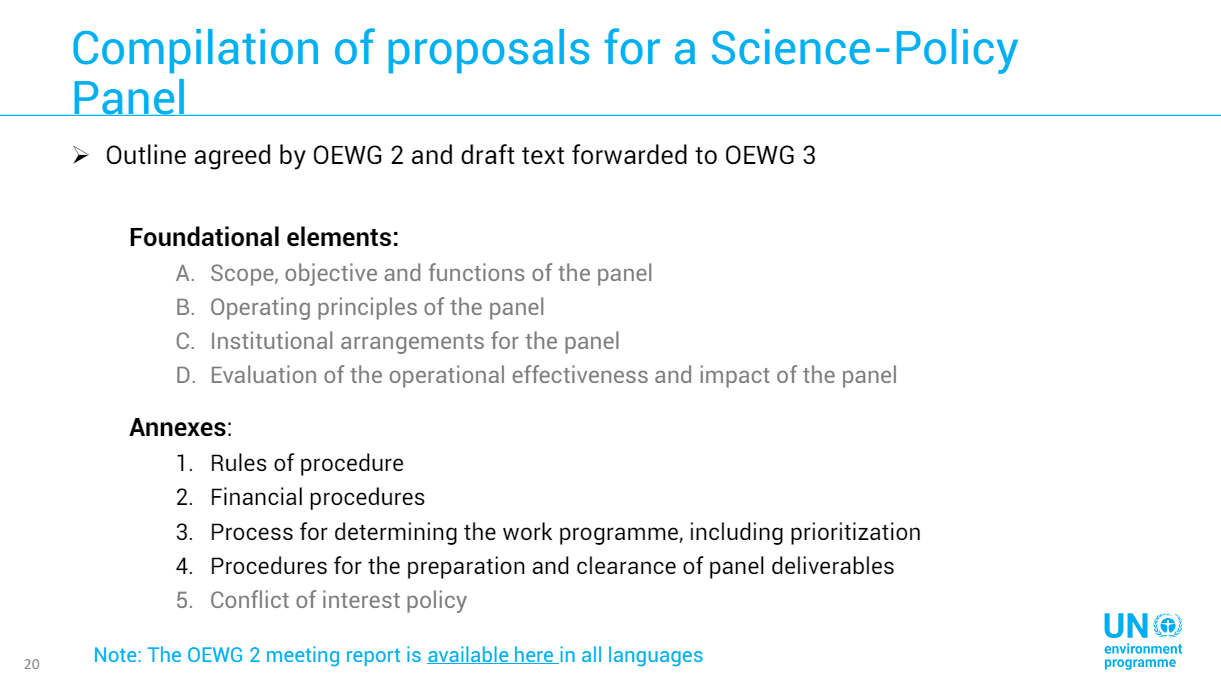
- An outline for compiling all proposals was agreed upon and started to be populated with the outcomes of the sessions. The proposals can be divided into foundational elements necessary to establish the panel and procedures, policies, and guidelines for the panel itself, which are clustered in the outline under annexes. The foundational elements include:
A. Scope, objective, and function of the panel
B. Operating principles of the panel
C. Institutional arrangements for the panel
D. Evaluation of the operational effectiveness and impact of the panel
- These elements are key to establishing the science-policy panel and are included in Annex 2 of the report of OEWG 2 and part of Working Document 2 (UNEP/SPP-CWP/OEWG.3/2).
For annexes 1 to 4, draft texts have now been proposed in the following addenda:
- Draft rules of procedure
- Draft financial procedures
- Draft process for determining the work program, including prioritization
- Draft procedures for the preparation and clearance of the panel deliverables
- Draft conflict of interest disclosure form
Working Documents and Information Documents

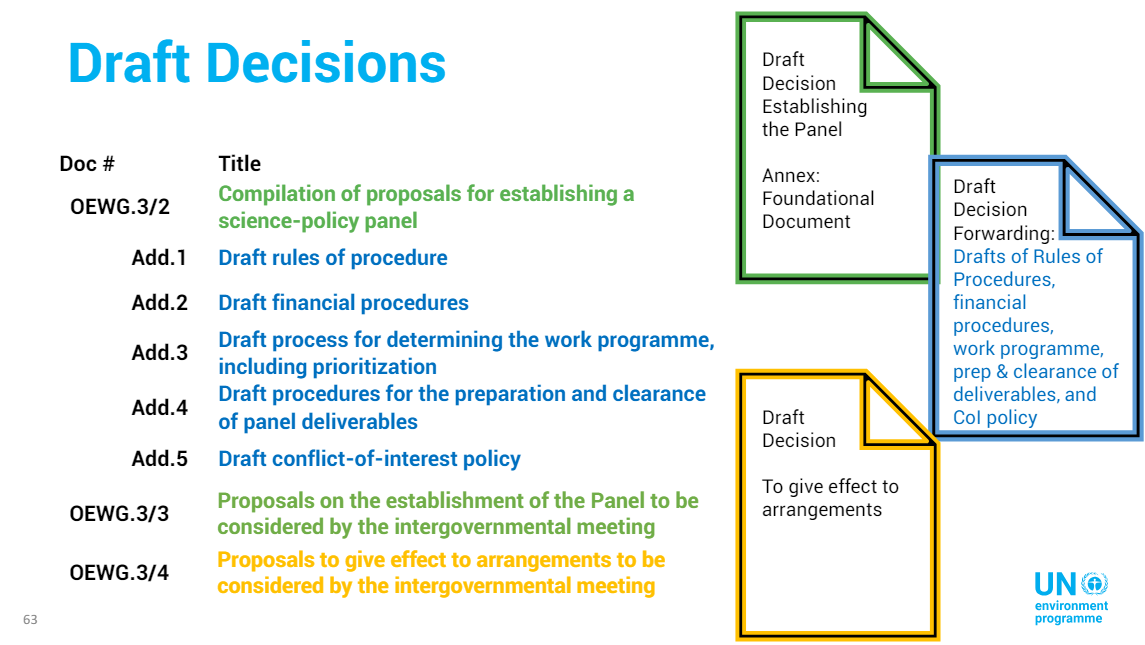
- The first cluster of documents, in blue, is related to the preparation of proposals for the science-policy panel (Working Document 2 and its addenda).
- The second cluster relates to the intergovernmental meeting that the executive director is requested to convene for the purpose of considering the establishment of the science-policy panel.

In addition to the working documents, information documents are being prepared. These include:
- INF/1 Scenario notes by the chair
- INF/2 Background document on financial arrangements
- INF/3 Summary of views expressed on the capacity building function of the panel
- INF/4 Supporting information on work-related processes and procedures
- INF/5 Possible modalities of cooperation and complementarities between the panel
- INF/6 Overview of the history of the science-policy panel
- INF/7 Compilation of written submissions on the open-ended working group 3 meeting documentation
Provisional Agenda
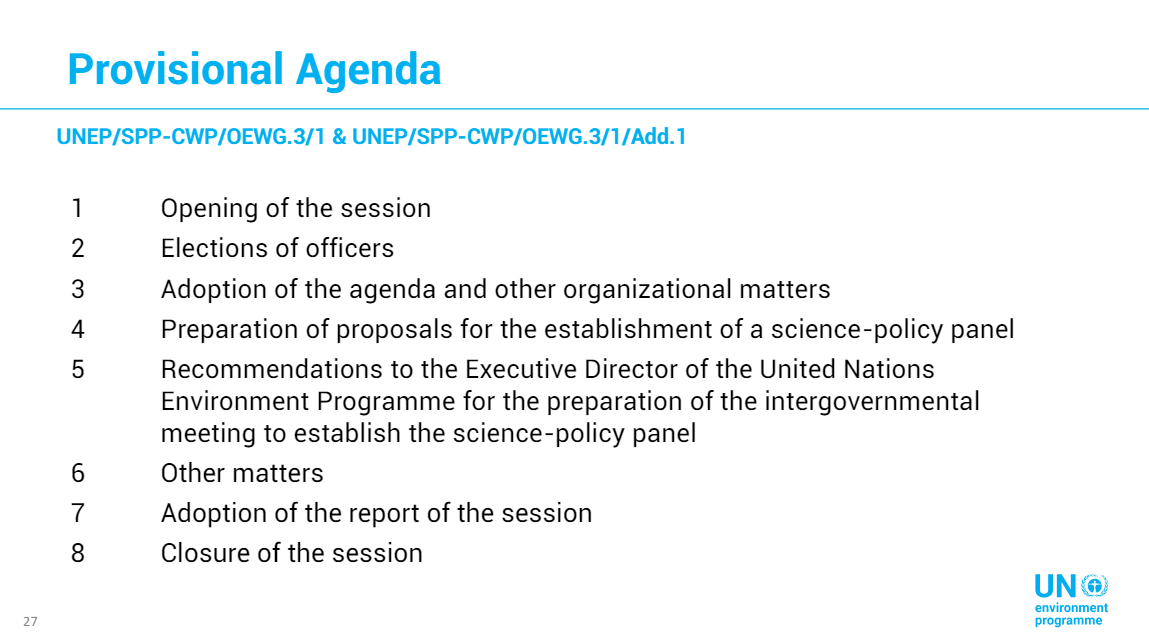
- The provisional agenda (UNEP/SPP-CWP/OEWG.3/1), as adopted by the second session of the open-ended working group, was issued on 15 February in all six UN languages.
- The annotated provisional agenda (UNEP/SPP-CWP/OEWG.3/1/Add.1), now available, sets out the expectations for the proceedings of the open-ended working group in greater detail and will be considered in conjunction with the scenario note from the chair, available in early June.
Presentation of Working Documents for OEWG 3 | Draft Rules of Procedure
Alvin John GACHIE | Secretariat of the OEWG on a Science-Policy Panel on Chemicals, Waste and Prevention of Pollution
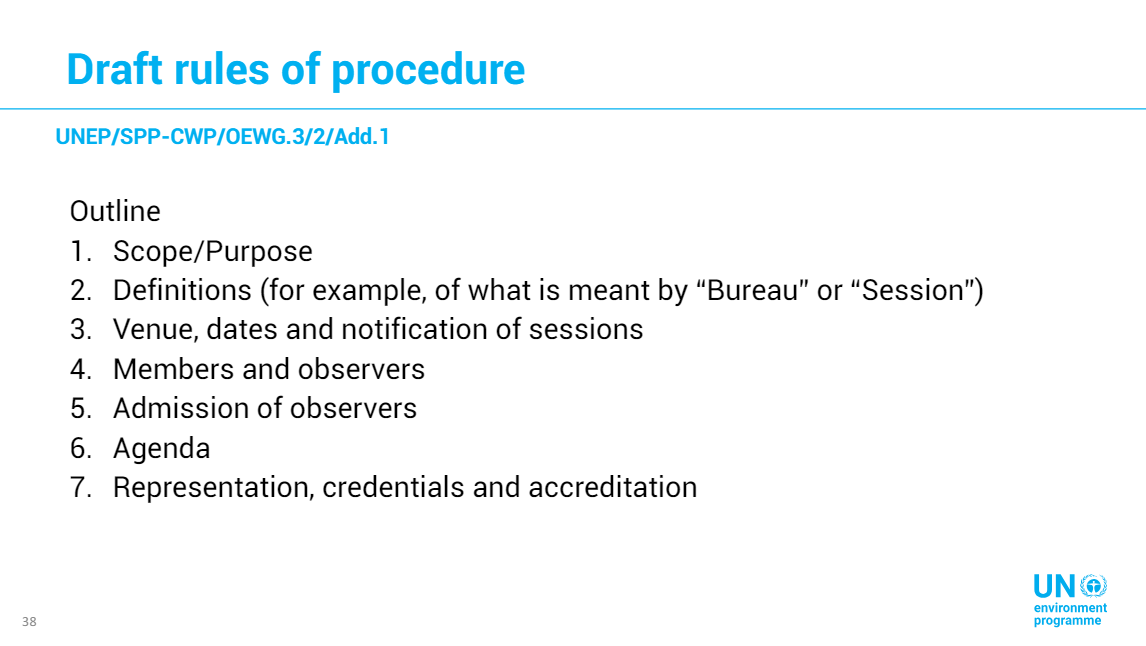
- The Draft Rules of Procedure are contained in Addendum 1 of Working Document 2 (UNEP/SPP-CWP/OEWG.3/2/Add.1).
- These rules are crucial as they shape how the panel will operate.
- As requested, the Secretariat drafted these rules, drawing inspiration from established bodies like the Intergovernmental Panel on Climate Change (IPCC), the Intergovernmental Science-Policy Platform on Biodiversity and Ecosystem Services (IPBES), and the United Nations Environment Assembly (UNEA).
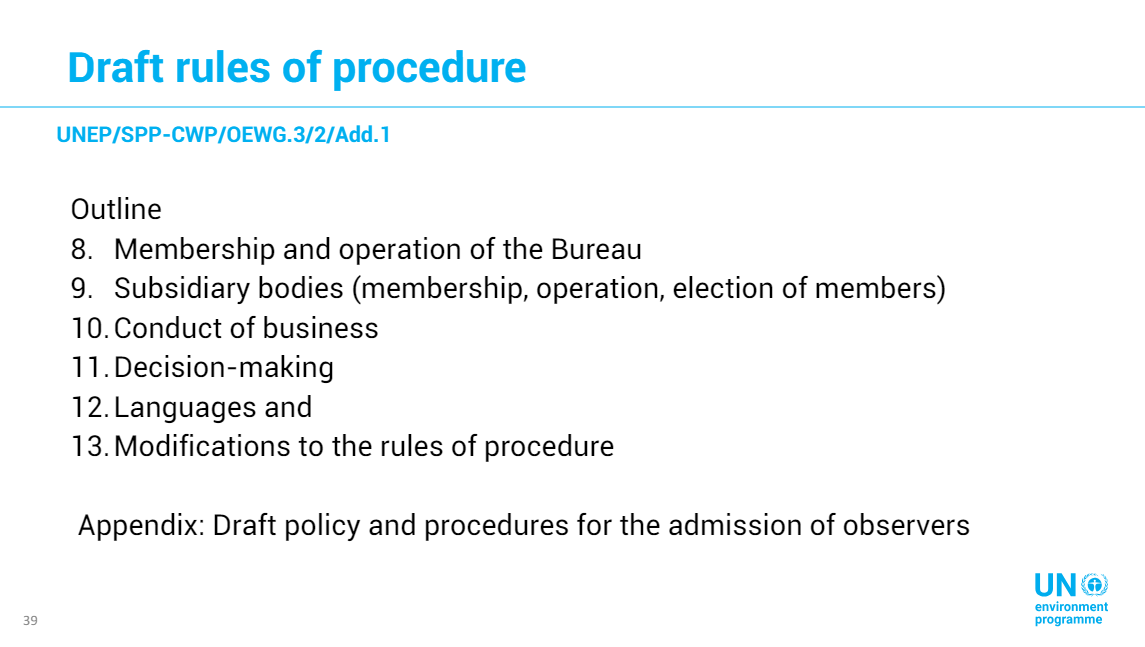
- The Draft Rules of Procedure have been shaped by the outcomes of the second session (OEWG 2), particularly Section C of Document 2 on institutional arrangements for the panel. These rules outline how sessions of the governing body of the panel will be conducted. The rules, as drafted, follow the outline agreed at the second session of the ad hoc open-ended working group. They cover important aspects such as the scope or purpose of the rules, definitions, session logistics, and membership details.
- The rules outline who can participate in the sessions in terms of modalities of participation in sessions of the governing body of the panel, including for members and observers such as states not members, United Nations bodies, and other intergovernmental and non-governmental organizations. Rules on admission and participation of observers are also outlined. There are rules on agenda setting and notification, and rules on representation, credentials, and accreditation.
- Expanding on the panel’s organizational framework, the rules address the membership and operation of the bureau, covering aspects such as nomination and election of bureau members. Additionally, they delve into the functioning of subsidiary bodies, specifying membership operation and the election process for bodies like the interdisciplinary expert committee, alongside general rules applicable to other subsidiary bodies. These rules establish protocols for conducting business during sessions of both the panel’s governing body and its subsidiary bodies.
- Regarding decision-making, they delineate processes for substantive and procedural matters, incorporating rules on voting and elections. Further, the rules include provisions for language usage and outline procedures for modifying the rules of procedure. Annexed to these rules is a draft policy and procedures for admitting observers, which is directly tied to Rule 7 within the Rules of Procedure.
Presentation of Working Documents for OEWG 3 | Draft Financial Procedures
Didier SALZMANN | Secretariat of the OEWG on a Science-Policy Panel on Chemicals, Waste and Prevention of Pollution
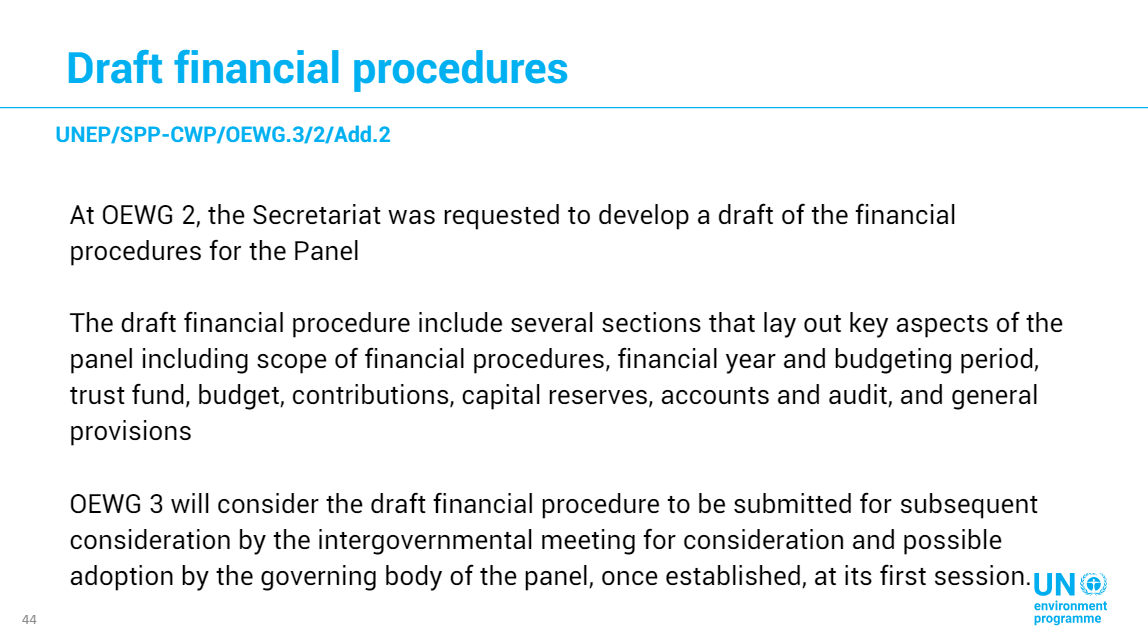
- Upon request of the ad hoc open-ended working group in its second session, the Secretariat has prepared a draft financial procedure (UNEP/SPP-CWP/OEWG.3/2/Add.2) for consideration by the ad hoc open-ended working group.
- The text was developed based on the financial rules and procedures of the United Nations Environment Program (UNEP) and the financial procedures of the Intergovernmental Science-Policy Platform on Biodiversity and Ecosystem Services (IPBES), on the assumption that UNEP will host the Secretariat of the panel.
- The text includes sections presenting the scope of the financial procedures, the financial year and budgeting period, the panel trust fund, the currency, the budget contributions, the working capital reserve, the account and the auditing processes, and general provisions.
- The document is supported by an information document which provides further context and information on the content. Issues considered in the information document touch on the funding methodology of the panel work program and the support of least-developed countries and small island developing states to participate in sessions of the governing bodies of the panel.
Presentation of Working Documents for OEWG 3 | Draft Process for Determining the Work Programme, Including Prioritization, Draft Procedures for the Preparation and Clearance of Panel Deliverables & Draft Conflict-of-interest Disclosure Form
Pia KOHLER | Secretariat of the OEWG on a Science-Policy Panel on Chemicals, Waste and Prevention of Pollution
Compilation of proposals for establishing a science-policy panel Annexes 3 – 5
- Draft process for determining the work programme, including prioritization (UNEP/SPP-CWP/OEWG.3/2/Add.3)
This document was prepared in response to a request at the second ad hoc open-ended working group. The draft process was developed building on those views expressed at the second session and also taking into account lessons and experiences of existing procedures, in particular those of IPBES. The proposed draft process in Document AD-3 is a three-step process, starting with compiling issues that might be considered, then those issues are prioritized, and finally determining the work program. Information Document 4 will provide supporting information on this document.
- Step 1: Compiling Issues | Issues are compiled by the Secretariat. As set out in the proposal, they can be brought forward by governments, relevant multilateral environmental agreements, other international instruments, intergovernmental bodies and processes, as well as relevant UN entities, and relevant key stakeholders such as international and regional scientific organizations, trust funds, governmental and non-governmental organizations, indigenous peoples, local communities, private sector entities, and foundations.
These suggestions can be put forward individually or jointly. When putting forward a submission, if possible, it should be accompanied by information on the nature of the proposed issue, including a description of the issue, its associated problems and opportunities, and an indication of whether it is cross-cutting or multisectoral. Information on the relevance to the panel’s objective and to relevant multilateral agreements, instruments, and intergovernmental processes, including a rationale for why the panel is thought to be best suited to consider the proposed issue, information on the urgency for action by the panel in light of the imminence of the problem and opportunities associated with the proposed issue, and finally, information on the availability of existing knowledge, data, and expertise on the proposed issue. As part of this first step, the Secretariat would compile the submissions received and post them, with a deadline at least six months before a governing body session so that the next two steps can be completed. - Step 2: Prioritization of compiled issues | First, the Secretariat would cluster the issues received and produce a consolidated list of topics for further consideration and prioritization. Next, the Secretariat, with the intergovernmental expert committee, conducts an initial screening of those topics to ensure that they fall within the scope and objective of the panel and are not already being or have not already been considered in other settings. The intergovernmental expert committee then systematically reviews the topics, consulting additional experts as relevant, and proposes a ranking of topics through the transparent application of a rigorous interdisciplinary review, taking into account the information in the submissions as well as information accessible from publicly available sources. Then, the Secretariat, under the guidance of the intergovernmental expert committee, can prepare a report on the top-ranked topics, documenting the information gathered, the rationale underpinning the prioritization, and including an analysis of the scope and types of outputs that would make the topic suitable for inclusion in the panel’s work program.
- Step 3: elaborating the draft work program | Based on the basis of the outcome of the prioritization phase, the Secretariat, in consultation with the interdisciplinary expert committee and the bureau, prepares a draft work program that includes elements such as the objectives and associated deliverables for the work program, timelines for producing each deliverable, institutional arrangements that might be necessary for the implementation of the work program, and budgetary implications for inclusion in the draft work program. That draft work program is then submitted to the governing body of the panel for consideration and adoption.

2. Draft procedures for the preparation and clearance of panel deliverables (UNEP/SPP-CWP/OEWG.3/2/Add.4)
- This document is supported with additional information in Information Document 4. These draft procedures for the preparation and clearance of panel deliverables build on views expressed during the second session of the ad hoc open-ended working group and take into account lessons and experiences of existing procedures, in particular those of the IPCC, IPBES, the Global Environment Outlook, and the Stockholm Convention’s POPs Review Committee.
- This is a detailed document and it contains multiple sections. It has a section on definitions and a section on deliverables that provide an overview of the deliverables to which these procedures would apply. This includes a range of deliverables such as assessments, synthesis reports, summaries for policymakers, but also new deliverables that don’t exist in those settings, like horizon scans.
- In terms of general procedures, these are set out not to be specific to any one kind of deliverable but to align with the provisions in Resolution 5/8. The general procedures include information on scoping of deliverables, nomination and selection of experts, review processes, and clearance of deliverables, differentiating between validation, acceptance, and approval. This document also has sections that relate to items that have either been requested in Resolution 5/8 or by the open-ended working group, such as the error protocol, procedure for the use of sources, policy on data and knowledge management, guidance on the use of digital tools and artificial intelligence, procedure for safeguarding commercially sensitive information, and finally, a procedure for languages and translations.
- This document that it also includes three annexes.
- Examples of the roles and responsibilities of how these procedures would be applied for the preparation of assessments specifically;
- & 3. Declaration forms related to the procedure for safeguarding commercially sensitive information.
3. Draft conflict of interest disclosure form (UNEP/SPP-CWP/OEWG.3/2/Add.5)
- Discussions began at the second session of the open-ended working group. The text has been forwarded to the third session.
- In document two, along with the foundational elements in addendum 5 to document 2, we have a revised conflict of interest disclosure form, which was requested during the second session of the open-ended working group, asking to separate out financial from, non-financial interests.
- Information document 4 provides supporting information to this document.
Proposals on the Establishment of the Panel to be Considered by the Intergovernmental Meeting & Proposals to Give Effect to Arrangements to be Considered by the Intergovernmental Meeting
Alvin John GACHIE | Secretariat of the OEWG on a Science-Policy Panel on Chemicals, Waste and Prevention of Pollution
- Document 3 – Proposals on the establishment of the Panel to be considered by the intergovernmental meeting (UNEP/SPP-CWP/OEWG.3/3) -, outlines proposals on the establishment of the panel to be considered by the intergovernmental meeting.
- UNEA Resolution 5/8 contained a request for the Executive Director of UNEP, upon completion of the proposals, to convene an intergovernmental meeting to consider the establishment of the science-policy panel. At its second session, the OEWG 2 requested the Secretariat to prepare proposals to be considered by the intergovernmental meeting for the purpose of considering establishing a science-policy panel.
- The document underscores that the primary outcome of OEWG 3 would be a final text proposal, termed the foundational document. This foundational document is crucial for establishing the panel, as it is intended to be forwarded to the intergovernmental meeting. The Ad Hoc Open-Ended Working Group may decide to adopt a resolution that requests UNEP Executive Director to transmit this proposal to the intergovernmental meeting.
- The proposal set out in Document 3 includes two draft decisions for consideration and adoption by the intergovernmental meeting:
- A Draft Decision on the Establishment of the Panel, as specified in the foundational document. This draft decision would be accompanied by the foundational document or Sections A to D of Document 2.
- A draft decision that the Ad Hoc Open-Ended Working Group may transmit to the intergovernmental meeting. It is a draft decision that offers recommendations for consideration by the governing body of the panel at its first session. Through this draft decision, the intergovernmental meeting may propose to forward draft rules, procedures, policies, and guidelines contained in Annexes 1 to 5 of Document 2 to the governing body of the panel for consideration at its first session.
Proposals to give effect to arrangements to be considered by the intergovernmental meeting (UNEP/SPP-CWP/OEWG.3/4)
- For the background on this document, during the second session, the Ad Hoc Open-Ended Working Group requested the Secretariat to formulate proposals on interim arrangements to be considered by the intergovernmental meeting, and these proposals are set out in this document form.
- On March 6, 2024, the Bureau of the Ad Hoc Open-Ended Working Group deliberated on a proposal to organize the intergovernmental meeting back-to-back with the inaugural session of the governing body of the panel. Such a sequential arrangement draws from past experiences in establishing similar bodies and enables the panel to promptly commence its operations and give effect to institutional and financial arrangements. The Bureau endorsed this proposal, acknowledging the mandate of the Executive Director of UNEP to convene the intergovernmental meeting.
- In Document 4, these proposals take into account a proposed back-to-back convening of the intergovernmental meeting and the first session of the governing body of the panel. The intergovernmental meeting and the governing body of the panel will be invited to decide on certain matters to give effect to arrangements emanating from the foundational document. Firstly, regarding elections of officers, where the governing body of the panel at its first session will be invited to elect its own officers to constitute the Bureau.
- The governing body will be invited to consider for adoption rules of procedure and a conflict of interest policy to govern its work, including with respect to the election of officers. The governing body of the panel may also be invited to consider the election of officers of subsidiary bodies, including the Interdisciplinary Expert Committee and the Conflict of Interest Committee.
- Secondly, concerning the Secretariat, the governing body of the panel at its first session will be expected to agree on the administrative and financial arrangements of the Secretariat. The governing body may request UNEP ED, potentially jointly with the Director-General of WHO, to establish administrative protocols for the Secretariat in line with UN regulations and practices. Thirdly, pertaining to financial arrangements, the governing body will be expected to take measures to give effect to the financial arrangements outlined in the foundational document, including the trust fund. Fourth, regarding strategic partnerships, the governing body may explore authorizing the Secretariat to prepare guidelines for strategic partnerships.
- Lastly, at its first session, the governing body will adopt a process for developing the work program, including prioritization, which is crucial for initiating the preparation of the panel’s initial work program.
- A proposed draft decision on recommendations to implement the arrangements outlined in the foundational document is presented in Annex 2 of Document 4.
Draft decisions presented in Documents 3 and 4:
Q&A
Q: Can explain the conflict of interest policy?
Pia KOHLER: The conflict of interest policy was discussed for the first time at the second session of the open-ended working group. This policy relies on disclosure and is based on precedents from IPCC and IPBES. The conflict of interest policy aims to ensure that rather than avoiding bias, we are avoiding conflicts of interest. We ask experts, those nominated to the interdisciplinary expert committee, and those nominated to the Bureau to complete disclosures about both financial and non-financial interests. These interests can then be reviewed by the conflict of interest committee, which can determine whether there is a potential conflict or perception of a potential conflict that might need to be addressed or managed to preserve the credibility and legitimacy of the work of the panel.
The contact group discussion on this at the second session of the open-ended working group made good progress and did a full read-through of the conflict of interest policy, which can be found in Document 2.
The conflict of interest policy is in three parts: a description of the policy, an annex with the implementation procedures for how the policy would work in practice, and the declaration form, which has been revised and is included as Addendum 5 to Document 2.
Q: NGOs and non-governmental participants, as well as the chair of the United Nations Environment Management Group, may participate as ex officio members in the interdisciplinary expert committee meetings. But the definition of ex officio members, including their status, is unclear. Are there any explanations of that in the rules of procedure document?
Alvin GACHIE: In the compilation of proposals, there is a provision for ex officio members, which include the chair of the Environment Management Group (EMG) and observers. In preparing the draft rules of procedure, we drew inspiration from existing mechanisms of engagement of non-governmental organizations in subsidiary bodies, such as the multidisciplinary expert panel and equivalent participation in IPCC, for example. In the rules of procedure, in Rule 44, the membership of the IEC is based on equal representation with five members nominated by each of the UN regions and five members nominated by observers of the governing body of the panel. Additionally, in paragraph 45, the co-chairs of the committee may invite bureau members to participate as observers of the committee. The chairs of scientific subsidiary bodies related to chemicals, waste, and pollution prevention, IPCC, and IPBES, and the chair of the EMG also participate in committee meetings as observers. Paragraph 46 states that the committee may invite experts from the scientific community to provide scientific information, upon which they will have observer status as well. The observers are not given voting rights.
Q: While there are links with the IPCC, IPBES, the Stockholm Convention, there seem to be none with the ongoing plastics treaty process. How different would the rules of the new panel be if compared to the IPCC and IPBES? What would be the reasons for such differentiation?
Alvin GACHIE: The Mandate from the second session of the open-ended working group was for the Secretariat to prepare the draft rules of procedure looking at the IPCC, IPBES and UNEA examples. In response, we haven’t given attention to the rules of procedure for the INC on Plastics especially because that would have been outside the mandate.
The rules of the panel could have commonalities across the different bodies in terms of notification by the Secretariat of the agenda and how the agenda would be changed, in the conduct of elections.
The process does not defer so much from the various bodies. We are currently reviewing them and taking the options that would promote the work of the upcoming panel. We also are considering the Draft Rules of Procedure of these bodies. We have the benefit of hindsight and that also allows us to be looking at the evolvement process of the UN rules of procedure.
Gudi Alkemade: The draft decision that establishes the panel could serve as the preambular part to fill that place in the skeleton outline as we have left it as an outcome of the second session. We want to avoid duplication of efforts also noting that most likely the working group will be most informed of where we are um with the foundational elements.
Q: What will the membership of contact groups be like?
Gudi Alkemade: In previous meetings, contact groups, since these are informal meetings, allowed the participation of member states as well as stakeholders. We would ask them to ensure that all can have a seat behind a place with a microphone as well as provide them with the opportunity to make proposals, but proposals will only be carried forward if they are supported by member states. We would also request stakeholders to limit proposals because often when the debate continues it may lengthen the process. We also encourage stakeholders to present their submissions in writing so if they are relevant they can be also taken by member states in the in the discussion.
We anticipate to continue working the way we worked during previous meetings, but finally it’s up to the member states to decide on how to carry these.
Q: What are the expectations related to regional meetings? Will these go through all the documentation?
Tessa Goverse: Regional meetings are the opportunity for the regions to prepare for OEWG. The regional meetings are the space of governments themselves to identify what they would like to focus on and where they would like to have internal consultations within the region. In that regard, the Secretariat will be there and presenting an overview of the documentation prepared. We have been encouraging everyone participating in regional meetings to follow this webinar but we will be present for further kind of introduction and clarification as needed.
Q: What do you expect in terms of the scope of submissions for INF-7? Do you expect comments on both process and substance?
Tessa Goverse: The call for submissions is an opportunity to express views on it and we would anticipate the main focus to be the substantive part of the documentation on the website.
Summary and Next Steps
Highlights
Video
Documents
Links
- Ad hoc open-ended working group on a science-policy panel on chemicals, waste and pollution prevention | UNEP
- Road to OEWG 3 | Science-Policy Panel to Contribute Further to the Sound Management of Chemicals and Waste and to Prevent Pollution
- Developing a Global Science-Policy Panel on Chemicals, Waste and Pollution Prevention
- Geneva addressing Hazardous Substances
Photo Credits
Photo by IISD/ENB | Anastasia Rodopoulou