
Event Conference
States’ duty to regulate corporations in the face of triple planetary crisis | HRC60 Side Event
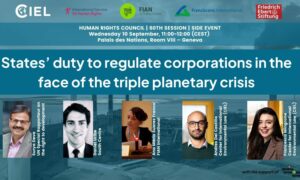
10 Sep 2025
11:00 – 12:00
Venue: Palais des Nations | Room VIII
Organization: Center for International Environmental Law, International Service for Human Rights, FIAN International, Franciscans International, Friedrich-Ebert-Stiftung
This side event to the 60th session of the Human Rights Council (HRC60), organized by the Center for International Environmental Law (CIEL), the International Service for Human Rights (ISHR), FIAN International, Franciscans International, and Friedrich Ebert Stiftung, with the support of the Geneva Environment Network, examined the multiple ways in which corporate power is undermining human rights and the environment across different fora and mechanisms.

About this Event
Effective regulation of businesses is essential to prevent corporate-led environmental and human rights violations, and ensure effective remedies when harm occurs. Corporate influence is already undermining multilateral fora, for instance in the context of the plastic treaty negotiation, whose last iteration concluded in August 2025 (INC-5.2), as well as limiting States’ ability to put in place effective policies, including through Investor-State Dispute Settlement mechanisms. Fossil fuel corporations are among the main contributors to the triple planetary crisis – climate change, pollution, and biodiversity loss – as many human rights experts have warned.
The open-ended intergovernmental working group on transnational corporations and other business enterprises (OEIGWG), whose eleventh session is set for 20-24 October 2025, provides a key opportunity to establish an international legally binding instrument to regulate, in international human rights law, the activities of transnational corporations and other business enterprises.
A growing body of jurisprudence and findings by human rights institutions at the national, regional, and international levels is being developed on the role that corporate actors – especially transnational corporations and financial institutions – play in fueling the environmental crisis and undermining human rights, including the right to a healthy environment, and corresponding responsibilities of States and corporations. The recent advisory opinion of the International Court of Justice (ICJ) on the obligations of States in respect of climate change addressed the question of corporate accountability, affirming that the “[failure] of a State to take appropriate action to protect the climate system from GHG emissions — including through fossil fuel production, fossil fuel consumption, the granting of fossil fuel exploration licenses or the provision of fossil fuel subsidies — may constitute an internationally wrongful act which is attributable to that State”. Similarly, the Inter-American Court of Human Rights’ landmark Advisory Opinion 32 of 2025 on State obligations in addressing the climate emergency called on States to impose stricter duties on companies with high greenhouse gas emissions, implement the ‘polluter pays’ principle, and strengthen the effectiveness of national mitigation measures. The Framework Principles on Human Rights and the Environment, which outline States’ obligations with regard to the right to a healthy environment, also establish that States must regulate private actors that have the potential to harm the environment and human rights.
This side event examined the multiple ways in which corporate power is undermining human rights and the environment across different fora and mechanisms. Panelists reflected on the recent findings of the International Court of Justice and Inter-American Court on Human Rights, and identify key elements and expectations for the eleventh session of the OEIGWG in October 2025. Some concrete cases were discussed to explore the multiple ways in which corporations are undermining effective policy-making, drawing from examples in the context of the plastic treaty negotiations and ISDS mechanisms, and reflect on solutions.
Environment @ HRC60
The 60th Regular Session of the Human Rights Council (HRC60) is taking place in Geneva from 8 September to 8 October 2025. Consult this regularly-updated page that highlighted the environmental-related activities of this session.

Speakers

Surya DEVA
UN Special Rapporteur on the right to development

Daniel URIBE
Lead Programme Officer, Sustainable Development and Climate Change (SDCC) Programme, South Centre

Ana Maria SUAREZ FRANCO
Secretary General, FIAN International

Andres DEL CASTILLO
Senior Attorney, Environmental Health Program, Center for International Environmental Law

Francesca MINGRONE
Senior Attorney, Environmental Health Program, Climate & Energy Program, Center for International Environmental Law
Highlights
Video
Live from Palais des Nations
Summary
Can you give us an overview in how corporate accountability has been addressed in human rights institutions?
Ana Maria SUAREZ FRANCO | Secretary General, FIAN International
Already in the 1970s, civil societies were recalling and asking for corporate accountability (in Latin America). This created an environment where the Global South wanted the bringing of rules to regulate corporate actions. In the Global North, they were not in favour of this; they preferred a voluntary approach (which was the dominant discourse).
In 2010, there was the establishment of the UN Guiding Principles on Business and Human Rights (UNGP) which is voluntary (civil societies have been advocating for shifting this approach). Some organizations left the process because we will never get what we need.
Civil societies then pushed for an intergovernmental working group to adopt a UN legally binding instrument on transnational corporations (TNCs) in respect to human rights (HR), which is a different mandate as it puts the focus on marginalized people and also on connection with environment, including right to a clean, healthy and sustainable environment.
Not only have the UNGP have been the rule, treaty bodies such as the Committee on Economic and Social and Cultural Rights have interpreted their treaties taking into account states duties to regulate, monitor, investigate sanctions and state actors (TNCs – comment #24 in paragraph on extraterritoriality). Since 2013, Ecuador and South Africa passed a resolution 26/9 supported by civil society. We have participated for 11 years and it needs time. But we know that the process is relevant. We have learnt how important it is to connect the environment with human rights.
There have been tensions because some states have wanted to take out this element, others not… It’s still in the negotiation process. But it’s important that this treaty includes environmental and human rights approach, right to healthy environment otherwise it would not be pertinent to the UN Charter’s values.
We mentioned the AO, especially the ICJ and IACtHR, how can the drafts of legally binding instruments be informed by these rulings?
Daniel URIBE | Lead Programme Officer, Sustainable Development and Climate Change (SDCC) Programme, South Centre
The ICJ had an idea of stringent due diligence while IACtHR had an idea of an enhanced standard. The important part is that these ideas belong to CIL, so using existing international law.
Another issue is lex specialis and this has been countered by both Courts, recognising that obligations in international environment law (IEL) apply to international (IL) and international human rights law (IHRL), so there is no difference.
Liability and full reparations: even in cases of violations of hr or obligations should be accessible to full restorations, and this goes with the concept of human right to diligence and standard (stringent obligation).
The news of the ICJ and the AO have the power of countering the prevalent discourse and countering the idea that corporations are outside the sphere of IL. Both courts can be a mechanism for counterbalancing the idea that corporations should be excluded from obligations of the states.
Can you give us a preview of this publication?
Ana Maria SUAREZ FRANCO: The publication is important because it adds up on the collective knowledge on the legally-binding instrument (LBI) process. It reiterates the impacts of the triple planetary crisis. We need to ensure a just transition that this treaty tackles the issue of corporate accountability. We wrote this before the AO and in the following publications we will strengthen this connection.
Some states have proposed some language to be included. We have to recall that the legal experts that are advising the WG also invited states to investigate environmental harms to make it consistent in multilateral and judicial HR and IL. It’s highlighted that LBI is not only an opportunity to put environmental issues on the plate: but that states have obligations of cooperations and enable realisation of HR (extraterritorially) and they need to be effective (these regulations). In this paper we identified elements and we offer very textual proposals.
We put focus on the connection between environment and gender justice: the impact of corporate harm is different depending on the gender. We also refer to environmental impact in terms of occupation and war (mentions of Gaza).
We need to revise article 6 of prevention (its based on an outdated principle and it is known to not be based on real prevention) and article 8 in liability (introduce independence between due diligence and liability) → It should not take only into account risks that were foreseen which they decide to mitigate but they should be able to look into strict liability for fossil fuel process and activities, the duty of care should be into the heart of the duties of what companies have to take into account.
Evidence shows that corporations have been in many ways undermining HR and it is institutionalized in investment-state dispute settlements (ISDS). We thought that it would be interesting to be hearing from you about the problem of ISDS and what is the impact that these mechanisms have on governance.
Surya DEVA | UN Special Rapporteur on the right to development
There is a difference between a duty to regulate vs. the right to regulate. Of course, they have a right to regulate, what is critical to understand is that states have an obligation to regulate (even extraterritorially). HR should be taken into account. We are trying to connect the dots here.
The challenges that businesses are causing are multidimensional (HR, environmental crisis, pollution, etc). The violation of HR is related to the very existence of businesses and corporations. Look at the colonization period and the idea of profit maximization.
Let me pick up on ISDS and pick up on Honduras: this Prospera case. The context: states have a duty to regulate but this is undermined by factors. ISDS (which is part of most investment mechanisms) is highly problematic and constrains states’ duty to regulate. What happened is that in the previous government of Honduras enacted a new legislation to create employment and economic development. And this is done on an island in Honduras, and it is like we had a state within a state (because not all special economic zones are the same). That island has its own civil and commercial law so the laws of Honduras do not apply to the island.
Prospera argues that their rule of law is strong (i.e., arbitration). So a dispute of settlement in arbitration is their rule of law. This is how they continue to market this idea that they come here, they invest here and get a company incorporated and then you have this low tax.
The current government repealed this regressive legislation so it meant that this economic zone became illegal and triggered a claim from Prospera to the Honduras government that is 10.7 billion dollars which is around 30% of Honduras’s GDP. Prospera said that they have certainty for 50 years so that legal certainty prevails over anything else. So if you want to repeal this legislation to protect climate and human rights, this does not matter to them. The Supreme Court of Honduras then had to say this legislation was unconstitutional so basically they upheld the repeal of legislation.
We have lessons to learn: the states do not have just power, they have a duty to regulate. They should not feel powerless. States are not powerless against private actors. So do not create any false illusion. States have power to regulate BUT also a duty to regulate. Put people at the front.
We have situated the issue around ISDS, what can HR mechanisms do to further address this issue?
Daniel URIBE: LBI is not just a political instrument but also a legal instrument. There is a mechanism as a tool to counter regulatory change. There is an important element that implies that there is an obligation of the state to protect human rights and implies regulations, and this regulation comes from international duties and obligations. You have to balance the agreements to protect community effect and protect investors. The idea is to give a stable ground to states to see that these are our international obligations in relation to investors at the national level.
On ISDS, the LBI is establishing the idea of a counterbalancing approach to give rights to businesses, not just investors. This is stated in Article 8 and 9 in respect to action to justice.
In article 9, you have the idea of principle that national courts of any state might say that in this particular case. This court is not the most appropriate court to procure the claims because the claims are happening elsewhere (principle used in international litigation). This idea of not applying of not applying this principle of not convenience has to be sorted.
The idea is that investors that have been able to bring claims to private international tribunal to present a case against a state.even though at the same moment the protectors of hr are trying to bring that case to national courts. The idea of LBI is to prioritize human rights (of communities affected) and they should have access to justice.
On the HRC: what does it do?
- Continue with idea of scrutinizing and looking for HR violations. South Centre has been doing this analysis of seeing how ISDS entrenches HR, including the right to development.
- HRC should give more capacity for the process of environmental growth and capabilities. It should be a continuous process that should include affected communities and technologies that can help us.
- HRC has the capability of identifying standards and establishing standards for human rights. This can be done through resolutions, and could be a resolution looking at environmental impact of ISDS. Another option could be to look at how HRC with its resolutions can be part of a mechanisms of coordination, cohesion and support of existing reform process of ISDS recentering HR.
What does corporate capture look like when we talk about corporate accountability?
Surya DEVA: I wanna make an observation about the LBI: I think we need to think beyond HR due diligence. If we look at binding regulations it is about UNGP duty to regulate and you will hardly find reference to HR due diligence. HR due diligence is part of pillar II, and I think most are not appreciating that pillar I offers a variety of tools to regulate (including ISDS issues, as part of principle 9 of UNGP). We are not trying to address the root causes of business violating hr and remaining unaccountable.
Corporate capture: political, regulatory, economic, and cultural capture.
- Political is significant in democracies and non democracies because businesses make donations to political parties (sometimes on both sides): as such, you have at least a seat on the table. The issue is that businessmen are also politicians and many politicians have their businessm, so we have reflections of the views of the business across the world. If we make to make progress in the HR field we need to bring this political capture to light → there is a complete capture by the political discourse.
- Regulatory capture: many don’t say this publicly but when we talk about regulations, they tell me, “We need to have the buy in by the private sector”. The corporate capture is complete. How do we get to buy in from the private sector? It’s nonsense because you are asking a potential thief to make regulations against theft. We need to understand this regulatory capture → there are many tools.
- Economic capture: this is where ISDS comes in. “We create more jobs for you, we bring technological innovations” → these are devices that businesses use to capture the economic policy space in the countries. In practice, this idea of ease of doing business continues, and this means that their capture in the economic sphere is complete. They need to dilute environmental laws and everything because “growth” is crucial, and we cannot achieve this without businesses…
- Cultural capture: businesses do not have political and economic power. They have a significant cultural power, and they are promoting that cultural power in terms of how we eat, what we drink and what we do and everything is regulated by businesses for their purposes. For instance, we want to buy more and more and this inherently consistent with the triple planetary crisis. They are also misappropriating Indigenous knowledge → these are the new tools that they use.
When we talk about corporate accountability, is particularly problematic in the plastic negotiation context, can you provide examples of what corporate capture looks like from what you have witnessed?
Andres DEL CASTILLO | Senior Attorney, Environmental Health Program, Center for International Environmental Law
During the second day, the UN released the list of participants, and CIEL, the same day, published a report on the number of oil and gas and chemical industry lobbies and now the trends are confirmed that there are more lobbies (around 234). Chemical industries lobbies outnumbered the combined diplomatic delegations of the 27 EU member states. What is impressive is that you are already winning the delegations (19 fossil fuels that got lost in more than 6 countries).
There were 36 Indigenous People, so you have the right to buy 7:1.
Corporate capture is very problematic when it comes to chemicals. If you see a scientist coalition, there are 60 scientists so almost 4 times more lobbyists than scientists). But they don’t have the same access means as politicians. Their presence is the tip of the iceberg: it allows lobbyist to be watchdogs and whenever they see an ambition country that wants to make sure that plastics are regulated globally. They call capitals, and they tell the ministers of economy how these delegates are numbering the economics of the country/is against the economy of that country.
Under the UNFCCC, we are seeing that they are also in the driving seat. There are people denying the climate crisis and it is eroding nationally democracies and rule of law and international level it erodes what we are trying to do with governance. There is a duty to cooperate not corporate. When you come to negotiate as a country , you need to make sure that those negotiations go with rules that need to be fair and accessible for the right people that are affected.
Vulnerable groups: the room at the plastics treaty negotiations was against regulating LED in toys for kids. You have countries that are against removing these chemicals in toys. This shows how eroded the negotiations to the point that they don’t even care about children’s health.
What opportunities are there in upcoming meetings to effectively counter corporate capture?
Andres DEL CASTILLO: In the UNFCCC, you have seen the secretariat has a will to change the ways things are done at the COP and one way is to address corporate capture, specifically counter interests there. At every state, when possible, it is necessary to mention corporate capture and the need to address it. There are different tools: at national level, the UN framework convention on tobacco control which tells companies to regulate themselves (so there is precedent).
We need to make sure how many lobbyists there are at the negotiations.
In December there might be a resolution on corporate interests but we don’t have any mandate to work at the national level.
We need to make sure that there are some links with what the special rapporteur already mentioned and the concerns they raised.
Open floor for questions or comments
Ecuador: I have a question that goes beyond plastics treaty negotiations and other forums. I hope to achieve something like 5.3 on the Convention of Tobacco Control and other legal instruments. We know this is the reality and we have at the same time the request for a wider stakeholder participation in all processes including UNFCCC, opening the door to questions of Indigenous People and other stakeholders. How to make a division to ensure balance so that that aspiration that don’t yet exist (like 5.3) in other conventions could be implemented?
Andres DEL CASTILLO: In subsidiaries bodies dealing with societies, it is important to have the templates of disclosure of corporate interests. The other is that we need to recognise the need to protect converters’ interests because plastic is something because of the supply chain, businesses can be many. Then the distinction between stakeholder and rightsholders is also important
Ana Maria SUAREZ FRANCO: We need to differentiate which are the actors and the symmetries in the process to make clear why we need to differentiate the spaces and companies not in the processes. This also explains why the tripartite model is not functioning in this type of negotiations and for that we need political models (states’ alliances to defend their sovereignty and civil societies bringing their evidence). I hope negotiating states can bring in the proposals that we have on corporate capture.