
Événement Conférence
Chemicals and Waste Negotiations Briefing 2026

12 Fév 2026
10:00 – 12:00
Lieu: International Environment House I | Room 3 & Online | Webex
Organisation: Geneva Environment Network, Global Framework on Chemicals, Conventions de Bâle, Rotterdam et Stockholm, Convention de Minamata sur le Mercure, Branche produits chimiques et déchets du PNUE
This briefing, organized within the framework of the Geneva Environment Network, provided an overview of the status of the negotiations related to chemicals and waste and upcoming important conferences.

About this Event
This Chemicals and Waste Negotiations briefing, organized within the framework of the Geneva Environment Network, provided an overview of the work and key activities to advance the sound management of chemicals and waste globally. It reviewed the outcomes of the negotiations related to chemicals and waste that took place in 2025 and in early 2026, and presented the latest information on the important conferences scheduled in 2026, as well as a follow-up on resolutions adopted at the UN Environment Assembly.
In 2026, major meetings and negotiations on chemicals and waste include:
- 1 – 6 February | 1st Session of the Plenary of the Intergovernmental Science-Policy Panel on Chemicals, Waste and Pollution (ISP-CWP P1) | CICG
- 7 February | Third part of the fifth session of the Intergovernmental Negotiating Committee to develop an international legally binding instrument on plastic pollution, including in the marine environment (INC-5.3) | CICG
- 9 – 11 February 2026 | Minamata Convention Eighth Meeting of the Effectiveness Evaluation Group (EEG-8) | International Environment House
- 16 – 19 June | Second meeting of the Stockholm Convention Compliance Committee (SC CC-2) | International Environment House
- 18 – 21 June | Seventeenth meeting of the Basel Convention Implementation and Compliance Committee (BC ICC-17) | International Environment House
- 19 – 21 June | Fourth meeting of the Rotterdam Convention Compliance Committee (RC CC-4) | International Environment House
- 23 – 26 June | 15th meeting of the Open-ended Working Group of the Basel Convention (BC OEWG-15) | CICG
- 28 – 30 June | 5th High-Level Ministerial Conference on AMR | Abuja, Nigeria
- 14 – 18 September | 22nd Meeting of the Chemical Review Committee (Rotterdam Convention) | CRC-22 | Rome, Italy
- 21 – 25 September | 22nd Meeting of the Persistent Organic Pollutants Review Committee (Stockholm Convention) | POPRC-22 | Rome, Italy
- 16 – 20 November | The Global Framework on Chemicals – First International Conference (GFC IC1) | CICG
Speakers
By order of intervention.
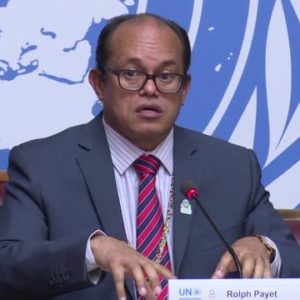
Rolph PAYET
Executive Secretary, Basel, Rotterdam and Stockholm Conventions | Chair
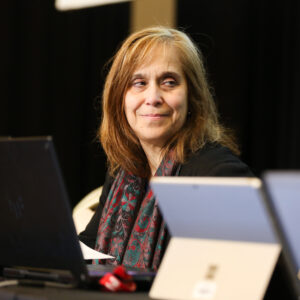
Jacqueline ALVAREZ
Chief, Chemicals and Health Branch, UNEP

Monika STANKIEWICZ
Executive Secretary, Minamata Convention on Mercury

Susan WINGFIELD
Programme Officer, Governance Branch, Basel, Rotterdam and Stockholm Conventions

Kay WILLIAMS
Head, Global Framework on Chemicals
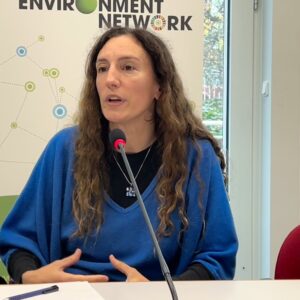
Aitziber ECHEVERRIA
Programme Management Officer, Chemicals and Health Branch, UNEP

Juliette KOHLER
Chief, Governance Branch, Basel, Rotterdam and Stockholm Conventions
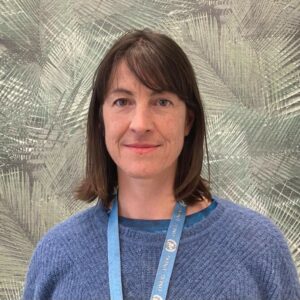
Eloise TOUNI
Programme Management Officer, Chemicals and Health Branch, UNEP

Brenda KOEKKOEK
Senior Coordination Officer, Minamata Convention Secretariat

Sara BROSCHÉ
Science Advisor, IPEN

Océane DAYER
Waste and Chemicals Focal Point, Federal Office for the Environment, Switzerland
Highlights
Video
Live from the International Environment House.
Summary
Opening Remarks
Rolph PAYET | Executive Secretary, Basel, Rotterdam and Stockholm Conventions
- A lot has been happening here in Geneva since the beginning of the year.
- State representatives and international organizations in Geneva play a key role in advancing our shared work and coordinating with the capitals to help us facilitate decisions at the highest possible political levels. Your commitment here in Geneva truly makes a real difference in our work.
- 2025 was an exceptionally active and dynamic year for the chemicals and waste cluster, with the Conferences of the Parties and several committees convening.
- For the BRS Conventions, 2026 is a year that will be focused on implementation.
- We have also already begun the year at full speed as we look ahead to the 2027 BRS COPs, which will be held in Panama City, Panama.
- During this intersessional period, significant must be advanced to ensure we can deliver on our program of work for the period at the 2027 COPs.
- Key body meetings scheduled for 2026 include:
- 16 – 19 June | Second meeting of the Stockholm Convention Compliance Committee (SC CC-2) | International Environment House
- 18 – 21 June | Seventeenth meeting of the Basel Convention Implementation and Compliance Committee (BC ICC-17) | International Environment House
- 23 – 26 June | 15th meeting of the Open-ended Working Group of the Basel Convention (BC OEWG-15) | CICG
- 14 – 18 September | 22nd Meeting of the Chemical Review Committee (Rotterdam Convention) | CRC-22 | Rome, Italy
- 21 – 25 September | 22nd Meeting of the Persistent Organic Pollutants Review Committee (Stockholm Convention) | POPRC-22 | Rome, Italy
-
The 6th round of national reporting under the Stockholm Convention has been launched and all parties are encouraged to submit their reports electronically through the electronic reporting system available in all UN languages. The deadline for submission is 31 August 2026.
- Isabel Martinez has been appointed as the Deputy Executive Secretary of the Basel, Rotterdam, and Stockholm Conventions. She has been working in various roles within UNEP over the years, bringing more than three decades of dedicated service to multilateral environmental governance and a career marked by collaboration.
- The work ahead will rely greatly on your continued leadership and coordination. Your engagement as permanent missions and official contact points will be essential for our next phase.
Jacqueline ALVAREZ | Chief, Chemicals and Health Branch, UNEP
- While this is the first briefing of the year, UNEP and the various chemicals and waste MEAs have already been providing various briefings and updates on the work plan of the year. This is an implementation year for many different things, marking important milestones for the chemicals agenda.
Updates from ISP-CWP P1
- Last week, the Intergovernmental Science Policy Panel on Chemicals, Waste and Pollution (ISP-CWP) held its first plenary meeting in Geneva. The science-policy panel has been created in compliance with a member state’s decision taken at UNEA in 2022, and it was formally established last year in Punta del Este, Uruguay.
- The first plenary, initially presided over by UNEP Executive Director Inger Andersen, aimed to adopt the UNEA rules of procedure, but it did not happen like that. Since the panel is a very important element and structure within environmental governance, members wanted to make all the conditions stable and known to everyone.
- We therefore started with the election of Osvaldo Álvarez Pérez from Chile as the Chair of the meeting.
- The plenary also elected by acclamation bureau members from four out of the five UNEP regions: Belgium, China, the Democratic Republic of Congo, Kenya, Mexico, Saudi Arabia, and the United Kingdom of Great Britain and Northern Ireland are part of the bureau. Two remaining seats are still under discussion by the Eastern European group, and we hope to hear from them very soon.
- The plenary decided that the term for these officers is two years, and agreed to continue discussions on the rules of procedure in a contact group.
- As of now, we have 129 members of the panel. We started with 97, and this increase demonstrates that the rate of interest is huge, with more than 30% additional member states expressing their wish to be part of the panel.
- It is also important to note that around 550 participants attended the meeting: the panel is intergovernmental, but the representation of other stakeholders is critical and very substantive, as we saw during the meeting.
- The Chair will soon host a bureau meeting to discuss the continuation of the Panel’s work. So far, about half of the rules of procedure have been adopted ad referendum, but further work is still needed.
- One of the most important elements of the rules relates to the Interdisciplinary Expert Committee (IEC). Discussions on this have not yet fully started, but it is understood to be at the core of the panel’s functioning
- Other policies and structures, including the conflict of interest policy, have also not yet been discussed. This will be an important topic for the future operationalization of the panel.
- We look forward to continuing to work with all of you in this process. We will inform you when and where the next session will take place.
Monika STANKIEWICZ | Executive Secretary, Minamata Convention on Mercury
- When we met last year, I mentioned the high prices of gold, which led to more mining, more mercury use, and more releases of chemicals to the environment. This year, these prices are even higher. This is an example of the challenges that conventions in the chemicals and waste cluster have to face head-on.
- The Sixth COP of the Minamata Convention (Minamata COP6), held in November 2026 in Geneva and presided over by Osvaldo Álvarez Pérez of Chile, once again demonstrated the strong collective commitment of parties and stakeholders to address mercury challenges. It was a success not only because of the decisions adopted, but also because of the constructive and collaborative spirit that guided the negotiations. Consensus prevailed and discussions remained smooth throughout the COP.
- Three examples of agreements made illustrate this progress.
- Mandating work to analyze a transparency and certification mechanism in the supply chain that could help reduce mercury use in gold mining.
- The agreement to phase out the use of dental amalgam globally. This was an issue that a few years ago could not really be agreed upon, but there has been a significant shift in approach, also thanks to the strong engagement of stakeholders across all continents.
- The broadening of stakeholder participation at the COP through the launch of the Convention’s Women’s Caucus, the Youth Declaration, and the establishment of the International Indigenous Peoples Forum on Mercury.
- This commitment is also related to having a clear vision of what is to be achieved and the pathways to reach this goal, as prescribed in the legally binding convention. There is clarity on what must be done to address mercury and chemicals overall.
- One issue I would like to address today is the importance of the Global Environment Facility (GEF) as the financial mechanism of some of our conventions to support implementation. COP successes are important, but even more important is that implementation takes place on the ground, and for that, we need resources.
- There is increasing emphasis within the GEF on integrated programs, combining the goals and objectives of multiple MEAs.
- Within the chemicals and waste cluster, we have a good understanding of how best to integrate and achieve strong results.
- We have been very active in replenishment meetings and other events to share this perspective.
- An important aspect is to ensure that integrated programs and projects follow the priorities set by our parties.
- For the Minamata Convention, one such priority is linkages to biodiversity.
- There is an important opportunity ahead in relation to the Convention on Biological Diversity (CBD).
- Last year, an agreement was reached to put forward a proposal to the CBD COP later this year to establish an ad hoc expert group on biodiversity and pollution to develop guidance on addressing the impacts of pollution on biodiversity.
- If adopted, this would provide a mechanism for even stronger interaction between the mercury and biodiversity agendas, something we have been pursuing for some time.
- The second component of the financial mechanism of the Minamata Convention is the Special International Programme, a small grants programme. Following the recent launch of a call for project proposals, we have already received substantial contributions from parties. I would like to thank Austria, Germany, France, Sweden, and the United Kingdom for their support and invite additional contributions.
- This week, we also concluded a meeting of the Effectiveness Evaluation Group. Effectiveness evaluation is a process to assess how the convention is performing, what is working well, where we see impact, and what needs to be improved.
- The Stockholm Convention has been conducting this process for some time, and we are now following in those footsteps.
- Recommendations will be presented at the next Minamata Convention COP, which will also mark the tenth anniversary of the Convention.
- This will be a timely opportunity to take stock and guide our future action.
Basel Convention OEWG-15
Susan WINGFIELD | Programme Officer, Governance Branch, Basel, Rotterdam and Stockholm Conventions
- The Open-Ended Working Group is an important technical subsidiary body of the Conference of the Parties to the Basel Convention.
- The meeting takes place midway between COPs. The last COPs concluded in May 2025, and the next COPs will take place in April 2027.
- The OEWG is therefore an opportunity to take stock of the work done intersessionally to implement COPs mandates and to prepare the technical, scientific and legal work for the next COPs.
- The 15th meeting of the Open-ended Working Group of the Basel Convention (BC OEWG-15) will be held from 23 to 26 June 2026 at the CICG. It is a four-day meeting, preceded by regional meetings and bureau meetings on Monday, 22 June 2026. There will be several back-to-back meetings of the conventions, including the compliance committees of the Basel, Rotterdam and Stockholm Conventions.
- France, Norway and Switzerland have generously provided funding to support travel for participants, and efforts to mobilize additional funding are ongoing.
- There will also be opportunities for side events, with details to be published shortly.
- Meeting documents are being prepared and will be made available from 23 April 2026, two months before the meeting. The provisional agenda (UNEP/CHW/OEWG.15/1) is already available.
Registration
- Registration is now open through the electronic registration system and should be accompanied by an official nomination letter from the Government or a note verbale from the Permanent Mission. No credentials are needed for this meeting.
-
The deadline for parties is 5 March 2026 and for observers in 8 May 2026.
OWEG-15 Agenda
- The provisional agenda is already available on the Open-ended Working Group webpage.
- The tentative schedule and scenario note will follow, after approval by the bureau in early March.
- The meeting is expected to open in plenary on Tuesday, with main topics introduced over approximately one and a half days.
- By Wednesday at lunchtime, discussions are expected to move into contact groups.
- Three contact groups are anticipated, two of which would run in parallel, covering strategic, technical and legal matters.
- The meeting would return to plenary on Friday to consider and adopt the outputs of the contact groups.
- Strategic Matters
- Parties will consider ongoing discussions on improving the functioning of the prior informed consent procedure (FPIC).
- A report was submitted to the last COP and several streams of work have since been undertaken.
- The OWEG will hear updates and discuss possible next steps.
- Technical Matters
- Will include further work on technical guidelines, which supplement the provisions of the Convention and provide detailed guidance on environmentally sound management of waste streams.
- There will be work on updating and developing new technical guidelines on persistent organic pollutants (POPs), in line with new listings under the Stockholm Convention.
- The e-waste technical guidelines, previously adopted, will be updated based on the experience gained from testing and piloting them.
- Additional work will focus on specific waste streams, including lead-acid batteries and other batteries, tyres, and mercury. The mercury guidelines will be updated to reflect decisions taken at the last Minamata COP.
- Other technical matters include national reporting, possible changes to the reporting format and associated guidance, and discussions on plastic waste. This provides an opportunity to consider work already undertaken under the Basel Convention, including the plastic waste amendments, and whether additional work should be initiated.
- A new agenda item concerns used textiles and textile waste. Following discussions at the last COP, a report has been prepared based on feedback from parties and observers. The Open-ended Working Group will consider this report and decide what recommendations to forward to the COP.
Legal Matters
- There will be continued discussion on providing further legal clarity, including amendments to annexes of the Convention.
- Annex IV was amended at the last COP, and there will be consideration of its implications.
- Further discussions are also expected on possible amendments to Annexes I and III.
International Cooperation and Coordination
- The partnership programme will consider progress under three partnerships: the Partnership for Action on Computing Equipment, including new cooling and heating guidance, the Household Waste Partnership, and the Plastic Waste Partnership.
- There will also be discussions on cooperation with the World Customs Organization to harmonize Basel waste codes with Harmonized System codes.
- A new agenda item concerns cooperation with the International Maritime Organization on ship recycling, particularly in light of the entry into force of the Hong Kong Convention and its relationship with the Basel Convention.
Global Framework on Chemicals First International Conference
Kay WILLIAMS | Head, Global Framework on Chemicals
- The Global Framework on Chemicals is one of the more recent agreements, adopted in 2023 in Bonn after difficult negotiations. We now have a structured framework with 5 strategic objectives and 28 targets, and the focus since adoption has been on implementation.
- 2026 will be a very important year. A lot of work is focused on implementation, and we are investing heavily in our focal points. The framework is multisectoral and multistakeholder. We have focal points at the national level, in the private sector and in civil society. We also work across sectors such as health and labour, and we have alternate focal points in those areas. We are carrying out training and induction for newly appointed focal points.
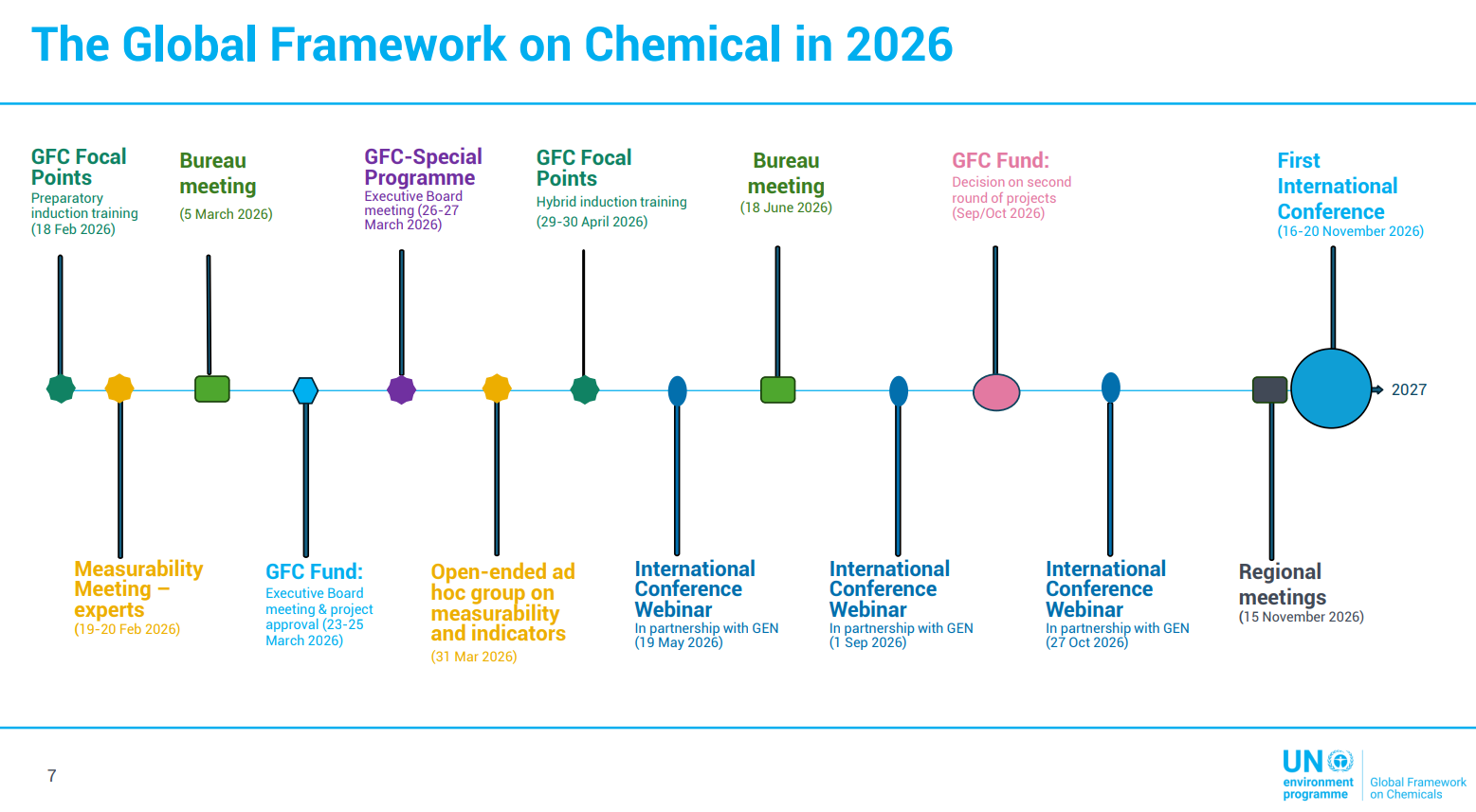
- A key area of work is measurability and indicators. Since the adoption of the framework, we have been working on a suite of indicators to assess progress. Many of the targets are to be achieved by 2030, and it is critical that we understand whether we are on track.
- We have two important funding mechanisms.
- One is the Global Framework on Chemicals Fund, a trust fund established under the framework.
- The other is the Special Programme, established under UNEA, which supports institutional strengthening across the chemicals and waste cluster. The boards of both funds will meet for the Fourth meeting of the Executive Board of the Global Framework on Chemicals Fund from 23 to 25 March 2026 in Geneva.
- Decisions on the second round of funding under the Global Chemicals Fund will be taken later this year.
- Implementation programs are central to the framework. We are working closely with the Inter-Organization Programme for the Sound Management of Chemicals (IOMC), which has shown leadership in bringing forward two global implementation programs on:
- Legal frameworks and institutional capacities for chemicals management.
- Engagement with economic and industry sectors, under which we are engaging new stakeholder groups, specifically in textiles, electronics, building and construction, and healthcare. These programmes are being developed while activities are already underway.
- Health and labour are also very important pillars of the framework.
- On health, we are reinforcing national health mandates and linking chemical management to disease prevention and exposure control. Not all institutions fully appreciate the linkages between chemicals and health, so coordination at the national level is critical.
- On labour, the coming years are important because of negotiations on a chemicals protocol under the international labour framework. This will be significant for how we address chemicals through occupational health and safety.
- The Global Framework on Chemicals Fund currently holds approximately 228 million US dollars. The fund is operational.
- In the first call for proposals last year, four regional projects were approved, covering 11 countries in Latin America and Africa.
- For the second round, we introduced a concept note stage. Over 130 eligible concept notes were received. These are being reviewed in preparation for the executive board meeting in March, and decisions on the second round of projects will follow later in the year.
- The approved projects focus on regional coordination and collaboration to enhance impact. We are working closely with the Special Programme, which supports national-level institutional strengthening, and building on that work to move to regional scale. Some funding can go directly to civil society organizations to coordinate regional activities.
- The Special Programme remains critical because it provides the institutional foundations necessary for effective chemicals management.
- Without strong national regulatory systems, it is difficult to ensure safe and sustainable management of chemicals.
- The Special Programme has now completed eight rounds of applications, with 91 approved projects in 75 countries.
The First International Conference of the Global Framework on Chemicals
- The Global Framework on Chemicals – first International Conference will take place from 16 to 20 November 2026 in Geneva, preceded by briefings and regional Meetings on 15 November 2026.
- Various sessions will be held in preparation for the conference. → Road to the First International Conference of the Global Framework on Chemicals
- We are working closely with the Basel, Rotterdam and Stockholm Conventions, with the Minamata Conventions, and with the Intergovernmental Science-Policy Panel on Chemicals, Waste and Pollution to maximize synergies.
- The conference will focus on tracking progress against the 28 targets and five strategic objectives. We will assess whether we are on track, with most targets due by 2030 and some by 2035. Based on that assessment, we aim to accelerate action in key areas, prioritize efforts, and strengthen partnerships.
- Another key focus will be increasing investment. We are engaging the finance sector, including investors and banks, to mobilize resources and transform industries such as textiles, electronics, building and construction, and healthcare.
- A major expected outcome of the conference is the adoption of the indicators under the measurability framework. Engagement in the intersessional open-ended working group on measurability and indicators is encouraged, with a meeting planned towards the end of March (Eighth meeting of the open-ended ad hoc group on measurability and indicators)
-
The conference will also consider actions and terms of reference for implementation programmes, and review new and existing issues of concern. If there is an issue of concern that could be addressed under the framework, the application process is open until 31 May 2026.
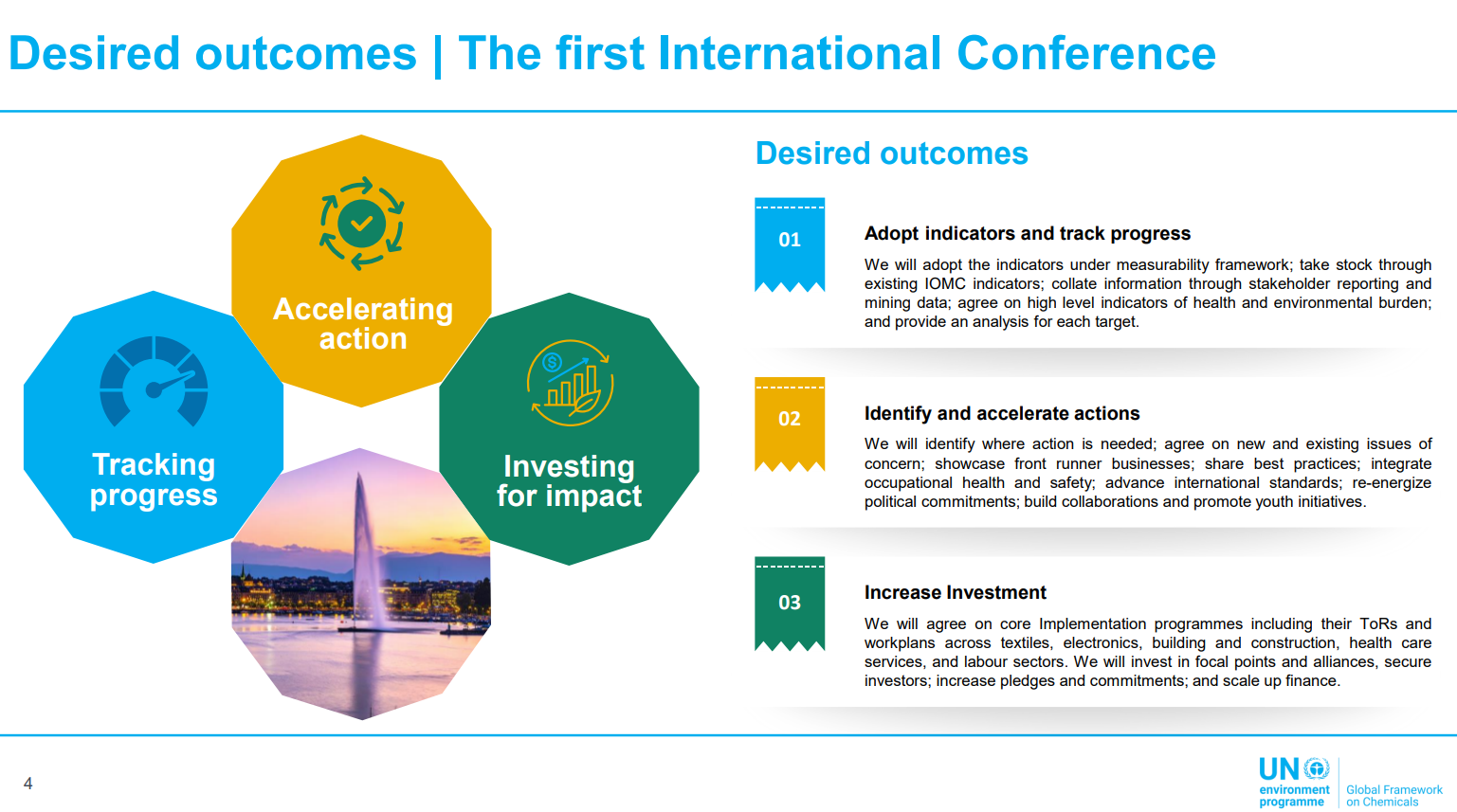
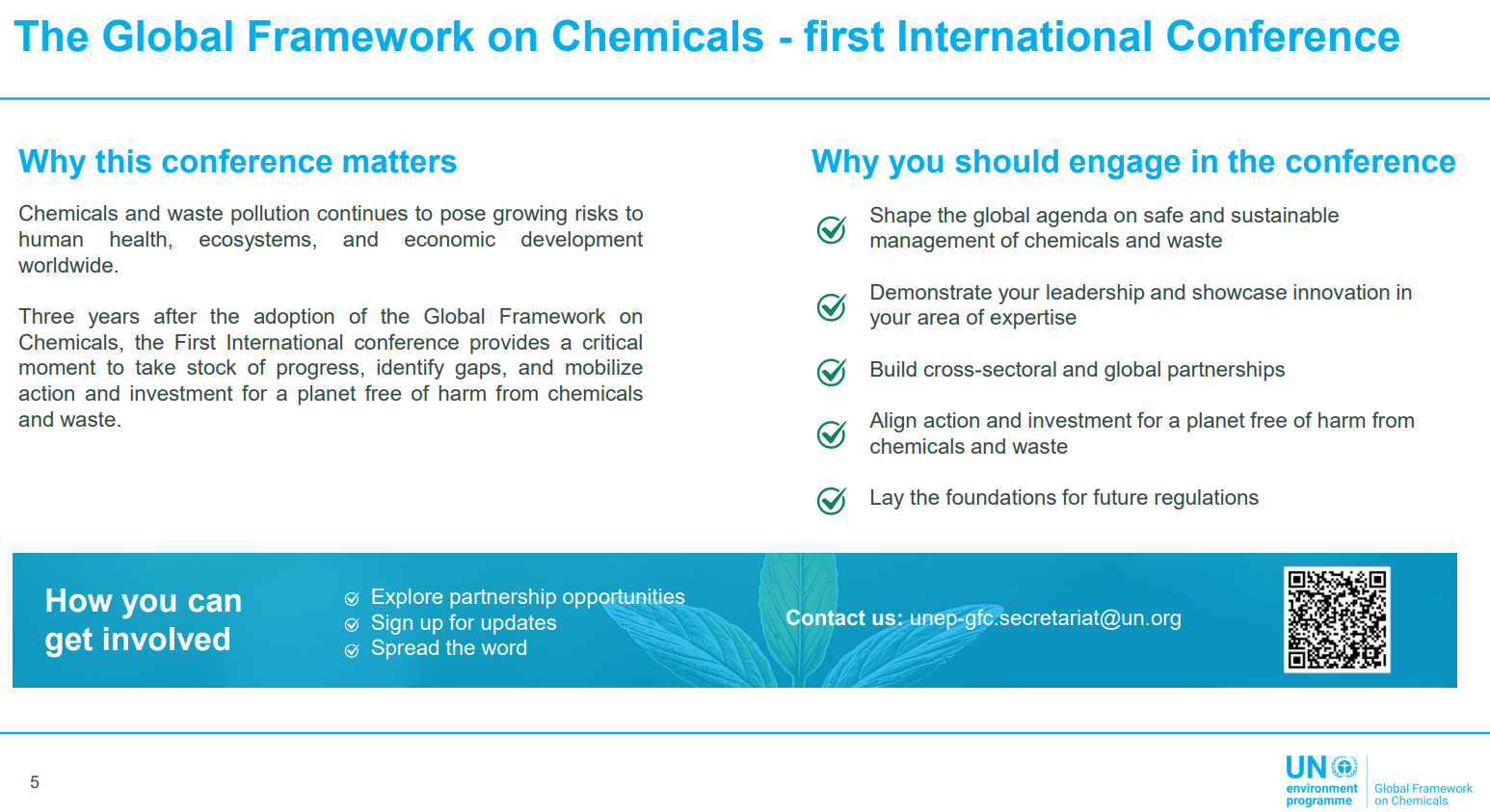
- Three years since adoption, this is a critical moment to identify gaps and mobilize action.
- The framework is voluntary, which allows flexibility and innovation, and we welcome new approaches and ideas in the lead-up to the conference.
- Engagement is encouraged for those who want to shape the global agenda, showcase innovation, build cross-sectoral partnerships, invest in transformative action, and contribute to a planet free of harm from chemicals and waste.
- There are multiple entry points for engagement, including on legislative frameworks, sectoral partnerships, and through newsletters and updates.
- Continued contributions and pledges are essential. Without them, implementation would not be possible. We remain deeply grateful for the support received and look forward to working together to deliver on the framework’s targets.
Updates on AMR, including the 5th High-Level Ministerial Conference on AMR
Aitziber ECHEVERRIA | Programme Management Officer, Chemicals and Health Branch, UNEP
- Environmental action is essential in the global response to antimicrobial resistance (AMR), including in the current political momentum.
- Antimicrobial resistance occurs when microorganisms, bacteria, viruses, fungi and parasites no longer respond to agents designed to kill them. They develop resistance to antimicrobials.
- AMR is recognized as one of the top 10 global public health threats. Projections indicate that if no action is taken, by 2050, we could see three deaths per minute.
- AMR has a devastating impact not only on human health but also on economic development, livestock production, food security and environmental sustainability.
- Although it is often discussed in the context of human health or agriculture, AMR is a global threat that cuts across all sectors.
- The environment plays a key role in the development, transmission, and spread of AMR. When antimicrobials, resistant microorganisms or resistance genes are released into the environment, they can select for further resistance and increase the burden.
- While understanding of the environmental contribution to AMR is still evolving, we already know enough to act and ensure that the environment is a core part of the solution.
- Over the last decade, we have seen significant global momentum.
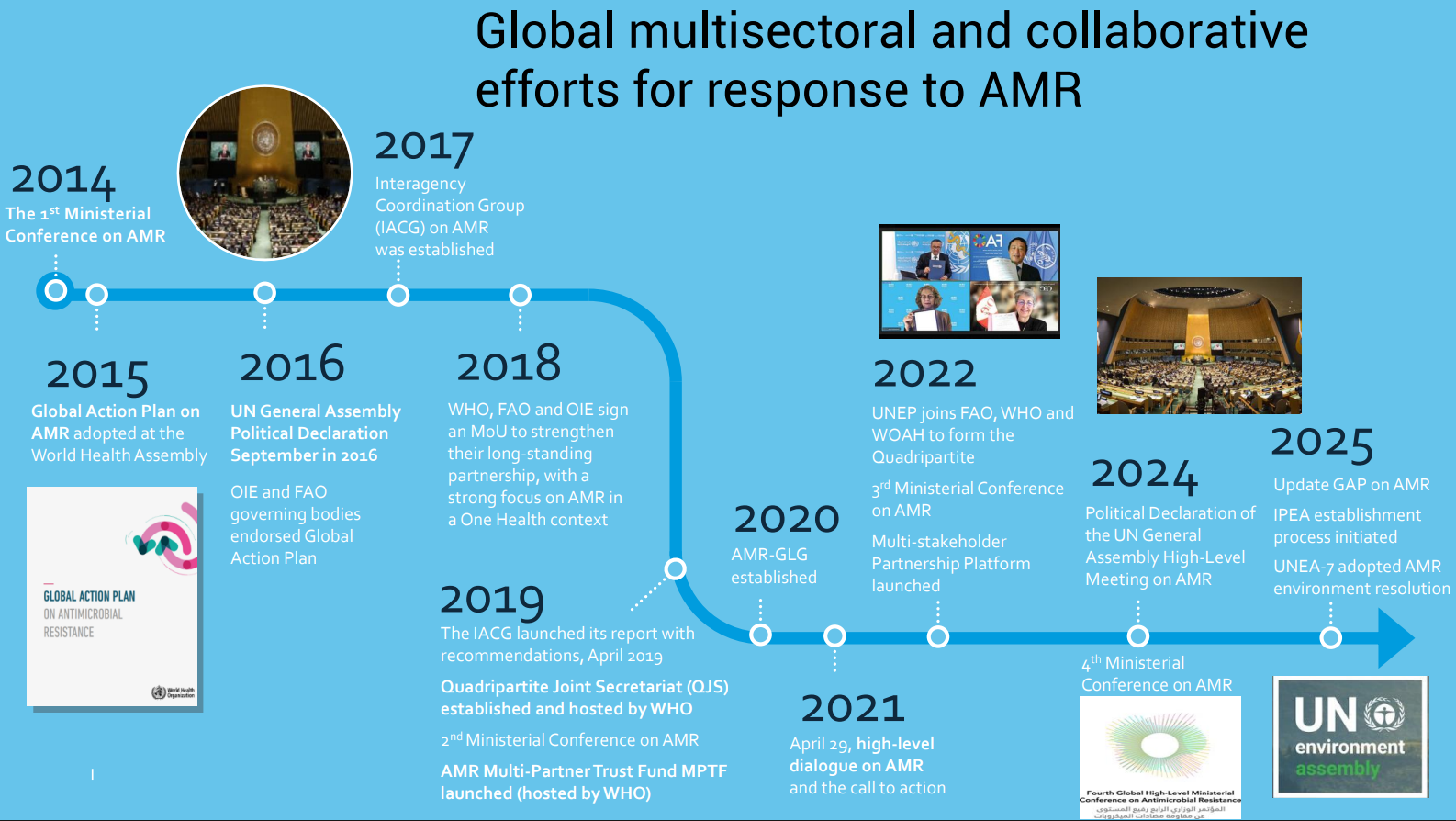
- Given the multidimensional nature of AMR, the Food and Agriculture Organization (FAO), UNEP, the World Health Organization (WHO) and the World Organization for Animal Health (WOAH), which make up the Quadripartite Joint Secretariat on Antimicrobial Resistance, are working together as the central coordinating mechanism for the multisectoral response to AMR.
- UNEP supports global governance architecture and collaborates across key technical streams, including awareness raising, legislation support, research, integrated surveillance and economic analysis. This integrated One Health approach ensures coherence between human, animal, plant, and environmental sectors.
- Within this framework, UNEP plays the leading role in the environmental dimension of AMR. Our work focuses on four main areas, based on the 2023 report and its call to action.
- Strengthening environmental governance, planning, and regulatory frameworks.
- Promoting evidence generation and knowledge sharing to support policy and action.
- Raising awareness of environmental AMR risks.
- Scaling up preventive action in key value chains that drive AMR in the environment. These value chains include pharmaceutical manufacturing, animal production, crop production and healthcare facilities. Households and municipal systems are also critical components.
- UNEA-7 adopted a resolution on the environmental dimensions of AMR (UNEP/EA.7/Res.11), giving UNEP a strong mandate to deepen this work and support countries in translating global guidance into national action.
- Ministerial high-level meetings have been instrumental in maintaining political momentum.
- The first two (June 2014 and June 2019), hosted by the Netherlands, led to outcomes including the establishment of the AMR Multi-Partner Trust Fund, a key multisectoral financing instrument.
- The third meeting held in Oman in November 2022 resulted in the Muscat Manifesto.
- The fourth, held in Jeddah in 2024, saw the adoption of the Jeddah Commitments.
- The next milestone is the 5th Ministerial High-Level Meeting will take place in Abuja, Nigeria, from 28 to 30 June 2026, under the theme “One Health: Advancing Global AMR Commitments through Local Action.”
- At this meeting, there will be a round table to leverage and replenish the AMR Multi-Partner Trust Fund and to advance the establishment of the Independent Panel on Evidence for Action against AMR, both mandated by the UN General Assembly.
- This will be a critical opportunity to reinforce multisectoral implementation on the ground and to elevate the environmental dimension of AMR within the global response.
Updates from the Basel, Rotterdam and Stockholm Conventions
Juliette KOHLER | Chief, Governance Branch, Basel, Rotterdam and Stockholm Conventions
2027 BRS Conference of the Parties (COP)
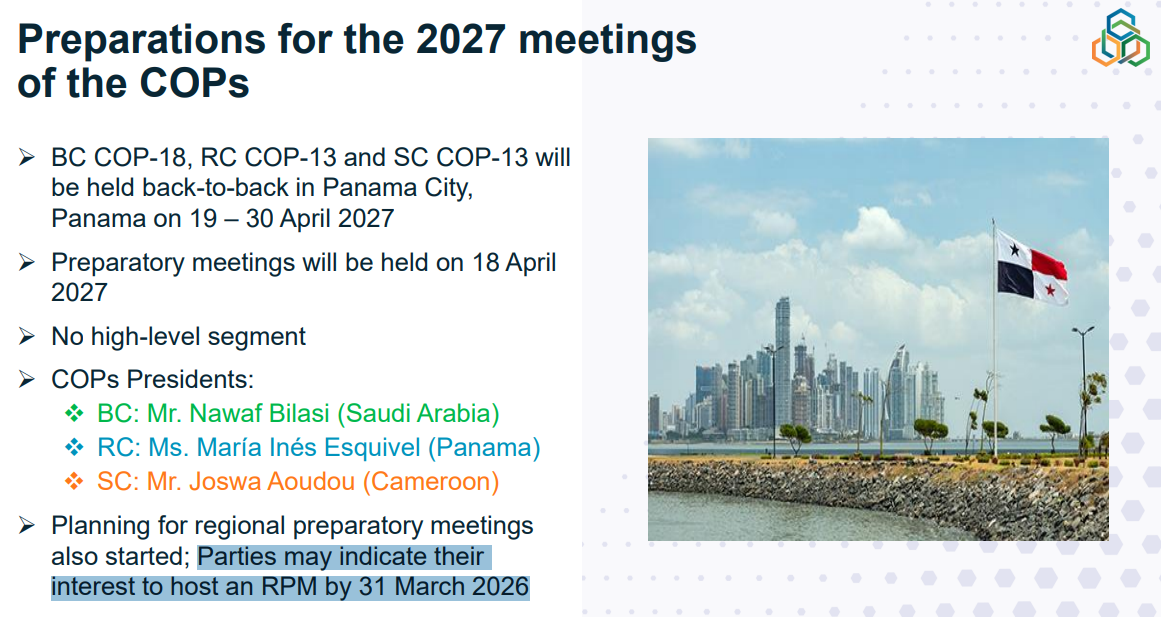
Bureau Meetings
- The planning towards the COPs includes bureau meetings. The three COP bureaux will meet individually and once jointly.
- The individual meetings will take place online between May and July this year:
- 18 – 19 May 2026 | SC COP Bureau meeting
- 20 – 21 May 2026 | RC COP Bureau meeting
- 30 June – 1 July 2026 | BC COP Bureau meeting, just after OEWG 15 so the bureau can reflect on the outcomes of that meeting to plan the work during the COPs.
- The joint bureaux meeting will be held on 23 – 24 November 2026 in Geneva, and it will look at:
- The organization of work for the three COPs.
- The theme for the meetings.
- Facilitating the process for nominations for elections during the COPs.
- Guiding preparations for the regional preparatory meetings.
- Hearing feedback and updates on fundraising efforts.
- Agreeing on the approach to review credentials put forward by parties during the COPs.
Compliance Committees
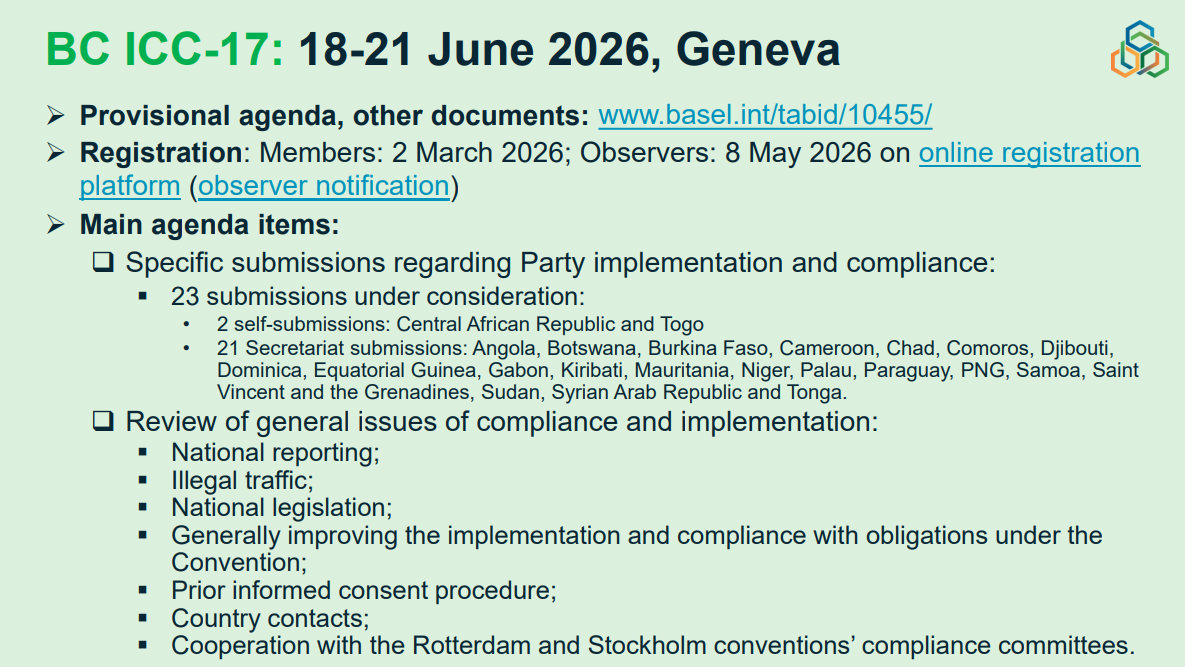
Basel Convention Implementation and Compliance Committee (ICC-17)
- BC ICC-17 will be held from 18 to 21 June 2026 in Geneva
- The registration deadline for Members is 2 March 2026 while for the observers is 8 May 2026
Rotterdam Convention Compliance Committee (CC-4)
- The fourth meeting of the Rotterdam Compliance Committee will take place back-to-back from 19 to 21 June 2026.
- The registration deadline for Members is 2 March 2026 while for the observers is 8 May 2026
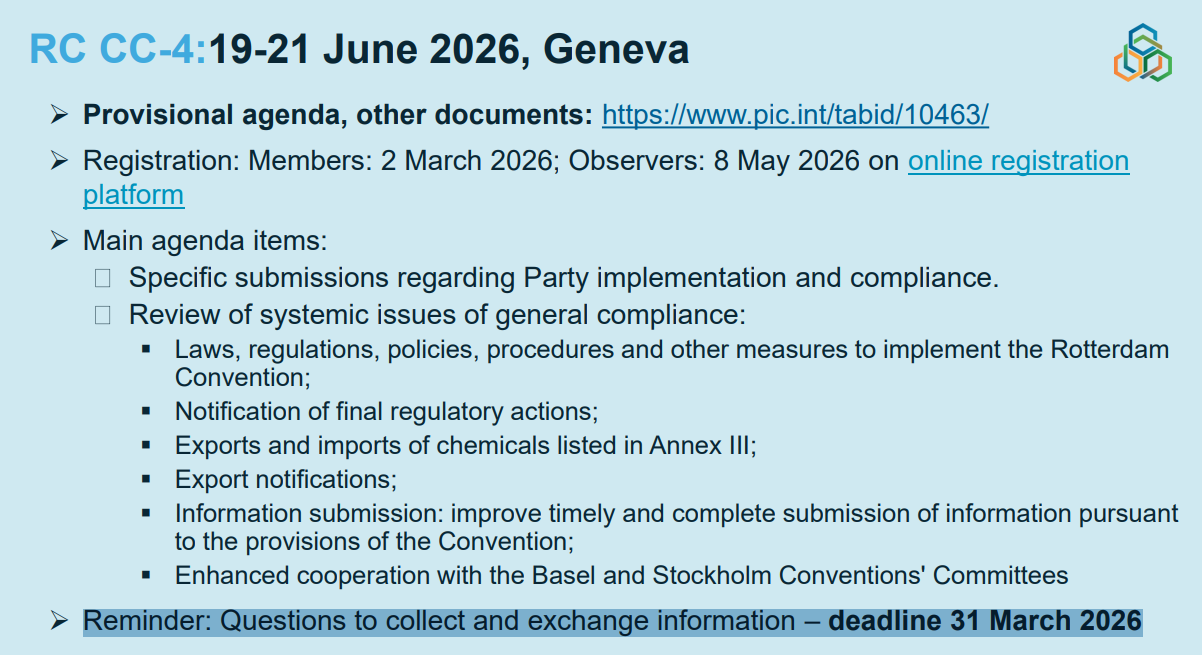
- A questionnaire to collect and exchange information has been sent to parties. The deadline is 31 March 2026. The information received is critical to ground the committee’s work in reality.
Stockholm Convention Compliance Committee (CC-2)
- The Stockholm Convention Compliance Committee was established at the 2025 COP. It already held a first online meeting in November to set the scene. The second meeting, to be held from 16 to 19 June will be its first face-to-face meeting.
- The registration deadline for Members is 2 March 2026 while for the observers is 8 May 2026
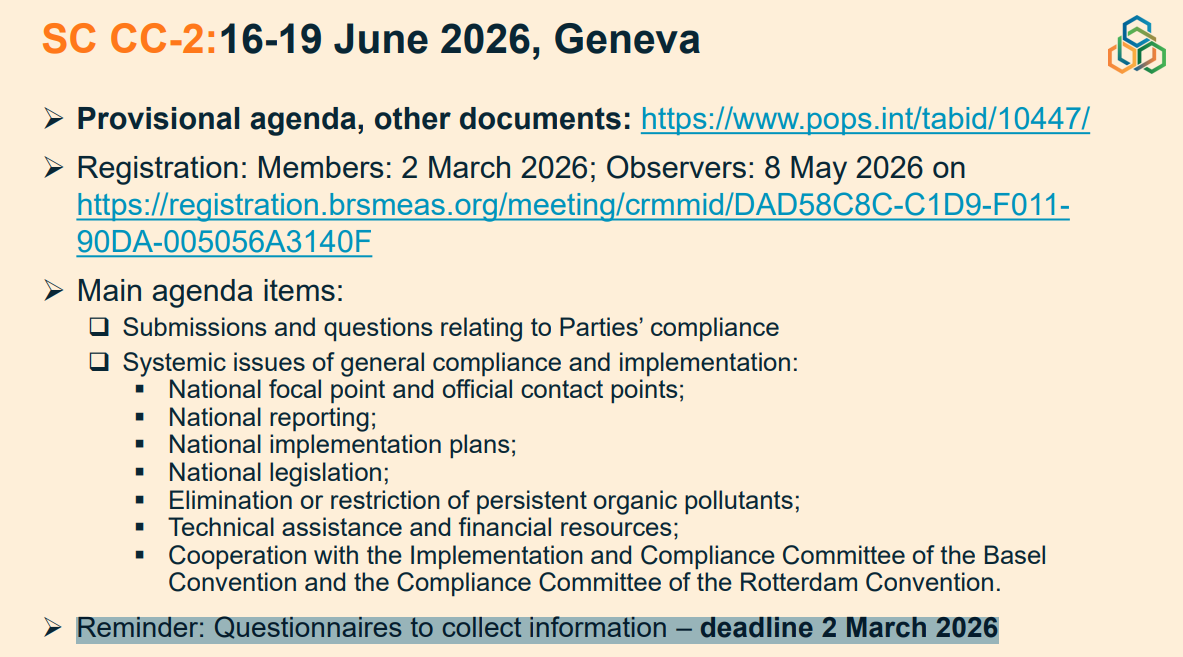
- Two questionnaires have been issued, one to parties and one to implementing entities. This includes the GEF, the 18 implementing agencies of the GEF, but also the Stockholm Convention Regional Centres and other entities of the UN system, for example, UNITAR, WHO and the OECD. The deadline is 2 March 2026.
Scientific Technical Committees
Chemical Review Committee (CRC 22) – Rotterdam Convention
- The 22nd Meeting of the Chemical Review Committee (CRC-22) will meet from 14 to 18 September in Rome, Italy.
- The committee will:
- Develop a draft decision guidance document for methyl parathion following the recommendation to list it in Annex III.
- Review eight new chemicals for which final regulatory actions have been notified.
- Review six returning chemicals.
- The bureau will approve the final agenda after 1 May when the new membership rotation takes place and when the new chair, which is only now incoming interim chair, will take up his role, Mr. Stephan Sangster from Belize.
Persistent Organic Pollutants Review Committee (POPRC 22) – Stockholm Convention
- The 22nd Meeting of the Persistent Organic Pollutants Review Committee (Stockholm Convention) will meet back-to-back from 21 to 25 September in Rome.
- The main agenda items include:
- Development of the draft risk profile for PBDFs and PBCDFs.
- Follow-up on the report on POPs in stockpiles, products and articles in use and in waste.
- Evaluation of continued need for POPs exemptions.
- Review of specific exemptions for PFOI in pharmaceutical production.
- Review of indicative lists of PFOA and PFHXS related compounds.
- New proposals for listing chemicals in Annex A, B, and or C must be received by 21 April 2026.
- The provisional agenda will be available by 21 June 2026.
Intersessional Work and Meeting of Ad Hoc Subsidiary Bodies
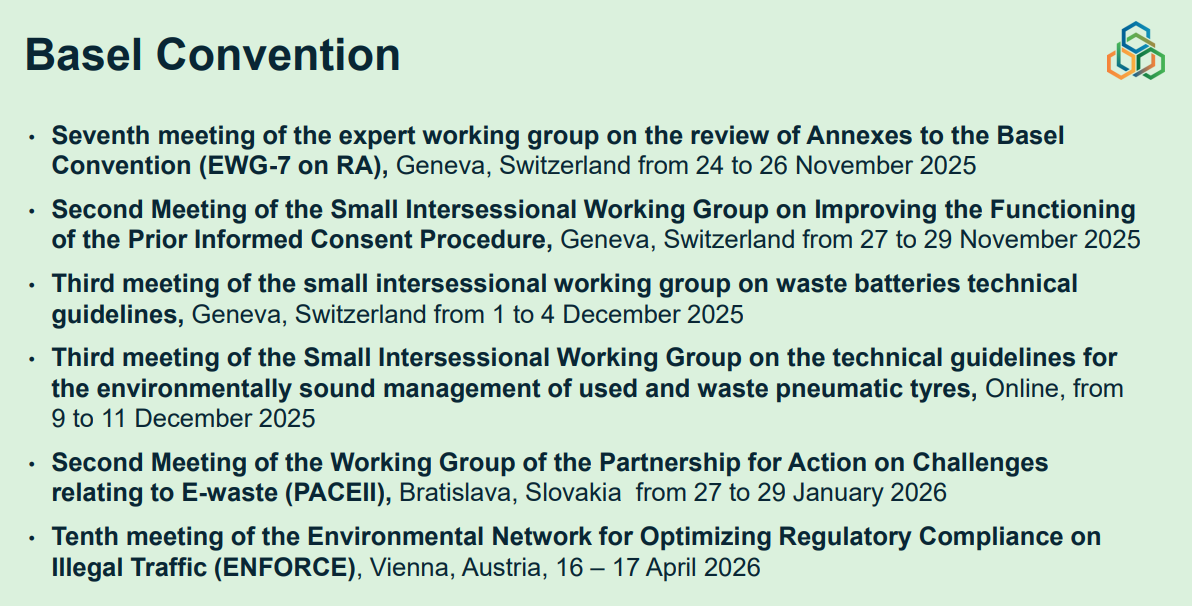
- Basel Convention, work continues on:
- Review of Annexes I and III.
- Improving the PIC procedure.
- Development of technical guidelines on waste batteries and waste tires.
- The Enforce network meeting in April in Austria. Enforce is the environmental network for optimizing regulatory compliance on illegal traffic
- Under the Rotterdam Convention:
- There is an open-ended call for parties and observers to transmit information under the decision on enhancing effectiveness of the convention (RC-12/5)
- This is about resources and tools to support effective implementation and best practice and chemical management systems and experiences in using these resources and tools
- This also includes the Rotterdam convention provisions that may be relevant for quality standards in the area of agriculture and food production.
- The information will be compiled for consideration by COP 13 and will be made available on the BRS website.
- A meeting of relevance to this issue of enhancing the effectiveness of the Rotterdam convention is the 18th FAO who WHO joint meeting on pesticide management which took place in October 2025. It is referred to in the decision RC25 and the secretary participated as an observer.
- Under the Stockholm Convention, the sixth cycle of national reporting is ongoing with a deadline of 31 August 2026.
- The BAT/BET expert group meeting was held in November 2025 and its next online meeting is tentatively scheduled for 30 June 2026.
- The 10th meeting of the small intersessional working group on PCBs (PCB-SIWG) met in December 2025 and its 11th meeting will be held online on 9 to 11 June 2026 for its 4th intersessional meeting.
- The DDT expert group, which is reviewing progress by parties that are registered in the DDT register, is scheduled to meet on 5 to 7
May 2026 in Geneva. - There is ongoing work on the POP’s global monitoring plan (GMP). The regional organization groups and the global coordination group will be meeting to finalize the fourth regional reports from 5 to 9 October 2026.
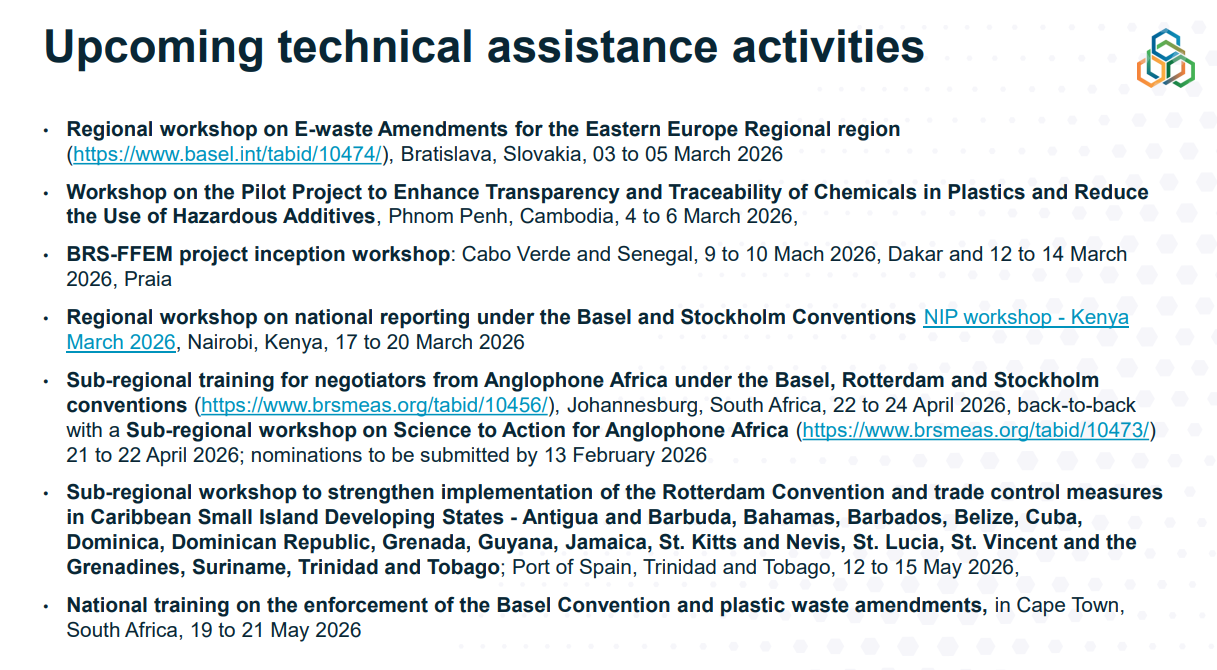
Technical Assistance Activities
- Past activities under the Basel Convention have focused mainly on plastic waste. There have been a lot of activities in that area, but also activities on e-waste.
- These plastic waste activities are carried out either directly by the Secretariat, under the Plastic Waste Partnership, or by the Basel and Stockholm Convention Regional Centers making use of the small grants programme.
- Under the Rotterdam Convention, there has been a regional and subregional workshop for Pacific SIDS.
- There has also been work on a series of national-level projects to help parties establish national registration systems for industrial chemicals and to develop national action plans. In addition, there has been a series of online trainings for designated national authorities.
- This work took place in 2025 and there is more to come in 2026.
- Under the Stockholm Convention, work has focused on PCB management, including pilot projects, online trainings and webinars.
- There has also been a series of webinars on the Global Monitoring Plan data warehouse and on POPs data availability.
- Our technical assistance programme also provides for joint activities of interest to two or more of the conventions. We call these synergies technical assistance activities.
- We have had work in Yerevan, Armenia, to support enforcement of the BRS Conventions, and this was done in partnership with Green Customs.
- We have also worked with the World Customs Organization on enforcement issues in support of Demeter 11.
- Upcoming technical assistance activities
Update from UNEP Chemicals and Health Branch
Eloise TOUNI | Programme Management Officer, Chemicals and Health Branch, UNEP
- This presentation will give an overview of the support to the conventions for which the Global Environment Facility (GEF) is the financing mechanism and of some of the results from last year.
- As the financing mechanism for the Stockholm and Minamata Conventions and the Global Framework on Chemicals, the GEF funds a large number of technical projects, which our unit also delivers. These range across DDT, PCBs, PFAS, mercury and gold mining, mercury in products and many others. It is a very large portfolio, and this will not go into the technical details of all of the projects.
- The UNEP chemicals and waste GEF team provides cross-cutting support to the Stockholm and Minamata Conventions and their secretariats, and to the Global Framework on Chemicals, including on some of the underlying obligations of the conventions that have been mentioned this morning.
Enabling Activities under The Stockholm and Minamata Conventions
- UNEP is one of the few implementing agencies delivering enabling activities under the Stockholm and Minamata Conventions.
- Under the Stockholm Convention, we currently have 39 active projects for national implementation plans. Two were submitted in 2025, three or four the year before. The Stockholm Convention requires regular National Implementation Plans (NIP) updates as chemicals are listed under the Convention, so we maintain a large portfolio of these projects and continue adding new ones in 2026.
- Under the Minamata Convention, we have six active Minamata Initial Assessment projects. Two MIAs (Minamata Convention Initial Assessments) and one National Action Plan for artisanal and small-scale gold mining were submitted last year.
- We are also preparing for the new RIAs: The Review of Implementation of Article 7 of the Minamata Convention, which we hope to launch in 2026 in around 20 countries.
- These enabling activities are critical for countries and for GEF agencies, as they help direct funding in line with national priorities expressed in NIPs or MIAs.
Global Monitoring and Effectiveness Evaluation
- We also support the effectiveness evaluation of the Stockholm Convention through the Global Monitoring Plan.
- The second phase concluded in 2025 and directed GEF resources to support monitoring of water, air and breast milk in 42 countries where there were significant data gaps.
- The evaluation of that programme is being finalized. Preliminary results have already been used as we develop and seek approval for the next phase, which we are calling the Global Chemicals Monitoring Programme.
- In this next phase, we will also add mercury monitoring, which will significantly increase the scientific and technical scope of the programme.
Support to the Global Framework on Chemicals (GFC)
- We concluded a long-standing GEF-6 phase project in 2025.
- That project established a knowledge management platform and communities of practice for SAICM stakeholders, now the Global Framework on Chemicals.
- It delivered technical results on lead in paint.
- Forty-three countries banned lead in paint.
- We worked with 86 companies that adopted chemical management best practices, particularly in the construction, toy and electronics sectors.
- In the new phase of the Global Framework, our team supports the implementation programmes for industry and economic sectors. These bring together multistakeholder action on chemicals in value chains and map closely to GEF chemicals and waste programmes initiated over the last few years.
- One example is the GEF-7 programme on financing agrochemical reduction and management, targeting POPs and highly hazardous pesticides in direct support of the HHP Alliance under the Global Framework on Chemicals.
- We also have industry value chain approaches in textiles and construction.
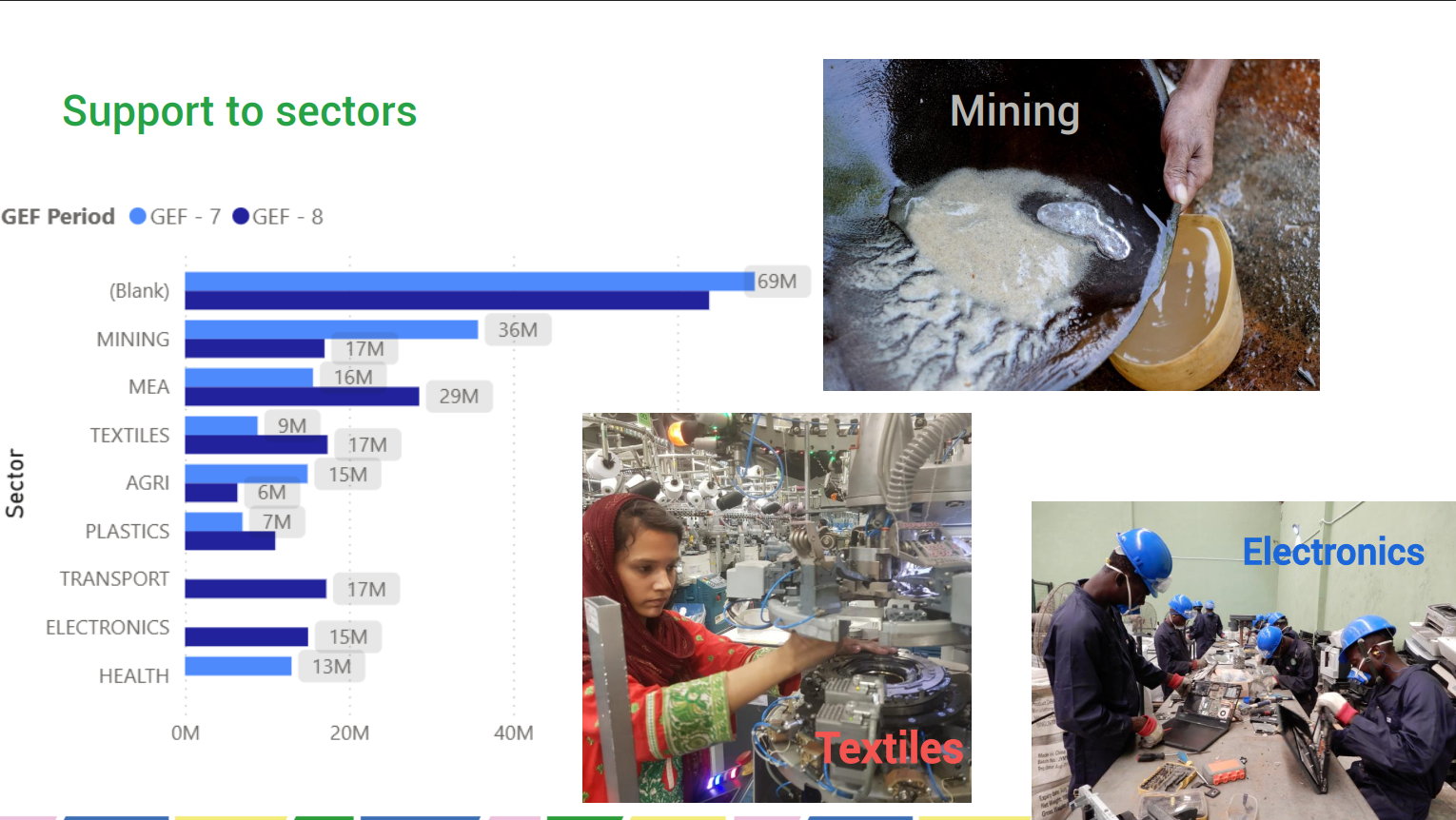
High Impact Sectors
- Our portfolio has been mapped to UNEP’s high-impact sectors under the new medium-term strategy.
- Between GEF-7 and GEF-8, we reoriented much of the portfolio toward high-impact sectors including mining, textiles and electronics.
Planet Gold Programme
- UNEP’s mining high-impact sector is supported by the Planet Gold programme, active since 2018 and now present in 27 countries.
- The first phase evaluation concluded in 2025 and showed:
- Almost 14,000 artisanal and small-scale gold miners were supported.
- Seventeen new financial mechanisms or products channeled over USD 1.7 million to miners.
- Almost 1.5 tons of responsible, mercury-free gold were produced.
- This directly reduced almost 38 tons of mercury use.
- The evaluation identified promising results and areas for stronger focus, especially financing and formalization, which are being incorporated into the next phase.
Textile Sector
- We have a regional project in Asia on textiles that started in 2020.
- Chemical inventories were conducted in over 150 mills to establish a baseline of chemical use. A PFAS substitution pilot began in Indonesia.
- In Pakistan, we cooperated with the ILO Better Work programme to fund chemical risk reduction action plans in 10 mills. This pilot has since expanded to over 100 mills and MSMEs.
- This work directly informed the GEF-8 integrated programme on eliminating hazardous chemicals from supply chains, focusing on fashion and construction value chains.
- We are co-implementing this programme with UNIDO, FAO and UNDP.
- It has a target of avoiding over 18,000 tons of hazardous chemicals and the eight country projects were launched in 2025.
- We are working very closely with the Global Framework on Chemicals partners on this, although we may need to distinguish the programme names more clearly.
GEF CW contribution to the 2024-2025 UNEP Programme of Work
- We are currently in a transition moment with UNEP’s new medium-term strategy and programme of work for 2026–2027 being finalized.
- The review of the previous programme of work showed that GEF projects contributed significantly, especially under indicator 4 on reduction of pollutants released to the environment.
- This aligns closely with GEF core indicator 9 on tons of chemicals disposed or prevented.
- Under the new programme of work, and with the programmatic and value chain approaches in electronics, textiles and mining, we expect much larger impact numbers as we move toward strategic, industry-wide transformation rather than individual disposal projects.
GEF-9 Replenishment Period
- We are also entering the GEF-9 replenishment period, beginning in July 2026.
- We are developing a strategy to prioritize projects and are consulting widely with partners and countries to understand national priorities for the next replenishment period.
Updates from the Minamata Convention on Mercury
Brenda KOEKKOEK | Senior Coordination Officer, Minamata Convention Secretariat
Overview of Minamata COP-6
- Minamata COP-6 was held from 3 to 7 November 2025 in Geneva and was presided over by Osvaldo Álvarez Pérez from Chile.
- We had 135 of our 153 parties represented at COP-6.
- The Minamata Convention secretariat is a small team, and we benefited greatly from support from BRS staff, GFC staff and the UNEP chemicals branch to deliver the COP.
- Many side events were organized, facilitating knowledge sharing and advocacy.
- The meeting report is available on the website in English at this stage. The webcast remains available in UN languages.
- Twenty-two decisions were adopted at COP 6.
- A letter was sent to national focal points and permanent missions on 9 February 2026, outlining follow-up from COP 6, including invitations for submissions and contributions.
- Decision 22 adopted the programme of work and budget for the upcoming biennium, agreeing on a zero nominal growth for 2026–2027.
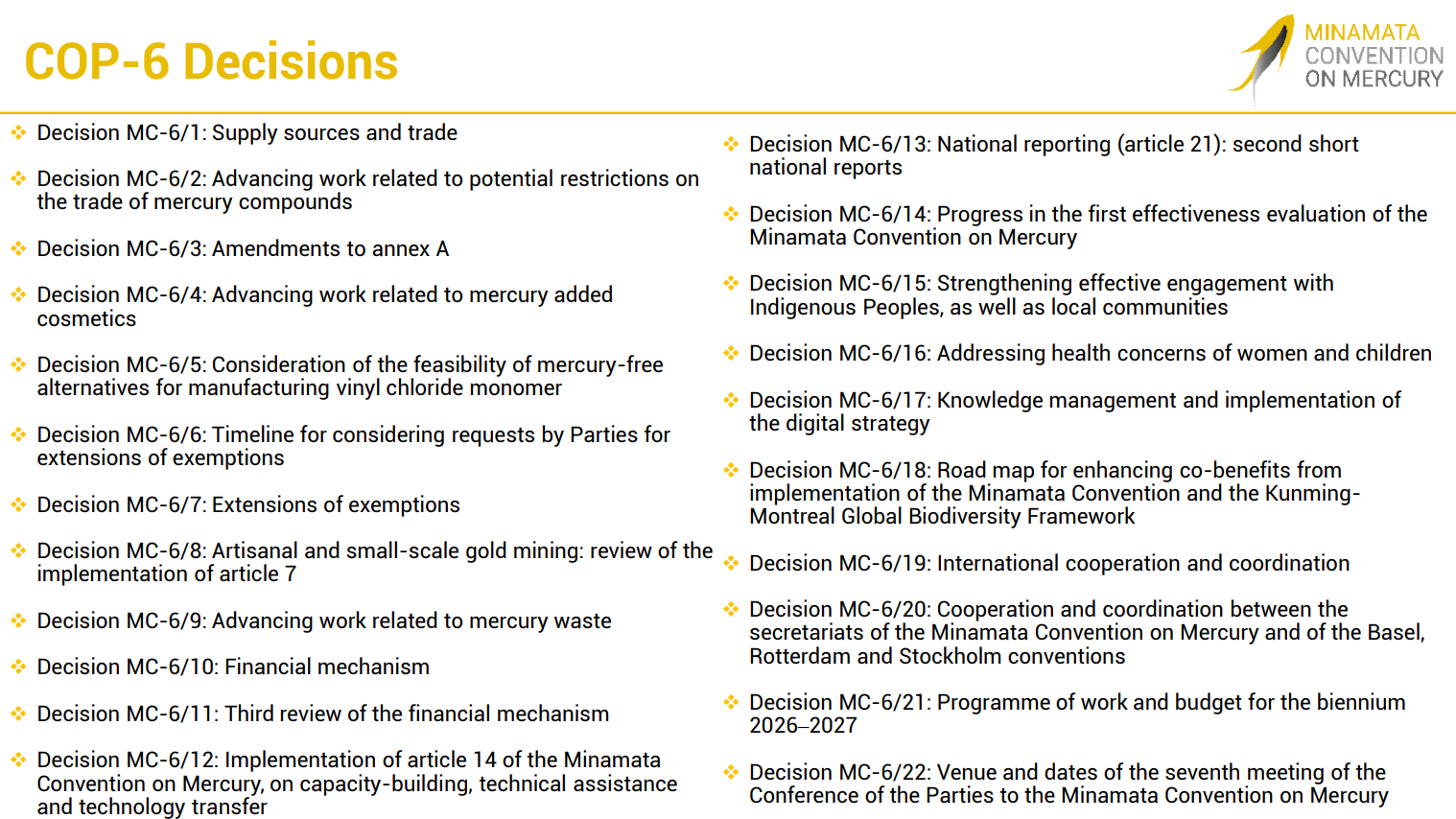
COP-6 Decision Highlights
- Mercury Added Products
- Decision 6/3 marked a landmark achievement with the global phase-out of dental amalgam.
- This has been under discussion for many years, and it was recalled how difficult it was even to discuss dental amalgam in the early days of the Convention negotiations.
- This represents a milestone achievement in strengthening measures under the Convention.
- We also received a mandate to advance work on mercury-added cosmetics, including efforts to address illegal trade.
- This includes cooperation with Interpol and the World Customs Organization, and inviting the WHO to share lessons learned and prepare, together with the secretariat, an outline of a strategy to advance work in this area.
- Strengthening Science and Cooperation
- We received several mandates to strengthen science and cooperation.
- Scientific Cooperation:
- We were requested to undertake a scoping study on where stronger science-policy linkages can best advance implementation, under decision 6/19.
- This work will draw upon party input and scientific expertise.
- We have been asked to coordinate with the International Conference on Mercury as a Global Pollutant, which will meet in India in October.
- The COP also welcomed the roadmap for enhancing co-benefits between the Minamata Convention and the Kunming-Montreal Global Biodiversity Framework.
- Cooperation Across the Chemicals and Waste Cluster:
- We were mandated to implement joint activities and strengthen collaboration with the Global Framework on Chemicals.
- We were supported to take steps toward formal participation in the Inter-Organization Programme for the Sound Management of Chemicals (IOMC) to reinforce system-wide coherence.
- We were also requested to continue cooperation and explore further strengthening cooperation with the BRS Conventions.
- Trade and Enforcement
- We were requested to increase cooperation on trade, particularly with UNODC, the World Customs Organization and Interpol.
- We were also requested to strengthen cooperation with key observers, including Indigenous Peoples.
- Several of these mandates are new elements of work. With a zero nominal growth budget, this is challenging, but we are finding ways to collaborate and follow through.
- National Reporting
- We reported to COP 6 on the second short national reports.
- We achieved an 86% reporting rate, which we are proud of.
- The second full national reports were due on 31 December 2025.
- The current reporting rate is 70%, which is lower than the short reports.
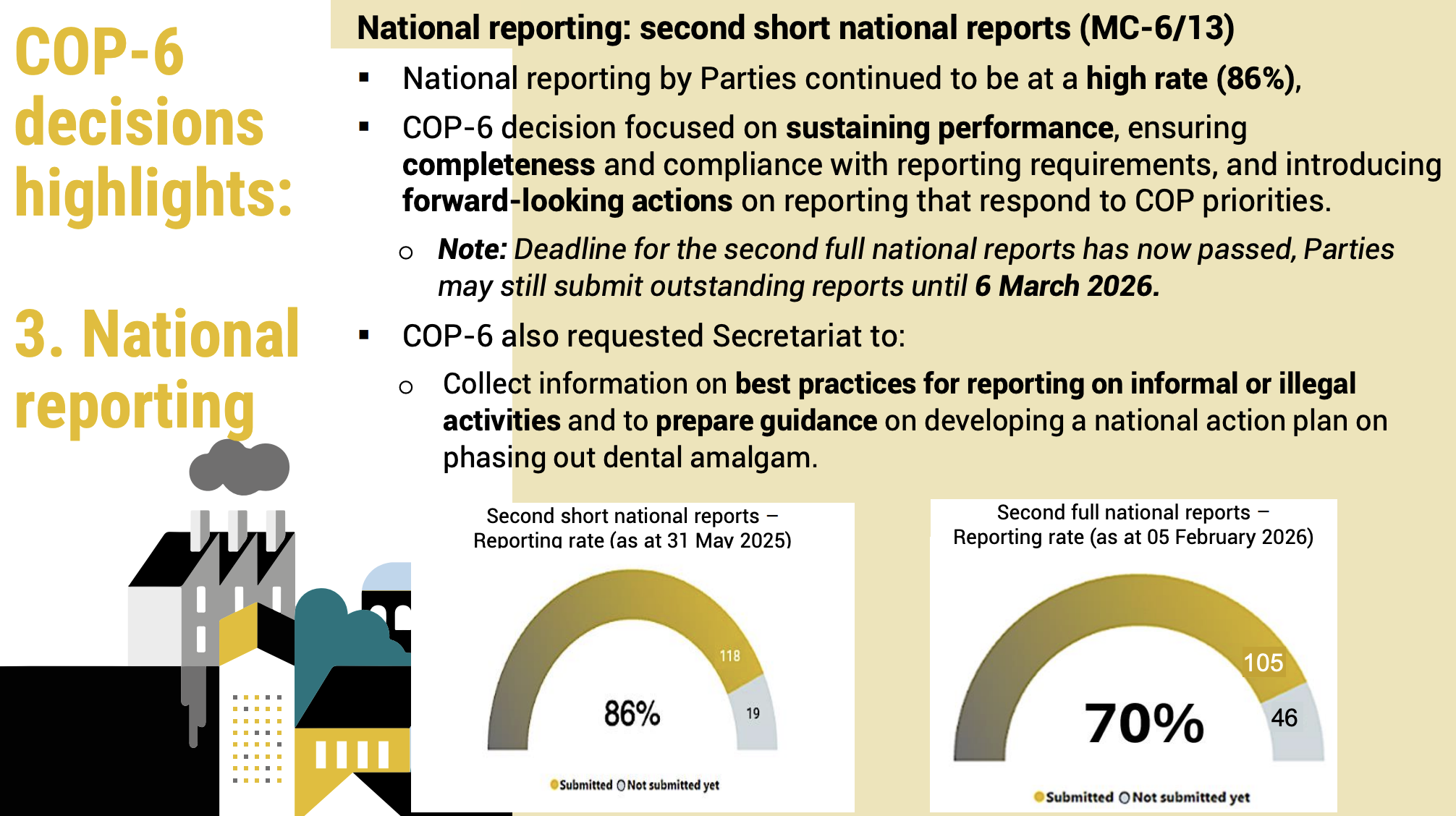
- National reporting data is critical for our first effectiveness evaluation.
- The Effectiveness Evaluation Group met face-to-face this week in Geneva and relies heavily on the data from reporting.
- If there are any issues with the reporting system, parties are encouraged to contact the secretariat for assistance.
Looking Ahead at COP-7
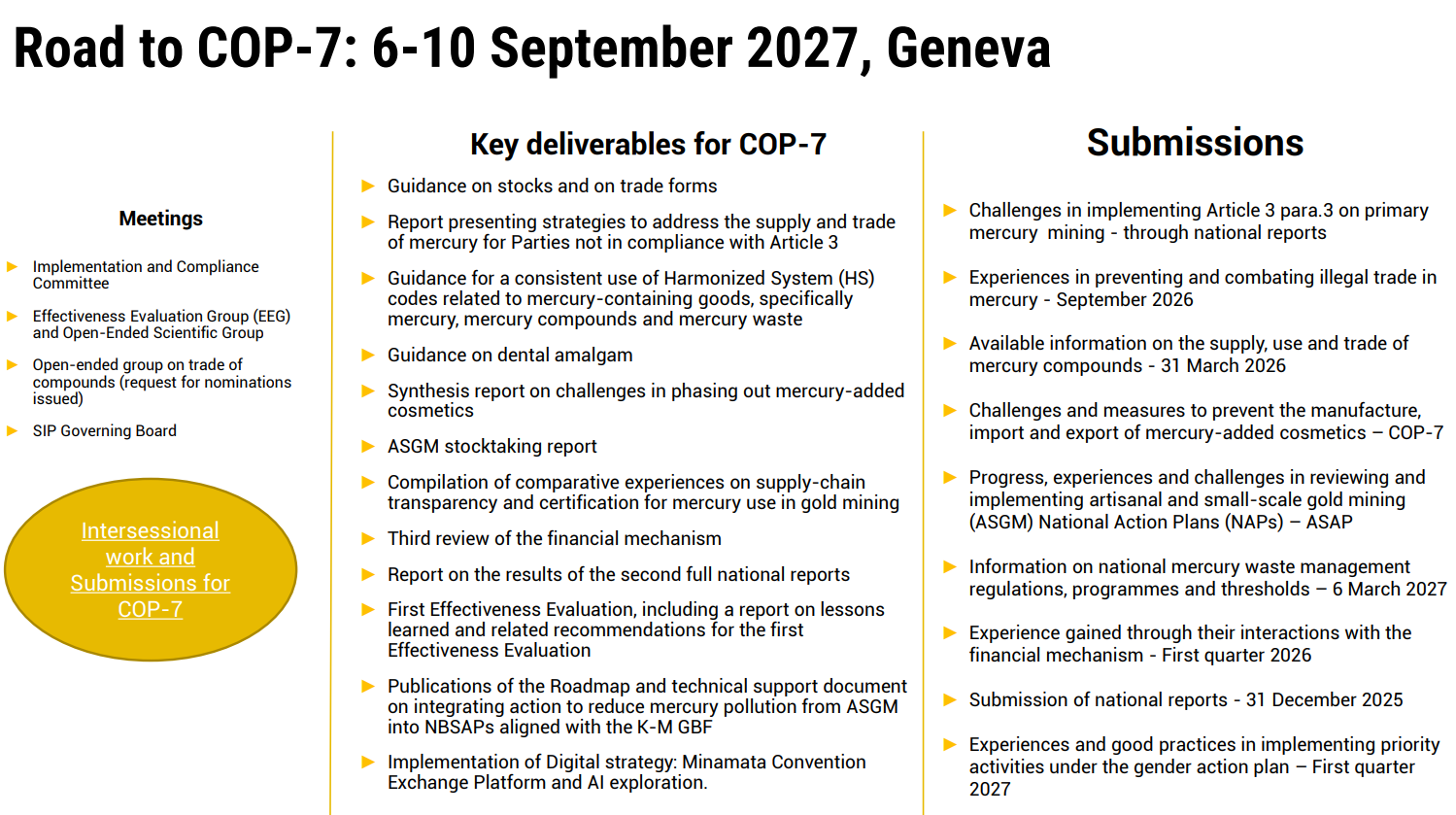
- COP-7 will take place from 6 to 10 September 2027 in Geneva. This date is slightly shifted from the original date agreed at COP 6.
- Osvaldo Álvarez Pérez passed the traditional Kokeshi dolls to the incoming COP 7 President, Marie-Claire Lorrain of France. The dolls are carved by Mr. Oata, a Minamata disease victim and storyteller, and symbolize the shared mission to make mercury history.
- COP-7 marks the 10-year anniversary of the entry into force of the Minamata Convention.
- Key items expected at COP-7 include:
- The results of the first effectiveness evaluation.
- The third review of the financial mechanism.
- An anticipated decision on renewal of the Specific International Programme.
Road to COP-7
Additional Key Programme Elements
- Additional important mandates include:
- On trade, we have an additional mandate on illegal trade and on developing strategies to prevent illegal trade.
- We also have guidance to be developed on the use of harmonized system codes, and those HS codes are very important for implementation reasons.
- On ASGM, as Monica mentioned in her opening remarks, we have a stocktaking and comparative analysis study requested of the secretariat, as well as a comparative analysis on supply chain transparency and certification in mercury use in gold mining.
- These are really important elements given the high price of gold, which makes this issue particularly relevant at the moment for our convention.
- We also received an extended mandate under the digital strategy to develop the Minamata Convention exchange platform and to explore the use of artificial intelligence within the Convention.
- I encourage everyone to read through the letter we sent on Monday. It outlines all aspects of COP-6 implementation, where we are looking for inputs and submissions, and where we could use additional support for voluntary funds within our budget.
Perspectives from Civil Society
Sara BROSCHÉ | Science Advisor, IPEN
- IPEN is a global network of public interest civil society organizations in over 130 countries and we have been heavily engaged in the BRS and Minamata Conventions and now the Global Framework on Chemicals for many years.
- Civil society engagement in these processes is extremely important, including for these reasons:
- Civil society contributes with citizen science reports highlighting issues at the national level and connecting them internationally, showing that these are global problems. With these reports, we come to meetings providing technical information and data to support the work of the conventions, the Global Framework on Chemicals and other processes.
- Civil society participation is also a mechanism for transparency. The more engaged civil society is, the more transparent the processes are, and the more trust there will be in the outcomes and in the work of these processes. That trust is essential for effective implementation. Civil society can help implement and support implementation at all levels.
- Looking ahead, and reflecting on the presentations we have heard, there are several key points to highlight.
- We are in a chemicals crisis. These agreements, the legally binding conventions and the Global Framework on Chemicals are what we have in place to combat and tackle that crisis. No country can mitigate these impacts alone: we need global policies. Maximizing the use of these agreements will be vital. The Global Framework on Chemicals is particularly important because it addresses the majority of the issues we see.
- Effective decision-making mechanisms are critical. We saw recently that where effective mechanisms exist, progress can be made in an organized way. This will be critical in 2026 and beyond. If consensus cannot be reached, mechanisms must exist and be used to move work forward.
- We are facing a planetary crisis. That requires comprehensive approaches. Multisectoral and multistakeholder approaches are central under the Global Framework on Chemicals, but they are also essential for the successful implementation of the conventions.
- There are already interlinkages, for example, with biodiversity and with ILO’s work on occupational exposure, and it is encouraging to see those strengthened. But these linkages must continue to be integrated into the work of the chemicals conventions and frameworks.
- Finally, we need to look at alternatives. Business as usual has led us to this point. What are the alternatives, who provides them, and how do we scale them up?
- There are non-chemical alternatives that have been proven effective and that do not rely on the industries that contributed to the current crisis. Agroecological approaches are one example of alternatives to pesticide use. There are other non-chemical approaches that can replace chemical uses in various sectors.
- However, alternatives must be environmentally sound. We cannot rely on hope or magical thinking. If something sounds too good to be true, it probably is. Alternatives must be verified and truly sustainable.
Q&A
Q: How can regional organizations better access the Special Program to build local technical capacity for the sound management of chemicals and waste particularly regarding the phase out of pollutants or POPs under the Stockholm Convention?
Kay WILLIAMS | Head, Global Framework on Chemicals
- We have some very good news regarding the Special Programme. A donation of 5 million Euros has recently been received.
- This means that projects which were approved but previously unfunded are now being reconsidered. We anticipate there may be future funding rounds.
- Please keep an eye on the website for updates. An Executive Board meeting will take place in March, and more information will be posted after that.
Q: On legal issues, Kenya’s courts recently made rulings related to waste management. Is this something expected across Member States?
Jacqueline ALVAREZ | Chief, Chemicals and Health Branch, UNEP
- UNEP and the conventions are here to support countries. We provide tools and frameworks for implementation, but Member States decide what is best for their jurisdictions.
- Waste management is an essential area of our agenda. Waste should be seen as a resource. We often speak about circularity and how to ensure materials are not wasted.
- It is difficult to predict how courts in different countries will act. Member States will follow their own legal and policy processes. In the context of the Basel Convention, waste management across all stages remains a critical area.
Q: How can focal points of the Intergovernmental Science-Policy Panel on Chemicals, Waste and Pollution participate in POPRC to help merge experiences?
Juliette KOHLER | Chief, Governance Branch, Basel, Rotterdam and Stockholm Conventions
- The POPRC is composed of members elected by the COP. It is for Parties to decide who serves as members.
- However, meetings are open to observers. Parties can nominate additional representatives to attend as observers.
- When invitations are sent out for POPRC-22, Parties and observers will be notified. Anyone interested should coordinate at national level with their Stockholm Convention focal point to request observer participation.
Q: Given the central role of science and evidence in chemicals governance, how do you assess engagement of observers and the scientific community? Are there plans to strengthen their role?
Kay WILLIAMS | Head, Global Framework on Chemicals
- We welcome engagement from scientists and academia. Everyone under the Global Framework on Chemicals has an equal voice and can contribute.
- We are exploring the possibility of establishing multidisciplinary expert groups, including academic experts, to support countries. We are assessing funding options for this.
- Science and evidence are fundamental to our work.
Q from Indonesian Mission
- Concern about parallel contact groups at the Basel OEWG meeting, noting that smaller delegations may struggle to participate meaningfully.
- Clarification on the number and regional distribution of approved GFC projects, particularly limited representation from Asia-Pacific.
- Confirmation regarding Pakistan’s role as a new donor/partner in GFC.
- Request for transparency regarding donor contributions.
- Suggestion for clearer consolidated meeting calendars.
- Confirmation that Indonesia has submitted its Minamata national report.
Susan WINGFIELD | Programme Officer, Governance Branch, Basel, Rotterdam and Stockholm Conventions
- Regarding OEWG contact groups, we try to ensure plenary and contact groups do not overlap.
- It is difficult to avoid parallel contact groups due to time constraints. However, we structure the schedule carefully, and technical matters usually run throughout while legal and strategic matters are sequenced to minimize overlap for delegations with limited capacity.
- We are aware this can be challenging for smaller delegations.
Kay WILLIAMS | Head, Global Framework on Chemicals
- Regarding GFC projects and donors, only four regional projects across 11 countries have been formally approved so far.
- There has been high interest, but not all applications are eligible. We strongly encourage careful review of guidance before submission. The Secretariat is available to support applicants.
- It is true that last year we did not receive many eligible proposals from the Asia-Pacific region. We have increased outreach, including engagement with the Asia-Pacific regional forum. If more support is needed, we are ready to provide it.
- Pakistan does currently hold the presidency of the first International Conference under the GFC and has made a contribution. We will look into how appropriate donor contribution information can be shared transparently.
Closing Remarks
Océane DAYER | Waste and Chemicals Focal Point, Federal Office for the Environment, Switzerland
- These exchanges help us plan strategically and move our shared agenda forward together.
- The year 2025 has been a pivotal one for the global governance cluster on chemicals and waste. The Conferences of the Parties to the Basel, Rotterdam and Stockholm Conventions, as well as to the Minamata Convention, adopted important decisions that bring us closer to a world aligned with the sound management of chemicals and waste.
- Allow me to highlight in particular the decision to phase out dental amalgam containing mercury. This long-awaited outcome was made possible by a window of opportunity that we created together, in a spirit of trust and cooperation. Let us make it our shared objective to nurture that same spirit of trust and ambition in the year ahead.
- The year 2025 also saw the formal establishment of the Intergovernmental Science-Policy Panel on Chemicals, Waste and Pollution (ISP-CWP). Like the IPCC for climate and IPBES for biodiversity, this Panel aims to provide robust and policy-relevant scientific information to governments and stakeholders, strengthening informed decision-making.
- With this third science–policy interface, we have added a fundamental piece to the global response to the triple planetary crisis. As we have just concluded the first part of the ISP-CWP’s first plenary session, which was marked by challenges in operationalizing the new panel, it is important to recall why this Panel matters.
- It is essential that we succeed in making it fully operational, for the benefit of governments and all instruments within the cluster. Let us not miss this opportunity. Let us strengthen the process and move forward together.
- Looking ahead, 2026 will also bring further progress under the Basel Convention and the first International Conference of the Global Framework on Chemicals.
- As the successor to SAICM, the Global Framework on Chemicals must deliver stronger results. To do so, we must equip ourselves with the necessary tools. The adoption of implementation programmes and a robust measurability structure will be crucial steps.
- Achieving the objectives of the GFC will also require the engagement of all actors, governments, industry, civil society and international organisations. Only a truly holistic participation in implementation programmes, combined with a broader and more sustainable funding base, will enable success.
- The political, technical, financial, and logistical strength of the chemicals and waste governance cluster lies in collaboration and in the effective use of synergies among its instruments.
- My call to you today is therefore to further strengthen these synergies. At a time when multilateralism and the United Nations face unprecedented political and financial pressures, we must adapt and cooperate even more closely.
- This means maintaining strong coordination among the BRS Conventions, reinforcing links with the Minamata Convention, and deepening collaboration with other instruments such as the Global Framework on Chemicals, the ISP-CWP and the future plastics treaty. By leveraging these connections, we can enhance the effectiveness and impact of our collective action.
- Geneva, as the global hub for chemicals and waste governance, plays a central role in these efforts. It hosts the secretariats of the Basel, Rotterdam and Stockholm Conventions, the Minamata Convention, and the Global Framework on Chemicals, as well as the chemicals and health branches of UNEP and WHO.
- By maintaining a holistic perspective, strengthening existing instruments and developing new ones where needed, we can ensure that global governance on chemicals and waste remains fit for purpose in the face of future challenges.
- As we conclude, let us draw inspiration from the progress achieved and from the important tasks that lie ahead. The sound management of chemicals and waste is a journey that requires vision, cooperation and sustained commitment.
- Let us foster trust and approach the challenges before us with ambition and determination.
Photo Gallery


