
Événement Conférence
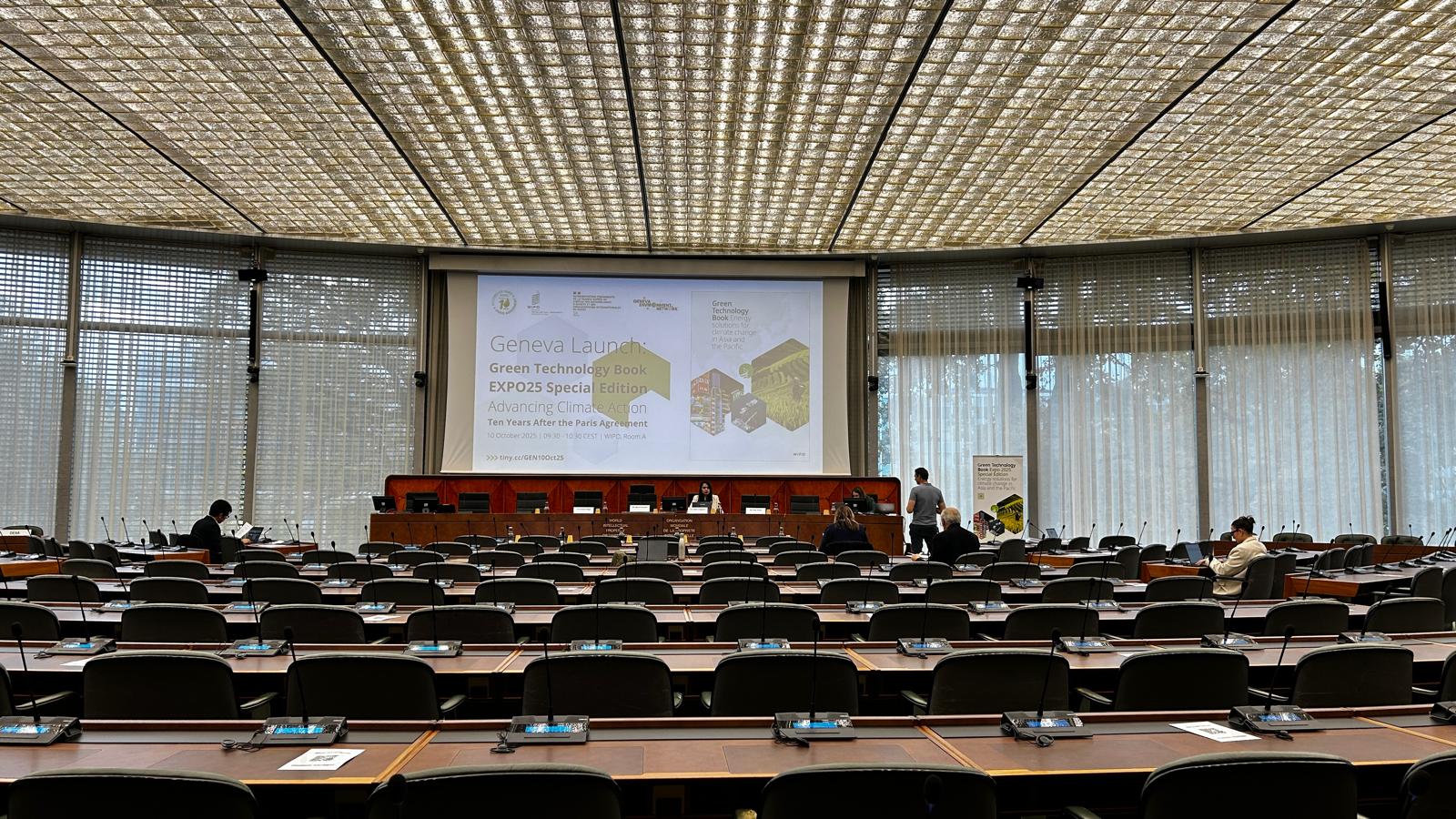
Geneva Launch: Green Technology Book EXPO25 Special Edition | Advancing Climate Action Ten Years After the Paris Agreement

10 Oct 2025
09:30 – 10:30
Lieu: WIPO | Room A
Organisation: World Intellectual Property Organization, France, Geneva Environment Network
The event will be hosted by the World Intellectual Property Office (WIPO) in Geneva, in collaboration with the Permanent Mission of France to the United Nations Office in Geneva and the Geneva Environment Network. It is part of the series of events celebrating the 10th anniversary of the Paris Agreement.

About this Event
The Green Technology Book (GTB) is WIPO’s flagship publication under WIPO GREEN, designed to bridge the gap between the demand for and supply of green technologies. By providing accessible and neutral information on practical technological solutions, the GTB highlights opportunities to accelerate innovation deployment and contribute to addressing global challenges.
The GTB EXPO 2025 Special Edition, developed with the support of the Japan Patent Office (JPO) through FIT/Japan IP Global focuses on energy technologies in the Asia-Pacific region. Given Asia’s scale, growth, and energy intensity, the region plays a decisive role in the global energy transition. This publication highlights proven, emerging, and upcoming technologies across cities and rural areas, tackling a wide range of sectors and services. It offers a practical and forward-looking overview for policy makers, businesses, innovators, and solution seekers.
This post-launch event presented the publication’s findings, featuring high-level perspectives, and provided a platform for dialogue on scaling up energy technologies for climate action. It also raised awareness of WIPO GREEN’s work, foster partnership opportunities, and support the 10th anniversary series of the Paris Agreement.
Speakers
By order of intervention.

Edward KWAKWA
Assistant Director General, Global Challenges and Partnerships Sector, WIPO

H.E. Amb. Céline JURGENSEN
Permanent Representative of France to the UN in Geneva

H.E. Amb. Katsuro NAGAI
Permanent Representative of Japan to the WTO, WIPO and UNCTAD

Ariesta NINGRUM
Director, Climate Technology Centre and Network, UNEP (Video Message)

Natasha MAHEZABIN
Climate Change Technology Expert, WIPO

Heather JACOBS
Climate Change Technology Expert, WIPO

Diana RIZZOLIO
Coordinator, Geneva Environment Network

Peter OKSEN
Green Technology and Research Manager, WIPO | Moderator
Highlights
Video
Live from WIPO.
Summary
Opening Remarks
Peter OKSEN | Green Technology and Research Manager, WIPO | Moderator
- This is the first time that we launch the green technology book in Geneva as it is normally launched at climate COPs. every year.
- This is a special edition that was launched in Japan last Saturday and is followed by a special launch in Geneva as part of a series of events organized by the French mission called « advancing climate action, ten years after the Paris Agreement ». It has been 10 years since COP21 and the historic Paris Agreement, which was groundbreaking.
Edward KWAKWA | Assistant Director General, Global Challenges and Partnerships Sector, WIPO
- The special edition of the Green Technology Book focuses on energy solutions for climate change in the Asia Pacific region and has been made possible through the general support of the Japan Patent Office.
- This year marks a significant milestone in global climate action. In particular, the 10th anniversary of the Paris Agreement, the first binding international accord for countries to report their nationally determined contributions. Over the past decade, the Agreement has provided a framework for nations to commit to emission reductions and to commit to sustainable development. As part of the Paris+10 celebrations, we reflect on the progress made so far as well as the work that still lies ahead.
- We all agree that climate impacts are no longer distant warnings; they are daily realities. We are talking from record-breaking heat waves and floods, to declining agricultural productivity, the signs are all around us.
- In the face of these challenges, innovation and technology offer powerful tools for change. Yet deployment of climate solutions remains far too slow. One key reason is the gap in knowledge about what technologies already exist, how those technologies work and how they can be good for the climate as well as for business.This is why WIPO GREEN was created over a decade ago: to connect technology providers and seekers through a free global online platform dedicated to sustainable innovation.
- Since 2013, WIPO Green has grown into the UN family’s largest green technology matchmaking platform. It currently hosts over 140,000 technologies from more than 140 countries. These technologies are not just ideas on paper. They are making a real difference.
- WIPO green acceleration projects have helped Chilean farmers with solar dryers, introduced bio-based fertilizers in Argentina, and in Peru and supported electric vehicle charging solutions in China. These are just examples demonstrating how innovation, when guided by local needs and partnerships, can create tangible benefits for people and for the planet.
- The Asia Pacific region is a hub of remarkable innovation, but it also faces rapidly rising energy demand and emissions. In this context, we proudly launch in Geneva the WIPO green technology book.
- The Expo 25 Special Edition on Energy Solutions for Climate Change in Asia and the Pacific presents 215 pioneering energy technologies, many of which are already commercially available or are nearing market readiness. It is designed as a practical resource for policymakers, practitioners, investors and researchers, and it highlights technologies that are applicable to rural and agricultural areas and energy-intensive service sectors.
- The 10th anniversary of the Paris Agreement reminds us all that the climate change challenge requires faster, more decisive and more collaborative action. WIPO remains committed to supporting governments, industries, and innovators in harnessing intellectual property for sustainable development.
- Through initiatives like WIPO GREEN, we hope to bridge the gap between ideas and impact and to accelerate the global transition to a greener and more resilient future.
H.E. Amb. Céline JURGENSEN | Permanent Representative of France to the UN in Geneva
- The launch of this Green Technology Book is a wonderful opportunity to celebrate the 10th anniversary of the Paris Agreement. This agreement was a significant moment in which the international community came together to decide to act together against a threat that affects us all and that has been caused by human activity.
- The permanent mission of France, together with various partners, is organizing in Geneva a series of ten events taking place this autumn to call for ambitious action.
- This anniversary and its celebration are happening at a very difficult time. Environmental priorities are being questioned and challenged. Multilateralism, cooperation and even science are under attack. But as the President of France said at the UN General Assembly in New York, we cannot allow ourselves to become weary.We cannot allow ourselves to become resigned. We have only one responsibility. Act and act together.
- Because climate change is with us. It’s a reality, and it cannot be swept aside. In New York, over 100 countries declared that they were ready to rise to this challenge and publish enhanced climate commitments before COP 30. This is a clear sign that the spirit and the ambition of the Paris Agreement are still alive and even more lively than ever.
- The energy transition is already underway in many countries and it now needs to be stepped up. This is precisely why we need innovation, and concrete initiatives like WIPO GREEN to guide this transition.
- For four years already, the successive editions of this green technology book have provided an overview of innovations that can be used to adapt to and mitigate climate change. They highlight the innovations made in the field in many areas such as sustainable agriculture, water management, smart cities, renewable energy and the circular economy. It is a book of solutions, innovation and action.
- France occupies a noteworthy and prominent role on the WIPO Green Platform through the diversity of its innovations and the quality of its technical contributions. In this year’s edition, I would particularly like to point out in the area of water management, the collaboration between Veolia and Sun Culture Europe to roll out solar pumps and smart systems and to guarantee best guaranteeing sustainable solutions to water supply. These solutions are supported within WIPO Green projects in West Africa.
- These technologies illustrate the vitality of French innovation and its roots in a global vision of sustainable development and international cooperation. They show France’s ability to combine scientific excellence, ecological transition and international solidarity, bringing together countries and private actors with pioneering international organizations like WIPO. This very concrete initiative shows to what extent multilateralism is really indispensable and brings an undeniable added value to our societies, our economies and our citizens.
- It brings a concrete impact and I think this is what we are seeking here in Geneva, a concrete impact for solidarity in development. This event today also shows that the Geneva ecosystem is very dynamic.
H.E. Amb. Katsuro NAGAI | Permanent Representative of Japan to the WTO, WIPO and UNCTAD
- WIPO Green was established in 2013 based on the proposal by the Japan Intellectual Property Association.
- Japan has been actively involved. WIPO Green provides a platform for connecting providers and seekers of environmental technologies and through the fund’s interest, Japan has supported an acceleration project in promoting such connections in the region, such as Latin America and countries like India. This year it’s acceleration project will be expanded to Africa and Asia Pacific region, including island countries that have been one of the most heavily affected by climate change. Furthermore, as various stakeholders are involved in the promotion of WIPO Green, networking is crucial in this initiative.
- Last week at Expo 2025, in Osaka, Japan, the Japan Patent Office hosted the WIPO International Forum, including the round table discussion on WIPO Green to share success stories of WIPO Green Leadership and discuss the roles of government and industry.
- WIPO Green Technology books showcase green technology registered in the WIPO Green database to the world. So far, three editions of this collection have been published and presented globally at Climate COPs every year. This special edition, funded by FIT Japan, EAP Global, was successfully launched at the time of Expo 2025 in Osaka. This special edition of the Green Technology Book features and showcases more than 200 examples of the level of energy technologies and solutions from the Asia Pacific region.
- We hope that this GTB Expo special edition will offer opportunities to know more about green technology and to be used extensively as a catalyst to promote deployments and matchmaking of green technologies.
- FIT Japan IP Global has been used by the government of Japan to make voluntary contributions to WIPO since 1987. Recognizing the importance of improving the business environment by strengthening IP protection for autonomous and sustainable development, WIPO and the government have helped strengthen IP infrastructure around the world through initiatives such as human resource development and technical cooperation through FIT, Japan IP Global. We are pleased that the FIT Japan IP Global can contribute to the GTB Expo special edition. In order to contribute toward further development around the world, Japan will continue working with WIPO in the area of the global IP systems.
Ariesta NINGRUM | Director, Climate Technology Centre and Network, UNEP (Video Message)
- This publication highlights a simple truth. Energy efficiency is key to solving our climate and energy challenges in Asia and the Pacific. Energy demand is growing fast. Middle classes are rising and lifestyles are changing.The region must act now.
- At the same time, the region leads in innovation. Countries like Singapore, Korea, China and Japan are among the most inventive countries in the world.
- This edition shares real solutions from households and transport to agriculture and public services. Over the past decade, countries have turned to CTCN for guidance in building sustainable energy systems for their countries. One in five requests coming to CTC and focuses on renewable energy and energy efficiency.
- This edition shows practical, scalable solutions for one of the world’s most climate-vulnerable regions. Solar power, micro grids, bio gas, agri-voltaics, these are not just technologies. They are tools to cut emissions and build resilience.
- As countries prepare for the next climate commitments, this book aims to inspire and to guide. It supports decision makers, practitioners and innovators. The message is clear: let us turn ambitions into action where it matters most.
Presentation of the GTB EXPO 2025 Special Edition
Peter OKSEN | Green Technology and Research Manager, WIPO
- WIPO GREEN is a very small unit of WIPO working to showcase how innovation and technology are part of the solution to the global challenges and notably climate change, food security and the environment.
- WIPO Green does this through matchmaking by trying to connect those who need the technologies with those who do not have them.
- The idea behind WIPO green is that challenges are numerous, but technologies can offer solutions, if deployed at the speeds with which we need them to. The pace is the challenge that we are trying to address through:
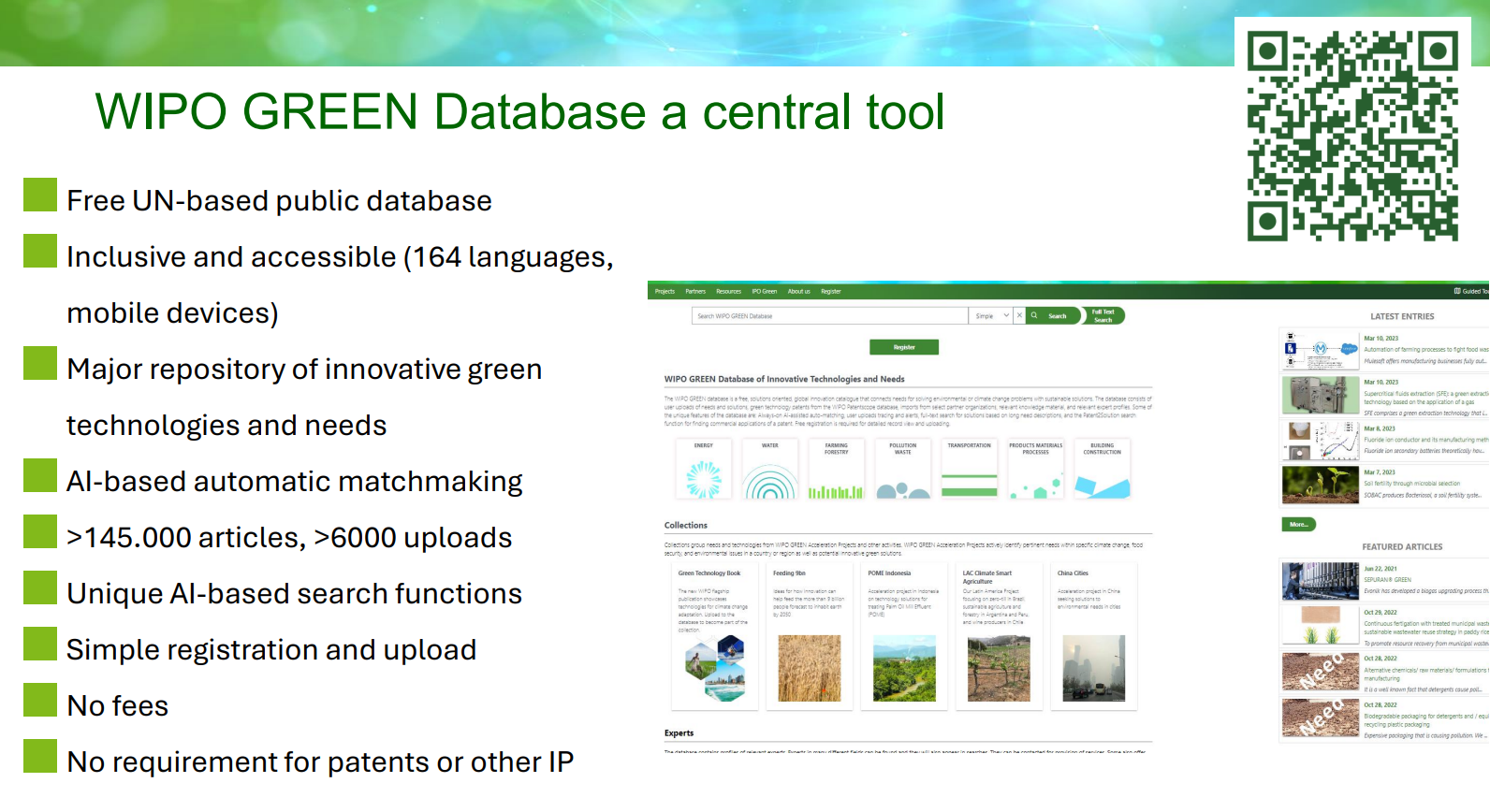
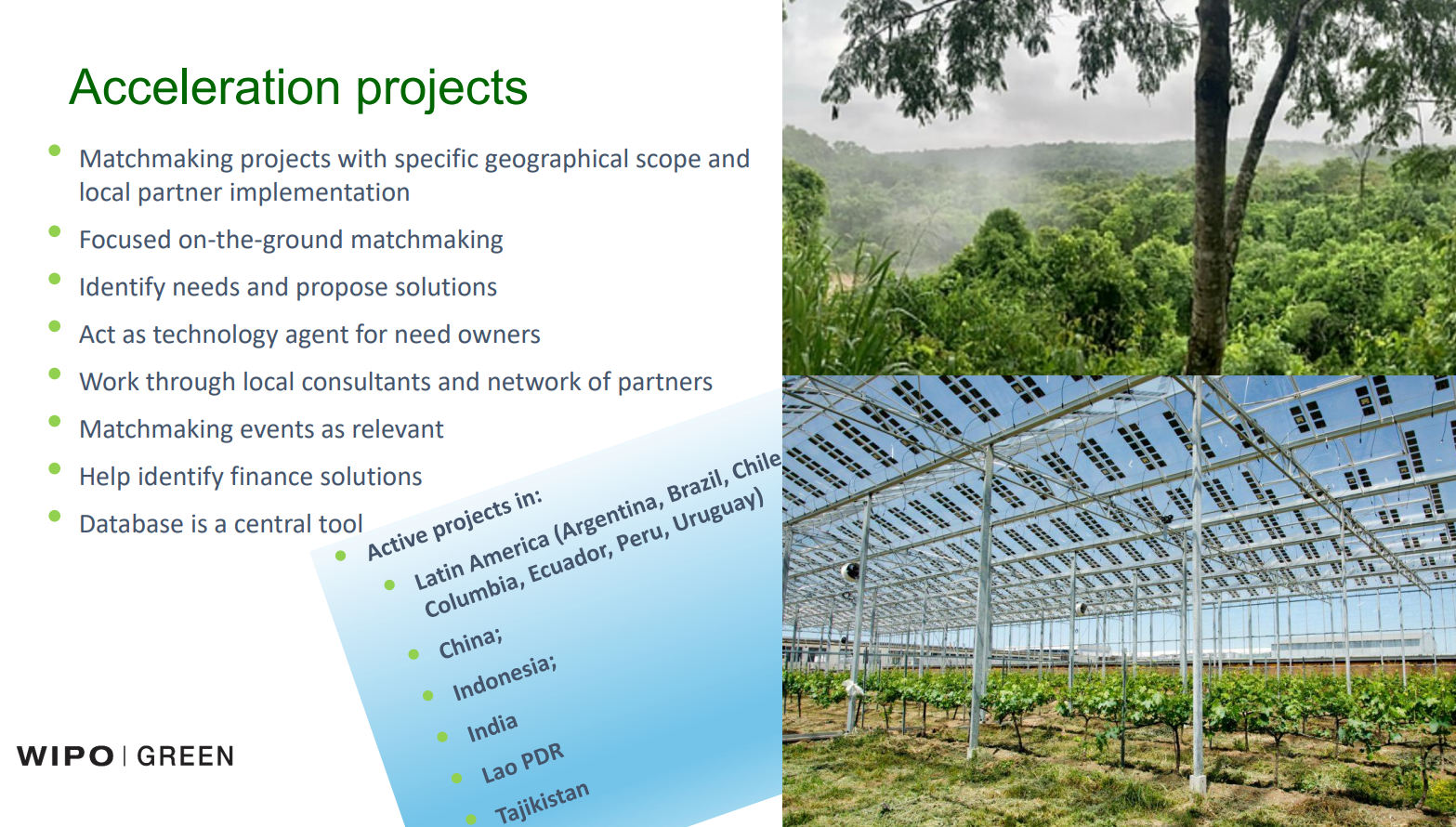
- In addition to the database and the acceleration projects on the ground, WIPO Green operates though a large partner network and produces various knowledge and research materials.
- Working on the ground allows to connect local experts with specific needs among farmers, communities, fishers, whatever it is that focuses in the individual country and we then try to work as individual technology agents for these need owners and individual farmers and try to find the best solution that fits into the specific need that this person has. So very granular, very focused way of working. And we do it because we want to show that a technology actually works in the real context. It is not only good for reducing emissions, for example, but it is also good for business
- Another key part of WIPO Green’s work is the Green Technology Book, a publication started in 2022 that showcases more than 1,000 solutions. The book aims to show what is available out there as tactical solutions.
- In each book, we showcase more than 200 technologies as examples that users can then identify. We expect that we will continue to develop the book in a very close relationship with the database.
- We have special collections in the database for each of the books where we show all the technologies, plus many more that are coming in.
Natasha MAHEZABIN | Climate Change Technology Expert, WIPO
- The EXPO2025 Special Edition GTB looks at three key areas: urban, rural and key service sectors.
- Under urban energy, we explore households, public spaces and transport and water utilities.
- Under rural areas, the focus is on households, agriculture, fisheries and aquaculture.
- Under key services, we look at hotels and shopping malls.
- Asia Pacific is central in terms of energy. It is where nearly half of the world’s energy is consumed, 46%, making it a global energy powerhouse. The region is incredibly diverse: it is home to both wealthy and low-income countries all of which are growing rapidly, both economically and population-wise. This growth is basically driving a surge in the energy demand as more people are adopting middle-class lifestyles and consuming more energy.
- But most of this energy, 83%, still comes from fossil fuels and consequently Asia contributes over half of the global greenhouse gas emissions, which is alarming. The main sources of these emissions include electricity generation and heating, transport, agriculture and so on, sectors where innovation and cleaner technologies will make big difference.
- In terms of the innovation landscape, Asia-Pacific is emerging as a global leader in the clean energy transition with several countries recognized among the world’s most innovation-capable countries including Singapore, the Republic of Korea, China and Japan, according to the 2024 Global Innovation Index.
- This momentum is reflected in the region’s innovation landscape and patent activity. As you see that clean energy patents increased from around 29 ,400 filings in 2007 to over 44,000 in 2022. Innovation spans several key technology areas: advanced batteries, electric vehicles, smart farming tools and so on. China is leading in solar and hydro technologies as well as battery storage, while Japan dominates fuel sales and transport innovation. Other emerging technologies such as offshore wind, floating solar, biofuels, are also gaining momentum across the region.
Technology Trends in Urban Asia
- The Asia-Pacific region houses over half of the world’s urban population and 26 or 40 megacities.
- Smart homes are one of the fastest growing areas in Asia, which means all connected devices and appliances in the households, like lights, heating, ventilation and cooling systems and they are enabled by 5G Internet of Things.
- We see the cooling demand is rising sharply. So nearly 300 million new air conditioners are expected in Southeast Asia alone by 2040. But people are now using inverter air conditioners, heat pump systems to cut the energy use.
- For example, in Japan, 90% households are already using a combined heat pump system and the air conditioning system. However, the reality is that fans still remains dominant in some countries like India and Indonesia because of affordability and this shows how technology adoption varies across the region.
- At the same time, rooftop solar and home batteries are increasing and e-cooking technologies are becoming more available.
- In public spaces and transport, electrification is transforming urban life from EV buses to ferries to two-wheelers and three-wheelers and we are also seeing a rise in battery swapping stations and public charging stations which are definitely making electric mobility more convenient. Smart traffic management systems are also reducing both congestion and energy use. Finally, water utilities are increasingly part of the clean energy conversation.
- In some Asian cities, up to half of the water gets lost before it even reaches people, meaning wasted water and wasted energy. To tackle this, many utilities are now using smart meters, efficient pumps, variable speed drives,and digital monitoring systems, which help save around 25 to 30% of energy.
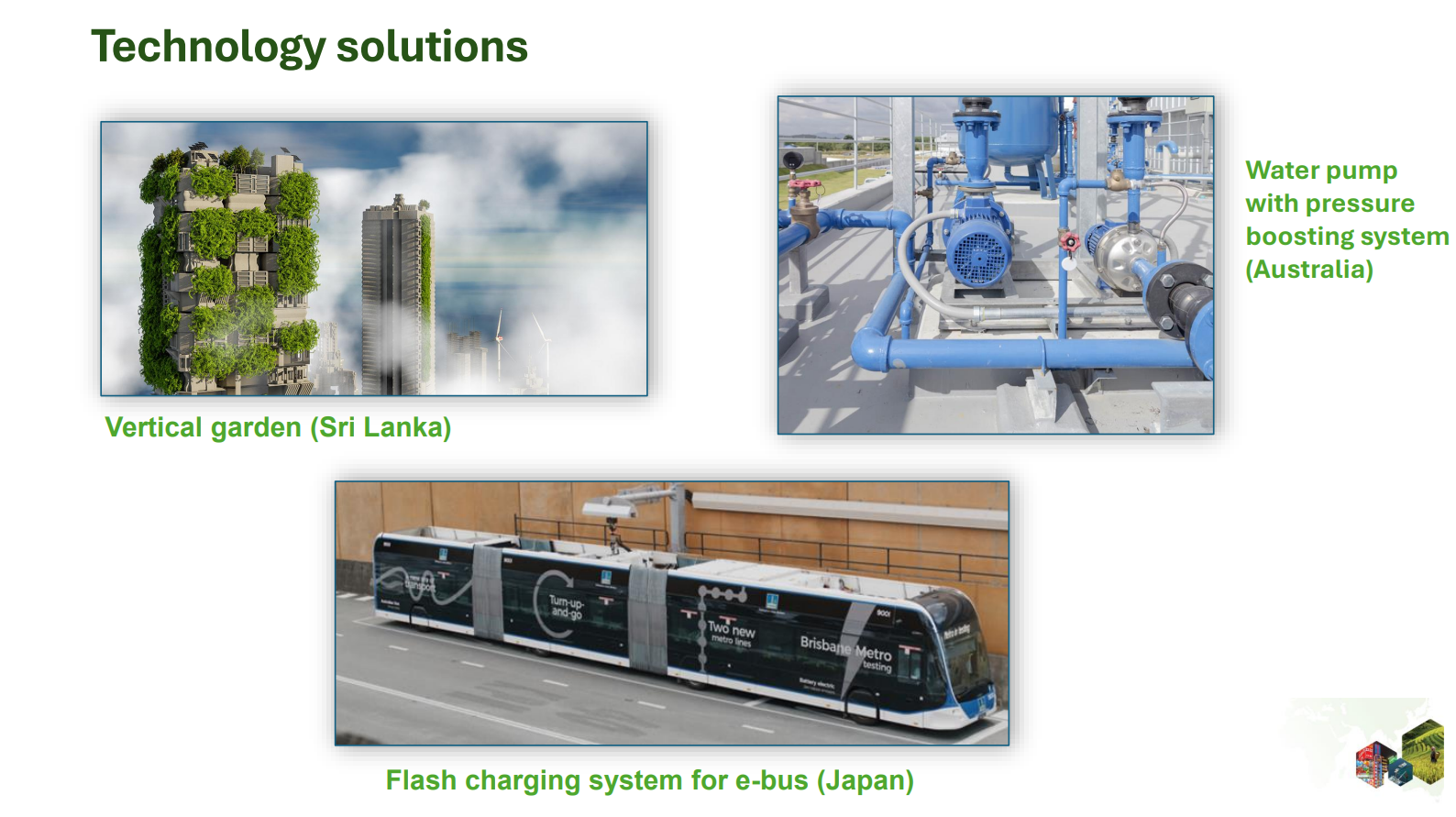
- Examples of these technologies include:
- The tallest vertical garden in the world, in Sri Lanka, which is covered with plants and it uses recycled water through an automated system. So the greenery cools the building naturally reducing the air conditioning needs and energy use.
- The smart charging solution for electric buses from Japan delivers ultrafast charging over 600 kilowatts in just seconds. So this means that buses can run longer without taking long charging breaks or without using heavy batteries.
- In Australia we have a water pump with a booster pressure system. This technology ensures steady water pressure even when supply fluctuates. It combines a strong pump with a smart controller to reduce energy waste. It’s ideal for hot climates where water efficiency really matters.
Rural Asia
- Innovation is not just happening in cities, it’s also transforming rural communities. Across the region, we see all the renewable systems like small-scale solar, wind and microhydro power are expanding access to electricity in remote areas.
- For example, in Bangladesh, solar home systems have already electrified around 20 million people. These decentralized systems are becoming smarter with technologies like mobile payments, remote monitoring, etc.
- At the same time, clean cooking solutions like biogas and solar cookers are becoming common and reducing dependence on firewood and charcoal. However, it’s worth mentioning that over a billion people in the region still lack clean cooking energy access.
- In agriculture, irrigation is the largest energy user; thus, farmers are increasingly turning to solar-powered irrigation. Every voltage where crops grow under the solar panels is helping maximize the land use while generating and clean power.
- We are also seeing solar and biomass-powered meals, dryers and cold storage units that reduce post-harvest losses.
- What helps farmers adopt these systems is the innovative financing models that make these technologies affordable, especially for the smallholders.
- Another technology advancing in East and Southeast Asia is precision agriculture, which uses drones, IoT sensors and AI to further help the farmers to manage their resources efficiently.
- In fisheries and aquaculture in Asia, hybrid and solar-powered boats are reducing fuel use while floating solar systems on fish bones are generating electricity and also helping regulate the water temperature.
- We also see solar and wind-powered aviation, a smart sensor-based aquaculture system.
- Technology examples include:
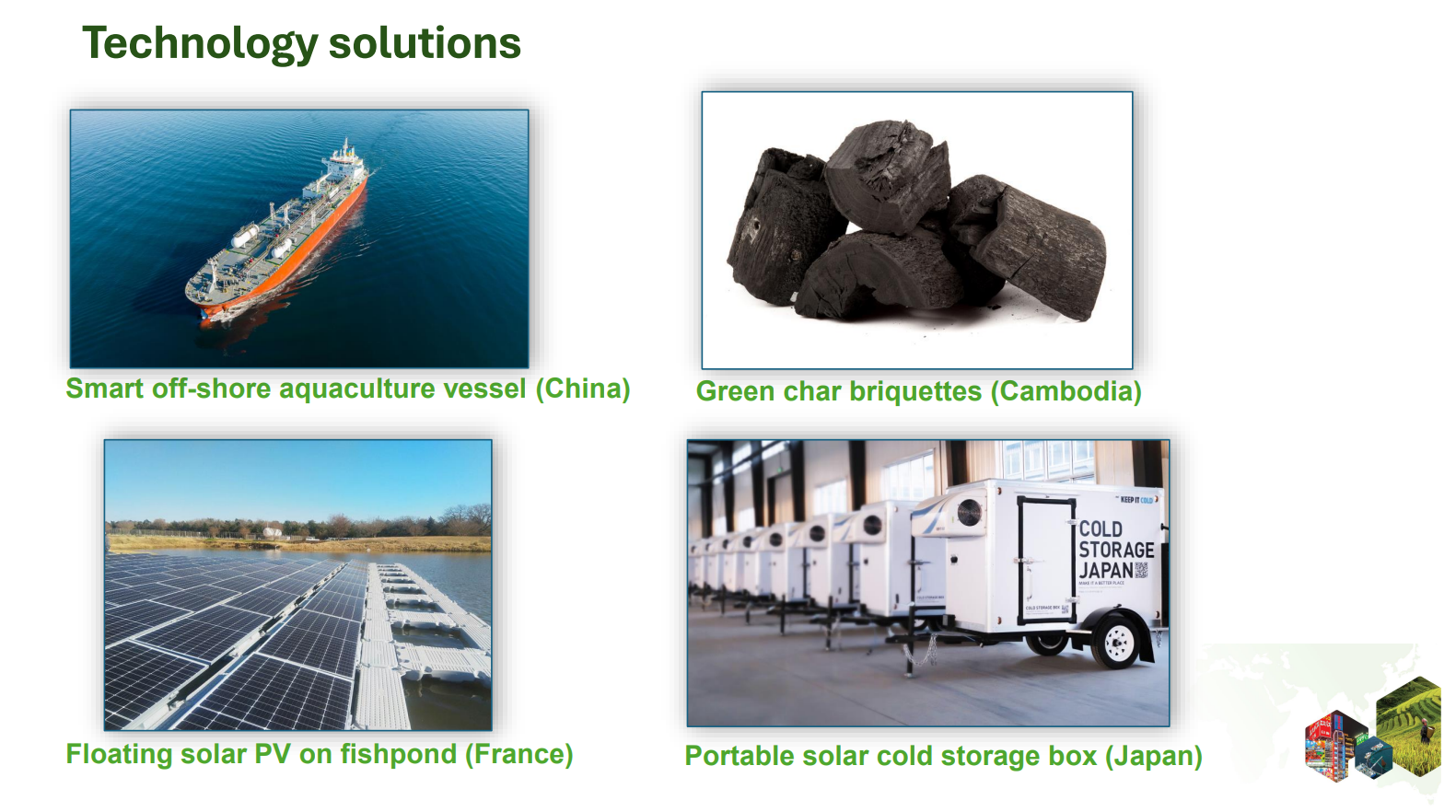
- The world’s first smart aquaculture vessel from China: a floating fish farm on the sea raising over 3 million fish each year in an automated breeding tank powered by sensors and smart water system. Everything happens on the ship.
- From Cambodia, green charcoal offers a clean alternative to traditional wood charcoal. It’s made entirely from coconut shells, reducing deforestation and also indoor smoke. Then bottom left, we have the floating solar system technology from France. It’s built to handle strong winds and harsh weather. It’s perfect for lakes and reservoirs and their servers where land is limited.
- A portable solar cold storage unit from Japan, which provides off-grid refrigeration from minus 25 degrees Celsius to 10 degrees Celsius using integrated solar panels and batteries. It requires no additional power infrastructure, which is great for the rural communities. And then the last chapter that we have in the book is the key services sectors, so starting with hotels, where you all know that there is a 24/7 need for cooling, lighting and water. So many are now shifting to smart heating, ventilation and cooling systems in water air conditioners and heat use.
Key Services
- Inside the buildings, motion sensors, integrated energy management systems are increasingly used to help monitor and optimize the performance.
- Pools are being heated with solar energy, and low-flow fixtures and grey water recycling are reducing both water and electricity demand.
- Some hotels are even turning the food waste into energy using the biodigesters.
- Malls are no longer just shopping malls in Asia as people use them for socialization, entertainment and many other purposes, which means they use a lot more energy. To manage this, there are technologies like zone-specific heating, ventilation and cooling systems, variable speed escalators and regenerative elevators that reuse the energy.
- Energy-efficient refrigeration systems are seen in supermarkets and food courts, for some of more technologies that could be used in hotels and shopping malls.
- Examples of technologies include:
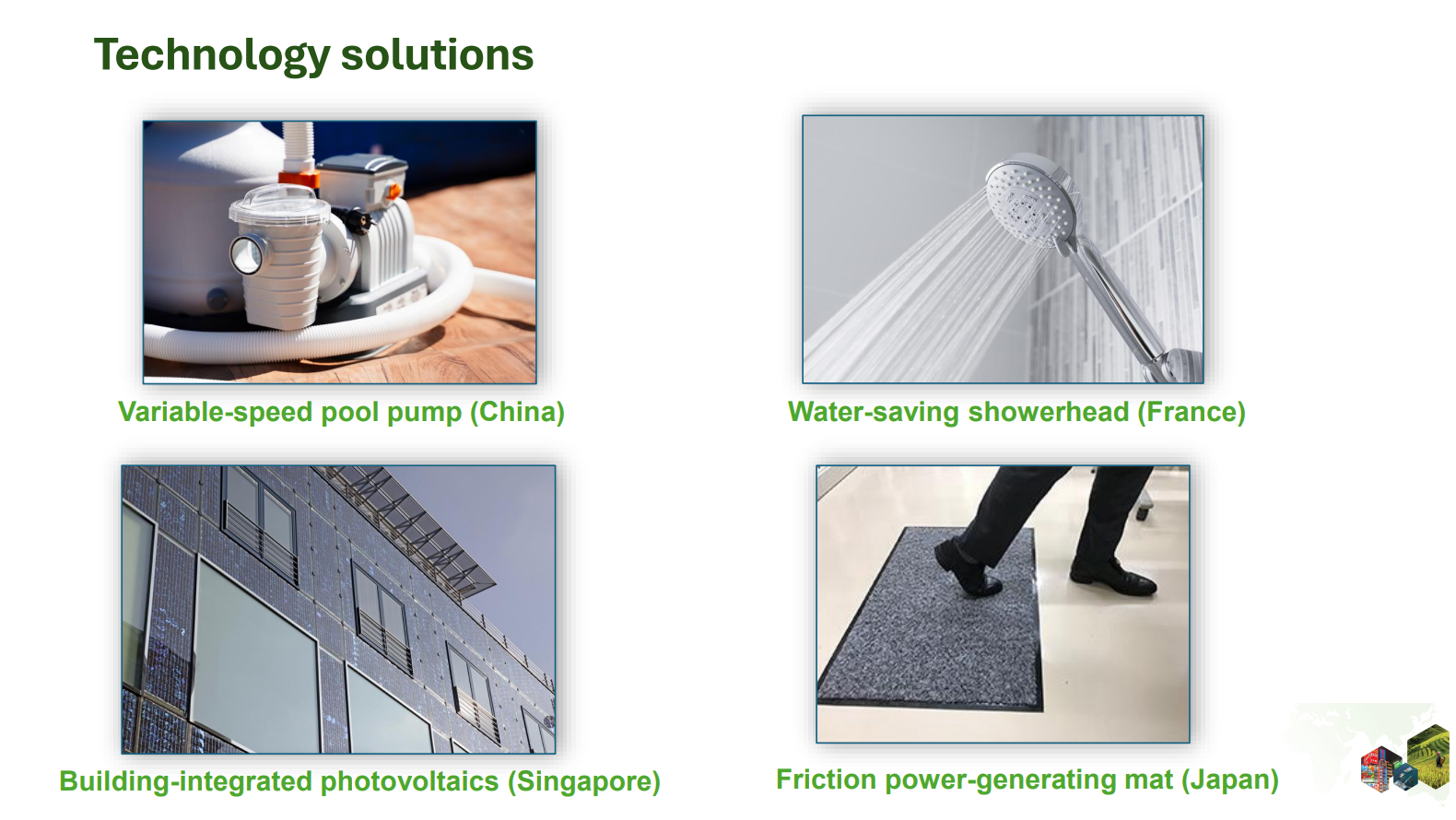
- A variable-speed pool pump designed for hotels. They use highly efficient motors and adjust speed as needed, saving up to 80% energy compared to standard pumps.
- A showerhead using LED lights to show the real-time water use, thus encouraging guests to save water. So you can basically track your own usage and set goals through the app. The LED light works without the battery, so entirely powered by the water flow.
- A power facade from Singapore employs a modular solar wall system: the panels are easy to install and resemble regular building materials, so they do not affect the building’s appearance as such, which is very important for shopping malls and hotels.
- Another horizon technology is a friction power-generating mat. The electricity is produced when one steps on the and it is sufficient to power small devices.
- These are basically horizontal technologies that are awaiting large commercialization.
- These power-generating method shows how innovations could turn everyday movement in public spaces into clean energy.
Key messages from the EXPO edition:
- Multiple solutions are available and show that real change is possible.
- Asia is leading the way in innovation, making these technologies more affordable worldwide.
- We need solutions that fit local realities because in many places, people still do not have reliable access to electricity or the Internet. Closing these gaps will help ensure that everyone can benefit from new technologies and to speed up clean technologies in areas that need it most.
- Innovative financing is urgent.
- Increased awareness of how to use energy efficiently is just as important as the technology itself.
The Green Technology Book 2025
Heather JACOBS | Climate Change Technology Expert, WIPO
- The Green Technology Book 2025 will be launched at COP30 in November 2025.
- It focuses on climate disaster response technologies, a timely topic since disasters are affecting everyone across the globe in both developed and developing countries alike.
- It is centered around four thematic area:
- Water-related disasters with storms, flooding, coastal erosion and landslides;
- Dry weather-related disasters of wildfire and drought, extreme heat
- Cold events;
- Disaster response logistics, which encompasses communications, emergency infrastructure and deployment and financial and insurance technologies.
Extreme Heat
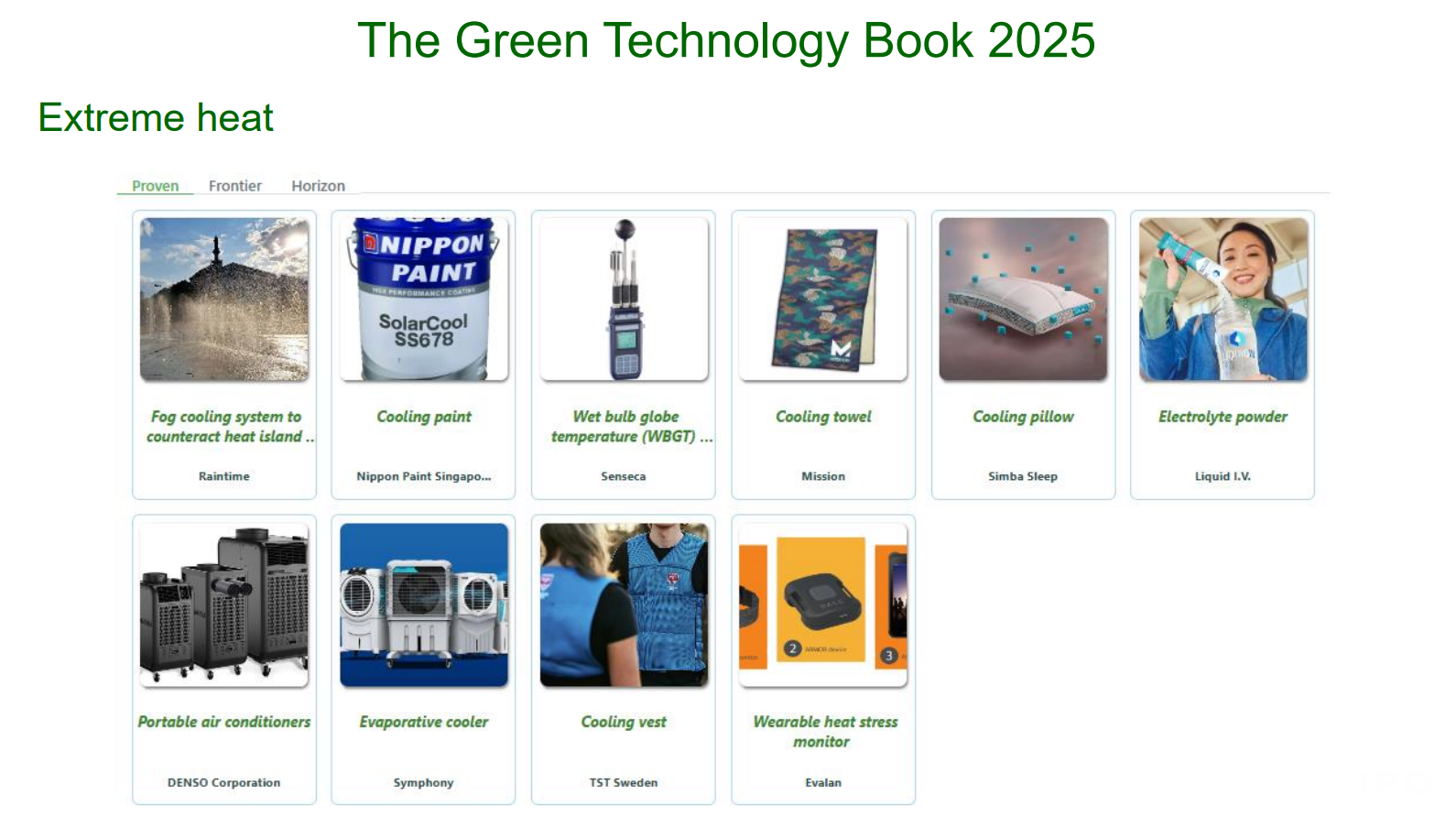
- For instance, the wet bulb globe temperature index analyzer – a very important threshold for humans who are working in the heat – provides a more accurate measuring than just measuring air temperature, allowing to know precisely when the threshold of 35 degrees Celsius above which we cannot go or we risk death. It takes into account humidity and wind, and radiant heat, also from sunlight or machinery that you might be working with.
- Cooling towels, cooling pillows, evaporative coolers, portable air conditioners, cooling vests are useful for people working in the heat.
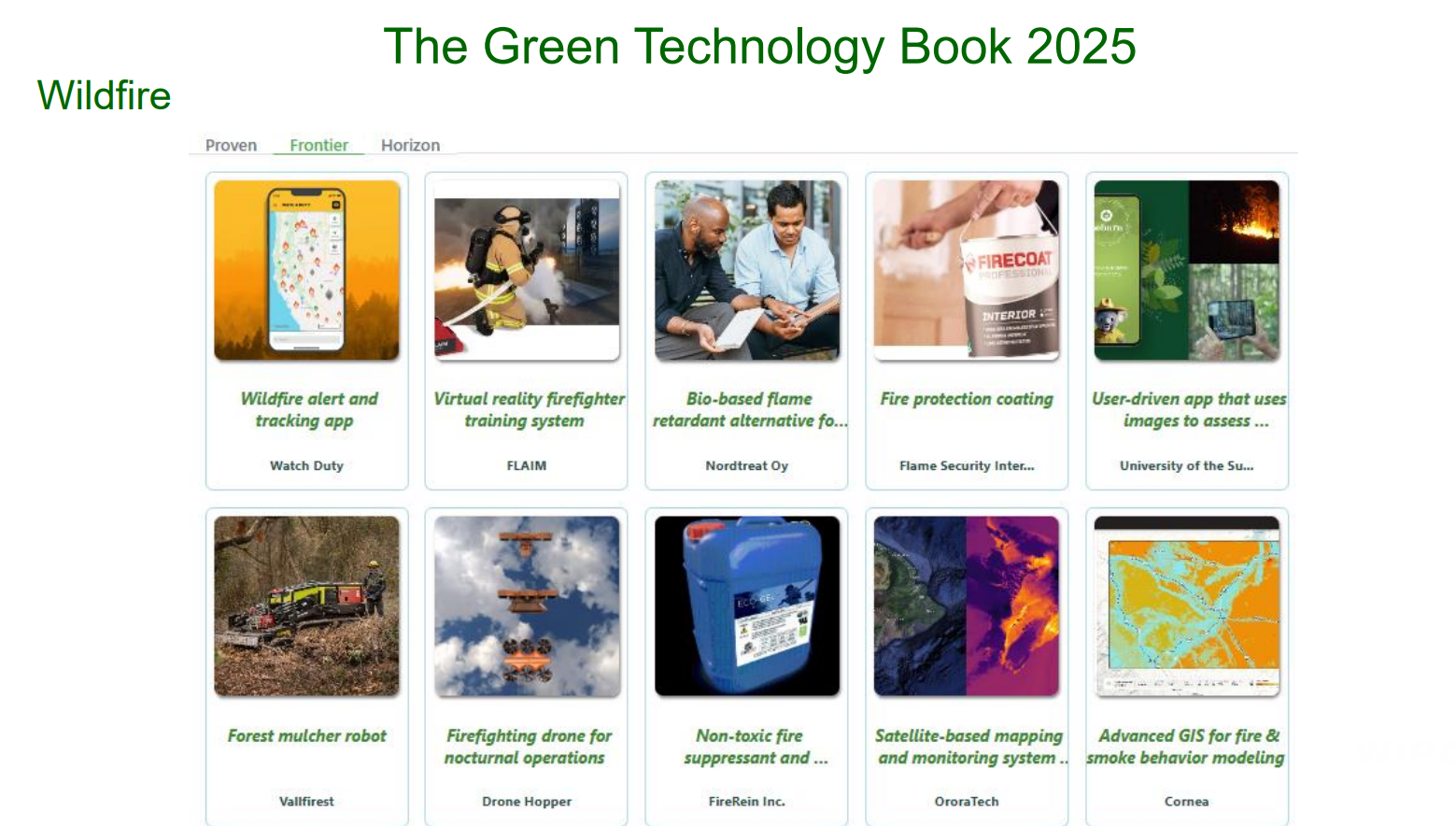
- For wildfire, there are a plethora of technologies that have been invented in the past few years, many of which incorporate AI for wildfire detection and prevention.
- One that has really gotten a lot of attention in 2025 is the Watch Duty App, a wildfire alert and tracking app that uses an interactive map that relies on open street map layers and sources information from everyone from the public to firefighters to radio traffic and provides real-time alerts on road closures and evacuations and fire containment status.
- In terms of emergency infrastructure and rapid deployment, manY interesting technologies are being driven by the proliferation of drones, which are being used for rapid food and aid, and medical delivery.
- For instance, giant inflatable emergency response shelters, which are very quickly deployable. It takes six minutes to deploy them, but lightweight durable shelters that also have a door on each side that enables them to be modular and connected to each other, which can then create an even bigger structure.
- There has been a large shift from recovery to preparedness, and this is being supported by things like AI-enabled weather forecasting and digital twins, which are able to simulate disasters such as floods.
- Advancements in early warning systems is not just simply digitization, but rather a fusion of these physical mobility systems, like drones and vehicles and shelters, with this digital intelligence.
- From AI to satellites, technology is transforming how we see and anticipate and manage climate risks during every phase of the disaster response cycle. Technologies can support efforts to anticipate disasters and then to preposition relief supplies ahead of these disasters also using predictive supply chain analytics.
- For instance, IoT sensors can track parameters like river levels for flooding and then drones and satellites are allowing us visibility in places that humans are not able to safely reach. Information is aid and this is especially true in the disaster context, where information needs to rapidly reach the people that are being affected.
- Digital communication tools really are our core infrastructure now for modern disaster response and no single technology will suffice.
- We need everything from satellites and radios to broadband and mobile apps and chat chatbots and alert systems. These all come together to create a resilient and flexible multilayered response system. Early warning systems, for example, rely on both traditional and modern media.
- Disaster finance is about building resilience before disasters hit. It is no longer just about post-disaster relief; it is more about anticipatory aid through things like cash transfers and parametric and index-based insurance and catastrophic bonds and AI AI-powered risk models, and all of these things come together to automate payouts and facilitate the process, which makes it faster and also reduces fraud and increases coverage for a larger percentage of the population. These tools really help shift risk and impact burdens.
To be continued.
Documents
Links
- Special EXPO25 Edition on Asia-Pacific Highlights 200+ Climate Solutions Available Today and Tomorrow | WIPO Green | 6 October 2025
- Mobilisation pour les 10 ans de l’Accord de Paris : la France se mobilise à Genève
- Mobilizing Climate Actors in International Geneva | GEN
- Geneva Launch: Green Technology Book EXPO25 Special Edition | Advancing Climate Action Ten Years After the Paris Agreement | WIPO