Nouvelle
International Day of Clean Air for Blue Skies
Mise à jour: 16 Août 2026
Encouraged by the increasing interest of the international community in clean air, and emphasizing the need to make further efforts to improve air quality, including reducing air pollution, to protect human health, the General Assembly decided in 2020 to designate 7 September as the International Day of Clean Air for blue skies.
International Day of Clean Air for Blue Skies
Clean air is important for the health and day-to-day lives of people, while air pollution is the single greatest environmental risk to human health and one of the main avoidable causes of death and disease globally. According to the United Nations Environment Programme (UNEP), air pollution is the world’s biggest environmental killer. Data from the World Health Organization (WHO) indicates that air pollution is responsible for around seven million premature deaths each year through diseases such as lung cancer, acute respiratory infections and heart disease, and that 9 out of 10 people breathe air containing high levels of pollutants. In addition, air pollution disproportionately affects women, children and older persons.
Air pollution doesn’t only affect human health, it also negatively impacts the climate, economic growth and our natural environment. Air pollution decreases the oxygen supply in our oceans, making it harder for plants to grow and as such, contributes to climate change. The good news is that air pollution is largely avoidable and its negative consequences are preventable. Solutions are known and can be implemented. The world needs to act now.
In order to raise awareness and mobilize efforts against air pollution, the international community celebrates each year International Day of Clean Air for Blue Skies, as set out in the UN General Assembly resolution 74/212.
International Day of Clean Air for Blue Skies 2026
The economic case for air pollution action has been outlined in the past, but never with the strength that it will have during this year’s International Day of Clean Air for Blue Skies.
New findings brought by UNEP and its convened Climate and Clean Air Coalition (CCAC) will be at the center of the 2026 Clean Air Day campaign, with the launch of a UNEP Spotlight Report – Hidden assets: The economic and health case for climate and clean air action. The report demonstrates that integrated action on climate change and air pollution is a smart investment, and that proven solutions available today can generate economic returns that far exceed their implementation costs while protecting public health, strengthening economies and accelerating progress towards global climate and sustainable development goals.
Air pollution has long contributed to death and disease, undermining economic prospects and community well-being. Many sources of air pollution, such as the burning of fossil fuels and biomass, also contribute to greenhouse gas emissions, causing our planet to warm. Like climate change, air pollution affects everyone but impacts pregnant people, babies and children, older people, those living in poverty, and historically marginalized communities. The enormity and immediacy of these challenges cannot be ignored.
This year’s observance emphasizes the undeniable economic case of integrated climate and clean air action to support healthier populations and economic prosperity.
#CleanAirDay.
The day is marked by a range of events and activities, including:
- WMO Air Quality and Climate Bulletin 2026 | On the occasion of the International Day of Clean Air for Blue Skies, WMO is releasing on 7 September 2026 its Air Quality and Climate Bulletin, which reports annually on the state of air quality and links to climate. It reflects 2025 trends in the geographical distribution and levels of pollutants such as wildfire smoke and ozone.
- Businesses for Clean Air: Advancing Human Rights Through Action | The UN Special Rapporteur on the right to a healthy environment and the UN Working Group on Business and Human Rights are hosting an online event to discuss the role of businesses in tackling air pollution and recommendations and pathways for businesses to advance human rights, including clean air for all. The event will feature an address by the UN Special Rapporteur on the human right to a clean, healthy and sustainable environment, Astrid Puentes Riaño, whose report to the sixty-first session of the Human Rights Council (A/HRC/61/47) discussed “Priority actions towards breathing clean air, protecting public health and ensuring a healthy environment”. → Register to attend the event taking place on 7 September 2026 at 15:00 CEST
International Clean Air Dialogue
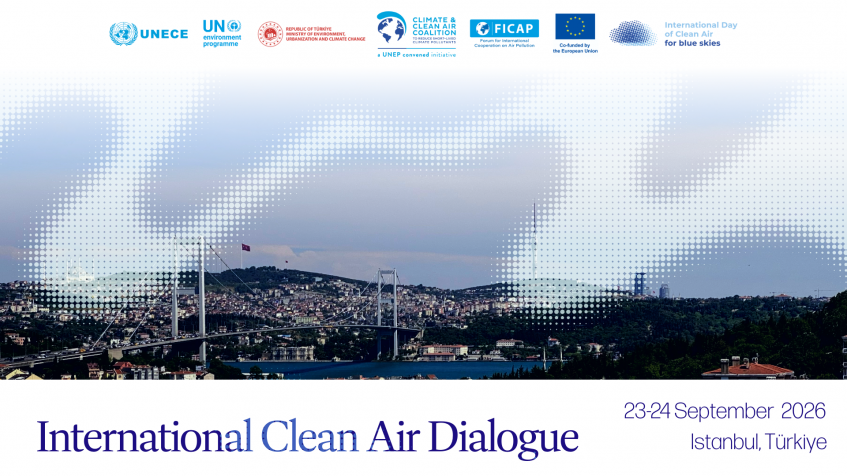
The International Clean Air Dialogue will bring together government representatives from different regions, international organizations, academia, research institutions and civil society to exchange solutions and strengthen global and regional cooperation for cleaner air. It will take place on 23 and 24 September 2026 in Istanbul, Tükiye.
Co-organized by the United Nations Economic Commission for Europe, UNEP, Climate and Clean Air Coalition, Forum for International Cooperation on Air Pollution and the Government of Türkiye, the Dialogue will build on recent international commitments and major air-quality initiatives. It will examine global and regional air-pollution trends, impacts and policy challenges, while showcasing evidence-based policies, legislation, tools and technologies that can deliver benefits for health, the environment and climate.
The two-day programme will address science-policy cooperation, regional frameworks, transport emissions, financing for clean-air solutions and effective communication of air-quality information to the public. Participants will also develop practical recommendations to support stronger air-quality policies and governance.
The Dialogue aims to:
- increase awareness of emerging air-pollution trends and policy challenges;
- share effective solutions with climate and sustainable-development benefits;
- strengthen cooperation on air-quality monitoring, management and governance; and
- identify practical recommendations for action at global, regional and national levels.
The event is organized with financial support from the European Union, Türkiye and the United Nations Development Account.
Clean Air and the United Nations Environment Assembly
On March 1, during the sixth session of the United Nations Environment Assembly (UNEA-6)—the world’s highest decision-making body on environmental issues—the resolution (6/10) titled “Promoting Regional Cooperation on Air Pollution to Improve Global Air Quality” (UNEP/EA.6/RES.10) was passed. This resolution calls for strengthened regional cooperation and the establishment of national programs, policies, and standards to address air pollution. It urges Member States to expedite the implementation of air quality initiatives and set national standards in accordance with WHO guidelines.
Additionally, the resolution requests the UNEP Executive Director to create a cooperation network to raise awareness, enhance monitoring capabilities, share knowledge, and support regional air quality initiatives. It also invites various stakeholders, including governments and organizations, to mobilize resources and develop regional solutions, with a particular emphasis on aiding developing countries in combating air pollution.
As follow up, ahead of International Day of Clean Air and blue skies 2024, the Climate and Clean Air Coalition (CCAC) has developed and launched an Air Quality Management Exchange Platform (AQMx) designed to help air quality professionals everywhere tackle air pollution. The platform is a one-stop-shop that provides the latest air quality management guidance and tools proposed to meet WHO Air Quality Guidelines interim targets.
Clean Air is a Human Right
According to the World Health Organization (WHO), air pollution kills an estimated seven million people worldwide each year and that 9 out of 10 people breathe air containing high levels of pollutants. In addition, air pollution disproportionately affects women, children and older persons. Poor air quality has implications for a wide range of human rights, including the rights to life, health, water, food, housing and an adequate standard of living.
Air pollution also clearly violates the right to a healthy and sustainable environment. Air pollution is a preventable problem. The solutions − laws, standards, policies, programmes, investments and technologies − are known. Implementing these solutions will of course entail large investments, but the benefits of fulfilling the right to breathe clean air for all of humanity are incalculable.
Various UN Special Procedures mandate holders have addressed the issue:
- In his report to the UN General Assembly, The Right to Breathe Clean Air (A/HRC/40/55), the former UN Special Rapporteur on human rights and the environment, David R. Boyd, offers a number of recommendations to States for actions they should consider as part of a national air quality action plan. He also points out the specific obligation to protect people and groups in vulnerable situations. He identifies several good practices implemented worldwide that have helped to improve air quality. The Special Rapporteur also urges businesses to fulfill their responsibility, to contribute to and support efforts to reduce air pollution.
- Building on past reports and research, the report of the UN Special Rapporteur on the human right to a clean, healthy and sustainable environment, Astrid Puentes Riaño, to the 61st session of the Human Rights Council highlights the need to advance the protection of clean air as a vital element of the human right to a clean, healthy and sustainable environment (A/HRC/61/47). The public health crisis can be solved and further risks prevented, as evidenced by research and improved monitoring and governance to tackle main drivers linked to a fossil-fuel-dependent economy and unsustainable activities. Stronger measures to improve air quality, prioritizing health to protect people, must be urgently implemented by States, aligned with their international and human rights obligations. The duty of private actors to support these efforts, and their urgent responsibility to prevent, reduce and remediate pollution, must also be underscored. The Special Rapporteur underscores that States must prioritize the additional recommendations towards clean air and protecting public health, which complement and build upon past recommendations.
Plastics and Air Pollution
While we are familiar with the presence and impact of plastic on oceans and the freshwater ecosystem, the plastic crisis is multifaceted and deeply connected to other aspects of the ongoing environmental crisis. In fact, the plastics sector is one important industrial contributors to air pollution. Microplastics have been detected in the atmosphere of urban, suburban, and even in remote areas such as in high-altitude glaciers, the Arctic and Antarctic suggesting potential long-distance atmospheric transport for microplastics. The incineration of plastic waste also releases toxic gases such as dioxins, furans, mercury and polychlorinated biphenyls into the atmosphere and poses a threat to the environment.
Monitoring Air Quality
Globally
In 2021, UNEP published the First Global Assessment of Air Pollution Legislation (GAAPL) and presented the findings of a study of air quality legislation in 194 countries and the European Union. Using the Air Quality Guidelines developed by the WHO as a starting point, the report examines the legal measures for determining whether air quality standards are being met and what legal standards exist for failure to meet them. UNEP also published The European and Central Asian Actions on Air Quality report. In September 2023, the WHO published an Overview of methods to assess population exposure to ambient air pollution, summarizing several air quality measurement and modelling methods that can be used to estimate ground-level air pollutant concentrations and presents multiple approaches to monitoring ambient air pollution at different spatial and temporal scales.
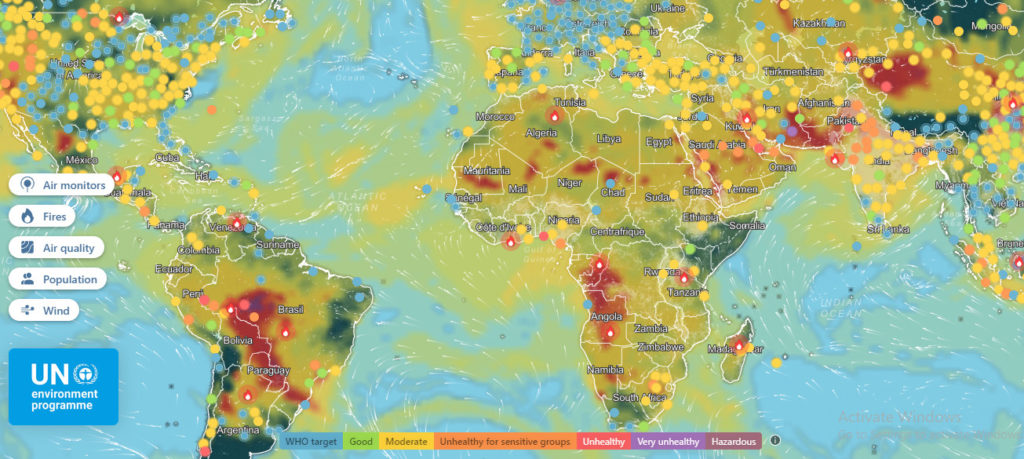
Click on the image below to explore the quality of air worldwide in real time.
In Geneva
The air quality in Geneva is constantly under observation and four fixed measuring stations are active in the canton. Geneva is implementing measures targeting the sources of the pollution and applying a cantonal strategy to prevent air pollution.
- La qualité de l’air en 2022 | Swiss Federal Office for the Environment (FOEN) | 16 October 2023
- Qualité de l’air en 2022 à Genève: tendance favorable au-delà des effets dus à la pandémie | 4 July 2023
- Current air quality in Geneva
- Air quality in the last 10 days
- Air quality in recent years
- Air2G² : air quality in Great Geneva region
- Stick’AIR sticker
- Blogs Air-Genève
- Spatial distribution of nitrogen dioxide
The Role of Geneva
Addressing air pollution requires multisectoral and multistakeholder efforts that build upon synergies between different organizations. As a global hub for international environmental governance, air pollution is a priority for Geneva and the various intergovernmental, international and non-governmental institutions active in the area (listed below in alphabetical order). The First WHO Global Conference on Air Pollution and Health took place in Geneva in from 30 October to 1 November 2018.
The Global Alliance on Health and Pollution (GAHP)
GAHP is a collaborative body of more than 60 members and dozens of observers that advocate for resources and solutions to pollution problems. Focusing on improving health as a priority and key metric for combatting pollution, GAHP recognizes that collaborative, multi-stakeholder, multi-sectoral approach is necessary and critical to deal with the global pollution crisis and resulting health and economic impacts, as seen in their report, “Air Pollution Interventions: Seeking the Intersection Between Climate and Health« .
International Organization for Standardization (ISO)
ISO is a global network of the world’s leading standardizers. ISO has many international standards that contribute to cleaner air and reducing pollution. ISO’s technical committee ISO/TC 146, Air quality2) , has over 170 published standards and 37 in development that cover a range of areas such as the measurement of air pollutants and emissions, workspace air and indoor air.
Minamata Convention on Mercury
Mercury is an extremely toxic chemical that can enter the environment as emissions into the atmosphere from human activities. Mercury emissions can travel long distances, accumulate through the food chain, and negatively impact human health and the environment. The Minamata Convention on Mercury has developed guidance on best available techniques and best environmental practices (BAT/BEP) to control emissions.
Stockholm Convention
The Stockholm Convention on Persistent Organic Pollutants is a global treaty to protect human health and the environment from chemicals that remain intact in the environment for long periods, become widely distributed geographically, accumulate in the fatty tissue of humans and wildlife, and have harmful impacts on human health or on the environment. Exposure to Persistent Organic Pollutants (POPs) can lead to serious health effects including certain cancers, birth defects, dysfunctional immune and reproductive systems, greater susceptibility to disease and damages to the central and peripheral nervous systems. Given their long range transport, no one government acting alone can protect its citizens or its environment from POPs.
United Nations Economic Commission for Europe (UNECE)
To improve air quality, UNECE member states have been working successfully to reduce air pollution in the region through the Convention on Long-Range Transboundary Air Pollution. Eight protocols identify specific measures to be taken by the Parties to cut their emissions. The Convention also provides access to emission, measurement and modelling data and information on the effects of air pollution on ecosystems, health, crops and materials.
United Nations Special Rapporteur on Human Rights and the Environment
The Special Rapporteur on Human Rights and the Environment is mandated to continue to study the human rights obligations relating to the enjoyment of a safe, clean, healthy and sustainable environment. The current Special Rapporteur, David R. Boyd, developed « The Right to Breathe Clean Air » report for the UN General Assembly with a number of recommendations to States for actions they should consider as part of a national air quality action plan. He also urges businesses to fulfill their responsibility, to contribute to and support efforts to reduce air pollution.
World Economic Forum (WEF)
The Alliance for Clean Air works towards a 1.5° trajectory by 2030 by catalyzing action on ambient air pollution and prioritizing health. WEF also provides strategic insights and contextual intelligence on air pollution.
World Health Organization (WHO)
The First WHO Global Conference on Air Pollution and Health took place in Geneva in from 30 October to 1 November 2018. The WHO also developed the guideline « Health and the Environment: Addressing the Health Impact of Air Pollution« .
World Meteorological Organization (WMO)
The Global Atmosphere Watch Programme of the WMO studies the variability and trends in atmospheric composition and related physical parameters, and assesses their consequences. One major aspect of the Global Atmosphere Watch is to organize, participate in and coordinate assessments of the chemical composition of the atmosphere on a global scale. In this way, the Global Atmosphere Watch provides reliable scientific information for national and international policymakers, supports international conventions on stratospheric ozone depletions and monitors climate change and long-range transboundary air pollution.
The WMO publishes the Air Quality and Climate Bulletin, reporting annually on the state of air quality and its connections to climate change, reflecting on the geographical distribution of and changes in the levels of traditional pollutants. The Bulletin highlights the main factors that influence air quality patterns, in comparison to other years, showing how there were episodes of both improvement and deterioration of air quality in different parts of the world.
Global Campaigns
Alliance for Clean Air
The World Economic Forum has partnered with UNEP to engage the private sector and garner commitments through the Alliance for Clean Air. It brings together different sectors and organization to share facts, best practices, work through the barriers to action, and develop public-private partnerships.
BreatheLife
BreatheLife is a global campaign launched in 2016 to mobilize cities and individuals to protect our health and planet from the effects of air pollution. It combines public health and climate change expertise with guidance on implementing solutions to air pollution in support of global development goals. The campaign is supported by WHO, UNEP, the World Bank and the Climate and Clean Air Coalition. BreatheLife’s growing network includes 76 cities, regions, and countries.
Clear the Air
As the population approaches 10 billion with people concentrated in urban areas, air pollution is likely to worsen. Clearing the air has garnered governmental commitment. On 1 September 2020, UNEP launched Clear the Air as part of its #BeatPollution campaign and aims to raise awareness about the impact of air pollution.
Learning

Air Pollution Quiz
Clean air for blue skies
Resources
- Official Website of the Day
- International Day of Clean Air for blue skies | United Nations
- UN General Assembly resolution 74/212 | UN | 22 January 2020
- Clean Air Day Guide | UNEP
- Climate and Clean Air Coalition
- Air Pollution | WHO
- Clean Air | UNECE
- Global Atmosphere Watch Programme | WMO
- Clean Air and Human Rights | UN Special Rapporteur on Human Rights and the Environment
- Air pollution and Multilateral Environmental Agreements | InforMEA
- Alliance for Clean Air | WEF
- Air Pollution | Strategic insights and contextual intelligence | World Economic Forum
- Global Coalition on Health, Environment and Climate Change (HECC) | WHO-UNEP-WMO
- Pollution Action Note – Data you need to know | UNEP
- Air | Swiss Federal Office for the Environment
- Air Quality in Geneva (LIVE) | Canton of Geneva
- Macaron Stick’AIR | Canton of Geneva
- Sustainably Improving Air Quality in Geneva | Canton of Geneva
- Electromobilité for Better Air Quality | Canton of Geneva
- PACT’Air Regional Collaboration | Canton of Geneva
- COVID-19 and Air Quality in Geneva | Canton of Geneva
News
- 10 things you should know about air pollution | UNEP | 5 September 2025
- WMO Air Quality and Climate Bulletin highlights vicious cycle | WMO | 5 September 2025
- New air quality management platform to support global clean air action | UNEP | 5 September 2024
- Vicious circle of climate change, wildfires and air pollution has major impacts | WMO | 5 September 2024
- WMO Air Quality and Climate Bulletin No. 4 | 5 September 2024
- State of Global Air Report 2024 | June 2024
- Finding super solutions to super pollutants | UNEP | 21 February 2024
- La première directive cantonale pour une meilleure qualité de l’air lors de chantiers | Département du territoire (DT) du Canton de Genève | 12 February 2024
- WMO Bulletin: heatwaves worsen air quality and pollution | WMO | 4 September 2023
- Clean air + green planet = good health for all | WHO Press Release | 5 July 2023
- Collaboration key to securing clean air for all, experts say | UNEP | 19 June 2023
- Slow Transition to Clean Energy Puts Billions at Risk of Household Air Pollution | Health Policy Watch | 6 June 2023
- Available air pollution reduction measures far cheaper than costs of damage to health, ecosystems and economy, confirms UN report | UNECE | 14 December 2022
- Does air pollution reduce cognitive function over time? | Liji Thomas | News-Medical.net | 4 December 2022
- Estimation of stillbirths attributable to ambient fine particles in 137 countries | Xue, T., Tong, M., Li, J. et al. | Nature Communications | 29 November 2022
- WMO Air Quality and Climate Bulletin highlights impact of wildfires | WMO | 7 September 2022
- Statement by Chief Scientists for the 2022 International Day of Clean Air for blue skies | IUCN, UNEP, WHO, WMO | 7 September 2022
- After landmark UN declaration, hope for cleaner air | UNEP | 24 August 2022
- International Day of Clean Air for blue skies highlights links between human and planetary health | UNEP | 7 September 2021
- The Gap Between Air Pollution Pacesetters and Laggards in Europe and Central Asia Has Widened, New Report Finds | UNEP | 3 September 2021
- 1 in 3 countries Have No Outdoor Air Quality Requirements: UN Report | The Hill | 2 September 2021
- Less Air pollution and More Access to Green or Blue Spaces: A Recipe to Improve the Life Quality of People with COPD | Science Daily | 2 September 2021
- Long-Term Exposure to Low Levels of Air Pollution May Be Linked to Higher Mortality | News Medical | 2 September 2021
- Air Pollution Linked to More Severe Mental Illness – Study | The Guardian | 27 August 2021
- These Five Cities Are Taking Aim at Air Pollution | UNEP | 27 August 2021
- Climate Change: Global Greenhouse Gas Levels Were Highest Ever in 2020 Despite Lockdowns, Study Finds | SkyNews | 26 August 2021
- Our Trash is Trashing the Planet’s Air Quality | UNEP | 12 August 2021
- UN Investigates How to Hit the Brakes on Traffic Pollution | Geneva Solutions | 14 January 2021
- Cooperation for Clean Air Must Be at the Heart of a Green Recovery from the COVID-19 Crisis | UNECE | 26 August 2020
- Blue skies ahead? Why cooperation between science and policy is the key to reducing air pollution | Pip Cook | Geneva Solutions | 14 September 2020
- Build a better future with blue skies for all, UN urges, marking first International Day of Clean Air | UN News | 7 September 2020
- Clean Air for all: towards a global community of action | Geneva Solutions | 7 September 2020
- The Big Interview: Dr Maria Neira, World Health Organization | Air Quality News | 7 May 2020
- Beat Air Pollution High-Level Dialogue, World Environment Day 2019 | Geneva Environment Network | 3 June 2019
- With a premature death every five seconds, air pollution is violation of human rights, says UN expert | UN News | 3 June 2019
- The Right to Breathe Clean Air | David R. Boyd, UN Special Rapporteur on human rights and the environment | 2019
- First WHO Global Conference on Air Pollution and Health | WHO | 30 October – 1 November 2018
- Climate Change and Air Pollution: Two Sides of the Same Coin | WHO | 2018
- The Paris Agreement is a Health Agreement – WHO | UNFCCC | 3 May 2018