
Event Conference
Biodiversity and Human Rights: From Agreements to Action | HRC57 Side Event
11 Sep 2024
14:00 – 15:00
Venue: Palais des Nations | Room XXV
Organization: Geneva Human Rights, Biodiversity and Land Task Force
The side event to the 57th session of the Human Rights Council discussed key elements relating to biodiversity and human rights. It was an opportunity to highlight the role that the Human Rights Council can play in supporting the implementation of the Kunming-Montreal Global Biodiversity Framework following a human rights based approach.

About this Event
In the perspective of the 16th Conference of the Parties (COP16) of the Convention on Biological Diversity (CBD) later this year, the Geneva Human Rights, Biodiversity and Land Task Force (GeHRBiL) organized a side event to discuss key elements relating to biodiversity and human rights. This was an opportunity to highlight the role that the Human Rights Council can play in supporting the implementation of the Kunming-Montreal Global Biodiversity Framework following a human rights based approach.
This was especially relevant as Colombia, who will host the 16th Conference of the Parties (COP16) of the Convention on Biological Diversity (CBD) from 21 October to 1st November in Cali, is proposing at this HRC 57th session a resolution on the importance of applying a human rights perspective on the Kunming-Montreal Global Biodiversity Framework (KMGBF). The KMGBF was adopted in 2022 during the CBD COP15 in Montréal and includes that its implementation ‘should follow a human rights-based approach, respecting, protecting, promoting and fulfilling human rights’ and it ‘acknowledges the human right to a clean, healthy and sustainable environment’ (Section C, para 7g).
Environment @ HRC57
The 57th regular session of the Human Rights Council (HRC57) is taking place in Geneva and online from 9 September to 11 October 2024. With the environment high on the agenda, consult regular updates on key environmental issues at HRC57, side events, and further resources available on our dedicated HRC57 and the environment update.

Speakers
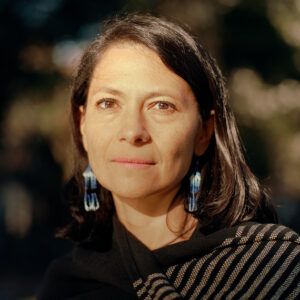
Astrid PUENTES RIAÑO
UN Special Rapporteur on the right to a clean, healthy and sustainable environment | Video message
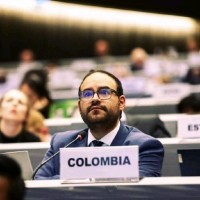
Miguel RUIZ BOTERO
Second Secretary, Permanent Mission of Colombia to the UN Office and other international organizations in Geneva

Nela CERNOTA
Associate Human Rights Officer, Office of the High Commissioner for Human Rights

Bruna DE ALMEIDA CAMPOS
Senior Campaigner, Offshore Oil & Gas, Center for International Environmental Law

Alexandra GOOSSENS-ISHII
Representative to the UN & Programme. Coordinator, Climate & Environment Advocacy, Soka Gakkai International | Geneva Human Rights, Biodiversity and Land Task Force

Yves LADOR
Representative to the United Nations in Geneva, Earthjustice | Geneva Human Rights, Biodiversity and Land Task Force | Moderator
Highlights
Video
Live from Palais des Nations.
Astrid Puentes, UN Special Rapporteur on the right to a clean, healthy and sustainable environment
Summary
Opening
Yves LADOR | Representative to the United Nations in Geneva, Earthjustice | Geneva Human Rights, Biodiversity and Land Task Force, Moderator
- One important element that happened at the last COP of the Convention on Biodiversity in 2022 was the adoption of the Kunming-Montreal Global Biodiversity Framework (GBF), which is today the main policy instrument for international work in the field of biodiversity.
- We can see elements of language that this framework should follow a human rights based approach, respecting, protecting, promoting and fulfilling human rights, and it also acknowledges the human rights to a clean, healthy and sustainable environment.
- At this session of the Council, we will also have a resolution in order to prepare and send a message from the Human Rights Council to the COP16.
Panel Discussion
Astrid PUENTES RIAÑO | UN Special Rapporteur on the right to a clean, healthy and sustainable environment | Video statement
- Today, humanity faces existential threats from the climate change, biodiversity and pollution crisis, aggravated by systemic inequalities which are impacting the enjoyment of all human rights.
- The cumulative experience and expertise of the Human Rights Council is vital in the implementation of this GBF. Clarification of states and business’s obligations in relation to biodiversity protection can be significantly important.
- All actions related to solving the triple planetary crisis must have human rights at the center. This not only prevents further violations but it also contributes to more effective measures both in relation to biodiversity protection and climate action.
- The key in implementing the framework includes the content of the human right to a healthy environment, in relation with the substantive and procedural elements including access to information, participation, and access to justice.
- The council has developed special measures that states should develop in relation to marginalized communities such as women, children, youth, Indigenous Peoples, people of African descent, peasants and rural communities. All of this knowledge should be used at the UN in order to advance effective measures.
Nela CERNOTA | Associate Human Rights Officer, Office of the High Commissioner for Human Rights
- According to the Intergovernmental Science-Policy Platform on Biodiversity and Ecosystem Services (IPBES), the global rate of species extinction is already tens to hundreds times higher than the average rate over the past 10 million years, with acceleration.
- Biodiversity and human rights are interdependent. Biodiversity loss undermines the ability of humans to exercise their human rights, disproportionately impacting those already in vulnerable situations and who are directly dependent on nature.
- Healthy biodiversity and ecosystems are among the crucial elements of the right to a clean, healthy and sustainable environment recognized by the Human Rights Council in 2021 and the UN General Assembly in 2022.
- Biodiversity conservation needs to be consistent with human rights. Respecting, protecting, and fulfilling human rights is an obligation under international human rights law. Rights-based biodiversity action leads to better outcomes for both people and biodiversity.
- The GBF reflects the interlinkages between biodiversity and human rights. Section C underlines the need for the framework to follow a human rights-based approach, explicitly acknowledging the right to a clean, healthy and sustainable environment, as well as the right to development. Targets 2, 22 and 23 mention the rights of Indigenous Peoples and local communities, participation in decision-making and access to information, and gender equality in the implementation of the framework.
- Silos between human rights and environmental processes is one of the key challenges to rights-based environmental action.
- The CBD COP16 and the transition of the Human Rights Council have the opportunity to break these silos and advance rights-based environmental action. The decisions of the CBD COP16 on new areas of work to support the scientific and technical needs for the implementation of the GBF, as well as the equipment of states with necessary guidance to implement the framework from a human rights-based approach, should have human rights in the center.
Bruna DE ALMEIDA CAMPOS | Senior Campaigner, Offshore Oil & Gas, Center for International Environmental Law
- Fossil fuels are a common root cause of the triple planetary crisis. Oil and gas exploitation directly impacts human rights and particularly communities that are dependent on biodiversity. Loss of ecosystems and deforestation, pollution, and oil spills harm Indigenous Peoples and local communities, especially those based on fishing, agriculture, natural resources, and harvesting.
- In Brazil, a network of women have recently documented their hands-on experience, mentioning the impact of a recent oil spill that has affected their livelihoods and health. They have had an increase in uterus cancer cases since they have to go into water that is entirely polluted by oil.
- The health of the oceans are often not clear and known to people. However, offshore drilling has a major impact on coastal communities, as seen in examples of offshore oil spills affecting the lives and businesses of communities.
- Another problem is that there is not a space for frontline environmental defenders or Indigenous Peoples to come in and voice out their opinions, nor sufficient support and protection. For example, an NGO (Red Thread) of women from Guyana are being harassed and threatened for speaking up against oil and gas in their country.
- Impacts witnessed by communities are usually not documented, and there is a lack of incorporation of Indigenous knowledge into the GBF. The knowledge of Indigenous Peoples needs to be integrated in the decision-making.
- National action plans for biodiversity (NBSAPs) need to take into account sectoral aspects such as offshore oil and gas, explaining concrete measures to tackle the issue.
- There needs to be a more robust regulation of industries that is consistent with the precautionary principle.
- Our first and foremost recommendation for the CBD is to protect frontline defenders, adopting measures to prosecute when there is repression or discrimination.
Alexandra GOOSSENS-ISHII | Representative to the UN & Programme. Coordinator, Climate & Environment Advocacy, Soka Gakkai International | Geneva Human Rights, Biodiversity and Land Task Force
- The civil society working group that I am part of focuses on human rights and biodiversity in the CBD. The working group has been following the CBD process and the GBF negotiations, advocating for the inclusion of a human rights perspective. We have published briefs to show where human rights aspects could be integrated in the text.
- We are working to publish a guide, “From Agreements to Actions”, for the application of a human rights-based approach to the GBF. The purpose is to signpost where there is human rights language in the GBF, with resources of key questions for the national and subnational level.
- The first part of the guide identifies rights holders, stakeholders and duty bearers, mentioning the rights of children and youth, women and girls, people living in coastal and rural areas, local communities, and Indigenous Peoples.
- The second part focuses on foundational elements of human rights-based approach in the GBF, namely equity, participation and access to justice, as well as showing already existing instruments.
- The third section looks at the methods to integrate a human rights-based approach in key processes for biodiversity policy in a national and subnational level.
- The last section looks at concrete thematic elements such as land tenure, land use change, sea tenure and marine resources.
- In a dialogue series where we convened Indigenous Peoples, local communities representatives, women, youth, and member states researchers, we found out that there is overall thirst and need for more concrete guidance, support to states and other actors around capacity building and awareness raising of a human rights-based approach.
Miguel RUIZ BOTERO | Second Secretary, Permanent Mission of Colombia to the UN Office and other international organizations in Geneva
- Human rights implications of biodiversity loss is particularly important for developing countries, where those who are most vulnerable within the society are affected the most, including Colombia.
- There is a gap in the Human Rights Council in tackling the triple planetary crisis. Biodiversity loss, which is one of the components of the triple planetary crisis, is not on the agenda at the moment.
- Our main objective is to close this gap and make certain that the Human Rights Council includes human rights considerations in tackling the triple planetary crisis. In order to achieve this, the approach of Peace with Nature, theme of COP16, needs to be prioritized as a general approach to implementation of CBD obligations.
- Another of our objectives is to allow the OHCHR to provide technical support to states in implementing the GBF in line with relevant human rights considerations and obligations.
- We also aim to request the OHCHR to report on outcomes and advances of COP16 on the implementation of relevant human rights considerations in the GBF.
Open Discussion
Q: In Switzerland, I have the impression that everybody supports biodiversity as long as it’s not in their proper garden. It gets more complicated when it touches their economic interests or other personal interests. On a national level, we also have to balance the interest between having more biodiversity and implementing policies to promote new energy institutions and infrastructures. Do these discussions exist in other countries as well?
Q: In developing countries, we have serious environmental issues like water pollution because of the many tourists who visit the country. What is the policy of the UN to address and overcome all the environmental issues discussed, and how can it be addressed locally? How can NGOs use this platform to assemble people and gain information on how the land is used, how political interests are prioritized instead of local interests?
Q: We see a trend in the UN ecosystem of lumping together indigenous peoples with local communities and other groups, even though indigenous peoples have the unique status under international law. I request the core group and panelists to keep this in mind, while peasants and African descendants are also important.
Nela CERNOTA
- International human rights law has developed in response to balancing rights and conflicts, and any restriction on rights needs to be lawful (necessary, proportionate and indiscriminatory) and to pursue a legitimate aim which can be the protection of the environment or of another right.
- It should not happen that those who are already most affected by biodiversity loss also pay for the price of conservation. They need to be able to participate, to meaningfully express their views on the processes from the very outset, as well as access justice in case their rights are violated.
Bruna DE ALMEIDA CAMPOS
- The system in Switzerland has much more informed decision making compared to many other parts of the world. Often risks and impacts are not well understood or acknowledged, and information is biased and not accessible to everyone.
- Regarding the balance of interest between more biodiversity and other policies and infrastructure, the EU recently passed the Nature Restoration Law. It’s one of the few places in the world where nature has become so degraded that you need to pass a new law to restore nature, and this is very costly.
Miguel RUIZ BOTERO
- With our concept of Peace with Nature, we want to move past this dichotomy between nature and economic development.
- Economic development in the past two centuries has often been violent to nature. Key ecosystems are vital to economic development, which is often overlooked when calculating the pros and cons of biodiversity conservation. Inadequate biodiversity conservation will hinder sustainable economic development. The two should be mutually reinforcing.
- In developing countries, we want to make our own path of economic development that is no longer violent, but that is done together with nature.
Documents
- Draft Resolution on Biodiversity and Human Rights, Rev. 1 | Colombia and Costa Rica
Links
- From Agreements to Actions: A guide to applying a human rights-based approach to the Kunming-Montreal Global Biodiversity Framework | Human Rights and Biodiversity Working Group | 2024
- Biodiversity and the Role of Geneva | GEN
- Human Rights and the Environment | GEN