
Event Conference
Briefing on the Preparations for the Fifteenth Meeting of the Open-ended Working Group of the Basel Convention (OEWG-15) and other Subsidiary Bodies under the Basel, Rotterdam and Stockholm Conventions
11 Jun 2026
10:00 – 11:30
Venue: International Environment House I | Room 2 & Online | Webex
Organization: Geneva Environment Network, Basel, Rotterdam and Stockholm Conventions
This briefing, organized within the framework of the Geneva Environment Network, provided updates on preparations for the meetings of the subsidiary bodies of the Basel, Rotterdam and Stockholm Conventions taking place in Geneva in June 2026.
About this Event
This briefing, organized within the framework of the Geneva Environment Network, provided updates on preparations for the meetings of the subsidiary bodies of the Basel, Rotterdam and Stockholm Conventions taking place in Geneva in June 2026.
The compliance committees under the Basel, Rotterdam and Stockholm Conventions will be meeting in Geneva at the International Environment House between 16 and 21 June 2026. The Second meeting of the Stockholm Convention on Persistent Organic Pollutants (POPs) Compliance Committee will convene from 16-19 June 2026, the Seventeenth meeting of the Basel Convention on the Control of Transboundary Movements of Hazardous Wastes and their Disposal Implementation and Compliance Committee (ICC-17) from 18-21 June 2026, and the Fourth meeting of the Rotterdam Convention on the prior informed consent procedure for certain hazardous chemicals and pesticides in international trade Compliance Committee from 19-21 June 2026. The committees will be meeting independently to progress their work to improve implementation and compliance with a range of obligations under the conventions and will hold a joint session on 19 June 2026 on activities, operations and processes of joint interest.
The fifteenth meeting of the Open-Ended Working Group (OEWG) of the Basel Convention on the Control of Transboundary Movements of Hazardous Wastes and their Disposal – one of the subsidiary bodies of the Conference of the Parties to the Basel Convention – will take place from Tuesday, 23 June to Friday, 26 June 2026, at the International Conference Centre Geneva (CICG), with pre-meetings, including Bureau and regional meetings, taking place on Monday, 22 June.
The OEWG is expected to advance key items within its work programme, focusing on a range of priority areas. These include efforts to improve the functioning of the prior informed consent procedure, as well as the development of technical guidelines addressing Persistent Organic Pollutants, e-waste, waste lead-acid batteries, used and waste pneumatic tyres, and mercury. Additional topics of focus include plastic waste, used textiles and textile waste, and the provision of greater legal clarity. Furthermore, the OEWG will support activities under the Basel Convention Partnership Programme and strengthen cooperation with the World Customs Organization and the International Maritime Organization.
Speakers
By order of intervention.
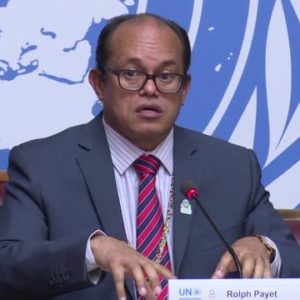
Rolph PAYET
Executive Secretary, Basel, Rotterdam and Stockholm Conventions

Juliette KOHLER
Chief, Governance Branch, Basel, Rotterdam and Stockholm Conventions

Marylene BEAU
Head, Legal and Policy Unit, Governance Branch, Basel, Rotterdam and Stockholm Conventions

Yvonne EWANG
Legal Officer, Governance Branch, Basel, Rotterdam and Stockholm Conventions

Susan WINGFIELD
Programme Officer, Governance Branch, Basel, Rotterdam and Stockholm Conventions

Océane DAYER
Waste and Chemicals Focal Point, Federal Office for the Environment, Switzerland
Highlights
Video
Live at the International Environment House.
Summary
Welcome and Opening
Rolph PAYET | Executive Secretary, Basel, Rotterdam and Stockholm Conventions
- These briefings are a very important opportunity to share practical information and explain the main issues before the Conventions’ bodies and support delegations and other stakeholders in preparing for effective participation.
- The coming weeks will be a particularly active period for the Basel, Rotterdam and Stockholm Conventions as the compliance committees under the three conventions will meet in Geneva from 16 to 21 June 2026. The 15th Open-Ended Working Group (OEWG-15) of the Basel Convention will also take place from 23 to 26 June at the CICG, with pre-meetings on 22 June.
- Together these meetings are an important step on the road from the 2025 meetings of the Conferences of the Parties to the next COPs in 2027.
- They are not simply procedural milestones. They are where mandates are translated into practical recommendations, technical guidance and concrete support for implementation and where parties can take stock of progress, identify challenges and shape the work that still needs to be done before the COPs.
Compliance committees of the BRS Conventions
- From 16 to 21 June, the three committees will meet separately to address activities on the respective work program, starting with the second meeting of the Stockholm Convention Compliance Committee, followed by the 17th meeting of the Basel Convention Implementation and Compliance Committee and the fourth meeting of the Rotterdam Convention Compliance Committee.
- A particularly significant development this year is that the three compliance committees will also hold a joint session. This is a first and it offers an important opportunity to strengthen coherence across the three conventions, exchange experiences and lessons learned and identify practical ways in which the committees can support one another’s work while respecting their separate mandates. This is synergy in action.
Basel Convention Open-Ended Working Group 15
- The meeting will consider a wide range of strategic, technical, legal and cooperation matters under the Basel Convention.
- The outcomes of OEWG15 will help shape the work leading to COP18 of the Basel Convention to take place early in 2027.
- The meeting of both is both a midpoint in the intersectional process and a critical opportunity to identify where further guidance, technical work or decisions may be needed.
- A successful OEWG, it will therefore help ensure that the COP is presented with well-considered proposals and clear options for decision-making.
2027 Meeting of the Conferences of the Parties to the BRS Conventions
- Preparations are also advancing for the 2027 meetings COPs, which will be held in Panama.
- Preparations with the host government are progressing very well. The first mission of the BRS secretariat to Panama took place in April 2026. The BRS team discussed key logistical aspects with the host government organizing team.
- An electronic visa application system will be put in place allowing delegates who need a visa to apply online. In order to ensure that there is sufficient time for visa application, the invitation letters to the meetings will be sent approximately 7 months ahead of the meetings, leaving delegations a two-month period for nominations to be made through the national channels. Delegations should therefore be prepared to transmit nominations earlier than in the past, namely by mid November 2026. This deadline will be particularly important for all participants requiring a visa for Panama.
- Full information on the visa procedures will be provided with the invitation letter.
- Further details on logistical prepar preparations will be provided during the joint bureau meeting in November.
Meetings of the Bureaux
- The bureaux play a crucial role in guiding preparations for the 2027 BRS COPS including on the provisional agendas, organization of work, elections, credentials, and other matters needed for well-prepared and efficient meetings.
- The Bureau of the Conference of the Parties of the Stockholm Convention met online on 18 and 19 May 2026.
- The Bureau of the Conference of the Parties to the Rotterdam Convention met online on 20 May 2026.
- The Bureau of the Conference of the Parties to the Basel Convention will meet online immediately after OEWG-15 on the 30 of June and 1 July 2026.
- The documents for these bureau meetings are publicly available and the reports of those meetings will also be made available on the Convention’s websites.
- Transparency and early engagement are also essential. We encourage parties and observers to consult the meeting webpages, review the available documents and prepare actively for the discussions ahead.
- The secretariat remains available to support delegations and to answer questions on the substance, organization of work, logistics and participation.
Juliette KOHLER | Chief, Governance Branch, Basel, Rotterdam and Stockholm Conventions
- The Stockholm Convention compliance committee is the newest among the three under the BRS conventions.
- Established in 2023 at COP11, its objective is to assist parties to comply with their obligations under the convention and to facilitate, promote, assist in, advise and aim to secure the implementation of and compliance with the obligations under the convention.
- The first cohort of CC members was elected at COP 12. 12 out of 15 members were elected.
- The Chair is Jimena Nieto, Vice-Chair Mark Govoni, Rapporteur Jennifer Kutesakwe Kotaku.
- The committee has already held its first meeting online in November, where it initiated consideration of all the activities of its work program and the objective was to have a preliminary review of the status of implementation and for the committee to have access to information on activities under the Convention of relevance to the work of the committee.
- For example, the mandates entrusted to the secretary by the COP or the mandates entrusted to other subsidiary bodies. This is particularly linked to the work of the effectiveness evaluation committee.
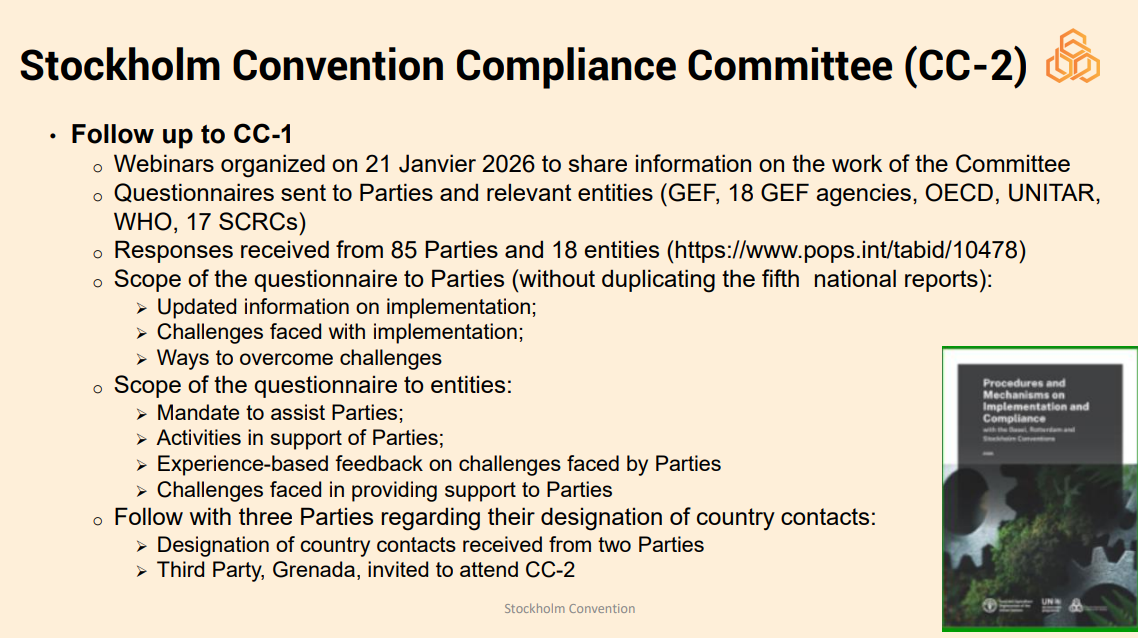
- At that meeting, the committee decided on some steps and, in follow-up to the Meeting, the BRS secretariat organized webinars on 21 January 2026 to share information on the work of the committee as requested by the committee.
- The secretariat also prepared, under the guidance of the committee questionnaires that were sent to parties and relevant entities: the GEF, the 18 GEF agencies, the OECD, UNITAR, WHO, and the 17 Stockholm Convention regional centers.
- Responses were received from 85 parties to the Stockholm Convention and 18 entities.
- The scope of the questionnaire intended to parties was to collect information on the status of implementation of the Convention, challenges faced by parties with the implementation of the Convention and suggestions on how to overcome those challenges.
- With respect to the scope of the questionnaire for entities, it was to seek information on the mandate of those entities to assist parties, what activities are undertaken in support of parties, their experience-based feedback on the challenges faced by parties, and information on their own challenges when providing support to parties.
- Another follow-up step after the first meeting of the committee was to follow up with three parties regarding the designation of country contacts. Since then, two parties have designated their country contacts.
- The third party, Grenada, the committee will consider at the second meeting how best to support this party. Granada was invited to attend the second meeting of the committee.
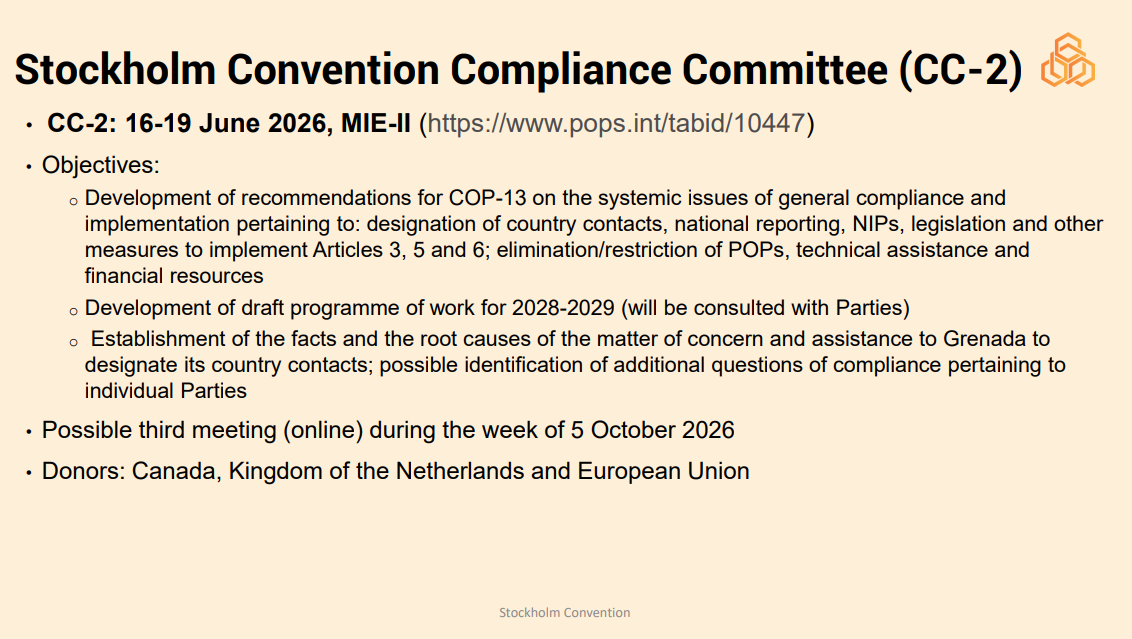
- This second meeting will be taking place from 16 to 19 June 2026 at the International Environment House II.
- The objectives of the meeting are for the committee to:
- Develop recommendations on the systemic issues of general compliance and implementation pertaining to the obligations set out in the work program, namely designation of country contacts, national reporting, National Implementation Plans (NIPs) legislation and other measures to implement Articles 3, 5 and 6 of the Convention, restriction of POPs and technical assistance and financial resources.
- Consider the development of its next work program for 2028/2029, which is to be consulted with parties.
- Consider the facts and the root causes of the matter of concern and provide assistance to Grenada in relation to the designation of its country context.
- Identify additional questions of compliance pertaining to individual parties and consider holding a third meeting online during the week of 5 October. This would be if it needs to finalize its recommendations in time for consideration by COP 13.
Marylene BEAU | Head, Legal and Policy Unit, Governance Branch, Basel, Rotterdam and Stockholm Conventions
- The Basel Implementation and Compliance Committee was established in 2002 by the sixth meeting of the Conference of the Parties to the Basel Convention.
- In the decision that established the committee, COP6 also adopted its terms of reference, which provide for the modalities of its work, mandate, scope as well as objective.
- The TOR of the committee has been subsequently amended by the COP several times: by COP10, COP11, COP14 and COP17.
- The objective of the committee is to assist parties to comply with their obligations under the Convention as well as to facilitate, promote, monitor and aim to secure the implementation of and compliance with the obligations under the Convention.
- The committee is a 15-member body with equitable geographical representation.
- The bureau is composed of five officers: the chair of the committee is Sophie Bernier from Canada. She’s supported by three vice chairs: Hassan Azhar; Katrin Kaare; Mishelle Govender; Nneka Nicholas (Rapporteur).
- The committee has a dual mandate: it supports individual parties with their compliance difficulties and challenges through the specific submission track and it reviews general issues of compliance and implementation.
- The general review track helps identify recurring implementation challenges that can then be turned into practical recommendations to the COP, tools and guidance that can assist and be of benefit to all parties under the Convention.
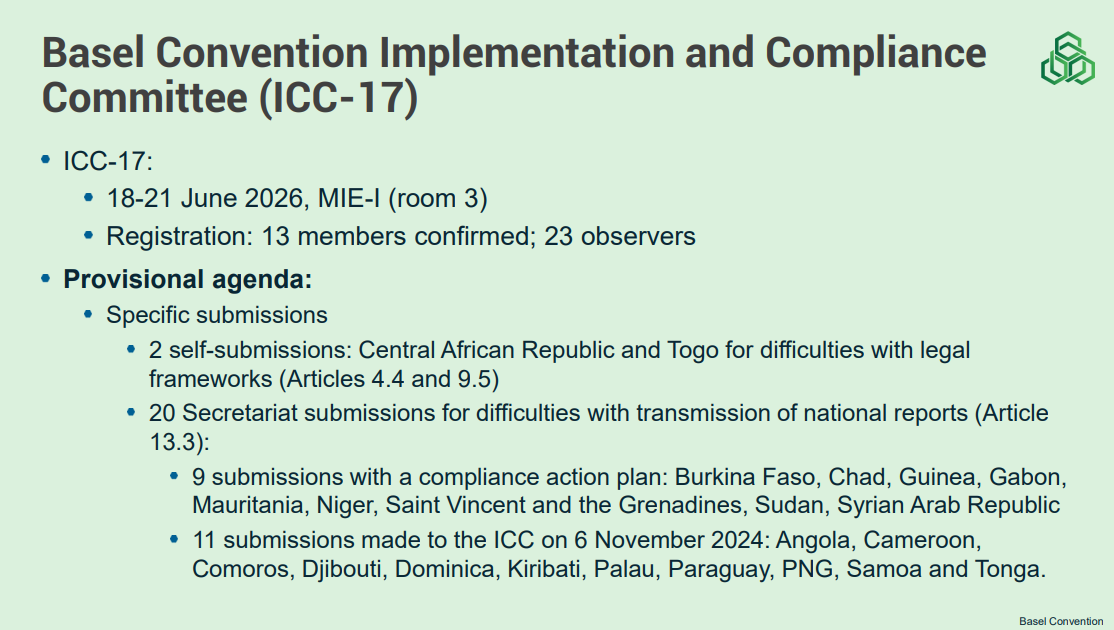
- The 17th Meeting of the Compliance and Implementation Committee will be held from 18 to 21 June at the International Environmental House I.
- 13 members and 23 observers confirmed participation. Observers will be participating in the open sessions of the meeting as per the terms of reference of the committee.
- Sessions addressing individual cases of compliance through the specific submissions will be held in closed sessions.
- The first track of its work is the specific submissions, with a record of 22 specific submissions to be considered.
- Among these are countries that have made submissions to the Committee to seek its assistance, including two related to difficulties with compliance with the development and updating of legal frameworks under Articles 4.4 four and 9.5 of the Convention and they were made by the Central African Republic and Togo.
- The other 20 specific submissions were made by the Secretariat to the Committee as per the TOR paragraph 9 C for difficulties related to transmission of national reports.
- In this 20 specific submissions, there are kind of two groups: one composed of the nine specific submissions that have already been discussed within the committee and have already received support on restoring compliance (Burkina Faso, Chad, Guinea, Gabon, Moritania, Niger, St. Lincent and the Grenadine, Sudan and Syrian Arab Republic), the other 11 specific submissions are newer and made by the secretariat in November 2024 and are yet to engage with the committee and and seek its support (Angola, Cameroon, Comos, Djibouti, Dominica, Caribati, Palao, Paraguay, Papuan Kinya, Samoa and Tonga).
- Because of the high number of specific submissions, it’s agreed with the Chair that the first group of specific submissions will be considered in the June meeting while the 11 newer specific submissions will be taken up in a resumed session during the week of 12th October 2026.
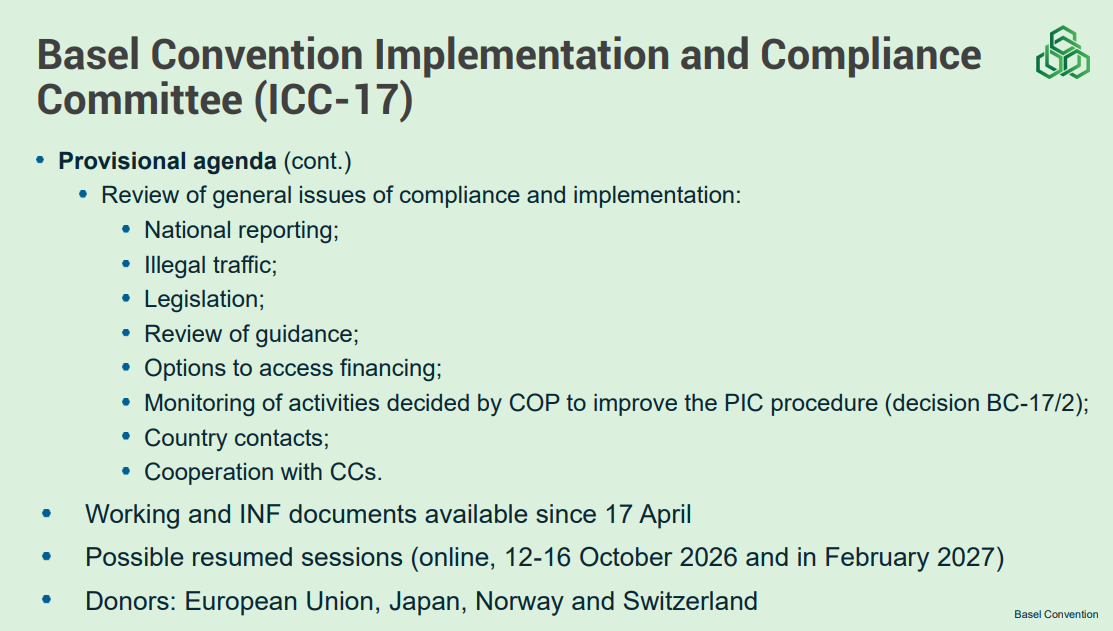
- Under the general review mandate, the committee will review issues of compliance on key obligations:
-
- National reporting obligation (paragraph 3 of Article 13),
- Obligation regarding the prevention and combating of illegal traffic (Article 9),
- Obligations regarding the development of legislation (Paragraph 4 of Article 4 and Paragraph five of Article 9)
- Implementation and compliance about Article 6, which is the implementation of so controls of transboundary movements (TEBDM) in particular through the implementation of the prior informed consent procedure.
- Compliance and implementation with regard to country contacts.
- In addition to those key obligations under the Convention, the committee will also undertake activities on generally improving implementation and compliance.
- Under this crosscutting work area, the Committee is updating and reviewing guidance documents and will be looking at a report on options available to parties to access financial support for implementation of the Convention.
- It will also engage in an item on cooperation with the Stockholm and Rotterdam Conventions compliance committees through a joint session.
- Products that the Committee will be considering:
- Under national reporting, the Committee will review draft classifications of parties compliance performance with national reporting for 2022-2023. Here it looks at the initial findings of this classification as one of the COP agreed targets – the 70% target for transmission rate of national reports is being met for 2022 – meaning that 70% of national reports have been transmitted by parties for the year 2022, which is a big achievement because it is the second time uh that this target is being met in recent years.
- Work on Article 6 on the PIC procedure, a new work activity in the committee’s work program. The committee has been instructed by COP17 to look at and monitor activities that have been undertaken since COP17 on improving the functioning of the PIC procedure under the decision BC 17/2. Significant work has been done intersessionally and the committee will have an opportunity to review activities done and propose some follow-up recommendations to COP18 next year.
- All the documents related to the general review mandate on the website, since the 17 April, with the exception of specific submissions that are not available publicly.
- The committee will resume its online session of the 17th meeting from 12 to 16 October and in 2027.
Yvonne EWANG | Legal Officer, Governance Branch, Basel, Rotterdam and Stockholm Conventions
- The Rotterdam Compliance Committee was established in 2019 by a new Annex 7 to the Convention, which used as its basis Article 17 of the Convention, looking at how to address parties with compliance difficulties and setting up this institutional mechanism looking at compliance.
- There are 15 members of the Committee, a bureau composed of the Chair, who is currently Karoliina Anttonen (Finland), and a Vice-Chair, Helges Samuel Bandeira (Brazil), and a rapporteur: Hamadjoda (Cameroon).
- It also has a dual mandate to look at individual parties’ compliance under specific submissions and to review systemic issues of general compliance of interest to all parties, looking at both aspects and seeing how best to assist parties in achieving compliance.
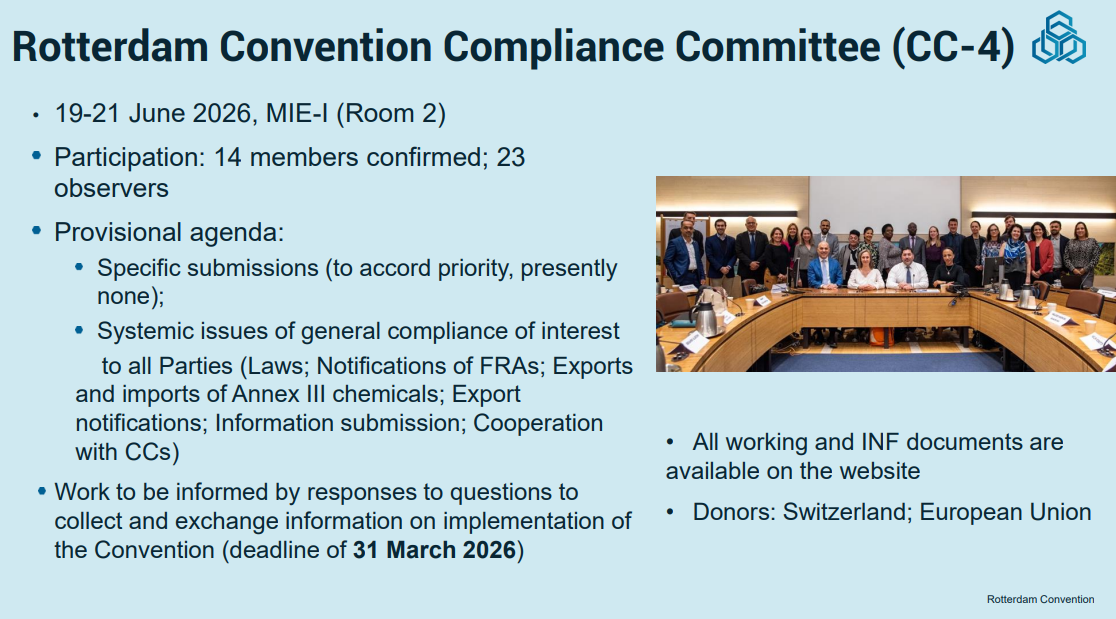
- The committee will meet from 19 to 21 June at the International Environment House I.
- It has generated a huge level of interest, with 14 of the members confirming their presence as well as 23 observers.
- The committee will look at both aspects of its mandate.
Specific submissions
- Presently there are no specific submissions. Since it was set up, the committee has looked at one specific submission related to country contacts and has resolved it.
- This current uh meeting it will be looking in a more general manner rather than at specific individual parties.
Systemic issues of general compliance of interest to all parties
- Activities related to laws to implement the Rotterdam Convention.
- Notifications of final regulatory action, as well as various different elements of exports and imports of chemicals that are controlled under this Convention.
- It will also be looking at the issue of export notifications, which are when a party has restricted or prohibited a chemical and then exports it. There is a notification process to the party that is receiving those imports.
- There is also work related to information submission, looking at how, when parties have information needs, how they integrate those into the sustainable development cooperation frameworks as well as the issue of cooperation with the other two compliance committees.
- There was a questionnaire circulated to parties earlier this year. Information that’s been received from parties was compiled and is being used to inform the committee’s work. So really, whatever the committee does is looking at the information the parties have provided of what the challenges are that they’re facing, and what are the recommendations that could be taken forward to COP.
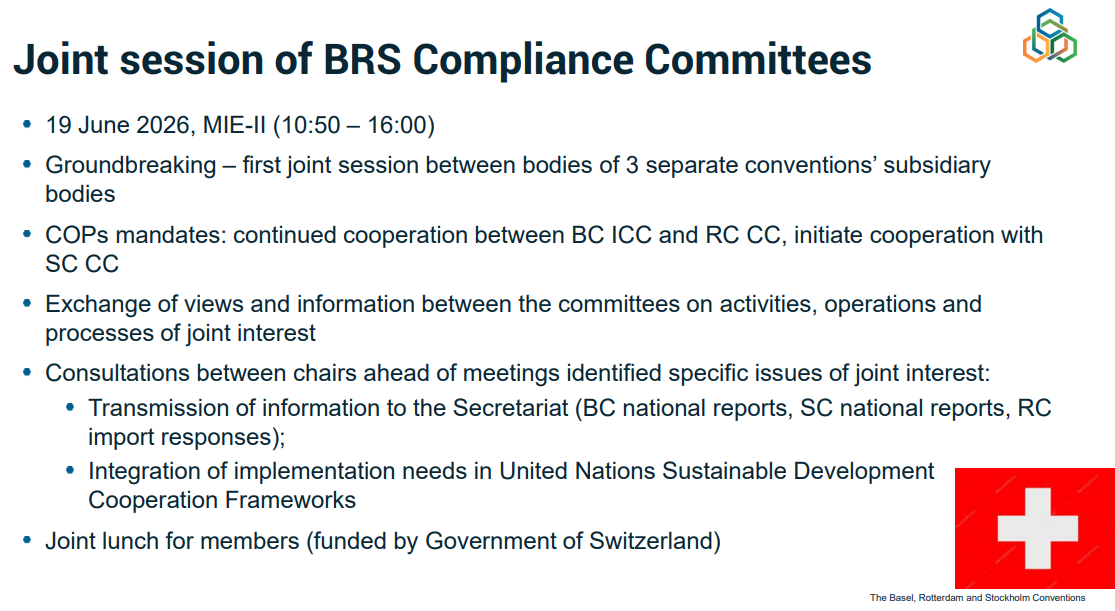
- The Rotterdam Committee will begin its meeting on 19 and end on 21 June 2026, with 19 June as a crossover day with the joint session of the three committees taking place from late morning until late afternoon.
- It’s a chance for the three committees to meet for the first time together. There has in the past been a joint session between the Rotterdam and Basel Committees, and as the three have a mandate to cooperate, it will mean continued cooperation between the Basel and Rotterdam committees and to initiate cooperation with the Stockholm one.
- The objective of the joint session is to give the committees a chance to exchange views and information between them on three different aspects looking at activities, operations and processes that could be of joint interest: what issues do they have on their programs of work that are in common? Where could they share information about lessons learned about the different processes and practices that they’ve put in place?
- This will enrich the work of each of the Conventions, recognizing that there may be certain practices and processes that could provide a new perspective.
- There has been discussion between the chairs to plan as we go forward for this joint session and they identified specific issues on the work program that of each of the committees that could be of joint interest.
- Transmitting information from the Basel and Stockholm perspective in relation to national reports for the Rotterdam Convention would be important responses
- Integrating parties’ implementation needs into sustainable development cooperation frameworks.
Susan WINGFIELD | Programme Officer, Governance Branch, Basel, Rotterdam and Stockholm Conventions
- The fifteenth meeting of the Open-Ended Working Group (OEWG) of the Basel Convention on the Control of Transboundary Movements of Hazardous Wastes and their Disposal– one of the subsidiary bodies of the Conference of the Parties to the Basel Convention – will take place from Tuesday, 23 June to Friday, 26 June 2026, at the International Conference Centre Geneva (CICG), with pre-meetings, including Bureau and regional meetings, taking place on Monday, 22 June.
- A total of 585 participants have registered so far, representing 146 Parties and 198 observer participants registered. This represents the highest ever for an OEWG.
- Only one chair will lead the OEWG meeting: Nneka Nicholas of Antigua and Barbuda.
- Océane Dayer of Switzerland will act as technical Vicechair and Nancy Allimadi of Uganda as Rapporteur.
- The open-ended working group agenda has been developed on the basis of the work program for the group for the biennium 2026 to 2027, a document that is considered by the cop. So it was considered and adopted by the COP last May and for parties to follow during their meetings of the OEWG.
- This upcoming meeting will include both plenary sessions, although it’s expected that the majority of the work will take place in contact groups.
- It’s a technical meeting and really it’s a chance for parties and observers to get to work looking at all of the intercessional work that’s been done since last COP.
- It will be ensured that there are not more than two contact groups meeting in parallel and not while plenary meets.
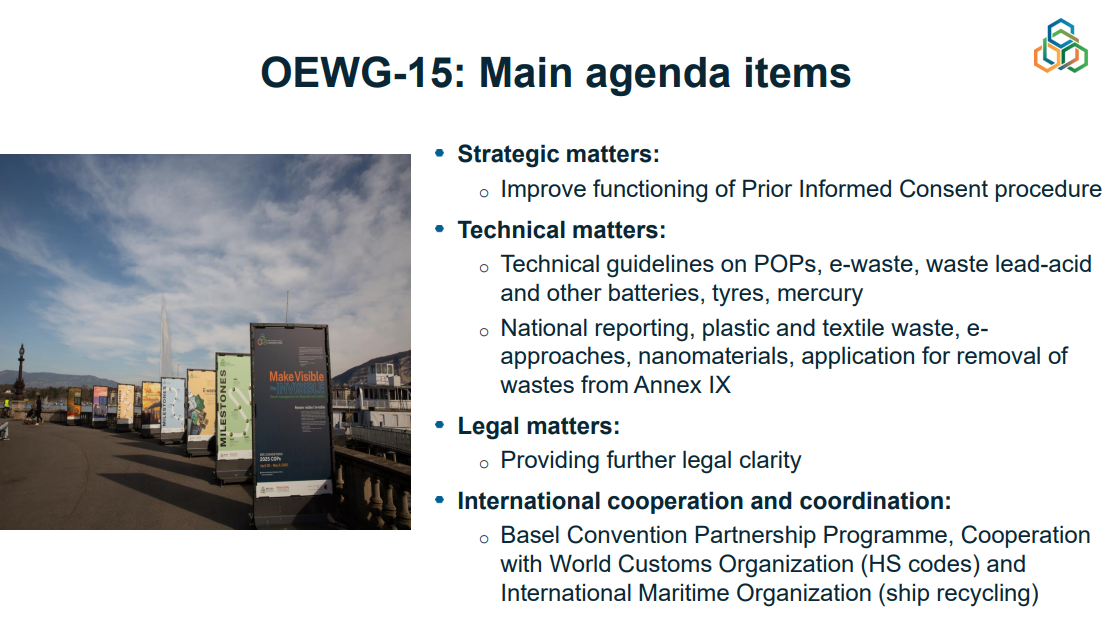
- The focus is more on technical matters, with discussion on strategic and legal importance and under international cooperation and coordination.
Strategic matters
- Improving the functioning of the PIC procedure: a group has been working interessionally on a report on ways to improve the functioning of the PIC procedure and this will be presented to OEWG for its consideration and expected that OEWG will provide guidance for their further work in the lead-up to the COP.
Technical Matters
- Numerous technical guidelines will be up for consideration, including on Persistent Organic Pollutants (POPs) for the updating of the general POPs guidelines on the basis of POPs that were adopted by the Stockholm Convention last year and additional POPs guidelines, individual POPS guidelines.
- In addition, there will be e-waste, lead-acid batteries, and other batteries, tyres, and mercury guidelines for consideration.
- There will al also be some consequential adjustments that have been made to various sets of guidelines as a result of the plastic and e-waste amendments for OEWG to consider.
- National reporting, specifically to look at changes in the format to one of the tables in the national reporting template and its associated manual.
- Plastic waste has been on the agenda for a number of years. It’s expected that this discussion will be based around comments received from parties and others on the experiences, challenges and impacts of implementing the plastic waste amendments.
- Textile waste is on the agenda for the first time at the OEWG. At the 2025 BRS COPs, there was a discussion on its inclusion in the open-ended working group work program to look at the possible options available under the Basel Convention to address used textiles and textile waste.
- Up for discussion is also an application that was received from Norway within the deadline for removal of waste from Annex 9 to the Convention, and this is in relation to plastic waste.
Legal matters
- On providing further legal clarity, the expert working group on the review of annexes worked exceptionally hard in the lead-up to last COP to propose and have adopted the amendments to Annex 4. Well, now there are various work streams continuing as a result of that, and there will also be a draft report on recommendations on adjustments to Annexes 1 and 3 for consideration by the open-ended working group.
International Cooperation And Coordination
- This is the opportunity for parties and others to consider the work going on.
- There’s a lot of work ongoing under the Basel Convention Partnership Program, specifically on e-waste, household waste and plastic waste as each of these three partnerships has its own work program.
- This is a good time for a check on the implementation of those work programs and, again, any guidance to be provided by the open-ended working group.
- As usual, there will be an update on the cooperation with the World Customs Organization and work on the harmonization of the Harmonized System (HS) codes with the Basel Convention wastes.
- Cooperation with the International Maritime Organization specifically to consider the issue of ship recycling. Those parties and others may be aware that the Hong Kong Convention, specifically relating to ship recycling, entered into force last year and this discussion will specifically look at the interplay between both the Barcelona and Hong Kong Conventions.
Schedule
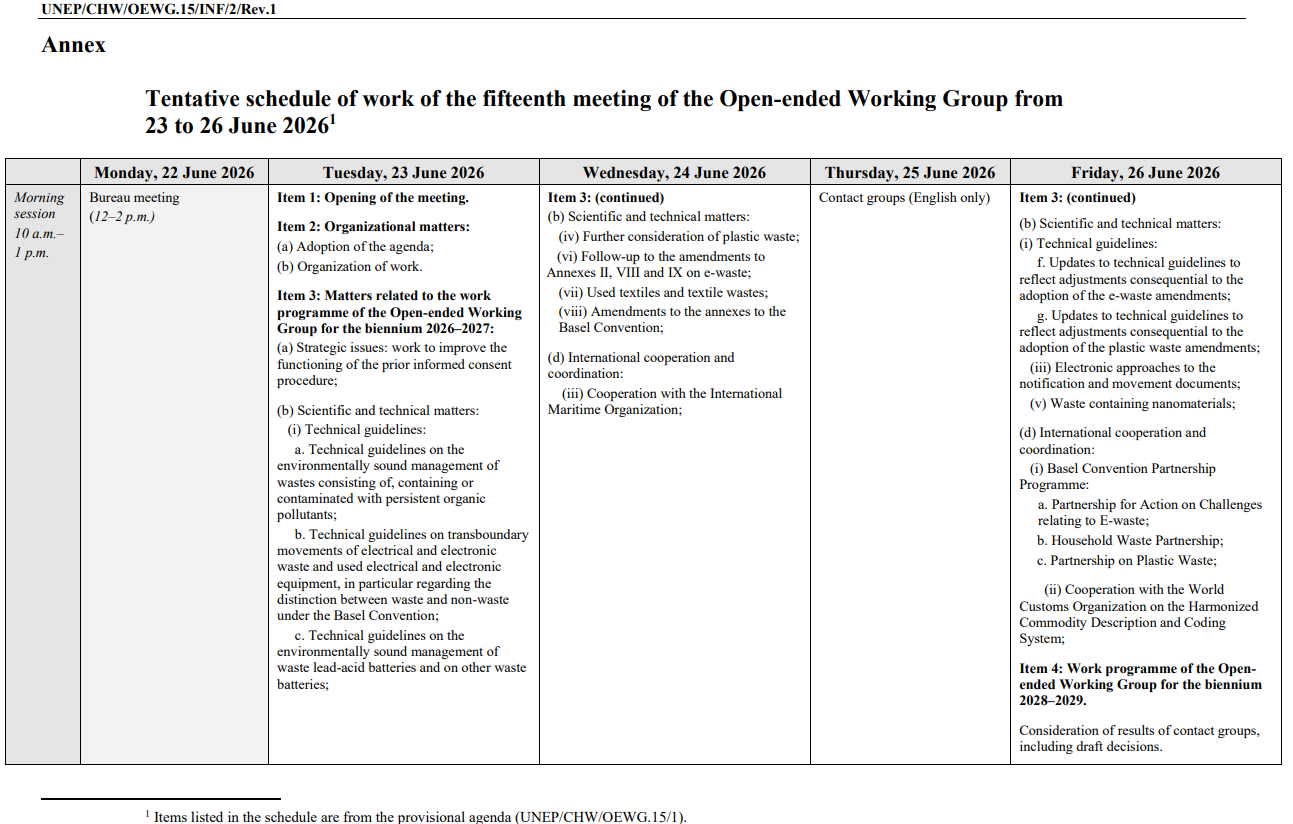
- Items don’t actually go in the order they appear on the provisional agenda and there is a reason for this. For the first day, it starts out with the procedural matters, opening of the meeting, adoption of the agenda and so forth.
Then we move into the matters on the open-ended working group, starting with strategic matters that important discussion on the functioning of PIC.
- Moving then on to technical matters and for that morning session there’ll be a focus on discussion of the technical guidelines. Discussion will continue into the afternoon and then mid-afternoon it’s expected that we would move on to discussion of legal matters, specifically providing further legal clarity, to then move back to scientific and technical matters.
- The bureau thought that this would be a good formulation. Basically because we can have contact groups meet on Tuesday evening and having had items already considered, for example, technical guidelines and legal matters on the first day would allow those contact groups to meet if so decided.
- Wednesday morning, scientific and technical matters will be considered and we will finish, hopefully, before lunch on Wednesday with cooperation with the IMO.
- Many of those items we’re expecting would be referred to contact groups for further discussion. Contact groups are expected to begin or resume their work on Wednesday afternoon in three streams: a technical and a legal stream and a strategic matters contact group and they will essentially work through until Thursday evening. No more than two contact groups in parallel.
- We come back to plenary on the Friday and we hear briefer reports and so these items are reflected in the tentative schedule for the Friday.
- It is expected that the secretariat will provide brief reports on each of the items and that the working group will agree to the proposed action and way forward. Most importantly, we will then have the contact groups make their reports back to the plenary. This is expected either before lunch on the Friday or just after lunch.
- Then, going through the outcomes from each of the contact groups on the agenda items which were referred to them and hopefully the adoption of decisions. We expect to close by 6:00 PM on Friday after the adoption of the report and any closing statements.
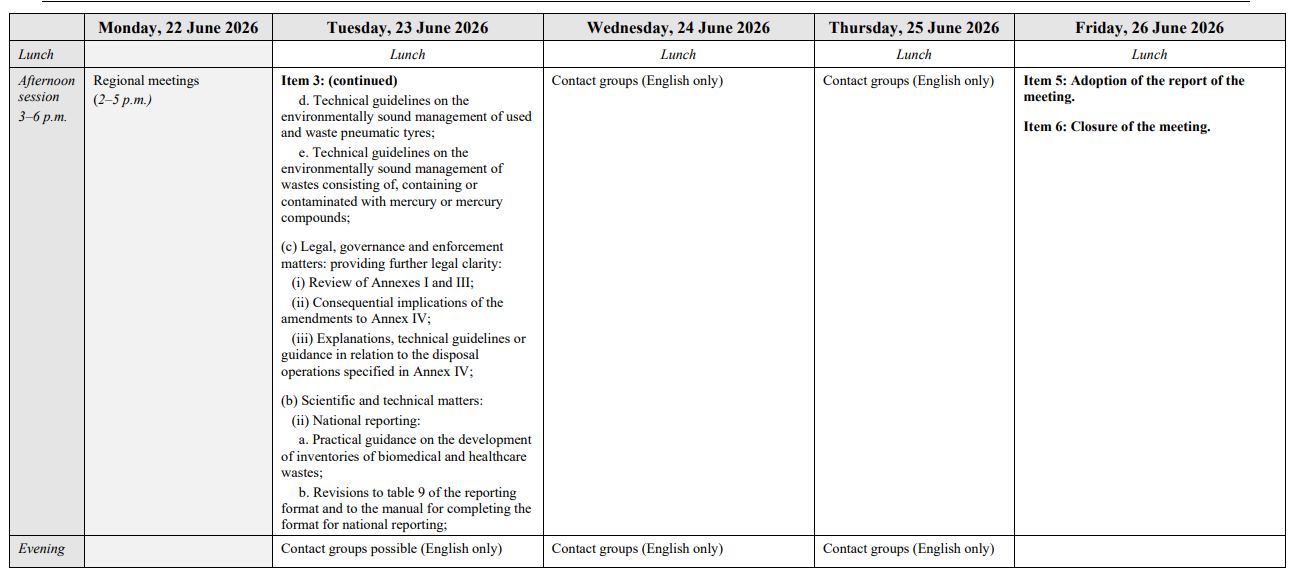
- Side events will take place throughout the week: two events scheduled each lunchtime and evening, with the exception of Friday evening.
- The documents that form the basis for preparations for the work of the open-ended working group:
- Scenario note (UNEP/CHW/OEWG.15/INF/1)
- Tentative schedule (UNEP/CHW/OEWG.15/INF/2/Rev.1)
Q&A
- We noticed several areas that may need a deeper technical engagement, including improving the functioning of the PIC procedures, technical matters, technical guidance as well as legal matters and international cooperation. We would like to seek your view on which items are highly expected to be discussed in the contact groups.
- Are members expected to give an opening or closing statement during the plenary?
Susan WINGFIELD
- It is difficult to schedule in the many items that will need more in-depth discussion. What we expect is that the technical matters group will run the whole time, while the other contact group running in parallel would either be the legal or strategic matters group .
- We are working with the bureau to ensure that we have a good balance of timing in those groups for each item, but it is a challenge.
- Progress will be reviewed daily by the Bureau so we can make adjustments as needed and work with the co-chairs of those contact groups to ensure that the items get the time that they need in the contact group setting on regional or on statements to the meeting.
- The bureau has agreed that regional statements will be welcome during the opening of the meeting and will be of no longer than three minutes duration.
Q: Could you please confirm whether QR codes for collecting security ID badges at the CICG registration desks have already been issued or whether we should expect to receive them by email shortly?
Susan WINGFIELD
- An email with the QR code will be sent out next week with some additional information for delegates.
- If you don’t receive a QR code by next week, please let us know.
- For each agenda item, there is a working document available on the OEWG website and in each working document, there is a proposed action drafted by the secretariat.
- For a number of the items, OEWG is really the opportunity; it’s a midpoint review between the COPs.
- For example, for the item on providing legal clarity on the technical guidelines is an opportunity for the working group to consider the work done by the intersectional groups that have been meeting since last COP, to continue those discussions and to provide guidance for the further discussions after OEWG.
- The main outcomes there will be is that guidelines be progressed, the reports discussed and it’s anticipated, following the meeting, a call for parties and observers to provide further information.
- We normally issue a call for information after cops and OEWGs. For this particular open-ended working group, the deadlines will probably be quite tight because of the timing of the COP next year. So, that’s just something to bear in mind that you will most likely be invited to provide these further comments after the meeting, but it will have to be done fairly quickly.
- This is to allow, from September onwards, all of those intersessional groups to meet.
- There will also be the opportunity to discuss textile waste for the first time as mentioned. It’s expected that from the report that’s been developed by the Secretariat and based on comments received from parties and others, there are a set of possible options for the way forward and how to integrate consideration of used textiles and textile waste under the convention. It’s expected that OEWG will discuss these options, may select some of these options and forward those to COP for their consideration.
- Similarly, with cooperation with IMO: there are certain recommendations within a report prepared by the secretariat and those could be discussed and taken forward in the a draft decision by the open-ended working group for the COP to take action.
- The amendment proposal received from Norway for an entry in the Annex on plastics represents an opportunity for the open-ended working group to discuss and provide feedback on the amendment proposal.
- Any um amendment that would go forward to COP doesn’t automatically go from OEWG but is a separate process that would take place between OEWG and COP.
- It is not expected, but it is a possibility.
Closing
Océane DAYER | Waste and Chemicals Focal Point, Federal Office for the Environment, Switzerland
- For over 30 years, the Basel Convention has effectively combined policy decision with technical work, and it is this duality, among other qualities, that makes it such a robust and time-tested instrument.
- Parties to the Convention are bound by important obligations, including the prevention and minimization of waste generation, the application of the big procedure, the assurance of environmentally sound management and the protection of human health and the environment.
- Membership means much more because as it entails access to a wealth of valuable technical resources supporting sound management of waste, including technical guidelines, technical assistance, pilot projects with industry through partnerships, regional and global exchanges and much more.
- This represents a rich ecosystem of policy obligations and technical and implementation supports to ensure that everywhere in the world and in every party we manage to implement sound management of waste.
- The Basel Convention not only addresses waste at the treatment stage, but it also works to limit its very existence. Article 4 commits parties to minimizing waste generation and exports. This holistic approach that is included in the Convention makes it a comprehensive instrument in the service of both parties and environmental protection.
- The meeting of the open-ended working group that will soon take place in Geneva will lay the groundwork for the 2027 Conference of the Parties, ensuring that the COP receives the necessary guidance to take decisions in a timely manner.
- OEWG-15 will address a range of issues, spanning from waste definition, prevention, transport and treatment. It will also consider the effective implementation of key convention elements, including the plastic waste amendments, as well as updated approaches to specific waste streams such as textile.
- In a context where pollution remains a threat to the environment and human health, strengthening the Basel Convention and aligning it with the challenges of the 21st century must be a priority for all parties.
- We must reinforce both policy and technical frameworks to ensure that the generation of these waste streams is reduced and that their treatment meets the highest standards.
- Switzerland remains committed to giving the Basel Convention the space it needs to deploy its full impact and we look forward to working with all of you to that end.
- We are very pleased to welcome you once again to Geneva at the heart of the global chemicals and waste government cluster. Here the Basel Convention is embedded in a rich ecosystem from which it can draw resources, synergies and expertise while avoiding duplication.
- The technical guidelines on POPs or the technical guidelines on mercury are vivid examples of how the Basel Convention’s work aligns with that of the Stockholm and the Minamata Conventions, and that is a shared compass in Geneva naturally facilitates and strengthens.