Event Conference
Corporate Influence in the Context of Health and Environmental Protection — What role for human rights and accountability? | HRC63 Side Event
14 Sep 2026
15:00 – 16:00
Venue: Palais des Nations | Room XI
Organization: Center for International Environmental Law, FIAN International
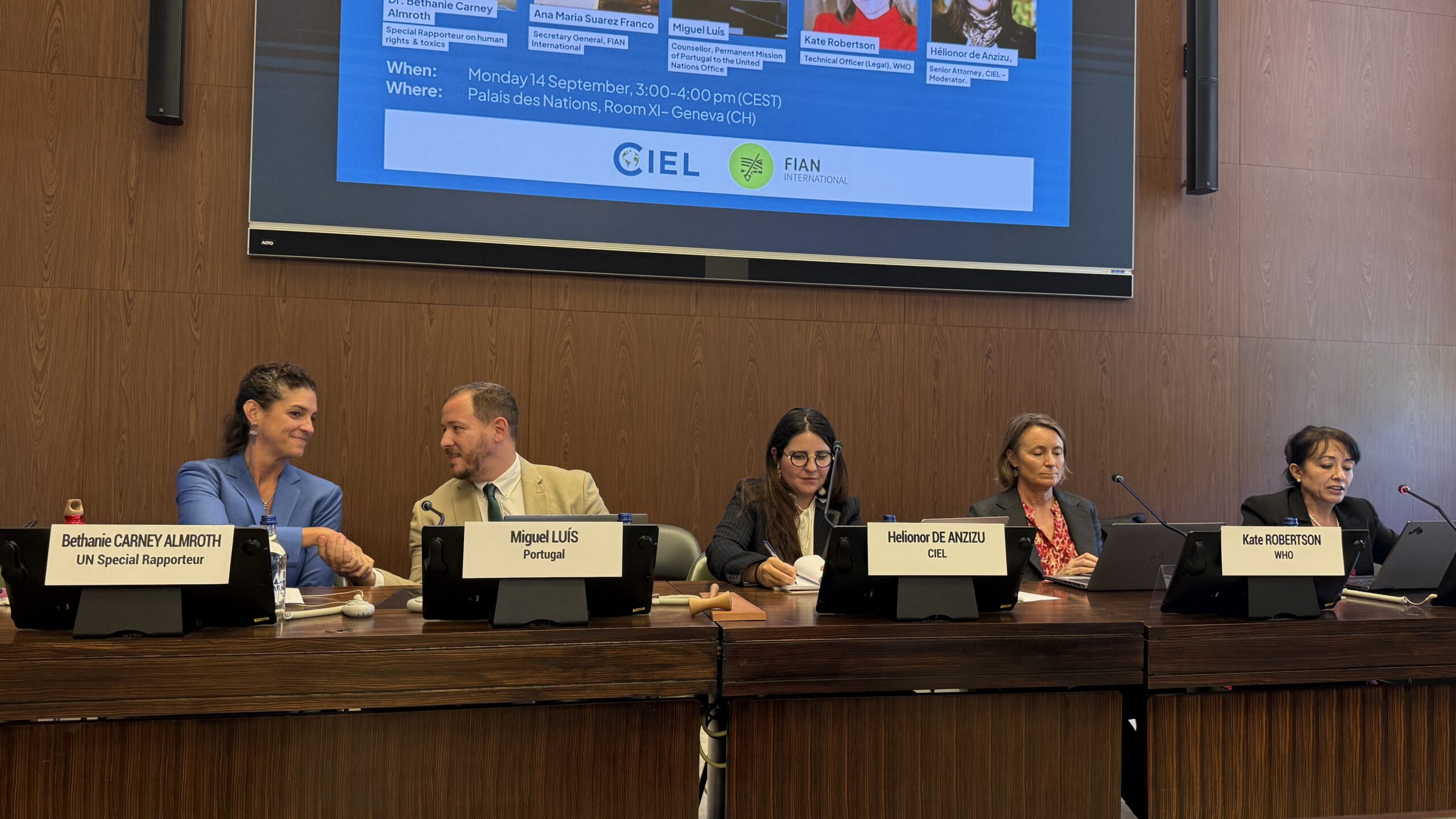
This side event to the 63rd session of the UN Human Rights Council (HRC63) examined how corporate influence is undermining human rights, health, and environmental protection by delaying regulation, using a pollution playbook spanning from endocrine-disrupting chemicals, to pesticides, and plastics. Panelists reflected on common issues, from the plastics treaty process to the 12th session of the OEIGWG, and identify potential common solutions. This side event was organized by the Center for International Environmental Law (CIEL) and FIAN International, with the support of the Geneva Environment Network.

About this Event
Through deregulation, disinformation, and conflicts of interest, corporate influence is already shaping and undermining regulation and multilateral fora. Many human rights experts have warned that fossil fuel corporations are among the main contributors to the triple planetary crisis of climate change, chemicals and pollution, and biodiversity loss. These same industries are the primary drivers of the global toxic and chemical pollution burden on human health. Despite growing awareness of health, environmental, and human rights impacts of these chemicals — including endocrine disruption, reproductive harm, and links to cancer — industries are still producing endocrine-disrupting PFAS, highly hazardous pesticides, and toxic plastics.
What’s the role for human rights, accountability, and transparency, in light of upcoming multilateral negotiations? What can we learn from other processes and institutions?
In the context of the plastic treaty negotiation, whose last formal substantial session (INC-5.2) ended in August 2025, CIEL’s analysis shows that the number of lobbyists has risen throughout the course of negotiations. It raises concerns about corporate influence, finding that chemical and fossil fuel industry lobbyists were the highest recorded in the negotiations, outnumbering the Scientists’ Coalition for an Effective Plastic Treaty (60) by nearly four to one, and the International Indigenous Peoples’ Forum on Plastics (36) by nearly seven to one. Provisions on chemicals, production, human rights, and health protection in the plastic treaty text remain at risk. While the next INC negotiation (INC-5.4) is scheduled for March 2027, Member States’ discussions have continued in informal Heads of Delegation meetings throughout 2026, and will continue at the next informal session in Bangkok at the end of September 2026. However, despite several calls from civil society and rightsholders, observers have not been invited.
In October 2026, the twelfth session of the open-ended intergovernmental working group on transnational corporations and other business enterprises (OEIGWG) will continue to discuss an international legally binding instrument to regulate, under international human rights law, the activities of corporations.
The spotlight on the role that corporate actors — especially transnational corporations and financial institutions — play in fueling the environmental crisis and undermining human rights is growing, building on the body of jurisprudence and findings by human rights institutions. This includes the right to a healthy environment, and corresponding obligations of States and corporations. From the advisory opinions of the International Court of Justice (ICJ) and the Inter-American Court of Human Rights (IACtHR), to the Framework Principles on Human Rights and the Environment, which outline States’ obligations with regard to the right to a healthy environment, also establish that States must regulate private actors that have the potential to harm the environment and human rights. Environmental disinformation also affects the enjoyment and realization of human rights, and States should take measures to prevent and counter it at all levels of environmental governance.
This side event examined how corporate influence is undermining human rights, health, and environmental protection by delaying regulation, using a pollution playbook spanning from endocrine-disrupting chemicals, to pesticides, and plastics. Panelists reflected on common issues, from the plastics treaty process to the 12th session of the OEIGWG, and identify potential common solutions.
Environment @ HRC63
The 63rd regular session of the UN Human Rights Council (HRC63) will take place in Geneva from 7 September to 7 October 2026. Consult this regularly-updated page that highlighted the environmental-related activities of this session.

Speakers

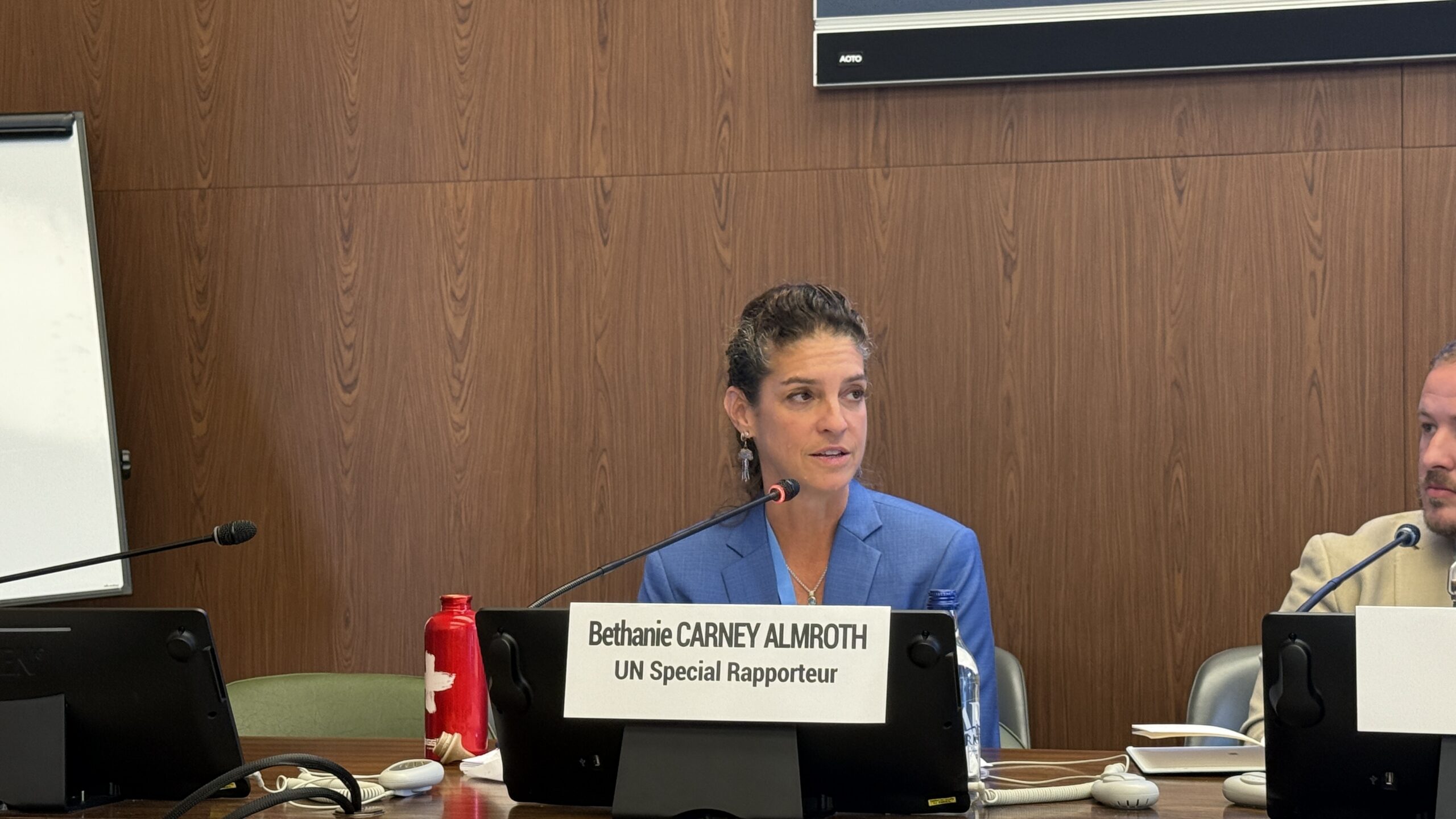
Bethanie CARNEY ALMROTH
UN Special Rapporteur on toxics and human rights

Ana Maria SUAREZ FRANCO
Secretary General, FIAN International
Miguel LUÍS
Counsellor, Permanent Mission of Portugal to the UN Office and other international organizations in Geneva

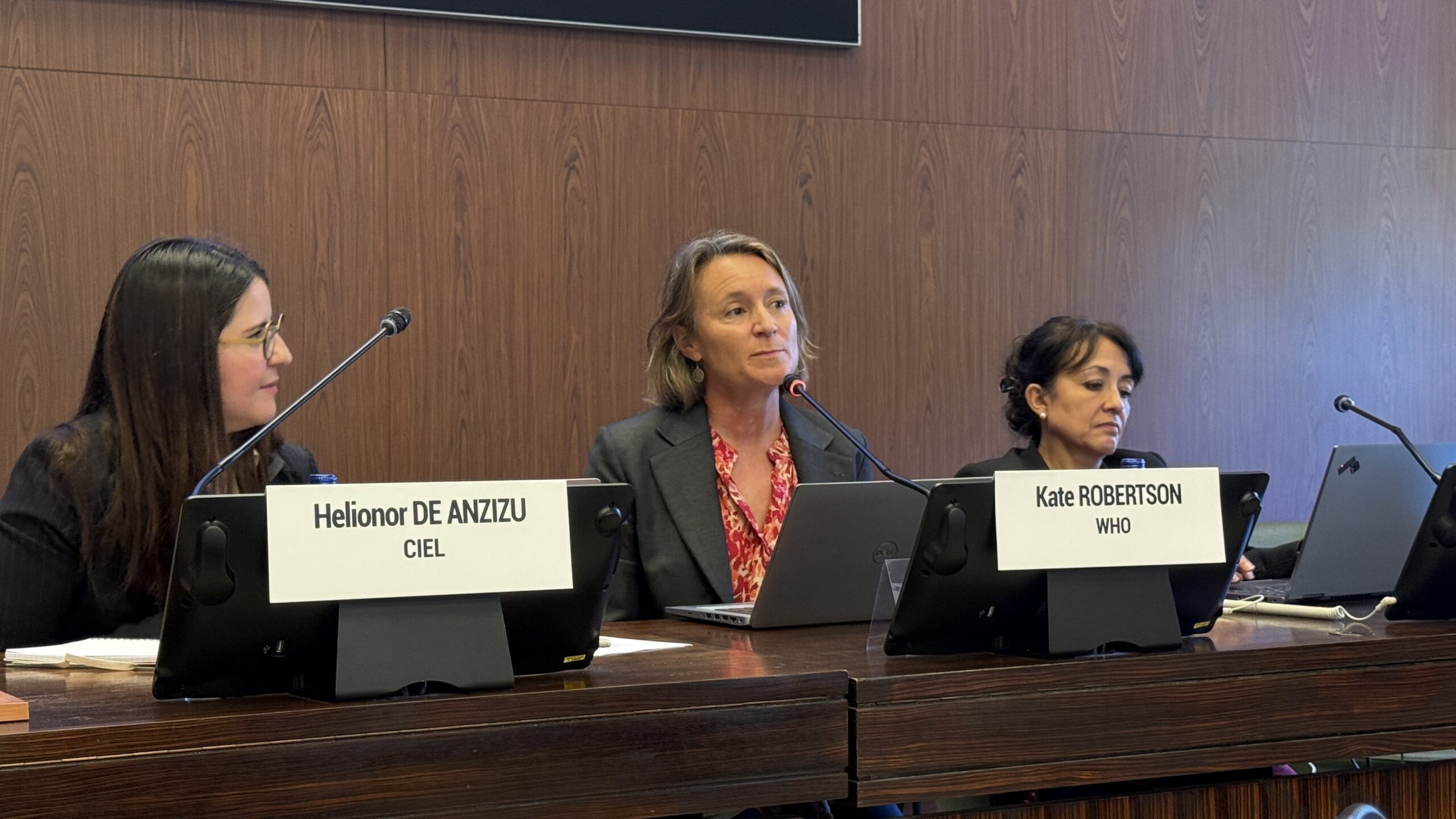
Kate ROBERTSON
Technical Officer (Legal), Fiscal and Legal Measures Unit, Department of Health Determinants, Promotion and Prevention, World Health Organization

Helionor DE ANZIZU
Senior Attorney, Environmental Health, Center for International Environmental Law | Moderator
Highlights
Video
Live from Palais des Nations
Summary
Welcome
Helionor DE ANZIZU | Senior Attorney, Environmental Health, Center for International Environmental Law | Moderator
- Negotiations are underway, and colleagues at CIEL have done an analysis a few months ago that showed a significant presence of fossil fuel and chemical industry lobbyists along the whole process since the process started, which has raised concern about the extent and the nature of corporate influence in the negotiations.
- This issue extends beyond the plastics treaty. There are questions that could be raised in the context of the UNFCCC reform, and in many other processes in multilateral environmental treaty-making.
- There is an upcoming session of the Open-Ended Intergovernmental Working Group on Transnational Corporations and Other Business Enterprises with Respect to Human Rights, which continues discussions on an international legally binding instrument concerning the activities of transnational corporations and other business enterprises.
- There are also questions to think about conflict of interest.
- Across those processes, there is an important convergence: the recognition that states have not only a responsibility to protect human rights and the environment, but also a responsibility to ensure that private economic power does not prevent them from fulfilling that obligation. There is here a tension to discuss and to unpack.
- Today, we will be guided through three questions.
- The first one is: what does corporate influence mean from a human rights perspective, and what forms can it take?
- The second question would be: what can we learn from existing multilateral processes and institutions, including from the challenges around science, disinformation, and participation?
- The third question is: what concrete safeguards and accountability mechanisms can help ensure that multilateral decision-making remains transparent, evidence-based, and centered on human rights and the public interest?
Panel Discussion
How has corporate accountability been addressed from a human rights perspective up to today?
Ana Maria SUAREZ FRANCO | Secretary General, FIAN International
- When we speak about a topic from a human rights approach, it means that we consider people as human rights holders who can claim their rights, which means there is a duty bearer for the protection of the environment from corporate harm: states, which can hold all these private actors accountable. The main principle is always human dignity.
- At the centre of any policy, and of course, of ensuring accountability, the main principle is always human dignity. So this story of the accountability of corporations and other business enterprises in human rights law is not new.
- It began already in the 1970s, in view of systematic harm and impunity, during the dictatorships, especially in Latin America. This originated two approaches to the topic. The civil society approach mainly said that we need norms that are obligatory for states, while mostly industrialized countries and the companies based in them argued that it would be better to take a voluntary approach that ensures companies collaborate in regulating this.
- This created different regulatory processes. The voluntary approach was strong for many years, and the highlight, after many other standards, was the UN Guiding Principles on Business and Human Rights (UNGPs), which take up corporate responsibility. They do not speak about accountability from a national approach, which means the state is responsible for the harm that happens within its territory. But this leaves out the transnational or extraterritorial harm, which in an economy and a political system as the one we have today does not make much sense, because normally the owners of the capital that invests in the places where the people that are harmed are based are transnational.
- Therefore, civil society was a big part of this and was very vocal in saying that the UN Guiding Principles would not be enough, also because they did not mention corporate capture, which for civil society means the way corporations influence regulatory and governance processes for their benefit, to protect their businesses, in many cases affecting human rights and environmental rights.
- The biggest gap in the UNGPs was the voluntary approach. There were no clear legal consequences for corporations that were harming human rights. That is why, in 2013, civil society, but also the State of Ecuador and the State of South Africa, requested the Human Rights Council to have a negotiation space to develop a legally binding instrument on transnational companies and other business enterprises with respect to human rights. This had civil society at the centre of the demand, looking into international law that would cover the gaps in accountability that were harming not only people but also nature, as we are interdependent.
- It was not so explicit at that time that the connection with environmental rights should be present, but it was very explicit in the cases we were working on with affected communities.
- The legally binding instrument focuses on prevention of harm, access to justice, ensuring that there is symmetry, that there is balance in the access to justice, which means all the imbalances in the judicial processes and administrative processes should be corrected. For instance, through reversal of the burden of proof and other kinds of measures that are very relevant, for example, for the issue of hazardous pesticides.
- And we were demanding accountability for transnational corporations where they are active, but also along the value chains. At that time, even speaking about value chains was almost taboo. Today it is normal; some states have already adopted laws, like France or Germany, that recognize the accountability for the activities of their corporations along their value chains.
- Very relevant is the development of the last years, which was not so evident at the beginning but is very present now: the issue of corporate capture or corporate influence. The ESCR-Net has done huge work on the different ways in which corporations interfere, from the local to the global level, in governance, but also in the executive, legislative, and judicial branches of power, which in many cases are subject to the influence of corporations.
- So this struggle by civil society and affected communities is now supported by many states. It has already been eleven years. We will have the twelfth session in October, but in between, things have happened, especially taking into account that human rights law is evolving.
- In 2011, for example, we began speaking about corporate capture. Later on, General Comment No. 24 of the Committee on Economic, Social and Cultural Rights reaffirmed the obligations of states to protect people from this kind of harm, and different courts and different special procedures have recognized that states have to regulate the activities of corporations to impede corporate capture.
- For example, the Special Rapporteur on toxics, Marcos Orellana, in his report on the right to science, paragraphs 60 to 62, addresses corporate capture and undue influence. To counter this impact, that report recommends enacting strict conflict-of-interest policies, analyzing this information, and establishing independent panels.
- More recently, in Advisory Opinion 32 of the Inter-American Court of Human Rights, the advisory opinion on the climate emergency, it establishes in paragraph 347 that, based on the obligations to protect and guarantee the right to a healthy environment and a healthy climate, states must establish appropriate mechanisms to prevent greenwashing and undue corporate influence in the political and regulatory domains, and to support the actions of human rights defenders.
- In 2025 as well, the UN Committee on Economic, Social and Cultural Rights, in its General Comment No. 27, affirmed that international and domestic decision-making must also be governed by integrity safeguards such as transparency, conflict-of-interest controls, and anti-capture measures, so that outcomes are free from influence that may impair the right to a clean, healthy, and sustainable environment.
- This is very relevant because we see how our legislation is advancing. Now the challenge is to make that happen.
How have you seen this corporate capture affect multilateral environmental processes, and what approaches do you think are the most effective today to address them? How disinformation and corporate capture affect multilateral environmental processes and what approaches are the most effective today to address it?
Miguel LUÍS | Counsellor, Permanent Mission of Portugal to the UN Office and other international organizations in Geneva
- My intervention will be based on the experience of the plastics negotiations, which is a hot topic, also taking advantage of the fact that we have the recently appointed Special Rapporteur on toxics here.
- Focusing on the plastics negotiations umbrella, there is no doubt for anyone that stakeholder participation is essential. Governments, and us as negotiators, need scientific expertise, we need civil society perspectives, but we also need knowledge from industry.
- In this case of plastics, also in climate and biodiversity, maybe a bit less, but particularly when they deal with complex value chains, like you mentioned, product designs, chemicals, so a lot of technical issues that we, as governments, do not always have the capacity to deal with.
- In this sense, it is fair to note that the private sector and these actors can indeed make useful contributions. They are the ones that deal with production processes, with supply chains, with technical feasibility, and sometimes wanting or going for big systemic changes without taking this into consideration can have long-term and short-term consequences that can be even worse than simply going against some of those commercial interests.
Nevertheless, the challenge is not whether they should participate, but rather how to ensure that they inform the process without allowing their commercial interests to shape the limits of what can be discussed.
- On plastics, one of the clearest examples is how the problem itself was framed from the beginning. While some actors argue that an effective treaty must address the full life cycles of plastics, others, with, of course, commercial interests in the profits coming from some of the extractive measures, but not only from the production of certain parts of plastic products, favour an approach based on waste management.
- That really shaped this discussion as a confrontation of narratives, sometimes putting aside the scientific reality and what science shows us. This is where disinformation and selective information can be difficult.
- In this case, it does not obviously take the form of false claims, but rather presents a selective part of the evidence, because waste management is fundamental to solving the plastic pollution crisis, but alone it will not be the silver bullet.
- The selective presentation of evidence, the costs of one measure while ignoring the cost of inaction, is where disinformation plays a role that really can take us off track in negotiations.
- It is important to note that it is also a question of capacity, and we saw that several times. Fortunately, Portugal is part of the European Union, so we have a different context, even if we have a small delegation. But we can understand that, for some delegations, in particular most developing countries, there is a problem with the size of delegations and their ability to follow all these processes.
- Sometimes we see companies represented in these multilateral agreement negotiations and discussions with more participants than some of the states, using this strength in numbers to influence some of these positions. And we see it even more when we connect it to states that have less capacity to retain knowledge at the national level.
- This asymmetry is important to tackle, and there is a clear human rights dimension. Access to reliable information and meaningful participation are essential to legitimize the decisions that we take in these processes.
- Coming to the solutions:
- The first one is transparency. We need clarity on who is participating, which interests they represent, and where their evidence or proposals come from. Here, those who have contrary interests should not be excluded from participation, because they are fundamental to shaping policy, but they should be clear when they come with those contrary interests.
- The second is that independent science is fundamental. We see more and more that there is an attack on science. We had a discussion about GEO some weeks ago where we saw this very clearly. We were not able to agree on a Summary for Policymakers because even the scientific evidence was put into question.
- But it continues to be the best safeguard that we have against disinformation, and it works both ways. Sometimes, coming from a country that identifies itself as ambitious, for example in the plastics process, we jump very quickly when we see science that agrees with our position, without recognizing that we would benefit from some more information on particular points that we do not have.
- The information that we have, of course, points towards what we think, but we need to arrive at a conclusion that will then also allow us to defend ourselves better from disinformation.
- And the third is regarding national capacity. So if Member States in general, in particular most developing countries, have the internal capacity to build their positions, have access to information, and have contact with civil society – and civil society, at the same time, has access to national governments and the way that they build their positions – the harder it will be for commercial interests to enter and shape narratives. And it is a part that, a lot of times, we miss.
- It is not helpful if we frame this as business versus civil society versus government. We need all actors on board. But it is impossible in the plastics process to have a medium- or long-term solution that is sustainable if we do not have buy-in from the private sector, because they have a lot of capacity at the national level to influence policy decisions.
- So we have to figure out how to get the balance right while safeguarding the importance of science, the participation of civil society, and, more importantly, the impact that this has on people and communities.
Helionor DE ANZIZU | Senior Attorney, Environmental Health, Center for International Environmental Law | Moderator
- We just learnt about how the plastics treaty has come about and how things have sometimes been complex to navigate, because also in the context of corporations, not all companies may have the same objectives within the process. There are also groups within groups many times.
- At the same time, it is about direct conflicts of interest and undue influence in forums such as the plastics treaty.
- Also, the question of the number and the strength in the context of how many participants have come to the space, and how sometimes delegations have also been outnumbered, and the question of capacity also for those delegations to have the resources, the capacity to engage, to also think about what type of information is to be taken on board and what information is not necessarily useful or appropriate to take on board.
- In that context, the Science Coalition for an Effective Plastics Treaty has done incredible work as well to bring science to the process. It is not necessarily something that we have seen in all processes, unfortunately, because it is something that was created for the plastics treaty but that has had a tremendous and positive effect.
How can multilateral processes be strengthened in the context of the science-policy interface while protecting decision-making from disinformation and undue corporate influence? And on which mechanisms are needed to ensure that robust, independent and reliable scientific evidence informs policy?
Bethanie CARNEY ALMROTH | UN Special Rapporteur on toxics and human rights
- The question that we are asking is not simply how to bring new science into policy spaces. We already have an enormous body of scientific evidence showing that hazardous chemicals and materials contribute to pollution, contribute to biodiversity loss, contribute to climate challenges, and contribute to impacts on human rights: the right to health, the right to life, the right to a healthy environment, and the right to science.
- But the difficult question is more about how we can build multilateral processes that are robust and can rely on independent science to shape decisions without being distorted, delayed, or undermined by vested interests.
- There are a few priorities that I have thought through when preparing for this.
- The first is that we do need to protect the independence and integrity of the science-policy interface. The scientific advice that comes into this space needs to be credible not only in its content, but also in how the science is produced.
- We know from decades of work that research on hazardous chemicals and their impacts can be influenced by conflicts of interest, and that these do matter in the science that is produced. They can introduce biases into the research: how questions are asked, what kinds of data are used, and what kinds of conclusions are drawn.
- Industries producing these chemicals do have important data and technical expertise, and this is information that can be very relevant to the discussions that are going on and, many times, should not be ignored. But providing that information, bringing that data, making it accessible, and being transparent about the information and data that they do have is not the same thing as having an equal role in evaluating that data, in setting the evidentiary standards and the criteria that are used to assess it, nor in determining the policy responses.
- So we need strong transparency and conflict-of-interest policies to safeguard against undue influence in multilateral processes. For example, financial relationships, funding of research, or other relevant interests should be disclosed.
- Independent experts should have a central role in evidence assessment, also subject to conflict-of-interest statements, and there must be clear distinctions between the roles of scientists, governments, and civil society actors, on the one hand, and actors with vested economic interests in the data that they are providing and in the outcome of analyses, on the other.
- So this is recognizing that participation and decision-making are not the same thing, and interpretation of the data needs to be protected from conflicts of interest.
- We also need to address disinformation and the strategic manufacturing of scientific uncertainty. Science is, by definition, open to revision. It is a process by which we create new knowledge, so we are constantly learning and improving our science, and uncertainty is an inherent part of this knowledge creation. It drives research fields forward, but this uncertainty can also be exploited.
- We have seen a number of situations where uncertainty can be pointed at and used as a delaying tactic. A lack of certainty does not necessarily mean that harm does not exist. So demands for more data and uncertainty can, in fact, be delaying tactics, and this can create dangerous asymmetries where very high standards of proof may be demanded before regulating a substance, while lower standards are required before putting something on the market.
- So how these standards and criteria are set is very important. Multilateral processes need mechanisms to distinguish legitimate scientific disagreement and progress within research fields from efforts to organize and manufacture doubt.
- Therefore, we need to be able to see the difference between these two things. There are a lot of well-established tactics that are used. This means transparency about the origins of evidence, funding sources, and methodological quality, and systematic approaches to evaluating evidence rather than what often happens, which is that a small number of strategically produced studies influence policy. It also means recognizing that uncertainty does not mean that we do not find evidence of harm.
- We can create excellent scientific panels, we can produce excellent assessments, but these conclusions do not necessarily translate directly into decisions. So there needs to be an interface there, and we need formal mechanisms that require decision-makers to respond to scientific assessments.
- We cannot just do the assessments. They actually have to come into decision-making spaces. And when independent scientific bodies identify serious hazards, governments and institutions should have to explain, when they are not taking action, why they are not taking action.
- There should be a mechanism of accountability regarding how their decision-making processes are conducted. This makes it harder for scientific findings to disappear in the political process.
- We should also consider mechanisms for scientific assessment as new science evolves, when emerging hazards are identified and new knowledge is created, so that we do not have to wait years going through these processes again. We should be able to act faster when we have information.
- Meaningful participation has been mentioned. This means that independent scientists, actors from across regions, knowledge holders, Indigenous Peoples, and civil society actors should be able to participate in these processes, understanding science very broadly as diverse systems of knowledge creation.
- The science-policy interface cannot be legitimate if the communities that are experiencing harm are not included in these evidentiary discussions and in how evidence is generated and interpreted.
- We have many challenges with a lack of data, but this is not only about that, because oftentimes we do know enough to act even in the face of uncertainty.
- The challenge here is also around the architecture through which knowledge becomes policy. Reiterating again, we need transparency and reporting of data. We need strong rules to mitigate conflicts of interest. We need independent scientific assessments and independent funding for the creation of science and data.
- We need to disclose the identities of chemicals. Chemicals that can cause harm to humans should not be secret. That information should not be kept from us. The production of those chemicals and their inclusion in products should be disclosed.
- We need methods to identify and respond to disinformation so that we can recognize it for what it is, manage it, and mitigate the harm that it might be causing.
- I would also call for precautionary approaches in addressing chemicals and mixtures of chemicals. So where there are strong, credible indications that chemicals might be persistent or that harm might occur, we cannot delay action. We need to act on that precaution.
- We need to understand that those who have financial interests in the continued production or use of a hazardous substance cannot be allowed to determine the scientific standards by which that substance is regulated.
- Science is not policy-prescriptive, but it can tell us where evidence exists, which risks exist, where harm might occur to planetary systems and to people, where violations of human rights might occur, and it can help us find safer and more sustainable solutions.
- So we do need to build institutions that can make responsible decisions in the face of uncertainty when we have indications of harm, and we should be protecting people’s rights.
We should be protecting planetary health rather than the vested interests of the companies that are causing the harm.
Can you share the experience from the WHO as it has developed different mechanisms and legal thinking around corporate capture corporate capture and corporate interests?
Kate ROBERTSON | Technical Officer (Legal), Fiscal and Legal Measures Unit, Department of Health Determinants, Promotion and Prevention, World Health Organization
- When we speak of commercial determinants of health, the WHO definition is of private-sector activities that affect people’s health, whether that is direct or indirect, or whether it is positive or negative. There is the option for these activities to contribute positively, and there is also the option for them to impact health negatively.
- I would like to share some experiences of WHO, not just from environmental issues but also from other areas of work, particularly around addressing risk factors for noncommunicable diseases, so things like cancers, diabetes, and hypertension. These diseases constitute nearly 75%, of the global health burden, and they have informed a lot of WHO’s work and thinking over the past decades.
- Looking at things like tobacco control, and then also the harmful use of alcohol, unhealthy diets, air pollution, and physical inactivity. We have a number of evidence-based measures that WHO recommends to Member States to address how to prevent and control noncommunicable diseases, and a lot of those are implemented through regulation.
- A lot of these regulations are also directly supported by human rights committees and human-rights-related rapporteurs, because the practices that are used to promote these products, and also the products themselves, infringe people’s human rights to health and to food. And where children are targeted, specifically, other rights, such as freedom from exploitation.
- The reason also for drawing on those is that we see that the way these issues play out tends to follow a very similar playbook, whether it is tobacco, food, plastics, or pollution more broadly. There are a number of different things that we see pretty much every time, so the lessons learned and the ways of addressing them tend to be developed following those patterns.
- So the first is lobbying. From a health perspective, and it appears to me to be the same from an environmental perspective, this lobbying tends to be at a high level, and it tends to take place through more powerful ministries or more powerful actors than those working in health.
- Sometimes, even within countries, we will see approaches being made by trade delegations from other countries against regulations that countries intend to implement, as a way of dissuading them from acting. Proposing alternative solutions is a very common tactic, generally ones that cause less economic impact, but also generally have less impact on the public health objectives that they are actually designed to meet.
- Also, it is really common to see the reframing of systemic problems, like issues around the food environment and the choices people genuinely have around what they eat, as individual responsibilities, so as a matter of choice or lack of control.
- Similarly, you see that in pollution. It is not framed as a problem that huge amounts of unnecessary plastic waste are being produced; it is that people do not recycle or dispose of things properly. So it is this reframing that allows division, doubt, and other ideas to creep into the policymaking process.
- Similarly, there is casting doubt on evidence around health harms and presenting industry-funded research.
- There is also a lot of litigation or the threat of litigation. Generally speaking, most litigation does not eventuate, and, in most cases, well above 80% of litigation is actually unsuccessful. But the impact of that, and the desired impact of that, is that it introduces a regulatory chill and discourages countries from actually acting, or delays them from acting in time.
- More relevant to this particular discussion is the way that we see commercial interests seeking to engage in the policy cycle. So they are seeking a seat at the table by offering support, partnerships, or funding in order to have influence in the policymaking process.
- The problem with this is that generally it is a really concentrated set of voices representing the interests of the least healthy products that are actually seeking to be involved in this process.
- So it is not the ones that potentially could be benefiting or could be allies. It is usually the ones whose interests are most going to be impacted by it. The problem with that is that it then introduces potential conflicts of interest and the possibility of corporate actors having undue influence on the policy process.
- Also, where a measure is eventually introduced despite that involvement, it is usually weaker, generally delayed, and often abandoned altogether. Even where measures come through, there is generally less public trust in the outcome and the measure itself.
- This is a similar thing, and this has already been discussed at the international level. We see attempts to prevent or weaken measures in international standard-setting bodies, and that is becoming an increasingly common thing.
- We see efforts to capture and disrupt treaty secretariats. For example, at the WHO Framework Convention on Tobacco Control COP, we are seeing more and more efforts by delegations with strong support from industry, raising industry arguments, industry ideas, and pushing back against any kind of multisectoral or multicountry agreement on effective tobacco-control measures.
- We are looking at efforts to undermine or redirect research on, for example, novel tobacco and nicotine products, and also to influence treaty negotiations.
- So we have already had a number of examples of how this is playing out in the plastics treaty process. But increasingly, very similar opposition to protections for health and to strong protections for the environment, where those would disrupt commercial interests, is becoming more and more frequent.
- To finish with a couple of lessons learned.
- One is that the private sector is certainly not homogeneous, and there are some commercial actors who should not be involved in certain treaties or at certain stages of policy or treaty development.
- The most obvious examples from WHO are the tobacco and arms industries, which we in fact do not engage with at all, and which we would encourage Member States not to engage with either, except to the extent that, like any other member of the public, they should have the right to input in a public comment process.
- But there are allies that could be sought, including corporate allies who do, for example, produce healthier foods and healthier products in general, who could actually be involved in initiatives that align with public and planetary health objectives.
- And it is also really important that public health policies and public-interest policies are actively protected.
- It is important to note that it is not just a situation of balance; it is not just about letting everything play out and seeing how it all adds up. It is about recognizing that these kinds of attacks on these policies are deliberate, well-funded, well-organized, and successful.
- So it is really important that proactive protection is carried out as well, and that you are really minimizing the opportunity for greenwashing or health-washing, or allowing actors that really do not align with the interests you are trying to protect to have a visible seat or take credit for initiatives intended to prevent this harm.
- The third point is transparency. We have already heard a great deal about the critical importance of transparency in the plastics treaty process, but I would also add that it is important that transparency extends to stakeholder engagement.
- It should be very clear who governments and treaty bodies are engaging with. Wherever possible, this should be public information or take place through public meetings.
- And, alongside transparency, there should be declarations of interest and effective policies to manage those conflicts of interest where they arise, so that there is, in fact, a mechanism in place to manage conflicts of interest and to remove certain actors from parts of the policy cycle where their influence would be harmful.
- This is also important to build public trust in the processes and the outcomes of that work.
- A final couple of points: it is really important to build public support and awareness. This is a really important way of supporting governments and building momentum for change.
- And also to consider the processes that are available. So if the process being used does not adequately protect the public interest, we need to look at what other alternatives or other methods within those processes are actually available to do that.
- And just to finish with a reminder that business as usual is not cost-neutral. At the moment, where we have some really strong commercial interests with a great deal of power and a great deal of money, the profits are accumulated by corporations and institutional investors, while the costs are borne by governments, individuals, and families.
- So a solution that is simply business as usual is not cost-neutral in that sense.
- And finally, an increased and consistent level of corporate accountability for activities, practices, and products that are harmful to health or harmful to the environment is urgently needed at this point.
- One is that the private sector is certainly not homogeneous, and there are some commercial actors who should not be involved in certain treaties or at certain stages of policy or treaty development.
Open Discussion
Q: Emily Donovan
- An interesting thing happened with the WHO back in 2022, where the working group for PFOS and PFOA drinking water standards had corporate influence inside the body.
- I am wondering if there was a mechanism put in place to safeguard disclosures, to make sure that if you are disclosing independent income, there is a mechanism now to make sure that regulated companies get flagged with disclosure from there.
- Then the other question is: there is a legal route, a tobacco standard, a WHO instrument that binds industry, where it is not allowed to influence in the tobacco arena. And I am wondering if there is a legal route and pathway to get chemical companies included in that same process.
- The process is Article 5.3, the Framework Convention on Tobacco Control.
A: Kate ROBERTSON
- Yes, Article 5.3 is an obligation under the WHO FCTC, so the Framework Convention on Tobacco Control that she mentioned.
- It is framed the other way around. Essentially, it is an obligation on parties to the Convention to protect public health policies from tobacco companies. So it is a recognition in the treaty that those interests are fundamentally different, that they cannot be aligned, and that there is a need for protection.
- The obligation is actually on Member States, or on the parties to the treaty, to regulate. And yes, certainly that could be done, but the mechanism is that one: to include it in some sort of relevant treaty process and to make that a binding obligation on governments.
- In terms of how you manage conflicts of interest and disclosures, we have developed quite a number of forms for disclosure and policies for disclosure within, for example, WHO expert groups. These are very detailed and go through a number of ways in which people can have interests that might present them with some sort of conflict.
- The main lesson learned from that is that you do need a very comprehensive disclosure requirement that is necessary for everyone to comply with. And also, you need to repeat that fairly regularly, because people’s interests change.
- So either when something changes or at some regular interval, you need to keep getting people to disclose what their interests are. Because interests might be financial or non-financial, or they might relate to benefits to family members. There are many different ways in which this can come up.
- But having both the disclosure obligation and then a very clear policy about how those disclosures are considered, and what the outcomes of an assessment of whether someone has a conflict of interest might be, is all really important. It needs to be clear to the people who are involved in these committees, for a start, but also to inform how these useful functions.
Q: Ecuador
- How, in your view, could the model or mechanism of Article 5.3 of the Framework Convention on Tobacco Control work in the other processes that have been raised here as examples, such as the plastics process, or, even more challengingly, in the context of human rights?
- Taking into account all the criteria and considerations that were put forward – that we also need the participation of the sector, but at the same time we need to ensure transparency and full disclosure of any real corporate interest that may go against the objectives of any issue in those areas.
A: Kate ROBERTSON
- Article 5.3 is a fairly strong example, in the sense that recognizing that there really is no overlap between the interests of a treaty or a measure and the interests of a certain group of people is reasonably rare. It is fairly rare for it to be that black and white.
- Certainly, there is scope to include something similar in other multilateral treaties, whether it is something as clear as Article 5.3 or whether it is a more general obligation to protect the public interest against other interests, and perhaps a recognition in other parts of the treaty that these interests create a risk.
- Most certainly, that is something that could be replicated, but you would need to carefully consider what the treaty is about and, for example, in plastics, what you are trying to protect, so that you do not prevent meaningful and positive contributions at the same time.
Links
- Environment @ 63rd Session of the UN Human Rights Council
- Human Rights, Hazardous Substances, and the Role of Geneva
- UN Special Rapporteur on the implications for human rights of the environmentally sound management and disposal of hazardous substances and wastes
- Thirty years of the mandate on toxics and human rights (A/81/170)
- Forever chemicals and human rights |(A/HRC/63/27)
- Right to science in the context of toxic substances (A/HRC/48/61)
- Human Rights Council Advisory Committee
- WHO initiative page on plastics and health | WHO
- No Profit Without Accountability for People and the Planet | FIAN International, FES, CIEL, ESCR-Net, Franciscans International, ISHR
- The Pollution Playbook: How Industry Blocks Regulation of Toxic Chemicals | CIEL & CEO
- The Plastics Plot: The Corporate Disinformation Tactics Behind Plastics Pollution | CIEL
- Fossil Fuel and Petrochemical Lobbyists Overrun Plastics Treaty Negotiations | CIEL
Photo Gallery