
Event Conference
E-Waste Trafficking Out of Control One Year After Basel E-Waste Amendments | Basel OEWG-15 Side Event
25 Jun 2026
13:30 – 14:30
Venue: CICG, Room 4 & Online | Webex
Organization: Nexus3 Foundation, Basel Action Network, BAN Toxics, EARTH Thailand
This side event to the fifteenth meeting of the Open-ended Working Group of the Basel Convention on the Control of Transboundary Movements of Hazardous Wastes and their Disposal (OEWG-15) is organized by Nexus3 Foundation in collaboration with Basel Action Network and BAN Toxics with the support of the Geneva Environment Network.

About this Event
The Basel Convention E-Waste Amendments (EWA), which entered into force in January 2025, were intended to strengthen controls on transboundary movements of e-waste by bringing all e-waste exports under the Prior Informed Consent (PIC) procedure. By providing greater clarity on the distinction between waste and non-waste electrical and electronic equipment, the amendments were expected to improve transparency, traceability, and enforcement of existing Basel obligations, including the right of importing countries to refuse shipments, take-back obligations, and measures against illegal traffic. However, one year after their entry into force, poorly controlled and often illegal transboundary movements of e-waste continue to pose significant challenges for destination countries seeking to implement and enforce the Convention.
Southeast Asia remains at the center of this challenge. The region continues to experience a sustained influx of e-waste shipments, placing increasing pressure on ports, customs authorities, and environmental enforcement agencies. As countries strengthen inspections and enforcement actions, trafficking routes and processing operations frequently shift across borders, creating a “whack-a-mole” dynamic in which brokers and recyclers relocate from one country to another. Recent years have seen such shifts between Thailand, Indonesia, Malaysia, and the Philippines, underscoring the need for stronger regional cooperation and more effective implementation of Basel controls.
Particular challenges remain in addressing shipments originating from non-Parties to the Basel Convention, especially the United States. As documented in Basel Action Network’s report Brokers of Shame: The New Tsunami of American E-Waste Exports to Asia, large volumes of e-waste continue to move from the United States into Asian countries. Once illegally traded shipments enter the territory of Basel Parties, questions arise regarding the effectiveness of existing mechanisms for ensuring repatriation, accountability, and enforcement of return-to-origin obligations.
At the same time, the region faces emerging challenges that may further increase e-waste generation and trade. The rapid expansion of data centres, accelerating electrification, growing volumes of end-of-life batteries and electric vehicles, and increasing demand for critical minerals recovery are expected to place additional pressure on waste management systems. Against this backdrop, the roundtable examined whether current Basel mechanisms are sufficient to address evolving e-waste flows and explore practical solutions to strengthen enforcement, regional cooperation, and environmentally sound management of both imported and domestically generated e-waste.
About OEWG-15
The fifteenth meeting of the Open-Ended Working Group (OEWG15) of the Basel Convention – one of the subsidiary bodies of the Conference of the Parties to the Convention – will convene from Tuesday, 23 June to Friday, 26 June 2026, at the International Conference Centre Geneva (CICG), with pre-meetings, including Bureau and regional meetings, taking place on Monday, 22 June. The OEWG is expected to advance key items within its work programme, focusing on a range of priority areas. These include efforts to improve the functioning of the prior informed consent procedure, as well as the development of technical guidelines addressing Persistent Organic Pollutants, e-waste, waste lead-acid batteries, used and waste pneumatic tyres, and mercury. Additional topics of focus include plastic waste, used textiles and textile waste, and the provision of greater legal clarity. Furthermore, the OEWG will support activities under the Basel Convention Partnership Programme and strengthen cooperation with the World Customs Organization and the International Maritime Organization.
Speakers
By order of intervention.

Yuyun ISMAWATI
Senior Advisor and Co-Founder, Nexus3 Foundation | Co-Chair, IPEN

Jim PUCKETT
Founder and Chief of Strategic Direction, Basel Action Network

Nurulasma MARZUKI
Senior Assistant Director of Customs II, Malaysia

Sirinart PONGYART
Director, Hazardous Waste Subdivision (Senior Professional Level), Waste and Hazardous Substances Management Division, Pollution Control Department, Thailand

Jashaf LORENZO
Deputy Executive Director, BAN Toxics

Pui Yi WONG
Researcher, Basel Action Network | Moderator
Highlights
Summary
Jim PUCKETT | Founder and Chief of Strategic Direction, Basel Action Network
- Eighteen months ago, the Basel Amendments on e‑waste entered into force.
- The amendments were a radical change because they created a situation where there is no avenue for “no controls”: the Basel Convention is now going to control every type of e‑waste.
- At OEWG‑15, people are discussing achieving an equal level of change with other topics like textiles, etc.
- For the first time, the Basel Convention was placing its controls — at minimum, prior informed consent (PIC) — on non‑hazardous electronic waste. The Convention is usually about hazardous waste, but they decided Annex II can be applied to non‑hazardous waste and still have the controls of the Convention, including PIC.
- That means, depending on where we are in the world, there are different types of controls. In fact, bans are involved with this new amendment.
- Virtually all e‑waste exports, regardless of hazardousness, will be controlled at least by the PIC procedure.
- The one area that is going to be the listing that covers all those non‑hazardous wastes is Y49, the new listing. It is asserted as non‑hazardous but seen as needing trade controls to protect the environment and provide transparency.
- This is due to the likelihood of improper management — for example, informal recycling or dumping — because proper recycling is often uneconomic.
- This is why it was really needed to cover everything. The default control procedure is PIC. But there is a ban in place from the EU and EFTA countries on anything in the Y49 category — non‑hazardous electronics — going to non‑OECD countries. Those are banned.
- For another reason, because the United States is not a party to the Basel Convention, trade with the US is also banned, both for imports and exports.
- There are three important exceptions to this:
- If you make a claim that it is not waste at all because it is aimed for direct reuse or repair. Those two are possible exceptions. For repair, however, the criteria in the technical guideline are very strict. For direct reuse, if you have a working computer, it falls outside the Convention — it is not waste.
- If you have a processed waste fraction that originated from electronics but is in a state already listed in Annex IX, such as B10 (scrap metal — very clean with nothing dispersible in it), then you can claim that it is also not covered under this amendment.
- In the middle of all this, we were working and focusing on the legalities of these new amendments.
- BAN looked into the trade data and was shocked to find that there was so much movement of electronic waste from the United States to Southeast Asia. This resulted in a report, The Brokers of Shame, that identified companies channeling all of this waste.
- These brokers were not recyclers; they were ten companies that we called out with evidence presented in the report.
- None of these ten companies said that we were wrong, nor did they sue us.
- Unfortunately, they are continuing this type of activity, channeling American e‑waste to Indonesia, the Philippines, Thailand, etc.
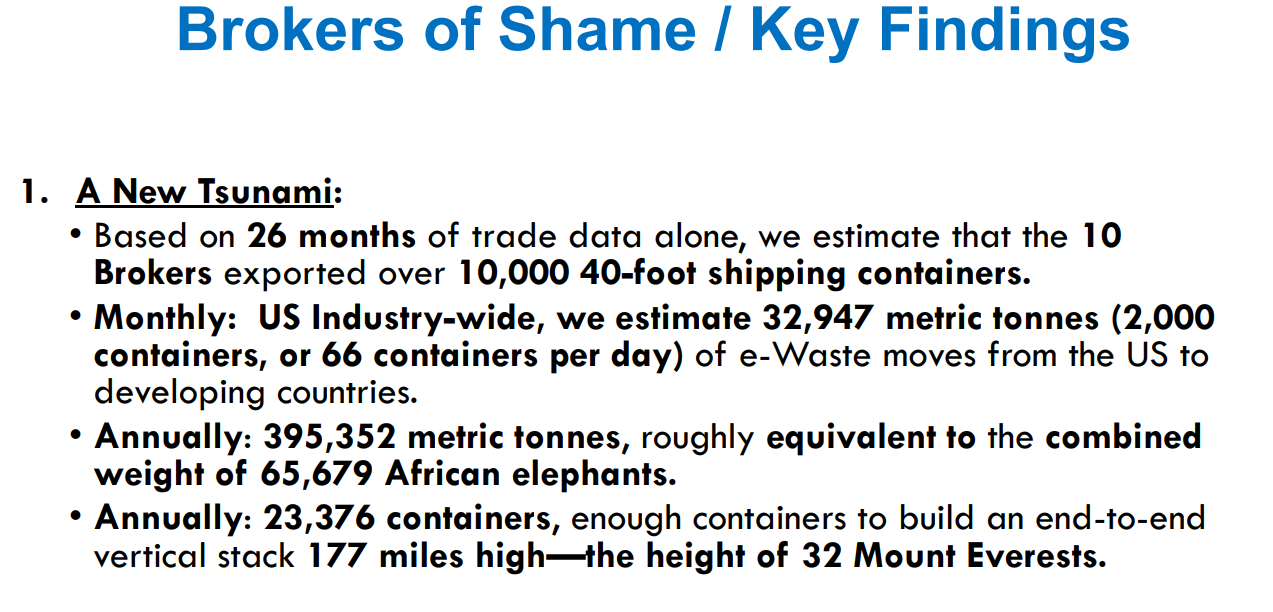
- The trade was almost surely illegal because the US is not a party to the Basel Convention. Under the Convention, importation of controlled waste from non‑parties is absolutely illegal without a special Article 11 agreement.
- Many countries like Malaysia, Thailand, and Indonesia also have national e‑waste import bans.
- Large customers were found caught in these export pathways. Although we did not design the study to look at them, we found evidence that the US Department of Defense was involved. Large companies like Iron Mountain and Best Buy were involved in channeling this illegal waste to these brokers.
- We found a lot of evidence of falsified trade declarations: the majority of exporters would never use the proper code for e‑waste, HS 8549. Instead, they used other codes for unwrought metals or functioning electronic equipment.
- Misdeclaring cargo is a crime. But they followed a pattern, which helped us find these illegal shipments just by the unrelated HS codes they were using.
- There is also a real case of certification gaps and problems. Eight of the ten “brokers of shame” held an R2v3 certification for being an ethical, responsible recycler — yet they were violating the law, which is not allowed under that standard.
- We documented the great environmental and occupational harm being done by this trade. Greenwashing comes in multiple forms.
- Almost all of these brokers market themselves with concepts such as circular economy, ESG, carbon‑footprint reductions, etc.
- Recent developments after the report came out — collected through BAN’s program Can Opener (named because containers are known as “cans” in the industry and we wanted governments to open them):
- We were able to monitor trade and obtain data in time to anticipate shipments arriving in receiving countries.
- We warned countries — the Philippines, Malaysia, Thailand, Indonesia, Vietnam, and this year India — providing exact ship names, arrival times, container numbers, etc.
Other important developments this year:
- The EU announced it would consider lithium‑ion batteries and black mass (a material made from those batteries) as hazardous waste. This is extremely significant. It is not a global determination yet, but the fact that the EU is considering it means it is very likely to become a global consideration.
- Southeast Asian countries — Thailand, Malaysia, and Indonesia — have been swamped by e‑waste imports. In this new “tsunami,” the good news is that governments are cracking down. BAN issued a press release praising these governments for mobilizing major resources across agencies to shut down facilities popping up everywhere.
- More and more waste is being redirected now that those countries have cracked down. We now see it moving to the Philippines, Pakistan, India, and the UAE.
- A major issue related to the amendments: certain trade associations are complaining about trade in what they call Zorba, which is smashed cars separated from ferrous material. Thailand found, for the first time, that these shipments contain circuit boards. After testing, the Thai government found them hazardous. This is now a major point of contention at this meeting.
- We were horrified to find that the guideline being submitted on how to implement the e‑waste amendments gives a major concession to industry, allowing 10% of a load to be e‑waste. Ten percent is a huge amount and completely contrary to everything already in Annex IX. More is in the dedicated delegate alert.
Nurulasma MARZUKI | Senior Assistant Director of Customs II, Malaysia
- The enforcement division of RMCD is a unit performing monitoring, assessment, and risk analysis on containers related to import, export, and transshipment activities, as well as carrying out detention, physical examination, and release of containers through the port system.
- Our main target is goods subjected to the Customs Prohibition of Import or Export Order, such as e‑waste.
- E‑waste trafficking is a global environmental crime where electronic waste — such as obsolete computers, smartphones, and batteries — is illegally shipped from developed countries.
- Malaysia is confronting a severe environmental and economic crisis due to the illegal smuggling and processing of electronic waste, often misdeclared at ports to bypass international laws.
- Although the nation is a signatory to the Basel Convention, it has become a global dumping ground for hazardous materials from developed countries, resulting in toxic pollution and billions in lost tax revenue.
- Currently, our government has implemented an absolute ban on e‑waste effective from 1 April 2026: waste from electrical and electronic assemblies containing components such as accumulators, mercury switches, glass from cathode‑ray tubes and other activated glass, or polychlorinated biphenyl capacitors — all contaminated with cadmium, mercury, lead, nickel, chromium, copper, lithium, silver, manganese, or any polychlorinated biphenyl — is banned from all countries and cannot enter Malaysia.
- From 2023 to 2025, over 1,000 containers suspected to contain e‑waste and plastic waste or scrap were inspected. Around 700 of these containers were confirmed as waste, including e‑waste.
- The Department of Environment (DOE) Malaysia has issued or will issue notices of repatriation or re‑export instructions, and currently about 134 containers have already been re‑exported or repatriated.
How Malaysia handles e‑waste:
- Information on suspected containers containing e‑waste is received, often from the Basel Action Network.
- We begin by holding or blocking the containers through the port system, where the port operator gives us access to their system for monitoring.
- When containers are in the port system, we conduct physical inspections to confirm whether the consignment contains e‑waste or other waste.
- The physical inspection is conducted by various agencies, led by the e‑waste task force of the Malaysia Border Control and Protection Agency.
- After inspection, containers are either released or handed over to the investigation departments. For e‑waste cases, we hand them directly to the Department of Environment.
- In 2026, we received information on nearly 300 containers suspected to contain e‑waste and plastic waste from BAN. So far, we have found that these suspected containers were falsely declared as aluminum under HS 7601, aluminum flakes under HS 7603, slag aluminum alloy under HS 7601, aluminum material as copper alloy, and more.
- Currently, the problem we face is the large number of containers containing e‑waste. Although they have already been inspected and confirmed as e‑waste, they are still located at the port because they are awaiting repatriation. This process is causing port congestion with these e‑waste containers.
Yuyun ISMAWATI | Senior Advisor and Co-Founder, Nexus3 Foundation | Co-Chair, IPEN
- Indonesia is seen as the largest e‑waste generator in Southeast Asia due to the size of its population and the widespread use of electronic gadgets.
- Each year, Indonesia generates about 600,000 tons of electronic waste of various types and characteristics.
- Indonesia has regulations in place on specific waste streams, and e‑waste falls under those regulations. So far, there is no EPR system for waste yet, although Indonesia generates large amounts of electronic waste. EPR is one of the action plans under the government’s circular economy program.
- Right now, there are no collection targets and the infrastructure for e‑waste collection at the provincial and city levels is not yet ideal.
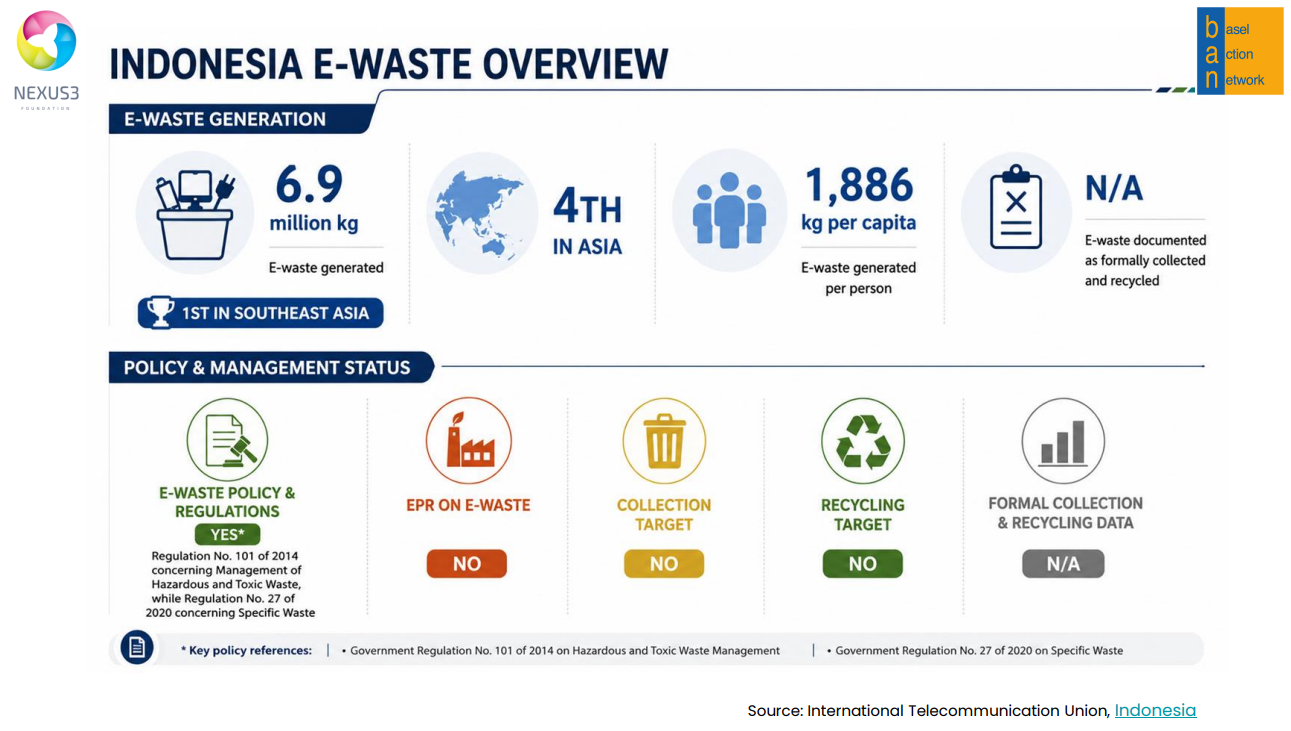
- In Indonesia, several companies process electronic waste. The one in Batam operates in a free economic zone that allows them to import e‑waste but also requires them to export the processed products. Each year, the amount treated or handled by these companies is only about 6,000 tons — still very small compared to the total waste generated.
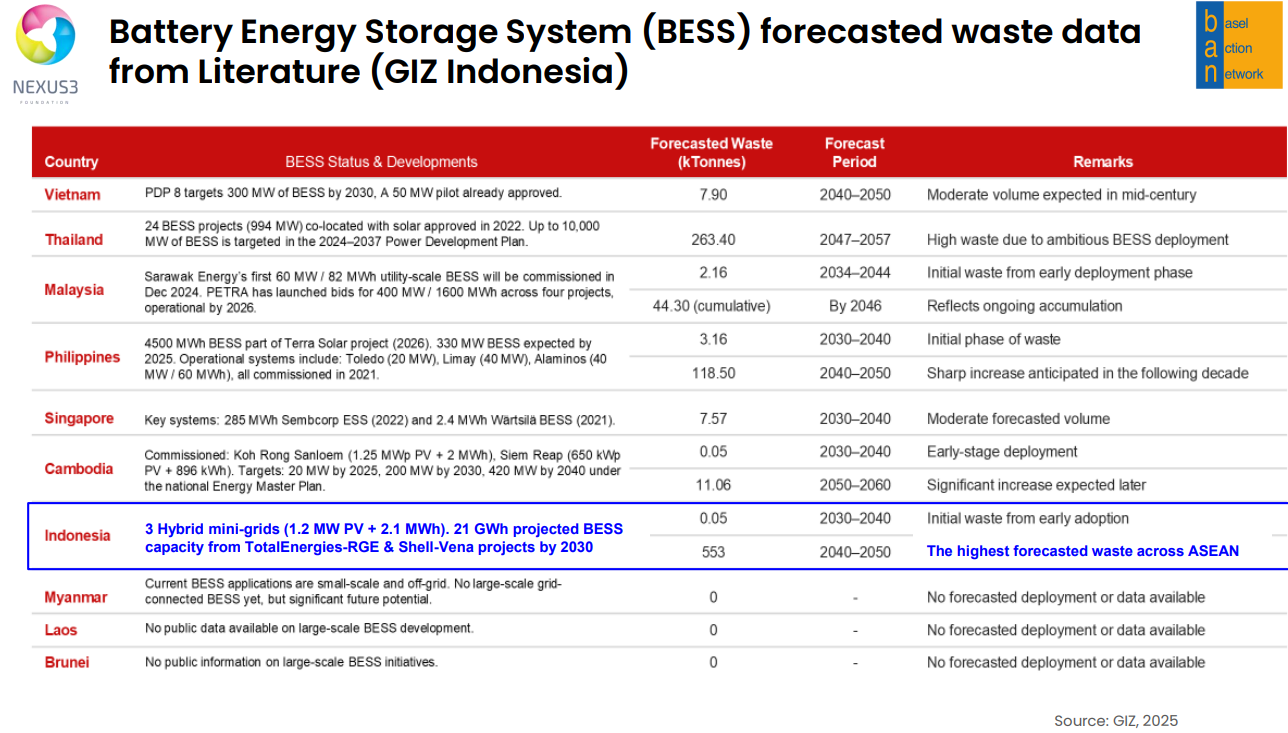
- A 2025 study by GIZ Indonesia highlighted projected increases in electronic waste due to battery energy storage systems (BESS), which will potentially generate even more e‑waste that must be managed.
- There are many platforms for online reporting systems in Indonesia, mainly coordinated or issued by the Ministry of Environment. However, they are not publicly accessible, and there is no annual summary or recap of data available to the public. We must wait for the minister to announce and present it.
- There are procedures to import electronic waste, but there is also a prohibition on importing “non‑functional electronic waste.”
- Companies can import e‑waste as long as they use it as raw material for industrial purposes.
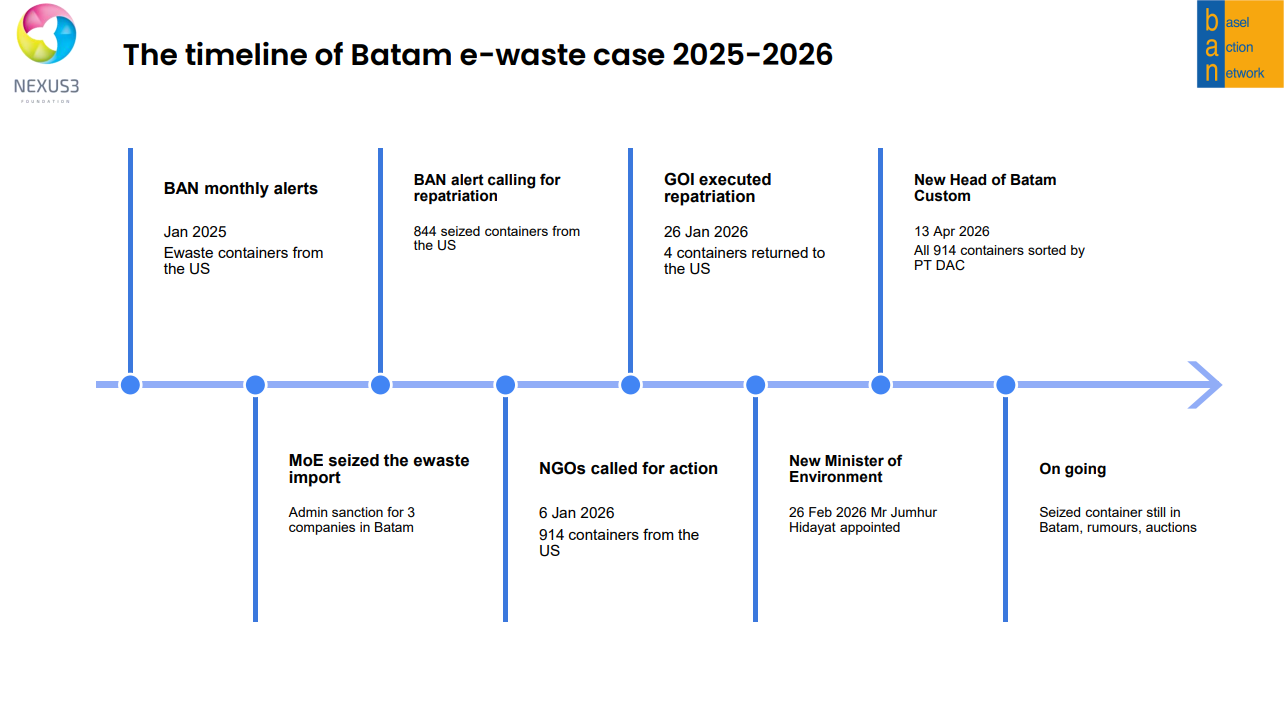
Ongoing case in Batam since last year:
- As many as 782 of the total 914 containers (98 re‑exported and 34 granted goods‑release approval letters) are still piled up at the port, and the process has not been completed.
- The shipments were linked to imports of scrap materials suspected of being mixed with electronic waste and other hazardous materials.
- It was previously known that the hundreds of containers came from three companies: PT Esun, PT Batam Battery Recycling Industries, and PT Logam International Jaya.
- BAN sent alerts to delegates every month identifying the types of electronic waste and plastic waste sent to Batam, and the Government of Indonesia actively responded.
- The Minister of Environment issued an order requiring these illicit or illegal containers to be returned to the senders.
- However, in April 2026, Batam authorities announced plans to destroy over 650 containers of illegally imported US e‑waste stored for months at the local port, abandoning earlier plans to re‑export them.
- Environmental groups alerted Indonesian authorities to suspected illegal e‑waste shipments entering the country in late 2025, leading to investigations in Batam.
- The case has become one of Indonesia’s largest recent enforcement actions against illegal transboundary waste trafficking.
- It is still ongoing, and there are many confusing updates and pieces of information.
- Indonesia is the largest producer of nickel for electric vehicles, but most Indonesian nickel is actually used for the steel industry because Indonesia does not produce lithium batteries.
- The government allows the importation of lithium batteries for industries that produce or use them as secondary materials. However, we have found many cases of e‑waste warehouses catching fire — some due to lithium batteries and others due to improper handling or management.
- Indonesia developed a circular economy strategy that includes the electronic sector. The government already has 14 action plans, and we hope to see improvements in the future.
- We hope that governments, especially Parties, can adopt and monitor implementation of the Basel e‑waste amendment, expand implementation into national legislation and regulation, and enforce mandatory return‑to‑sender requirements for illegal US shipments.
Sirinart PONGYART | Director, Hazardous Waste Subdivision (Senior Professional Level), Waste and Hazardous Substances Management Division, Pollution Control Department, Thailand
- To implement the Basel e-waste amendments, Thailand follows existing laws and regulations.
- The main regulation to implement the Basel Convention in Thailand is the Hazardous Substance Act, which covers only hazardous waste.
- In addition to this, additional related policies and registration for hazardous waste management instruments exist in Thailand:
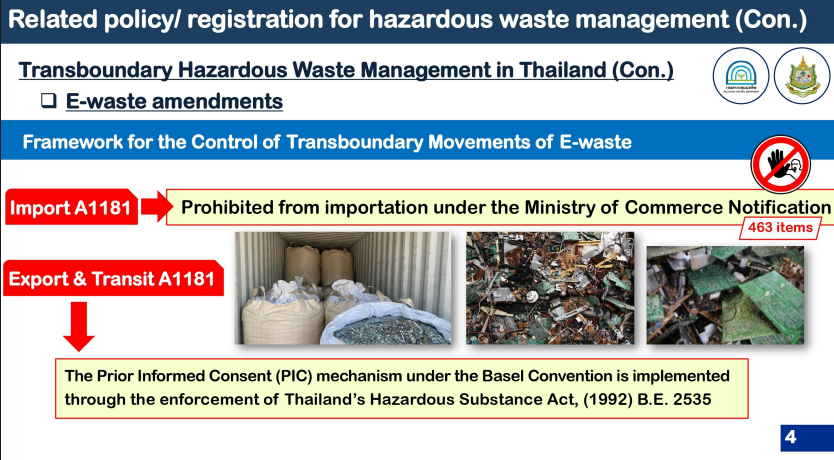
- For the Y49, we required the PIC procedure for transparent movement, but we cannot use our main regulation because the Y49 is not non-hazardous waste.
- Thailand is now in the process of ensuring a notification from the Ministry of Commerce to control Y49 by the PIC process, while at the same time considering the specification of the customs tariff course for Y49.
- Currently, we are facing many cases of illegal traffic; most of them are misdeclaration, for example, declaring aluminum waste instead of electronic waste.
- We also received notifications from BAN. From April 2025 to June 2026, for a total of 13 times, around 700 containers were found containing e-waste and plastic waste.
- For the cases where the Pollution Control Department received notification from customs, it will be reported back to BAN for further actions
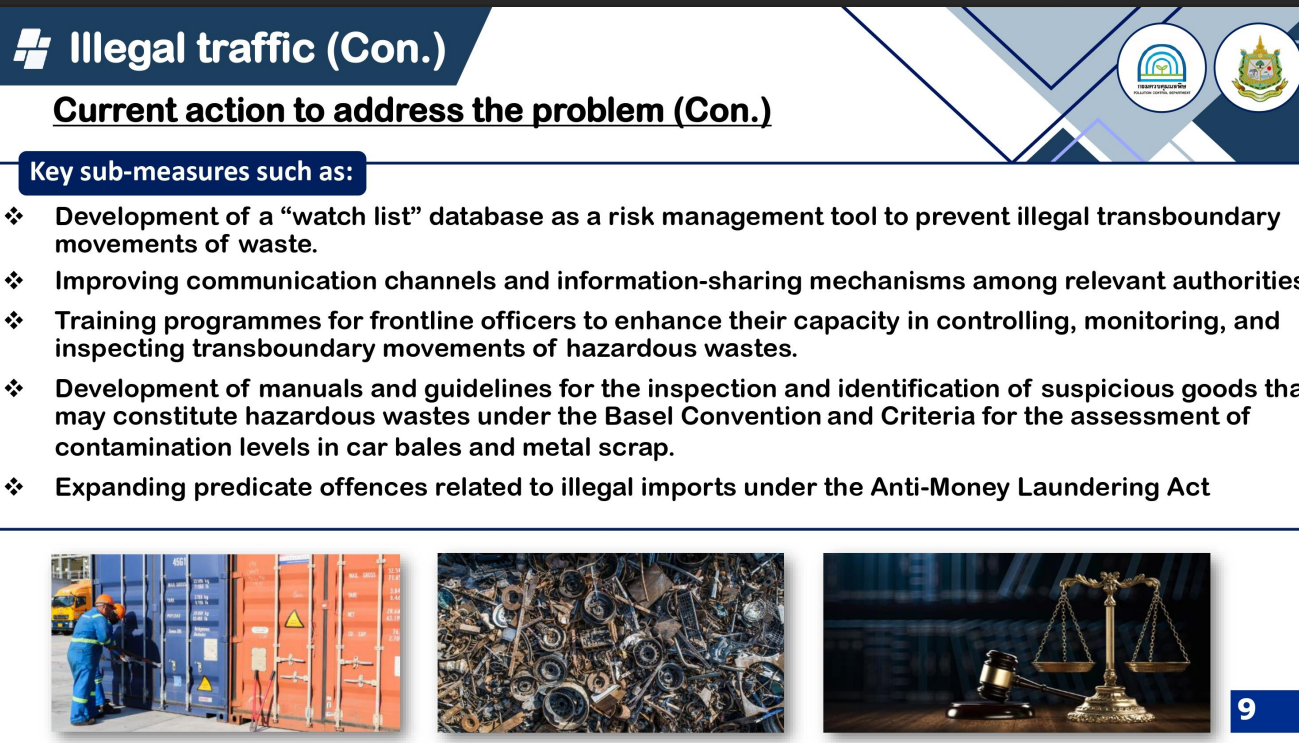
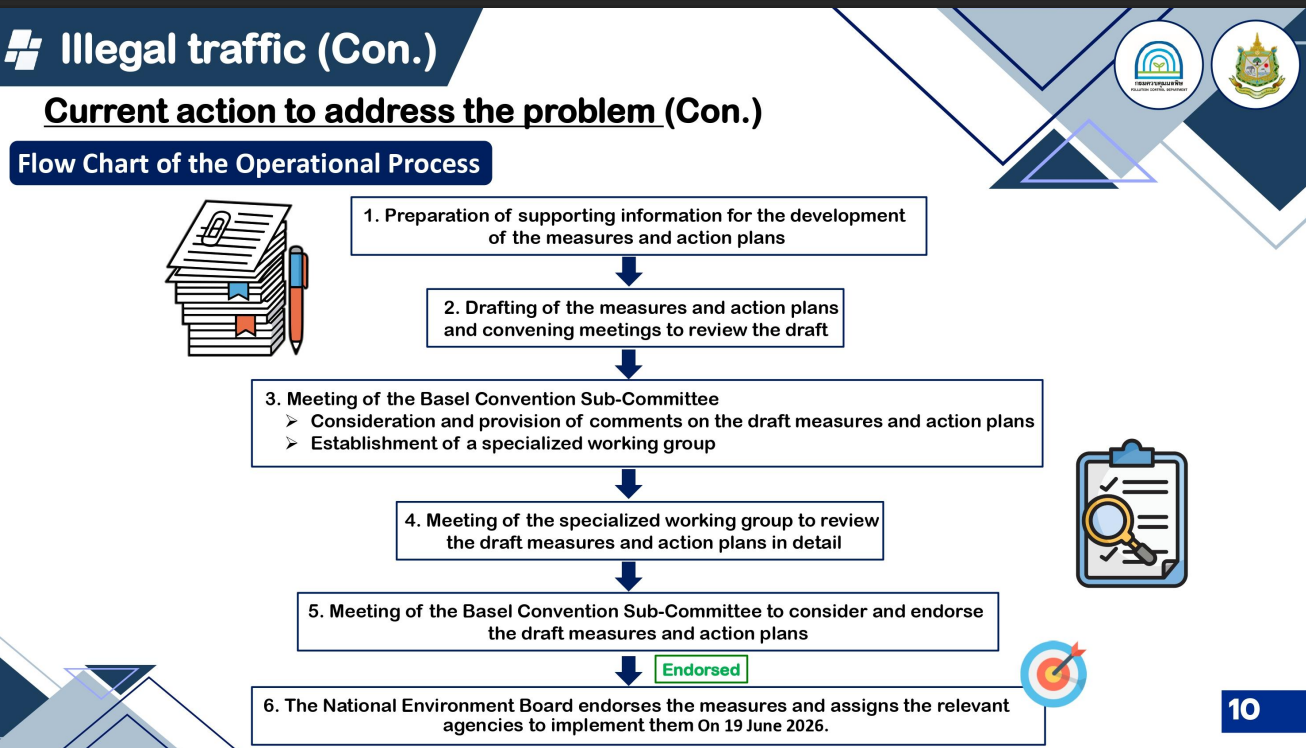
- We are in the process of addressing the problem, developing measures and action plans to enhance the control, supervision and monitoring of transboundary movement of hazardous waste.
- The measures consist of:
- Enhancing pre-screening efficiency.
- Strengthening cooperation and coordination networks.
- Capacity building
- Improving law enforcement effectiveness.
- Sub-measures include the development of the watch list and improving communication channels and information sharing mechanisms among authorities.
Jashaf LORENZO | Deputy Executive Director, BAN Toxics
- The presentation will focus on freeport zones in the Philippines and how electronic waste has been entering these areas.
- The entry of hazardous wastes into the Philippines is governed by the National Law Republic Act 6969 or the “Toxic Substances and Hazardous and Nuclear Wastes Control Act of 1990” and the accompanying Department Administrative Order (DAO) 2013-22 or the “Revised procedures and standards for the management of hazardous wastes.” department administrative order or DAO 201322 or the revised procedures and standards for the management of hazardous wastes.
- Section 10 of DAO 201322 provides guidance on the importation and exportation of hazardous substances and wastes in line with Article 11 of the Basel Convention, including the requirement for a pre-shipment importation clearance.
- These two policies are the mechanisms of the Philippine government to actually comply with the BC. Based on these, the Philippines has government agencies in charge of implementing the Basel Convention: the Department of Environment and Natural Resources, responsible for pollution prevention and control as well as environmental impact assessment, and the Bureau of Customs, the Environmental Protection and Compliance Division.
- Since 2024, we have been monitoring shipments of electronic waste entering a free port zone in the Philippines, the Subic Bay Freeport Zone.
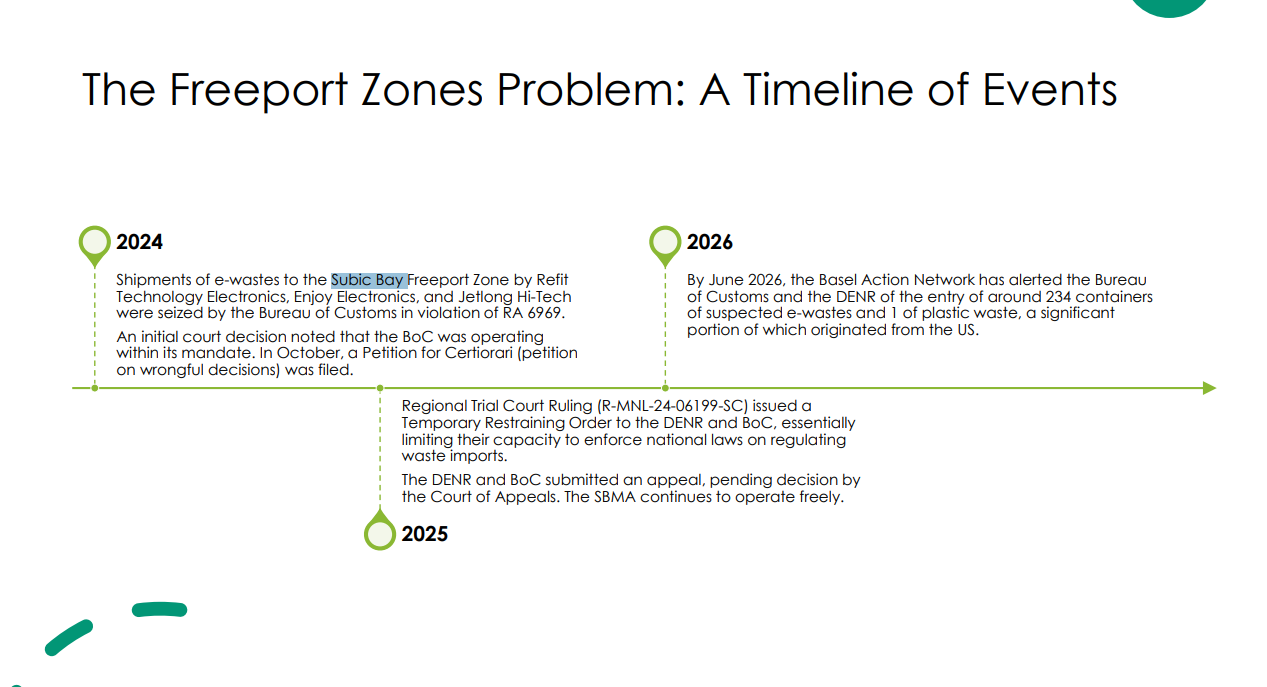
- In 2024, shipments of e-waste to some companies based here were seized by the Bureau of Customs (BOC) and were found to violate RA6969.
- An initial court decision noted that the BOC was operating within its mandate; however, the SBMA as well as these companies filed a petition on wrongful decisions.
- In 2025, a regional trial court ruling was issued, and this provided a temporary restraining order to the DNR and the BOC, which essentially limited their capacity to enforce national laws on regulating waste imports.
- Due to this court ruling, the DNR and the BOC submitted an appeal pending decision by the Court of Appeals. But since that was issued, the Free Port Zone has continued to operate freely.
- By 2026, the Basel Action Network had alerted the Bureau of Customs and the DNR of the entry of around 234 containers of suspected e-wastes and one plastic waste, a significant portion of which was coming from the US.
- The regional trial court ruling found that RA6969 and its implementing rules, including provisions on pre-shipment importation clearance – a key requirement for entities importing hazardous wastes into the Philippines – are unconstitutional.
- The ruling says that e-waste is not inherently hazardous based on the amendments to the annexes of the Basel Convention and that the PIC requirement is beyond the scope of RA6969, which only provides for new chemical substances or mixtures and not e-waste.
- The RTC ruling says that national government agencies such as the Bureau of Customs lack jurisdiction over free ports.
- The case presents a misreading of the Basel Convention, Philippine environmental laws, and the interaction of Philippine municipal laws and international law.
- The RTC ruling is in conflict with our international obligations and domestic prohibitions; it disregarded the scope of RA6969 including provisions on the entry and transit of hazardous and nuclear wastes and it disregarded the constitutionality of the PIC provision based on BC e-waste amendments, which requires PIC for e-waste regardless of hazardous characteristics.
- Although this is just a regional trial court ruling, it has had a huge impact on national sovereignty.
- Immediate impacts include:
- Continuous shipments of e-wastes, especially without the pre-shipment importation clearance requirement, which is requested under Philippine law
- Total waste shipments are estimated to have risen by 350% in the free port zone.
- National government agencies in the Philippines are left with little or no power to monitor and regulate shipments and there are current efforts to use the RTC ruling as a basis for amending national laws to reflect the autonomy of free port zones from environmental laws.
- We are looking at this as a dangerous precedent for passel compliance.
- In response to this, the current wave of illegal e-waste imports in the Philippines, BAN Toxics and BAN have established an NGO task force in the Philippines with the primary objectives of raising critical awareness regarding illicit e-waste trading, ensuring accountability and legislative processes and advocating for stricter compliance with the Basel Convention.
Q: How does the PIC procedure work? Is there an active PIC procedure for e-waste in Thailand?
Q: As customs department official, do you have any engagement with the Basel Convention PIC process at all? How does the inter-agency collaboration between the BC focal point versus non-BC focal point work?
Nurulasma MARZUKI | Senior Assistant Director of Customs II, Malaysia
- For the BC focal point, Customs is not the competent authority but rather the Department of Environment. The information received from BAN is normally received from our intelligence unit; thus, most of the information flows quite smoothly.
Sirinart PONGYART | Director, Hazardous Waste Subdivision (Senior Professional Level), Waste and Hazardous Substances Management Division, Pollution Control Department, Thailand
- This is a major challenge in Thailand. We cannot control Y49 by the PIC process because our main regulation does not cover non-hazardous waste.
- We currently try to inform about potential voluntary actions while at the same time giving the mandate to our competent authority.
Q: How do Malaysia and Thailand manage the fact that the USA is not a party to the Basel Convention? Do you speak to the US government?
Nurulasma MARZUKI | Senior Assistant Director of Customs II, Malaysia
- The management of the relationship with the USA with regard to this falls under our Department of Environment.
Q: Is there a list of shipping agents or freight forwarders who have been found to send illegal e-waste to Malaysia? Is there cooperation with US customs agency to further monitor shipments from these agents?
Nurulasma MARZUKI | Senior Assistant Director of Customs II, Malaysia
- We have the list from our systems, but we don’t have any engagement with the USA customs currently.
Q: Are you returning any containers back to the USA?
Sirinart PONGYART | Director, Hazardous Waste Subdivision (Senior Professional Level), Waste and Hazardous Substances Management Division, Pollution Control Department, Thailand
- This is a very big problem right now.
- We have many containers from non-parties, and we try to inform them that we cannot receive the waste from non-parties.
- It is not working right now, so we need international cooperation to help us deal with this waste that we cannot manage in our country.
Q: Why is it important that the public knows more about these enforcement challenges? Why is e-waste exports/imports a serious issue?
Jim PUCKETT | Founder and Chief of Strategic Direction, Basel Action Network
- The work of the Basel Convention is about environmental and human health impacts and that’s what electronic waste is about.
- The situation is quite similar around the world: small operations, informal sectors and illegal immigrants involved in the trade, while still being run primarily by Chinese businessmen, while causing harm to Malaysia, Indonesia and Thailand.
- These facilities are very difficult to operate without impacting human health and the environment.
- Recycling electronic waste is very difficult; it operates on really low margins, ending with the dumping of residues that are not economically recyclable.
- Burning electronic waste generates chemicals in the form of phthalates and dioxins etc. This is why the public needs to know what’s going on and governments need to act.
- It’s a shame that the situation in Southeast Asia is caused by one nonparty that does not take responsibility for a lack of mandate.
Yuyun ISMAWATI | Senior Advisor and Co-Founder, Nexus3 Foundation | Co-Chair, IPEN
- The public must know.
- It is also important to educate on the hazardous components in the electronic waste and the harmful chemicals generated if discharged, dumped or burned.
- Environmentally sound management is important. But then if some residuals cannot be recycled, some companies are instructed to burn. Awareness about the kind of harmful chemicals in e-waste must reach the public because the issue is not only USA importation but also US-generated domestically.
- Concerning the importations with non-parties to the BC, the Indonesian government must be ready and anticipate new regulations, especially if it becomes an OECD country.
Jashaf LORENZO | Deputy Executive Director, BAN Toxics
- Going back to the issue the Philippines is facing with free port zones, the central question is: if these companies are willing to circumvent international law, how far can they go? Are they upholding workers’ rights?
- We are just calling for transparency to ensure we are protecting human health and the environment, especially for workers who are exposed to e-wastes and communities.
Other Side Events
The Case for Basel Controls on all Plastic Wastes: Local Realities of the Global Waste Trade | Basel OEWG-15 Side Event
23 June 2026 | 18:30 – 19:30 CEST
Basel Action Network, International Pollutants Elimination Network with the support of GEN