
Event Conference
The Case for Basel Controls on all Plastic Wastes: Local Realities of the Global Waste Trade | Basel OEWG-15 Side Event
23 Jun 2026
18:30 – 19:30
Venue: CICG, Room 4 & Online | Webex
Organization: Basel Action Network, International Pollutants Elimination Network
This side event to the fifteenth meeting of the Open-ended Working Group of the Basel Convention on the Control of Transboundary Movements of Hazardous Wastes and their Disposal (OEWG-15) is organized by Basel Action Network and IPEN with the support of the Geneva Environment Network.

About this Event
In 2019, during the Plastic Waste Amendment (PWA) negotiations, China at Basel COP14 proposed that the Basel Convention control all plastic wastes, regardless of their destinations or hazardousness. However, that proposal did not succeed and several types of plastic waste remain exempted from Basel controls.
A few years later, Switzerland and Ghana proposed that we do precisely that for all forms of electronic waste. The Basel Parties agreed and created the E-Waste Amendments, which placed all exports of e-wastes under Basel control procedures, without any listings that are exempt.
This year, beginning May 21, 2026, all 27 member states of the EU require prior informed consent (PIC) for all plastic waste leaving the EU under their revised Waste Shipment Regulation, regardless of whether the waste is going to OECD or non-OECD countries, or whether they are hazardous or not.
The notion of controlling all plastic waste trade is an idea whose time has come.
A lot has changed since 2019 when the PWAs were passed. Even though the Plastic Treaty negotiations have been delayed, it has become abundantly clear that the reason why a treaty has not been agreed upon is not due to the fact that plastic is not a serious pollutant throughout its entire lifecycle, but rather, due to the lack of political will to stem the tide of virgin plastic production.
Over the years, we have gathered a significant amount of new scientific knowledge about the harm of plastic. We now know that plastic is in fact toxic, with more than 16,000 chemicals being used in its production, and more than 4,200 are chemicals of concern, which are persistent, bioaccumulative, mobile or toxic. Plastic also releases harmful microplastics at every stage of its production, consumption and waste management. We have also learned that plastic is not inherently circular – the number of times the material can be recycled is limited, and contaminants are found in recycled pellets, with the risk of being recycled into new products.
We know that almost all plastic waste trade is driven, not by a need to increase recycling or circularity, but by the economic incentive to exploit cheaper labour, lower energy costs, and weaker legal safeguards for human and environmental health in importing countries.
Case studies from Tunisia, Malaysia, and Australia will demonstrate how the trade in household waste, textile waste, plastic waste, and refuse derived fuel are under-regulated, avoiding tracking and PIC procedures, leading to de facto waste dumping from wealthy countries to lower-income countries. One case demonstrates how the Basel convention waste codes can be applied to improve local outcomes and support the spirit and intent of the plastic waste amendments.
It has become clear that, for importing countries to properly protect their population’s health and their environment, they require the transparency and assurances of environmentally sound management (ESM) that the Basel Convention controls can offer. Just as the Parties have done with e-waste, we should now require PIC as a minimum control procedure for all plastic waste under the Basel Convention. This side event will dissect these issues.
About OEWG-15
The fifteenth meeting of the Open-Ended Working Group (OEWG15) of the Basel Convention – one of the subsidiary bodies of the Conference of the Parties to the Convention – will convene from Tuesday, 23 June to Friday, 26 June 2026, at the International Conference Centre Geneva (CICG), with pre-meetings, including Bureau and regional meetings, taking place on Monday, 22 June. The OEWG is expected to advance key items within its work programme, focusing on a range of priority areas. These include efforts to improve the functioning of the prior informed consent procedure, as well as the development of technical guidelines addressing Persistent Organic Pollutants, e-waste, waste lead-acid batteries, used and waste pneumatic tyres, and mercury. Additional topics of focus include plastic waste, used textiles and textile waste, and the provision of greater legal clarity. Furthermore, the OEWG will support activities under the Basel Convention Partnership Programme and strengthen cooperation with the World Customs Organization and the International Maritime Organization.
Speakers
By order of intervention.

Jim PUCKETT
Founder and Chief of Strategic Direction, Basel Action Network

Semia GHARBI
Goldman Prize Winner, Association d'Education Environnementale pour les Futures Generation (AEEFG)

Pui Yi WONG
Researcher, Basel Action Network

Lee BELL
Technical and Policy Advisor, IPEN
Ole Thomas THOMMENSEN
Senior Adviser, Environment Directorate, Norway

Griffins OCHIENG
Executive Director, Centre for Environmental Justice and Development, Kenya

Sara BROSCHÉ
Science Advisor, IPEN | Moderator
Highlights
Other Side Events
E-Waste Trafficking Out of Control One Year After Basel E-Waste Amendments | Basel OEWG-15 Side Event
25 June 2026 | 13:30 – 14:30 CEST
Organized by Nexus3 Foundation, Basel Action Network, BAN Toxics with the support of GEN
Video
Summary
Jim PUCKETT | Founder and Chief of Strategic Direction, Basel Action Network
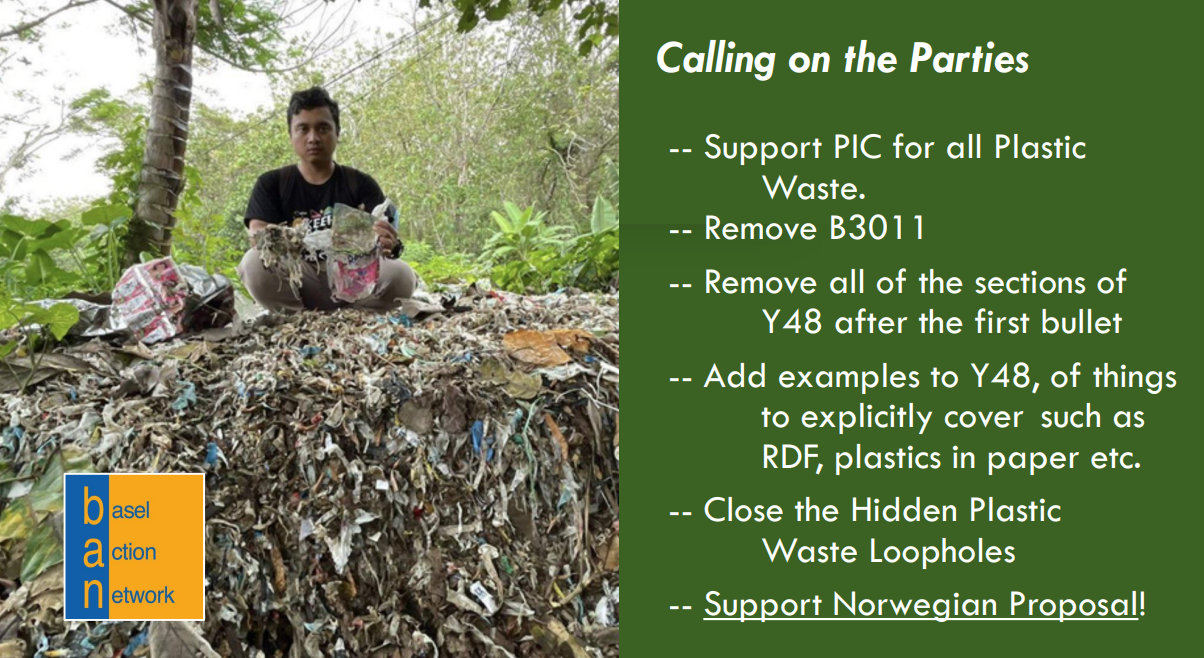
- Changes are needed in terms of the Basel Convention Plastic Waste Amendments. After five years of experiencing said amendments, we want to see all of the plastic waste controlled.
- Norway has made an Application to OEWG-15 for the removal of entry B3011 on plastic waste from Annex IX to the Basel Convention to achieve that.
- Top exporting countries are exporting plastics primarily for economic reasons: Japan, Mexico and Turkey. However, a lot of European waste is moving in that direction from OECD to non-OECD. Germany, UK, Spain come next, followed by the Netherlands and Belgium. Europe definitely tops Japan and the USA in terms of this type of economic export.
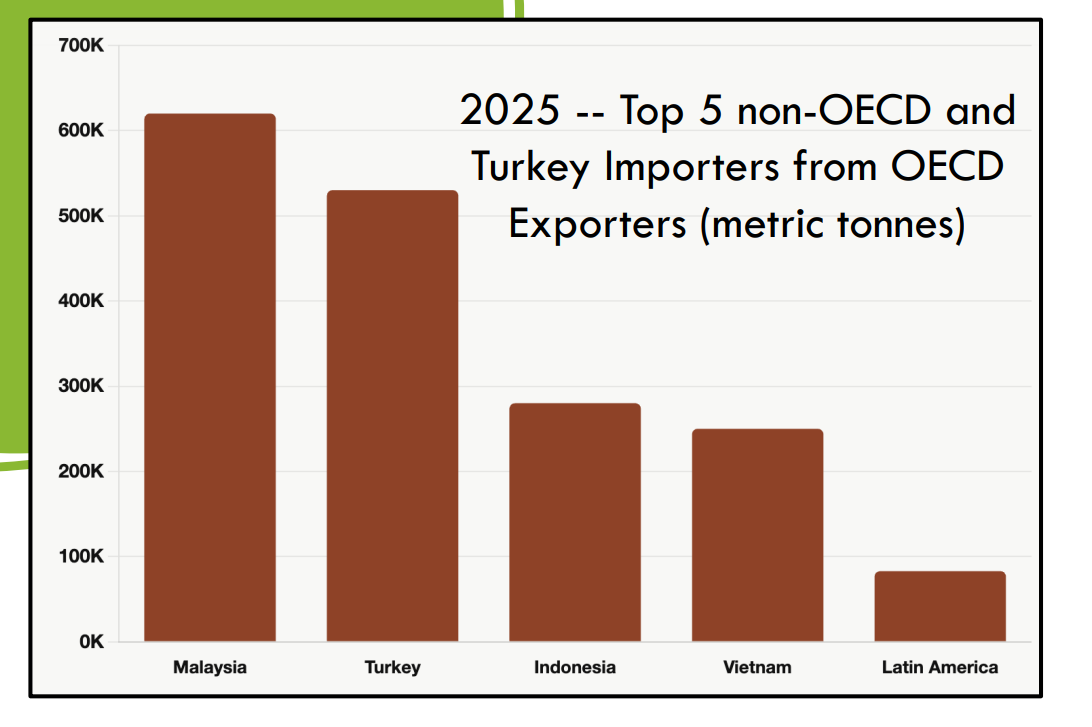
- These are the receiving countries, which are experiencing a growth in the material that is flowing globally.
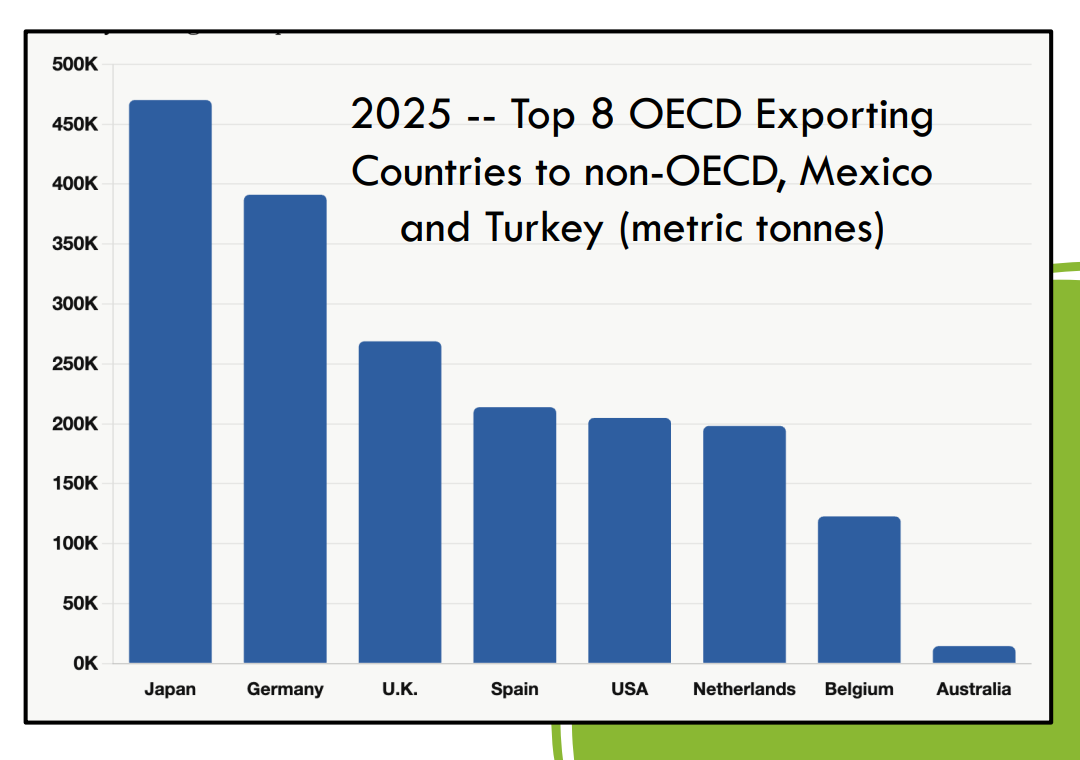
- There are various reasons why change is necessary:
1. The hidden and forgotten plastics
- All plastic waste was meant to be covered by A3210, Y48 or B3011, yet many plastic wastes were found to be
constituents of legacy B listings when they should have been listed as Y48 (problematic) or A3210 (HW) - These include textiles/used clothing, rubber wastes, tyres, shredder fluff, paper waste, laminated paper etc.
- Some plastics have never had a proper listing in Basel (e.g. RDF).
2. Vague and confusing definitions
- Plastic waste has been, by far, the most complicated listing historically causing difficulty for practitioners, customs, and enforcement to distinguish between the 3 categories and leading to poor implementation.
- The definition of “almost free of contamination and other types of waste” and “almost exclusively consisting of “ is left to subjective interpretation and thus, an uneven playing field globally.
- The high costs of having to distinguish between the listings is burdensome (particularly in developing countries)
- It takes a lot of analysis and investigation, and time, money to determine whether something is Y48 or 811320 or B3011.
3. Physical harm and chemical toxicity ignored
- There are 16,000 chemicals used in the production of plastics, out of which 4,200 are chemicals of concern — toxic, persistent, bioaccumulative, endocrine disruptive etc.
- Many of these are intentionally added as additives in the products, causing harm throughout the life-cycle, including in the recycling process, workplace and in the new recycled product.
- These additives are largely unregulated by the Basel Convention. If they were, most mixed loads of plastic would have to be A3210 (hazardous plastic)
- The Basel Convention has, until now, not adequately addressed microplastics, which belong in Annex I and III.
4. Unexamined legacy exemptions in B3011 (i.e. unmixed polymers, cured resins, fluorinated compounds)
- The legacy exemptions found in B3011 and mirrored in Y48 are no longer fit for purpose. They must be removed.
- They were created back in 1996, before anybody knew about additives, PFAS etc. and were based on what we knew about concerns they caused in products, not after export and recycling.
- The first two categories are non-exhaustive lists, so there is no scientific way one can justify exempting these polymers, or resins as we don’t know what they are.
- These fluorinated compounds are either PFAS or can break down to PFAS.
5. Plastics recycling, even of B3011, causes more harm than previously thought
- The more we learn, the more plastic is revealed as a non-circular product.
- All mechanical recycling is “downcycling” and thus cannot compete (quality and price) with virgin plastic when virgin prices are low.
- It carries legacy toxic additives that can dangerously become part of the new product (e.g. toys, food containers).
- Almost all plastic recycling, especially of post-consumer mixed loads, is only partially recycled — large amounts (e.g > 50%) is not recycled.
- Those unrecycled fractions once sorted out are often dumped and burned as there is little incentive to ensure they do not cause harm.
- Therefore, almost all exports for recycling entail final disposal with recycling — yet Parties ignore this fact in their transboundary movement
Pui Yi WONG | Researcher, Basel Action Network
- In Malaysia, Indonesia and the Philippines, both the people and the ecosystem are facing consequences from plastic pollution, with all this waste being imported.
- Malaysia was a top importer of plastic waste, with the waste-importing business tending to generate more costs than benefits, where the benefits tend to accrue to a small minority.
- While data is lacking due to the limitations of freedom of information, it’s hard to know how many people are getting sick because of the imported waste, but they are certainly getting sick.
- In 2018-2019, the Malaysian Environmental Ministry took action against waste colonialism. It supported the plastic waste amendment strongly and the plastic waste smuggling problem ceased; it shifted to e-waste.
- Due to a lack of information and disasters, locals reacted negatively to the recycling facilities in Malaysia, making them move.
- Locals who are just regular working citizens in Selangor gathered together to organise and mobilised against plastic waste dumping, making complaints to various agencies and documenting suspicious sights.
- Malaysia has recognised waste traffic and waste trafficking as a national security threat.
- In Malaysia waste trafficking has become a criminal matter, with police involvement being necessary due to the traffickers threatening officers with guns.
- Waste trafficking is more than an environmental issue, with the Malaysian government taking action to stop it. Some importers are abusing fines, which is an issue that must be addressed.
- The Basel Convention is important as international standards are way to push local governments to hold businesses accountable.
- Exporting countries should also stop exporting their waste in order to stop plastic pollution
Lee BELL | Technical and Policy Advisor, IPEN
- The main users of refuse-derived fuels (RDF) are cement kilns worldwide. RDF is nearly impossible to track, with it lacking a descriptive harmonized system (HS) code or a Basel Convention code.
- The Basel convention is mostly silent on RDFs with it lacking a specific Basel Code. RDF movements cannot be accurately measured using public information.
- We know that it is moving, for example the UK is exporting 1.5 million tons of RDF a year to scandinavian countries, yet data is still lacking.
- Australia has taken the lead on RDF classification, adopting Basel waste code Y48 of mixed plastic waste to RDF, requiring prior informed consent (PIC) to export RDFs from Australia.
- Transparency is an issue when it comes to RDFs, even though the Basel code application of Y48 would be an improvement, it would still lack some accuracy.
- A new Basel code like Y50 should be created for RDFs and similar products to allow accurate tracking of their movements.
Semia GHARBI | Goldman Prize Winner, Association d’Education Environnementale pour les Futures Générations (AEEFG)
- In Tunisia, the second hand textile sector plays an important economic and social role. Tunisia has been importing second hand textile for more than 60 years. It is a proper sector, a business, but there are a lot of gaps.
- Based on the national statistics, Tunisia is ranked between third and fourth among African second-hand clothing importers. It imports between 120 to 150,000 tons of these second-hand textiles and has over 47 offshore sorting plants, and we import from more than 50 countries, as well as 75% of the containers, which are in the port in the capital of Tunis. More than 83 Tunis city dwellers buy second hand.
- Based on the field surveys and a sectoral assessment report around 200,000 retailers at the national level operate within the sector supporting the livelihoods of approximately 600,000 of people. There is this dependency of Tunisia on the import export and we should know that more than 80% of this import came from the EU countries.
- Through the importation we have detected that we have some container storage that is not really declared, and where we can see it burning. This is from this importation, from the sorting centers. We have many sorting centers and we got some testimonials that indicate that we can have fires by factories to eliminate textile waste.
- When clothes are not sold many of them will be redistributed to other regions within the country, and then many of them will not be disposed of in an ecological way. We have regulations on this kind of waste, still the implementation of this regulation is really far from reality. Toxic chemicals will be everywhere, and nowadays the textile has a lot of plastic inside. 100% of this textile is made of polyester and other plastics. Many contain a lot of toxic chemicals.
- Tunisia exports to 17 destinations, many of them in Africa, to Germany, to other EU countries, to Jordan, to India and the United Emirates. 13% of imported goods should be directed to the local market. Some to the African markets and the remainder ends up as a rag material or is destroyed. In 2019, the National Agency on the management of waste banned dumping the textile waste in controlled landfills, which means that the management will be the worst of the waste.
- Tunisa ban the import of footwear, toys, handbags, and more, but unfortunately these items are imported. We find them on the markets and they contain a lot of toxic chemicals. People make fires to dispose of these large quantities of waste, which release even more toxic chemicals. Under the 63 the HS code of 6310, Tunisia also is importing 100 tons and exporting 17,000 tons, which means that it exports more than it imports under this HS code.
- Tunisia is exporting 150 times as much as it imports based on national statistics. In 2025, Tunisia has a total of almost 91,000 tons of second hand textile remaining in the country. If calculating only 0.1% of the estimated 55,000 tons of synthetic textiles remaining in Tunisia containing pops such as PBDEs, SCCP, or PFOS, or PFAS, this would correspond to approximately 55 tons of hazardous chemicals potentially present within the textile flow each year.
Ole Thomas THOMMENSEN | Senior Adviser, Environment Directorate, Norway
- Norway believes that the 2019 waste amendments were a major move forward, welcoming the processes launched by Basel Convention COP 17, and proposing an amendment to Annex 9 in order to ensure that COP 18 has full competence to make changes.
- From Norway’s experience, the wording of B3011 leaves too much room for interpretation, making enforcement difficult and creating opportunities for misclassification and circumvention. Finally, they also hear concerns from countries about receiving plastic waste that they cannot manage in an environmentally sound manner, leading to dumping, leakage, or open burning.
- There is a clear need for better data and transparency. Norway believes that it is important to learn from the experiences of developing countries to make sure that the COP has the necessary basis to informed decisions on how to adjust the system to better control plastic waste movement.
- They believe that the key issue is to balance stronger control and enabling a function circular economy. Even though the current system allow too much uncertainty, heavy administrative burdens can slow or stop recycling activities that are environmentally sound.
- They believe that digitisation can be a way to improve the PIC in order to lower administrative burdens, believing that it is equally important to improve things in practice as it is to discuss legal text.
- In order to manage plastic waste in an environmentally sound manner, it is necessary to work on multiple fronts:
- Design and prevention must be at the core; plastics should be reusable or recyclable and free of hazardous substances with the work under the Stockholm Convention and POPs waste technical guidelines being essential.
- In the absence of industrial post-sorting plants for household waste, collection of plastic waste must be done separately.
- Strengthening sorting systems should be a priority due to the essentiality of effective sorting systems when recycling.
- Treatment capacity must be in place, potentially requiring regional cooperation to ensure sound recycling.
- Financing mechanisms are critical, with extended producer responsibility schemes being a key tool in Norway.
- International cooperation is crucial.
- Member States should also encourage parties and observers to engage actively in this partnership as it offers a way to move from discussion to implementation.
Griffins OCHIENG | Executive Director, Centre for Environmental Justice and Development, Kenya
- Kenya was the beneficiary of the plastic waste partnership pilot project, “Preventing Marine Litter: Global Partnership and Activities (GIZ)“, addressing black plastics as it was found there was a lack of control on chemicals in plastics, particularly as a net importing economy. This was brought up in a multi-sectoral committee where the leadership at the National Bureau of Standards welcomed this as a way to increase national standards to control products.
- Kenya developed an extended producer responsibility law. Moreover, when looking at the standards and lack of standards in Kenya, there is a gap, allowing for the development of new standards, such as for children’s toys.
- Kenya wishes to strengthen the informed consent procedures, which are controlled by the National Environment Authority in Kenya.
- They also wish to extend producer responsibility in order to stop misinformation in products, where for example products which were labeled bisphenol free were found to have high levels of bisphenol.
- They also wish to have dialogues in order to discuss with regulatory agencies on how to improve policy.
- There should also be the application of a precautionary principle in the development of laws.
- The Basel Convention should strengthen the existing control on transboundary movements of waste.
Q&A
Q: RDF comes from sorting rejects and recycling rejects. What we see in regions, especially in Western Europe, where there is more recycling, is that access to RDF is easier because the infrastructure is present, as well as the players in the volume chain. And it’s easy to just get the rejects because it is a process of recycling, and there’s always a fraction that you cannot use for whatever reason. What we see in other regions, where there is no recycling or very little, is that we have to build an infrastructure and we have to start from scratch. And so on the point of including RDF, in Europe, in the EU, it is on the orange list, so part of the notification system. It is a waste. It is not a product.
Lee BELL | Technical and Policy Advisor, IPEN
It can be categorically said that RDF is non-hazardous. Chemical additives, as we heard earlier, are extensively incorporated in plastics throughout every type of plastic material that’s produced, they will be contained in the RDF as well, there’s very legitimate reasons to classify RDF as hazardous material on its plastic basis. Probably not on the many of the other constituents in it, but certainly on its mixed plastic waste basis.
Jim PUCKETT | Founder and Chief of Strategic Direction, Basel Action Network
What comes with PIC, you know where things go. Just burning anything anywhere doesn’t make it right; there are conditions that might make it better. The competent authorities need to know where it’s going, and how much is coming in. That’s the important part of the transparency aspects of prior informed consent. The position would be good if they make from the waste wood category and next to the annex one.
Q: I’ve been working in hazardous waste globally since some time. We import hazardous waste into the Union. And we have worked with PIC for many years and we are here from Norway. Thank you for this statement that PIC should be digitalized and so on. We have hoped for that for many years on a global term because we used to run with a pack of paper from country to country, seriously. And now it got better with emails, but it’s still a mess. So, is there any update from your perspective when this could happen and how can this be supported?
Ole Thomas THOMMENSEN | Senior Adviser, Environment Directorate, Norway
- Many countries are building systems, but not all. There’s an agenda item at the OEWG that will cover it.
- To my understanding, there’s been a fact sheet drafted by the secretariat and this uh small technical working group that at least I think is a major step forward.
- Now, for going forward, I think it’s just important that this work is prioritized so that we as quickly as possible can make all these systems talk to each other and get as much e-PIC as possible.