Event Conference
HRC52 Side Event | Women, Girls, and the Right to a Healthy Environment
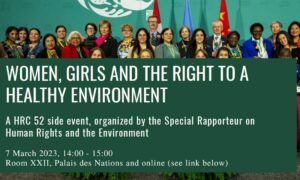
07 Mar 2023
14:00 – 15:00
Venue: Palais des Nations | Room XXII & Online | Webex
Organization: Special Procedures of the UN Human Rights Council
A HRC52 side event, organized by the Special Rapporteur on Human Rights and the Environment, and sponsored by various member states, Costar Rica, the Maldives, Slovenia, and Switzerland, all members of the core group on human rights and the environment, as well as the Principality of Monaco and Germany. UN Women, the United Nations Environment Programme and the Geneva Environment network are also sponsoring this event.
About the Event
Women and girls are powerful, transformative agents of change who should be primarily viewed not as victims, but as equal, indispensable partners and leaders in the transition to a just and sustainable future. In order for women and girls to realize their rights and potential, nature must be conserved, protected and restored, pollution must be prevented, and urgent action must be taken to achieve a safe climate. In his report to this 52nd session of the Human Rights Council the Special Rapporteur decided to dedicate his report to the topic of Women, Girls and the Right to Healthy Environment.
The report outlines State obligations, business responsibilities and the potential benefits of achieving gender equality and ecological sustainability. It makes recommendations related to dismantling systemic discrimination, empowering women and girls as climate and environmental leaders and ensuring that women and girls are able to fully enjoy their right to a clean, healthy and sustainable environment.
Video
Summary
Opening Remarks
H.E. Amb. Anita PIPAN | Permanent Representative of the Republic of Slovenia to the United Nations Office and other international organizations in Geneva
Two of our priorities in the Human Rights Council and international forums in general are the human right to a healthy, sustainable environment and women and girls. These two topics are also intrinsic parts of the feminist foreign policy of our new first female foreign minister.
I wish to thank Dr. Boyd for his participation at the high-level ministerial side event on mainstreaming the right to a healthy, clean, sustainable environment. This event hopefully set the tone for our engagement at the current session of the Human Rights Council, which is extremely important when it comes to this right.
The side event at the high-level segment of the Human Rights Council was the first event with the participation of the ministers of the core group, whose members were just enumerated. I believe this is a testimony to our political commitment to make the right to a healthy environment truly meaningful for rights holders, especially women and girls.
We share the concerns Dr. Boyd eloquently raised in his latest report to the Human Rights Council about the disproportionate impacts of the global environmental crisis on women and girls. Data in your report shows some alarming developments: for example, women comprise 70% of the world’s poor, do three times more unpaid household and care work, and receive 20% lower wages for the same work, among other disparities.
In short, the environmental crisis is not gender neutral. My government was pleased to engage with the Special Rapporteur during his country visit to Slovenia in September last year. I hope, Dr. Boyd, that you witnessed Slovenia’s commitment to gender equality, especially in relation to the triple planetary crisis.
I would like to share two practical examples of integrating gender equality into the climate and environmental agenda. One is the new Slovenian law on climate change, currently being drafted, which has gender equality strongly mainstreamed into its provisions. Another example is a regional international project with the Slovenian Forestry Institute under the name “Fem4Forests : Forests in Women’s Hands.” It is being implemented in the Danube region and aims to empower women and girls as climate and environmental leaders in the forestry sector.
In conclusion, I would like to express, on behalf of the core group, our sincere appreciation to Dr. Boyd for all your work related to human rights and the environment. I am sure that together we will push even harder, using our minds and hearts, to work towards a world where all people, particularly women and girls, can enjoy their right to a clean, healthy, and sustainable environment.
Adriana QUIÑONES | Head, Human Rights and Development, UN WOMEN, Geneva
A year ago, we were celebrating the resolution for the right to a healthy environment, and we committed to revisiting the results a year later, integrating a gender perspective and the voices of women and girls. I would like to share that UN Women with UNDP conducted an analysis of 5,000 policy measures worldwide for recovery after the COVID crisis. They found that only 23 percent of task forces addressing recovery included women. They also found that stronger women’s movements led to stronger responses and better results for women’s and girls’ lives.
This year, this tracker is being updated to include a green perspective, focusing on green and gender recovery options after COVID. This is crucial for examining the implementation of this resolution. One key issue has always been participation: Are women included in the negotiations? Are women benefiting from the different projects? Moreover, how many of these policy measures consider key elements for gender equality and women’s empowerment, such as social protection, employability, new skills for a new economy, and addressing discrimination and violence against women and girls?
I will share some of the findings, even though this tracker is being updated and will be released later this year. Initially, only 18 out of 705 measures looked at by the OECD in the Green Recovery Database assessed gender relevance and gender sensitivity. Only 2.5 percent are considered gender-relevant, and 13 percent of these gender-relevant measures are also considered gender-sensitive. Half of the gender-relevant green recovery measures are linked to skills, training, research and development subsidies. When assessed based on gender sensitivity, the majority of these measures contribute to supporting women’s economic security.
Gender-relevant measures are concentrated in sectors such as buildings, energy, and surface transport. However, no gender-relevant measures were found in the database for other sectors like agriculture, forestry, maritime transport, air transport, industry, or waste management, where many women are employed. This indicates a vast untapped potential for introducing a gender perspective into the design and implementation of green recovery measures.
Always looking at where we are and how we can move forward in this collective effort, my key message for today is that gender and climate can come together to alleviate suffering, reduce poverty, increase development, and address structural barriers to the participation of women. The majority of the measures assessed are likely to have positive impacts on the environment. Taking gender considerations into account when designing and implementing green recovery measures can contribute both to reducing gender inequalities and achieving environmental objectives.
Panel Discussion
Video Message: Nikte CAAL | Young Leader, Guatemala
I am Nikte Caal Matzir, Maya Q’eqchi’ Kaqchikel from Guatemala, Central America. From my family and my culture I learned that water is our life. The humanity and the different species of animals, plants and other beings that exist in Mother Nature cannot survive without nature. Water is our source of life. Therefore, to defend water is to defend our life.
The environment has changed terribly since the hijacking of our sacred rivers. Mayan communities are more vulnerable. The impact of the Iota and Eta storms that occurred in November 2020 is an example of this. All the life, ecosystems and biodiversity that existed in our rivers when they were free was destroyed. Plants and animals such as fish, crabs, crayfish, and other species that we used to extract from the river to feed us now no longer exist. Since the arrival of the hydroelectric plants Renace and OXEC, the Cahabon and Oxec rivers were captured, they were hijacked for about 50 km. The waters of the Cahabon and Oxec rivers no longer follow the path they did for thousands of years.
To defend the ecosystems and biodiversity of the Cahabon river is to fight for the life of our Mother Earth, the life of our Mother Nature, to fight for our life and for the life of the next generations. We cannot be observers of the destruction of our environment. We must inform ourselves of what is happening and act. When our fathers and mothers dare to defend our rivers, they are criminalised and unjustly imprisoned. The hydroelectic companies, together with the Guatemalan State continue to strap us of our natural goods. They take away our access to water from our rivers.
For four years and two months, I could not hug and live with my dad because the company contracted by OXEC hydroelectric invented crimes against him. The corrupt justice system operating in Guatemala imprisonned my father without any evidence against him. This caused irreparable and irreversible damages to me and my little sister. But it is also the story that many girls in the country are living. My father only defended the water. My father only demanded the right to be consulted as established in the ILO Convention 169.
I hope that the UN will call on States to ensure that companies comply with the obligation to repair the damages caused to the environment. I also hope that the UN demands from States that countries, especially Guatemala no longer authorise more operating licences for mines, hydroelectrics and monocultures, because these mega projects are violating human rights. It is a system of death that is imposed on our land. I demand that international agencies stop financing mega-projects in our countries because they only cause death and destruction to our territories, environment, water and natural goods.
David R. BOYD | UN Special Rapporteur on environment
It has been 75 years since the Universal Declaration of Human Rights declared that all human beings are born free and equal in rights and dignity. It has been more than 40 years since the Convention on the Elimination of All Forms of Discrimination Against Women came into force. Yet, we are still living in a world where there is systemic discrimination against women and girls that undermines their ability to enjoy their human rights. Ambassador Pipan spoke of some of the statistics in the report regarding the triple planetary crisis. Women and girls are systematically excluded from participating in decision-making, unable to get a fair share of the incredible benefits of nature, and bear a disproportionate burden of the triple planetary crisis: the climate emergency, loss of biodiversity, and pervasive toxic pollution.
Let me give you just a handful of quick examples. Because of gendered cooking responsibilities, millions of women and girls die from household air pollution every year. In households that lack access to water on the premises, the collection of water is a burden borne by women and primarily girls in 80 percent of those households. Women are disproportionately vulnerable to toxic substances that cause heart disease, respiratory illnesses, cancer, and reproductive illnesses. Additionally, 80 percent of people displaced by climate-related disasters are women and girls.
The bad news is that this triple planetary crisis has disproportionate impacts. The good news is that we know that women and girls have a track record of inspiring leadership as human rights defenders and environmental human rights defenders. We know that when women and girls are involved in the development and implementation of climate and environmental policies, the outcomes are better. There is a positive correlation between women in positions of political authority, lower carbon footprints, higher ratification of environmental treaties, and stronger environmental standards. These are the types of outcomes we urgently need in this triple planetary crisis.
I think it is critical, and these are the categories of recommendations in our report, that we have actions by states to empower women and girls as climate and environmental leaders. Examples of this include education and breaking down the barriers to equitable participation. The second category of recommendation is to empower women and girls as economic actors, such as through equitable and equal land ownership and access to natural resource tenures. The third category of actions relates to accelerating the pace of climate and environmental action. This means taking rights-based, gender-transformative actions to ensure that every woman and girl can breathe clean air, has access to safe and sufficient water and sanitation, eats healthy and sustainably produced food, lives in non-toxic environments with healthy ecosystems and biodiversity, and has access to a safe and livable climate.
We have an annex of good practices in this report, which includes hundreds of examples of good practices in recognizing and implementing women’s and girls’ rights to a clean, healthy, and sustainable environment. The final thing I will say is that we also need to provide additional resources to women and girls. Whether that is through grants to grassroots organizations working on climate and environmental action or increased finance through biodiversity and climate finance mechanisms, those are the steps that are critically important.
Viviana TINOCO | Minister Counsellor, Permanent Mission of Costa Rica to the United Nations in Geneva
Women and girls bear the most disproportionate part of the effects of climate change, biodiversity loss, and pollution. Unfortunately, they have not always been taken into consideration when it comes to policy-making or conservation projects. This has not been an exception in my country, Costa Rica. We also have problems with discrimination against women, but we have been trying to work on this. On the side of conservation, in 2019, we created a gender action plan for the REDD+ strategy.
For those who don’t know, REDD+ stands for the Reduction of Emissions from Deforestation and Forest Degradation, taking into consideration conservation and sustainable use of forests. In 2019, we worked with indigenous communities, civil society, and small rural producers to create a roadmap for including women in this strategy. During this process, we found out that women owned only 15 percent of all properties in Costa Rica. This is a very small number, especially considering our forest coverage, which is almost 60 percent of the country. Of that, only 15 percent belongs to women, highlighting a clear gap.
To address this, the country started prioritizing its program for Payment for Environmental Services to women. We are trying to give financial recognition for the compensation of carbon emissions, protection of biodiversity, and water sources, as well as the scenic beauty of these properties. Women are becoming more empowered with their own money and properties. This program is part of a wider initiative called “Plus Women Plus Nature,” financed by the World Bank and UNDP, to create small loans and other facilities for women to access financial resources.
Another example I wanted to present today is a civil society initiative from a cooperative of women in Puntarenas, a coastal city. The cooperative is formed by 50 people, 47 of whom are women, and they work in the mollusc industry in the mangroves. They understand the relationship they need to have with this ecosystem and recognize that their industry is extractive. They have been planting native trees and dedicating two days a month to clean the beach and the mangroves of plastic pollution. This helps repopulate the biodiversity of the ecosystem. Mangroves and wetlands are extremely important in the fight against climate change, water resources, and food security.
These are the small initiatives we have in the country.
Video Message: Prisca
I am a student living with my mother and two brothers. I am a group leader of a children’s grassroots group working in the community. Through our group, I participate in awareness and advocacy activities on children’s lives. We also focus on environmental protection issues in our community. In collaboration with parents and local leaders, we advocate for children who are out of school, working in dangerous conditions, living on the streets, born to young mothers, and affected by child abuse.
Concerning girls’ health, the environment, climate change, and environmental degradation have many effects that impact children, especially girls. These include scarcity of water, scarcity of food, air pollution, an increase in diseases like malaria, and natural hazards like landslides and floods.
For example, in my community, during the dry season, it is difficult to get water. Many people struggle as the few wells that remain dry up.
Let me tell you my story. I wake up early in the morning, and since we do not have water in our house, I take a jerrycan and walk 4 kilometers to fetch water. When I come back, I have to go to the washroom and then walk another 5 kilometers to school. When I get to the well, there are so many people fighting for water. The strong men, especially boys, get water first, and girls and women fetch water afterward. Sometimes, kind people understand that I am a student and need to study early, so they let me fetch water first. But when there aren’t kind people, I have to wait until the fighting is over to fetch water peacefully, as I don’t want to fight with the men. As a result, I reach school very late. At school, I am punished for being late. They either beat me, make me clean classrooms, or send me back home to my parents, or they deduct points from my discipline marks, which affects my overall school performance. This is hard for me, but it is not just me; many other children, especially girls in my community, experience the same problems.
This makes me sad. Moreover, the issue is becoming worse as the environment is continually destroyed, and water scarcity increases in my community. People fight more and more, which affects children and especially girls, who usually handle domestic work and miss school.
Through the grassroots group, we engage in various activities to protect our environment, including raising awareness about climate change and environmental protection among fellow children, the community, and schools. We also plant trees in homes and public places where they never existed or have been destroyed. We get seedlings provided by local authorities and plant them in different places. Since last year, we have planted 183 trees.
I would like to request the government and international agencies to allocate enough budget for addressing climate change and environmental protection, engaging all people, including children and women, in programs to protect the environment, drilling many water wells in different places, respecting and protecting the rights of women, and increasing the capacity of girls and women to participate in decision-making.
Stephanie Keene | International Human Rights Lawyer
The annex to the Special Rapporteur’s latest report features over 200 good practices on recognizing and implementing women’s and girls’ right to a healthy environment. I want to discuss a few.
- The Gambia’s Women’s Act of 2010 guarantees women freedom from all forms of discrimination. It recognizes women’s right to a healthy and sustainable environment, food security, sustainable development, and a range of other rights. The Act takes an intersectional approach by providing specific measures and protections for rural women, elderly women, and disabled women. It commits The Gambia to increasing women’s participation in environmental management.
- Thailand’s largest solar power generation company is women-led and prioritizes women’s inclusion in the clean energy sector. The solar power company has installed 36 solar farms across the country, eliminating over 200,000 tons of CO2 emissions annually while also improving local air quality by reducing fossil fuel combustion.
- In Sweden, after scientists discovered polybrominated diphenyl ethers (PBDEs) in the breast milk of Swedish women, the government acted swiftly to ban PBDEs domestically. They also led a successful global effort to add PBDEs to the Stockholm Convention’s list of prohibited substances, resulting in a rapid decline of PBDEs in breast milk.
- Bolivia and its partners implemented a six-year biodiversity conservation initiative that benefited over 27,000 indigenous, peasant, and local community women, in addition to youth and men. The project was grounded in a gender and inclusion strategy, heavily influenced by the gender-differentiated traditional and scientific knowledge of the beneficiaries related to nature management. To increase women’s participation and availability, the project provided childcare, reducing their workload. It established over 500 women-led ecosystem and biodiversity management groups, and women’s groups received almost half of the conservation allotment. This was especially empowering for Indigenous women, as they were managing funds directly, often for the first time, making it quite socially transformative.
- In the United States, in 2019 alone, the global food security and nutrition initiative Feed the Future helped almost 2.4 million women worldwide improve their agricultural practices. It also reached over 8.5 million pregnant women with nutrition-specific interventions.
These are just a fraction of the good practices that exist around the world. Clearly, gender-transformative climate and environmental action is taking place across a range of geographies and contexts. This means that realizing women’s and girls’ right to a healthy environment is very achievable. However, what we need is increased political will, expanded and enhanced gender-transformative environmental education, and increased responsiveness across all sectors.
Soo Young HWANG | Legal Officer, UN Environment Programme
The work we are embarking on is still a work in progress. I would like to introduce what we are working on, share some preliminary findings, and lay out next steps. We at UNEP are developing a database that tracks recommendations from human rights treaty bodies, UPR processes, and select special rapporteurs on environmental issues. This includes all environmental issues like climate, biodiversity, conservation, and pollution.
Importantly, we are disaggregating this data to track it by specific groups, such as indigenous peoples, women, or girls. Currently, we lack such data. We have many great resolutions and reports, but we need a centralized location where all this data is easily accessible. That is what we are working on now.
Although it’s still preliminary, we wanted to present this data and get feedback, but it requires more vetting and verification. Hopefully, it will be ready by the next session. We hope this will be helpful for countries to track recommendations related to the environment in specific regions, identify trends in environmental issues over the past ten years, and see how recommendations are being implemented.
For example, we have observed an increase in recommendations related to environment and businesses in recent years compared to ten years ago, with more focus on climate and biodiversity. This tool will provide easy access for countries, academics, CSOs, and UN country teams working at the country level.
On gender, we need disaggregated data to understand our progress in gender equality in environmental affairs. This tool will help measure and track the rights of women, girls, and other populations. Preliminary findings show many references to gender and women and girls in relation to the environment, but these are mostly focused on specific repertoires and treaty bodies working on gender issues. This indicates that gender is not yet mainstreamed throughout the human rights mechanisms.
We also found that many countries make similar recommendations on gender issues through the UPR process. This suggests a need for further gender mainstreaming across other treaties, special procedures, and mechanisms.
Recommendations are often very short, so we need to elaborate on them. The special rapporteurs’ work on good practices is very helpful here. We often question what a rights-based approach or gender responsiveness in environmental matters looks like. Good practices can show countries and stakeholders how things were successfully done.
For the database, we may add more substance to these recommendations by including examples of good practices. This will be our next step: making the database work with recommendations and examples of good practices. Stay tuned, and we will be happy to present this report once it is ready.
Q&A
Q (Maldives): The Maldives is very happy to co-sponsor this event today. From the SR’s report, what was really striking for me is the correlation that the SR has outlined between having women in decision-making roles and the positive impact on the environment. The report highlights that women in positions of political authority have lower national carbon footprints and parliaments with a greater proportion of women are more likely to ratify environmental treaties. The Maldives understands the importance of women leaders and we would like to ask the panel: What are some concrete actions that can be taken to promote women in leadership and decision-making roles across all levels and sectors that would support women and girls in realizing their right to a clean, healthy, and sustainable environment?
Q (International Muslim Women Union): How can women and girls work for a healthy environment in situations where only men are present? Everyone knows that women are not only friendly to the environment, but love nature, plantation, and forests. In my country, 70 percent of the land is agricultural land where women work, but they are not safe because of the presence of one million troops engaged in various practices. When women are working outside their homes, they are not safe. How can we suggest that they work in a safe environment, especially given the climate changes and the increase in temperature and carbon dioxide in the northern region of Indian-administered Kashmir?
Q (Office of the High Commissioner): I just wanted to ask for reflections and insights on the rights of gender diverse persons.
Stephanie KEENE: For the last question on gender diverse persons, the Special Rapporteur’s annex highlights the relative lack of good practices focusing on LGBT persons and the right to a healthy environment. There is a huge opportunity to fill this gap and massive data gap, especially in post-disaster contexts where LGBT people’s experiences are often erased. There are parallels between the experiences of LGBT people and those of women and girls.
In the context of armed conflicts and gender-based violence, the annex includes examples addressing environmental gender-based violence and women’s right to a healthy environment in conflict situations. However, there are still many opportunities for increased good practices in this area.
David BOYD: We originally set out to develop a report on gender and the right to a clean, healthy, and sustainable environment, but we narrowed our focus to women and girls due to a lack of accessible information. There are references to gender diverse persons in the report, but we couldn’t gather enough information to address the topic credibly. It likely merits its own report in the future.
To ensure that women and girls have access to political authority and positions of power, we need to improve access to education for girls and provide young women with opportunities. An inspiring example from our good practices annex is the Climate Youth Negotiators Program. Four young women secured funding and agreements from 27 states to include young people on their negotiating teams at COP27. They trained over 50 youth delegates, 70 percent of whom were young women. This is a transformative initiative.
In politics, there are States with quotas for women in parliaments and local governments. However, only 16 percent of government ministers today are women, and only nine percent of CEOs of large corporations are women. This is shocking. I urge my fellow men to acknowledge our privilege and power, advocate for the empowerment of women and girls in climate and environmental action and support them in these roles.
Q (Plan International): I am working on the rights of children and youth and gender equality. Thank you for including the voice of girls. I have a concrete question about the dissemination of the report and its good practices. Are there any proactive advocacy plans?
Q (Mexico): To Mr. Boyd and Ms. Keene: In the good practices, did you identify any cases of matriarchal communities and how they deal with environmental issues compared to patriarchal societies or communities?
Keene: The Special Rapporteur’s annex doesn’t expressly discuss matriarchal communities, but there is data supporting increased effectiveness in ecosystem management and conservation in these communities. It is not a panacea, but the data is clear: equitable participation of women and men leads to better outcomes for everyone, including the planet. Examples of matriarchal communities across sub-Saharan Africa and Asia support this.
Closing
David BOYD
In conclusion, we aim to disseminate the report widely through partners in the UN family, such as UNEP, UN Women, UNICEF and others. We would welcome the opportunity to work with groups like Plan International to develop a child-friendly version of the report.
Thank you to my fellow panellists and to all of you for joining us. The triple planetary crisis and systemic gender discrimination are daunting challenges, and we must address both to make progress. I look forward to working with all of you towards a gender-equitable and ecologically sustainable society.