
Event World Day
International Day for Disaster Risk Reduction 2026
On 13 October, the global community celebrates the International Day for Disaster Risk Reduction, an opportunity to acknowledge the progress being made toward reducing disaster risk and losses in lives, livelihoods and health, while reminding the world that disaster risk is man-made.
About
The International Day for Disaster Risk Reduction was started in 1989, after a call by the United Nations General Assembly for a day to promote a global culture of risk-awareness and disaster reduction. Held every 13 October, the day celebrates how people and communities around the world are reducing their exposure to disasters and raising awareness about the importance of reining in the risks that they face.
Countries are facing more record-breaking disasters. This is driven by an increase in extreme weather events and by development decisions that are not risk-informed, which increases the exposure and vulnerability of people and economic assets to a range of hazards.
Disasters are becoming significantly more expensive. While direct disaster costs have grown to approximately $202 billion annually, the Global Assessment Report on Disaster Risk Reduction 2025 estimates that the true cost, is 11 times higher at nearly $2.3 trillion. Developing countries bear the brunt of these impacts due to their smaller economies, even though developed countries suffer the most expensive disasters in absolute value.
At the same time, investments in disaster risk reduction (DRR) have not kept pace with increasing disaster risks. This was one of the key findings from the Midterm Review of the Sendai Framework for Disaster Risk Reduction, and a reason why many countries have been unable to reduce disaster impacts.
Adding to the problem, most economic and investment plans remain blind to disaster risks. This is especially common in the private sector, which is responsible for about 75% of investments through the creation of economic assets.
2026 Theme | Resilience starts at home
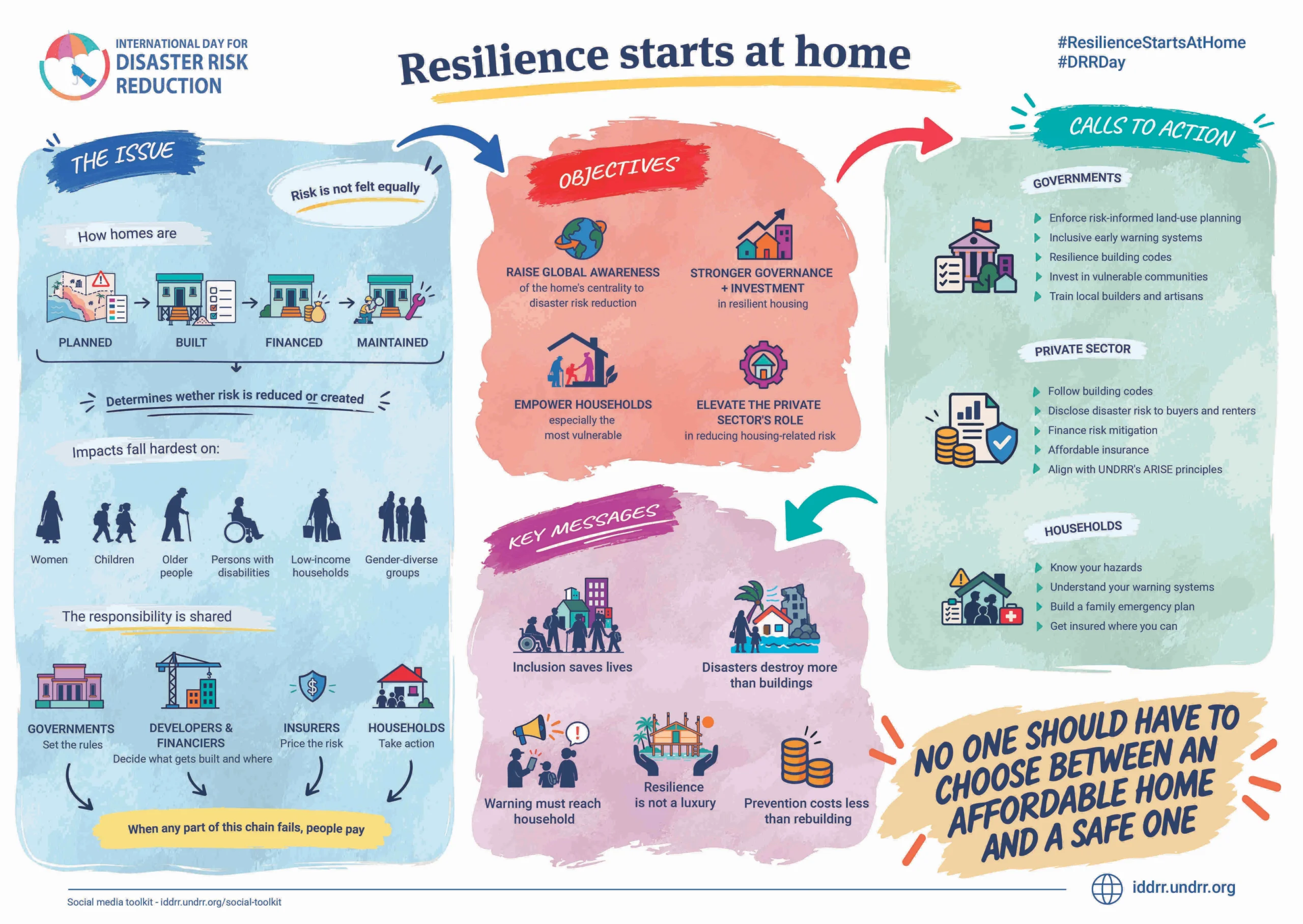
Homes are where people live, sleep, and care for one another, and seek shelter and security. For many, they are central to wellbeing and stability. However, the ways homes are planned, built, financed and maintained determine whether risk is reduced or created.
When houses are located in high-risk areas, built without disaster-resilient designs, or inadequately maintained to withstand growing hazards, homes become sites of vulnerability, contributing to loss of lives, displacement and economic losses. These risks often have differentiated impacts on women, children, older persons, persons with disabilities, low-income households and gender-diverse groups, particularly where inequalities in housing, land tenure, access to resources, mobility, caregiving responsibilities and decision-making persist.
The Midterm Review of the implementation of the Sendai Framework found persistent challenges in enforcing risk-sensitive land-use and building regulations, and in effectively involving communities and households in disaster risk reduction decision-making. It highlighted that many countries still lack adequate mechanisms to ensure resilient construction in hazard-prone areas. People living in informal settlements often remain underserved by planning processes, risk reduction measures and building regulation, with marginalized groups frequently facing additional challenges to secure housing, access to services, and participation in local decision-making.
Whether homes are resilient depends on the combined actions of governments, local authorities, the private sector, and households. States bear the primary responsibility to reduce disaster risk, but real estate developers, construction companies, financiers, and insurers also shape exposure and vulnerability through decisions on where and how houses are built, the materials and standards used, and the availability of risk-informed financing and insurance products. Strengthening accountability and incentives across these actors is essential to ensure housing resilience, including through inclusive and risk-informed housing policies, accessible and affordable financing and insurance mechanisms, universal design principles, and meaningful participation of women, persons with disabilities and local communities in housing and urban planning processes.
The Sendai Framework for Disaster Risk Reduction 2015-2030 establishes disaster risk reduction as a people-centred endeavour, emphasising that policies, systems, and investments must be designed around the needs and capacities of individuals and communities, recognising that disaster risks and impacts are not experienced equally across populations.
Nowhere is this principle more relevant than at home – the most personal and fundamental environment in people’s lives.
Environmental Disaster Risk Reduction
Disasters do not occur by accident – they are a result of the combined effects of hazards and vulnerable conditions. Disasters undermine hard-earned development gains and limit development achievements for future generations, with climate change expected to exacerbate the impacts of disasters globally. The Sendai Framework for Disaster Risk Reduction 2015-2030 (Sendai Framework) is the first major agreement of the post-2015 development agenda and provides Member States with concrete actions to protect development gains from the risk of disaster.
In the last decade, the role of ecosystems in disaster risk reduction (DRR) has received increased global attention. Sustainable ecosystem management for DRR is now recognized as a priority measure in the Sendai Framework for Disaster Risk Reduction. Learn more about environmental disaster risk reduction (Eco-DRR), the Sendai Framework and the Geneva-based organizations active in this field in our update below.
Events in Geneva

Geneva Youth Festival – International Day for Disaster Risk Reduction
13 October 2026 | Domaine de la Pastorale
Organized by UNDRR

Resilient housing in a changing risk landscape – A Geneva roundtable for International Day for Disaster Risk Reduction 2026
14 October 2026 | Domaine de la Pastorale
Organized by UNDRR, UN-HABITAT, Global Cities Hub, UNDP, UNECE
When home is lost: From prevention to durable solutions for disaster displacement
14 October 2026 | Domaine de la Pastorale
UNDRR, Sendai Stakeholder Engagement Mechanism (SEM), IDMC, IOM, Platform on Disaster Displacement

From knowledge to action: Communication for a safer world
14 October 2026 | Auditorium B, IFRC Headquarters
UNDRR, UNESCO, IFRC, Switzerland

Facing extreme heat in Europe: Reviewing summer 2026 - Preparing for summer 2027
15 October 2026 | Domaine de la Pastorale
Organized by UNDRR and Switzerland
Latest Resources
- 2025 Global Assessment Report on Disaster Risk Reduction (GAR) | Resilience Pays: Investing and Financing for Our Future (GAR 2025) | UNDRR | June 2025
- Policy Brief – Disaster Displacement and Disaster Risk Reduction | The Platform on Disaster Displacement (PDD) | 2025