
Event World Day
International Day of Awareness of Food Loss and Waste 2025

On 29 September, the international community celebrates the International Day of Awareness of Food Loss and Waste, recognizing the fundamental role that sustainable food production plays in promoting food security and nutrition. Across global food systems, food loss and waste is a widespread issue, posing a challenge to food security, food safety, the economy, and environmental sustainability. Actions are required globally and locally to maximize the use of the food we produce.
About
On 29 September 2025, the International Day of Awareness of Food Loss and Waste will be observed for the sixth time. The observation will highlight the critical need for financing to bolster efforts to reduce food loss and waste, contribute to achieving climate goals and advancing the 2030 Agenda for Sustainable Development.
The world produces enough food to feed everyone, and yet millions suffer from hunger and malnutrition. Food loss and waste exacerbate this problem by reducing the amount of food available for consumption, thus contributing to food insecurity. Many of the most highly nutritious foods, such as fresh produce, fishery, and animal products are highly perishable and sustain high levels of food loss.
Food loss and waste also translate into a substantial economic loss. This impacts not only producers but also consumers and nations, not to mention livelihoods and economic stability. Moreover, food waste in landfills contributes to 8 to 10 percent of total agrifood system emissions, impacting climate change and environmental sustainability.
Reducing food loss and waste is a climate solution, which countries and communities can employ to reduce greenhouse gas emissions. Successfully doing so will require a significant increase in the quality and quantity of accessible climate finance
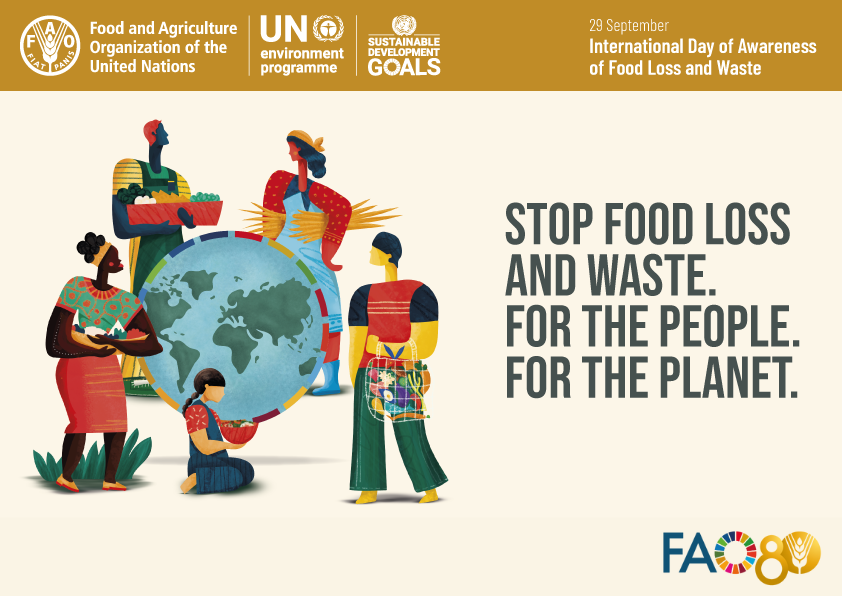
Stop food loss and waste. For the people. For our planet.
The United Nations recognizes the importance of reducing food loss and waste. On 19 December 2019, the UN General Assembly adopted resolution 74/209 proclaiming an International Day of Awareness of Food Loss and Waste (IDAFLW). The International Day of Awareness of Food Loss and Waste seeks to promote awareness and collective action to reduce food loss and waste.
Decreasing food loss and waste is, in fact, enshrined in the United Nations Sustainable Development Goals (SDGs) – within SDG 12, which seeks to ensure sustainable consumption and production patterns, Target 12.3 aims to “halve per capita global food waste at the retail and consumer levels and reduce food losses along production and supply chains” by 2030.
The world’s population, currently at 8.2 billion, is expected to grow to close to 9.7 billion people by 2050 (UNDESA, 2024). Ensuring a food secure world – where current and future populations have access to sufficient nutritious food – crucially requires new ways of working, and concerted efforts to improve the sustainability and resilience of agrifood systems globally.
Reducing food loss and waste (FLW) helps to protect natural resources and biodiversity, reduce pollution and greenhouse gas (GHG) emissions, and maximize the use of food produced. It is therefore central to securing efficient, inclusive, resilient and sustainable agrifood systems, and to improving food security, nutrition and health.
Embracing innovation and fostering circular economy approaches in agrifood systems to prevent, reduce, reuse and repurpose FLW also serves to create new job opportunities, improve livelihoods and generate financial benefits for a range of stakeholders.
Now is the time for everyone – from producers, investors, businesses and supply chain stakeholders to consumers of all ages, as well as academia and research, civil society, and the private and public sectors – to take urgent action to expand and strengthen efforts both individually and collectively, to reduce food loss and waste towards ensuring a food secure world – now and in the future.
Role of International Geneva
Our dedicated page on Food Loss and Waste dives deeper into issues at the nexus of food systems and the environment. It also lists relevant actions and actors in the Geneva region. Find out more below.