
Event Conference
Nature-Positive Infrastructure: Mainstreaming Biodiversity Across the Transportation Lifecycle
18 Sep 2026
10:00 – 11:30
Venue: Palais des Nations | Room S-29 & Online | Webex
Organization: United Nations Environment Programme, Geneva Environment Network
This event explored how biodiversity can be systematically integrated into transportation infrastructure development.

About this Event
Transportation infrastructure is essential for economic development, regional integration, and access to services. However, roads, railways, waterways, and ports are also among the leading drivers of habitat loss, ecosystem fragmentation, and biodiversity decline. Infrastructure expansion can disrupt wildlife movement, degrade ecosystems and ecosystem services, and increase pressures on sensitive natural areas. As countries continue to invest in connectivity and transport networks, there is a growing need to ensure that biodiversity considerations are integrated into infrastructure planning and decision-making from the earliest stages.
The Greening Transportation Infrastructure Development (GRID) Integrated Program was established to support this transition toward nature-positive infrastructure development. Funded by the Global Environment Facility (GEF) and led by WWF in partnership with UNEP and the Asian Development Bank, GRID promotes integrated planning approaches that balance transportation needs with biodiversity conservation and ecosystem resilience. Through national projects and a global knowledge platform, the programme supports governments, development partners, financial institutions, and practitioners in strengthening policies, planning processes, technical capacity, and decision-making tools that can help mainstream biodiversity into transportation infrastructure development.
This event explored how biodiversity considerations can be systematically embedded across the transportation infrastructure lifecycle, from strategic planning and investment decisions to design, procurement, construction, operation, and maintenance. Building on emerging experiences from GRID and broader international practice, speakers will discuss the policy, institutional, technical, and financial measures needed to advance nature-positive infrastructure development. The discussion highlighted practical opportunities for governments, development banks, conservation organizations, and the private sector to work together in ensuring that future transportation investments contribute to both sustainable development and biodiversity goals.
Speakers
By order of intervention

Kate NEWMAN
Vice President, Sustainable Infrastructure and Public Sector Initiatives, WWF

Evan FREUND
Senior Director, Sustainable Infrastructure, Forests, WWF

Rowan PALMER
Programme Management Officer, Infrastructure Unit, UN Environment Programme

Liesbeth CASIER
Lead, Public Procurement and Sustainable Infrastructure, International Institute for Sustainable Development

Diana RIZZOLIO
Coordinator, Geneva Environment Network | Moderator
Highlights
Video
Live from Palais des Nations
Summary
Rowan PALMER | Programme Management Officer, Infrastructure Unit, UN Environment Programme
- When we are talking about nature-positive infrastructure, we refer to two main aspects. The first is limiting negative impacts on nature from infrastructure that we build and operate. This is maybe the more obvious of the two. We know that all infrastructure has some impacts on nature, either through the resources that are used to build it, through the footprint of where it is actually built, as well as through the types of activities that it enables and incentivizes.
- The other side of the coin is that, aside from limiting negative impacts, it is also about working with nature to help deliver infrastructure services.
- For the second point, we need to consider that infrastructure systems are comprised of three main components. We have the built environment, and this is typically what everyone thinks about when they think about infrastructure: the stuff we build out of concrete and steel and what have you.
- Then we also have the natural environment, or sometimes referred to as green infrastructure or natural infrastructure. Here, we are talking about landscapes and ecosystems, or elements of them, that either deliver or contribute to the delivery of infrastructure services.
- When nature is involved in the delivery of infrastructure services, we use the term nature-based infrastructure, or NbI for short.
- Then the third part of the system is the enabling environment. These are the institutions, the policies, the knowledge, the people that work together to manage and enable the different parts of the system to work together and deliver the services that we need.
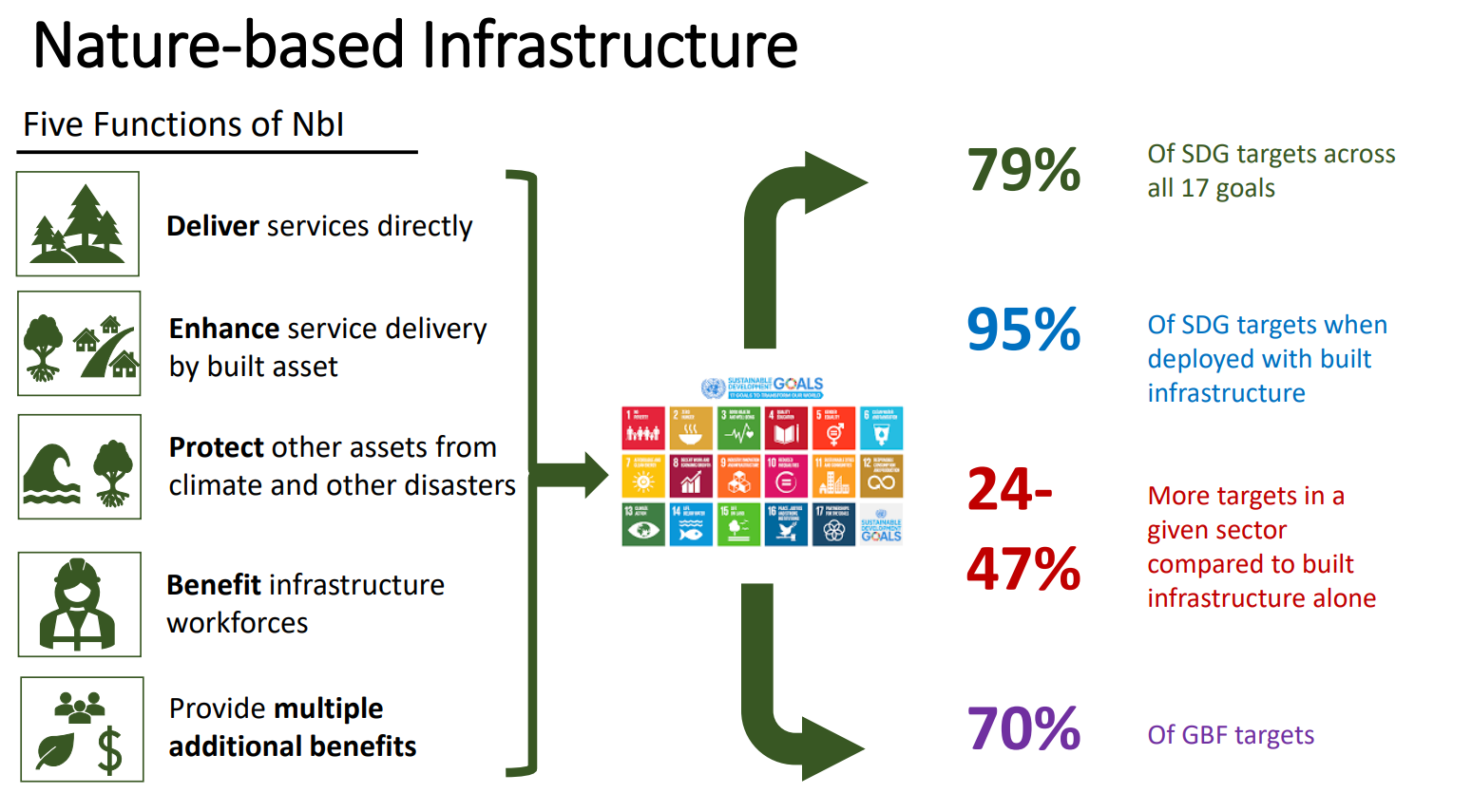
- The paper identifies five functions through which it does this.
- By delivering services directly.
- By enhancing or complementing service delivery by a built asset.
- The nature-based components can protect other assets from impacts of climate change and other disasters.
- It can also provide benefits to the people working on infrastructure, and so this helps improve the efficiency and effectiveness of service delivery.
- Then we have the co-benefits, so multiple additional co-benefits. These are all the other benefits you get out of the natural components of the system that are not necessarily related to infrastructure services themselves. So, biodiversity benefits, employment and livelihood benefits, et cetera.
- When we map all of this service delivery against the SDGs, we find that nature-based infrastructure can contribute to 79% of the SDG targets across all 17 goals. When combined with built infrastructure, that influence rises to 95% overall.
- Then when we look in any particular sector, the influence is a little more pronounced. By combining nature-based infrastructure with grey infrastructure at the sector level, the influence- the benefits you get out of it- can increase the SDG targets that are influenced by anywhere from 24 to 47%, depending on the sector.
- There are also strong linkages with the targets of the Global Biodiversity Framework. Nature-based infrastructure can influence three of the four long-term goals and 16 of the 23 targets, as well as contributing to both mitigation and adaptation objectives under the Paris Agreement.
- This kind of strong influence across the SDGs and the Rio Conventions shows the cross-cutting impacts, positive and negative, that infrastructure can have. This really means that we need to work with and engage a wide range of partners and stakeholders, trying to make the most of our infrastructure development.
Kate NEWMAN | Vice President, Sustainable Infrastructure and Public Sector Initiatives, WWF
- WWF is working to ensure a future in which natural infrastructure are holding water, protecting flows, and providing pollination and habitat for wildlife. A lot of services that humans need, and we call that natural infrastructure.
- These intact systems that we rely on are conserved and maintained with effort. They do not just persist on their own without humanity making an effort to preserve and maintain natural infrastructure.
- We have to always look at the infrastructure that we build. Of course, we know that humanity needs a lot more infrastructure in many parts of the world than it has right now. In order to meet development needs, infrastructure is inevitable and important, and everybody appreciates good, solid, safe infrastructure.
- Yet is it possible to achieve that need and meet the aspirations of all populations, but at the same time maintain and restore the biodiversity that has been declining and unfortunately is continuing to decline around the world, causing challenges to humanity in turn, in terms of our needs on this Earth for pollination, water, and so on?
- It is a cycle that we need to fix, where the infrastructure is delivered in harmony with the natural systems to avoid ecosystem damage and degradation, and then minimize greenhouse gas emissions and, in fact, sequester greenhouse gas emissions to help solve climate change issues.
- This is a vision that we have of getting involved.
- The various estimates say that about 75% more infrastructure will be around us by 2050 to meet our needs and our aspirations. That means all that we see is just 25% of what is coming ahead. But it is not here yet. So, in this time between now and when that sort of tsunami of new infrastructure happens, we have time and an increasing understanding of what it takes to actually build infrastructure that is built in harmony with our natural systems, and not only in harmony, but actually contributes to restoring biodiversity, to taking that curve and turning it back up so that we actually bring back the biodiversity that we need and that we want and that we value for its own intrinsic value on Earth.
- The interesting thing about infrastructure is that it is a pretty consistently managed process. It does not necessarily change very much whether it is a road or a dam.
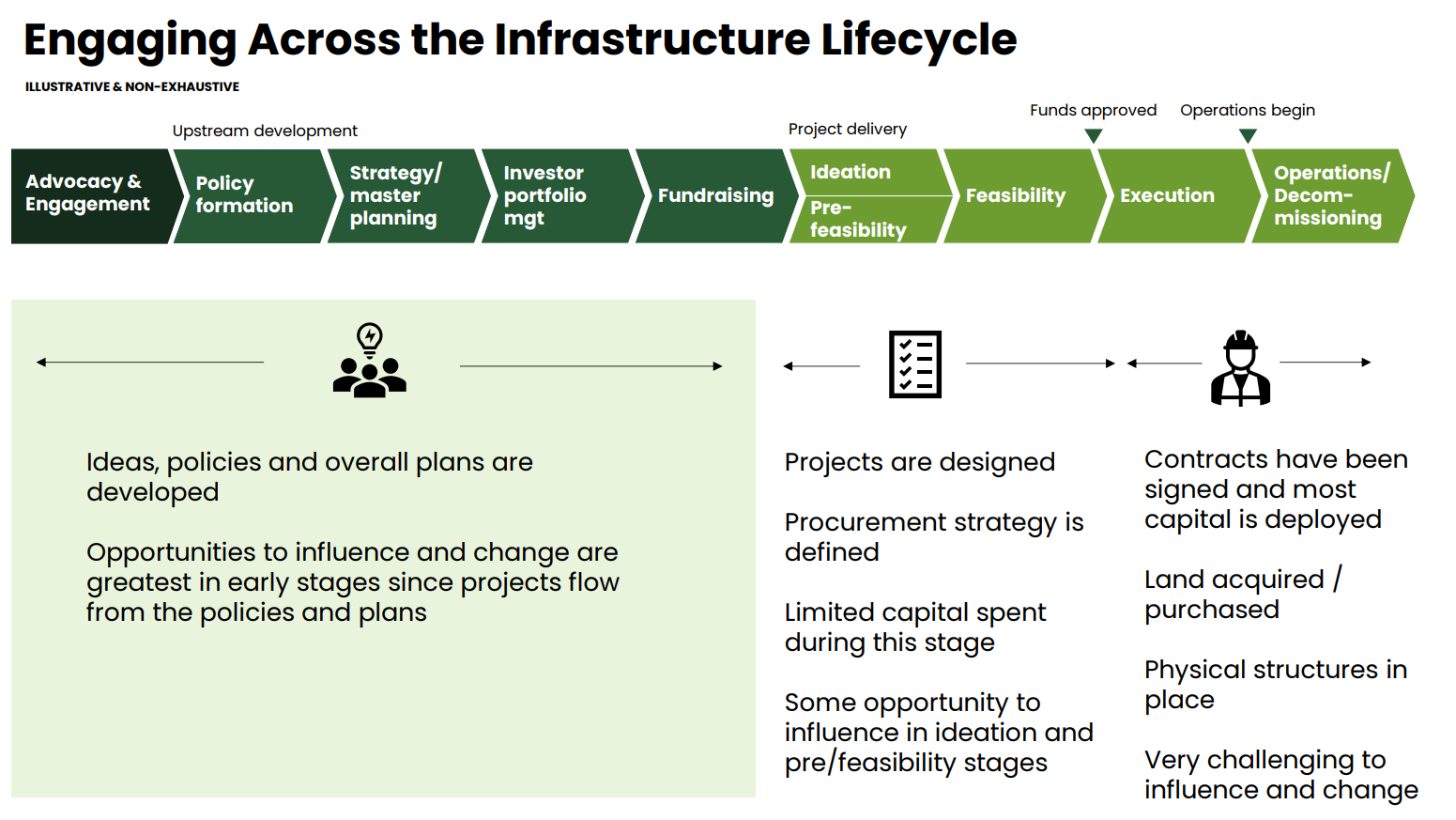
- At each point along this flow, there are things that can be enhanced and help with the contribution to biodiversity and, of course, do no harm.
- We have examined this life cycle pretty carefully. In the earliest stages, where there is green, darker green is where the ideas come about. We ought to have a road, and the policies are in place about, well, we should only put roads here and they should be built to this level of safety, and we need X many roads and plus railroads in order to meet the vision of our future.
- You see a lot of interest in economic corridors. Those are the economic priorities that are being set. Then, further downstream, projects are designed, procurement strategy is defined, the design is invested in, and then you have contracts put in place and land is acquired and communities are involved and physical structures are built.
- Anything down in that second half of the picture, there has already been a long investment in securing the financing, in figuring out the design, in having the consultations with communities. So, by the time you are in that latter half of the infrastructure life cycle, it is pretty much too late to have major impacts on the biodiversity.
- We have understood this through experience and advice from the professionals in this business that the most impact that you can have on the biodiversity outcomes eventually is when you work in this upstream space, on engaging in the policy dialogues.
- For example, the Convention on Migratory Species, in the past two COPs, has integrated very specific guidance on how to avoid your transportation or linear infrastructure impacting migratory species pathways.
- There are solutions, but they have to be built into the design, and they have to be identified as a priority in your policy environment, or the incentive is not there for the actual builders to take those steps.
- Another example is the Convention on Biological Diversity coming up in Yerevan. In the last COP, they focused on developing the mainstreaming component, and they explicitly talked about mainstreaming, including for infrastructure, and how you get any sector to think about how biodiversity is woven in from the earliest stage, from your transport to your water systems to your pipelines to your dams and so on.
- So mainstreaming became quite central for the CBD, and now it is time to give guidance on how to implement that. That is the sort of policy section up at the top.
- Then you move into the design phase, and there are many, many options when you are designing a road, say here, there, or elsewhere. Ideally, you use the mitigation hierarchy and you avoid putting that road through the last stretch of intact habitat that you might have in your country.
- It might be a little more expensive to go around, but you will actually be maintaining a healthy ecosystem and actually securing more biodiversity in your country over time by avoiding some of those precious, critical areas.
- But if you cannot avoid it, there are lots of ways to mitigate the damage and then actually turn biodiversity positive, contribute to biodiversity restoration, and all that has to be embedded in that early stage.
- We will talk a little bit more later about how that affects the actual procurement phase, which is when the two colors change. You can make a lot of difference pre-procurement, but after the tender document has been secured, it is really hard to make changes.
- So upstream is critical for having an impact, and in particular, transportation is a very interesting sector. It is across landscapes. So you have not just one habitat being affected by one project, one road. A road may go through many habitats and have lots of impact quite separate in each of these patches of habitat.
- The number of roads is increasing dramatically. Continents like Africa are experiencing a big road development process. There are a lot of economic corridors that are often connect mines to ports and so on. And there will be railroads and roads.
- Of course, transport is one of the most important sectors releasing greenhouse gases in the world, 19%. So that is a huge portion, along with agriculture. They are the two big contributors to greenhouse gas emissions, unfortunately.
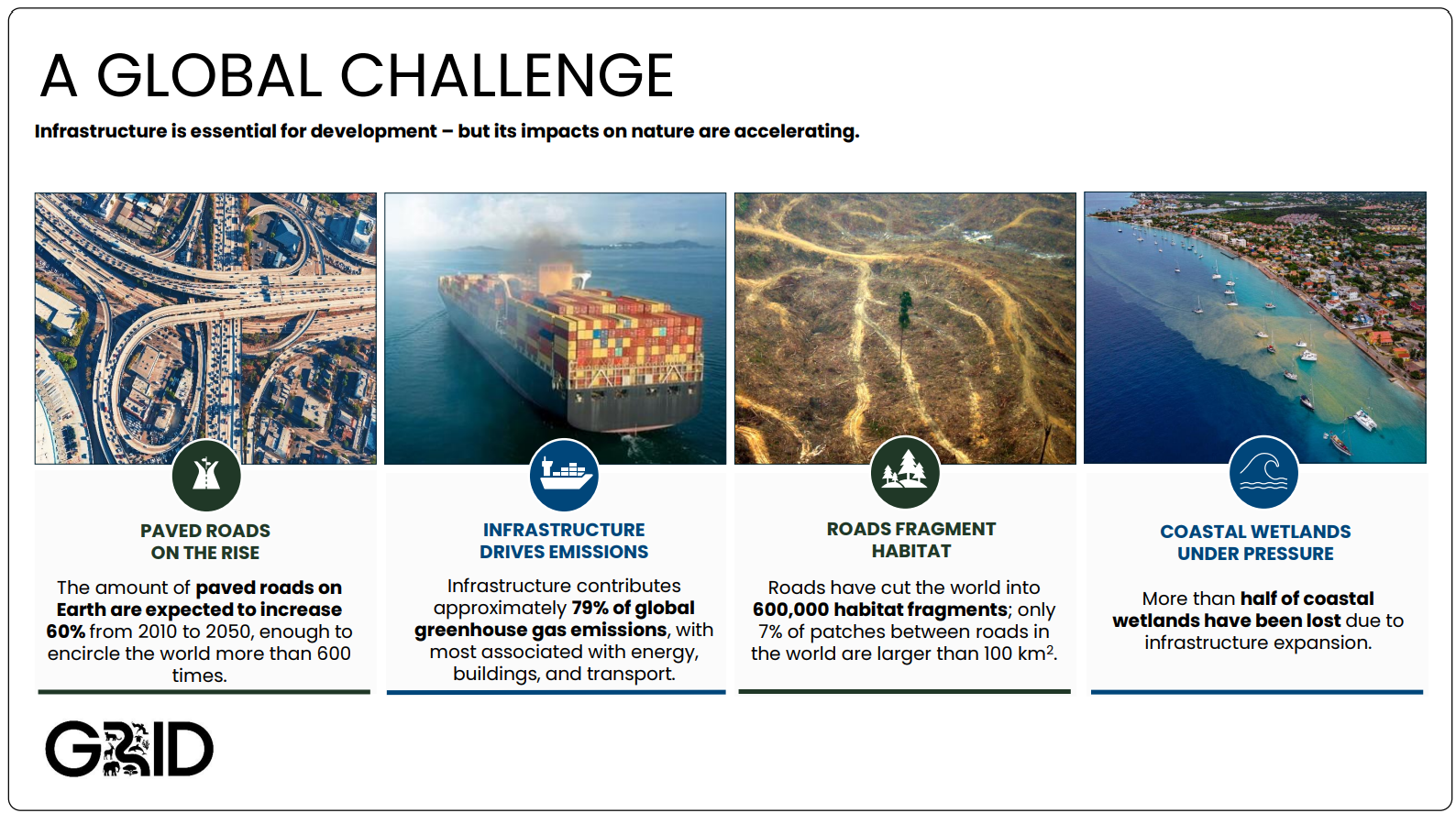
- The fragmentation in this picture is dramatic, but it is a real challenge now. We are seeing habitats that are globally fragmented; there are only 7% of patches of intact habitat larger than 100 kilometers, which is like the size of Paris.
- That means most habitats on Earth have at least one road cutting through, which brings people, which brings settlements, which brings cattle, which brings disease spillover. So fragmentation is one of the most important issues that we are concerned with.
- Coastal wetlands and coastal systems in general, you have the pollution issue coming out from the land, but also overuse of the system is impeding things like turtles being able to find their way home.
- Losing wetlands and your deltas is also harming your agricultural capacity to develop, and taking over for tourism or removing your natural infrastructure like mangroves is reducing your ability to address critical disasters like cyclones.
- Each of these addresses different aspects of maintaining biodiversity, but transportation as a sector is one of the most impactful. Therefore, we have had the privilege of getting resources from the Global Environment Facility to specifically look at how you can restore biodiversity in the transport sector.
Evan FREUND | Senior Director, Sustainable Infrastructure, Forests, WWF
- 75% of the world’s infrastructure is not yet being delivered or does not yet exist. Coupled with that is a pretty profound amount of money that is expected to be spent on infrastructure to deliver those services, to deliver the infrastructure services that are needed by society by 2050.
- It is hundreds of trillions of dollars, and the lion’s share of expected infrastructure expenditures between now and 2050 is likely to land in the transportation and logistics sector.
- It is against this backdrop that the Global Environment Facility designed the Greening Transportation Infrastructure Development Integrated Program, or GRID. Essentially, the goal of the Integrated Program is to move biodiversity and ecosystem-based considerations as far upstream in the transportation infrastructure planning process as possible.
- The biggest impacts and the biggest opportunity for change or influence in the infrastructure development life cycle are in those early policy formation and planning stages of the development life cycle.
- At each stage of the process, it gets a little bit more difficult to integrate biodiversity-based or ecosystem-based considerations into the process, and certainly once a transportation system, a road or rail or port, is being developed, environmental considerations almost become an afterthought.
- Building environmental and ecosystem-based considerations into the early stages of transportation planning is absolutely crucial.
- GRID is a six-year program, again funded by the GEF. It was approved in the last GEF-8 funding cycle and really aims to integrate biodiversity-based considerations into transportation planning. WWF-US leads the program and implements in partnership with the United Nations Environment Programme and the Asian Development Bank.
- It is a six-year program that is implemented in parallel tracks. There are five country programs managed by the three entities, WWF, ADB and UNEP, and executed by representative ministries and other agencies within those countries: Nepal, Suriname, Malaysia, Ukraine and the Philippines.
- A sixth global project that really serves as a vehicle to disseminate best practices, bring partners together, share information and build a knowledge hub to deliver new practices, new guidance materials, host webinars, trainings and other events, all in service of capacity building to advance this objective of mainstreaming biodiversity into transportation infrastructure projects.
- GRID is in its earliest stages. We have just finished the first year of implementing the global program. It is a $27 million project, again funded by the GEF and implemented in partnership with those three agencies.
- Each of the five countries, plus the global program, shares a couple of strategic priorities for GRID, again with the recognition that influencing the upstream stages of transportation infrastructure development is the most important.
- As the program was being developed, these four priority areas were identified by the various actors involved in the project, and they are as displayed on the screen, really focusing on strengthening the enabling environment. We are building the conditions that are necessary to deliver sustainable transportation infrastructure.
- There are activities embedded within each of those five programs and certainly within the global project to deliver against these priorities or these objectives.
- Again, really working with implementing partners, government agencies and other actors or stakeholders in the infrastructure space to improve the policy and enabling environment, working on integrated and participatory planning and design, looking at landscape-based approaches.
- Infrastructure is often thought of as a project or ring-fenced-based approach to delivering an asset.
- But really, thinking about how to mainstream biodiversity or deal with ecosystem considerations requires moving beyond the project. It really requires looking at a whole landscape and how a particular project fits within that landscape.
- A component of GRID really aims to strengthen these participatory approaches to planning and design.
- Certainly, there are new and interesting financial mechanisms, de-risking mechanisms and capital that can be deployed appropriately to sustainable infrastructure projects, and a component of GRID really aims to work with stakeholders in the finance community, both on the public finance side but also very much on the private sector side, to mobilize capital or use financial mechanisms to de-risk and address priority infrastructure development needs.
- The financing gap is massive, and it certainly will not be filled by public money. Whether that is coming from governments or multilateral development banks, there is a critical role for the private sector to play to deploy capital or to help deliver projects, certainly in the Global South and emerging markets.
- But sometimes the barrier is not so much capital, but it is understanding how to allocate capital against the particular risks of a project. And biodiversity presents a risk that is not easy to quantify and not particularly well known. It may leave an investor or series of investors who are involved in a particular process a little wary of investing.
- So the goal of GRID is to help bring some knowledge to sector stakeholders, particularly in the finance community, to help mobilize that capital and direct it towards projects that fit the criteria of sustainability and certainly integrate biodiversity and ecosystem services into the approach.
- Technical capacity is at the root of this project. Infrastructure is far more than just an asset. It is really dependent upon the owner or the operator, the manager of the system, to deliver the service and manage the service effectively.
- GRID really aims to build capacity and work with institutions that own, operate or manage those assets in order to ensure that it is designed and implemented, operated and ultimately decommissioned in the most effective and sustainable manner.
- There are five country projects, each of which is following a bit of its own timeline, identified here in Malaysia, Nepal, the Philippines, Suriname and Ukraine. They are all very different in nature.
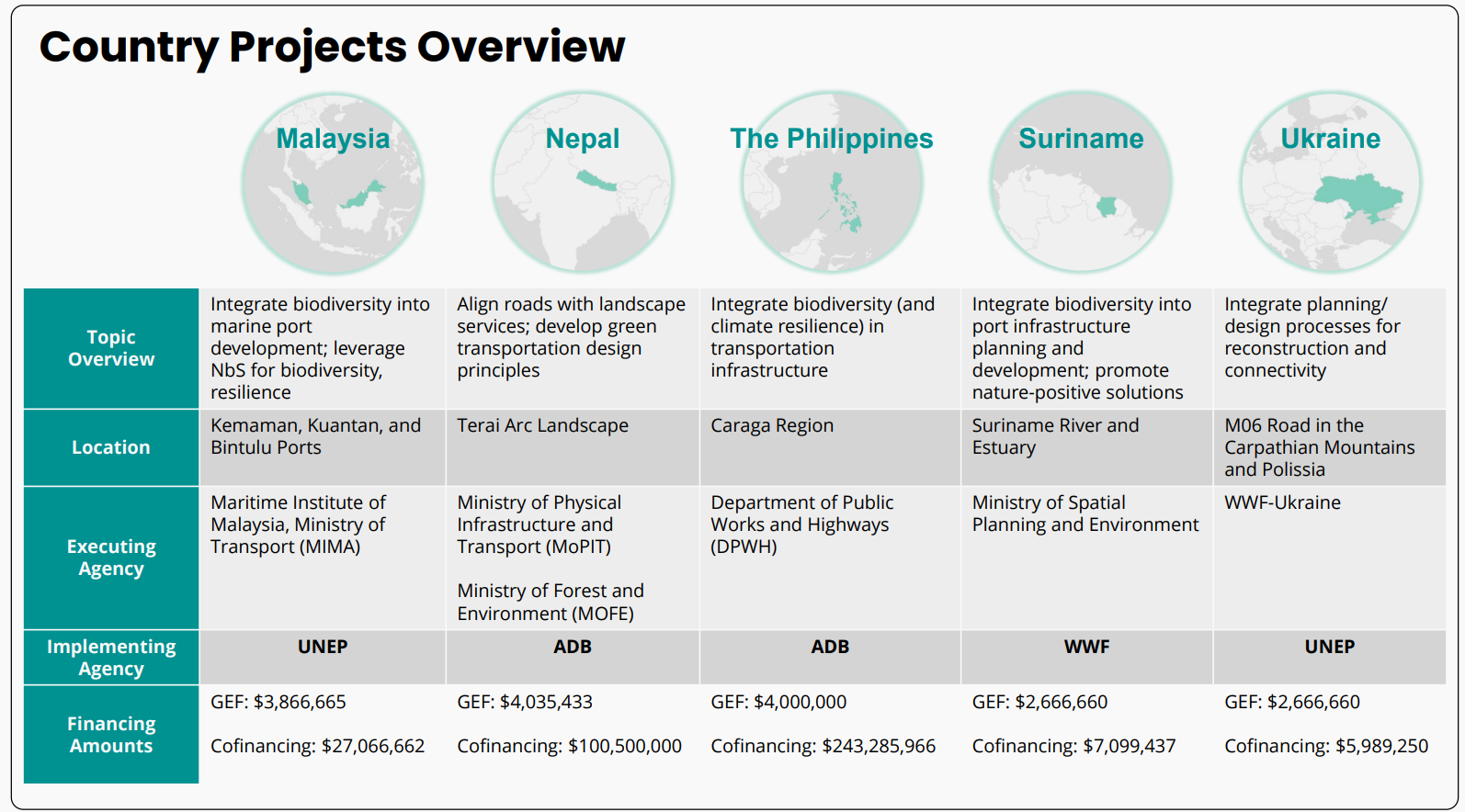
- The Integrated Programs are sort of a demand-responsive program. Countries are offered the opportunity to participate in this or any of the other 10 Integrated Programs that the GEF offers in each of its funding cycles.
- There is really not much similarity among these five country projects other than that they are all addressing major infrastructure development issues.
- Two of the five are dealing with massive port expansion and marine and coastal issues as a function of massive economic growth. Malaysia, for example, is a major transit corridor, a port infrastructure country, and it is experiencing a lot of growth in the federally owned and operated ports.
- Suriname, the other country that is experiencing, or focusing the program on port development, is responding to massive growth driven really by oil and gas development and a whole host of new ports that are expected to be developed and delivered to service that growing need.
- Nepal, the Philippines and Ukraine are each dealing with terrestrial infrastructure, road or linear infrastructure development challenges, whether it be expansive growth and new building in Nepal and the Philippines, or reconstruction and redevelopment post-conflict in Ukraine.
- The consistent thread through all of these is that transportation infrastructure development is a huge driver and a huge expected growth area over the next five to ten years. Each has acknowledged that building biodiversity considerations into those processes along the way would only strengthen the delivery and outcome of the projects.
- We are looking forward to working with each of the countries. They are all starting at different phases. Each is managed by the respective institutions that are participating in the program: UNEP, ADB, and WWF.
- We are just at the initial stages of implementing GRID. We welcome the opportunity to work with partners across the infrastructure life cycle to develop knowledge products, host trainings, webinars, and other events that expand this global base of knowledge and information around sustainable transportation.
- The network hosts a number of communities of practice that focus on different specific thematic and technical issues.
- We are also aiming for this program to be as demand-responsive as possible. So if there are particular themes that are of interest within the organizations that any of you around the table today might work for or work with, please let the GRID program know that we can look to ways to partner, develop appropriate knowledge exchanges or knowledge-building opportunities.
- The central knowledge hub is there and available for the six years of the program for all sorts of interactive knowledge, training, webinars, and new products that can be downloaded free of charge at any time.
Liesbeth CASIER | Lead, Public Procurement and Sustainable Infrastructure, International Institute for Sustainable Development
- The issue of public procurement is a really important leverage point in the early policy and planning process. What we have experienced over the past years is that this is where the operational bottleneck starts when we are trying to incorporate sustainability and nature-positive approaches into the operational character of infrastructure delivery.
- Specific challenges of the procurement processes:
- Public procurement has been considered an administrative, operational function of government for most of its existence. In recent years, we are starting to see changes in the perception of what public procurement actually means, particularly by understanding how much public spending is actually impacting a country’s GDP.
- There are estimates that between 12 and 15% of a country’s GDP is actually generated through public procurement processes. So that actually offers an enormous opportunity to use that process much more strategically to deliver Sustainable Development Goals, as well as nature and climate ambitions.
- But what we are seeing today, particularly in the area of nature and biodiversity, is that there is still a very limited awareness of how procurement units themselves can actually do that and integrate these approaches into their very specific processes, ranging from the design of RFPs and setting out the scope of projects, as well as using this as a lever to incentivize suppliers and the private sector to come up with more innovation. We need better infrastructure projects.
- That also relates back to the fact that the knowledge around the biodiversity crisis, as well as the climate crisis, is not necessarily well understood by procurement units in government. We are seeing changes there, particularly over the last few years, but there is still a lot of work to be done.
- To really think strategically around public procurement, one of the key bottlenecks that often comes up in the discussion is everything around price and cost of infrastructure that actually integrates climate and nature considerations.
- However, there is actually a lot of evidence that doing so reduces costs and risks over time for an infrastructure project. So what is really critical is to enhance that understanding that this is not just an agenda because it is good for the environment or good for climate and for people, but it is actually, in today’s world where fiscal constraints are real for most governments across the globe, critical to also see this as a way of better budgeting, better public spending and better use of taxpayers’ money.
- The challenge is that there are fragmented responsibilities across line ministries in government, and it is really important to start breaking some of those silos where those who are designing the scope of projects and those who are coming in on the infrastructure project, as well as those who are involved in the policies and planning design, are much more closely connected and actually sit around the same table when infrastructure is being planned and formed.
- Procurement will always remain an operational, administrative process, but it is not only that. It is really important to start developing clear guidance for procurement units themselves on how to do this, and this is something that we will be working on together with WWF and other partners in the context of GRID.
- There are different ways in which the procurement process can actually support nature-positive transport. At a very high level, there are three critical ways to do so.
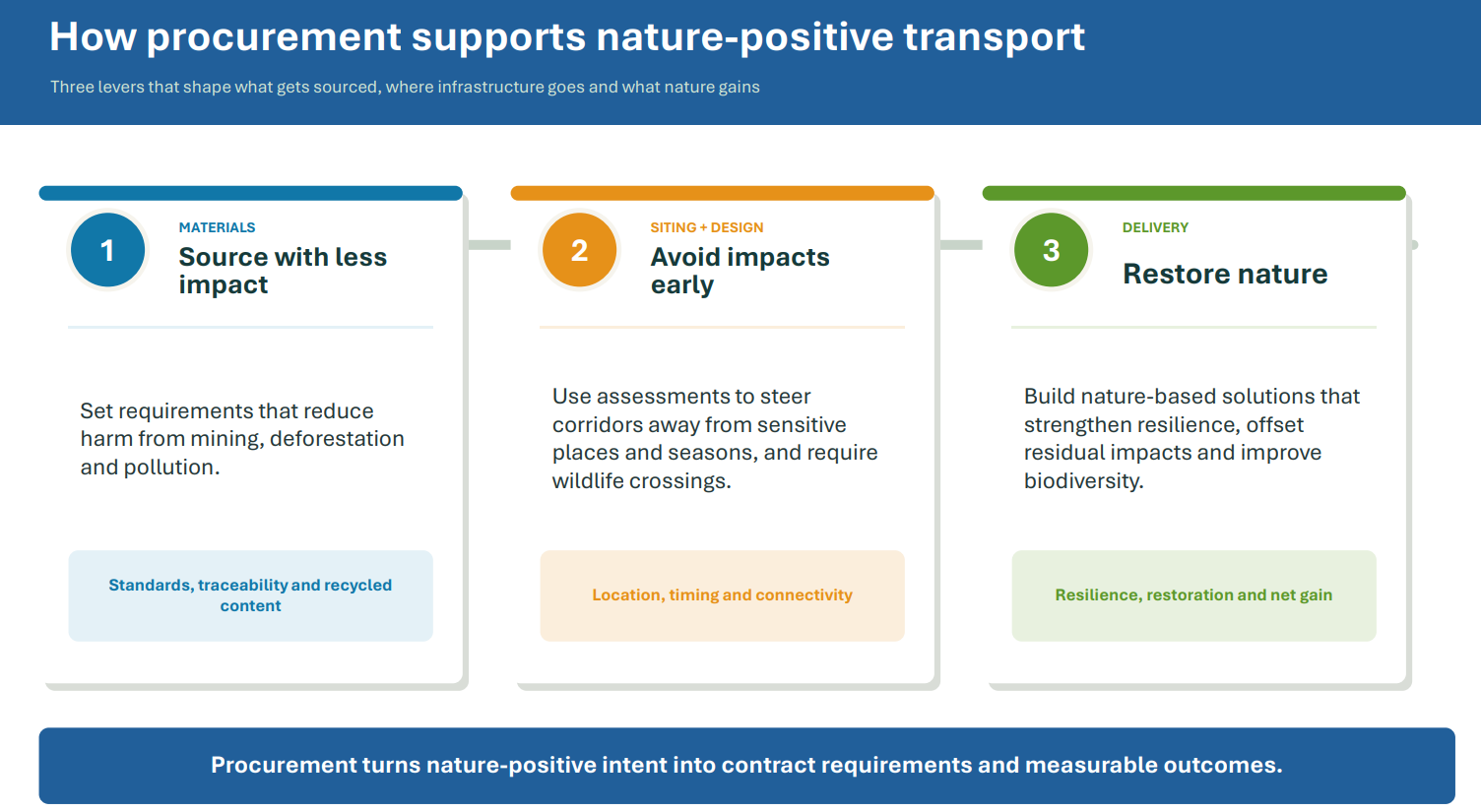
- The first is to set up procurement processes that incentivize suppliers to use materials that have less impact on the natural environment. And that means that through a procurement process, we need to set requirements that reduce harm from mining, deforestation and polluting activities.
- What will be very important there is to make sure that procurers have the right standards in hand on how to be able to do that, as well as mechanisms for awarding contracts to suppliers that are actually doing so.
- It is very important to think about standards and traceability, and an important area will be to think about the recycled content of infrastructure materials.
- We heard it mentioned a few times: 70% of the infrastructure is yet to be built. We will really need to think about resource efficiency in this agenda moving forward, and the procurement process can help facilitate that.
- Also important is to avoid impacts early on, and that goes back to thinking about where infrastructure is built and what the design of an infrastructure project is. So we need to use a lot better the information that comes out of environmental and social impact assessments much better, and that knowledge needs to be integrated into the procurement process.
- The scope of tenders that often go out for those who design infrastructure projects needs to be mindful of including nature-positive approaches much earlier on into those RFPs for design contracts.
- In the delivery, that goes closer to the infrastructure asset and the contracts and procurement processes for those. It will be really important to highlight the role of nature-based solutions.
- The reason is that they strengthen resilience, they offer biodiversity gains, but they also help to reduce future costs. This is an agenda, separate from the procurement work that IISD is involved in, that has been worked on for many years: to really calculate the avoided impacts by integrating nature-based solutions in infrastructure.
- Activities IISD will be doing in the context of the GRID project:
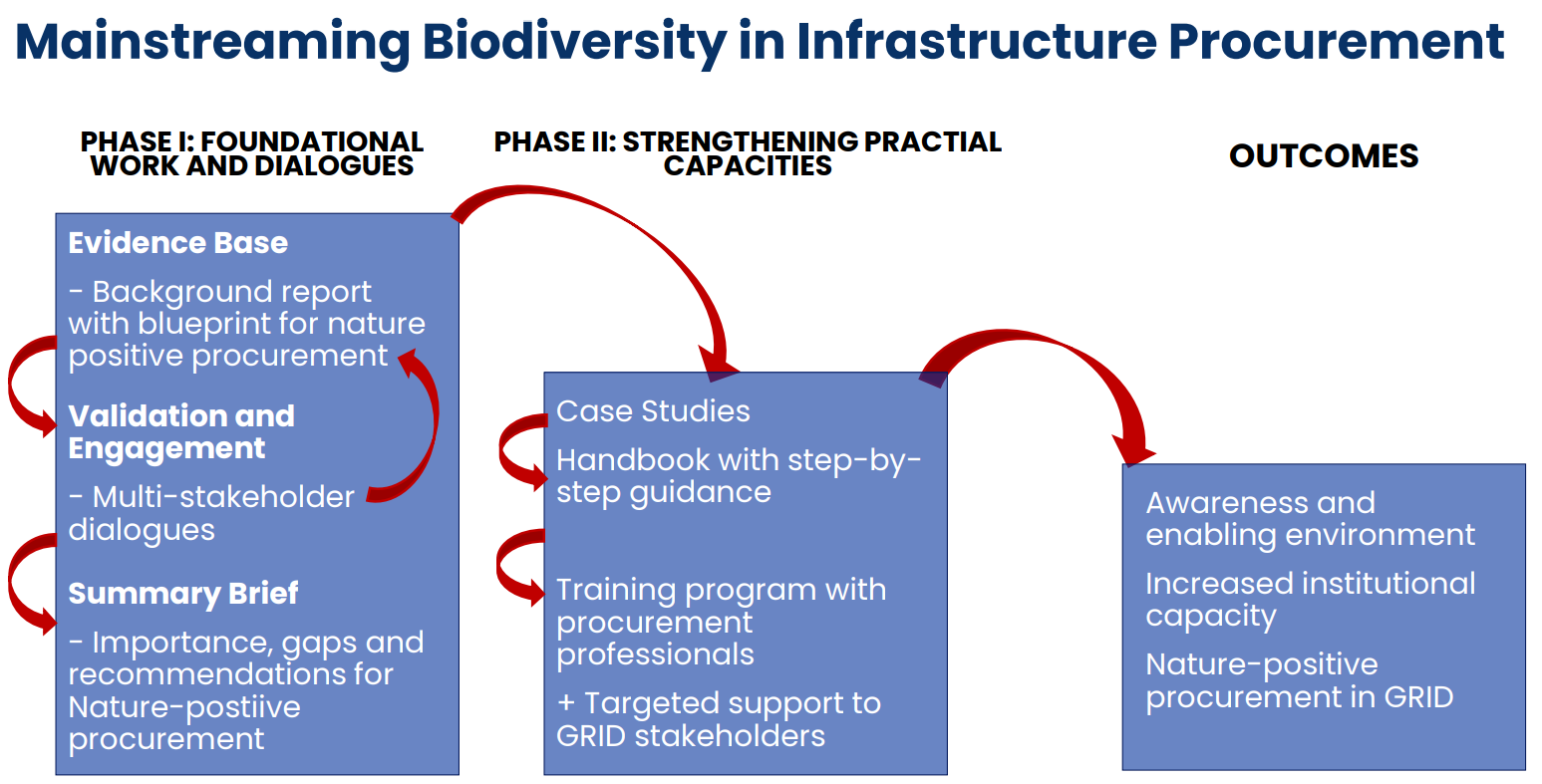
- The first phase will be that we are holding a lot of dialogues, including the interactions we are having today, to really start building a blueprint of what nature-positive procurement can look like in the future.
- A lot of collaboration with the multilateral development banks will be very important in this regard because they have been very important players in supporting countries in the reform of their procurement systems.
- The second phase of our work will then start focusing on strengthening the practical capacities of procurers through the development of case studies, which is a very useful tool for procurers to start getting inspired by what others are doing in this area.
- We will also be developing a handbook and a training program on how to do this practically.
- Ultimately, what we really want to do with our work under the program is to raise awareness that procurement can indeed be a really important lever for integrating nature-positive approaches into transport infrastructure, and that we also see increasingly enhanced capacities of procurers and governments to be able to do this in a practical manner.
Evan FREUND | Senior Director, Sustainable Infrastructure, Forests, WWF
- Infrastructure is a really dynamic sector. Lots of different actors are participating at different stages.
- The success of GRID and the utility of GRID is bringing these partners together who are, in many cases, non-traditional actors, really working towards the same objective but at different phases of the life cycle.
- We are very eager to collaborate and work together to achieve some of the outcomes that we intend to achieve under the program.
Open Discussion
Marianna BOLSHAKOVA | Regional Coordinator, Environmental Law and Governance, UNEP
- Can you talk a little bit about how you are addressing the balance between regulatory constraints and incentives?
- There are obvious long-term benefits of using nature-based infrastructure, but there are also short-term presumed lower costs of not using nature-based infrastructure.
- So there needs to be some regulatory approach, but also some incentive.
- In terms of legislation, as Ukraine is on the list of countries in the project: how is the work aligning with, or building on, the work with the EU, a key approximation that is happening right now, approximation to the European Union legislation? Is there an opportunity, or has there been some convergence in terms of looking at the regulatory system to advance NbS?
- Are you also looking at transboundary routes? We have the Trans-Caspian Transport Corridor. Obviously, that is a big initiative right now in the region. Is that something that is being looked at, not particularly this one, but in general, in terms of transboundary transport networks?
- On investment, you talked about the importance of working with the private sector and having financial mechanisms that prioritize nature-based infrastructure. How are you approaching the sustainability of that effort? Because a one-off project is very possible, but replicating it may be hard.
Rowan PALMER | Programme Management Officer, Infrastructure Unit, UN Environment Programme
- Going back to the first question, in terms of how we work on the regulations versus incentives, or maybe carrot versus stick, at UNEP anyway, on the incentive side, a big part of our work now is working with ministries of finance to align public spending on infrastructure, in this case, to better align it with the objective for sustainable and resilient infrastructure at the national level. That can then serve as the foundation to send market signals and bring in other funding.
- On the incentive side, the question you asked about the costs and how to balance the fact that, in many cases, using a nature-based option may have cost benefits over the long term but may be more costly upfront.
- Just one of the important things is making sure that you take a sort of full life cycle approach to understanding those costs and benefits and making sure that you are understanding the long-term, bigger picture of how it balances out.
- Certainly, in some cases, doing the more sustainable option or the nature-based option may have a higher upfront cost, but that is not always the case.
- If you have a nature-based solution that involves just the protection or maintenance of an existing asset that is functioning, keeping something that is already there is usually going to be cheaper than having to build something new if that is already been ruined.
- In many cases, it may not have a higher upfront cost.
Liesbeth CASIER | Lead, Public Procurement and Sustainable Infrastructure, International Institute for Sustainable Development
- It is definitely not true that for all cases this is more expensive, and it also depends a little bit on what we are talking about.
- Certainly, outside of the area of transportation, when we look at water, like managing water quantity and quality, nature-based approaches are often cheaper. Where the challenge then arises is often around the maintenance and operational costs of nature-based solutions, where we often have discussions on what is required, because often it needs a lot more maintenance than built infrastructure.
- But what we have also seen is that the cost of thinking about adding a nature-positive approach is marginal when it comes to the full cost of an infrastructure project. That is also something we need to increasingly highlight, that it is sometimes a very small premium for doing so.
- That does not take away the fact that, of course, there is still a premium. But what becomes interesting in connection to public procurement is that, if we then highlight that certain innovations, and some of them are actually not new technologies, have been around for a very long time, there is a market for those.
- What is important there is to have very early engagement with suppliers, with the private sector, to make them also understand: government is going to create this demand, and so we want to match that with the supply of the innovation that you are providing as suppliers.
- That is when the power of governments really kicks in. It is in this demand creation.
- But what is important is that governments put it on the table, because otherwise there is no incentive to respond to that. And that is the incentive question then: there is no incentive to respond to that.
Evan FREUND | Senior Director, Sustainable Infrastructure, Forests, WWF
- Traditional delivery of grey infrastructure really pushes these perverse incentives. If you are a contractor, for example, you are typically rewarded for the lowest-cost bid and valued on the basis of delivery schedules, on time.
- When the reality is, if you build biodiversity-based, nature-based approaches into the entirety of the delivery of the project or the asset, again, you might see reduced costs over time from an operations and maintenance perspective, and incentives, if appropriately built within the contract, to deliver and maintain that asset for much longer than its economic lifespan if it were just a traditional grey model.
- The incentives are designed to reward a contractor who is going to typically supply a least-cost bid, and additionalities, which are often the environmental components of the projects, are the first to go in a project.
- There is this issue of changing those incentives or reworking the way a project is structured and managed, and certainly tendered, in order to not simply reward a least-cost solution, but really give an advantage to an entity that is thinking about life cycle cost and delivery of ecosystem services or ecosystem benefits alongside the benefits that the grey asset itself may deliver.
- Then the second point on sustainable finance. Just at a high level, there is not really a shortage of capital in the market. There is not, and there is a lot of money that is out here in the world looking to be deployed in infrastructure.
- From an investor standpoint, infrastructure generally offers a very nice, steady, predictable return. Finance will reward a well-designed project, and aligning capital with the designed project is the tricky part.
- But if the market understands what a project looks like, the finance will follow.
- The tricky thing with nature-based solutions, integrating green components into traditional grey projects, is that those are often hard to quantify, hard to price, and hard to evaluate.
- Insurance companies have a hard time putting an insurance package around something that is challenging to quantify or has not been delivered in the past.
- So the sustainable finance issue is one of aligning the green elements, if you will, of the project with the type of capital that is meant to be deployed for the project.
- The finance community does not really speak the language of the conservation communities, for example, or the nature community that is working on infrastructure issues.
- There is just a bit of a translation problem with working, whether it be with public finance or private finance, to align the incentives and the motivations for moving that capital into a project with the conservation objectives or nature-based outcomes that are meant to be delivered alongside the grey infrastructure.
- That will bring sustainable finance to a project, but there is not yet enough of an evidence base to really motivate the market to invest heavily in these types of solutions.
Kate NEWMAN | Vice President, Sustainable Infrastructure and Public Sector Initiatives, WWF
- If it is achieved, then it meets the mainstreaming requirements that are in the CBD, not just as an add-on, maybe, but woven all the way up into the earlier stages of procurement.
- That is what this whole mainstreaming agenda is about at the upcoming COP17.
Evan FREUND | Senior Director, Sustainable Infrastructure, Forests, WWF
- Regarding the question about regional connectivity and corridors, transportation projects are increasingly being looked at and delivered on a regional basis, on a corridor-based basis, and they are not just a road project from point A to point B. It is a road coupled with a rail or a pipeline terminating in a port.
- The integrated approach to designing and delivering transportation infrastructure is way more sophisticated than it has historically been, particularly in Asia and Africa, where there is a huge need for connectivity, driven in part by rural-to-urban migration, but also from a natural resources management delivery perspective.
- The GRID project really aims to, in some of the countries anyway, look at this corridor-based approach. Ukraine is a great example of that as a connecting country for the broader region.
- But it also speaks to this landscape-based approach to GRID in the first place. Taking a project in isolation removes the ability for the multitude of stakeholders who are involved in the project to understand the dependencies of nature on infrastructure and infrastructure on nature, and to take a step back and look at the broader landscape in which a particular project or set of projects might fit.
- Designing infrastructure in the future will be a disservice if you do not look at the landscape or take a landscape-based or corridor-based approach to how that infrastructure delivery works.
- So working with, or at the stage maybe of, a master planning exercise, a 10-year master planning exercise, is going to be far more beneficial than looking at the project-based approach.
- That is really why GRID does not focus on specific individual road or rail or port projects, but really on the upstream phase when the planning is being done.
Rowan PALMER | Programme Management Officer, Infrastructure Unit, UN Environment Programme
- A lot of the ecosystem services that are coming from these natural infrastructure assets need the ecosystem to be functioning at the landscape scale or at the ecosystem scale, and that is very often going to cross borders as well.
- So, the fact that a more corridor-based approach to planning and more transboundary cooperation really does provide an opportunity to then manage those natural assets at the scale needed as well.
- But it needs to be explicitly recognized for what it is. It will not happen by accident.
Intervention from the Floor
- In some cases, when there is a high upfront cost, when you integrate more into the calculation, you did mention that the costs might be high upfront but might be lower across the life cycle. But then, in reality, I want to know from your experience working with government public procurement, because the life cycle, or the lifespan, of a particular project might be longer than the government term.
- Not often, in reality, do they actually care so much about the entire lifespan of the project itself, looking at their terms. So I want to know what your experience is in trying to convince them that it is longer than their term.
- One of the components of GRID is innovative financing mechanisms. When you plan, design or construct a project, there will unavoidably be some impact on biodiversity, and you go through the mitigation hierarchy, and then there might still be some residual impact.
- If you want to really achieve no net loss, you will have to, for example, purchase biodiversity credits to offset your impact. But the regulatory framework in each country is very different on this. Some countries allow this; some countries do not. Some countries only allow the purchase of credits within your own country and not across borders.
- So how is your approach dealing with this? Do you want to achieve the final goal of having no net loss of all infrastructure projects within a certain country? And if so, what is your view on offsets and biodiversity credits? And if that does not work, how do you see this being solved?
Liesbeth CASIER | Lead, Public Procurement and Sustainable Infrastructure, International Institute for Sustainable Development
- How do we convince governments? And, of course, indeed, the life cycle of infrastructure goes long beyond the term of one government. And that is actually what makes it so that all of us come together to think about this issue.
- From the procurement side, those involved in the procurement authorities involved in specific infrastructure projects, thankfully, as part of the administration, have a keen interest in this. They are under the supervision of the public budget holders and ministries of finance.
- So there is actually, in the area of infrastructure, thankfully, a life cycle approach that, in many cases, is even mandatory.
- And actually, this comes to the point of the regulation versus incentive debates. Increasingly, we see not only life cycle approaches becoming mandatory in large infrastructure procurements, but also the incorporation of environmental specifications as part of the technical side of RFPs.
- Particularly in Europe, we have seen this incorporation of green and sustainable public procurement in countries becoming more and more mandatory.
- That is actually one way that is sometimes not popular when it comes to regulation, but we do see an impact when specific mandatory targets are being set, and governments need to then get together to understand how this can be implemented, how this can be monitored, and then looked at over time.
- So that is one way that has been working and is increasingly being done.
- Then the other is to increasingly look at what the risk is of not including sustainability requirements in infrastructure projects.
- There are so many examples today of not having taken into account what climate risk does to infrastructure. The cost of these is enormous, and with that information becoming much more publicly available, governments will be held accountable for not taking it into account in relation to transport infrastructure.
- We have estimates from what has been happening over the summer in Europe, with the heat, that are astronomical, because that transport infrastructure could not function because we did not think about how hot temperatures got.
Kate NEWMAN | Vice President, Sustainable Infrastructure and Public Sector Initiatives, WWF
- But the problem there is that the cost occurs to some other party, people who created the asset.
Liesbeth CASIER | Lead, Public Procurement and Sustainable Infrastructure, International Institute for Sustainable Development
- Which is again where the regulation and also the breaking of the silos and fragmentation will need to play a role.
Kate NEWMAN | Vice President, Sustainable Infrastructure and Public Sector Initiatives, WWF
- What do we mean by offsets really these days in the context of biodiversity and infrastructure? The case I am about to go to is the United Kingdom, where they have a relatively new policy on requiring a 10% net gain for any significant new project.
- That requires a regulatory push for ecologists to come all the way up into the room at the very beginning and take into account the ecological implications of that case, and from the very beginning think about how that particular asset is going to add more biodiversity back to this system.
- If it is going through a degraded habitat, when there is a degraded habitat, you can actually use the property of the infrastructure that has been degraded and bring in trees and pollinators and so on, create corridors so that the wildlife is thriving instead of being excluded from the space.
- There are a lot of methods for making your infrastructure system actually be productive rather than destructive entirely. That will get you some biodiversity back.
- You are not replacing what could have been right under that pavement. But a lot of times, if we design well, the infrastructure has not gone through intact habitat. That is the priority. It usually does go through a degraded habitat situation, but still, does that get you 100% more biodiversity than could have been there? And what kinds of offsets are offered?
- So in the UK, it has to be local and it has to be like-for-like. So you are unlike the ideas behind offsets for carbon, where you buy a patch of forest or something in the Congo Basin to offset your whatever you are doing in, let us say, England.
- This is very localized, and so it has to be local, which may not be exactly replacing in that space, but it is adding more biodiversity into the space around it, into that landscape is so vital.
- So it is an interesting examination of how beneficial that can be at a landscape scale. But we need more research to see if it is 100% adding on top of the existing impact that that particular physical infrastructure will have.
- But most of the time, you are improving an existing alignment, you are improving existing infrastructure. So it is always considered degraded. So any additional biodiversity that you are providing is actually improving the landscape.
- So we avoid offsets in general because of the many challenges many of you might know about offsets. Leakage: offsets will pop up everywhere, and then the degradation will happen somewhere else and there will not be a net benefit.
- But when it is local, when it is like-for-like, and when it is already improved in degraded space, then we really encourage that.
- So it needs a lot more research, frankly, and I appreciate the question. It is part of this sort of cost and benefit that we need to examine better.
Evan FREUND | Senior Director, Sustainable Infrastructure, Forests, WWF
- The UK is just one of a handful of countries that are implementing this via a regulatory approach. At a high level, it speaks to the importance of a biodiversity baseline assessment. Know how much biodiversity is there, and then measure against that baseline.
- Somebody asked about over time. Monitor. That is critical. All that should be considered in this upstream phase of a project.
- I recently met with a concessionaire who has a 30-year concession on a road project in Normandy, and they are very interested in this biodiversity net gains question. They have taken it upon themselves, although it is not mandated in their contract, to undertake a biodiversity baseline assessment in the first year of the concession, and they will do repeated monitoring to see how much new biodiversity is added as a function of the project.
- That is purely from the contractor’s own desired decision to be very forward on this issue.
- But universally, in places like the UK that are mandating it, you have to understand where you are starting, and then make sure that you have a long-term framework that effectively accounts for it.
- And perhaps a contractor should be incentivized to not just hit the 10%, but achieve something beyond that 10% if it is required.
- You obviously have to demonstrate that you are going to hit that 10%, but there are certainly ways in which you could surpass that threshold, whatever it may be.
Intervention from the Floor
- So, under GRID, do you also intend to work with countries on these kinds of approaches? For example, in this case in the UK, when you build critical projects, you have to have net gain or at least no net loss. Do you intend to work on these?
Evan FREUND | Senior Director, Sustainable Infrastructure, Forests, WWF
- Answering that question, generally all of the projects in each of the five countries are executed by representatives of the government, whether it be the Ministry of Public Works, Ministry of Transport, in the case of Malaysia the Malaysia Maritime Institute. So there is direct government engagement and actually ownership and leadership of the execution of the projects themselves, driven by the government.
- But there is not a one-size-fits-all approach to this issue. Certainly, the approaches that each of the projects will take will be driven by the desires and demands of those representative entities who are executing the projects in particular regions of the countries, against the goals that they have as executing agents, whether they be governments or quasi-government agencies executing the work.
- But if there is a regulatory requirement to demonstrate net gains, for example, the project will certainly provide support in whatever way possible. It may be just linking to the best available resources and policies that are out there, providing exchange opportunities to learn how to implement a BNG-based approach to delivering infrastructure.
- And that is really the goal of GRID, to sort of break down some of these information silos or barriers and provide the best available resources that are out there.
Evan FREUND | Senior Director, Sustainable Infrastructure, Forests, WWF
- Over the last decade or so, from a multilateral bank perspective, which are financing quite a bit of infrastructure projects, this goes back to the incentives question.
- Structuring contracts in such a way that there are output forms of contract that are output- and performance-based, where the risk on the contractor or the incentives for the contract really shift towards the latter half of the contractor’s involvement in a project.
- So typically, a contractor is rewarded and compensated for delivery of a road. They build the road, their performance guarantee is then secured, they leave the site, and off they go.
- But creating an incentive structure whereby a contractor is required to provide routine maintenance, stay on site and monitor the works for a period of time, and the compensation is shifted towards that monitoring period, is one way to ensure that monitoring and performance of the asset, for any of the functions, not just the biodiversity-based functions that we are discussing, is a different approach to delivering a transport system.
- But whoever asked is absolutely right, and that infrastructure life cycle diagram misses that very important monitoring phase to ensure that the asset is delivering the services that are intended for at least the economic lifespan, if not beyond, that it was designed to do.
- And then the question about Suriname, I will answer just briefly. Suriname is a really interesting project, and we are really pleased that it was an addition to GRID, as I briefly mentioned.
- The Government of Suriname recognized the immense development and pressure that the country was experiencing as a function of hydrocarbon growth in the region.
- Suriname, from a biodiversity and nature-based standpoint, is a really interesting country. It has 97% to 96% forest cover and intact biodiversity. One of only three biodiversity-positive and carbon-positive countries in the world is how it is characterized.
- And the government has made a concerted effort over quite some time to ensure that intact biodiversity remains in the face of all of this development pressure.
- So when Suriname entered the GRID program, it did so with the recognition that there is real potential conflict between all of this new potential port development, particularly in coastal ecosystems.
- A lot of the ports that are being developed are in and along the Suriname River, some of which are small ports to service bigger ports that are there and developed for potential oil and gas operators.
- And the pressure on the coastal ecosystem, which is immensely biodiverse and also very fragile, is quite extreme.
- So the program really aims to work with and set some regulatory frameworks that frankly do not exist yet in Suriname, to ensure that the delivery of these new ports is done in a regulated and appropriate manner.
- The project has not yet begun. So it comes, as a project, at a really interesting time for the country, and it can capitalize on the knowledge that is being developed and shared between the five countries and the global project, as well as through any particular work that is being done in-country, to ensure that the delivery and development of this new infrastructure that is meant to service this growing industry is done around a robust framework.
- So we will see where it goes. It has just begun implementation about a month ago, with the program management unit being established and starting to put the particular pieces of the project together.
Interventions from the Floor
- A quick recap on maintaining road transport infrastructure. I was thinking about an easy way to ensure the sort of nature-positive practice would be to have a supplier using alternative fuel in their construction applications.
- We are developing an interesting activity related to bio-support in terms of a sustainable manner. That could be a nice solution to also include in the procurement phase, if everyone can guarantee and ensure that there are alternative solutions in their applications.
- That could help to achieve an important nature-positive outcome.
Evan FREUND | Senior Director, Sustainable Infrastructure, Forests, WWF
- If you think about the procurement of a civil works contractor, there are so many ways that you can incentivize a contractor, from where they access quarry pits, the type of fuel that is used, and you can reward a contractor for including those in a contract.
- The real question, beyond my knowledge, but something people are starting to think about in the context of procurement, is how to not scare the market away and ensure that there are appropriate conditions that are set forward in a contract, like fuel supply.
- I mean, if a contractor says, “Well, I can only use aggregate from a certain quarry, but it is 500 miles from here, I am going to add a cost premium, a big cost premium to it.” So, you have to sort of balance the practicalities of the supply chain issues that go into a construction contract with the overall price envelope, frankly.
- But I totally agree, and there are lots of really creative ways that are just being started to push out to the market now, and that is one of them.
Kate NEWMAN | Vice President, Sustainable Infrastructure and Public Sector Initiatives, WWF
- For example, in Colombia, it has been wonderful to watch over the past 20 years now how the Ministry of Environment and Ministry of Transportation have joined together on how to develop green roads in the Amazon context originally, but now it is the whole country.
- They have developed, together with two NGOs, WWF and a local NGO, the Green Road Infrastructure Guidelines, which are now to be used in a mandatory way. It is required for any new construction or renovation.
- There was a pilot project. They used an excellent standard, actually coming from the United States and engineering practice. It called for expanding the culverts to allow for much more water to flow through because climate change is pushing larger bursts of water than most bridges are built for, using a steel plate over it and then having more of an opening underneath, also big enough for wildlife to pass through.
- Then they went out to check on the project to see how the engineers and construction guys were doing, and they found that they did not do any of those things that were right in the blueprint that was approved and that they got contracted to do in this particular spot. They could not find the steel plate.
- So this is the convenience of requiring certain materials. It still needs to be doable and could be researched early in the procurement phase and not put in there assuming they will figure it out.
- So they said, “Okay, we could not find steel, so we are not going to bother with it.” Plus, the culverts that are there are pretty good. They are solid. They are not crumbling. They are just two holes, regular old culverts.
- And they saved money. Their supervisor said, “Yes, you have saved money.” And you can now use that for other problems downstream, which is how an ongoing construction project works. You have always got problems; you solve them, you save money for the next challenge.
- What we learned from interviewing the engineers on the ground was, “Oh, well, we always do that. Could not do it, so solve the problem.” And plus, that did not need to be changed. They did not have any idea why the change was being requested.
- There was no training in the education system that would help engineers understand what resilience and adaptation require in the physical engineering world now: bigger, wider openings under bridges. And they did not understand that this was also for wildlife, and neither did their supervisors.
- It became clear that we may make recommendations on how to do all this and advise them to get better fuels or better materials, but if they cannot do it and they do not understand why they have to do it, they can just keep going.
- It has pulled us back to a recognition of a fundamental need to embed this, mainstream this information into engineering schools or on-the-job training and professional development schools, so that it will actually become models for everybody else to use.
Liesbeth CASIER | Lead, Public Procurement and Sustainable Infrastructure, International Institute for Sustainable Development
- Jumping in on making sure that we do not scare the market or suppliers away. Many of us work primarily with governments on new requirements to introduce and on the overall agenda, but it is equally important, including in capacity building and training, to work with the private sector and to not scare them.
- It is about providing lead time. And that is again where the planning process becomes so important, so that we let the market know today, “This is a requirement that we are going to start introducing, and in five years this will become a mandatory requirement.”
- So you also allow that time in the meantime for the market to prepare. And then in the market consultations and early market engagement, it is something we should not forget.
Rowan PALMER | Programme Management Officer, Infrastructure Unit, UN Environment Programme
- The topic of infrastructure is important for the upcoming COP.
- I know, not just as part of the GRID program but as part of broader efforts, WWF is leading some programming there and working with a few different partners.
Evan FREUND | Senior Director, Sustainable Infrastructure, Forests, WWF
- This is my first biodiversity COP.
- I will offer two thoughts. Two big agenda items for this COP are mainstreaming and mobilizing finance, which we talked a lot about today.
- The mainstreaming agenda is super critical. The CBD Decision 16/13 addresses mainstreaming across a number of sectors, including infrastructure. The COP provides a forum to advance this agenda further.
- As part of GRID, in fact, we have worked with a variety of stakeholders to stand up something called the Community of Practice on Nature and Infrastructure, which is a community of practice that is responsive to the CBD’s decision on the mainstreaming agenda in the infrastructure sector.
- I hope that parties at the COP will use the opportunity to continue this dialogue on mainstreaming in the sector, which is super, super critical and is making really nice headway.
- And the second is on mobilizing finance. We talked a lot about financing today and the financing gap, and everybody talks about the need for increased finance for nature.
- The spend on infrastructure, as a proportion, or relative to the spend on infrastructure – let me put it the other way – the spend on infrastructure globally relative to the spend on nature, is like a 20-to-1 ratio, right? But if you take the sort of premise that nature is infrastructure and infrastructure is nature, diverting some of the flows to traditional infrastructure in service of nature, nature as infrastructure, just shifting some of those flows would have a tremendous impact on the delivery of infrastructure services.
- So mobilizing finance for nature implicitly means mobilizing finance for infrastructure, just infrastructure with biodiversity-based considerations, nature-based considerations, or nature-based solutions as an alternative to grey infrastructure, is super important.
- A mobilizing finance agenda that will be discussed and promoted at the CBD is utterly critical. And infrastructure is not necessarily a natural topic to be discussed at the CBD, but it is a perfect environment in which to bring these different themes together.
Rowan PALMER | Programme Management Officer, Infrastructure Unit, UN Environment Programme
- It is sort of using the need for infrastructure as a means of helping to close that nature financing gap.
- In many cases, investment in conservation or restoration, sort of labeled like that, is going to be a tougher sell politically than investment in infrastructure, which is usually extremely politically powerful and used that way.
- That is a really, really critical point, and there is a lot of potential there for absolutely bringing the two agendas together.
Kate NEWMAN | Vice President, Sustainable Infrastructure and Public Sector Initiatives, WWF
- I want to raise a circularity issue which is also integral.
- There is a lot of talk about critical minerals now for all those purposes, but one of what we consider, and the UN considers, a critical mineral is sand. And there is a sand crisis on this Earth.
- And while we are talking about infrastructure, the construction of anything, including what you are going to construct with that critical mineral stuff that you are collecting, requires concrete.
- Then, the concrete requires three things. Water, which is also a precious commodity, increasingly driving decision-making; an aggregate, sand, with something to pull it all together. That is the Portland cement.
- And we do not have all the sand we need in the right places. And sand is being taken because it is considered cheap. It still is too cheap, but it is not where it is needed. And so people then steal it or they overharvest it out of rivers, which causes the degradation of deltas.
- So circular economy is also one of the big topics that links into infrastructure, and something as fundamental as sand and water and how that gets used really should be pulled into these discussions of mainstreaming.
- And the UN has this sand observatory, and so it has been tracking this issue for a while. And it would be great to see it elevated at the COP.
- It is also the UN Decade on Sustainable Transport.
Evan FREUND | Senior Director, Sustainable Infrastructure, Forests, WWF
- We launched this last December. This is a critical but probably very niche element of what the decade is designed to look at and think about, but elevating these issues in the context of delivering against the goals of the decade is super important.
- So, it is nice that we have this moment, both in the CBD and in the broader context of the UN Decade, to work on these issues.
Documents
Links
Directions to Palais des Nations, Room S-29
Photo Gallery
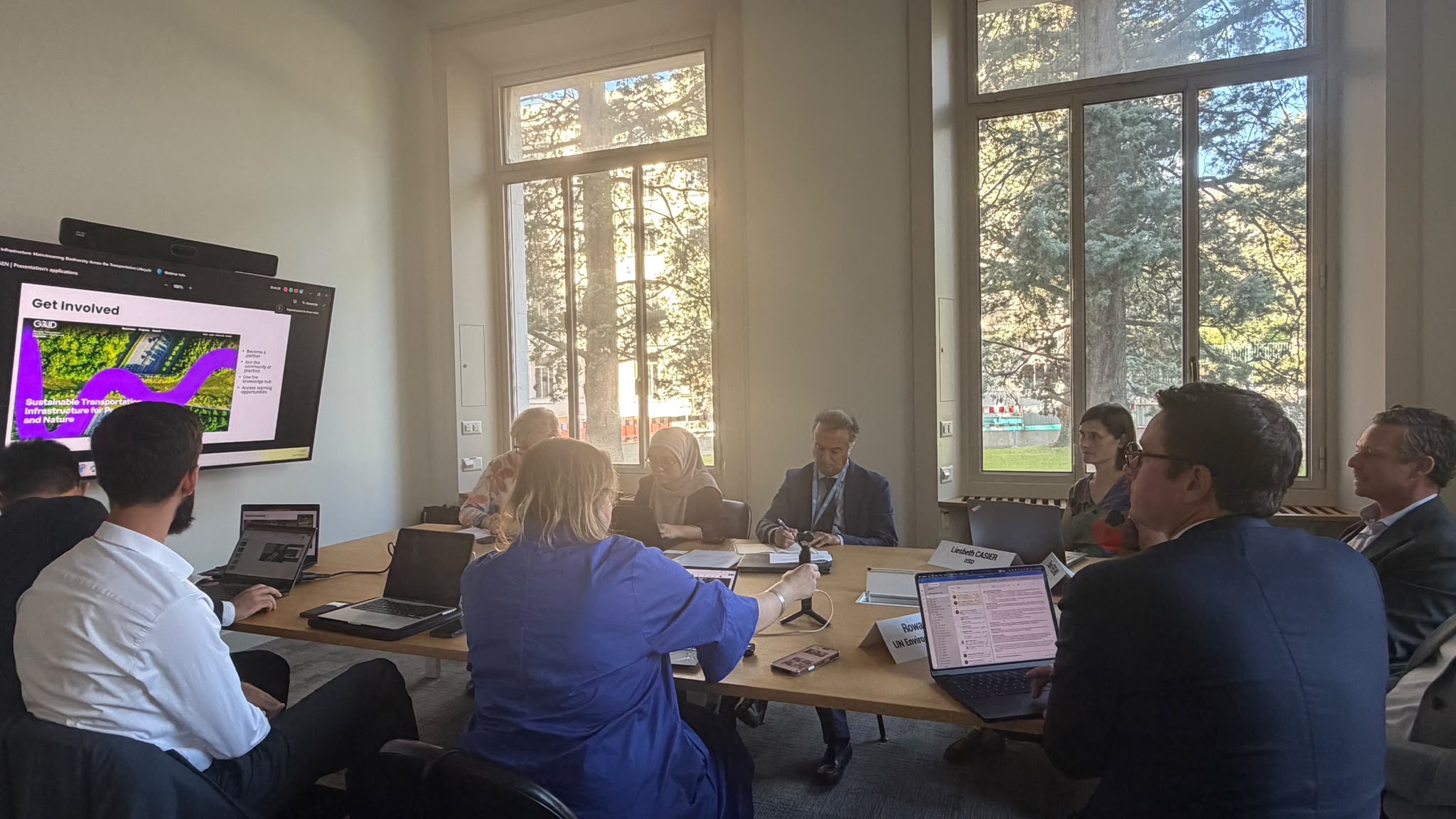
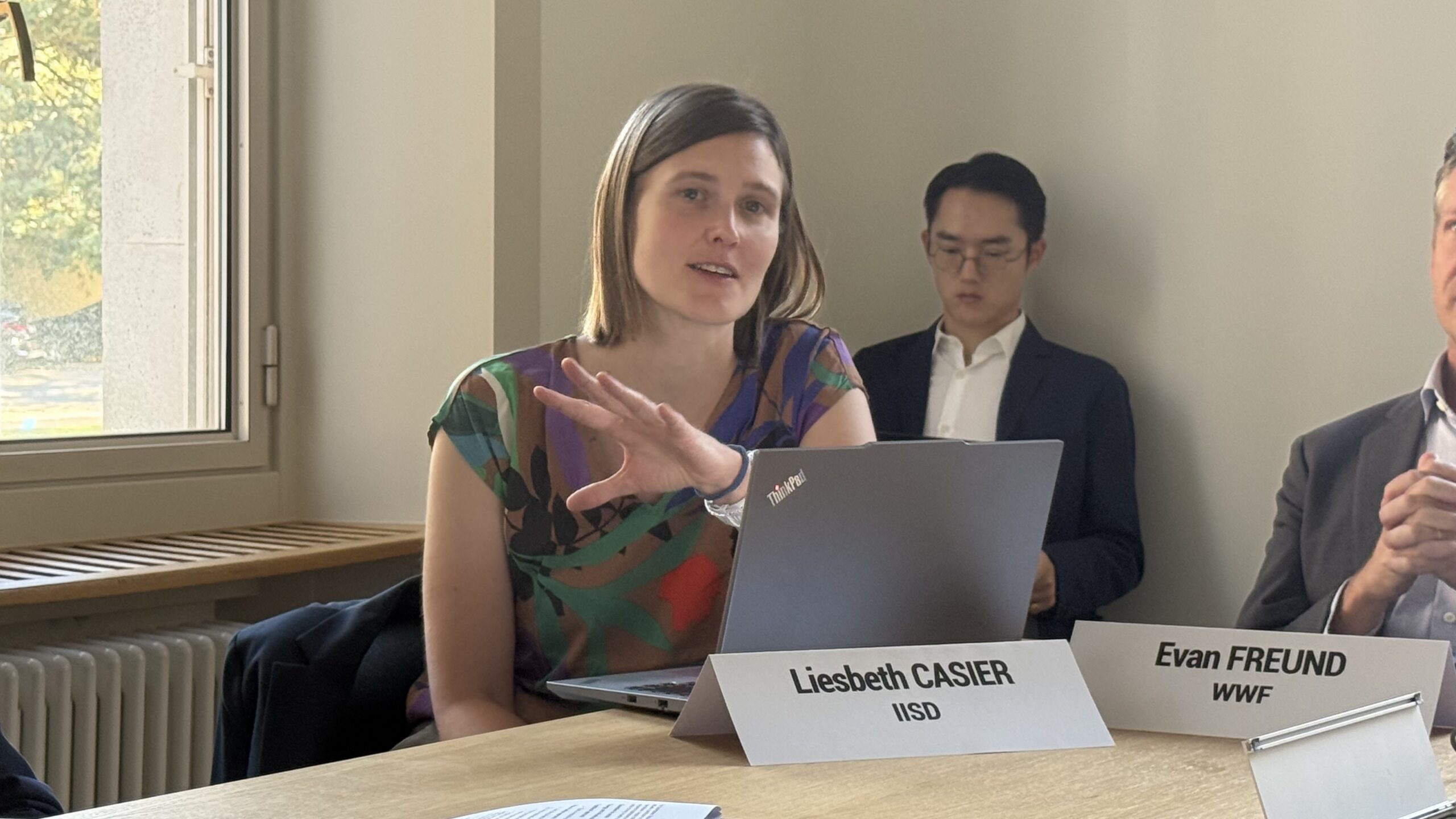
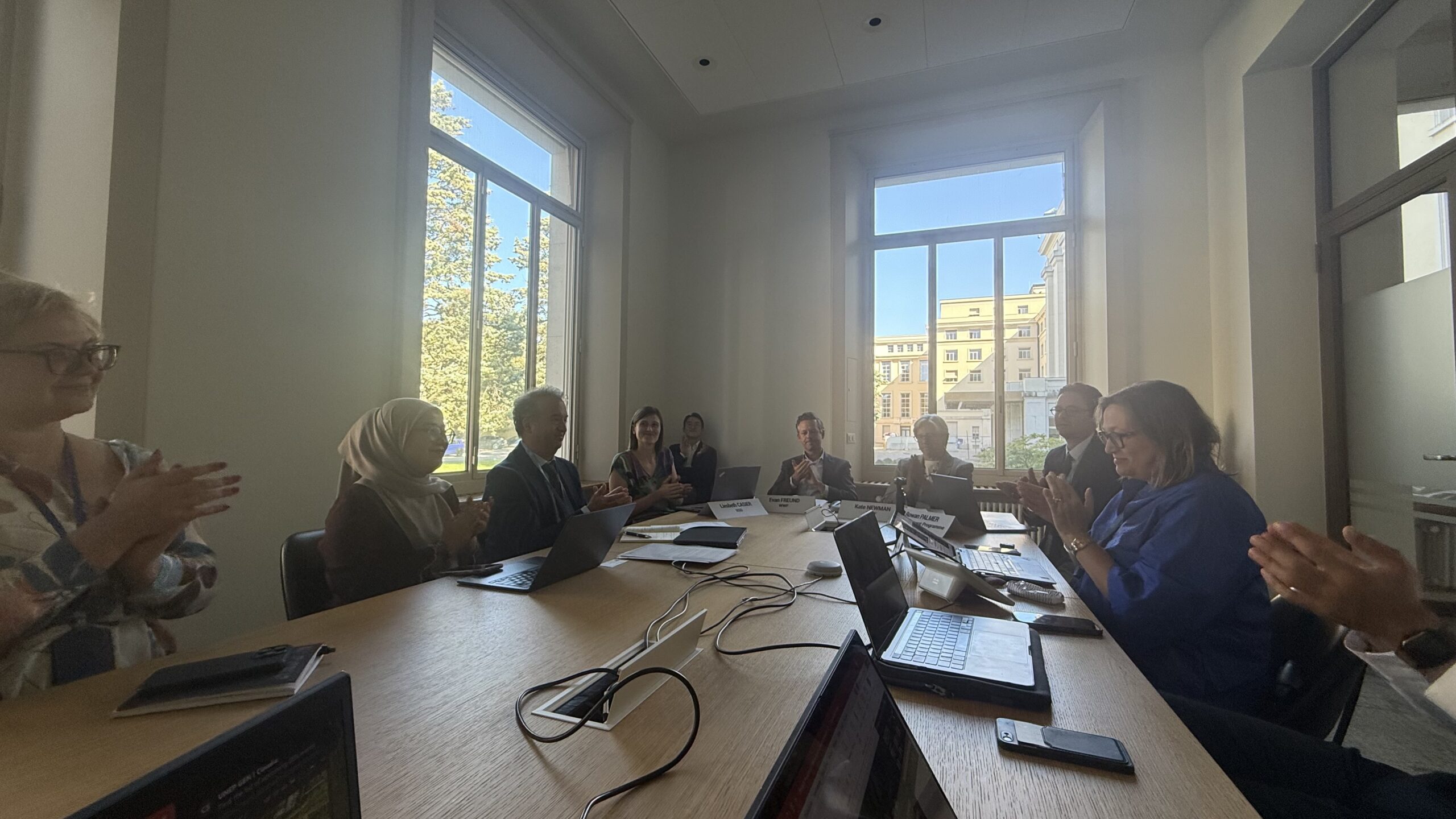
Photo Credit
© Getty Images | Artur Debat / WWF-US