Event Virtual
Road to OEWG 3 | Towards a Science-Policy Panel to Contribute Further to the Sound Management of Chemicals and Waste and to Prevent Pollution: An Overview
16 May 2024
14:00 – 15:30
Venue: Online | Webex
Organization: Ad hoc open-ended working group on a science-policy panel on chemicals, waste and pollution prevention, Geneva Environment Network
This online event is part of the "Road to OEWG 3 Series", co-organized by the Secretariat of the ad hoc open-ended working group (OEWG) on a Science-Policy Panel to Contribute Further to the Sound Management of Chemicals and Waste and to Prevent Pollution and the Geneva Environment Network.

About this Session
At its 13th meeting held on 31 January 2024, the Bureau of the ad hoc open-ended working group on establishing a science-policy panel to contribute further to the sound management of chemicals and waste and to prevent pollution requested the secretariat of the OEWG to develop an information document on the process to date.
The forthcoming information document (CWP/OEWG.3/INF/6) provides an overview of the origins of the initiative, key milestones to date (as of 30 April 2024), and a brief record of the ongoing negotiations towards the establishment of the panel. This webinar is a companion to this information document.
Featured speakers presented on their participation at different stages in this process, with the aim of informing Member States, non-government stakeholders and other interested parties as they prepared for the next steps on the “Road to OEWG 3”.
Road to OEWG 3 Series
In March 2022, the United Nations Environment Assembly at its resumed fifth session (UNEA-5.2) agreed to establish an independent, intergovernmental science-policy panel to contribute further to the sound management of chemicals and waste and to prevent pollution. An ad hoc open-ended working group (OEWG) process has been initiated to prepare proposals for the panel.
As set out in UNEA resolution 5/8, the panel will support countries to take action on chemicals, waste and pollution, including to implement various international instruments such as multilateral environmental agreements (MEAs), by providing policy-relevant scientific advice. The Panel will also further support relevant MEAs, other international instruments and intergovernmental bodies, and other relevant stakeholders in their work.
The OEWG concluded its second session in December 2023 in Nairobi, and will hold its third session in June 2024, in Geneva.
In preparation for the third session, the Road to OEWG 3 | Science-Policy Panel to Contribute Further to the Sound Management of Chemicals and Waste and to Prevent Pollution webinar and event series, co-organized by the OEWG Secretariat and Geneva Environment Network aims to build bridges between and among stakeholders, and promote collaboration and knowledge sharing in preparation for OEWG 3, taking place in Geneva, in June 2024.
Speakers
By order of intervention.

Michel TSCHIRREN
Head, Global Affairs Section, Federal Office for the Environment, Switzerland

Halshka GRACZYK
Technical Specialist, Occupational Safety and Health, International Labour Organization (ILO)

Ana Paula DE SOUZA
Human Rights Officer, Office of the High Commissioner for Human Rights (OHCHR)

Miriam DIAMOND
Vice Chair, International Panel on Chemical Pollution (IPCP)

David KAPINDULA
Zambia Environmental Management Agency (ZEMA)

Nalini SHARMA
Secretariat of the OEWG on a Science-Policy Panel on Chemicals, Waste and Prevention of Pollution | Moderator
Summary
Words from the Bureau
Michel TSCHIRREN | Head, Global Affairs Section, Federal Office for the Environment, Switzerland
- Science-policy panels for climate change with the IPCC and for biodiversity with IPBES have been in place for a long time. Intergovernmental science-policy panels working on these areas have proven useful in providing a global scientific consensus on important issues. For the area of chemicals and waste, such a panel has been lacking.
- Therefore, all UN regions through their Bureau members have been very supportive and the UN member states have been very engaged through various meetings and processes in the efforts to establish a science-policy panel on chemicals and waste and pollution prevention.
- To understand where we are going it is worth looking at where we are coming from, to pause and see what steps were already made, where we are at and what examples from the past are to be considered.
- Governments took a very clear decision with UNEA resolution 5/8 on the establishment of an independent intergovernmental panel that delivers policy-relevant scientific evidence without being policy-prescriptive. Before this UNEA resolution, a UNEP report mandated by a previous UNEA resolution presented several forms that this new science-policy panel could take, and member states went for the format of an intergovernmental, transparent and impartial panel. The intergovernmental aspect is very important as the governments need to see the relevance of the work done and to trust the panel.
- With IPCC and IPBES, we have good models to consider. Starting from scratch would be a missed opportunity. Many properties and wording from those panels, and their policies and decisions can and should be used for the new SPP and adapted where needed.
- The new SPP should get out of the environment silo by considering cross-cutting issues such as health and using the technical and organizational expertise, knowledge and networks of UNEP and WHO to reach stakeholders. To this aim, the new panel could have UNEP and WHO as institutional parents, through the creation of a joint secretariat and administrative support.
Resolution 5/8 and Presentation of the Information Document “Science-Policy Panel to Contribute Further to the Sound Management of Chemicals and Waste and to Prevent Pollution: an Overview”
Nalini SHARMA – Secretariat of the OEWG on a Science-Policy Panel on Chemicals, Waste and Prevention of Pollution
More information on WHO’s positioning on a joint secretariat was presented in the briefing held on 6 June 2024 through the presentation of the information document UNEP/SPP-CWP/OEWG.3/INF/5 – Possible modalities of cooperation and complementarities between the panel and WHO
- This webinar will be followed by an information document requested by the Bureau. It presents an overview of the process towards establishing the SPP on the sound management of chemicals and waste and to prevent pollution, and a record of the ongoing negotiations towards the establishment of the panel (including the early origins of the idea, key milestones to date including relevant UNEA resolutions and decisions taken by the governing body, key publications including from the International Labour Organization and the global scientific community).
A Record of Process | Towards a Science-Policy Panel to Further Contribute to the Management of Chemicals and Waste and to Prevent Pollution
- 2013: UNEP released the Global Chemicals Outlook I. The report was “designed to inform governments and industry on trends in chemicals production, use and disposal while offering policy advice”. It was “targeted to decision-makers in order to build capacity and to implement policy change to protect the environment and human health”. It represents an important early milestone for the global chemicals management community.
- 2013-2022: At least 17 major scientific publications produced by international organizations and the global scientific community were produced and established a strong knowledge base around the potential benefits of a scientifically sound and evidence-based detailed assessment of the state of the environment, for awareness raising informed policy formulation and decision making in the context of sustainable development.
- These were all published before the UNEA decision to establish an SPP on chemicals, waste and pollution prevention and according to the text of UNEA resolution 5/8, “individually and collectively, these publications represent a global consensus and call to raise global awareness of pollution and neglect of pollution related diseases and mobilize the resources and the political will needed to effectively confront pollution and to make pollution prevention a high priority nationally and internationally.”
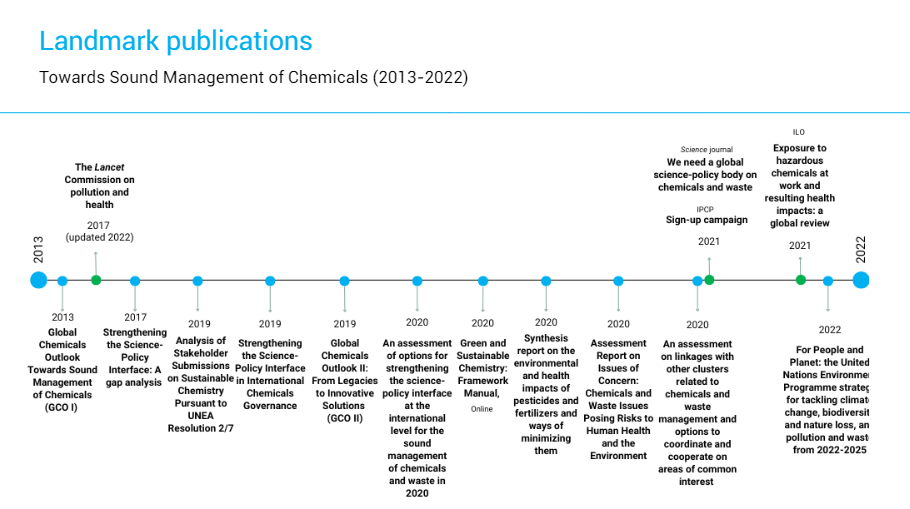
- 2017: The Lancet Commission on pollution and health. Its update from 2022 (Pollution and health: a progress update) states that “Pollution, climate change and biodiversity loss are closely linked: successful control of these conjoined threats require a globally supported formal science-policy interface to inform intervention influence research and guide funding.”
- 2017: UNEP released information documents on Strengthening the Science-Policy Interface: A gap analysis. It was followed by an analysis conducted by the International Panel on Chemical Pollution (IPCP), reflecting the views of international experts on desirable objectives and functions of a strong two-way science-policy interface and additional possibilities for strengthening a chemical science-policy interface.
- 2019: The Global Chemicals Outlook II by UNEP presented options for action to bring knowledge to decision-makers and “strengthen the science-policy interface and the use of science in monitoring progress, priority setting and policymaking throughout the life cycle of chemicals and waste”. The summary for policymakers makes clear that a comprehensive global framework is needed with ambitious priorities and coherent indicators and that global knowledge gaps can be filled by strengthening the science-policy interface through enhanced collaboration between scientists and decision-makers.
- 2020: Chemicals and Waste reports for UNEA 5, The global scientific community called for a global science-policy body on chemicals and waste through an open letter published in the Science journal and an IPCP campaign following the letter’s release.
- 2020: The ILO published an important study on the health impacts of exposure to hazardous chemicals at work, which calls to enhance the science-policy interface for occupational health and safety, and states that developing a robust two-way science-policy interface as part of the global efforts for sound management of chemicals represents a priority for the world of work.
Key decisions and resolutions in the past years:
- 2013: First resolution of the UNEP Governing Council | The council decided through decision 27/12 that UNEP would promote “a strong science-policy interface by reviewing the state of environment building on existing International instruments assessments panels and information networks including through an enhanced summary for policy makers for the global environment outlook”.
- 2014: The UN environment assembly’s first session (UNEA 1) requested through resolution 1/4 the Executive Director to “promote a strong science-policy interface” and to “foster collaboration with multilateral environmental agreement secretariats relevant United Nation agencies and programs and scientific panels for joint efforts to strengthen the science-policy interface”. It also requested the 2017 Gap analysis and recommendations on policy instruments.
- 2019: UNEA 4 Resolution 4/8 pointed to “the urgent need to strengthen the science-policy interface at all levels to support and promote science-based local, national, regional and global actions on the sound management of chemicals and waste beyond 2020, the use of science in monitoring progress thereon and priority setting and policy making throughout the life cycle of chemicals and waste, taking into account the gaps and scientific information in developing countries”.
- 2021-2022: UNEA 5.2. Adoption of a medium-term strategy (2022 to 2025) which includes a science policy subprogram with actions and interventions that include “developing an inclusive science policy interface that speaks to all”.
- UNEA Resolution 5/8 decided that a science-policy panel should be established to contribute further to the sound management of chemicals and waste, with an ambition to complete this work by the end of 2024 and to convene an ad hoc open-ended working group to prepare the proposals for the science-policy panel.
Summary of the work of the first and second OEWG sessions
- At its first session (OEWG 1.1 and OEWG 1.2), the OEWG worked through procedural matters, including the establishment of a Bureau and the budget, adopted rules of procedure for the conduct of its work and elected a Chair, Gudi Alkemade from the Netherlands.
- At its second session (OEWG 2), the OEWG agreed to establish contact groups to address the organization of work of the OEWG, the scope and the principal functions of the science-policy panel and agreed on an intersessional work plan: to undertake horizon scanning; to conduct assessments of current issues; to provide up-to-date and relevant information; to facilitate information-sharing with countries; and to facilitate capacity-building. It also started discussions on key topics such as operating principles, institutional arrangements or evaluation of the operational effectiveness and impact of the panel.
Objectives of OEWG 3:
- Proposal of a foundational document based on which the panel will be established. This document will be transmitted to the intergovernmental meeting, together with the Draft rules procedures and policies.
- Consider proposals for arrangements, including election of officers to constitute the Bureau, Strategic partnerships, etc.
Next steps:
Perspectives from Labour, Human Rights and Civil Society
Halshka GRACZYK – Technical Specialist, Occupational Safety and Health, International Labor Organization (ILO)
- Workers are overexposed to chemicals: 1 million workers lose their life every year due to chemical exposures. Whether it causes fatal diseases or injuries or non-fatal injuries that lead to disabilities, chemical pollution constitutes a global health crisis having a heavy economic impact on countries. The science-policy panel could shed light on these issues.
- ILO contributes to tackling this crisis by creating a legal framework for action based on social dialogue, including standards (recommendations or legally binding conventions), codes of practice and technical guidelines.
- ILO also creates a research framework through publications: its tripartite structure allows a direct access to the workplaces by working with the workers and the employer. It gives ILO insight into the most pressing challenges of hazardous chemical exposures throughout a variety of sectors and throughout the supply chain. ILO also creates tools on a range of topics related to chemicals, as well as training modules.
- A science-policy interface is essential for the world of work. Because of this pressing Global Health crisis, we need to have a strong evidence base for setting safety and health policies at two levels: the national level policy should be applicable practically and enforced at the workplace level. It is crucial to consider risk assessment for workplace exposures and understand what the health impacts are, especially when dealing with long latency periods, and in developing economies where the strong legal framework to protect workers doesn’t always exist. We must also be considerate of the importance of scientific evidence to understand the differences for gender and for workers in vulnerable situations. Furthermore, the world of work is changing and evolving. We need to think about just transition, the importance of green jobs reskilling, industrial policies, social protection, etc.
- It is essential to establish continued multi-sectoral engagement and to ensure that workers and employers are integrated and that this process is founded in social dialogue.
Ana Paula DE SOUZA – Human Rights Officer, Office of the High Commissioner for Human Rights (OHCHR)
- Science is showing us how pollution and the unsound management of chemicals and waste have become a threat to all human rights, including the rights to a clean, healthy, and sustainable environment, life, health, food, water, sanitation, a healthy work environment, etc. In doing so, science can give the tools for policy makers to take informed decisions.
- Too many governments, policy makers and big industry leaders are willfully shutting their eyes to science and deploying biased experts to create doubt and undermine scientific facts, suffocating scientific evidence at the expense of people and the planet.
- The new SPP has an incredibly important role in correcting our current path of destruction. Scientists have provided powerful tools to hold polluters responsible, which is why the right to science needs to be protected. Safeguarding commercially sensitive information at the expense of human health and the planet must be a no go. For science to flourish and development human rights principles of transparency, accountability and participation are essential to make science objective and reliable and to ensure that it’s not subject to the interests that are not scientific and are inconsistent with human rights principles and the welfare of society.
- The safeguarding of commercially sensitive information cannot be used as a tool against the protection of human and planetary health.
Key Messages
- A human rights-based approach requires that an effective science-policy panel engages all rights holders and disciplines securing opportunities for informed participation. Special attention must be paid to groups that have experienced systematic discrimination in the enjoyment of their right. They should participate and enjoy the benefits of scientific progress and its applications. Knowledge empowers communities.
- Information concerning the risks and benefits of science and technology should be accessible without discrimination. The new science policy panel must put in play all necessary efforts to overcome persistent inequalities in scientific advancement through culturally and gender appropriate means of education and communication, with the aim of encouraging the widest participation in scientific progress of those populations that have been traditionally excluded from such progress.
- Governments should fund research at the level that this existential threat deserves. International cooperation on technology transfer, mobilization of resources and sharing of scientific knowledge are essential to address deep disparities between countries and ensure that all people have a clean, healthy, and sustainable environment.
- The panel should be a safe environment for the conduct of free scientific inquiry, with specific guidelines to ensure the protection of scientists against corporate influence, direct attacks on scientific studies, campaigns against scientists, misleading literature, and exploitation of scientific illiteracy. These are tactics used to create doubt and suffocate evidence, keeping large parts of the population blind to the consequences of crossing the planetary boundaries, ignorant of how their choices are shaped by the profit of few and completely unaware of what we are consuming. The High Commissioner for Human Rights is calling on the new mandate to establish a system to prevent and address intimidation and reprisals against anyone engaging with the work of the panel.
- The SPP must include safeguards to avoid the risks associated with the existence of conflicts of interest by creating an environment in which actual or perceived conflicts of interest are adequately disclosed and regulated, especially those involving scientific researchers who give policy advice to policymakers and other public officials. Guidelines should also be in place to safeguard against attempts by business entities to achieve policy change by influencing research and knowledge production.
It is our hope that states will meet the challenge that falls upon them by carefully drafting a new science-policy panel with an ambitious mandate informed by robust independent science. For this to happen, we must protect the right to science to ensure that everyone can enjoy its benefits.
David KAPINDULA – Zambia Environmental Management Agency (ZEMA)
- Chemicals and waste still need a platform to govern the interaction between science and policy.
- UNEA resolution 5/8 has given the global community a mandate to create a unique body dealing with science and policy issues, especially on chemicals and waste, on the models of IPCC and IPBES. Chemicals and waste issues will receive the needed attention at international levels in relation to the triple planetary crisis relating to climate change, biodiversity loss and pollution that covers chemicals and waste. It will unlock the necessary resources for the implementation of chemicals and waste solutions at international level, as well as regional and national levels.
Key outstanding issues to the process going forward at the OEWG:
- Capacity-building. This issue is very critical to the existence and sustainability of the SSP, as it is with other existing panels such as IPCC and IPBES. Capacity-building is one of the functions of the SPP as agreed at OEWG 1.2 and OEWG 2 but needs to be further defined. There are currently two proposals in the text. Some aspects of capacity building should be emphasized. There is a need to elaborate what capacity is to be provided and to whom this capacity is to be given. There is also a need to mainstream capacity building and all the other functions of the SPP, which is very critical for taking care of the capacity needs of developing countries in relation to the efficient functioning of the SPP. → For a deep-dive on the capacity-building function of the SPP, revisit this session.
- Work-related processes and procedures. A schematic presentation of the diagram by the Secretariat is needed to help see the overall structure of the panel to establish the relationship between the plenary, the bureau, the interdisciplinary expert committee, working groups and other processes.
- Data sources should be looked at carefully and cover indigenous knowledge to unlock problem-definition and solution. Indeed, definition of knowledge will define how the problem is framed and the solution defined. It is therefore important that we do not discard indigenous knowledge and live behind developing countries.
- Crossover of mandates between other science-policy bodies should be looked at. UNEA resolution 5/8 is clear on creating an authoritative knowledge body on chemicals and waste such as the IPCC or IPBES. These bodies have their specific mandates which should not be in conflict. However, it is important to define how the SPP will cooperate with other bodies.
- Interdisciplinary expert committee, which is sufficient and broad enough to cover all the issues, being a mix of expertise including policy professionals. Therefore, there is no need for a policy committee as it would cause a proliferation of structures.
- Resourcing the Secretariat. As one of the lessons learned from other mechanisms, a well-resourced Secretariat in terms of staff and financial resources will enhance the work of the SPP. Therefore, there is a need to ensure that the Secretariat is well-resourced to cater for the needs of all stakeholders including developing countries.
Q&A
Q: What are the key objectives and priorities for the third session of the open-ended working group and how do these align with the international commitments on the Strategic Approach to International Chemicals Management (SAICM), now replaced by the Global Framework on Chemicals, and the Sustainable Development Goals?
Michel Tschirren: The future science-policy panel will provide assessments of important questions. The topics will be gathered, which means that different stakeholders, but also international organizations and existing conventions and processes will be able to submit these topics and questions. They need to be assessed by the panel to check that the questions are policy relevant, and the panel will provide answers and options. The answer or the option provided by the panel should respect the principle that these products are policy relevant but not policy prescriptive. It is an opportunity for other actors including these institutional stakeholders to pick up the analysis and the options in their work, include it in their decision-making and in their work in developing future steps. For example, such a report from the panel could be considered by the global framework on chemicals or by a chemicals and wastes convention if the topic assessed is pertinent for the scope of the instrument. At the same time, certainly other actors like national policy makers should have access to these products and should be able to take them up. In terms of topics and questions, these can be received from various sources. Then, the products are being made available so that they can be picked up by the actors that see merit with regards to the topics assessed.
Q: What are some of the successful examples of policies strategies and initiatives aimed at preventing pollution from chemicals and waste at the national, regional, and global levels and what lessons can be learned from these experiences?
Halshka GRACZYK: When it comes to implementing action, ILO follows a specific hierarchy of controls. The first would be eliminating certain hazardous chemicals that we know are toxic, that are known to cause deaths and to be carcinogenic, that have been labeled as such and classified as such. To do so, we ensure we can ban those chemicals or severely restrict their use to ensure that workers are not exposed. The next step would be substitution: allowing a process, an enterprise, or a production mode and mechanism can continue to operate without the most hazardous chemicals and with less hazardous substitutes by basing our choices on a sound scientific basis.
ILO also has in place mechanisms that work directly at the workplace level, as for instance occupational exposure limits. Ensuring that we have proper occupational exposure limits for the different types of chemicals that workers face exposure to, given their perhaps vulnerable status, the number of hours they work, the cocktail of chemical exposures they are exposed to. We also conduct risk assessments to make sure that there is a participative and constantly updated risk assessment at the workplace level to guarantee that workers are not being exposed.
All these actions are framed in that important avenue of social dialogue. The aim is to ensure that:
- employers and workers are on the same page,
- there is a mechanism for collective bargaining,
- there are other rights in place for workers to make sure that they have the right to knowledge, the right to remove themselves if there is a very hazardous situation and the right to a safe and healthy working environment.
The main preoccupations must be ensuring that the evidence-based approach uses the most up-to-date scientific policies, that social dialogue is in place at the workplace level and making sure that we have an evolving process of knowledge, up-to-date information, and that the newest information can be transmitted both into the workplace and also coming out of the workplace to the scientists and the policymakers.
Miriam Diamond: Amongst the successes are those achieved by the Stockholm Convention on Persistent Organic Pollutants (POPs)and through the Minamata Convention on the control the use and release of mercury. Both examples involve workers’ rights, environmental protection and global issues. It could not have been tackled by individual governments, which is why we need global cooperation.
Q: How can the science-policy panel support efforts to strengthen the scientific basis for decision-making enhance collaboration between scientists and policy-makers and promote evidence-based policies and practices?
Miriam Diamond: A science-policy panel has the authority to bring together nominated experts from different countries to collectively address the problem and to be dedicated towards addressing the problem, bringing together needed disciplines and ways of knowing to collectively address the issue, without vested conflicts of interest. The science-policy panel fosters the need in the scientific community to provide more tools for solutions-based assessments, to provide policy-relevant but not policy-prescriptive assessments. It indicates the need for new types of understanding and assessments and hopefully, the scientific community will respond to that need, in a concerted effort to solve these complex problems.
Q: How would plastic, microplastic and nanoplastic pollution fit into the scope of chemical pollution and what would be the best way to combat this type of pollution so that a multiplicity of efforts can be avoided?
Nalini Sharma : It will depend on the types of questions asked to the panel and on the topics that will be prioritized by the panel once it is established.
Q: How many contact groups will focus on the deliberated topics?
Nalini Sharma: The chair will prepare a scenario note which will be published in early June and will provide information about the organization of work for the third session, including the tentative schedule for that week.
Q: How will the information be made available to the public?
Nalini Sharma (moderator): This is part of the functions of the panel that are being agreed upon in terms of information sharing and communication awareness raising. These discussions on operationalizing the different functions will be taking place at the third session and will also be considered by the panel once it’s established. We hope that information will be shared in a very easy-to-understand manner, easy for uptake for various bodies including decision-makers and the public.
Highlights
Video
Live on Webex
Documents
- Towards a science-policy panel to contribute further to the sound management of chemicals and waste and to prevent pollution: an overview (UNEP/SPP-CWP/OEWG.3/INF/6)
- Presentations made during the event
- Exposure to lead in the world of work: Impacts for occupational safety and health | ILO | September 2023
- Hazardous exposures to plastics in the world of work | ILO | September 2023
- Pollution and health: a progress update | The Lancet | 2022
- UNEA Medium-Term Strategy 2022-2025 | 2022
- Safety and health in textiles, clothing leather and footwear | ILO | 2022
- Diagnostic and exposure criteria for occupational diseases | ILO | 2022
- Exposure to hazardous chemicals at work and resulting health impacts: a global review | ILO | 2021
- We need a global science-policy body on chemicals and waste | Z. Wang, R. Altenburger, T. Backhaus, A. Covaci et al. | Science | 2021
- Chemicals and Waste reports for UNEA 5 | UNEP | 2020
- UNEA resolution 4/8 “Sound management of chemicals and waste | 2019
- Global Chemicals Outlook II: From Legacies to Innovative Solutions | 2019
- Strengthening the Science-Policy Interface in International Chemicals Governance: A Mapping and Gap Analysis | IPCP | 2019
- The Lancet Commission on pollution and health | 2017
- Strengthening the Science-Policy Interface: A gap analysis | UNEP | 2017
- UNEA 1 Resolutions | 2014
- Global Chemicals Outlook I | UNEP | 2013
Links
- Ad hoc open-ended working group on a science-policy panel on chemicals, waste and pollution prevention | UNEP
- Road to OEWG 3 | Science-Policy Panel to Contribute Further to the Sound Management of Chemicals and Waste and to Prevent Pollution
- Developing a Global Science-Policy Panel on Chemicals, Waste and Pollution Prevention
- Operating Principles: Learning from Previous Practice | Background document to support discussions on operating principles
- Geneva addressing Hazardous Substances
Photo Credits
Photos by IISD/ENB | Mike Muzurakis