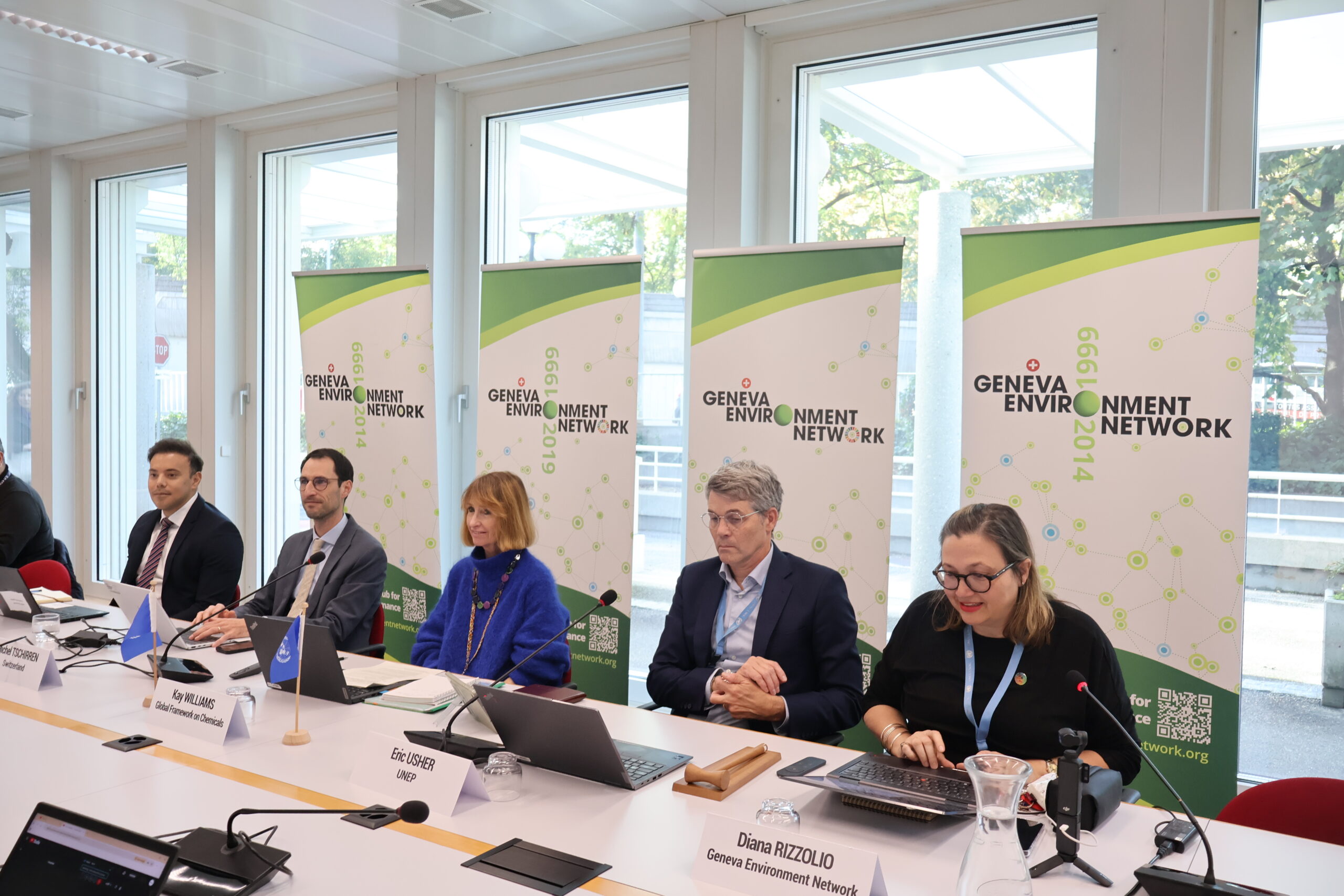
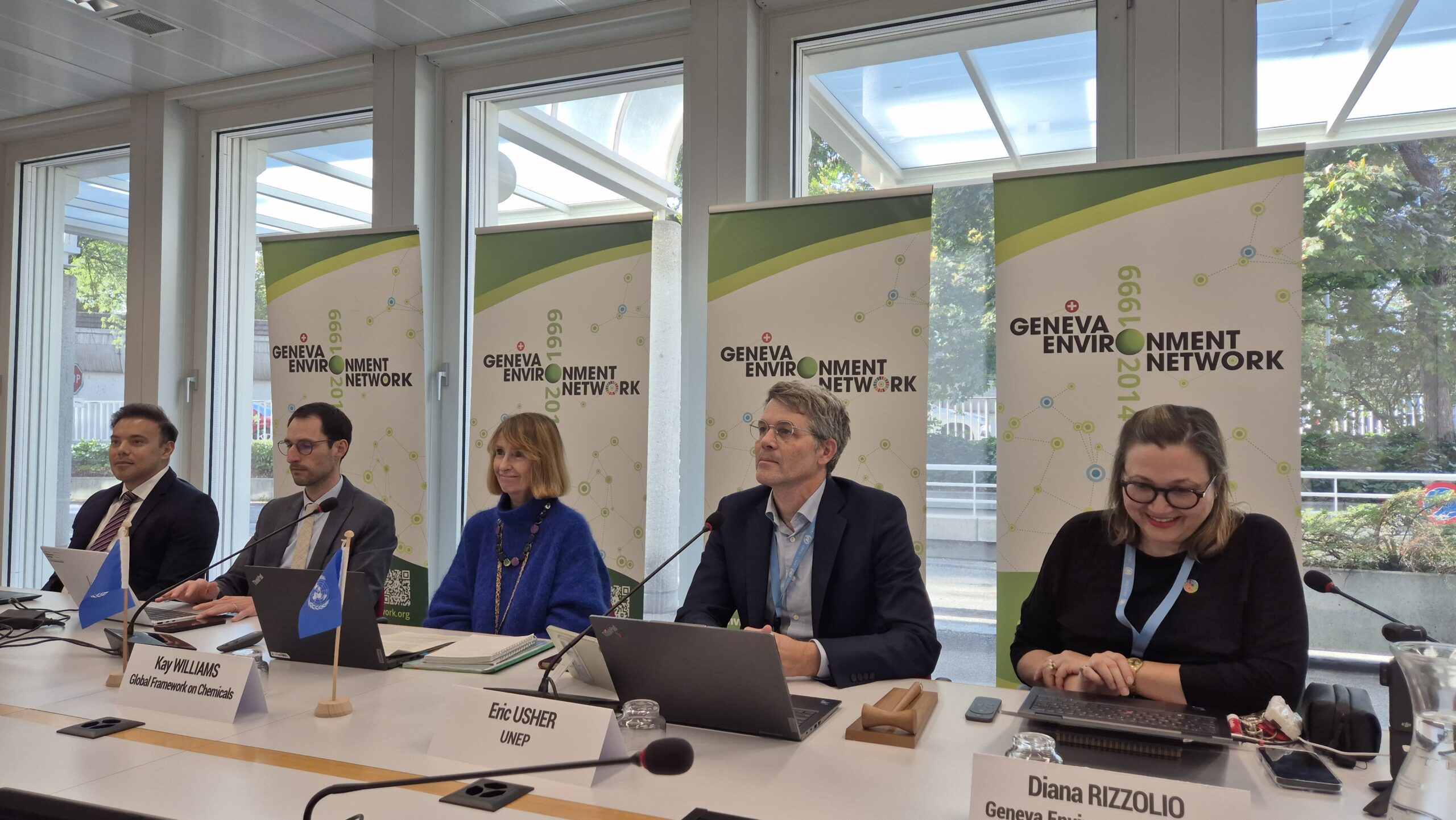
Event Conference
Road to the First International Conference of the Global Framework on Chemicals | Investing for Impact for a Planet Free of Harm from Chemicals and Waste
27 Oct 2026
14:00 – 15:30
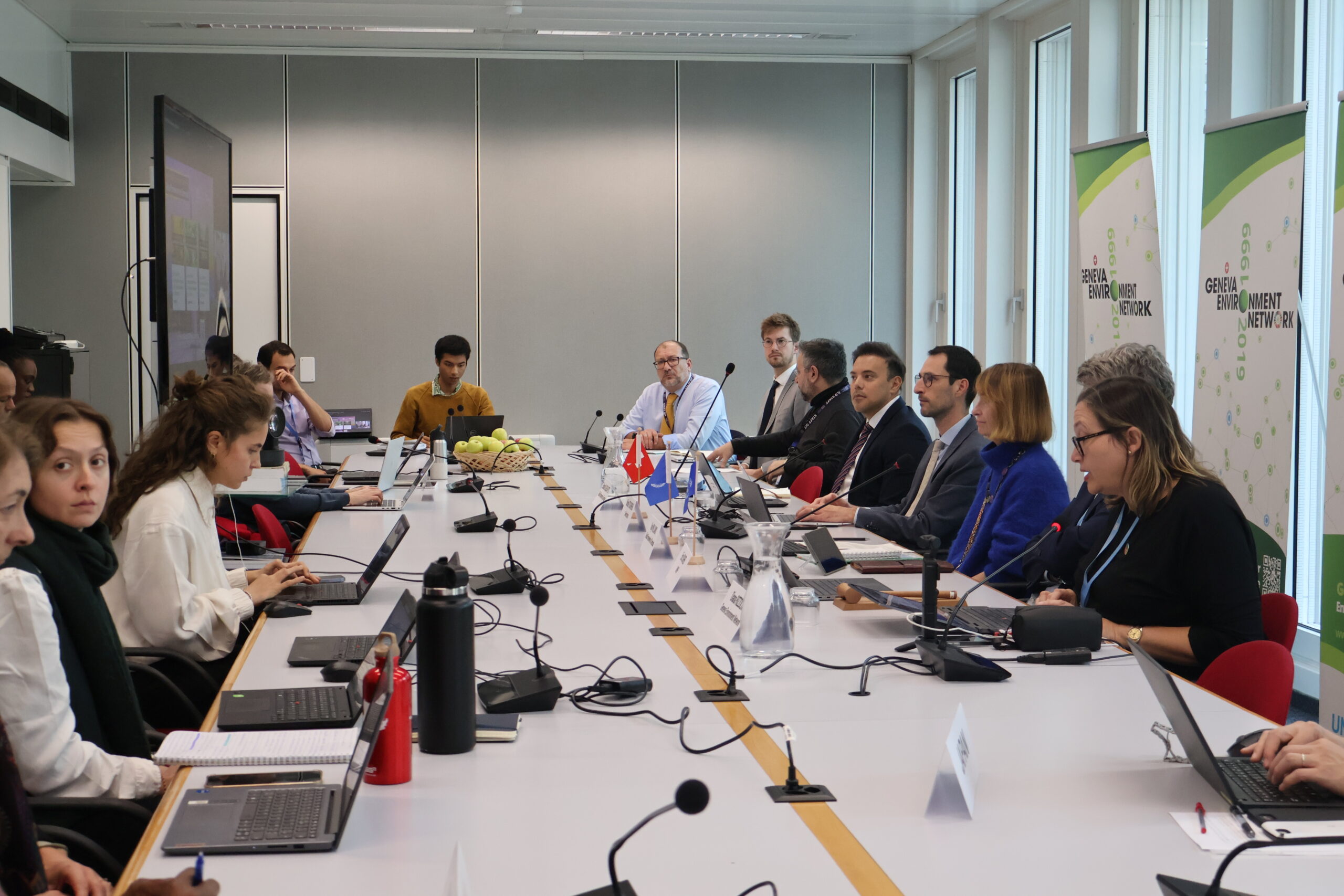
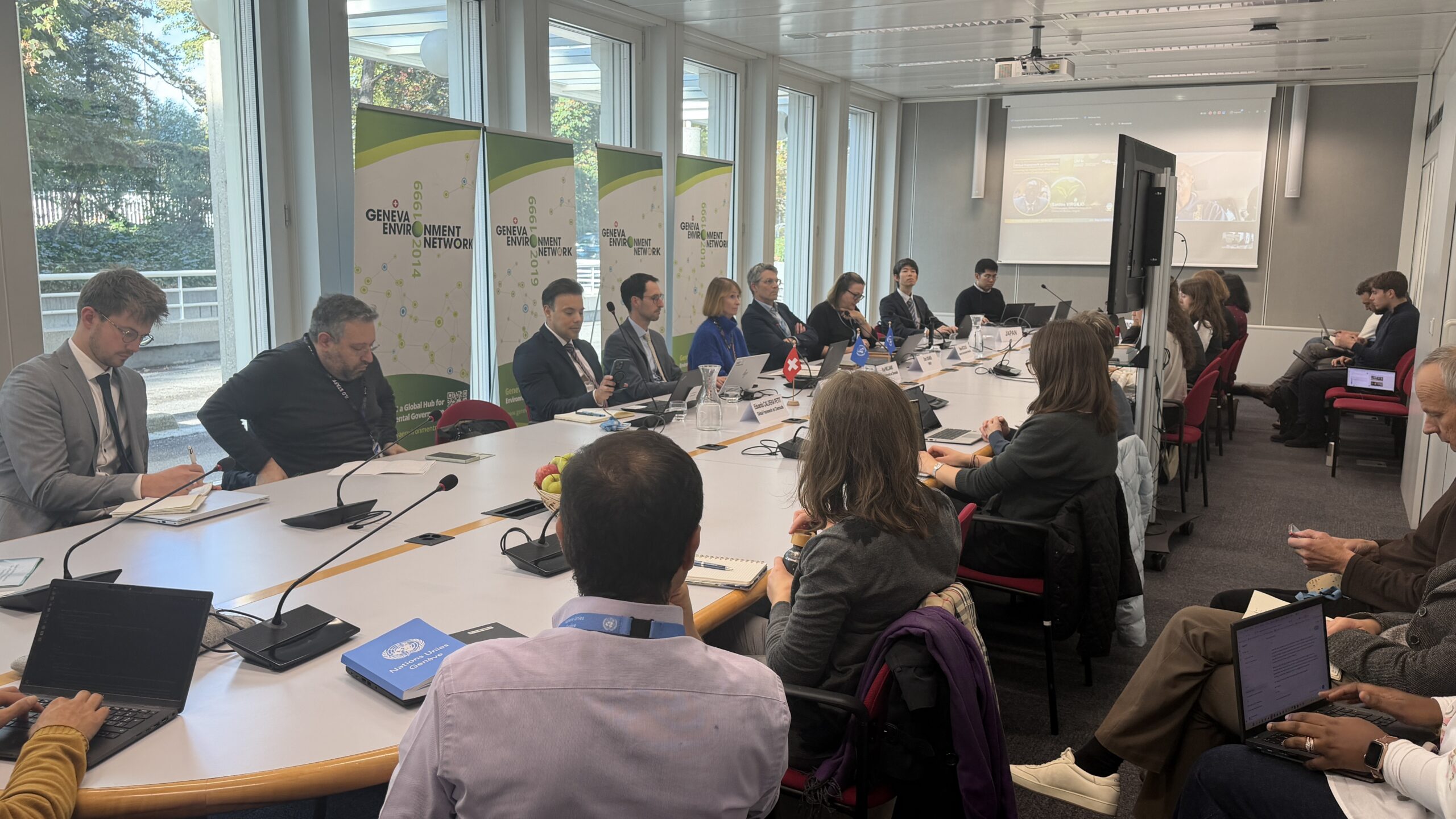
Venue: International Environment House I, Room 2 & Online | Webex
Organization: Global Framework on Chemicals, Geneva Environment Network
This event is organized in the run-up to the First International Conference of the Global Framework on Chemicals.
About this Event
The Global Framework on Chemicals, adopted in September 2023 at the Fifth International Conference on Chemicals Management (ICCM5), will convene its first International Conference from 16 to 20 November 2026 in Geneva.
Building on the discussions of the 4th Berlin Forum on Chemicals and Sustainability on Finance for a Planet Free of Harm from Chemicals and Waste, this session will take the conversation from finance to action, focusing on how financial resources can be better aligned and deployed to support implementation and deliver greater impact.
The event will connect the outcomes of the Berlin Forum with key financing discussions ahead of the first International Conference, including proposals for the future evolution of the GFC Fund and the longer-term financial sustainability of the GFC Secretariat.
Taking place three weeks before the first International Conference, the event will also provide stakeholders with a final overview of the Conference’s key priorities, expected discussions and programme, highlight opportunities to engage during the week, and provide a space to exchange views on key messages and priorities to carry forward to the first International Conference.

Road to the First International Conference of the Global Framework on Chemicals Series
Member States have adopted agreements that set common goals and targets to tackle the triple planetary crisis, including the Global Framework on Chemicals – For a Planet Free of Harm from Chemicals and Waste (GFC), adopted in Bonn in September 2023 and supported by a Secretariat hosted in Geneva. This Framework provides the essential building blocks for a future in which humanity benefits from chemicals in a safe and sustainable manner, while avoiding their negative impacts.
In preparation to the First International Conference of the Global Framework on Chemicals, to be held in Geneva from 16 to 20 November 2026, the Global Framework on Chemicals secretariat and the Geneva Environment Network are hosting a series of events providing an outlook on key aspects of the Conference, offering member states and stakeholders opportunities to share perspectives and expectations.

Speakers
By order of intervention.

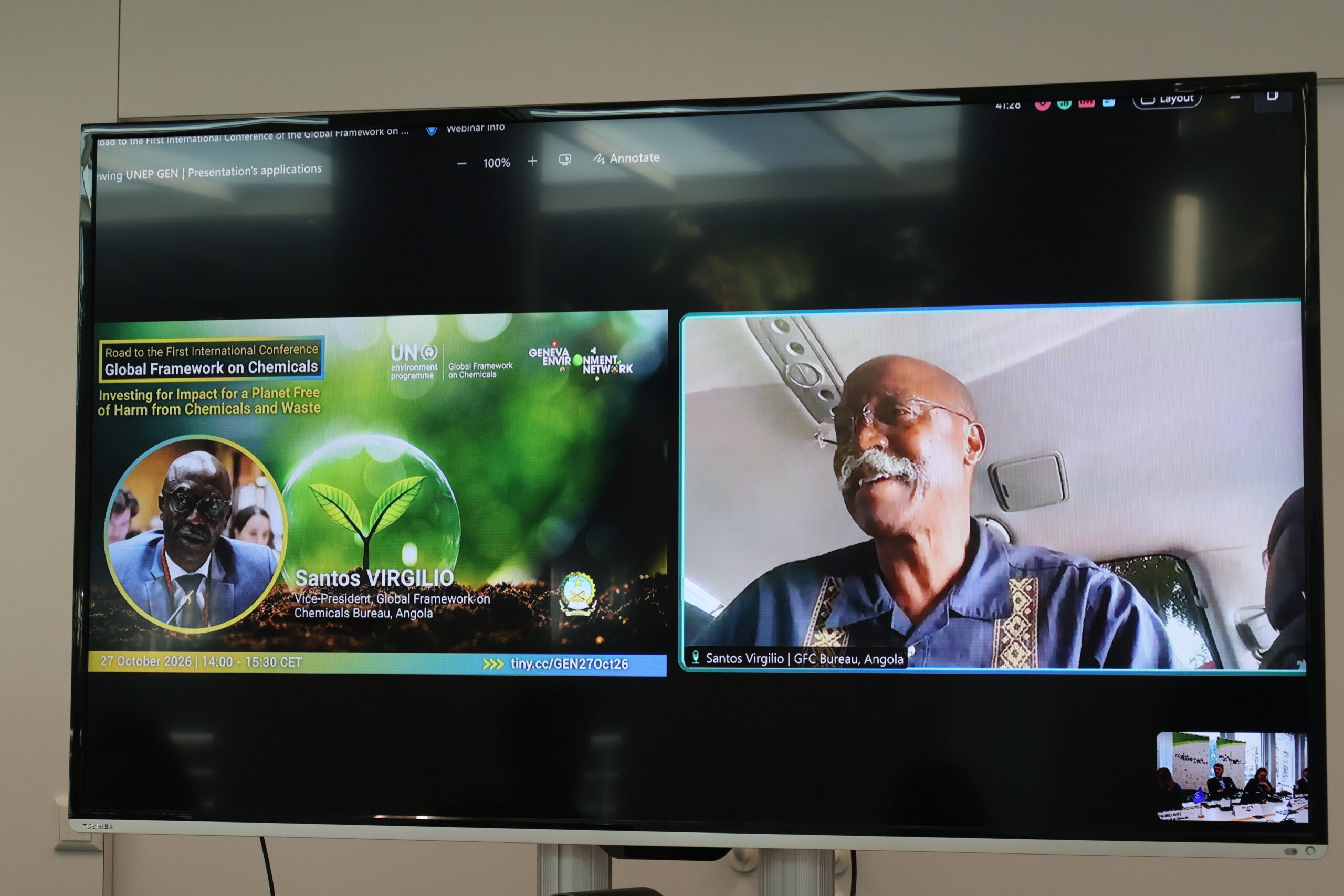
Santos VIRGILIO
Vice-President, Global Framework on Chemicals Bureau, Angola

Eric USHER
Chief of Finance and Economics Branch, UN Environment Programme

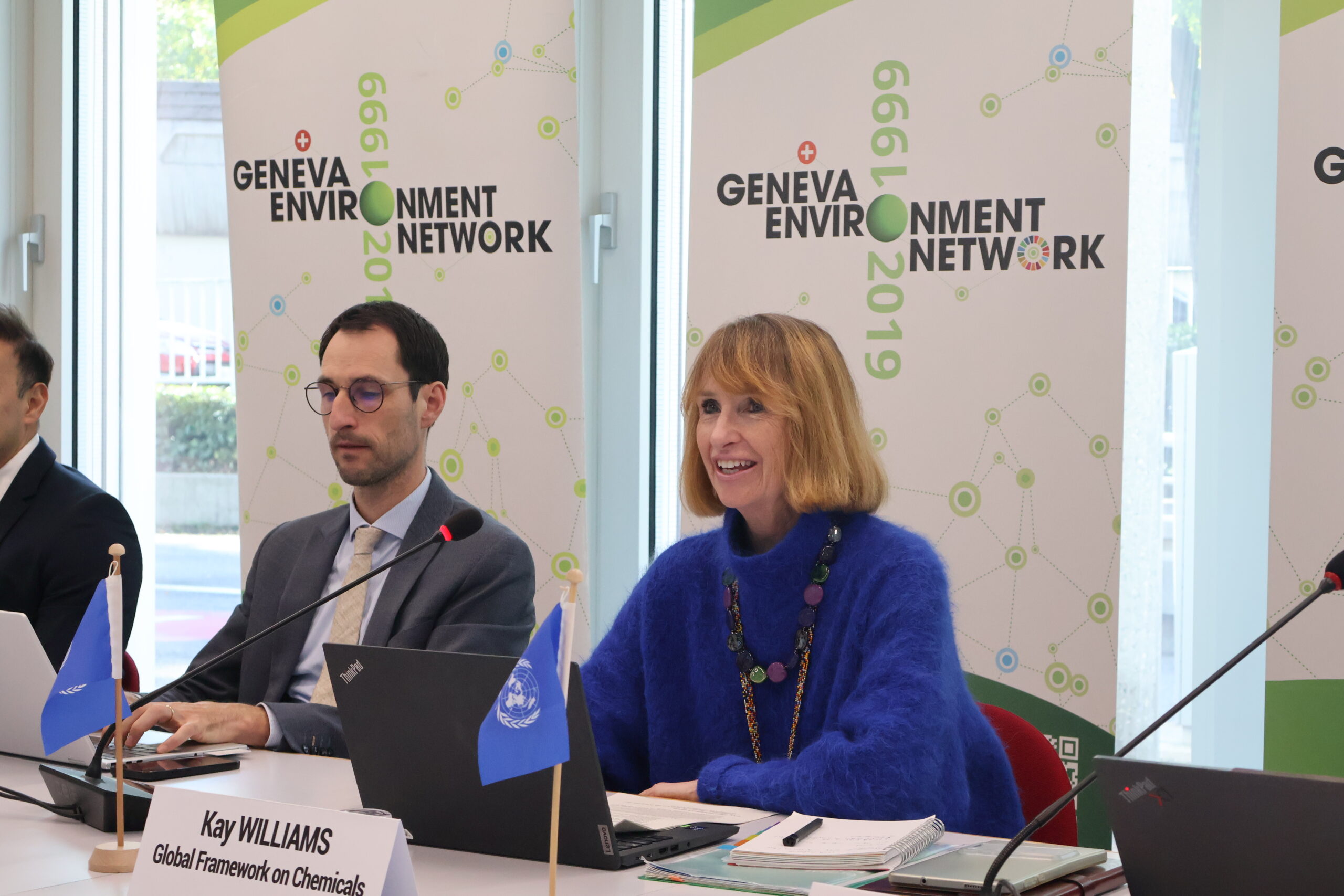
Kay WILLIAMS
Head, Global Framework on Chemicals
Eduardo CALDERA-PETIT
Coordinator, Global Framework on Chemicals Fund
Matthias WOLF
Senior Policy Advisor International Chemicals, Federal Ministry for the Environment, Nature Conservation and Nuclear Safety, Germany

Michel TSCHIRREN
Head, Global Affairs Section, Federal Office for the Environment, Switzerland

Diana RIZZOLIO
Coordinator, Geneva Environment Network | Moderator
Highlights
Summary
Opening Remarks
Santos VIRGILIO | Vice-President, Global Framework on Chemicals Bureau, Angola
- Let us take this conference as an opportunity to demonstrate how committed we are to the process and how the commitments we made in Bonn can be translated into national priorities, international action, partnerships and practical solutions. We need to establish a clear direction for the next phase of implementation and strengthen confidence in the commitment of all stakeholders to its long-term success.
- There is a need to build on what we achieved in Bonn, showing real, concrete and credible signals of commitment and engagement.
- This is the time for action. Chemicals and waste management must remain a priority on international and national agendas, based on political leadership, which is needed to ensure that the Framework’s objectives are reflected in national policies, institutional priorities, development planning and resource allocation.
- Businesses should demonstrate leadership by investing in safer alternatives and cleaner production, integrating chemical safety into business decisions, and mobilizing resources across their value chains to accelerate the transition towards safer and more sustainable practices.
- Banks, insurers and investors should integrate chemical-related risks and opportunities into their lending, underwriting and investment decisions, helping redirect capital towards safer and more sustainable solutions.
- Civil society leadership can connect local realities with global finance and build coalitions, generating evidence that attracts future investment and helping to make investment more equitable and inclusive.
- The Conference’s three themes – tracking progress, accelerating action and investing for impact – provide a clear framework for the discussions ahead. The Framework’s ambitions must be translated into practical action across countries and sectors.
- Finance is critical and must become an engine that enables the international community, countries and stakeholders to translate commitments into measurable progress.
- One of the defining strengths of the GFC is its multistakeholder nature, bringing together governments, industry, financial institutions, international organizations, civil society, academia, youth and other stakeholders around a shared vision.
- However, multistakeholder participation must mean more than being present at the same table. It must translate into shared, common but differentiated responsibilities.
- Different stakeholders have distinct but complementary responsibilities to contribute, but they cannot act in isolation. Governments need partners willing to invest. Businesses need clear direction and supportive conditions. Countries need access to the expertise and resources required to implement their priorities, and the private sector needs to show its commitment through visible contributions to innovative and creative means of implementation.
- It is particularly important that developing countries and countries with economies in transition can participate meaningfully in these efforts, with their circumstances, capacities and financing needs reflected in the decisions taken at the conference.
- One of the challenges in the remaining preparations, with less than three weeks before the conference, is the fact that developing countries had no opportunity to organize their regional preparatory meetings in order to agree on their priorities and common positions, which would have allowed them to better prepare their participation.
- Despite this, we are asked to make this conference an opportunity to identify common priorities, strengthen cooperation and advance practical approaches to implementation and financing.
- Today’s event can make a useful contribution to building a common understanding of the financing issues ahead of the conference and encouraging stakeholders to consider how they can support the next phase of implementation.
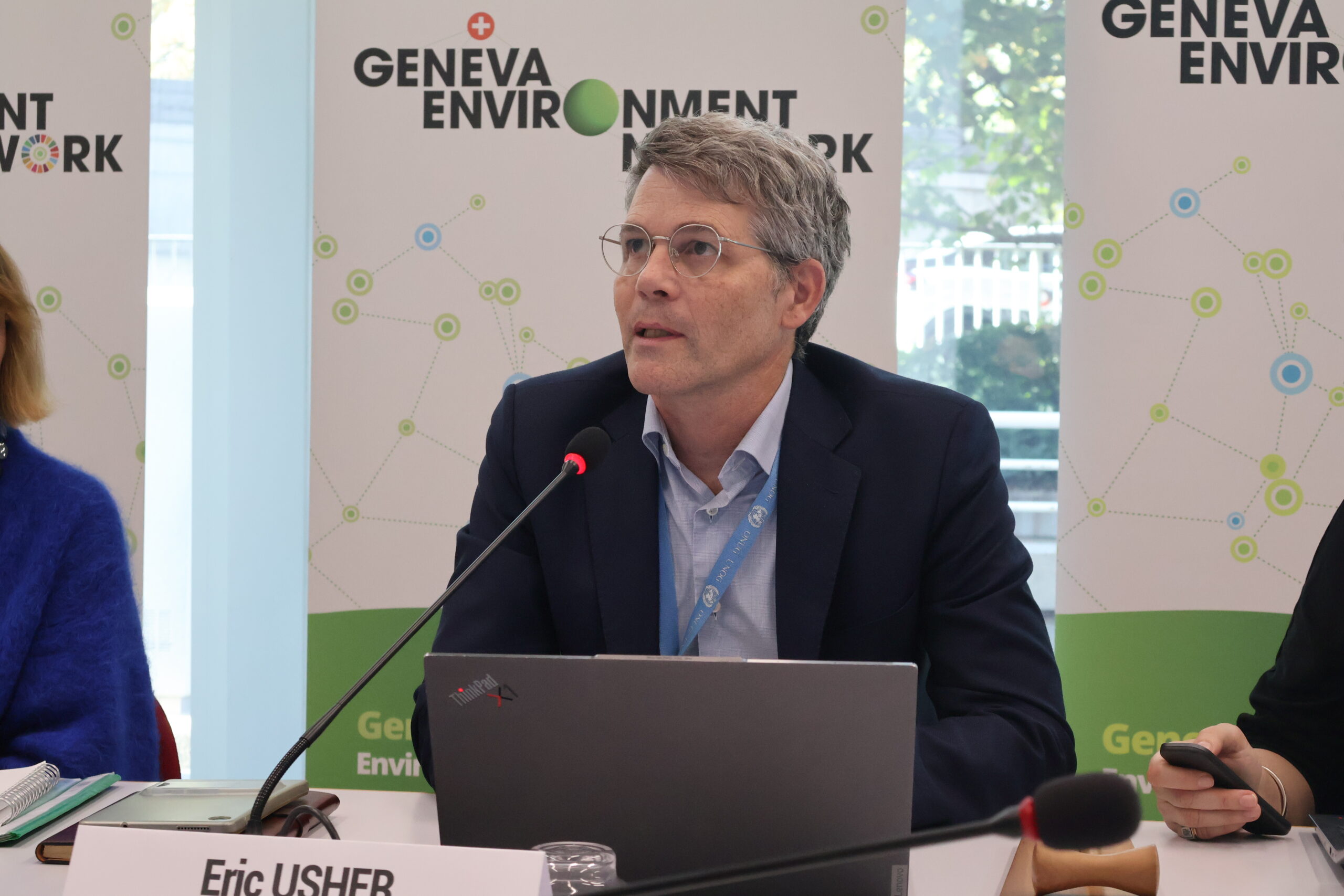
Eric USHER | Chief of Finance and Economics Branch, UN Environment Programme
- Chemicals are embedded across economies and value chains; more than 95% of manufactured goods rely on chemicals.
- The chemical industry contributes around US$5.7 trillion to global GDP and supports around 120 million jobs, underscoring how central the sector is to economic activity.
- The global chemicals industry generated approximately US$6.2 trillion in revenues in 2024, while the World Health Organization estimates that exposure to selected chemicals contributed to 2 million deaths in 2019.
- Safe and sustainable chemicals management should therefore be understood not only as an environmental objective, but also as an issue of economic resilience, competitiveness, health and development.
The finance challenge is one of alignment
- Hazardous chemicals can create various financial risks across portfolios – regulatory, litigation, market, and reputational risks. For example, we start to see multi-billion dollar settlements to resolve PFAS-related claims.
- The opportunity is equally significant. It is estimated that minimizing the adverse impact of chemical pollution can save tens of billions of US$ annually. With the global chemicals industry projected to reach US$10 trillion by 2030, there is substantial scope for the finance community to support safer alternatives, cleaner production and sustainable chemistry innovation.
- The key issue is not simply the availability of capital, but whether capital is aligned with safer, more sustainable and more circular production and value chains.
- Clear policy signals, predictable regulation, stronger institutions, transparency and investment-ready solutions are what give financiers the confidence to act.
- This is the enabling environment needed to move from isolated projects to scale.
- We are already seeing some emerging examples of good practice.
- A forthcoming report by the GFC Private Sector Financing and Investment Workstream under the IOMC Implementation Programme highlights some emerging practices across financial institutions, especially institutional investors.
- Some banks are moving beyond conventional exclusions and due diligence to engage clients on chemicals management and support the transition to safer alternatives, including through requirements for transition plans.
- Some insurers are adopting more differentiated approaches to chemicals-related liabilities, targeted exclusions and pollution liability products. Some investment managers have introduced exclusion policies targeting PFAS for instance, while others have successfully engaged major chemical producers to improve transparency and secure commitments on hazardous chemicals.
- Investors are also using shareholder resolutions to push companies towards stronger chemicals management.
- While these practices are not yet widespread, they demonstrate how financial institutions can move beyond compliance-driven risk management towards more proactive approaches to addressing chemicals-related impacts and risks and supporting the transition to safer alternatives.
- The opportunity is to move from isolated leadership to mainstream financing practice. While these examples demonstrate what is possible, action remains fragmented, with policy fragmentation and gaps in data and disclosure holding back wider adoption.
- That is where the GFC can play an important role to create the enabling environment to attract private capital.
Different sources of finance have different roles
- Banks, insurers and institutional investors can support the transition through lending and investment decisions, risk management, client or investee engagement and financing safer alternatives, supported by appropriate data, regulatory frameworks and risk-sharing mechanisms.
- Domestic public finance remains essential for core public functions and long-term national implementation.
- International and grant finance can play a catalytic role by strengthening laws, institutions, domestic financing systems and project readiness.
- Development finance and private capital can help scale solutions where appropriate business or revenue models exist.
- The objective should be to use these sources in a complementary way, while strengthening the enabling conditions needed to mobilise and scale finance for the transition to safer chemicals.
- The 4th Berlin Forum on Chemicals and Sustainability highlighted the role of public policy, domestic financing instruments and private finance in scaling implementation. And we will hear about the detailed outcomes of the Forum today as well.
- IC1 is an opportunity to bring together governments, industry, investors, development finance institutions and other stakeholders around a more coherent financing approach.
- Finance should become an engine of implementation, not a separate discussion from implementation.
- The priority is to create the enabling conditions that allow resources to flow toward safer chemistry, cleaner production, circular solutions and stronger national systems.
- The IOMC Implementation Programme is taking this forward. Under this Programme, the UNEP FI-convened Private Sector Financing and Investment Workstream provides a dedicated multi-stakeholder platform to help shape the transition and its financing. It aims to:
- mobilize finance and investment for safer and more sustainable chemicals management,
- raise awareness and build capacity,
- identify financing needs and opportunities to transition entire value chains, and the enabling conditions required to mobilise public and private capital, and
- provide implementation support to financial institutions, identifying key barriers and gaps, and informing priorities for scaling action.
- The transition to safer and more sustainable chemicals cannot happen without finance, and that is why finance is one of the three pillars of the GFC first International Conference
- Mobilising capital requires more than ambition. This is why your voice at IC-1 matters. Your perspectives can help shape practical solutions and ensure that the GFC’s implementation priorities reflect real-world investment needs and opportunities.
- We strongly encourage you to join the session “Financing GFC Implementation” on 19 November 2026. This is an opportunity not just to participate in the discussion, but to help shape the financing approaches, partnerships and enabling conditions needed to accelerate implementation.
- The GFC sets the direction, but the finance community can enable the transition. The challenge is to turn commitments into capital, influence into action, and ambition into measurable impact.
Investing for Impact: The Road to the First International Conference
Kay WILLIAMS | Head, Global Framework on Chemicals
- The three themes of the Conference – tracking progress, accelerating action and investing for impact – are interlinked and will be a focus for the whole week. Related to these, there are desired outcomes.
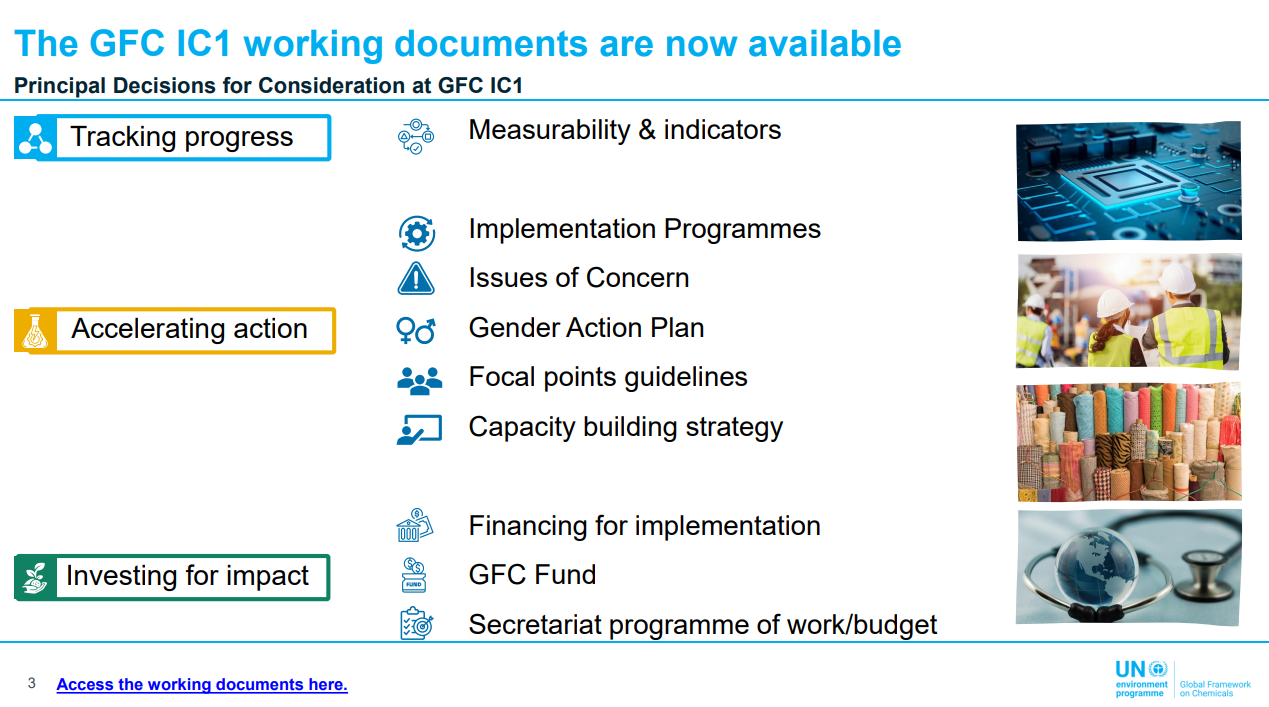
- The agenda can be broadly understood through those three themes.
Tracking Progress
Accelerating Action
- Under this, the Conference will be looking at the mechanisms through which we can accelerate action, such as implementation programmes, but also understanding and identifying the key issues of concern on which the International Conference wishes to take action and focus in the future.
- Discussions will include financing for implementation, including the Fund, but also how to keep the Framework going through its Secretariat.
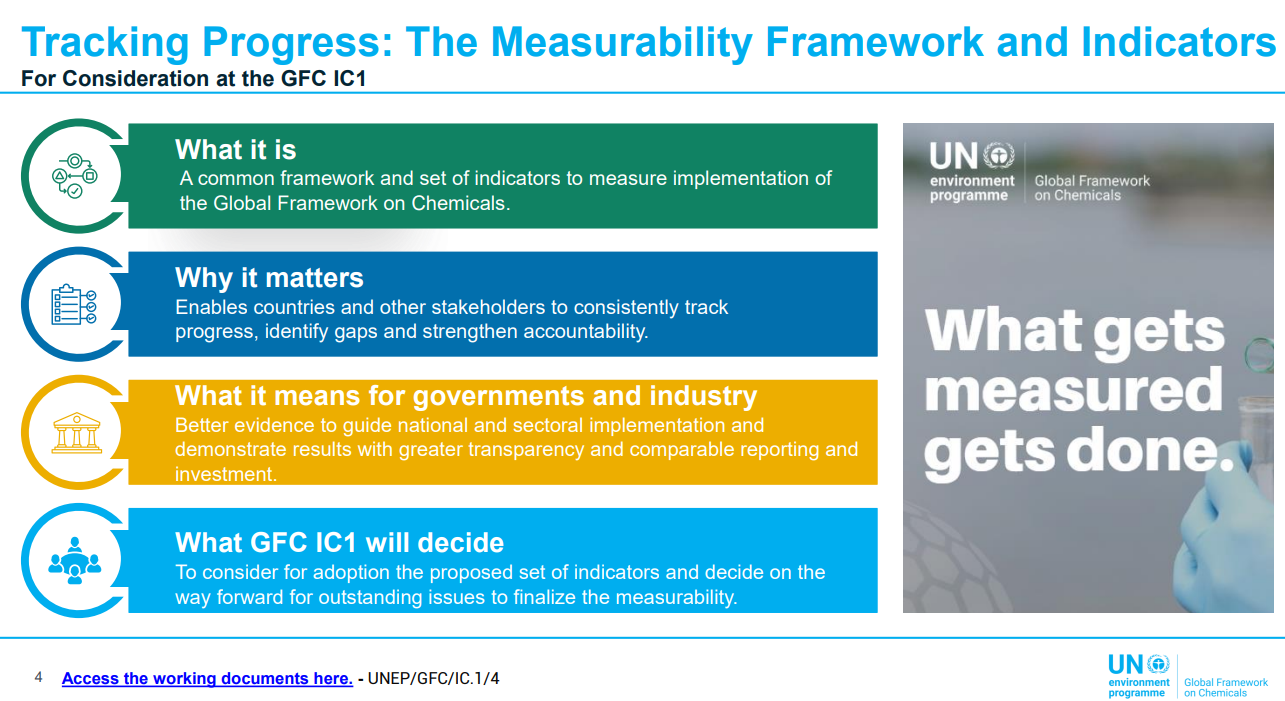
- In terms of measurability, this is about establishing a common way assess whether progress against the 28 targets that were agreed in Bonn in 2023 is being made. Having these comparable indicators will enable to see where we are advancing and where we need more action.
- In terms of the 63 proposed sets of indicators that have been worked on intersessionally, the Conference is going to decide which ones to take forward. Additional work has also been carried out through factsheets.
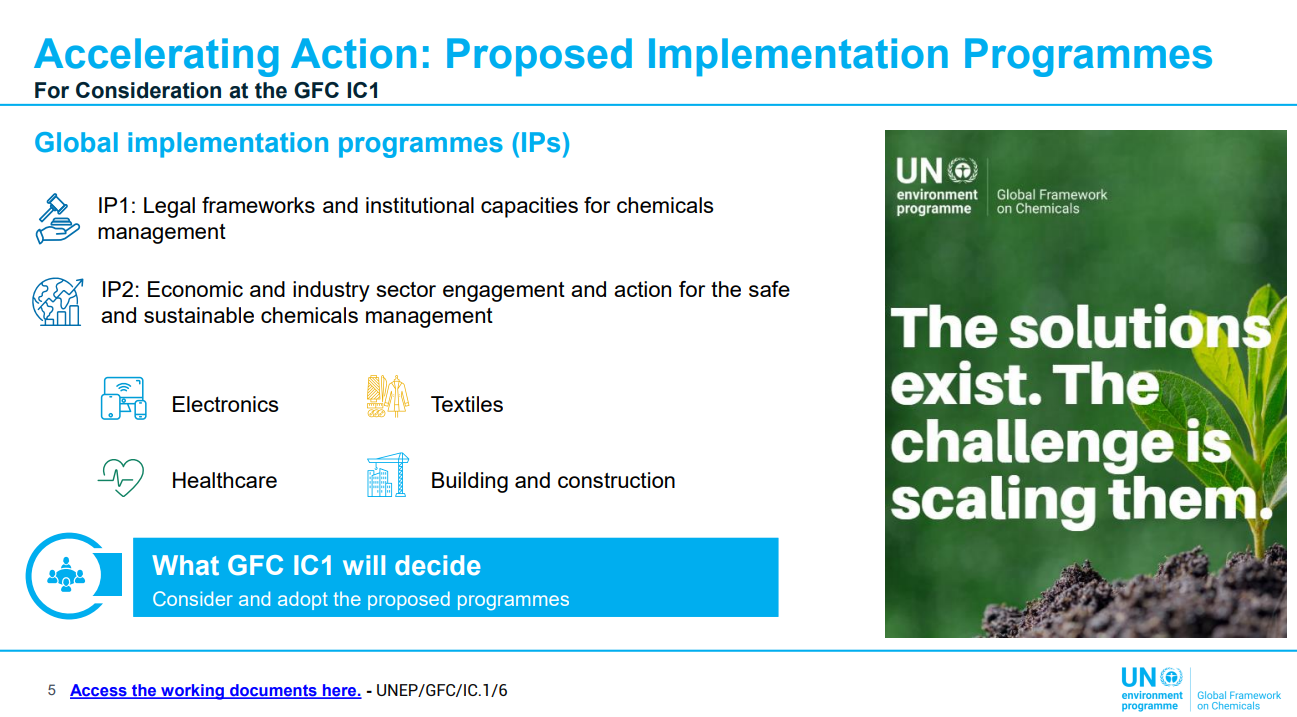
- The second item that we will be looking at in terms of accelerating action is the implementation programmes. A lot of work has gone on intersessionally to set up two global implementation programmes. One is looking at legal frameworks and institutional capacities for chemicals management, and the second is looking very much at different sectors, with a focus on those that are chemically intensive, such as electronics, textiles, healthcare, building and construction. The International Conference will be asked to consider the two global programmes and whether it wishes to adopt them.
- The Framework has also taken on the concept of issues of concern, which was first brought forward under the previous framework. It looks at emerging or insufficiently addressed chemicals and waste challenges that may pose a risk to human health or the environment.
- We have four newly nominated issues of concern for consideration at the Conference.
- Children’s health.
- A broader approach to lead,
- A broader approach to pharmaceutical pollution and its effects on human health and the environment,
- Information gaps in hazard assessment and how new approach methodologies fit into that.
- Additionally, there will be discussions on the existing issues of concern that were brought forward under SAICM, and decisions will also be made on the arrangements for these issues at the Conference.
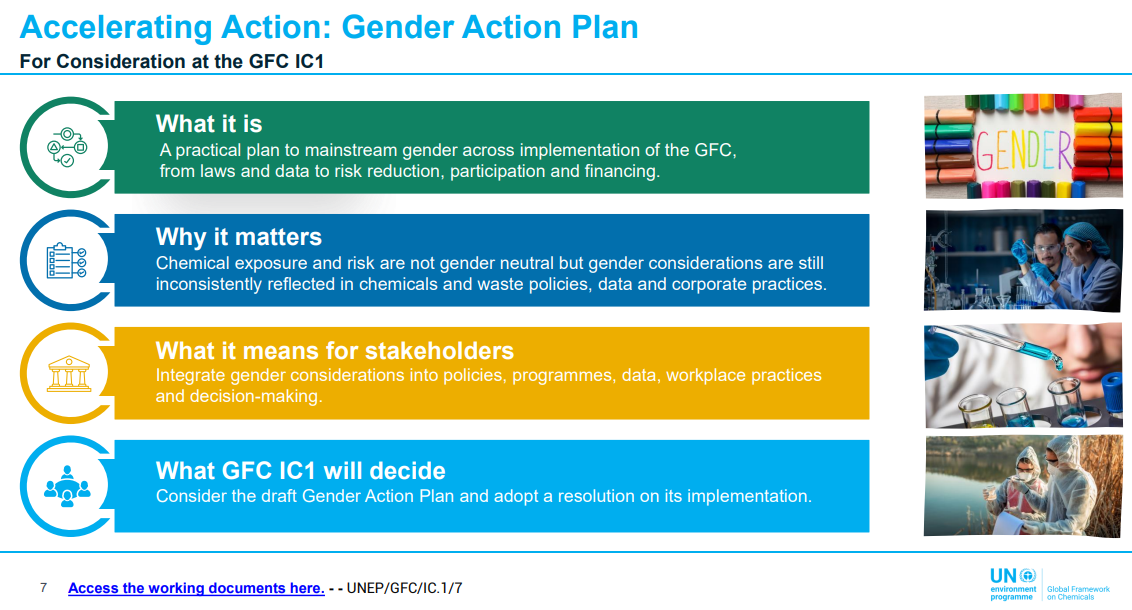
- We were asked under the resolutions to develop a gender action plan. That has been done, and a draft gender action plan has been available online for some time. Exposure, occupational and social roles, and access to information can affect women and men differently, and these differences are not consistently reflected in chemicals policies and data. The practical implication is that integration across policies and programmes is really important. The Conference will be asked to decide whether to take forward the gender action plan and consider its implementation.
- Additionally, a lot of work has been done to strengthen focal points at the national level. Guidelines have been developed in consultation with our stakeholders. We have been encouraging new focal points from different ministries, including health and labour, and I am very pleased to announce that we now have a national focal point from the labour sector, in addition to the environment sector.
- The roadmap translates functions into practical, nationally adaptable actions and is intended as a planning tool, not necessarily a compliance checklist. We will be looking at what the International Conference would like to do with those guidelines. → UNEP/GFC/IC.1/6 – Accelerating action: implementation arrangements, national focal points and capacity-building
- A capacity-building and technology transfer tool has been developed. It proposes a stepwise approach, including a voluntary self-assessment tool for countries to help identify their strengths, gaps and priority needs. → UNEP/GFC/IC.1/6 – Accelerating action: implementation arrangements, national focal points and capacity-building
Investing for Impact
- The Global Framework on Chemicals Fund has completed two rounds of funding. It is there to provide catalytic support to countries to turn commitments into action. It has approved projects covering 23 countries, with investments of over 8.2 million US dollars. It is not necessarily simply the size of individual grants, but we are seeing that the Fund is proving to be oversubscribed, with a lot of interest. It is there to demonstrate solutions and create conditions for longer-term implementation.
- An important consideration will be the revised terms of reference for the Fund and looking at its future governance and effectiveness. →UNEP/GFC/IC.1/8 – Investing for impact: finance and investment
- The benefits of action and value chain transition have been narrowed down by scoping the methodology and how we can identify the costs of inaction and the benefits of action. This is to enable us to strengthen the economic evidence for investment in prevention and safer alternatives. This is often very useful, both for governments and for other stakeholders. The value chain transition approach complements this by looking at where action across sectors and supply chains can deliver the greatest impact. The International Conference being asked to consider the methodology proposed here, with a view to developing this study after the Conference and putting forward some figures behind those benefits.
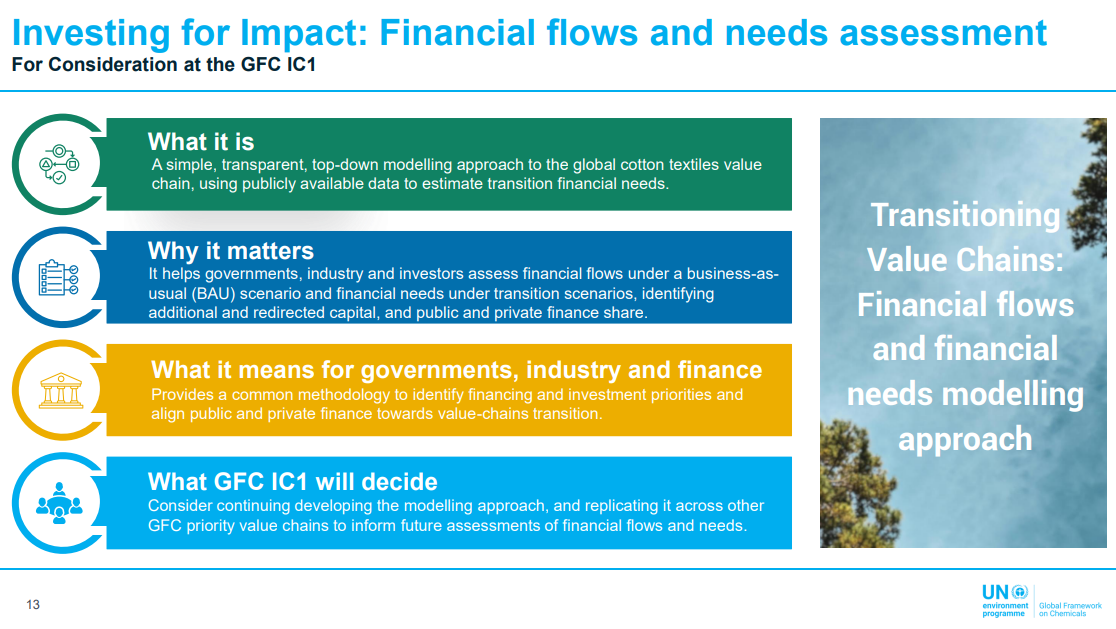
- Financial flows and the needs assessment: as part of Resolution 5/3, the Secretariat was asked to assess the existing financial investment flows, as well as the financial needs associated with the implementation of the Framework.
- Given the complexity of assessing financial flows, it was decided that the cotton textile value chain was a good starting point to look at the different chemical dependencies across the value chain and its relevance to the Framework. The objective has been to develop a simple, transparent and replicable modelling approach to estimate the financial needs across this particular global cotton textile value chain.
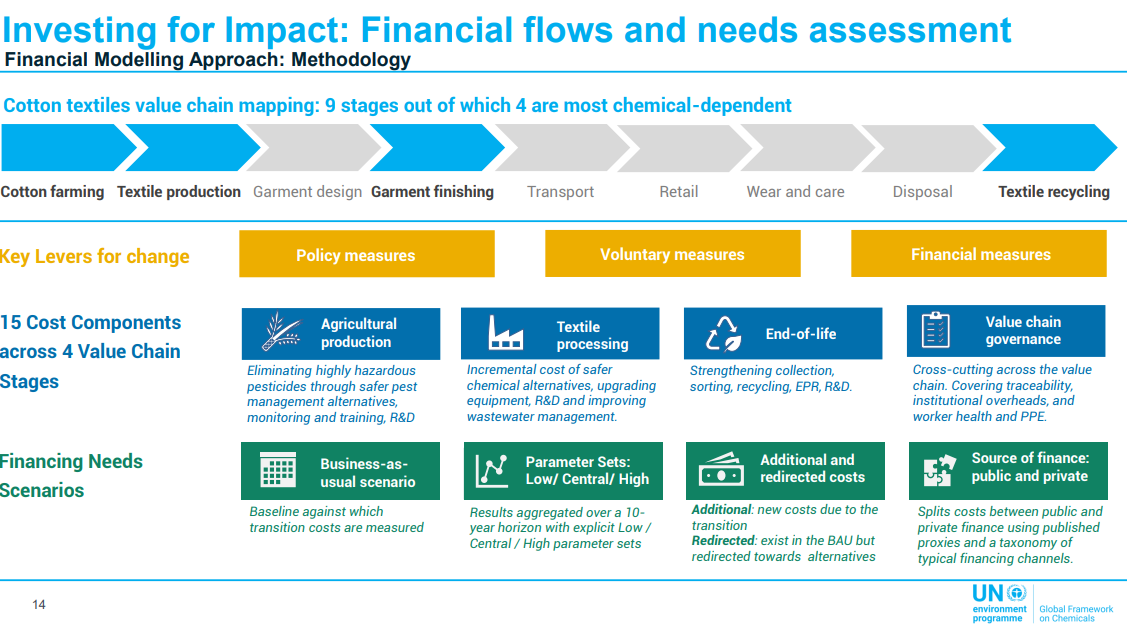
- This approach is aimed at helping identify where policy measures, public investment and targeted financial support are needed. For industry, it is about covering the costs and investment requirements, and for financial institutions, it is about identifying the financial needs and investment opportunities along a particular value chain.
- It is also aimed at identifying where existing finance can be redirected, where additional resources are needed, and how public and private finance can complement each other. At IC1, the request will be to consider the development and refinement of this modelling approach and include the possibility of extending it to other priority value chains.
- Going into a little more detail about these financial flows, I wanted to point out the stages that this financial modelling looks at. In terms of the cotton value chain, the methodology looks at agricultural production, textile production, garmenting, finishing and end-of-life management, as well as value chain governance across the whole process.
- The first three stages cover investments associated with specific chemical-intensive stages of the value chain, while value chain governance captures the cross-cutting costs across the entire value chain, including traceability systems.
- The aim of this work is to estimate both the direct costs of transitioning towards safer alternatives and the broader investments needed to support this transition.
- Transitioning towards safer chemicals requires a combination of policy, voluntary and financial measures, including chemical restrictions, but also standards, industry commitments and responsible procurement practices, as well as targeted financial support.
- Around 15 cost components have been identified across four broad areas: agricultural production, textile processing, end of life and value chain governance.
- The approach combines publicly available sector-level data with estimated costs of priority transition activities to assess the potential financial needs across the cotton textile value chain. These estimates are aggregated over a 10-year period, with the objective of providing an indicative picture of the financing requirements that can be refined.
- In considering these scenarios, a key feature of the modelling methodology is the distinction between additional costs, representing new expenditure, and redirected costs, representing existing expenditure that could shift towards safer alternatives.
- Understanding the roles of public and private finance is really important. The other activities that require a combination of these resources remain indicative and still require further refinement.
-
In summary, the modelling approach provides a single, transparent structure for estimating financial needs across the cotton textile value chain and accounting for different costs for each transition activity. It looks at the public and private share components and provides a point of reference for assessing the financial implications of priority transition actions.
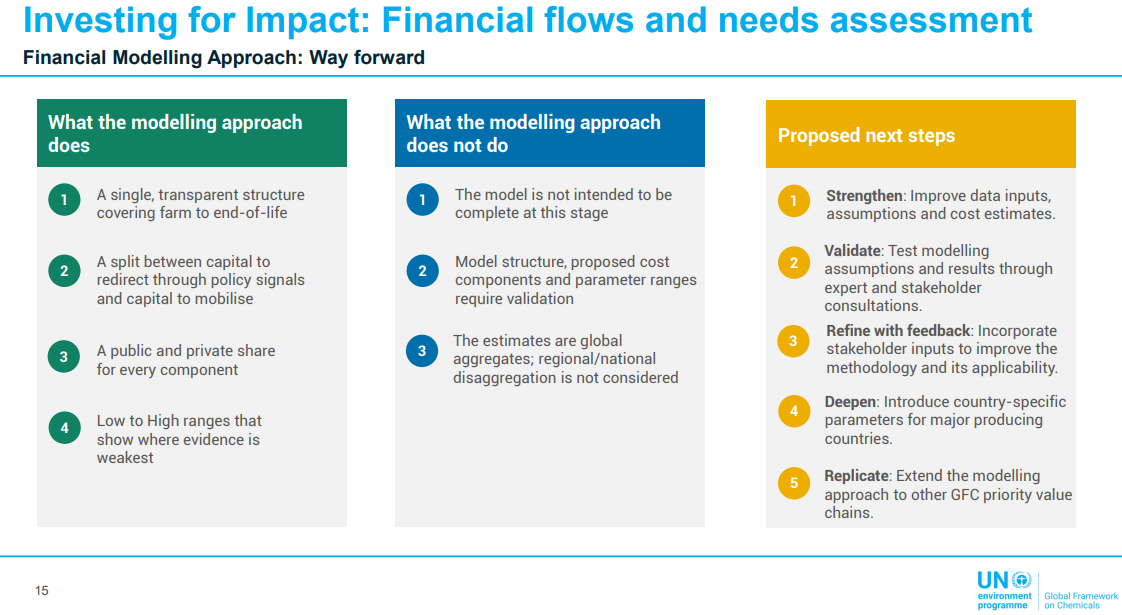
- The modelling approach does not yet capture everything. It is a preliminary approach for review and refinement, and it has several limitations. It does require more validation. The estimates are global aggregates and do not account for differences in production systems, and the approach does not capture all economic implications.
- There are some next steps proposed in the working documents. These include strengthening the data inputs, testing the modelling assumptions with a wider group of stakeholders, refining them with feedback, looking at country-specific parameters, and then considering whether this modelling approach could be applied to other priority value chains.
- The programme of work and budget will set out the Secretariat’s proposed activities and staffing structure. My colleague is going to talk a little bit more about what will be required or discussed at the Conference in terms of the programme of work. This will be a really important discussion for the Secretariat as it moves forward from 2027 to 2029.
Conference Programme
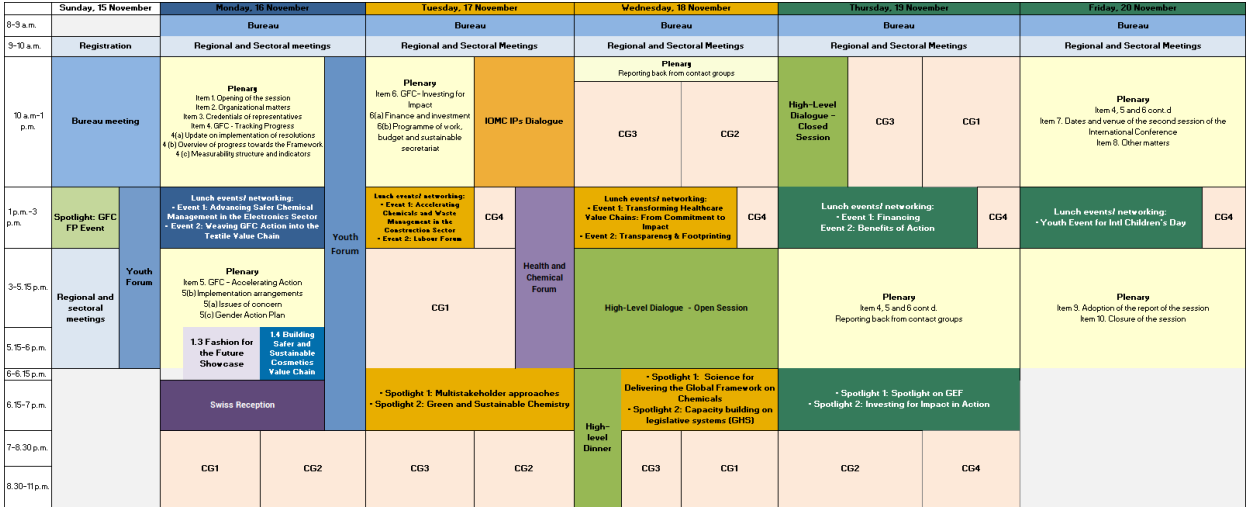
- We have a busy agenda of negotiations, while at the same time we have a number of forums taking place:
- The Youth Forum,
- The Health and Chemicals Forum
- The Labour Forum
- We have also got a dialogue by the participating organisations, talking about their work on implementation.
High-Level Dialogue
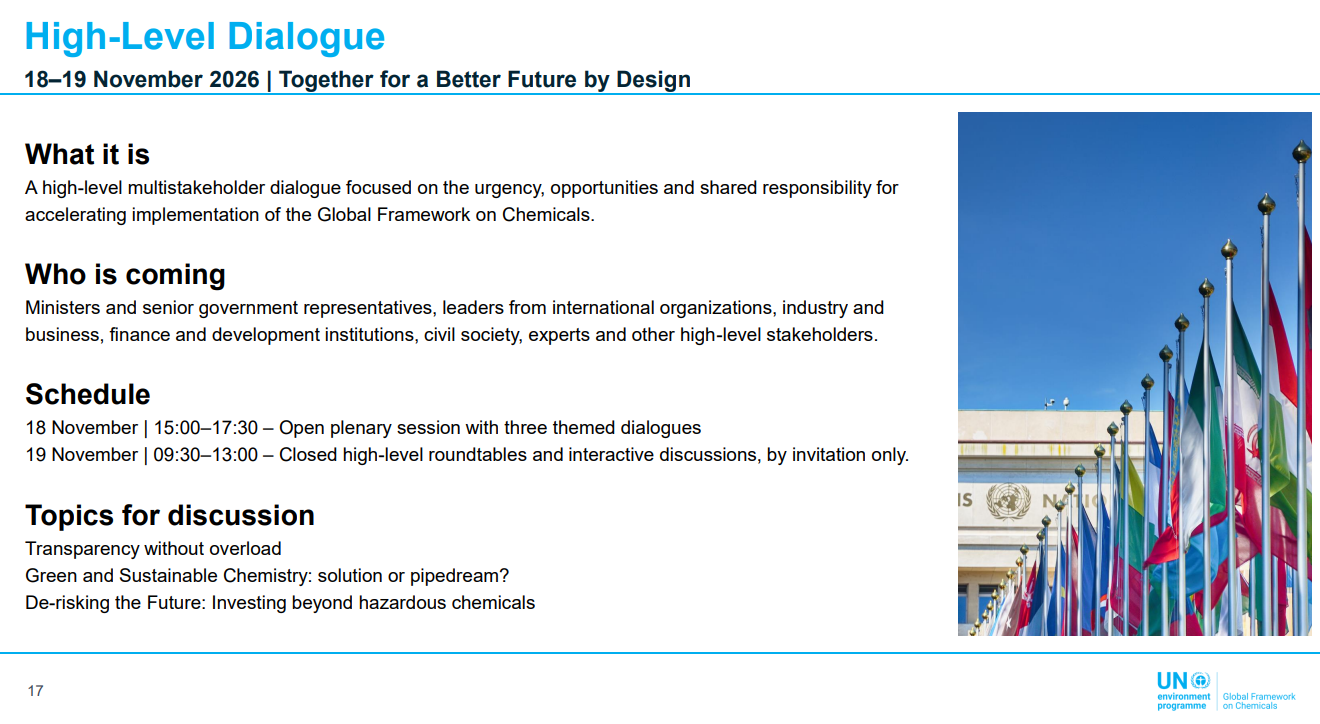
- The High-Level Dialogue has again been oversubscribed.
- We have ministerial and senior-level representatives, CEOs of industry, civil society representatives and leading academics coming together to help us prioritise our actions for the future, so that we can meet the targets that are due in 2030.
- There is an open session for the high-level dialogue, where delegates can have discussions in public. Anybody can attend that. We then have a closed session just for the high-level delegates on Thursday, to really get down to work and define our priority actions moving forward.
Practical Information
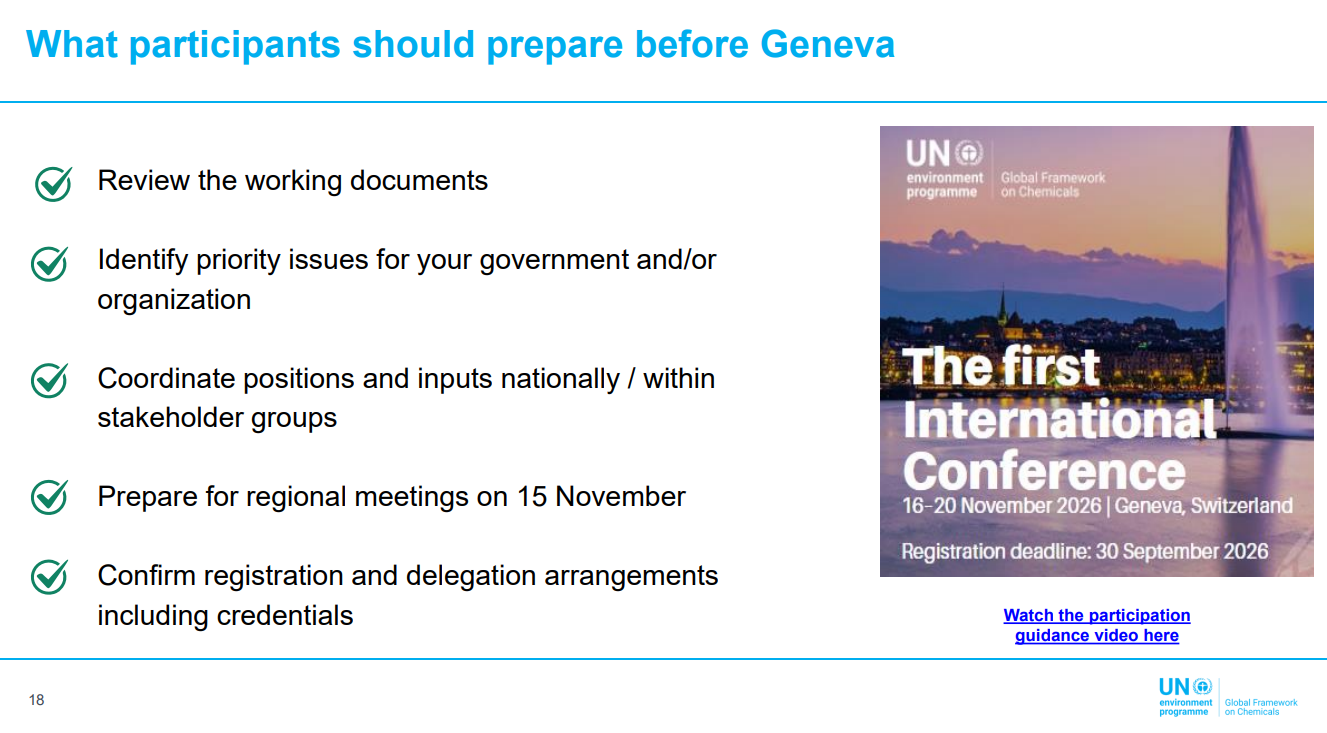
Practical information:
- We are extremely grateful to all our donors and partners who are supporting this agenda. We are a voluntary framework, and it is really essential that these contributions come forward because, without them, we would not be able to do our work.
Financing the Next Phase of GFC Implementation
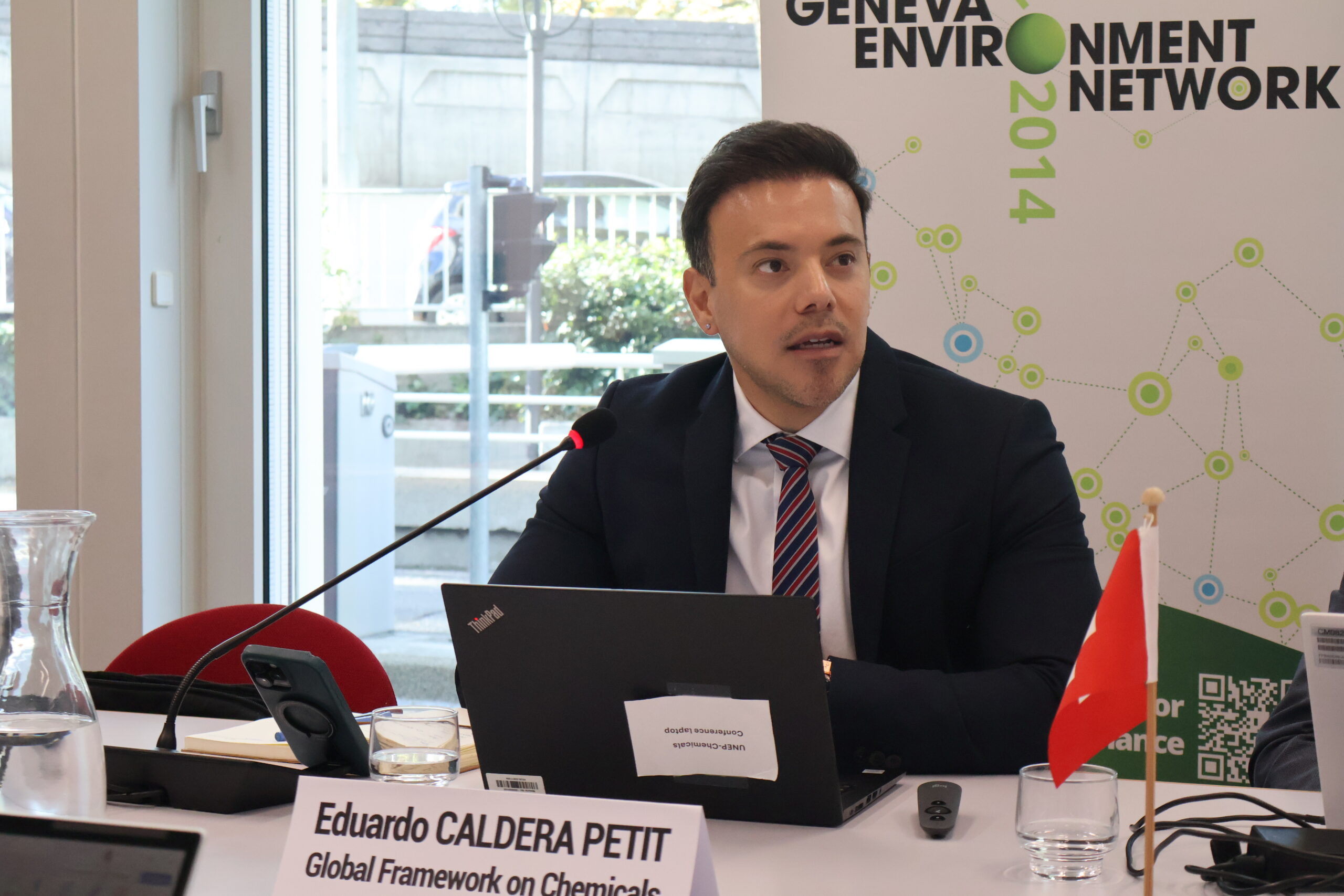
Eduardo CALDERA-PETIT | Coordinator, Global Framework on Chemicals Fund
- This presentation aims to discuss the financing proposals that will be considered at the Conference in November, detail on what they would mean in practice and how it can help countries secure financing that continues beyond an individual grant that might be provided through the GFC Fund.
- We are looking here at two connected financing needs. First, countries need resources to put the Framework into practice. The GFC Fund is one of those sources of support and has mobilised approximately US$27.8 million to date. Second, we also need institutional capacity to support the implementation of the Framework, organise the work, assist countries in following up on decisions taken by the Conference and report on progress. The proposed Secretariat budget for 2027 to 2029 is approximately US$15.8 million.
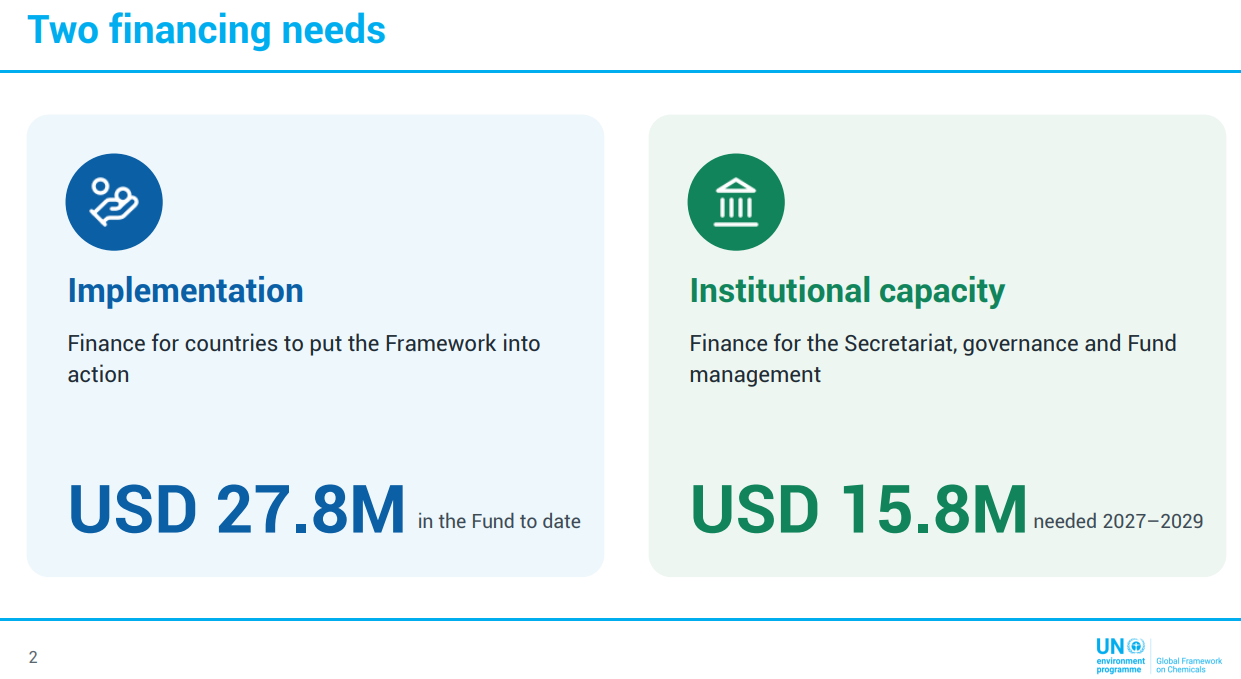
- The proposals put forward for discussion in November address both needs, although through different approaches.
- The GFC Fund provides grants of up to US$800,000 for projects normally lasting between two and three years. Following the first two funding rounds, we have already approved projects covering 23 countries around the world, supporting chemicals and waste management through these grants. With these projects, we are supporting legislation, institutions and national capacity, but also the preparation of larger initiatives that could be funded by other financial institutions.
- However, a grant of this size, US$800,000, cannot meet every financing need. It cannot pay for major infrastructure, and the Fund, as it is currently structured, cannot provide other financing vehicles, such as loans or equity. Some investments, for example in safer technologies or services, also need forms of finance that the existing grant arrangements cannot provide. That is why we are looking at how to make our grants from the Fund go further, alongside a complementary financing option.
The three financing pathways
- The first proposal concerns how we use the existing Fund. We would ask the Conference to request the Executive Board of the Fund to incorporate three financing pathways into the guidance for future funding rounds. This means that projects moving forward would have to consider these three financing pathways.
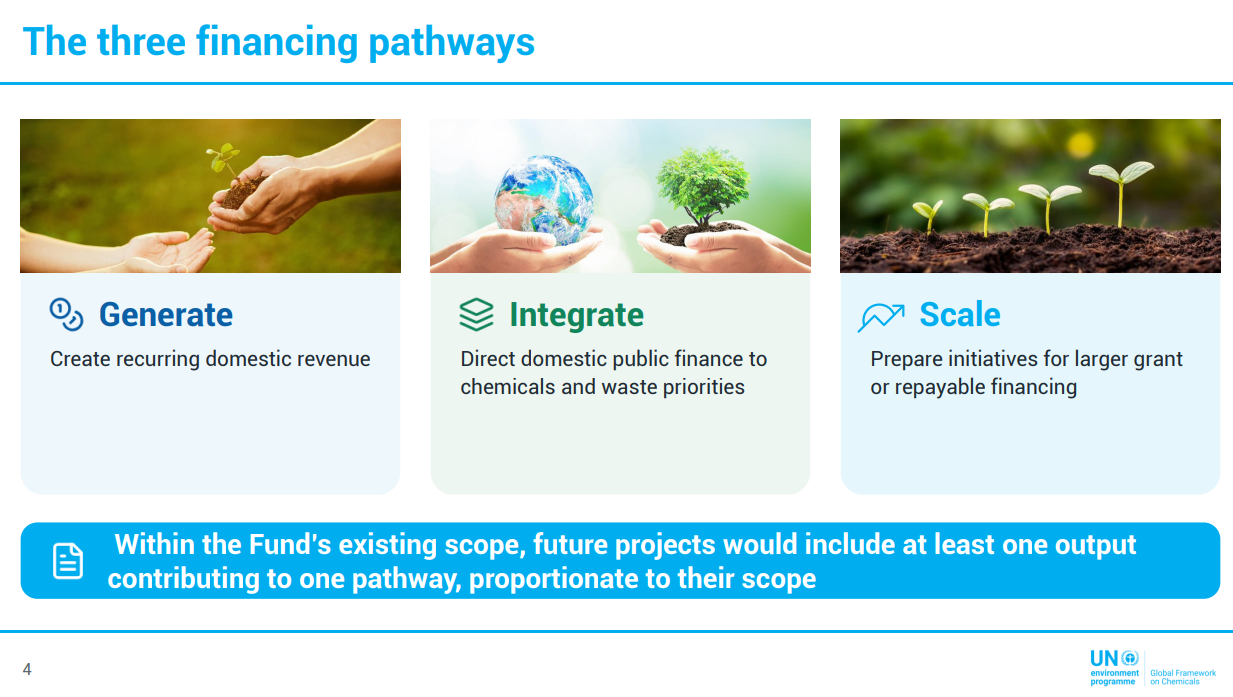
- Generate means helping countries establish continuing sources of domestic revenue.
- Integrate means helping chemicals and waste priorities secure a place in national budgets and other public financing decisions.
- Scale means preparing an initiative so that a larger financing partner can assess and potentially finance its expansion.
- This would remain within the Fund’s existing scope and structure. However, what we are asking is that, if this is agreed at the Conference, a project would include at least one output contributing to one of these three pathways, proportionate, of course, to its size and the purpose of that specific project.
- The overall objective of these three financing pathways is to leave countries with a financing mechanism or opportunity that continues beyond the grant they have received from the GFC Fund.
How the pathways could work in practice
- For Generate, a country might want producers and importers of electronics, for instance, to contribute to the management of electronic waste. A grant from the GFC Fund could help design the fees, the legal arrangements and the collection system. Producer payments under this scheme would then provide continuing financing beyond the duration of the project.
- For Integrate, a project could assess the cost of hazardous pesticide use and prepare a costed plan for safer alternatives. Through the project, it could then work with the agriculture and finance ministries and help make those activities part of the agricultural budget or national budget and priorities.
- For Scale, a grant from the GFC Fund could assess hazardous waste volumes, compare treatment options, test a collection system and prepare a costed investment proposal. This would be a large feasibility study. That work would give a larger funder something concrete to assess and potentially finance.
- For the Scale pathway, scaling up does not necessarily mean borrowing money. An initiative might seek a larger grant from the GEF, for instance, which is the largest financing mechanism we have for chemicals and waste management, or another eligible mechanism.
- The support that a country could receive through the Fund could help develop the evidence, pilot and programme proposal that could then move forward for financing under the GEF or another mechanism.
- There might also be another initiative that could generate revenue or savings to support repayment. For this type of initiative, it could then seek financing from a development bank or another financial institution.
- These routes have different requirements, and the country and potential financing partner would need to be involved early on.
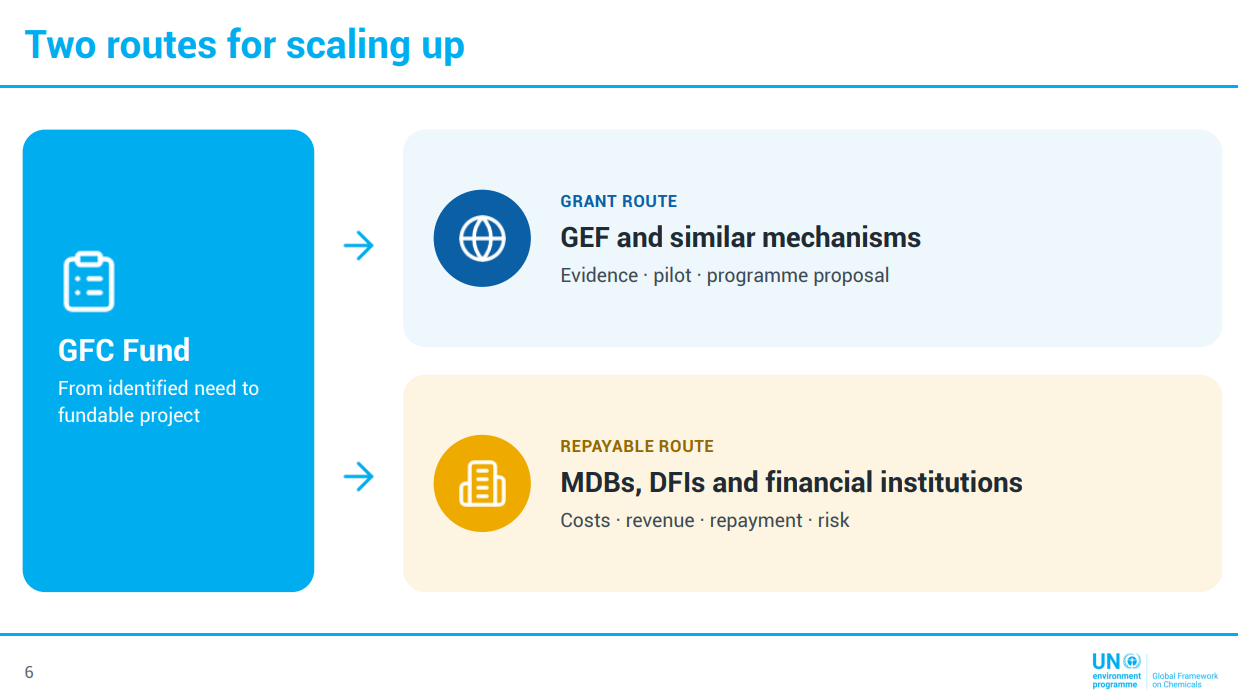
- In summary, our grant from the GFC Fund would help prepare the initiative and then make it attractive to a larger financing institution. It would not guarantee that another institution will finance it, but at least the initiative would have the potential to become attractive for investment.
The proposed two-window architecture
- The second proposal is to establish a new complementary financing window, which would address a different need.
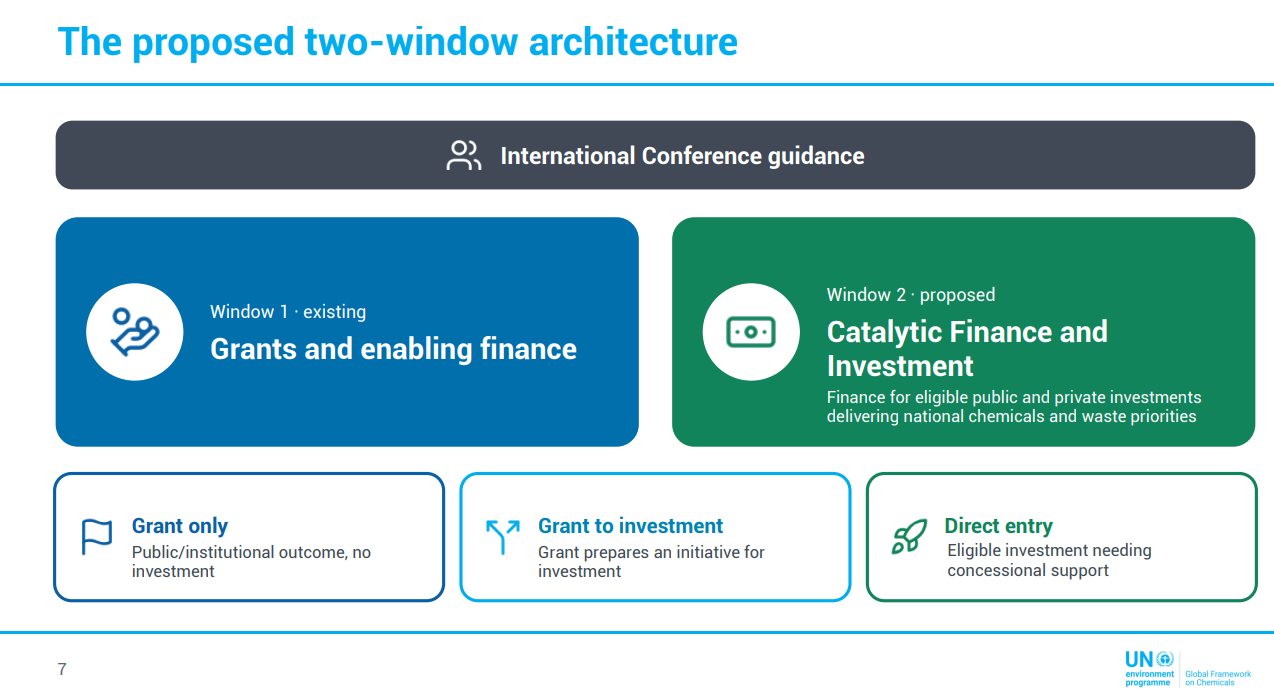
- There are investments that can generate revenue or savings but still face barriers to obtaining suitable finance. The existing grant window we have would continue supporting eligible public and institutional activities. However, this second proposed window could help finance eligible public and private investments that deliver national chemicals and waste priorities, for example, safer production processes or waste treatment services.
- A project could receive a grant without ever becoming an investment or moving into this second window. Other projects might use a grant to prepare for investment and then move into this second financing window. There might also be initiatives that are already eligible for investment and could enter directly into this second financing window if they meet the criteria for countries. The benefit would be an additional financing option for implementation.
- The detailed eligibility and access arrangements for this second financing window would need to be developed with partners moving forward, if this proposal is agreed by the Conference.
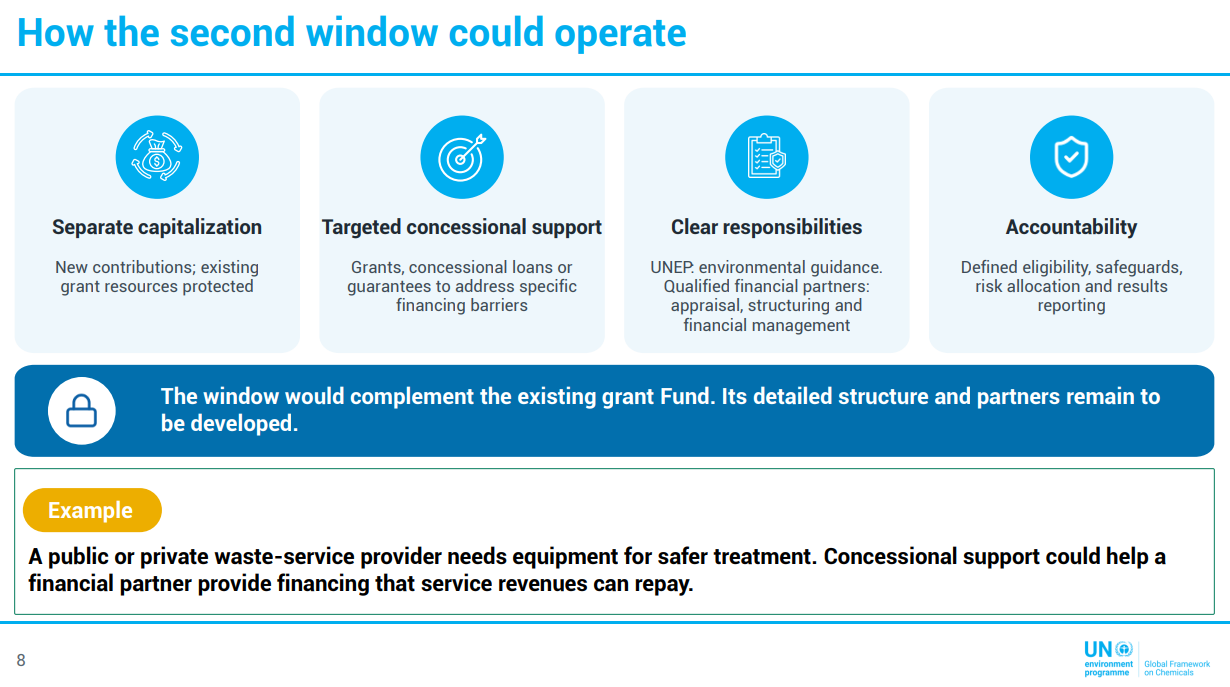
- The basic idea is to use limited public or philanthropic resources to help attract finance that would otherwise be unavailable on suitable terms. That is what we mean here by blended finance.
- For example, a public or private waste service provider may need equipment for safer treatment. These types of projects are not eligible under the existing window that we have in the Fund. However, if there is a promising proposal, such as this one, involving a revenue-generating activity, the charges for these waste treatment services could eventually cover the repayment of the initial investment.
- A lender may nevertheless consider that the initial risks are too high or offer terms that the provider cannot manage. That is where this window would come in and help address that specific barrier through concessional support or a guarantee alongside financing from a qualified financial partner.
- This second financing window could support existing solutions that we know are already available, but also suitable innovations. The support would, of course, need to demonstrate environmental benefits and a clear reason why concessional resources are necessary.
- In the case of this second window, the role of UNEP would be to define the environmental priorities, the eligibility criteria and the expected results. Qualified financial partners would then carry out the financial appraisal, structure the operations and manage the financing.
- It is also important to make it clear that this second proposed window would seek separate capitalisation from the existing GFC Fund window. This would guarantee that the existing grant resources that we have in the GFC Fund right now would remain protected.
- The governance, safeguards, risk allocation and treatment of repayments would need to be worked out if this proposal moves forward after the Conference. We think that some repayments could support further investments, but we should not necessarily assume that the window would cover all of its costs or become fully self-financing.
The proposed IC1 mandate and work during 2027–2029
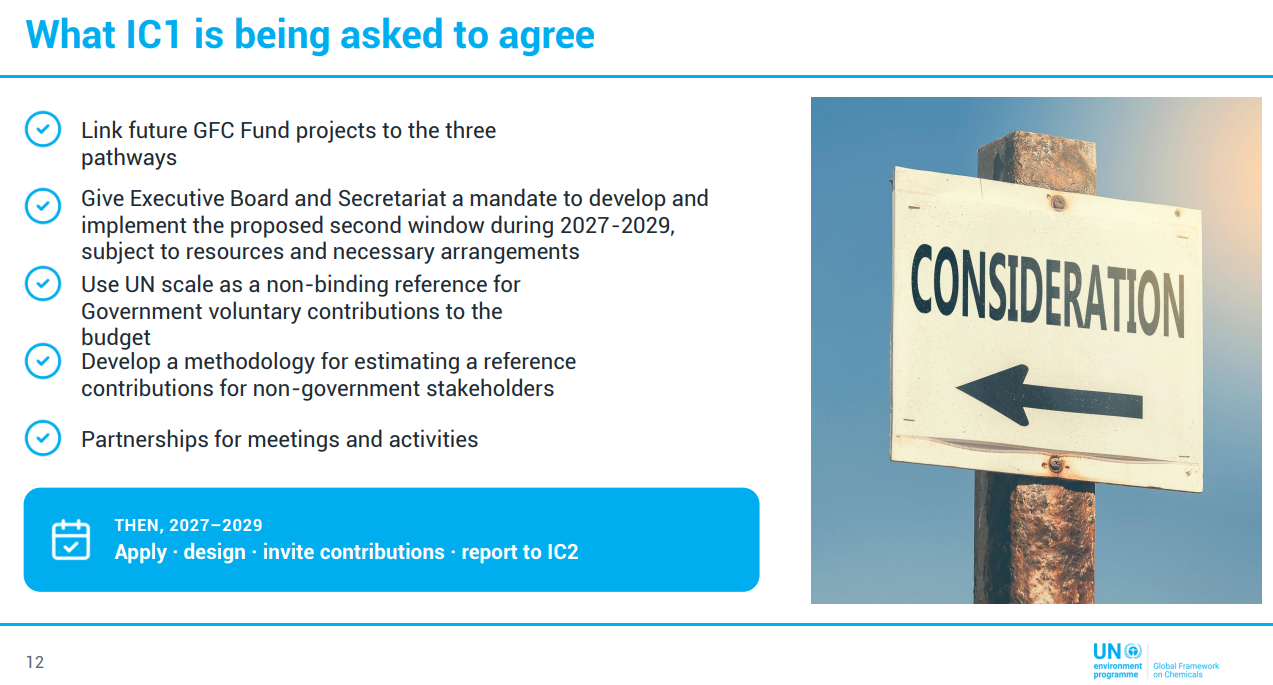
- At IC1, the proposal is to obtain a mandate for the Secretariat to develop and implement this approach in the next triennium, subject to resources and the necessary arrangements. We are not asking the Conference to approve individual investments or detailed financial terms at this point.
- The next steps would include developing the investment strategy, identifying partners, securing the capitalisation and establishing the arrangements needed to begin operations. The implementation of this second window could start when those conditions are met, with progress reported to the next Conference in 2029.
- We would therefore move forward during the triennium rather than wait three years to return with a proposal for the Conference.
Sustainability of the GFC Secretariat
- This is the second financing need.
- It is clear that countries and stakeholders of the Framework need a Secretariat with the capacity to support the decisions they take and the implementation they expect from us.
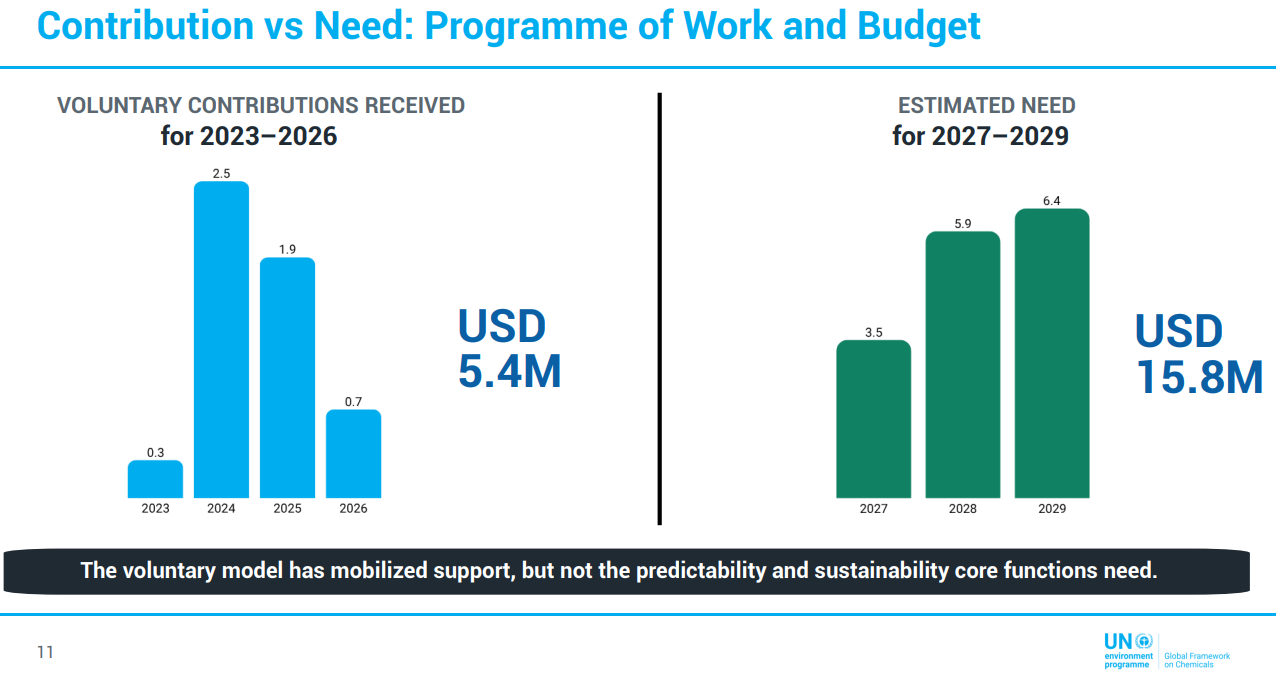
- The Secretariat received approximately US$5.4 million in voluntary contributions during the period from 2023 to 2026. The proposed programme of work and budget for the next triennium, 2027 to 2029, is approximately US$15.8 million.
- These are different periods, so this is not a comparison of annual spending. It shows the resources that have been mobilised so far alongside the requirements of the proposed programme of work for the next triennium.
- We are grateful to the contributors who have supported this work. However, the difficulty we face is that uncertain funding makes it hard to plan staffing and activities.
- The proposal we have on the table is to broaden participation and make voluntary support more predictable for governments.
- The proposal is to use the UN scale of assessment as a non-binding reference. In practical terms, a government would receive an indicative figure every year to help it consider and plan a voluntary contribution for the operations of the Secretariat.
- However, the contribution would remain voluntary, as it is for the Framework. There would be no payment obligation, and the reference would not be a ceiling either. Governments could contribute above or below it.
- The purpose is to provide a common starting point and encourage participation from a broader group of countries than the current donor base. It would not guarantee full financing of the budget, and we acknowledge that.
- However, one of the greatest features of our Framework is that it does not involve only governments. We also have other stakeholders, including civil society, industry and academia. We have a proposal for the Conference to entrust the Secretariat with developing a methodology that could also suggest voluntary amounts or ranges for these non-governmental stakeholders.
- Possible considerations to take into account when developing this methodology could include the type and size of the organisation and the form of support. We know that these details would require thorough consultations with all stakeholders.
- This would help put into practice the Framework’s invitation for all stakeholders to support the Secretariat, which is already included in the Framework text. Any support would, of course, follow the applicable UN rules and due diligence requirements. The fact that other stakeholders are contributing does not necessarily imply that they would have a certain influence or special privileges within the Framework.
From Berlin to Geneva: Financing for Chemicals and Waste
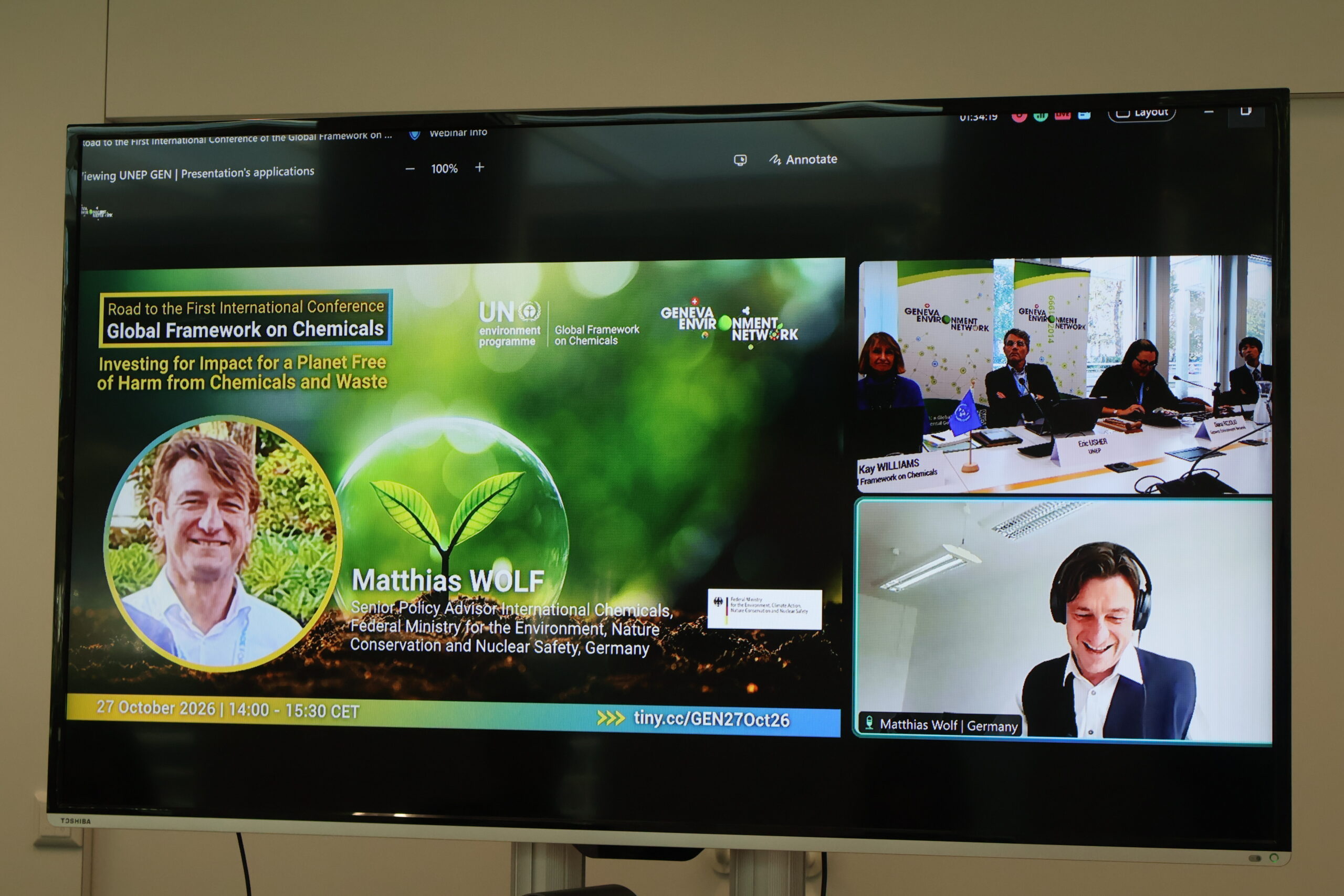
Matthias WOLF | Senior Policy Advisor International Chemicals, Federal Ministry for the Environment, Nature Conservation and Nuclear Safety, Germany
- The Berlin Forum was established during the COVID crisis to keep up the momentum and to inform the fifth International Conference on Chemicals Management (ICCM5), which had to be postponed at the time, and, of course, to facilitate the Strategic Approach to International Chemicals Management (SAICM), and now the Global Framework on Chemicals (GFC) and the International Conference on Chemicals.
- The 4th Berlin Forum on Chemicals and Sustainability took place online on 7 October 2026 and was co-chaired again by the IOMC participating organizations.
- This year’s Berlin Forum focused on some of the financial aspects of managing chemicals and waste and was split into two sessions. The first looked at extended producer responsibility (EPR) systems, and the second provided insights from investors and the reinsurance sector.
- Both EPR and the integration of GFC targets into investment decisions are key to implementing the framework.
- The discussions involved participants from developing countries, civil society, the chemical industry, banks, a reinsurer, and the IOMC participating organizations, as common experts and knowledge carriers at the international level when it comes to the management of chemicals and waste. All provided very helpful insights into their experiences, as well as the challenges they faced when trying to transform the management of chemicals and waste in their sectors.
- Organizers asked for views on how fora such as the World Chemicals Conference, the International Conference, might better facilitate this transformation at a time of dramatically constrained public budgets.
- The good news is that many opportunities exist beyond public financing, and they have not yet been used to their full extent. Our speakers on EPR in the first session mentioned some of them.
- All discussions in this session highlighted the need to further develop regulation, as well as the need to further build up capacities, in particular within institutions, to ensure implementation and compliance.
- Furthermore, it was mentioned that more incentives and disincentives are needed to unlock private capital and to shift investments in the direction the GFC is striving for.
- EPR schemes are an important element in doing so: shifting costs to the polluter and shifting investments by creating demand and, thus, markets. In this context, creating markets is a reason why the establishment of EPR schemes is very often supported by industry and the private sector too.
- However, participants also outlined the challenges faced by developing industries in particular. Often, it is not only regulations and institutional capacities that are lacking, but also the necessary infrastructure, for example, to collect and treat waste. This often hinders private-sector or industry investments.
- The idea was reiterated of establishing a moderate global fee on some chemicals to finance all the efforts that would be needed to fully implement the GFC.
- The different circumstances of countries were also mentioned, as well as the fact that, in many of them, the informal sector plays a critical role. This needs to be considered when developing EPR systems that should be fit for purpose and adapted to particular circumstances.
- Awareness-raising was mentioned as another important measure to change consumption and production patterns regarding chemicals and waste.
- To overcome all these obstacles, international cooperation was seen as key by the discussants.
- The second session looked at the issue from the finance sector’s perspective. The increasing number of legal battles and the often tremendous costs of settlements were discussed. More awareness-raising is needed within the investment sector.
- The sector is still struggling to fully understand chemical exposure risks, which are a prerequisite for integrating chemical information into investment decision-making.
- Data was highlighted as the basis, but currently also as the barrier, for everything else concerning chemicals. Legislation and, more broadly, standardised information ensuring the comparability of data, the disclosure of information, and its translation into financial language were mentioned as measures that are still needed, with implementation of the Globally Harmonized System (GHS) as a basic element on the path forward.
- Other examples mentioned in addition to the GHS were the chemical footprints under development, as well as taxonomy, as has been done in the climate field.
- The finance and investment sector is looking for an equivalent for chemicals to what exists for greenhouse gases, but has not yet succeeded in developing an indicator such as financed toxicity, for example. Something like this would really help to integrate chemical information into investment decisions.
- All these discussions have shown that the GFC and the World Chemicals Conference can play a relevant role in facilitating the establishment of EPR systems and helping the investment sector understand and integrate chemical information into decision-making.
- The International Conference would be the place to start thinking about further harmonisation and standardisation of data and information, including reporting.
- It would also be the place to think about what else could be done to enable informed decision-making in the finance and investment sector. The International Conference, as a platform, might also be better used to initiate ideas and partnerships for creating models or plans for EPR systems, for example upstream, in particular, as this stage of the life cycle is usually not addressed yet. This was also mentioned during the discussions.
- Last but not least, it could bring together the people needed to initiate more international cooperation on the ground. This cooperation could involve fostering the use of chemical risk assessments that have already been undertaken by someone else, initiating more training and knowledge-sharing between experts, and finding potential partners for technical cooperation and for building the infrastructure needed for sound management, because this is something governments usually cannot deliver.
- Last but not least, the Chemicals Conference is the international platform to raise awareness of the GHS and other measures improving the transparency of chemicals and products. It is a platform that we are missing elsewhere.
Q&A
Indonesian Mission to the UN Office at Geneva
- I would like to ask more about procedural matters regarding the next meeting. I was informed that there are some changes regarding the chairmanship of the meeting. I heard that Pakistan, which is supposed to be the President, will not be able to resume its role.
- I note that there will be a Bureau meeting on 29 October and I assume that there might be someone from the Asia-Pacific region. I was wondering how the matter will be managed within the Bureau. Has the Pakistani President decided on someone to replace them, or how will the matter be handled?
- Regarding the high-level dialogue on the second day. I noted that there is a closed session in which only invited participants will take part. I was wondering whether the invitations have been distributed.
- In our case, we do not think we have received an invitation to that meeting, since our head of delegation will not be coming at the ministerial level. Will delegations that are not attending at ministerial level be invited to the meeting?
Kay WILLIAMS | Head, Global Framework on Chemicals
- We did receive communication from the Conference President from Pakistan, Mr. Sumra, that unfortunately he was unable to take up the role of President of the International Conference due to commitments with the Climate Change Conference of the Parties.
- Under Rule 18 of the rules of procedure of the ICCM, he was able to nominate a Vice-President to take his place. That Vice-President is Magda Friedrich from Poland. She will therefore be presiding over the International Conference and the Bureau meeting this Thursday.
- I have not received any formal notification of any replacement on the Bureau. My suggestion is to inquire within the region about who might be attending the Bureau meeting on behalf of your region through the regional focal point from Japan.
- In terms of the high-level dialogue, invitations went through the standard route of our governance procedures in UN Environment in Nairobi. They should have reached your missions, and the focal points should have been copied.
- It could be that some invitations have been lost as they were being handed over or moved between different parts of the ministry. However, please do contact us if you have not received one. These invitations went out in August, so they were sent quite a long time ago.
- We understand that many people have received those invitations because a lot of people have registered for the high-level dialogue. However, please do reach out to us if you have not received the invitation and wish to attend.
Q: Many delegates received their invitation letters and other meeting-related documents very late. How does the Swiss host state plan to assist them in securing appointments and obtaining visas at certain embassies?
Kay WILLIAMS | Head, Global Framework on Chemicals
- I would like to address those questions by first setting the scene in terms of the Secretariat and the interest generated by this meeting.
- In terms of the finances, we are an extremely small Secretariat, and we are doing our very best to get through the applications to register for the conference. We have been completely overwhelmed in terms of the applications. We have had well over 2,500 people wishing to attend, and, in terms of our planned capacity based on the finances available, we can accommodate 1,200 people to participate.
- In that regard, it has been a very challenging process for our Secretariat to go through. Those are fairly straightforward in terms of assessing their suitability and their credentials to attend. We have a much broader stakeholder pool, and we have had to ensure whether they have been accredited or suitably accredited to our work.
- The team has worked exceptionally hard to go through this very long list of thousands of people applying to attend, to verify whether these individuals actually represent the organisations they say they do and whether they are relevant to our stakeholder space.
- So, we apologize if it has been a bit slow. We had not anticipated having so many applications.
- We have been working very closely with Switzerland and the missions, and they have been extremely helpful. Where we can, we are sending out supporting visa letters. We are doing that.
- May I just ask that, if you have any specific queries, please reach out to the Secretariat. We are still working on this. Registration has, in fact, closed, but we have noticed that several delegations, including government delegations, still have not registered appropriately. We urge you to please register.
- We are a small Secretariat, and we cannot function without knowing the numbers, because we have to make amendments to security arrangements and so on.
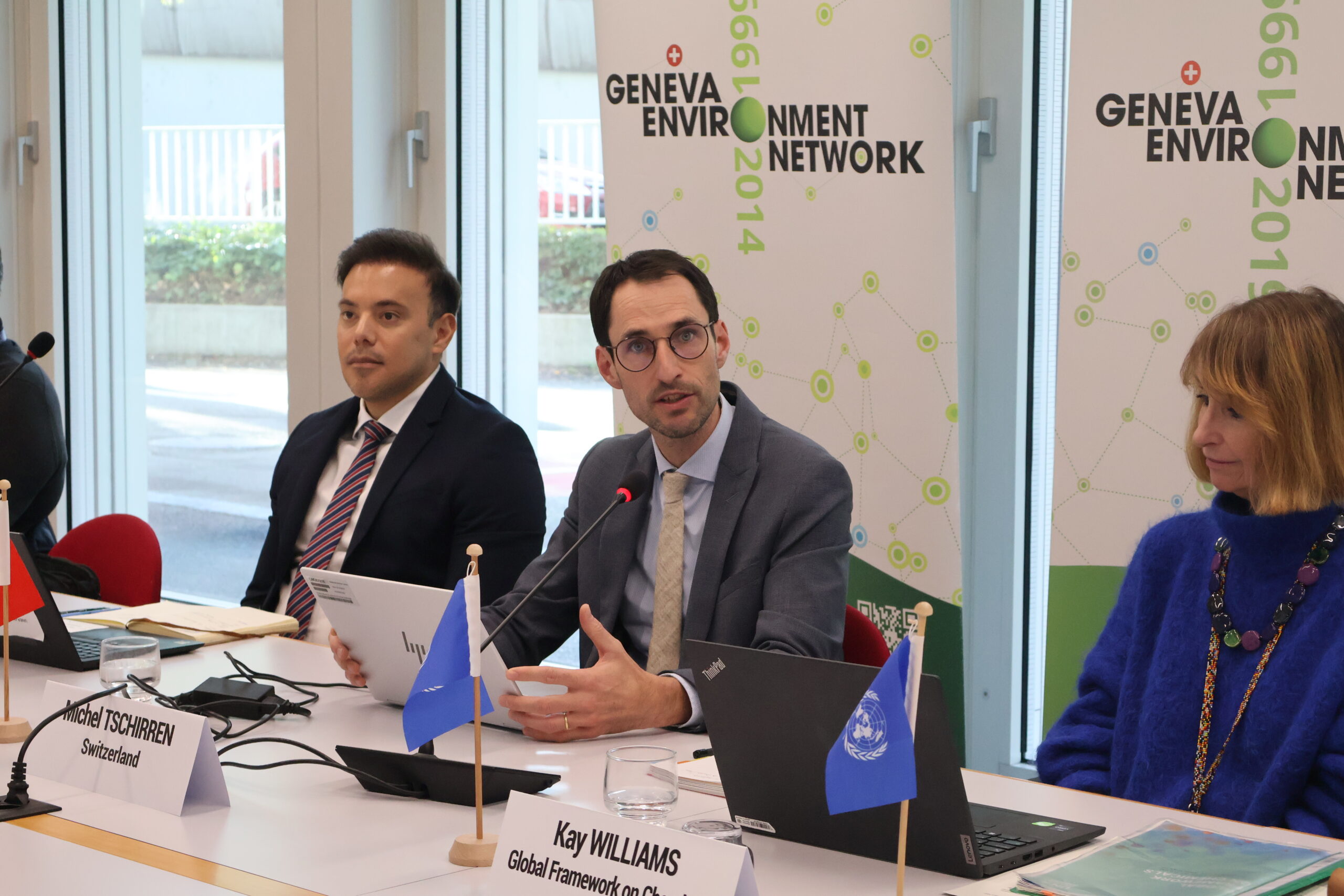
Michel TSCHIRREN |Head, Global Affairs Section, Federal Office for the Environment, Switzerland
- It is really positive that there is such great interest in the conference and such a huge number of registrations.
- Of course, this went through the regular channels, and we are here, ready to help wherever we can in order to go swiftly through the procedures. If there are any issues, we are made aware of them through the Secretariat, as we work very closely with them, as we do in other processes.
- It is through the Secretariats, the host country and Foreign Affairs that we ensure the processes go swiftly and that we can provide support wherever possible.
Q: Is the high-level session taking place on Wednesday open to all? Could you please clarify who can join the session and whether separate pre-registration is required?
Kay WILLIAMS | Head, Global Framework on Chemicals
- When I said that the high-level dialogue session was oversubscribed, I meant in terms of the number of high-level people wishing to attend.
- We have to cap the numbers again. On the advice of the Bureau, they wanted a small high-level dialogue, so we have capped it at 80 high-level participants. We have therefore been quite rigorous in terms of the levels of people attending. Unfortunately, we are not inviting heads of delegations if they are not at ministerial, vice-ministerial or Director-General level. That is one of the criteria for the session.
- However, the session on Wednesday is open for all participants to observe the high-level dialogue taking place. The high-level dialogue will involve those officials at the high level having a series of conversations. There will be questions and participation from high-level dialogue participants, from the high-level delegates on the floor, but anybody can come and watch those conversations to familiarise themselves with the issues and the challenges that senior decision-makers have to address in the course of transitioning, for example, to safer chemicals and waste management.
Q: How can people who cannot attend in person join?
The plenary sessions will be streamed on the YouTube channel, and there will also be specific sessions.
Q: There has been information circulating that only one delegate per organisation can attend the International Conference. With this restriction being announced just three weeks before the conference, they are concerned about meaningful civil society organisation participation. What solution could we find?
Kay WILLIAMS | Head, Global Framework on Chemicals
- We have had some very small organisations wanting to bring along 20 or 25 people, and this has been unexpected and unprecedented for us.
- For various planning reasons, we do have to restrict the size of the meeting. The more people we have, the more costs we have associated with security. We also have to put in place more registration desks, etc. We planned for 1,200 people.
- We have already approved more than that, anticipating that some may not turn up. This has been a little bit of an issue because various constituencies are also registering more people than will actually turn up. So, we do not know who is going to come.
- Be assured that I will personally look at all the applications that are now coming through and need to be reviewed, to make sure that we have a good balance.
- We have already approved many civil society organisations, and I am in touch with your Bureau member. I am working closely with the Bureau member to make sure that this constituency is well represented.
Closing Remarks
Michel TSCHIRREN |Head, Global Affairs Section, Federal Office for the Environment, Switzerland
- The exchanges have highlighted an issue that is fundamental to the success of the Global Framework on Chemicals: turning ambition into action requires financing, but also effective institutions, strong partnerships and a clear understanding of where resources can deliver the greatest impact.
- A recurring message from today’s discussion is that addressing chemicals and waste is not only an environmental imperative. It is also an investment in the future, in human health, in sustainable development and in economic prosperity.
- The challenge before us is therefore not simply to mobilise more resources, but to ensure that available resources are directed where they can have the greatest effect.
- This final webinar in the series of three has helped us prepare for the International Conference. Over the past months, this GEN webinar series has explored many of the key elements that we will discuss at the conference, from prevention and safer alternatives to implementation partnerships, and today, finance and investment.
- Taken together, these GEN events have helped build a common understanding of the opportunities and challenges that lie ahead and that we will discuss in just a few weeks, when we meet here in Geneva for the first International Conference.
- This International Conference is not simply the next meeting in this process. It is really the moment at which the Global Framework moves into full implementation, going beyond its establishment and this first phase. The challenge for us, and the task of our work here in Geneva, will be to jointly provide the strategic direction for the years ahead and strengthen the partnerships needed to achieve the Framework’s objectives.
- I would like to acknowledge the Secretariat for all the preparatory work for this first conference. We have just heard that there is a lot involved. You have presented all the themes, all the documents, and all the drafts. There is a lot of logistics involved, as well as high-level dialogue. This is intense work, and it is really appreciated.
- It is also a pleasure for Switzerland to host the GFC and the efficient GFC Secretariat here in Geneva. Moreover, Switzerland looks forward to hosting the first International Conference and welcoming you all to Geneva in a few weeks.
- Together with you, Switzerland remains committed to supporting a strong and effective global framework that can deliver meaningful progress towards a planet free of harm from chemicals and waste.
Video
Photo Gallery