
Event Conference
Sand and Sustainability: An Essential Resource for Nature and Development | Report Launch

13 May 2026
15:00 – 17:00
Venue: Palais des Nations, Room XII
Organization: UNEP Global Resource Information Database Geneva
This event, organized by UNEP/GRID‑Geneva and the Geneva Environment Network in the framework of the Geneva Dialogues on Minerals and Metals, launched the new publication "Sand and Sustainability: An Essential Resource for Nature and Development". The 2026 Sand & Sustainability report has been developed in response to UNEP/EA.7/Res.3, a UNEA Resolution on Strengthening International Cooperation on the Environmentally Sound Management of Minerals and Metals, and builds on past resolutions 4/19, 5/12 and 6/5. This document was prepared by a team of 27 authors under the coordination of the UNEP/GRID-Geneva.

About this Event
Sand resources are the most extracted solid material on Earth. They are also among the most undervalued despite how essential they are to nature and development. Extracted, they are used to build homes, highways, solar panels, sea walls, and for land reclamation in coastal cities. Left in place, sand regulates rivers, protects coastal aquifers, filters water, sustains biodiversity, maintains habitats, buffers coastlines against storm surges, and supports fisheries and tourism that billions depend upon. They provide the literal foundation of modern living and development: shelter, essential services, and the energy transition. As part of a dynamic Earth system flow, sand forms landscapes and provides the very morphological stability on which the fundamental functioning of societies and economies rests. These values extend to food and water security, climate resilience, disaster risk reduction, and territorial integrity, as sediment dynamics influence river courses, coastlines, and therefore borders and land availability.
Sand’s use values are immediate and visible; its non-use values are often indirect, long-term, and harder to quantify. Yet what is hardest to measure is often what sustains both nature and human societies over the long term. Over-reliance on short-term economic metrics risks obscuring the geological and ecological processes that take centuries to form and may never be restored once critical thresholds are crossed. These diverse values—tangible and intangible, immediate and intergenerational—remain poorly understood, largely invisible in global governance, and weakly integrated into biodiversity, climate, and financial decision-making.
Extraction is increasingly concentrated in ecologically sensitive riverine, coastal, and marine systems. Mismanagement can result in cascading consequences: deltas sink, coastlines erode, aquifers become salinised, and habitats fragment. These impacts are not confined to the extraction site. Through global trade and infrastructure investment, benefits accrue in growing urban centres while environmental degradation and livelihood losses are displaced onto vulnerable communities elsewhere. Critically, while a cubic metre of sand extracted for concrete creates value over an infrastructure’s lifecycle, that same cubic metre left in a river or coastal system can generate benefits over centuries, if not millennia. Conversely, well-governed sand systems can support resilient infrastructure, nature-based solutions, economic inclusion, and circular industrial transitions.
Over the past decade, the United Nations Environment Programme (UNEP) and its partners have produced a growing body of evidence on sand sustainability, with rising scientific attention, media coverage, and recognition by Member States through four resolutions adopted at the United Nations Environment Assembly (UNEA). UNEP’s triennial Sand and Sustainability report has evolved from identifying the sand resource challenge (first report) to offering stakeholder-focused recommendations (second report). The third edition launched on this occasion — Sand and Sustainability: An Essential Resource for Nature and Development — underscores sand’s strategic value. Since the recognition of the findings of the first report in 2019, Member States have been calling for further action for sustainable sand management, and strengthened technical, scientific, and policy knowledge, and information on existing good practices relevant to environmental aspects, as reflected in UNEA resolutions 4/19, 5/12, 6/5 and 7/3. Yet on-the-ground practices have shifted only marginally: demand continues to rise, governance remains fragmented, and extraction is often driven by short-term logic, with actors pursuing immediate economic gains while environmental, social, and long-term economic costs accumulate. Sand’s dual role as both a critical input for development and a key component of natural systems heightens this tension: unsustainable extraction is degrading land, rivers, coasts, aquifers, and biodiversity, while contributing to social harms such as lost of livelihoods, increased exposure to climate risks, and conflict.
Leading experts joining the panel of this event unpacked the report’s findings, which identify two fundamental fault lines in global sand governance. The first is strategic recognition: sand is rarely treated as a national asset for its diverse values, fragmenting responsibility across ministries and jurisdictions without accountability for its long-term stewardship. The second is biodiversity mainstreaming: ecological thresholds, sediment budgets, and cumulative effects remain absent from most decision-making, leaving extraction to proceed without regard for ecosystem connectivity or long-term resilience.
About the Geneva Dialogues on Minerals and Metals
The topic of sustainable management of minerals has never been so high on the global political environment agenda and the reason is that minerals are essential for the future. The energy transition, infrastructure and digitalization processes, among others, represent greener solutions. However, unsustainable extraction, manufacturing, use and disposal of resources is having important detrimental impacts on people and the planet. With an expected 500 per cent increase in the demand for minerals (from 2018 production levels), environmental challenges are going to be even more acute.
Various actors in Geneva are engaged in ensuring enhanced action to support the environmental sustainability management of minerals and metals along their full lifecycle. As Geneva is at the center of numerous debates and negotiations in the fields of science, health, human rights, development, trade and green finance, employment, peacebuilding and security, disaster risk reduction, humanitarian response, nature conservation, chemicals and pollution, as well as new technologies and innovation, the dialogues can be a conducive platform to explore interlinkages between these topics and mineral and metal resources governance.
The dialogues are organized by the Geneva Environment Network in partnership with Switzerland, Senegal, UNEP/GRID-Geneva, UNECE, the International Institute for Sustainable Development (IISD), the Intergovernmental Forum on Mining, Minerals, Metals and Sustainable Development (IGF), The Forum on Trade, Environment, & the SDGs (TESS) and the World Resources Forum.

Speakers
By order of intervention.

Arnold KREILHUBER
Director, Europe Office, UNEP
Laura PLATCHKOV
National Focal Point (UNEA5/12), Federal Office for the Environment, Switzerland

Pascal PEDUZZI
Director, UNEP/GRID-Geneva

Stephanie CHUAH
Programme Officer, UNEP/GRID-Geneva

Aurora TORRES
CDEIGENT Researcher, University of Alicante

Sheila PUFFER
Professor, Northeastern University

Cathy BLERVACQ
VP Sustainability, Sibelco

Munira RAJI
Geoscientist and Science Diplomat, University of Plymouth

Murtah SHANNON
Senior Expert, Water Governance & Environmental Justice, Both ENDS
Highlights
Summary
Opening
Arnold KREILHUBER | Director, Europe Office, UNEP
- This report is the third in a series that looks at sand and sustainability and portrays sand as the essential resource that it is for nature and development.
- UNEP’s two previous reports have already demonstrated that sand and gravel are the most heavily extracted solid materials globally. They are essential for construction, infrastructure development, and overall for our societies and not least for the health of our ecosystems.
- This series of reports has raised public awareness and among scientific circles and led to an increasing recognition of the issue among decision and policy-makers.
- In reaction to the first two reports, Member States in the context of the United Nations Environment Assembly (UNEA) have taken up this issue and incorporated it in resolutions on mineral governance, more broadly highlighting that we need more science, technical expertise and policies.
- We still have a long way to go in translating the findings of these reports into the day-to-day practice on the ground and to value sand appropriately for biodiversity and ecosystem services.
- Sand is the most extracted solid material on Earth. 50 billion tons per year are used, a huge number. Therefore, policies, regulations and practices have to integrate the scale of this extraction with the vital role that the resource plays for development and for the environment.
- In 2022, in the last report, UNEP outlined several strategic recommendations that are built upon in this report, placing additional emphasis on urgency and the need for actions that are taken by all stakeholders to preserve the ecological services provided by sand in its natural context.
- The integration of sustainable sand management into the broader national and regional environment and development agendas strengthens the governance frameworks, promotes innovation and circular economy approaches, as well as protects sand resources in places where it provides these critical ecosystem services.
- We are talking specifically about rivers, coastal and marine areas where the impact on the environment is of particular importance.
-
We need to balance the demands for development with the imperatives of ecosystem protection and intergenerational equity. Sand is a pivotal example in this context. It is a natural asset of incredible importance and indispensability across human prosperity and planetary health.
- This report is a step closer to valuing and adopting sustainable management practices, which can lead to this more holistic circular path needed for sand sustainability.
Laura PLATCHKOV | National Focal Point (UNEA5/ 12), Federal Office for the Environment, Switzerland
- Sand is all around us and fundamental for the development of critical infrastructure. It is used for buildings, roads, digital technologies and the low-carbon energy transition.
- We often underestimate its importance. It accounts for around 70% of the materials needed for wind turbines. And over the last two decades, global demand has tripled and is projected to continue to rise significantly in the coming decades.
- Despite this strategic importance, sand has remained quite absent from global policy discussions. In recent years, awareness has grown. This is really thanks to UNEP GRID-Geneva’s work, which has played an instrumental role in developing this knowledge and shedding light on these challenges and issues.
- Switzerland is very pleased to have supported this work and to support more informed decision-making processes.
- The new report emphasizes not only the strategic role of sand for human development but its fundamental importance for biodiversity. It provides essential functions for biodiversity in rivers, coastal zones and marine environments where it filters water and protects the coastline from erosion and storms. It supports biodiversity and livelihoods.
- However, once extracted, these ecosystem services are often lost permanently, and these environmental consequences generate social and economic impacts too. There is a need to strike a balance between these different aspects.
- Even if sand is often extracted and consumed locally, its environmental impacts can be transboundary.
- There are also large-scale infrastructure projects that involve global supply chains with different companies, multinational transport operators and financial institutions. This highlights the need for more international coordination and more harmonized governance and international standards.
- All countries ultimately depend on sand and no country can really address all the challenges on its own. This includes Switzerland as domestically, sand and gravel are becoming increasingly scarce.
- Extraction impacts biodiversity and competes with other land users. Therefore, Switzerland is also connected to global sand and infrastructure value chains through construction and materials company finance and trading network.
- Switzerland also has a role to play. That is why we have engaged and support international efforts toward more sustainable management of sand.
- The United Nation Environment Assembly, the world’s highest decision-making body on the environment, has adopted four resolutions on minerals and metals calling for this strengthening of sustainable management of minerals to be more aligned with international agreed environmental goals.
- During the intergovernmental discussions, many countries highlighted the need for more and better data on available sand resources. This allows a better tracking of flows of sand, a stronger monitoring system, and the improvement of assessment of environmental impacts and the promotion of circular solutions and innovation.
- But beyond UNEA, other international processes also create an important political momentum.
- In 2022, the international community adopted the Kuming-Montreal Global Biodiversity Framework, committing to halt and reverse biodiversity loss by 2030. As the report shows, several targets of this frameworks are directly relevant to sand. The sustainable management of sand is necessary to contribute to the achievement of these objectives.
- Another relevant process is the UN Secretary-General’s Panel on Critical Energy Transition Minerals, which issued recommendations to ensure a more equitable governance of minerals that are necessary for the energy transition.
- Recently, a UN task force was established to work toward the implementation of these recommendations. As the report shows, the strategic role of sand should be recognized.
- All these international policy developments reflect member states commitments. They provide a shared direction and a space for developing shared rules and a better governance.
- In the coming months, as part of the implementation of the last UNEA resolution (UNEP/EA.7/Res.3), UNEP will convene further dialogues to foster circularity in minerals and the exchange of best practices.
- This report will be very helpful to better understand and integrate biodiversity considerations and the different recommendations to really identify concrete opportunities for collaboration and actions for all stakeholders, not only governments or international organizations but also the private sector and financial institutions.
- Addressing these challenges will really require collective action and cooperation across sectors and borders.
Setting the Scene & Introducing the Report
Pascal PEDUZZI | Director, UNEP/GRID-Geneva
- In 2013, I started working on sand and at that time I did not know that it was going to become such a big project for me, or that I would start to be the voice of sand.
- Why are we talking about sand today? Because we are using 50 billion tons of sand per year. 50 billion tons is enough material to make a wall 27 meters high and 27 meters wide all around the Equator every year. That’s the amount of sand we are using.
- It comes only second after water. Except, the difference is that water will be recycled, evaporated, and continue its cycle. Whereas when you take sand and transform it into concrete, it is transformed forever. It is no longer sand. There is no going back to sand.
- That’s why I call it sand “dead” and “alive”. When sand is taken and put it into concrete for roads, solar panels made of silica sand, windows, dams, and other infrastructure, and multiple buildings, it becomes concrete. It is not sand anymore. It is in a dead stage.
- Whereas we also need sand in the “alive” stage. This is where it supports life and biodiversity. Think about turtles, crabs, fish, snakes, birds, and all the animals that live in sandy environments.
- We also need it for controlling and regulating our river flows. If sand is taken out of a river, you deepen the river, you change the river flow, and you might lower the water table. We also need sand to protect our shorelines against coastal erosion, storm surges, and the salinization of aquifers.
- So, this alive form is also needed. The problem is that, in those Western posters, what you see is “Wanted: Dead or Alive.” But here the problem is “dead” and “alive”. We want both, and you cannot have something that is both “dead” and “alive” at the same time.
- That is the dilemma we have: it means that we need to choose very wisely because how we are going to use this resource and use it with care. Because we depend on it for modern living and development in its dead form, and we also need it for ecosystem services, for food, land and water security.
- The problem is that sand is, in a way, a renewable resource, but on a geological timescale. This is because sand is produced through slow erosion processes by glaciers, rivers, and waves, and it takes them thousands and thousands of years to go from rocks to sand. Yet, we use it at the staggering amount of 50 billion tons per year.
- The problem is the “sand gap”. We have production over a geological timescale and an extraction at 50 billion tons per year. That is not sustainable. In places where we use sand, we are extracting it far faster than it can replenish itself.
- Sand demand is going to be exacerbated by climate change because of sea-level rise. We are going to experience shoreline erosion that requires beach replenishment. We are going to have problems with storm surges and the salinization of aquifers. Sand will be very much needed for protection. It is a first line of defense against climate change.
- Small islands will also be greatly affected by sea-level rise. Indonesia for instance has around 18,000 islands, and about 900 of them are inhabited. So, sand is the first line of defense for these livelihoods, on protecting freshwater resources and on protecting against erosion.
- Population growth, migration from rural to urban areas, infrastructure development, and economic growth are three drivers that are going to exacerbate the demand for sand. If this is not anticipated by governments, we will take sand from everywhere because we will need it.
- This is happening in Asia where demand for sand is currently the highest. Most rivers are being mined for sand. But it is now also becoming a very significant problem in Africa.
- The population in Africa is going to nearly double between now and 2050. Add to that migration from rural to urban areas and development issues, then, the demand for sand will become very large.
- The problem is that in many of these countries, sand is extracted by the informal sector, people with just a shovel and a truck. They cannot source sand from quarries or from crushed rock, which generally has less impact on ecosystems.
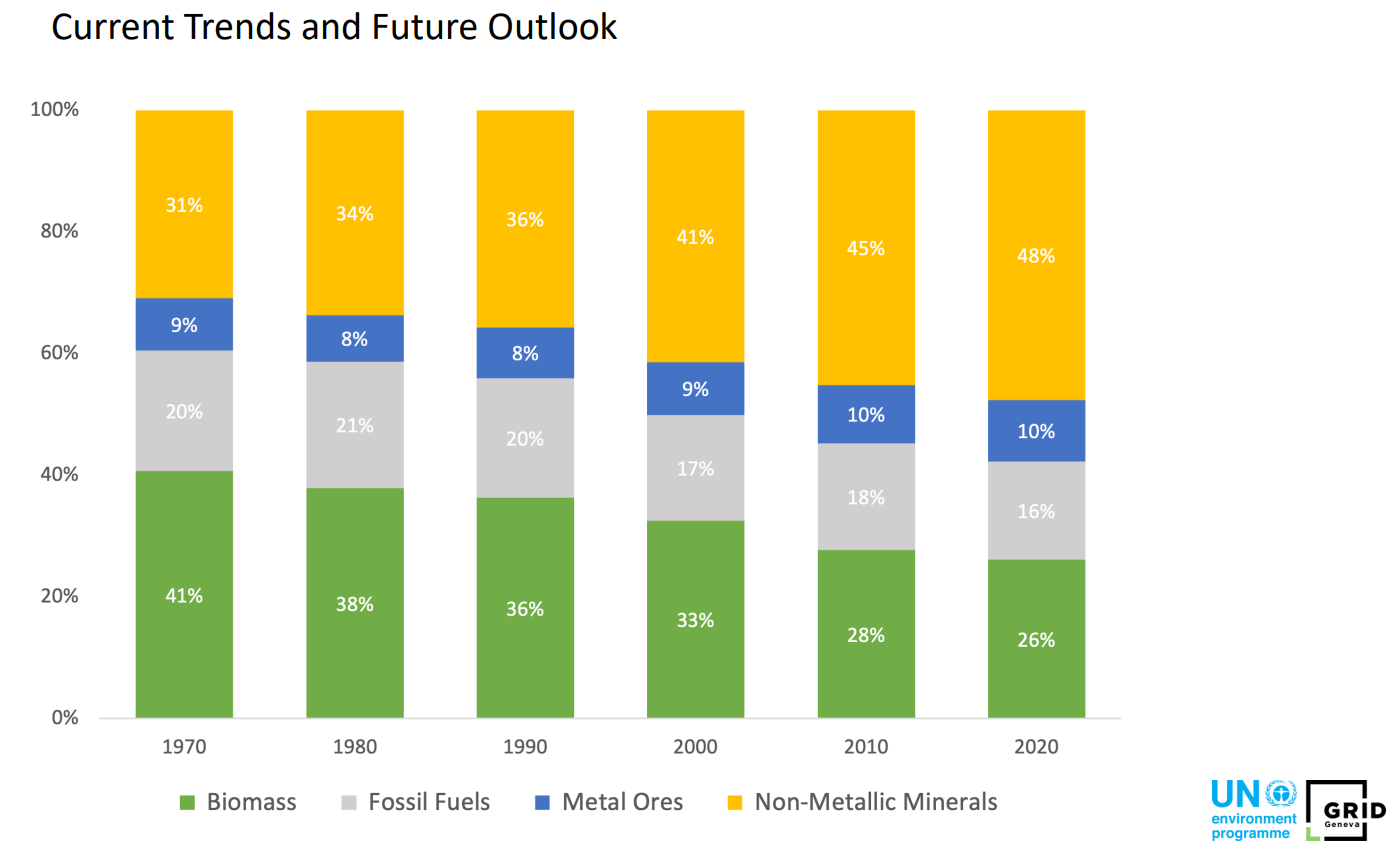
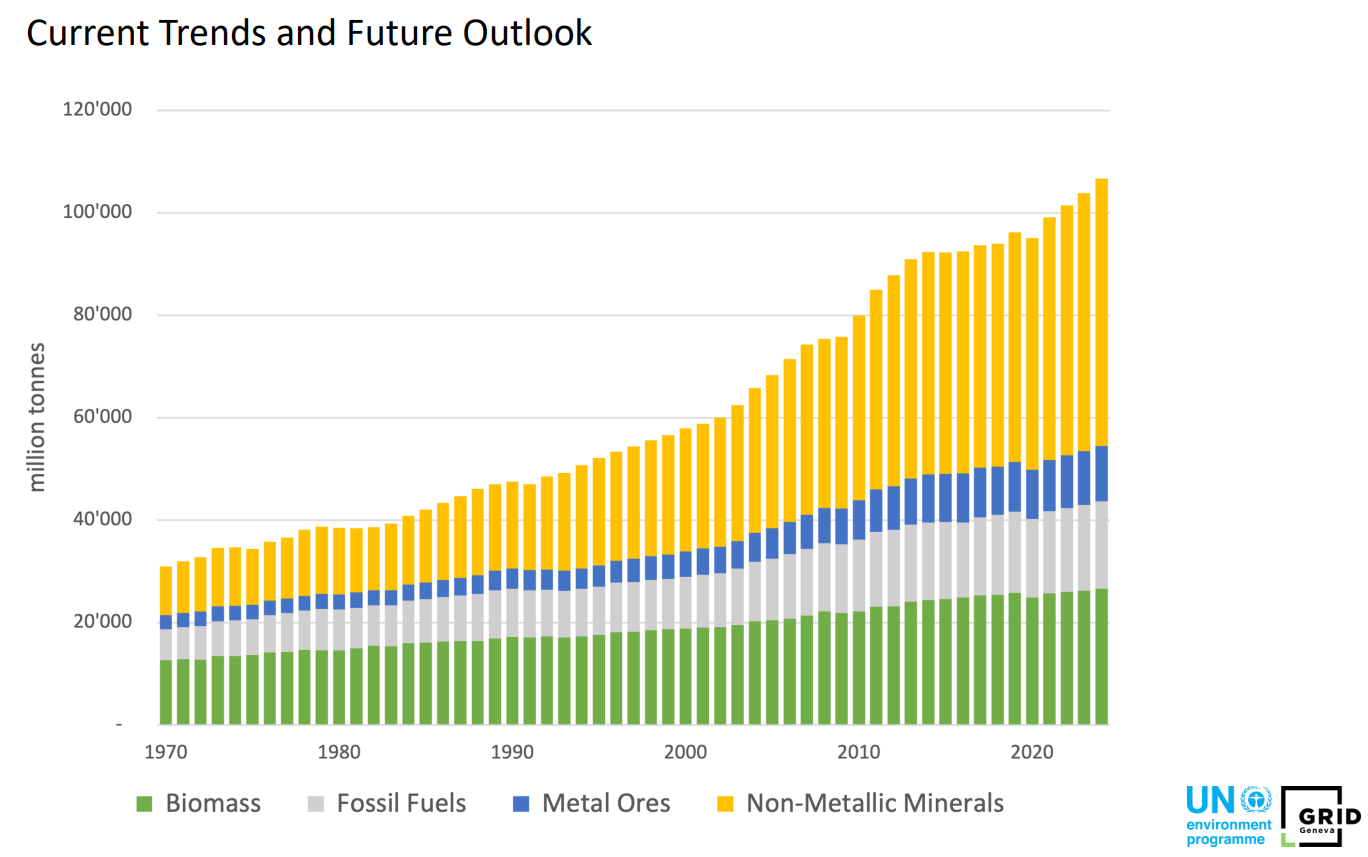
- Trends show that since the 1970s, the share of non-metallic minerals, mostly sand, stone, and gypsum, has increased. It represented 31% of extracted materials in the 1970s, and reached nearly half by 2020.
- In the 1970s, we were extracting about 35 billion tons of materials worldwide. Today, we exceed 100 billion tons.
- Sand demand for building is expected to increase by 45% between now and 2060.
- Already by 2020, the weight of human-made structures—bricks, concrete, roads, buildings, and all these structures made largely from sand-derived materials such as aggregates, concrete, and glass—had exceeded the weight of the planet’s dry biomass. So, the entire vegetation on planet Earth now weighs less than what humans have built.
- Demand will also be exacerbated by conflicts occurring in urban areas. For instance in Gaza, where 57 million tons of debris were generated by the war, and 85% of the infrastructure has been erased.
- This will create huge demand, first for recycling debris, but also for new sand and gravel to produce concrete for rebuilding homes and infrastructure.
- The map shown here was produced and published by UNEP on the devastation in Gaza. So far, you see local communities have been trying to recycle debris with the limited means available to them, but they have only managed to recycle 0.17% of the total.
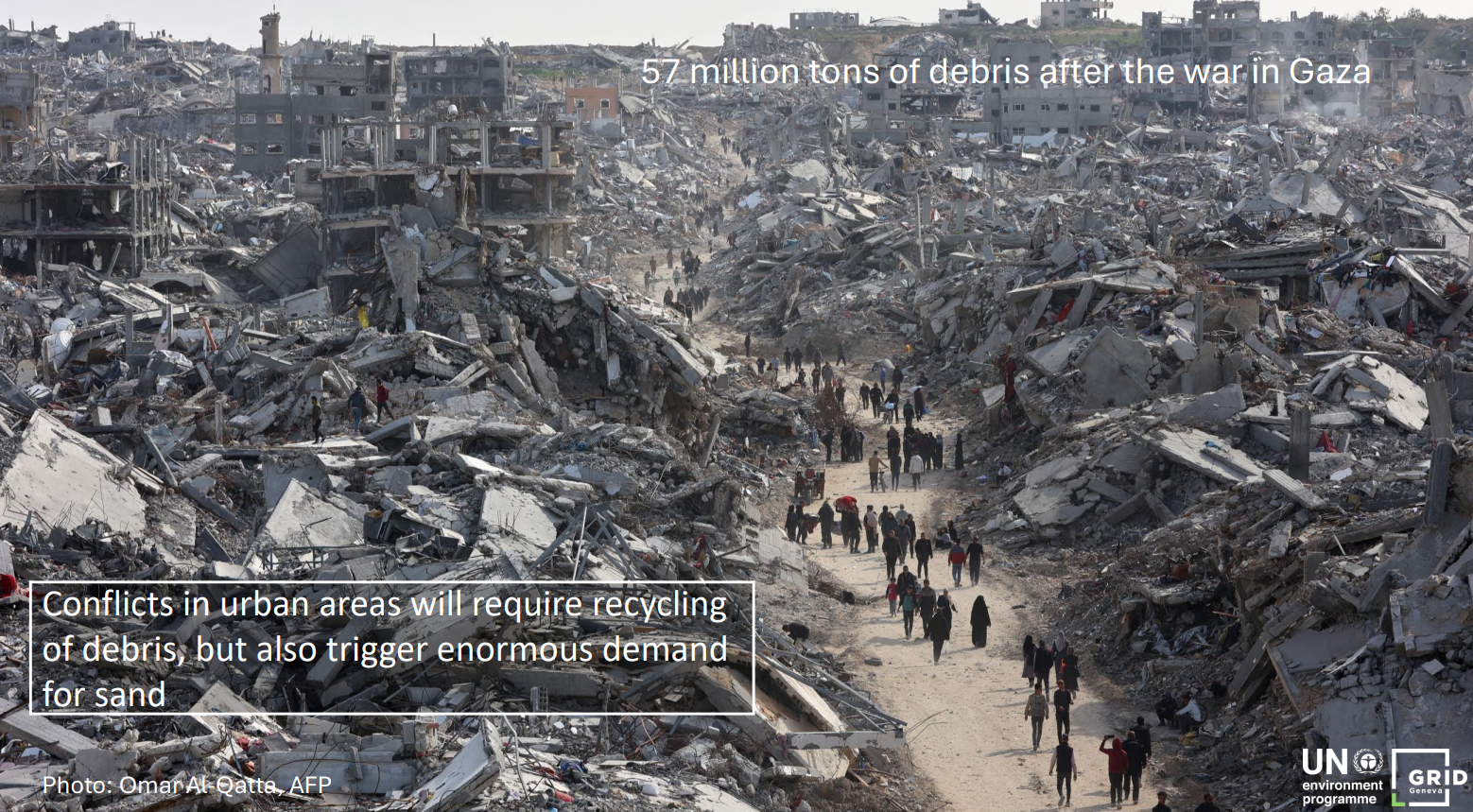
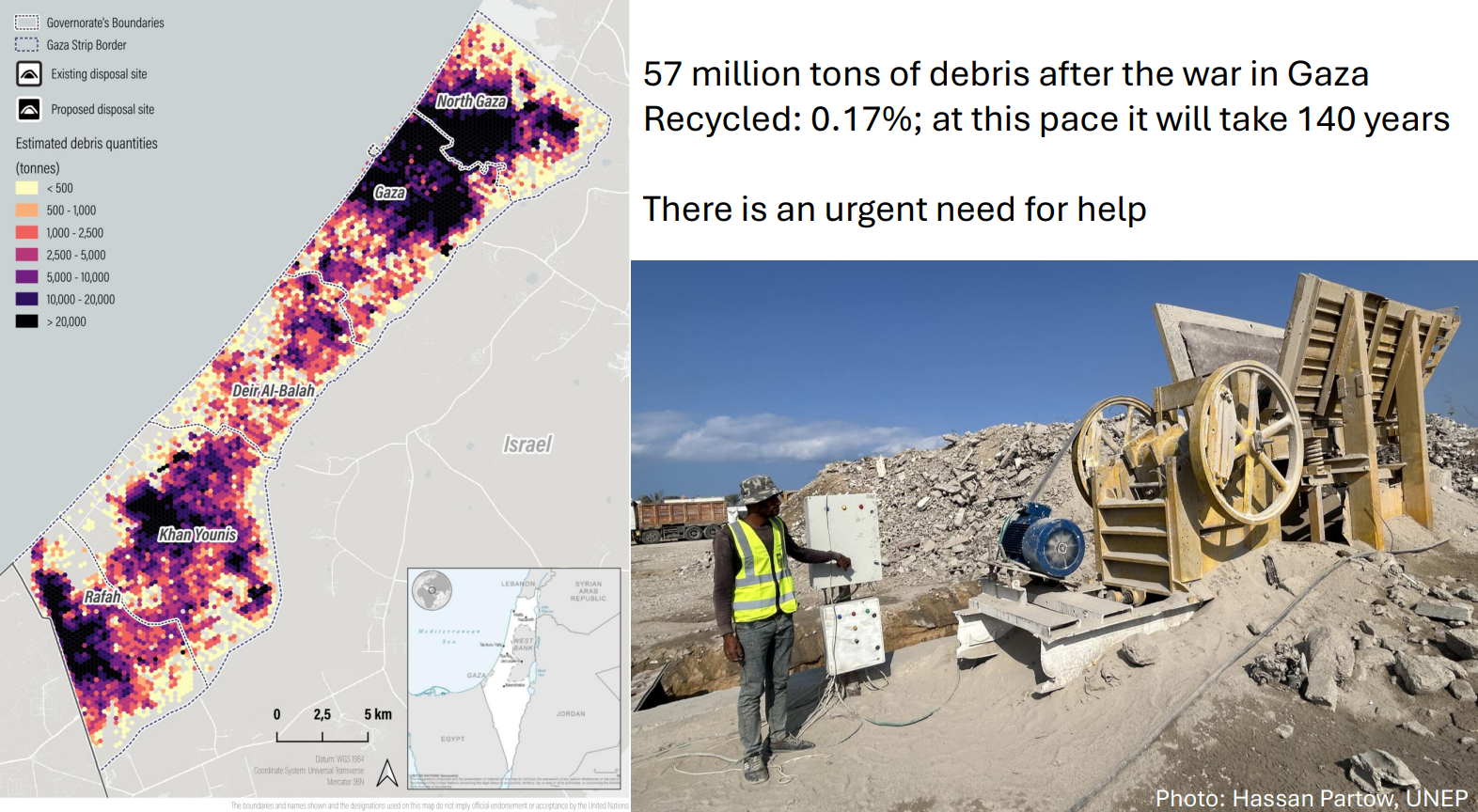
- At that pace, it would take around 140 years to process everything. We therefore need to support them with proper equipment so that this work can be accelerated. Even then, it will take decades.
Stephanie CHUAH | Programme Officer, UNEP/ GRID-Geneva
- The focus of this report “Sand and Sustainability: An Essential Resource for Nature and Development” is to showcase the value of sand for biodiversity.
- However, we are also seeing that extraction across the world and in different landscapes has led to negative impacts, for instance in our coastal areas where erosion has implications for resilience.
- We are also seeing cumulative impacts that we are only starting to understand, such as dredging.
- Sand is also very important to many unique and fragile ecosystems, such as mangroves, which support different species of animals, as well as riverine ecosystems and species. Again, we are seeing impacts across terrestrial, marine, coastal, and riverine systems.
- This report showcases that these impacts are not isolated, but they are connected, leading to cascading effects. For example, we see impacts on people because they affect livelihoods such as fisheries and tourism, which billions of people depend on, not only as a source of livelihood but also for food and water security.
- We are seeing cases of child labor in many contexts, which in turn affects resilience in the face of sea-level rise and climate change. With uncontrolled and unregulated sand extraction, we see salinization of coastal aquifers, which affects water supply and our defense against storm surges.
- The report Sand and Sustainability: An Essential Resource for Nature and Development is the third report in the Sand and Sustainability series. A few quick numbers: it has been in development for the last 14 months and was led by 27 experts, some of whom you will meet here today.
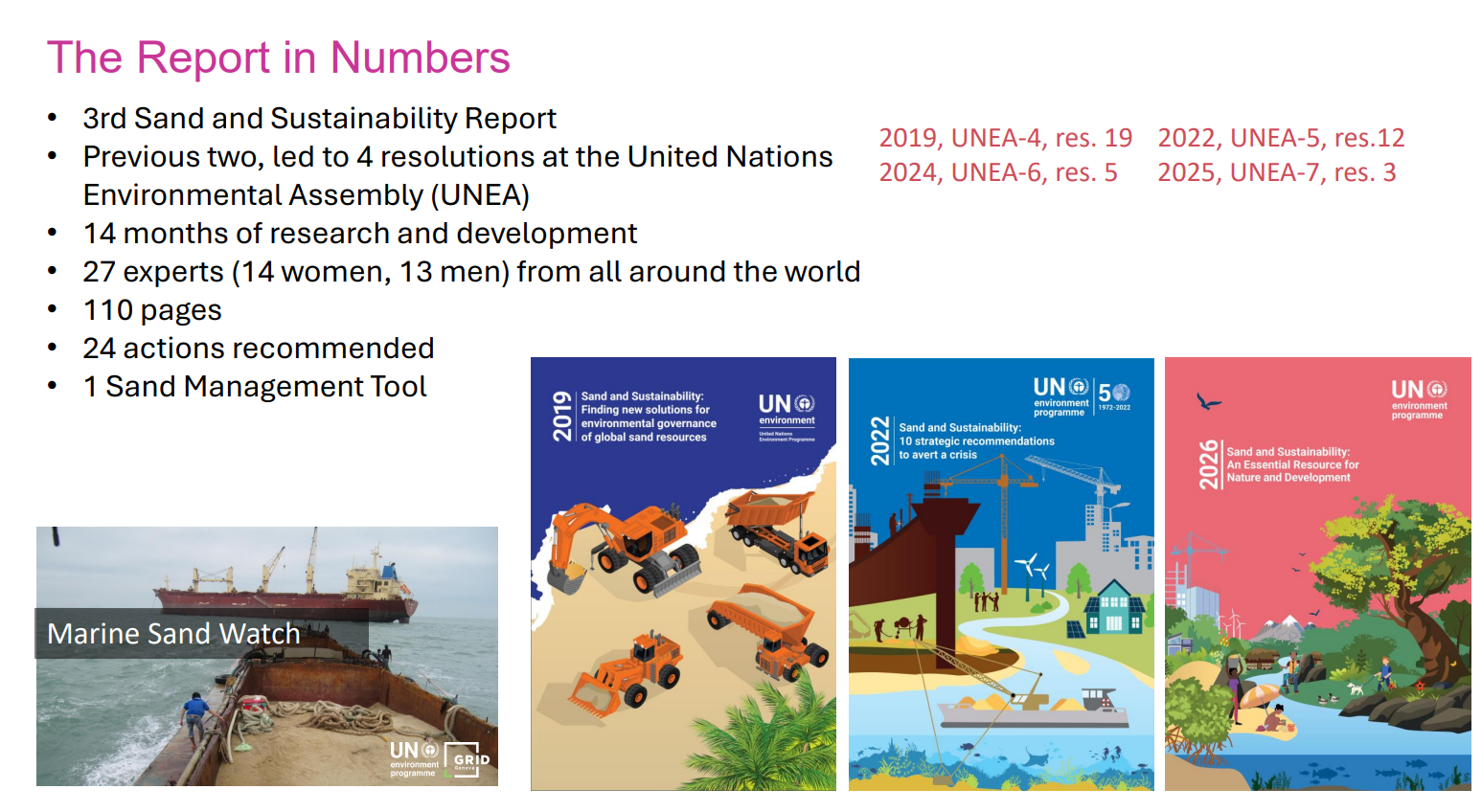
- We present concrete actions to be taken to manage and avert what we foresee as an impending crisis.
- This shows how UNEP has been engaging in the science-policy sphere over the last 10 to 12 years, going from policy work to technical reports, case studies, and practical solutions that member states and stakeholders could use to improve the governance of sand resources.
- This has led to four UNEA resolutions, showing that there is global momentum and a global mandate. We are starting to see changes on the ground.
- What we also want to do today is strengthen the narrative on the value of sand. Sand is a high-volume but relatively low-value resource, and we do not always understand the full range of its values.
- Sand forms the foundation of ecosystems and landscapes. Sand flows through our rivers and from our mountains into oceans, provides the stability of landscapes and contributes to long-term cultural values. Many people’s lives depend on leaving sand in nature. It regulates natural processes and provides livelihoods, even within the sand extraction sector itself.
- It underpins infrastructure and socioeconomic development. It supports the modern standard of living that we know today, including sanitation, infrastructure and many systems that support human well-being. It also has a multitude of industrial uses.
- One very important use that is not discussed enough is the energy transition. 70% of wind turbines, including their foundations, are made from sand-based materials, and around 30% of solar panels also depend on sand, despite requiring more specialized materials and processing.
- Much of the work in this report is inspired by the KMGBF’s global goal to halt and reverse biodiversity loss by 2030. Countries around the world have adopted this goal, and we need to align the way we use sand with the biodiversity commitments we have given ourselves.
- This report sets out several concrete strategic actions:
- Establish national policies, structures and processes | Sand needs to be seen as a national asset because of its value to nature, people, and development. We need national policies, structures, and processes that recognize these multiple values and allow for better coordination. In many countries, sand is managed by different ministries. There are laws and policies around extraction, some more formal than others. You also have environmental safeguards, but they are not always aligned.
- Create an inventory of its values to nature and as a resource, i.e. “Sand Budget” to ensure that decisions and policies take into consideration these values and not just merely as a resource. These can help us understand sediment flows into rivers, basins and coastal systems.
- Consensus-building. As sand affects people’s lives in very different ways, and we need to consider those perspectives.
- A case study used in the report is Colombia, which has recognized sand and aggregates as minerals of strategic interest. It is encouraging to see this approach being implemented in certain countries.
Sand as Part of Resilience and Long-Term Planning
- Another important point is that sand needs to be considered as part of resilience and long-term planning. Development plans are not made overnight, and planning around this resource must be done with the future in mind.
- In terms of intergenerational equity, the report proposes a model to estimate future sand demand. As showcased in the case of The Gambia, a model developed by UNEP/GRID-Geneva, foresees that the country could lose access to sand from some sources in the next five years.
- We can also tell that most of the country’s demand for sand comes from the need for roads and related infrastructure.
- The model also allows us to understand opportunities for substitution, alternatives, and recycling. However, it is important to think that in many developing regions, infrastructure stocks are not yet mature enough for recycling. These are the kinds of contexts that we need to consider when developing policies.
Sand Governance and the Question of Scale
- We have a spectrum ranging from artisanal to industrial extraction, and the report try to show some of the governance challenges that exist across this spectrum. We see artisanal and small-scale mining in certain contexts feeding into the development of cities while also providing materials for critical infrastructure such as shelters, hospitals, and schools.
- At the same time, we have mega-infrastructure projects happening around the world.
- We therefore call for greater formalization, but more importantly for collective responsibility and shared benefits within artisanal and small-scale mining contexts. We also call for strengthening corporate accountability within the sand sector through international frameworks.
Finance
- A lot of sand is used for infrastructure projects, and financing institutions such as multilateral and bilateral development banks, export credit agencies, and corporate finance institutions play a major role in enabling these projects.
- These institutions have the potential to mobilize more funding and capital towards nature-positive projects and to move us toward shifting away capital from harmful activities. They can also act as gatekeepers by being aware of harmful subsidies in line with the Global Biodiversity Framework.
- When we think about sourcing, there are a lot of challenges, but there are also many actions we can think about.
- For example, in the context of large infrastructure projects, we need to end lowest-bid tendering processes. We need minimum international environmental standards that allow for contracts to happen while keeping the environment in mind.
Sand-Biodiversity Nexus
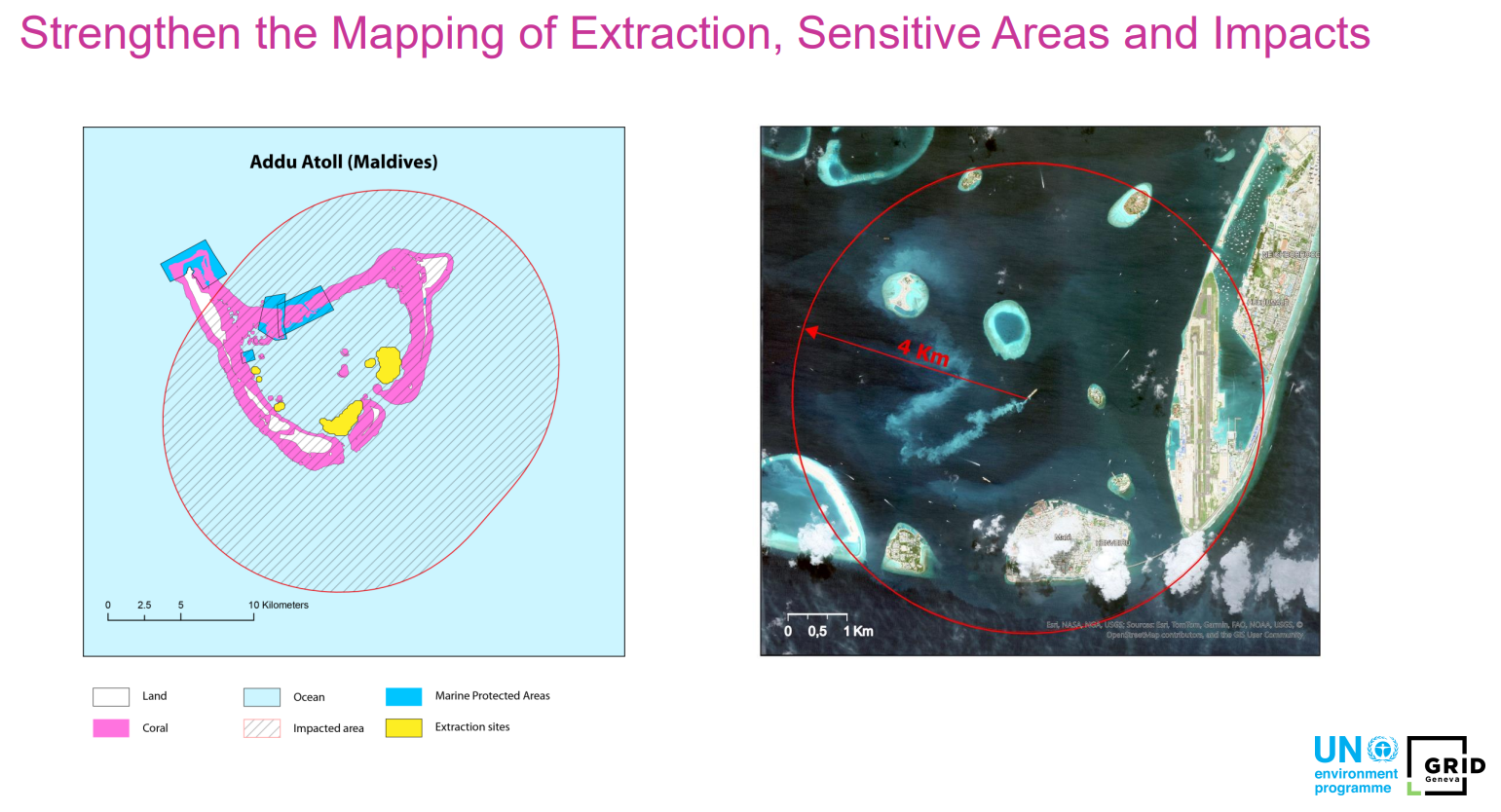
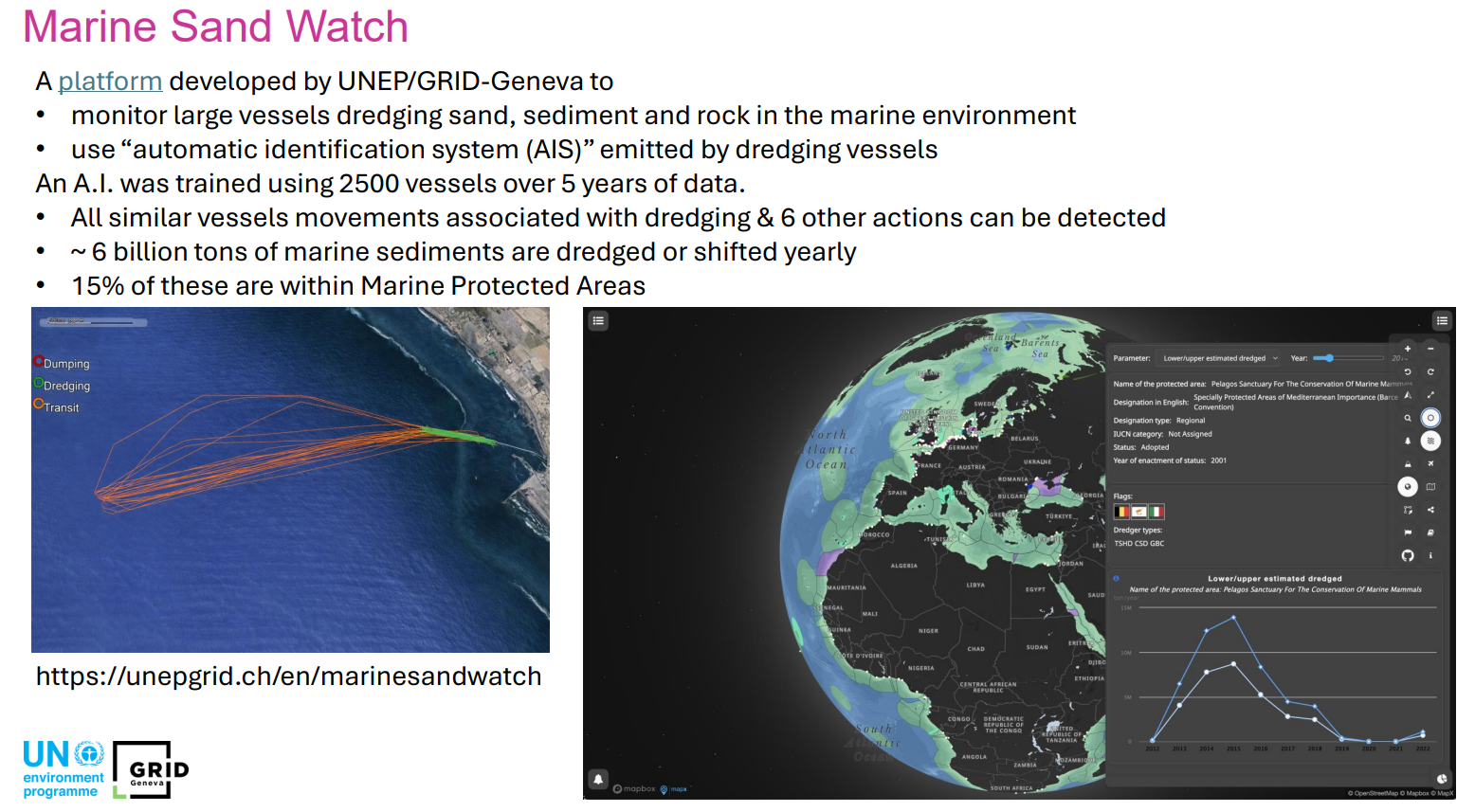
- The challenge is significant, but we have determined several priorities. We need to improve how we measure biodiversity and our impacts. We need to strengthen mapping efforts and improve our understanding of where sensitive ecosystems are located, where extraction is taking place, and where the impacts are.
- Ultimately, we need to prevent impacts. Where impacts cannot be avoided, there are actions we can take, such as sand-space restoration to help restore our environments. We will discuss these issues further during the panel discussion.
- The report also shows some of the mapping work we are conducting at GRID-Geneva.
- Part of our work is to help show and provide the evidence base needed to better understand and address these impacts.
Sand Assessment Tool
- This tool helps assess key governance gaps, technical challenges countries might face, and the strategic actions they can take. It helps build a roadmap for moving forward.
- We need to think about what the next steps are and what actions are possible. When this issue first surfaced, it seemed overwhelming, complex, and difficult to address, and it is.
- This report aims to show a path forward and encourage member states and stakeholders to work together and create a path forward.
- Sand is central to both development and healthy ecosystems. We need it to build and to provide a minimum standard of living for many people around the world.
- But we also need sand to remain in nature because it is a key component of Earth’s living systems.
Panel Discussion
What do you think are some of the key links between sand and biodiversity, particularly in relation to the Kunming-Montreal Global Biodiversity Framework and the goal of halting and reversing biodiversity loss by 2030?
Aurora TORRES | CDEIGENT Researcher, University of Alicante
- The KMGBF is about how we can bend the curve of biodiversity loss. This requires establishing concrete global targets on conservation, restoration, and the sustainable management of natural resources.
- It is also quite important that the framework aims to introduce biodiversity into economic decision-making. Why does sand matter in this context? Well, because sand extraction and use are probably going to impact, directly and indirectly, many of the species, ecosystems, and processes that the framework is trying to protect. This also includes nature’s contributions to people.
- This is another interesting element of the KMGBF because it states very clearly that, in order to effectively protect biodiversity, we need to look at the entire range of values that it provides to people. I think we need to take the same perspective with sand resources.
- Traditionally, we have looked at sand as a low-cost construction material that is crucial for construction, roads, and more recently the renewable energy transition. But sand is also a foundational component of ecosystems: it supports the creation of multiple habitats, complex networks of species, feeding grounds, and nesting habitats.
- At the same time, it is also a key component of many food systems because of its linkages with fisheries and agricultural land.
- Sediment supply is also shaping rivers and coastal areas and contributing to protection against sea-level rise and flooding. So, we need to consider this broad range of values.
- It is then easy to see that if extraction is poorly planned and poorly managed, we are going to see consequences through the disruption of sediment flows and irreversible damage to many ecosystems. This might compromise many of nature’s contributions to people.
- That is one of the key aspect why we need to think about sand in the context of the Global Biodiversity Framework.
- Going beyond the extraction side, the framework also establishes that it is very important to mainstream biodiversity across the economic sectors that have a footprint on biodiversity. That, of course, includes the construction and extractive industries.
- The framework is trying to promote greater engagement with responsible sourcing approaches, biodiversity-inclusive planning, and, overall, a more sustainable use of materials. The targets related to the circular economy and corporate accountability are also highly relevant.
- If we think about sustainable cities, this is quite an interesting point. When we think about sustainable cities, we usually think about green and blue infrastructure, and that is crucial. But we also need to think about where the grey is coming from. Where are the sand resources that make that grey infrastructure possible? I think the label of being a sustainable city should also include that consideration.
- In conclusion, sand matters to the Global Biodiversity Framework not precisely because it is explicitly mentioned, but because sand governance is central to achieving many of the targets set for 2030.
- In this context, it will be very interesting to see how different countries formulate their National Biodiversity Strategies and Action Plans, and whether they consider these types of activities. At the moment, these strategies already acknowledge that mining is a significant pressure on ecosystems, but we would like to see more concrete actions aimed at strengthening monitoring, data collection, restoration requirements, and, in general, moving us closer to the responsible extraction of sand resources.
How should we understand the sand challenge, especially when we think about solutions?
Aurora TORRES | CDEIGENT Researcher, University of Alicante
- As the topic is highly complex, it is quite important to approach it from a systems perspective.
- If we only look at individual extraction sites, it is simply not possible to achieve sand sustainability. We have to take a broader view of the entire system connected through the flow of sand resources.
- This challenge requires connecting the demand and the supply sides.
- On the one hand, we have many regions of the planet concentrating demand through construction, urban development, and infrastructure development. It is important to know where those centers of demand are located.
- But we also need to know where they are sourcing their materials from. Connecting supply and demand is critical because the distance between them can vary greatly. In some cases, supply and demand regions may only be a few kilometers apart, perhaps between an urban and a rural area. In other cases, those flows may extend across regions or even across countries.
- In all of these cases, it is essential that we map those connections and link supply and demand in order to ensure the sustainable sourcing of sand resources.
- From a policy perspective, this approach is very useful because it encourages different actors to look at the entire supply chain of the material, from extraction to transportation, use, and disposal.
- This perspective also makes us ask broader questions. Where is the demand coming from? How much sand is actually needed? Can that demand be met more sustainably? Can it even be reduced?
- This perspective dramatically changes the discussion. Instead of focusing only on guaranteeing supply, it pushes us to think about other questions, such as whether we can reduce material demand through better urban planning or building design, to what extent recycling and alternative materials can help reduce demand, and whether extraction can be redirected away from very sensitive locations.
- Implementing this systems perspective is challenging. One key issue is the need for coordination across different agencies: environmental agencies, urban planning authorities, water management agencies, and climate adaptation institutions.
- It is certainly a challenge, but it would create a much more coherent strategy that connects supply-side measures, such as better extraction and restoration standards, with demand-side measures.
- Ultimately, it changes the question from, “Where do we extract resources the next time ?” to, “How can we meet the growing demand for sand needed for development while minimizing harm to the environment and society, and while reducing demand for sand in the first place?”
Could you help us understand a bit more about cumulative impacts? What are we missing here, and what do we need to see and do differently?
Pascal PEDUZZI | Director, UNEP/GRID-Geneva
- As we have seen, ecosystems are deeply affected by sand extraction; therefore, we need to minimize the impacts on these ecosystems, specifically by conducting environmental impact assessments prior to starting extraction activities.
- However, the way these environmental impact assessments are currently set up, they usually do not take cumulative impacts into account. In the case of coral reefs, where corals are impacted by rising sea temperatures, ocean acidification, boat anchoring, snorkeling and diving activities and storm surges, the impact of sand extraction taking place in the middle of coral reef systems creates sediment plumes and dust that can kill the corals.
- Coral reefs were doing relatively well until the mid-1990s, but because of climate change, they have been declining very sharply since then, and they may disappear in many locations. This illustrates why we need to move beyond environmental impact assessments. These assessments are not even performed everywhere, although they should be the bare minimum.
- What is needed are cumulative effect assessments, which take into account all types of impacts acting on an ecosystem simultaneously.
- An ecosystem has a certain level of resilience. Some ecosystems are more vulnerable, more sensitive, or more fragile than others, but they all have some kind of resistance.
- A cumulative effect assessment can estimate that resistance and determine how much sand can be extracted without excessively impacting the ecosystem. But to do that, you need to recognize that the impacts are not limited to dredging or extracting sand from this ecosystem. The ecosystem is also affected by climate change and many other threats occurring at the same time.
- That is why we call for cumulative effect assessments, which are much more comprehensive and take all these pressures into account.
What can we do to improve and strengthen the knowledge base on sand?
Aurora TORRES | CDEIGENT Researcher, University of Alicante
- When someone thinks about the sand-biodiversity nexus, three core questions must arise: How do we map impacts? How do we measure them properly? How can we prevent irreversible damage to highly sensitive ecosystems while promoting the restoration of degraded ecosystems to the extent that is possible? These questions are connected to three central challenges.
- The lack of a robust spatial evidence base. Despite sand mining being the largest mining endeavor on the planet, there are still no global maps showing where mining is taking place. Many countries do not have this data, or at least do not make it openly accessible. This is not only an issue of informal mining. It also applies to legally permitted operations. We simply are not mapping them often enough, and that is a challenge because, quite often, you cannot quantify impacts if you have not mapped this activity.
- We need spatial information on biodiversity, including the distribution of habitats and habitat condition, which in many settings is also challenging to get. If we do not have these two pieces of information, it becomes very difficult to identify sensitive ecosystems, establish no-go mining areas, set extraction limits, or quantify cumulative effects. This spatial information is key. One of the next steps we need to take is ensuring open access to geospatial data of mining sites while also expanding efforts to map habitats and assess their condition. That would make a huge difference.
- Measurement is another transversal challenge. It is not something that only applies to sand mining. Quantifying biodiversity impacts is challenging because biodiversity is extremely complex. It is not like quantifying a carbon footprint, where we have more universal indicators. In the case of biodiversity, we need to consider many different dimensions and facets. It is also difficult to compare impacts across different systems – terrestrial, freshwater, marine – as well as across low-intensity and high-intensity mining operations. On top of that, something that reinforces the challenge is that the evidence base regarding how sand mining affects biodiversity is still developing in comparison with research on other minerals. Less research has been conducted, so we need to continue studying how sand mining affects biodiversity, in which cases it is more detrimental, and in which cases it can lead to more positive trajectories.
- All of this is important because if we do not properly measure biodiversity impacts, that limitation will cascade into environmental impact assessments. At the moment, we often see that biodiversity is not treated thoroughly enough within these assessments.
- The same applies to life-cycle analyses. One consequence is that this can penalize other options, such as secondary resources and alternative materials. If we are not properly quantifying the impacts of mining, we are less able to see the benefits of using secondary resources.
- In order to move forward, we need better data, better baseline information on mining operations, post-project monitoring, open data, and open databases.
- We also need to keep learning what is working and what is not working in mining operations, both in terms of management and restoration. Quite often, it is even more useful to understand what is not working and where the failures are so that we can learn from them.
- The report refers to many guidelines that can be used to anticipate biodiversity risks associated with mining operations, including the use of harmonized sets of indicators.
- This is another point that we highlighted in the previous report as well: the importance of applying the mitigation hierarchy and starting by avoiding impacts in the first place, particularly in highly sensitive ecosystems.
- Many systems, such as river systems and coastal areas, are already under intense sand extraction pressure. Beyond a certain threshold, impacts may become irreversible.
- We do not want to reach that point, because restoration will not be a solution. In those systems, prevention often has to be the primary approach.
- In many other cases, however, restoration has the potential to increase biodiversity gains and the contributions to people associated with mining operations.
- There are many successful examples of sand mining site restoration in Europe, which we also cite in the report.
- In this context, we recommend that companies use the standards developed by the Society for Ecological Restoration for the restoration and recovery of mining sites. These standards are trying to increase the level of ambition and effectiveness of restoration projects.
What are some concrete steps that can be taken to solve the sand challenge, especially in terms of alternatives and substitutions?
Sheila PUFFER | Professor, Northeastern University
Awareness Raising
- The first step is to raise awareness on the sand crisis among the general public as well as within industry itself.
- Together with colleagues at Northeastern University, we have conducted research to determine the level of awareness in the construction industry across various professions, and we found very low levels of knowledge both in Canada and the United States.
- Raising awareness is important, not only within the industry itself but also among the general public.
- One of the things I have become involved in is education at the grade 12 level in the USA. A project called BioBus travels to schools in New York City and Boston to provide children with environmental education. Following my recommendation, they included a curriculum on sand that allows children to examine different types of sand and get educated on the topic.
Availability of Sustainable Substitutes within the Industry
- There are many alternatives at various stages of research and development, as well as different stages of commercialization. However, scaling them up requires funding.
- My colleagues at Northeastern and I have published, for instance, a study of various aspects of steel slag as a substitute for sand in concrete.
- I think one of the best examples of how substitutes could be implemented comes from efforts related to energy and carbon reduction.
- There have been many subsidies and other ways designed to incentivize reductions in carbon emissions from concrete. Similar types of incentives could be applied to reducing the amount of sand used in construction materials.
Financing
- Channeling funding into areas of sustainability is crucial. Therefore efforts to create taxonomies for green investment are highly useful and can contribute to financing research and development on sand substitutes.
Could you share with us why this issue is important for the sand sector, and what the experience at Sibelco has been like? What are some of the challenges, especially considering everything we have been discussing about sand and sustainability? And perhaps, I hope, some of the opportunities that exist in the work that you do.
Cathy BLERVACQ | VP Sustainability, Sibelco
- From the industry standpoint, we are witnessing requirements, especially in certain geographies around the world, getting stricter in the sand extraction industry: this includes environmental impact assessments, more requirements from local stakeholders and so on, which makes it harder for a company to obtain access to new mining areas.
- The average time to gain access to a greenfield site is 10 to 15 years. Sometimes that is really the minimum. That is the challenge we face. But every challenge can be turned into an opportunity, and that is what we try to do at Sibelco.
- For us, biodiversity is a very important topic. It is something we have been working on for many years as we try to extract sand in a sustainable way.
- How can you do that?
- It starts with good planning. Having a plan for how the area will look when you stop operating is essential as much as involving local stakeholders, NGOs, and others. That is something we try to apply at every mine where we are active.
- Extraction needs to be carried out progressively. Mining industries must not create one large open pit that remains open for many years and start thinking only afterwards about how it will be closed and how biodiversity will be restored. A smart mine plan must be in place so that restoration follows extraction.
- Obtaining the necessary data and measurements is complex as no one-size-fits-all approach and conditions vary from one location to another.
- There is not yet a uniform standard for measuring biodiversity, but there are efforts moving in that direction.
- Sibelco collaborates with several partners, NGOs, and scientific institutes to test habitat mapping through remote sensing technologies.
- This gives us information at a global level to identify sensitive areas and understand how improvements can be made.
- We do not only look at our mining sites. We also include a large surrounding buffer area so that we can understand how the site fits within the broader environment.
- The idea is to use this momentum and gather more data, which will help us to steer our strategy from the global level while also supporting our local teams and helping us give something back to the field.
- We are the only company doing this; many industrial mining companies are moving in this direction. I think it will be beneficial for companies but also for scientists and society more broadly to work in this way.
As a company that is very active in this sector, do you see certain enablers – or gatekeepers, as we call them – within the financing system that could have major implications for where we are heading?
Cathy BLERVACQ | VP Sustainability, Sibelco
- Yes, there is an evolution. When we look at banks, there was a strong focus on CO₂ several years ago, which is now expanding towards biodiversity matters.
- It will be important to develop good standards for measuring biodiversity so that companies can respond appropriately and show the evidence of what they are doing.
Artisanal and small-scale mining, especially in the sand sector, provides livelihoods for many communities, but it is often informal and governance can be weak or fragmented. Help us understand that context. What can be done, and how can we address these challenges without harming the communities that depend on sand extraction for their livelihoods?
Munira RAJI | Geoscientist and Science Diplomat, University of Plymouth
- Artisanal and small-scale miners are a real part of the sand supply chain in many parts of Sub-Saharan Africa. They are the people who supply sand to communities for community projects, housing, and road construction. They also supply sand to larger infrastructure projects.
- In the context of Nigeria, if there is an estate development project and the developer is trying to obtain a mining permit to extract sand, the bureaucracy involved often leads them to find ways of using artisanal and small-scale miners to supply the sand instead.
- The problem is that, instead of talking about how we can stop them, we need to think about how we can bring them into a sand governance system that is realistic for them, that is just, inclusive, and environmentally responsible.
- Sand mining has one of the lowest barriers to entry in the mining sector. It just requires a shovel and a wheelbarrow, a beach, to extract sand and sell it. It is easy, and that makes it attractive for people to become involved in sand mining.
- We cannot simply continue to let that happen without oversight. We need to find ways to formalize these activities.
- To do that, we need to ensure that small-scale miners understand the impacts of mining in different environments, whether on beaches, in coastal communities, or in other extraction zones.
- We need to help them formalize their operations.
- For example, obtaining a permit in some countries is very expensive. The paperwork is complex, and many people do not understand what they need to become registered miners.
- We need to bring them into a simpler governance system, streamline the application process, and help them understand the importance of joining associations.
- Another point I want to raise is that it is easier to work with artisanal and small-scale miners when they operate as cooperatives rather than as individual miners.
- We encourage governments to support these miners in forming cooperatives, where they can come together as a collective group and apply for licenses jointly.
- In that way, governments can help them understand the benefits of monitoring sand extraction from specific areas. Governments can also provide training on sustainable sand mining, monitoring extraction zones, and collecting data.
- Bringing artisanal and small-scale miners into governance systems must be done at the appropriate scale.
- We cannot use the same systems that applies to large companies and expect small-scale miners to follow the same process. Large companies have established ways of applying for mining licenses, but we cannot simply hand the same application forms to small-scale miners and expect them to navigate them in the same way.
- Artisanal and small-scale mining applications need to fit local realities and community contexts.
- The formalization process needs to be simple. It should not be complex, and it should not become what I would call “formalization punishment by paperwork,” where we impose excessive criteria on people.
- In the mining communities in Nigeria, when miners want to apply for mining permits, they often have to travel to the capital, Abuja. Then they may need to return multiple times to complete additional forms or answer questions they do not fully understand.
- By the time they are close to obtaining a license, they may be told by the responsible office that, although a certain fee is listed on the government website, they must pay additional fees because of all the paperwork involved. At that point, many small-scale miners simply leave because they cannot afford the costs. They return home and continue mining without licenses.
- I would not necessarily call it illegal mining, but they continue mining outside the licensing system because the process is too difficult and expensive for them.
- We need to streamline that process and create a system where it is easier for them to apply for permits and become part of the formal governance framework.
Murtah SHANNON | Senior Expert, Water Governance & Environmental Justice, Both ENDS
- I would really like to bring the perspective of the communities we have been working with for many years in relation to these large mega-projects, particularly major dredging projects in low- and middle-income countries.
- In terms of the governance challenges, I think it is most useful to think about them as impacts that are felt locally while decisions and governance occur elsewhere.
- Quite often, in relation to these large dredging projects, you find many international actors involved: international corporations carrying out the dredging, export credit insurance agencies, banks, consultants, alongside all of the domestic actors.
- This is where much of the decision-making happens. This is where much of the governance happens.
- Not only is this far removed from the people who are on the receiving end of these projects, but it is also often very opaque. It can be difficult to understand where the roles and responsibilities actually lie.
- To give one example, it is still very common practice to see large projects where much of the data – if not all of the data – on environmental, social, and human rights impacts is hidden behind non-disclosure agreements on the grounds of business confidentiality rather than being treated as a matter of public interest.
- This gap really needs to be closed, or at least bridged more effectively.
- There are several standards and frameworks that provide useful guidance on how to do this. There are the UN Guiding Principles on Business and Human Rights, the UN Voluntary Guidelines on the Responsible Governance of Tenure, and, of course, the Kunming-Montreal Global Biodiversity Framework. Many of the actors involved in these large projects formally endorse these frameworks in their corporate social responsibility policies. However, if you look at how they are actually integrated at the project level, it is very inconsistent. The responsibilities defined in these frameworks are often not contractually guaranteed.
- Finance therefore has a major role to play here, which has already been touched upon today, because financial institutions essentially decide which projects go ahead, which do not, and under what conditions they proceed.
- We have been doing a lot of dialogue and engagement with export credit insurance agencies that support these large projects.
- There too, we see the same pattern: outward endorsement of principles such as the UN Guiding Principles on Business and Human Rights, but when it comes to the actual project-level contracts, there is often very little in place to ensure that the clients receiving that insurance are actually required to comply with those obligations.
- Closing this gap is one of the main challenges.
- That is why, in the report, we put forward this pathway of codifying relevant international frameworks into national legislation. This could include procurement law, corporate law, and other relevant legal frameworks and is obviously a long-term process.
- But in the short term, what can be done is to integrate these frameworks more systematically into project management and procurement processes, so that decision-making and governance become more transparent and more accountable to the people who are experiencing the impacts of these projects.
Many of these projects seem to be coastal projects as well. What are some of the implications for resilience? How does this affect these communities? What are you seeing on the ground, and what can be done?
Murtah SHANNON | Senior Expert, Water Governance & Environmental Justice, Both ENDS
- Sand is at the basis of livelihoods and climate resilience. It underpins well-being, and that is also detailed quite well in the report.
- If you take away a huge amount of that sand in a very short period of time, that is obviously going to have impacts across these domains of livelihoods, well-being, and resilience.
- Some of the impacts we see have already been touched on. We are talking about habitat loss, loss of ecosystem services, impacts on coral reefs, mangroves, and wetlands.
- There are also often very significant impacts on the livelihoods and local economies of coastal communities, particularly through impacts on fishing industries. These impacts can often be much longer-lasting and more significant than what is factored into impact assessments.
- Other impacts are closely related to resilience and associated with the removal of sediment that would otherwise replenish beaches or serve as a buffer against storms.
- We often see, in the short and long term, increased coastal erosion and increased susceptibility to storm surges.
- What is really striking in relation to many of these projects is the discrepancy between how these impacts are assessed and monitored at the project level and how they are actually experienced on the ground.
- It has already been mentioned that impact assessments can vary greatly in quality and robustness. They also tend to be quite narrow in scope, which means that many cumulative impacts are not factored in and, essentially, do not exist from the perspective of project proponents.
- As a result, the impacts experienced on the ground are often much more significant than what is depicted in these assessments.
- For this reason, the report argues that sand governance is also a justice issue.
- Moving forward toward sustainable sand governance and policy change requires incorporating concepts such as free, prior and informed consent, tenure security, inclusive governance, and gender responsiveness.
- None of this is particularly radical. These principles are all reflected in the Kunming-Montreal Global Biodiversity Framework.
- It is really about integrating the frameworks that already exist and making sure they are incorporated into the evolving policy discourse on sand.
Moving across this spectrum, and considering that this is a justice issue, it also affects livelihoods, survival, and well-being for people in many communities. At the same time, we understand that we need sand in nature and in our ecosystems in order to protect communities from many of the impacts we have discussed. A lot of environmental impact assessments are usually project-based. They are formal, they can be costly, and they require expertise that may be difficult to access and may even seem irrelevant in the context of artisanal and small-scale mining. Is there anything we could do to allow these livelihoods to continue while at the same time moving toward better environmental assessment, monitoring, and protection?
Munira RAJI | Geoscientist and Science Diplomat, University of Plymouth
- Most environmental impact assessments are conventionally designed for large extraction projects.
- One of the challenges with artisanal and small-scale sand mining is that when miners extract from individual sites – perhaps once or twice a day – the immediate impact appears very small. We do not notice it right away because they are simply going back and forth a few times a week.
- Initially, the impacts seem minor because we do not measure how these activities affect an entire river basin, catchment area, or coastal zone. As a result, we often miss the bigger picture.
- However, over a long period of time, we begin to see how these impacts significantly affect the environment. They affect sediment flows, riverbank stability, coastal erosion, groundwater recharge, and many other environmental processes.
- In Lagos, Nigeria, there were beaches where people extracted sand for many years. The government repeatedly told people to stop extracting sand, but there was very little monitoring.
- Eventually, significant erosion occurred, which affected many residential areas. Communities became very upset with the government because they felt nothing had been done to prevent it.
- What seemed like small-scale extraction taking place over many years eventually resulted in very significant environmental impacts.
- In order to find solutions, we need to recognize that sand mining is important for the livelihoods of some communities. We cannot simply tell people that they cannot mine sand anymore. The best approach here is forming cooperatives and strengthening formalization.
- We need to move away from monitoring impacts solely on a project-by-project basis and instead adopt a catchment-based approach.
- Governments can designate specific areas for sand harvesting and conduct community-level impact assessments for those areas. That means small-scale miners would not need to carry out those assessments themselves. Governments would take responsibility for preparing those impact assessments and providing the necessary information.
- When communities are brought together and engaged in the process, and when awareness is created, people begin to understand the impacts of extraction.
- Many miners do not realize that extracting sand from different areas affects them directly. They do not necessarily see the cumulative impact of small amounts of extraction carried out repeatedly over time.
- We therefore need to raise awareness and help communities understand why this matters.
- When people understand the impacts and feel that they have a voice in decisions affecting them, they develop a sense of ownership over their communities. They begin protecting their environment and their livelihoods.
- If outsiders come into the community and attempt unsustainable sand mining, local people are often the first to object because they understand the consequences.
- That is why we need to bring communities into the sand governance system, ensure they have meaningful participation, and help them understand the impacts of their activities over time.
- Communities often understand the impacts of sand mining long before governments do because they live there.
- They have indigenous knowledge about flooding, erosion, farming impacts, and fisheries impacts. They notice changes before governments do.
- Quite often, governments first become aware of a problem when they read about erosion or flooding in a newspaper. Meanwhile, communities have been observing those changes for years.
- We therefore need to bring communities into the system so that they can contribute their knowledge and so that we can integrate that knowledge into how we monitor environmental change.
- The key is that we must design practical implementation mechanisms for monitoring sand extraction, and those mechanisms must both protect the environment and the livelihoods of the community.
Stephanie CHUAH | Programme Officer, UNEP/ GRID-Geneva
- Sand underpins many of the ecosystem services we have discussed, but it also underpins the way we live today.
- Demand drives many of the impacts we see on the ground, and this is a complex issue requiring coordinated action across different levels of governance, involving different stakeholders and systems, with finance playing a particularly important role.
- In the end, this is about moving forward together – providing opportunities for development while also ensuring a good quality of life for people around the world.
Open discussion
Edward Girardet | Editor, Global Geneva Insights Magazine
- What about trafficking and illegal sand mining, does the report address it?
Pascal PEDUZZI | Director, UNEP/GRID-Geneva
- Illegal sand mining is a big issue. But legal sand mining is also a major issue.
- In terms of volumes, it is not true that illegal sand mining is the larger problem. It would be too easy if that were the case, and I think we deliberately tried not to overemphasize that aspect.
- There was no particular emphasis on illegal sand mining in the report. When we first started talking about the issue of sand extraction, most of the comments we received were along the lines of, “Oh, it’s illegal sand mining.”
- Every time I gave an interview, even when I tried to downplay that angle, the discussion always came back to illegal sand mining. It created the impression that illegal sand mining was the problem. Unfortunately, that is not the case.If it were only illegal sand mining, the situation would still be bad, but it would not be nearly as serious as it is.
- Legal sand mining also causes significant impacts.
- When large vessels legally extract sand from marine environments, they can have major impacts on benthic ecosystems and the seabed. When very large quantities are legally extracted from river systems, the impacts can also be substantial.
- That does not mean illegal sand mining is not a problem. It absolutely is.
- Because it is illegal, there is less control. It can be associated with violence. There have been murders linked to it. There are many social and environmental issues because these activities take place outside proper oversight, without environmental impact assessments and other safeguards.
- Of course, legal operations are supposed to follow those procedures.
- However, even where extraction is legal, there can still be problems. In some places, a concession may authorize a certain extraction volume, but three, four, five, six, or even seven times that amount may actually be removed from the area. In those cases, the concession may have been legal initially, but the actual extraction becomes illegal.
- There are all kinds of shades in this.
- So yes, illegal sand mining is a major issue. But overall sand extraction – even legal extraction – is largely overlooked because, until now, we have mostly focused on the value of sand for buildings and infrastructure.
- We have failed to properly consider the value of sand for biodiversity and the ecosystem services it provides.
- That is really the aim of this report.
- Even though we are not yet able to assign a precise dollar value to sand left in the environment, we are trying to better account for its benefits.
- The challenge is that when you extract a ton of sand, depending on where you are, it may be worth anywhere from $3 to $40. But when sand remains in nature, its value extends over decades or centuries.
- How do you account for services that continue for hundreds of years – supporting fisheries, protecting coastlines, reducing salinization, and providing many other ecosystem benefits? That makes valuation very difficult.
- The report tries to bring those environmental values into the discussion and make them part of decision-making.
Stephanie CHUAH | Programme Officer, UNEP/ GRID-Geneva
- One reason we brought in the perspective of artisanal and small-scale mining is that we recognize that there are many shades of grey within this issue.
- In many contexts, the difference between legal and illegal extraction may simply be the possession of a permit.
- A large share of extraction is informal. In some places, governance structures do not exist that would allow the people extracting sand to obtain formal legal recognition.
- That is not to say there are not contexts where laws exist and where illegal extraction activities take place. There certainly are, and these issues have been discussed extensively in the media for good reasons.
- For us, however, it is important to acknowledge that, in many of these contexts, demand is also driving the problem.
- We need to understand the root causes behind why extraction is taking place outside governance structures and why people may be breaking the law in order to access this resource. It is really about understanding the broader context.
Yves Lador, Earthjustice Representative
- In the framework for action that you propose, you emphasize the need for a specific entity that can recognize sand as a real asset. We completely agree with that.
- However, when you talk about empowering that entity, how do we empower the people who are most directly concerned?
- You have people whose livelihoods depend on sand extraction. As was said earlier, many of them come from some of the poorest communities. In many cases, they are effectively destroying their own environment because they see no alternative.
- Unfortunately, we see this in many situations around the world, where the poorest communities are making their own situation worse because no viable alternatives are available to them. In our work on human rights, this is a very important issue. So I would be interested to know whether you have any specific recommendations on that aspect.
- The second aspect concerns the idea of sand as an asset, and the report stresses the importance of timing.
- When we talk about human rights and their relationship with ecosystems, and how human survival depends on functioning ecosystems, it is important to remember that ecosystems are not simply nice places to look at, like a zoo. They are the very conditions that make life on Earth possible.
- When we discuss ecosystems and ecosystem restoration, we inevitably have to confront the issue of timing. How much time do we have?
Munira RAJI | Geoscientist and Science Diplomat, University of Plymouth
- From the perspective of local artisanal and small-scale miners, what we recommend is that, in areas where mining takes place in highly restricted or sensitive zones, and where communities have no alternative sources of livelihood, governments should help provide alternative sources of income.
- Once people have viable alternatives, it becomes easier for them to understand that continued mining in these areas will eventually affect their communities and may ultimately force them from their land.
- We need to create awareness so that communities understand these impacts. It is not enough simply to tell people that environmental damage is going to happen. We need to help them understand it for themselves and develop a sense of ownership over protecting their land.
- At the same time, we need to create alternative sources of income so that people have different livelihood options available to them.
What we often struggle to understand when it comes to nature and the impacts of our activities is the question of thresholds. Could you address the issue of thresholds and how we manage the question of time, which is also part of this broader systems understanding of impacts?
Aurora Torres | CDEIGENT Researcher, University of Alicante
- There are certain systems where, before allowing mining activities, we really need a good understanding of how the system functions. For example, we need to understand replenishment rates in order to determine to what extent extraction can continue and where the threshold lies.
- If that threshold is crossed, the system may become disrupted and shift into a more unstable state.
- In some places, this is addressed by creating panels of experts from academia and other institutions who periodically monitor how the system is evolving. Based on that information, they determine how much resource can be extracted while still allowing extraction to continue in a sustainable – or at least relatively sustainable – way.
- However, if you do not have that kind of system in place, it becomes quite likely that those thresholds will eventually be crossed.
- As I mentioned earlier, in some environments – particularly rivers and coastal areas – restoration is not really a viable solution.
- At the moment, we do not have restoration techniques capable of returning these systems to their previous state once major damage has occurred.
- That means we need very strong monitoring systems, as well as approaches focused on avoidance and prevention.
- At the same time, sand is also extracted from other types of systems that are less dynamic and where it may be easier to establish sustainable extraction limits and restoration approaches.
Pascal PEDUZZI | Director, UNEP/GRID-Geneva
- Since our first report, we have been trying to encourage governments to identify areas where sand and gravel resources exist, to map them, designate them as concessions, and ensure that they remain available for future use rather than being built over.
- These concessions can then be allocated to public or private companies.
- The reality is that artisanal workers often have only a shovel and a basket. They cannot operate in quarries. That is where companies can play an important role by employing those people and helping move them from the informal sector into the formal sector.
- This is also something we have been discussing with the International Labour Organization, which has programs focused on helping people transition from informal to formal employment.
- This is extremely important because if people remain exclusively in the informal sector, those who only have shovels and basic tools cannot access quarries. They will continue extracting sand from rivers, beaches, and other sensitive environments.
- To return to the issue of justice, it is really at the heart of our discussion.
- This is not only about people living today in difficult conditions who have few options other than extracting sand. We have to find solutions for them. We cannot simply leave them in a situation where they earn very little money while, at the same time, contributing to environmental degradation that ultimately affects them as well. But justice is also about future generations.
- This is one of the broader challenges we face when discussing human rights. How do we ensure rights for future generations who will also need access to these resources?
- What will happen if we extract all the sand now and transform it into concrete? What resources will future generations have for their own livelihoods?
- We therefore have a responsibility that extends across time.
- This issue is not unique to sand. It applies equally to forests, biodiversity, climate, and many other environmental challenges. Sand is simply another way of talking about sustainable development.
- We have had the same discussion with forests and fisheries. You cannot harvest more fish than can reproduce. You cannot continuously remove trees without allowing forests to regenerate. The same applies to sand.
- Sadly, it is another example of the same unresolved questions about how we manage natural resources.
Stephanie CHUAH | Programme Officer, UNEP/ GRID-Geneva
- This recommendation was developed together with people who have worked extensively on the ground, including industry experts.
- Even within industry itself, there is recognition that the way we manage this resource has become very siloed.
- Some people see sand purely as a resource. Others focus only on understanding environmental impacts, if those impacts are considered at all. Then there are people making development plans and saying, “We’re going to build a million houses.”
- But how often do these groups actually speak to each other? Not very often.
- At that point, the question becomes: who gets priority? Shelter? The resource itself? Nature?
- What we are trying to show is how these different perspectives can be brought together.
- For example, we highlight the case of Colombia, which has taken an important first step by recognizing the strategic importance of this resource.
- We also present a case from the Mekong Region, where governments and WWF Asia-Pacific have worked together on developing a sand budget.
- We need to understand sediment flows. We need to know how much can be extracted and where the limits are.
- In many places, it is difficult simply to tell people to stop building. At the same time, extraction is affecting local communities and ecosystems.
- So the challenge is to bring different actors together, empower governments to take a leadership role, and recognize sand as a national asset because of its diverse values.
- We are calling for that level of national attention.
You noted that there is often a lack of dialogue among the different interests and sectors involved in sand governance. Is there currently a forum or platform where this dialogue can take place and be strengthened? Could science diplomacy potentially serve as an honest broker to facilitate these conversations and help ensure that dialogue is as inclusive and balanced as possible?
Pascal PEDUZZI | Director, UNEP/GRID-Geneva
- Bringing science into decision-making is essential. We always want decisions to be informed by science, and unfortunately that principle seems to be drifting away in some places today.
- In 2023, thanks to the support of Switzerland, we organized five consultations around the world: in Geneva, Paris, Bangkok, Santiago de Chile, and Dakar.
- During these consultations, we gathered the views of countries on what could be done. We presented the issue of sand and proposed the creation of a Global Sand Observatory. The idea was to create a platform with three main functions:
- Monitoring – collecting data on extraction, use, and flows of sand.
- Solutions, particularly around policy. This would include regulations, new regulatory approaches, and standards: standards for extraction, standards for processing, standards for use, and ways to reduce environmental impacts.
- Innovation – looking at substitutes and new solutions.
- At the same time, we wanted to build a network of partners, including academic institutions, industrial partners, and other stakeholders, to advance work on this issue.
- We received support from more than 20 countries, which was very encouraging.
- However, the way processes work within the United Nations Environment Assembly is based on consensus. It only takes a small number of countries to disagree for progress to become difficult. We felt that was unfortunate because countries that did not wish to participate could simply have chosen not to participate.
- There was considerable demand, particularly from African countries.
- During the consultation in Dakar, every African country represented was telling us that they did not know how to deal with this issue. They needed support. They needed help with technology, regulations, and governance frameworks. They needed help bringing all of these elements together. It is a massive challenge.
- As we know, Africa will experience the largest population increase in the coming decades, combined with major migration from rural to urban areas.
- This is a huge issue that will continue to grow.
- We have already seen what happened during rapid urbanization in Asia. We have seen the impacts on river systems there, and we do not want to see the same thing repeated elsewhere.
- There are definitely proposals for moving forward. The challenge is obtaining sufficient buy-in from countries. As a result, instead of pursuing a purely top-down approach, we have increasingly moved toward a bottom-up approach.
- We are now supporting countries that are actively asking for assistance. We have received requests from countries such as The Gambia, as well as from Caribbean island states and others seeking support.
- Today we are helping countries that are willing to move forward, and perhaps over time the idea of a global observatory may return.
- Because I genuinely believe we need a space where these discussions can take place.
- How can it be that sand – the largest material extracted by humanity – has no observatory? We have observatories for glaciers. We have observatories for climate, water, and energy. It is something we believe is missing, and it remains missing today.
Vincent BASUYAU | Former Policy Officer, European Commission
- When we talk about raising awareness, what I can say is that at every site where I have worked, local awareness existed. There were discussions with local communities and other stakeholders. However, that awareness was focused almost entirely on local concerns. It did not really take into account long-term considerations or the broader issue of supply.
- As a result, the outcomes often resembled a “not in my backyard” approach and were not sufficient to address the larger challenge of aggregate supply.
- The second point concerns construction aggregates, sand, and gravel. This is fundamentally a question of stocks and flows.
- Average consumption worldwide is about six tons per capita. In the most advanced and long-industrialized countries, consumption is around 2.5 to 3 tons per capita.
- Of that amount, approximately one-third to one-half comes from secondary sources, including recycled materials and industrial by-products.
- That still leaves between 1.5 and 2 tons per capita that must be supplied from primary sources. In the rest of the world, however, most supply will continue to come from primary sources.
- What is your preferred option for supplying these five to six tons per capita at the global level?
Pascal PEDUZZI | Director, UNEP/GRID-Geneva
- What we say in the report is that the challenge is not only supplying sand and gravel, but also keeping sand in nature where it performs important ecological functions.
- We need to address both aspects simultaneously, which makes the issue even more complex.
- Our preference is that sand and gravel be sourced from quarries and from crushed rock because, in those settings, the material is relatively static and does not interact significantly with ecosystems.
- That is very different from extracting sand from rivers, lakes, beaches, and marine environments, where sand plays a highly active role within ecosystems.
- However, moving toward quarries requires equipment, technology, and infrastructure that are often not available to workers in the informal sector. That is why investment in this sector is important.
- We also need substitutes. We have conducted research into what we call “ore sand” – the use of materials generated alongside mining activities. Instead of leaving these materials in tailings, we can explore how they can be co-produced and used as construction materials alongside the extraction of valuable ores.
- We also encourage the use of substitutes such as adobe, straw, wood, bricks, and other building materials that were commonly used before concrete became the default option. Concrete has many advantages. It is inexpensive, can be molded into almost any shape, and is structurally strong.
- However, compared with buildings made of stone, it does not necessarily last very long.
- Another important question is whether we should be designing and constructing buildings with much longer lifespans. Many of these solutions were already discussed in UNEP/GRID second report.
- I would encourage people to go back to that report, where a range of possible solutions is presented.
- But we must find solutions quickly, before some regions reach the point where there is little sand left available.
Video
Photo Gallery


Documents
- Presentations made during the event
- Sand and Sustainability: An Essential Resource for Nature and Development | UNEP-GRID/Geneva | 12 April 2026
Links
- Geneva Dialogues on Mineral and Metal Resources
- Mineral Resource Governance and the Role of Geneva
- Launch of the Marine Sand Watch: Monitoring Marine Sand Extraction | WRF23 Lab | 6 September 2023
- Sand and Sustainability: 10 Strategic Recommendations to Avert a Crisis | Report Launch | 26 April 2022