
Event Conference
Shipbreaking: Revisiting a Waste Dumping Crisis | Basel OEWG-14 Side Event
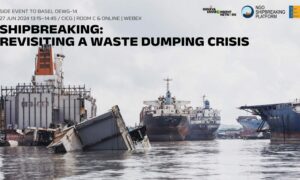
27 Jun 2024
13:15 – 14:45
Venue: CICG | Room C & Online | Webex
Organization: Basel Action Network, NGO Shipbreaking Platform, Geneva Environment Network
This side event to the fourteenth meeting of the Open-ended Working Group of the Basel Convention on the Control of Transboundary Movements of Hazardous Wastes and their Disposal (Basel OEWG-14) is organized by the NGO Shipbreaking Platform and the Basel Action Network with the support of the Geneva Environment Network.

About this Event
End-of-life vessels are hazardous waste, yet the vast majority of large ocean going ships containing residue oils, toxic laden paints, asbestos and many more harmful substances, are still being scrapped under dangerous conditions on three tidal mudflats in South Asia, without capacity to manage the many waste streams in a safe and environmentally sound manner.
The International Maritime Organisation’s Hong Kong Convention will enter-into-force in June 2025. Adopted in 2009, the shipping industry claims it will resolve the current crisis. However, alone, the Hong Kong Convention will fail: it stops at the ship recycling facility gate as it does not cover hazardous waste management downstream, and it does not restrict the trade of hazardous wastes with the aim of protecting developing countries. ESM and PIC are not part of the Hong Kong Convention. Illegal trafficking is not criminalised under the Hong Kong Convention.. The Basel Convention therefore has an important role to play, not in the backseat of the IMO, but as guarantors of environmental justice and promotors of reduction at source for optimised material recovery. In 2011, the Cartagena Basel Conference of the Parties did not find that the Hong Kong Convention provides an equivalent level of protection. Since then, the Basel Ban Amendment has entered into force and several ship owners have been held liable for the illegal trade of waste ships. The European Union has adopted its own Ship Recycling Regulation that goes beyond the weak standard set by the IMO, and just last year the United Arab Emirates adopted its own Ship Recycling Regulation which bans beaching.
The event will provide a re-cap on these developments, showcase the problems of status quo, and outline the many reasons why the Basel Convention is part of the solution.
Basel Convention OEWG-14
The fourteenth meeting of the Open-ended Working Group will take place from Tuesday, 25 June to Friday, 28 June 2024, with pre-meetings, including Bureau and regional meetings, to be held on Monday, 24 June. The Working Group is expected to progress items in its work programme, with topics to include:
- A draft renewed strategic framework
- Work to improve the functioning of the prior informed consent procedure
- Technical guidelines on Persistent Organic Pollutants, e-waste, waste lead-acid batteries and used and waste pneumatic tyres
- Practical guidance on the development of inventories of waste for certain waste streams
- Plastic waste
- Providing further legal clarity
- Work of the Implementation and Compliance Committee
- Basel Convention Partnership Programme
Speakers

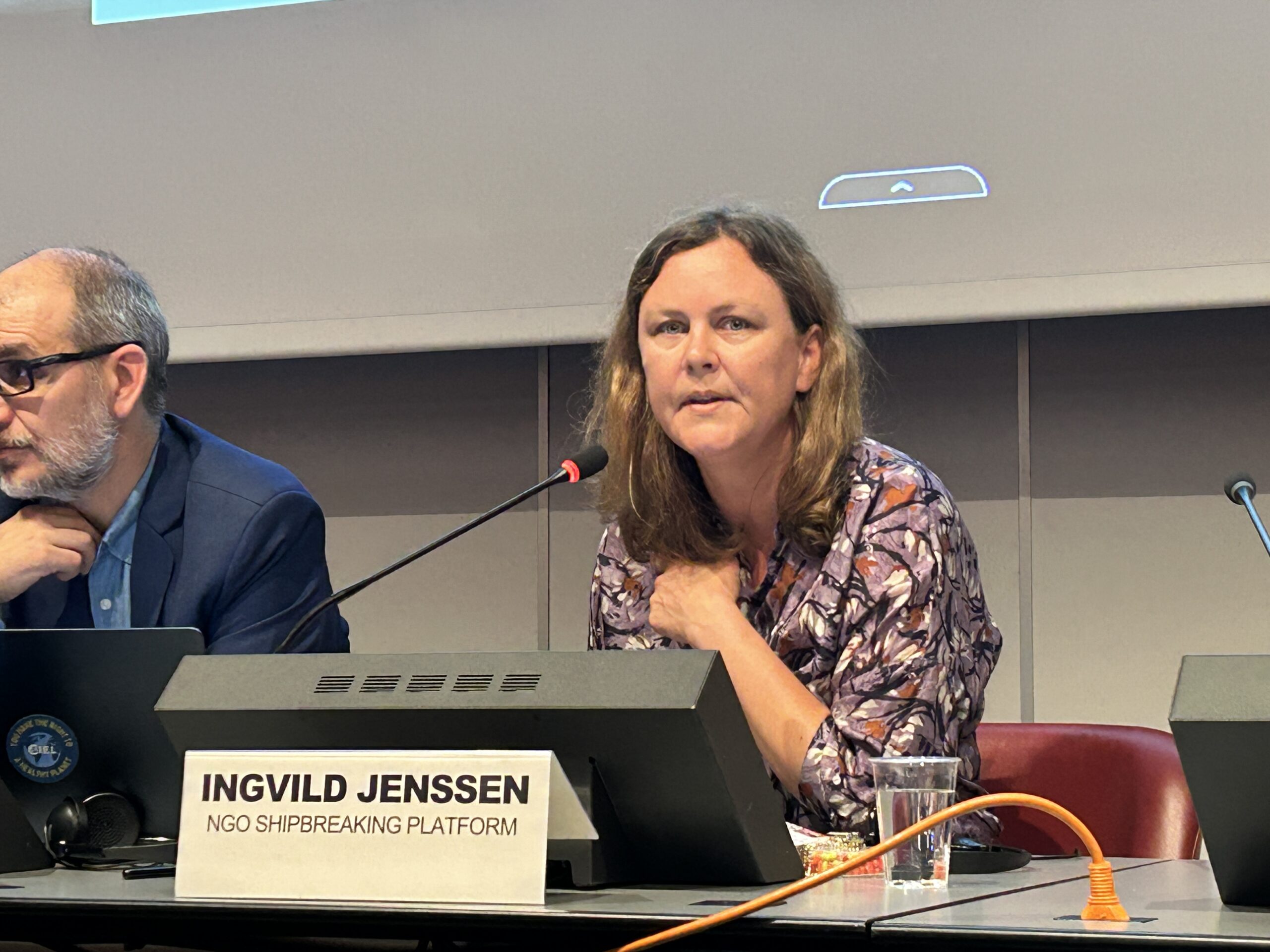
Ingvild JENSSEN
Director, NGO Shipbreaking Platform

Ekin SAKIN
Policy Officer, NGO Shipbreaking Platform

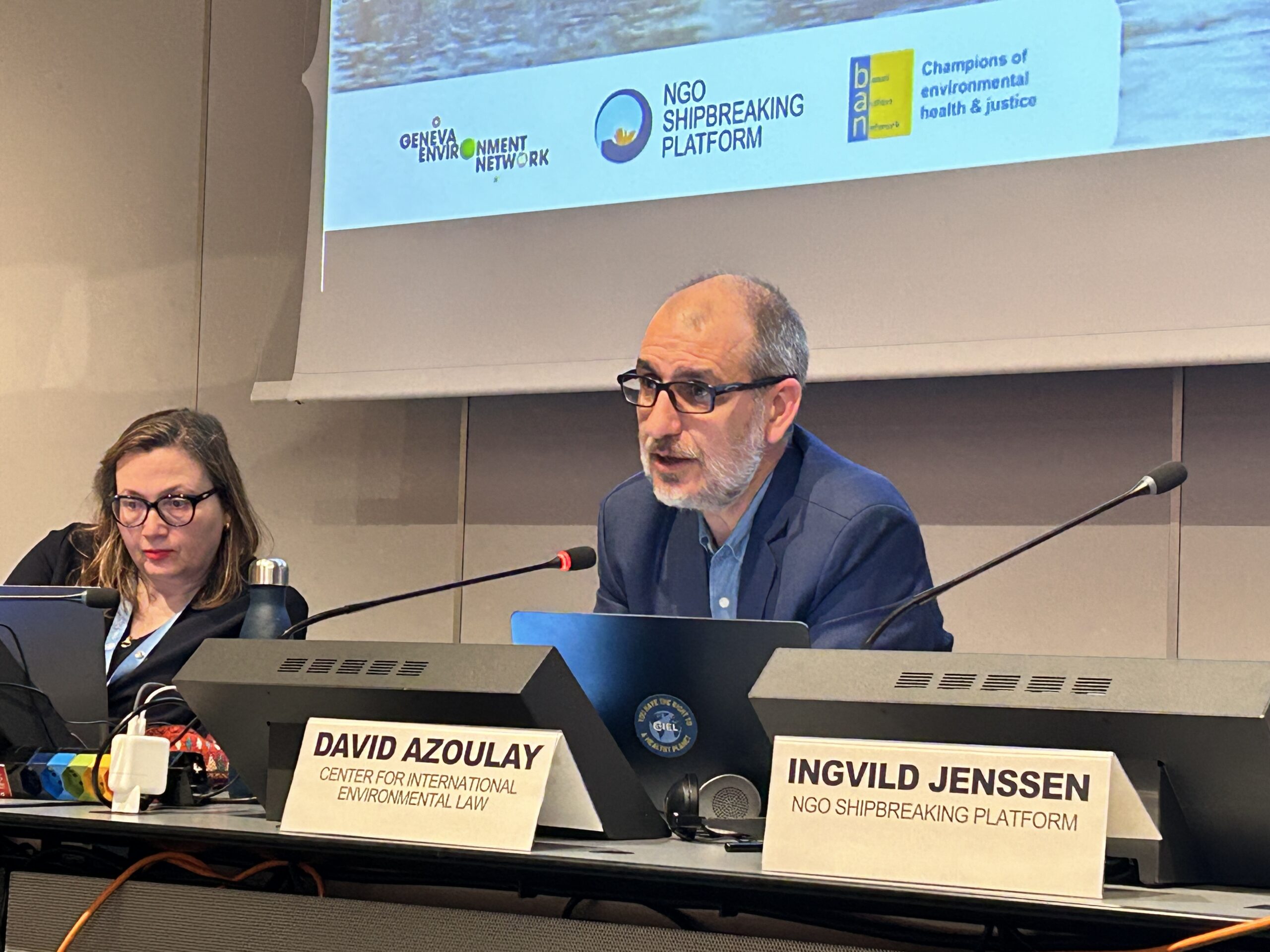
David AZOULAY
Director, Environmental Health Programme, Center for International Environmental Law
Highlights
Summary
Ingvild JENSSEN and Ekin SAKIN from the NGO Shipbreaking Platform gave an overview of the current conditions at the shipbreaking yards in South Asia and Turkey, and shared recent findings on the pollution and human rights breaches caused by the sector.
David AZOULAY, Managing Attorney at the Center for International Environmental Law (CIEL) explored the many reasons why the Basel Convention provides a higher level of protection than the International Maritime Organisation’s Hong Kong Convention set to enter into force in June 2025, and thus why Basel Parties need to continue to play a role in ensuring that ships are managed at end-of-life in a safe and environmentally sound manner in line with the principle of Environmental Justice.
Key points raised by JENSSEN and SAKIN included:
- Criticism of the Hong Kong Convention for setting low standards, allowing beaching, and placing enforcement responsibility on flag states with lax enforcement records.
- Concerns about the issuance of so-called Statements of Compliance with the Hong Kong Convention to South Asian beaching facilities despite documented poor working conditions and environmental practices that do not comply with the Basel requirements for Environmentally Sound Management (ESM). Focus was especially on the following recommendations outlined in the Basel Technical Guidelines for the Environmentally Sound Management of the Full and Partial Dismantling of Ships published in 2003, aimed to ensure environmentally responsible practices in ship recycling operations, as mandated by the Basel Convention, which remain unaddressed at shipbreaking yards using the beaching and landing methods:
- Lack of infrastructure to ensure complete containment to prevent environmental contamination, particularly through impermeable flooring and effective drainage systems. Especially the beaching method does not allow for containment as vessels are cut in the intertidal zone.
- Lack of waste management capacity in South Asian countries like Bangladesh, Pakistan and India, to handle several of the hazardous waste streams originating from ships, including asbestos which is not disposed, but instead reused on the second-hand market.
- Unlike the Hong Kong Convention, the Basel Convention mandates stringent controls via the PIC procedure and criminalizes illegal trafficking of hazardous waste, including end-of-life vessels. Since 2009, European enforcement authorities have actively pursued cases of illegal trafficking, such as the SeaTrade and Harrier cases, and penalised ship owners for the illegal export, or attempt to illegally export, vessels for scrapping. These cases have resulted in fines, bans on working in the shipping sector, and even prison sentences for offenders.
- Recent revisions to the European Union Waste Shipment Regulation have reaffirmed the applicability of the Basel Convention to EU-flagged vessels, closing previous exemptions and aligning with stricter environmental standards. This regulatory tightening reflects ongoing efforts to combat illegal practices and confirms the continued relevance of the Basel Convention in ensuring environmentally sound management of ship recycling activities.
AZOULAY outlined the legal complexities concerning the regulation of end-of-life ships under the Basel Convention versus the Hong Kong Convention. He emphasized that end-of-life ships are unequivocally regulated under the Basel Convention, which mandates strict controls on hazardous waste exports. Attempts to exclude end of life ships from Basel’s scope in favor of the Hong Kong Convention, which offers less stringent standards and does not criminalize illegal trafficking, must be contested by Basel Parties, as that would only allow the shipping sector to circumvent existing obligations and waste trade restrictions rather than addressing actual needs to ensure safe and environmentally sound practices. To ensure simultaneous and a more effective implementation of international laws governing ships and their recycling Basel Parties need to explore extending the scope of Basel to include beneficial ownership of waste ships in line with principles of corporate accountability.
Finally it was concluded by JENSSEN that the international community has a particular responsibility to mitigate the adverse impacts of shipbreaking in light of the many ships that are expected to head for scrap in the coming years. Capacity to recycle these in line with the Basel Technical Guidelines, while fostering a circular economy approach that integrates ship design, recycling, and materials recovery, should be developed. The simultaneous rise in demand for high-quality scrap steel as a means for the production low low-carbon steel production represent in that regard an opportunity for scaling sustainable ship recycling.
Video
Photo Gallery




Documents
Links
- Fourteenth meeting of the Open-ended Working Group of the Basel Convention (OEWG-14)
- Basel Convention OEWG-14 Side Events Schedule
- NGO Shipbreaking Platform
- Once Again Basel Must Stand Firm Against Efforts to Remove Basel Competency over Waste Ships
- Asbestos – The Never Ending Story (video played during the event from 58:26 to 01:03:34) | Arte | 2022
- Trading Lives for Profit – How the Shipping Industry Circumvents Regulations to Scrap Toxic Ships on Bangladesh’s Beaches | Human Rights Watch and NGO Shipbreaking Platform | 2023
- Ship Recycling in Turkey – Challenges and Future Direction | NGO Shipbreaking Platform | 2023
- Anchoring Circular Innovation for Ship Recycling | NGO Shipbreaking Platform | 2022
- Contradiction in Terms: European Union must align its ship exports with International Law and Green Deal Policies | NGO Shipbreaking Platform | 2020
- Shipbreaking and the Basel Convention: Analysis of the Level of Control Established under the Hong Kong Convention | CIEL | April 2011