
Événement Conférence
Changemakers for Sustainable Trade — Advancing circular and biodiversity-based economies | UNCTAD16 Parallel Event
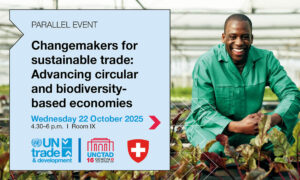
22 Oct 2025
16:30 – 18:00
Lieu: Palais des Nations | Room IX
Organisation: Conférence des Nations Unies sur le commerce et le développement, Geneva Environment Network
This parallel event to the 16th session of the United Nations Conference on Trade and Development (UNCTAD16) taking place from 20 to 23 October 2025 at the Palais des Nations, is organized by the UN Trade and Development with the support of the Geneva Environment Network. Discussions at this event will spotlight the important but often overlooked contributions of local changemakers in developing countries.

About this Event
Across developing countries, local producers, circular economy entrepreneurs and biodiversity-based businesses are at the forefront of building a sustainable trade future. Their practices show that trade and environmental stewardship can be mutually reinforcing, generating jobs, incomes and climate-resilient growth while protecting natural ecosystems. However, they often operate in fragmented markets, face higher barriers to scaling up and are largely left out of global trade and policy discussions.
This event spotlighted the important but often overlooked contributions of local changemakers in developing countries; and explored the economic and environmental importance of biodiversity and circular business models, while addressing the systemic challenges these actors face in accessing international markets, attracting investment and shaping policy frameworks. The discussions showcased how UNCTAD’s BioTrade initiative and the Sustainable Manufacturing and Environmental Pollution programme, implemented in partnership with UNCTAD, have empowered changemakers and promoted sustainable trade.
The event was followed by a reception offered by GIZ, opened to the participants.


16th session of the United Nations Conference on Trade and Development (UNCTAD16)
The 16th session of the United Nations Conference on Trade and Development (UNCTAD16) will take place from 20 to 23 October 2025 at the Palais des Nations in Geneva, with the theme “Shaping the future: Driving economic transformation for equitable, inclusive and sustainable development”.
Hosted by Switzerland and UNCTAD, the conference will convene Heads of State and Government, Ministers of Trade and Economy, Nobel Laureates, leaders of international organizations, representatives of civil society and renowned experts to engage in high-level dialogue on global trends and policy perspectives on trade, investment, development and the digital economy.
Speakers
By order of intervention.
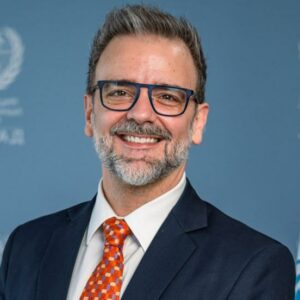
Pedro Manuel MORENO
Deputy Secretary-General, UN Trade and Development

Pierre MARCOLINI
Chocolatier and Sustainable Entrepreneur, Founder and Creation Director of Maison Pierre Marcolini
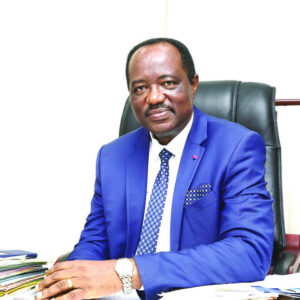
H.E. Amb. Salomon EHETH
Permanent Representative of the Republic of Cameroon to the UN Office and other international organizations in Geneva

Monica RUBIOLO
Head of Trade Promotion, SECO, Switzerland

Adrie EL MOHAMADI
Component Manager, BioInnovation Africa, South Africa

Ebenezer LARYEA
University of Aston & Freshppact Project Lead, Ghana

Emma ALGOTSSON
Project Lead, Catchgreen, Sweden-South Africa

Lisa Emelia SVENSSON
Minister Counselor, Permanent Mission of Sweden | Moderator
Highlights
Summary
The event opened with a keynote address by Pierre Marcolini, artisan chocolatier, who shared his work with cocoa farmers to develop chocolates ‘from bean to bar’, preserving native varieties and ensuring fair compensation. He emphasized that today’s consumers demand authenticity and traceability, and that artisanal producers can compete by embracing openness and storytelling.
The event highlighted the transformative potential of circular and biodiversity-based economies in driving sustainable trade, particularly in developing countries. Speakers emphasised that biodiversity loss and climate change are urgent global challenges, and trade must evolve to become a force for nature, equity, and resilience.
The Deputy Secretary-General of UNCTAD, Pedro Manuel Moreno, stressed that sustainability is not optional but essential. He noted that biodiversity-related goods already account for 17 per cent of global trade, and that UNCTAD programmes such as Sustainable Manufacturing and Environmental Pollution (SMEP) and the BioTrade Initiative are helping countries trade sustainably.
Several speakers (Cameroon, Sweden, Switzerland) underscored the importance of empowering local entrepreneurs and small producers. Cameroon emphasized the need to transform cocoa into a model for sustainable trade, with financial instruments and public–private partnerships supporting youth and women-led initiatives. However, infrastructure challenges and limited market access continue to hinder progress. Cameroon called for regional cooperation and capacity building to ensure that the implementation of new environmental regulations leads to competitiveness instead of excluding small producers.
Switzerland, a long supporter of the BioTrade Initiative, highlighted its integrated approach to sustainability, combining economic, social, and environmental dimensions. It supports living incomes, diversified forest systems, respect for human rights, and traceable value chains, and stressed the need of integrating more explicitly voluntary sustainability standards and credit access in policy. Public–private partnerships were cited as essential for defining practical paths forward.
Emma Algotsson of Catchgreen presented biodegradable fishing gear as a solution to marine pollution. She noted that trade frameworks must support such innovations, citing high tariffs (e.g., 30 per cent for exports to Kenya) as barriers. She called for new standards and HS codes for sustainable materials, and for trade policy to reward rather than penalize innovation.
The Access and Benefit Sharing Compliant Biotrade in South(ern) Africa (ABioSA) programme, presented by Adrie El Mohamadi, implements UNCTAD’s BioTrade Principles and Criteria to guide inclusive value chain development. The programme offers co-funded grants, sector development strategies and has developed tools to categorize MSMEs by growth stage, enabling tailored support.
Ebenezer Laryea from the University of Aston shared two projects supported by SMEP: Freshppact in Ghana, which develops non-plastic substitutes for agriculture, and Leathertrace in Bangladesh, which pilots e-traceability systems for sustainable leather exports. He stressed that traceability must not become a trade barrier and called on UNCTAD to continue supporting inclusive systems that empower smallholders.
The discussion also explored the role of technology and data in advancing sustainability. Delegates noted that digital tools can enhance transparency, traceability, and consumer trust. However, they warned that without adequate support, small producers can be excluded from digital-based trade ecosystems. Participants urged UNCTAD to help countries develop digital infrastructure and capacity-building programmes to facilitate small producers’ compliance with sustainability standards and regulations.
Speakers (Cameroon, Ghana, Sweden) agreed that sustainability requirements must become a source of competitiveness, not marginalization. They called for stable regulatory frameworks, inclusive trade policies, and continued support from UNCTAD to scale up successful models. The Forest Stewardship Council (FSC) urged UNCTAD to recognize credible certification systems that facilitate market access for smallholder forest enterprises.
In closing, participants emphasized the need for systemic change, inclusive dialogue, whole-of-society approaches, and reform of subsidies system. They called for stronger South–South cooperation, strategic public–private partnerships, and intentional support for entrepreneurs in the Global South. The event showcased how sustainability-driven trade can deliver tangible benefits for people and planet.
Video
Live on UNTV.
Short video summarising the event.
Photo Gallery


