Nouvelle
Climate Action from Geneva to Santa Marta | First Conference on Transitioning Away from Fossil Fuels
The First Conference on Transitioning Away from Fossil Fuels took place in Santa Marta, Colombia from 24 to 29 April 2026. This page highlights key outcomes of the Santa Marta Conference and the involvement of International Geneva.
First Conference on Transitioning Away from Fossil Fuels
The First Conference on Transitioning Away from Fossil Fuels, co-hosted by Colombia and the Netherlands, took place in Santa Marta, Colombia from 24 to 29 April 2026. The Conference was designed as a space for countries, subnational governments and other stakeholders that recognize the need to implement a transition away from fossil fuels in a just, orderly and equitable manner, in line with climate goals and the best available science.
The objective of the Conference was to initiate a concrete process through which a coalition of committed countries, subnational governments, and relevant stakeholders can identify and advance enabling pathways to implement a progressive transition away from fossil fuels creating sustainable societies and economies. This process was informed by the experience and perspectives of national and subnational governments, academia, Indigenous Peoples, Peoples of African Descent, peasants, civil society, workers, the private sector, and other key actors at different stages of the transition. The Conference is:
- A sustained political platform for countries ready to deliver implementation-driven action toward an orderly phase-out of fossil fuels;
- A complementary space to the United Nations Framework Convention on Climate Change (UNFCCC), formally contributing to the COP30 Presidency’s roadmap while accelerating practical delivery;
- An innovative, horizontal dialogue that deepens democratic climate governance through meaningful and influential participation by countries and subnational governments, civil society, and other stakeholders.
This forum is not intended to serve as a negotiating body, nor does it constitute part of any formal negotiation process or initiative, and it is not intended to replace the UNFCCC. It was the first implementation-focused Conference, intended to support practical action by those already prepared to move forward. It did not seek to deliver a negotiated outcome, but rather to generate shared understanding and actionable guidance that can help accelerate a just, orderly, and equitable transition away from fossil fuels.
Guiding Principles
The Conference was guided by three key principles:
- Participation by those ready to move forward, recognizing this as a space focused on action rather than persuasion.
- Implementation as the guiding star, based on the shared scientific certainty that accelerating the transition away from fossil fuels is essential to achieving climate goals, upholding human rights, and addressing the triple planetary crisis. Focus on action rather than further diagnosis.
- Focus on solutions that meaningfully support the transition rather than delay it.
Conference Outcomes
Aimed to be the first step in a process through which an international coalition of committed actors accelerates the transition away from fossil fuels, the Conference was guided by the best available science, by identifying concrete pathways and solutions for implementing the transition, to be further advanced through a second conference.
Key outcomes that set in motion an action-oriented course for countries to support each other in advancing the transition away from fossil fuels include:
- The second conference, co-hosted by Tuvalu and Ireland, has been announced for 2027, with the main conference taking place in Tuvalu and a pre-conference meeting in Ireland.
- A coordination group was created to ensure continuity towards the second and subsequent conferences. It will consist of countries leading different alliances and initiatives that are implementing elements of the transition away from fossil fuels, alongside Colombia, the Netherlands, Tuvalu and Ireland. They will connect with the COP30 Activation Group 4: Transitioning away from fossil fuels in a just, orderly and equitable manner.
- Ensuring complementarity with UNFCCC, existing frameworks and sustaining momentum by handing over the conference report to the COP30 Presidency to inform its roadmap, and to the UN Secretary-General, and working with COP31 Presidency and future presidencies.
- Three open and flexible workstreams will be established to organize efforts ahead of the second conference.
- Work to help countries develop roadmaps and align them with their NDCs. This work will be supported by the NDC Partnership and the Science Panel on Global Energy Transition.
- Work on macroeconomic dependencies and financial architecture, especially the fiscal, debt, and subsidy traps, to innovate a financial system that can support the transition. The International Institute for Sustainable Development (IISD) and Centre for Economic Policy and Research (CEPR) will support the workstream.
- Work on producer–consumer alignment for fossil fuel transition towards building fossil fuel free trade systems by understanding how trade continues to promote extraction and how to replace this with green trade. The Organisation for Economic Co-operation and Development (OECD) will support.
- The Science Panel for the Global Energy Transition (SPGET) was launched to support countries in overcoming dependence on fossil fuels. It will do so by helping develop roadmaps aligned with the 1.5°C trajectory, aimed at dismantling legal, financial, and political barriers to the energy transition.
The Conference made clear that countries are already making good progress in the transition to more sustainable, sovereign and secure energy systems. It also recognized that the countries present in Santa Marta still have structural dependencies to overcome, including fiscal dependencies, debt constraints, the dependence of the financial architecture on fossil fuels and the need to enable fossil fuels-free trade systems. As the transition requires broad economic transformation, the Conference made clear that the transition must be “planned with workers and communities, ensuring a transition that is fair, rights-based, and delivers tangible benefits for marginalized groups.”
Links with Other Multilateral Fora
Following the announcement at the 30th session of the Conference of the Parties to UNFCCC (COP 30) that took place in Belém, Brazil from 10 to 21 November 2025, the COP 30 Presidency is in the process of elaborating the COP 30 Presidency Roadmap for “transitioning away from fossil fuels in a just, orderly, and equitable manner”. This follows the decision adopted at COP 28 in Dubai, United Arab Emirates from 30 November to 13 December 2023 on the outcomes of the first Global Stocktake (GST), which:
28. Further recognizes the need for deep, rapid and sustained reductions in greenhouse gas emissions in line with 1.5 °C pathways and calls on Parties to contribute to the following global efforts, in a nationally determined manner, taking into account the Paris Agreement and their different national circumstances, pathways and approaches:
…
d. Transitioning away from fossil fuels in energy systems, in a just, orderly and equitable manner, accelerating action in this critical decade, so as to achieve net zero by 2050 in keeping with the science;(paragraph 28.d of the Global Stocktake (GST) adopted at COP28)
The COP 30 Presidency Roadmap aims to translate that global consensus into implementation, building on the debates initiated in Belém and recognizing initiatives and solutions being accelerated through the Action Agenda. It will map critical barriers and enabling factors, while recognizing that no single transition pathway applies to all countries and regions. The Roadmap will offer differentiated options that countries, subnational entities, and economic sectors can adapt according to their circumstances, serving as both a reference document and a catalyst for advancing this agenda.
As such, the Conference outcomes will provide inputs to other international processes, including the UNFCCC, the initiative of a global roadmap for the transition away from fossil fuels, amongst others. The conference report will be handed over to the COP30 Presidency to inform its roadmap, sharing it ahead of the intersessional meetings of UNFCCC in Bonn in June 2026 and formally presenting it at London Climate Action Week. The outcomes of the Conference are also expected to inform discussions at the upcoming UN Climate Change Conference COP31 taking place in Antalya, Türkiye from 9 to 20 November 2026, where the informal COP30 Presidency Roadmap for Transitioning Away from Fossil Fuels drafted by the team is expected to be delivered.
The conference report will also be handed to the UN Secretary-General during New York Climate Week. Finally, work with the incoming COP presidencies will be held to align the outcomes of this conference with the Global Climate Action Agenda and to channel these contributions toward the second Global Stocktake (GST2).
Thematic Pillars
The Conference produced a synthesis report identifying enabling pathways for implementing a just, orderly, and equitable transition away from fossil fuels. These pathways were organized around three thematic pillars that defined the Summary of the Conference.
Participation and Process
The Conference put in place a process to enable participation and jointly build the enabling pathways for the transition that the Conference will deliver. The process leading to Santa Marta was organized into stakeholder group chapters, comprising written inputs, online dialogues by group, and in person stakeholder-led dialogues involving Peoples (including Indigenous Peoples, Afro-descendant Peoples, peasants, frontline collectives, youth, among others), NGOs, academia, subnational governments, countries, workers, parliamentarians, the private sector, and others in Santa Marta. Between February and April 2026, governments and other stakeholders have been engaging and contributing to the technical and political discussions.
57 countries, representing approximately a third of global GDP and accounting for “~⅓ of global fossil fuel consumption and ~⅕ of global production,” participated in the Conference. Among these countries were producer and consumer countries of oil, coal, and gas, and are active participants in initiatives or coalitions that demonstrate a commitment to implementing the transition. The Conference was also greatly informed by contributions from various chapters, including representatives from subnational governments, academia, social movements, NGOs, trade unions, parliamentarians, the private sector, multilateral development banks, Indigenous Peoples, peoples of African descent, peasants, children and youth, and women and diversities.
A total of 2,608 organizations have also expressed their interest in participating in the Conference. The UN system is also mobilized to attend the Conference, including the UN Environment Programme (UNEP), the Office of the High Commissioner for Human Rights (OHCHR), and the International Labour Organization (ILO).
People’s Summit for a Fossil Free Future
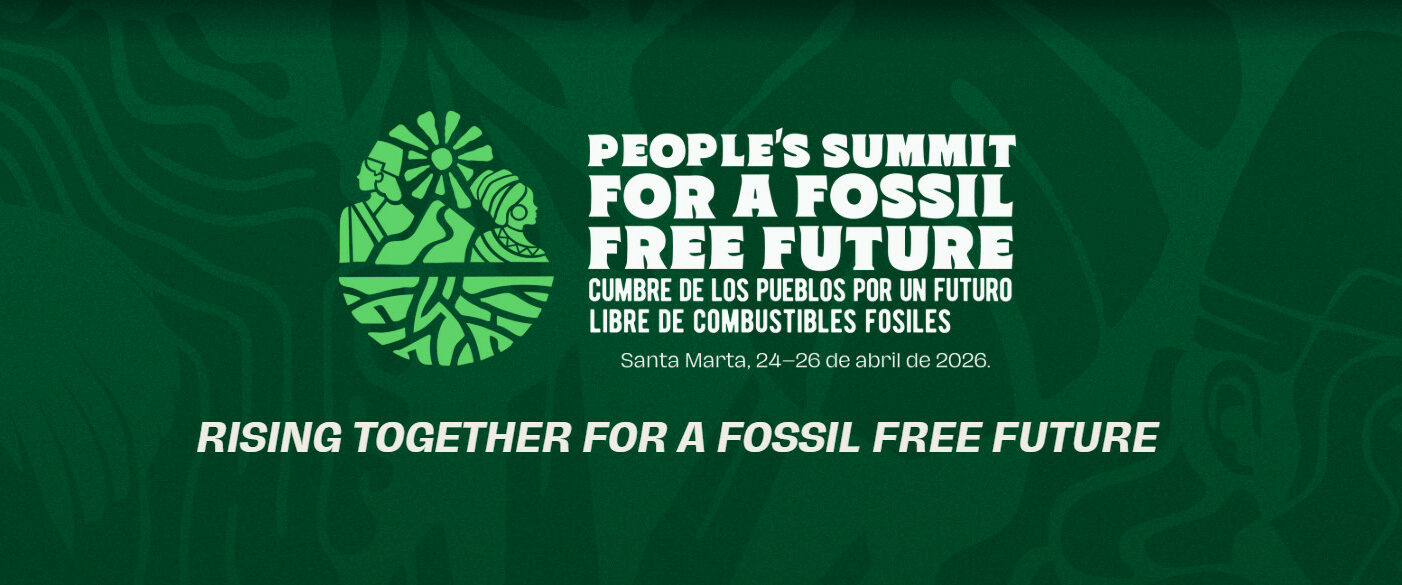
Having taken place in parallel to the First International Conference on Transitioning Away from Fossil Fuels, the People’s Summit for a Fossil Free Future was the civil society counterpart to the historic Santa Marta Conference. The People’s Summit was held from 24 to 26 April 2026 and served as a critical space for self-organized civil society to unify our demands and build collective power from the ground up. It is based on a global process for deepening and widening broad movement consensus on a more comprehensive agenda for a rapid, equitable, and just energy transition.
The People’s Summit for a Fossil Free Future was coordinated by a broad coalition of over 900 organisations and networks, co-convened by El Consejo Permanente para la Transición Energética Justa, the Global Campaign to Demand Climate Justice (DCJ) and the Climate Action Network International (CAN). Working alongside local partners and international movements, this coalition is establishing a platform to amplify the voices and demands of civil society organisations, frontline organisations, Indigenous Peoples, Afro-descendant communities, Feminists, Youth, Workers, and more. While we engage with the official process through dedicated pre-meeting spaces designed to move beyond symbolic participation, the People’s Summit stands as an independent movement space reflecting the broader struggle for a just and equitable transition away from fossil fuels.
People’s Declaration for a Rapid, Equitable, and Just Transition for a Fossil-Free Future
Ahead of the high-level segment, a powerful global coalition of civil society organizations, frontline communities, Indigenous Peoples, Afro-descendants, women, youth, and workers officially launched the People’s Declaration for a Rapid, Equitable, and Just Transition for a Fossil-Free Future. The declaration outlines 15 principles for a just transition, and calls for immediate, concrete actions, including:
- A complete equitable and just phase-out of fossil fuels aligned with meeting the goal of keeping warming below 1.5°c and reach global real zero emissions by 2050
- A rapid, direct, equitable, and just transition to 100% renewable energy; ensure equitable and universal access to renewable energy
- An end to barriers to the transition and pursue solutions
- A comprehensive just transition
Events in Geneva
Events in Geneva in preparation for the Santa Marta Conference are listed below.

International Geneva at the First Conference on Transitioning Away from Fossil Fuels
Climate change is deeply linked to biodiversity loss, human rights, economic prosperity, trade, health, and many other issues at the heart of multilateral processes in Geneva. These multilateral processes can be used to foster international cooperation on climate change. Below is a list of Geneva-based organizations and their engagement in preparation for and at the Santa Marta Conference.
International Labour Organization | ILO
The ILO is the UN Agency leading the work on the just transition. Its members adopted the guidelines for a just transition towards environmentally sustainable economies and societies for all in 2015, becoming a widely recognized point of reference for all work related to the just transition. A representative from the organization was present at the Conference.
Office of the High Commissioner for Human Rights | OHCHR, UN Human Rights
As the leading UN entity on human rights, OHCHR aims to provide guidance that encourages policy coherence and ensures that climate change mitigation and adaptation efforts are adequate, sufficiently ambitious, non-discriminatory and compliant with human rights obligations.
Center for International Environmental Law | CIEL
CIEL is committed to applying a human rights-based approach as a means to protect the peoples and communities on the frontline of climate change. In doing so, it works to design and integrate policies to safeguard rights and ecosystems and to ensure effective public participation within key climate institutions and mechanisms. In the lead-up to the Santa Marta Conference, CIEL has organized a side event to the 61st session of the Human Rights Council (HRC61) on « Advancing a Just Transition: How Human Rights Can Underpin International Processes to Phase Out Fossil Fuels« .
Franciscans International
Franciscans International aims to address the root causes of injustices by bringing cases of discrimination and violence committed against individuals and groups living on the margins to the attention of the international community, towards advocating for dignity, peace, and environmental justice. Ahead of the First Conference on Transitioning Away from Fossil Fuels, Catholic organisations and faith leaders from around the world, including Franciscans International, have issued a joint statement underscoring: the climate crisis is not only an environmental emergency, it is a moral one. The statement calls on governments worldwide to move beyond pledges and deliver real action on climate change.
Human Rights Watch
Human Rights Watch investigates and reports on abuses and human rights violations, including on the environment, happening in all corners of the world and works to protect the most at risk. Human Rights Watch stands with fence-line communities around the world to end the direct human harms inherent to fossil-fuel projects and uplift local community demands for stricter regulations, moratoria on new exploration and production, and alternative forms of cleaner energy. Human Rights Watch will have its presence at the Conference.
International Federation for Human Rights | FIDH
Defending all civil, political, economic, social and cultural rights as set out in the Universal Declaration of Human Rights since 1992, FIDH has mobilized to fight impunity to hold States and business accountable for environmental degradation, advocating that a just transition away from fossil fuels must be an imperative for all climate action ahead. FIDH, in its submissions to both the Santa Marta and the COP31 roadmap, calls for: meaningful and effective participation of rightsholders and human rights defenders in phaseout action plans; reform of trade and investment agreements to serve human rights and climate objectives instead of corporate interests; tax justice reform to remedy budgetary crunches arising from the phaseout and find new, increased resources to fulfil human rights.
International Institute for Sustainable Development | IISD
IISD is actively involved in the two main responses to climate change: adaptation and mitigation. It partners with countries to help them cope with a changing climate and transition to clean energy as quickly as possible. IISD is engaged to showcase how a just transition approach ensures that the affected people are considered by those making decisions. IISD is also active in its project on Advancing the Transition Away from Fossil Fuels, supporting credible roadmaps for a just, orderly, and equitable transition away from fossil fuels. IISD will be present at the Santa Marta Conference, including through the IISD-hosted Friends of Climate and Health, which serves as a platform for countries to discuss opportunities to integrate health into UNFCCC processes and advance global action on climate and health.
South Centre
South Centre provided an informal note, « The First Conference on Transitioning Away from Fossil Fuels: Reclaiming Multilateralism for a Just Transition« , analyzes how the conference addresses the ‘judicialization’ of climate obligations following landmark 2025 advisory opinions from the International Court of Justice (ICJ), the International Tribunal for the Law of the Sea (ITLOS), and the Inter-American Court of Human Rights (IACtHR). It highlights critical barriers facing developing countries, specifically the ‘regulatory chill’ caused by Investor-State Dispute Settlement (ISDS) mechanisms and the ‘debt-fossil fuel trap’ that binds extractive economies to external risks. It also recognizes that integrating the ‘People’s Summit’ outcomes into the official Conference could promote a reparative financial model and strengthen the principle of Free, Prior, and Informed Consent (FPIC).
UN Special Rapporteur on climate change and human rights
The UN Special Rapporteur on climate change and human rights is mandated by the UN Human Rights Council to study and identify how the adverse effects of climate change, affect the full and effective enjoyment of human rights. The current mandate holder, Elisa Morgera, has organized “From Durham to Santa Marta and Beyond” conference exploring and connecting diverse areas of evidence and thinking on equitable pathways to defossilize our economies and effectively protect human rights, with a view to supporting key international processes on climate change, human rights, and fossil fuels in 2026. She will be present at the Santa Marta Conference.
We Mean Business Coalition
An article published by We Mean Business Coalition highlighted that the Santa Marta Conference is a timely opportunity to drive forward a shared roadmap away from fossil fuels to clean, electrified solutions. expanding clean power generation alone won’t enable countries to transition to a safer, healthier future. The article argued that renewables combined with electrification allows electricity produced from the sun, wind and water to directly displace fuels like heating oil, diesel and gas across sectors – particularly in transport, building and industry, with huge potential savings.
Women Engage for a Common Future | WECF
In the run-up to the First Conference on Transitioning Away from Fossil Fuels, various NGOs, including WECF, published a position paper on the role of the Netherlands as co-organizer, uniquely positioned to shape the direction and ambition of the conference.
World Council of Churches | WCC
For the World Council of Churches and its member churches, this conference marks a defining commitment within the Ecumenical Decade of Climate Justice Action, which calls churches to move from fossil fuels toward renewable, community-owned energy systems and to advocate for a just transition grounded in equity. This commitment now finds a concrete arena. WCC delegates will travel to Santa Marta carrying a Multi-faith Call for a Fossil Fuel Treaty, co-prepared with partner faith actors, urging governments to advance the fossil fuel transition: ending new fossil fuel development immediately and guaranteeing a just, equitable phase-out of coal, oil, and gas.
WWF International
In the run-up to the First Conference on Transitioning Away from Fossil Fuels, various NGOs, including WWF International, published a position paper on the role of the Netherlands as co-organizer, uniquely positioned to shape the direction and ambition of the conference. Ahead of the Conference, WWF called for strong political signals that demonstrate leadership among committed governments and launch credible next steps, leading to accelerated progress on national implementation.
Resources and News
Links
- First Conference on Transitioning Away from Fossil Fuels
- People’s Summit for a Fossil Free Future
- Inside the First Conference on Transitioning Away from Fossil Fuels | IISD
- High-level Segment of the First Conference on Transitioning Away from Fossil Fuels | IISD ENB Coverage | 28-29 April 2026
- Action and Amplification Pack | People’s Summit for a Fossil Free Future
Reactions
- Santa Marta conference to end fossil fuels a landmark moment for climate and energy stability | Greenpeace International | 30 April 2026
- No Transition Without Justice: A Mandate from the Conference Towards Territories Free from Fossil Fuels in Santa Marta | Global Alliance for the Rights of Nature | 30 April 2026
- Santa Marta Conference: outcome | E3G | 30 April 2026
- WWF: Santa Marta marks a pivotal milestone in implementing the fossil fuel transition | WWF | 29 April 2026
- Historic Santa Marta Conference: A Turning Point for Global Fossil Fuel Phaseout | CIEL | 29 April 2026
Relevant News
- Civil society demands action from governments at first fossil fuel-free conference in Colombia| Michelle Langrand, Geneva Solutions | 30 April 2026
- Iran crisis shows fossil fuels-based energy system ‘is inherently volatile and unstable’| Conor Lennon, UN News | 29 April 2026
- Countries frame energy transition as a security matter at Santa Marta fossil fuel exit conference| Michelle Langrand, Geneva Solutions | 29 April 2026
- Countries call for a new legal mechanism on fair fossil fuel phase out at Conference Opening Plenary | Fossil Fuel Treaty | 28 April 2026
- The First Conference on Transitioning Away from Fossil Fuels: Reclaiming Multilateralism for a Just Transition – Informal Note | Daniel Uribe Terán, South Centre | 28 April 2026
- Santa Marta marks a new chapter in climate diplomacy| Climate Home News | 28 April 2026
- New Analysis Shows Governments Spent Five Times More Public Money on Fossil Fuels than Renewables, Putting Energy Security at Risk| IISD | 27 April 2026
- This is the way it should have begun (and it’s not hopeless)| Magnus Løvold | 27 April 2026
- In Santa Marta, Colombia gathering, WCC joins global call to end fossil fuels| World Council of Churches | 27 April 2026
- Global movements unite in Santa Marta to launch “People’s Declaration for a Rapid, Equitable, and Just Transition for a Fossil-Free Future” ahead of historic climate conference | Fossil Free Rising | 26 April 2026
- First scientific panel established to advise on the global energy transition (Se crea primer panel científico que asesorará la transición energética global)| Ministerio de Ambiente y Desarrollo Sostenible, Colombia | 25 April 2026
- The human rights imperative of defossilizing our economies at the opening of the First International Conference on Transitioning Away from Fossil Fuels in Santa Marta, Colombia | Statement by Elisa Morgera, UN Special Rapporteur on the promotion and protection of human rights in the context of climate change | 24 April 2026
- Rights Need to Guide Global Fossil Fuel Phaseout | Myrto Tilianaki, Human Rights Watch | 23 April 2026
- Santa Marta 2026: aligning ambition with action in fossil fuel phase-out | Stockholm Environment Institute | 23 April 2026
- We Don’t Have Time joins 340+ organizations in global statement on ISDS | We Don’t Have Time | 23 April 2026
- Africa Must Lead Its Own Fossil Fuel Phaseout | Big3Africa | 22 April 2026
- Santa Marta Conference: Health Must Become Imperative for Governments’ Exit From Fossil Fuel Dependence| Global Climate & Health Alliance | 20 April 2026
- Revealed: Scientists tell Colombia fossil-fuel transition summit to ‘halt new expansion’ | Carbon Brief | 20 April 2026
- After COP30, what’s next for the fossil fuel phaseout? | Global Witness | 20 April 2026
- Fossil fuel transition talks must address militaries | CEOBS | 20 April 2026
- Santa Marta Conference: A potential turning point for fossil fuels – and for the ocean? | Ocean Care | 17 April 2026
- Santa Marta calls time on fossil fuels, dares leaders to follow | WWF | 16 April 2026
- The Legal Foundations for Fossil Fuel Phaseout: An Open Letter to the Co-Hosts and Participants of the First Conference on Transitioning Away from Fossil Fuels | 20 April 2026
- Multi-faith Call for a Fossil Fuel Treaty | Faith Institutions
- Colombia convenes climate ‘coalition of the willing’ to break global fossil fuel deadlock | The Guardian | 17 April 2026
- Beyond the Burn: Why Santa Marta Must Tackle the Petrochemical Build Out | Delphine Lévi Alvarès, CIEL | 15 April 2026
- Spillover Effects: The Fossil Fuel Debt Trap in the Global South | Fossil Fuel Treaty Initiative, Oil Change International & MENAFEM | 15 April 2026
- Charting the Path to a Fossil-Free Future in Santa Marta and Beyond: What the Conference Must Deliver | Nikki Reisch & Lili Fuhr, CIEL | 14 April 2026
- 1st International Conference on Transitioning Away from Fossil Fuels | World Council of Churches | 14 April 2026
- Escape from Hormuz, via Santa Marta | Observatório do Clima | 14 April 2026
- From COP30 to Santa Marta: Feasible Pathways for Fossil Fuel Phaseout | Beardsworth, R. , Garvey, A. and Johnson, E., University of Leeds | 13 April 2026
- Subnational governments are already shifting away from fossil fuels | IISD | 13 April 2026
- Switzerland wants a global roadmap to phase out fossil fuels | Luigi Jorio, Swissinfo | 13 April 2026
- ‘The transition away from fossil fuels is a prerequisite for global peace’ | Luigi Jorio, Swissinfo | 13 April 2026
- Rethinking the Concept of International Disciplines on Fossil Fuel Subsidies | Robert Howse & Petrus van Bork | TESS Forum | 10 April 2026
- Letter to Colombia and Netherlands as Co-Hosts of the Santa Marta Conference | The Climate Reality Project, Center for International Environmental Law (CIEL), Earth4All, Global Witness, Transparency International | 9 April 2026
- Position Paper NGOs on the Transitioning Away from Fossil Fuels Conference | Oxfam Novib, Cordaid, Civil Society Platform for Peacebuilding and Statebuilding, Humanity Hub, Wo=men, SOMO, Climate Reality Europe, Both ENDS, WWF, Hivos, ActionAid, Milieudefensie, Greenpeace, Young Climate Movement, Reclame Fossielvrij, WECF and 350 | 9 April 2026
- A new economic superpower could spark a global retreat from fossil fuels | Mark Hertsgaard and Kyle Pope, Covering Climate Now | The Guardian | 7 April 2026
- Securing a Global Framework to End the Fossil Fuel Era | Youth Concern on Environment and Development YCED | 6 April 2026
- We Don’t Have Time Podcast New Episode: The beginning of the end of fossil fuels | We Don’t Have Time | 3 April 2026
- The Beginning Of The End For Fossil Fuels Can Start In Colombia | Catarina Rolfsdotter-Jansson, We Don’t Have Time | Forbes | 2 April 2026
- How fossil fuel companies and their financiers avoid criticism on X | Global Witness | 2 April 2026
- The beginning of the end of fossil fuels | We don’t have time | 2 April 2026
- 25 Countries and 27 Subnational Jurisdictions Already have Fossil Fuel Production Restrictions—and Many Have Held Firm Through Recent Energy Shocks | IISD | 1 April 2026
- Drawing the Line and Holding It: What existing moratoria, bans, and restrictions reveal about transitioning away from fossil fuels | Paola Andrea Yanguas Parra, Natalie Jones, IISD | 1 April 2026
- Catholic Actors’ Statement for Santa Marta: A Moral Moment to Deliver Action for Our Common Home | CIDSE, on behalf of Catholic faith leaders and organizations | 1 April 2026
- Developing an International Regime to Advance the Transition Away from Fossil Fuels: Three Tracks for a Just Transition | Fossil Fuel Treaty | April 2026
- Major oil producers among 46 nations joining fossil fuel phase-out summit | Climate Home News | 31 March 2026
- From the Santa Marta Conference to COP31, a fossil fuel phaseout must be brought about – and with human rights at its core | International Federation for Human Rights | 31 March 2026
- The Santa Marta 2026 Conference: Filling the Silence on Fossil Fuels from COP 30 | EcoJesuit | 31 March 2026
- Two-Speed Multilateralism: Breaking the Deadlock on Climate and Health | Felix Sassmannshausen, Health Policy Watch | 30 March 2026
- Inside the emerging roadmap away from fossil fuels | Elva Darnell, UNSW | 27 March 2026
- Policy Briefing: Expectations towards the Santa Marta Conference on Just Transitioning Away from Fossil Fuels | CAN Europe | 18 March 2026
- Fossil fuels are finished. Renewables are the future. | Daniel Högsta, WWF | 15 March 2026
- Amid Oil and Gas Volatility, Experts Outline What Credible Fossil Fuel Transition Roadmaps Should Include | IISD | 10 March 2026
With oil and gas markets facing renewed volatility amid the Middle East crisis, governments preparing for April’s Colombia–Netherlands-led conference in Santa Marta have an opportunity to advance credible national roadmaps — grounded in science, justice and international coordination —for the transition away from fossil fuels, according to a new report.