
Update
Just Transition and the Role of Geneva
The triple planetary crisis of climate change, biodiversity loss and pollution demands urgent global policy response towards greener, more resilient and climate-neutral economies and societies. Efforts needed to combat these environmental crises provide an opportunity for a just transition towards sustainable economies and societies that is anchored on human rights and the principles of a social justice, equality, and leaving no one behind. This update provides an overview of the different aspects of the just transition and the role that various institutions in International Geneva play in its advancement.
Just Transition and the Triple Planetary Crisis
The triple planetary crisis of climate change, biodiversity loss and pollution demands urgent global policy response towards greener, more resilient and climate-neutral economies and societies. The efforts needed to combat these environmental crises provide an opportunity for a just transition towards sustainable economies and societies.
Though subject to multiple definitions and understanding, just transition can be broadly understood as ensuring that no one is left behind or pushed behind in the transition to low-carbon and environmentally sustainable economies and societies.
A healthy planet is necessary to guarantee the transition to greener, more resilient and sustainable economies. Half of the world’s gross domestic product (GDP) or more than 1.2 billion jobs in farming, fisheries, forestry and tourism depend on a stable environment and ecosystems, according to estimates by the International Labour Organization (ILO). Without adequate action on climate change, up to 130 million people could be pushed into poverty within the next ten years, leading to displacement and migration, while 80 million jobs could be lost due to heat stress by 2030. As such, a just transition can help enable more ambitious climate and environmental action and provide an impetus to attaining the Sustainable Development Goals, while respecting, promoting, and realizing human rights and fundamental principles and rights at work.
As just transition requires multiple system changes, cooperation and coordination across various sectors are necessary, including finance, planning, environment, energy, transport, health and economic and social development. Understanding and addressing the various facets of the just transition — including decent work, greening with jobs, Nature-based Solutions, finance and human rights — are just as important to have a transition centered on protecting both people and the planet.
Decent Work and Just Transition: Leaving No One Behind
The concept of just transition traces its origins from the labor sector, as the defense of the interests of workers faced with job losses as a result of the adoption of environmental regulations. Over the years, it has expanded to include the broader interests of affected communities and other stakeholders, different concepts of justice, and elements of procedural justice such as inclusive and participatory decision-making.
The International Labour Organization (ILO) and the International Labour Conference (ILC) have played a key role in the definition of the just transition concept and its framework operationalization. Following the report on Sustainable development, decent work and green jobs prepared ahead of the 102nd session of the ILC in 2013 and the adoption by the General Conference of Resolution II, the International Labour Conference in its 111th session in 2023 adopted a Resolution and Conclusions concerning a just transition towards environmentally sustainable economies and societies for all, recognizing that:
A just transition promotes environmentally sustainable economies in a way that is inclusive, by creating decent work opportunities, reducing inequality and by leaving no one behind. Just transition involves maximizing the social and economic opportunities of climate and environmental action, while minimizing and carefully managing any challenges, including through effective social dialogue and stakeholder engagement and respect for the fundamental principles and rights at work (ILC.111/Resolution V).
Recognizing that policy responses that countries adopt to address climate and environmental change can have both intended and unintended consequences, such as the displacement of workers, possible job losses and adverse effects on the incomes of poor households from higher energy and commodity prices, representatives of governments, employers’ and workers’ organizations also developed and adopted the ILO Guidelines for a Just Transition Towards Environmentally Sustainable Economies and Societies for All.
Just Transition Policy Gateway
A first-of-its-kind global knowledge platform curated by the ILO, with the support of the German Federal Ministry for Economic Cooperation and Development (BMZ), the Just Transition Policy Gateway reflects the ILO’s long-standing mandate to promote social justice and decent work, and its commitment to placing people at the centre of environmentally sustainable transitions through tripartite dialogue among governments, employers and workers. The Gateway aims to support the effective implementation of the 2015 Just Transition Guidelines by:
- Making just transition policies and the dialogue processes behind them more visible and accessible across countries and regions
- Strengthening the linkages between labour markets, environmental sustainability and socio-economic development, demonstrating how integrated policymaking can deliver more inclusive and effective outcomes
- Fostering peer learning, policy exchange and innovation among policymakers and social partners
- Supporting more coherent, inclusive and ambitious national just transition pathways.
Decent Work and the 2030 Sustainable Agenda
One of the central pledges of the 2030 Sustainable Agenda and of its 17 Sustainable Development Goals (SDGs) and 169 targets is to leave no one behind. A transition to a world of work that supports and fosters the achievement of climate and sustainable development goals requires strong socio-economic policies aimed at dismantling inequalities. Nevertheless, with less than four years left to achieve the SDGs, the world is lagging behind. The UN Secretary-General Antonio Guterres in his report highlighted a Rescue Plan for People and Planet is necessary (A/78/80). According to the plan, job creation must be considered the main buffer for social protection amidst crises and investment in the green and circular economy could support this through the creation of 100 million jobs by 2030. The revenue from this job creation could fuel a virtuous cycle that can accelerate a just transition and create more resilient, inclusive, and equitable societies for all.
Jobs and social protection are also one of the six transitions or transformative entry points that can have catalytic and multiplier effects across the SDGs and an outsized determinant impact for achieving the Goals. The transitions represent a useful organizing frame that can spotlight investment pathways to accelerate SDG progress within and across countries, with the prevailing country context determining the priority level and action accorded to each area. These must be just and equitable transitions, with human rights, gender equality and the principle of Leaving No One Behind comprising their fundamental design elements.
Human Rights Imperative of a Just Transition
A just transition towards sustainable economies and societies centered on human rights is essential to the future of people and the planet. Just transition should be understood comprehensively as a transition towards environmentally sustainable economies and societies for all — a human rights economy — that is fair, equitable and inclusive, creates decent work opportunities, reduces inequalities and poverty, and enhances and upholds all human rights, including the right to development and the right to a clean, healthy and sustainable environment.
A just transition is intrinsically grounded in human rights standards and obligations. The UN Secretary-General, in his report to the Human Rights Council, “Synthesis report on opportunities, best practices, actionable solutions, challenges and barriers relevant to just transition and the full realization of human rights for all people” (A/HRC/60/52), describes how existing international human rights frameworks relating to a broad range of rights can guide a just transition, including to maximize its co-benefits and navigate difficult trade-offs and identifies actions for an enabling domestic and international environment. Beyond moving away from fossil fuel-based economies and from unsustainable consumption and production patterns, the report also highlights that just transition has been understood to also require broad, holistic systems thinking. This includes addressing interrelated multiple crises, including climate change, biodiversity loss, pollution and land degradation, including as part of meeting the goals and commitments of the Paris Agreement and, as appropriate, other international environmental agreements.
Human rights obligations apply across all aspects of just transition. The creation of new, green or nature-based solutions jobs that support the transition towards greener economies must be anchored in a human-rights-based approach as these new forms of employment might not be just by default. While the transition to greener economies and societies is imperative, making it just and sustainable requires enhancing all human rights and providing tools to overcome inequalities. By transitioning away from unsustainable and polluting economies and ways of consumption to a model that supports and fosters jobs that allow a greener society, the just transition can also support the creation of a human rights economy.
The human rights imperatives in the just transition have also been advanced by various human rights actors in Geneva.
Office of the High Commissioner (OHCHR) & International Labour Organization (ILO) | Key Messages on a Just Transition and Human Rights
The OHCHR and the ILO have prepared key messages articulating human rights obligations for the achievement of a just transition. As rights-based environmental action focuses on building inclusive economies and societies, the briefing highlights that just transition involves maximizing the social and economic opportunities of environmental action, including through the establishment of an enabling environment for sustainable enterprises, while minimizing and carefully managing challenges associated with it, based on effective social dialogue. Key messages are:
- Ensure equity and justice
- Mobilize maximum available resources for sustainable, rights-based development, including through international cooperation
- Guarantee access to information, participation, and access to justice
- Ensure the rights to work, including a safe and healthy working environment, and promote capacity-building and skills development, particularly for workers in the informal sector
- Ensure the protection and representation of informal workers, including in the design and implementation of just transition policies
- Guarantee access to adequate social security
- Ensure gender equality and women’s rights
- Require business enterprises to respect human rights
- Protect, respect and fulfil the rights of individuals, groups and Peoples in vulnerable situations
- Protect environmental human rights defenders in the move toward a zero carbon society
UN Special Rapporteur on climate change and human rights
The UN Special Rapporteur on the promotion and protection of human rights in the context of climate change, Elisa Morgera, in her report to the 80th session of the UN General Assembly, entitled “A human rights-based approach to the energy transition (A/80/188), presented a synthesis of evidence of the positive and negative human rights impacts of renewable energy development and its reliance on minerals, clarifying States’ obligations and the responsibilities of other actors to support a human rights-based approach to the energy transition. She underscores,
The full protection and realization of human rights in the energy transition, through clear standards and mechanisms for participation and accountability, supports adaptive, inclusive and transformative governance, which leads, according to the Intergovernmental Science-Policy Platform on Biodiversity and Ecosystem Services, to new collaborations in creative learning processes that can reframe problems, navigate tensions, challenge established lock-ins and open new ways to overcome institutional path-dependency, thereby co-producing more holistic and effective climate solutions across a plurality of knowledge systems.
UN Special Rapporteur on the situation of human rights defenders
The UN Special Rapporteur on the situation of human rights defenders, Mary Lawlor, in her report to the 80th session of the UN General Assembly, entitled “Tipping points: human rights defenders, climate change and a just transition” (A/80/114) examines contributions by human rights defenders to addressing climate change and achieving a just transition, despite the risks they face. She underscores, “Working with human rights defenders, States could adopt real solutions to reduce emissions; they could build mitigation strategies and resilience from the grass-roots level; they could transition to just and sustainable means of energy production that empower people and the realization of human rights.” Without which, the results are not clear.
UN Special Rapporteur on extreme poverty and human rights
The former UN Special Rapporteur on extreme poverty and human rights mandate holder, Olivier De Schutter, in his report to the UN General Assembly, The “just transition” in the economic recovery: Eradicating poverty within planetary boundaries (A/75/181/Rev.1), examines how the fight against poverty can be combined with the search for a development model that mitigates climate change and halts the erosion of biodiversity. The “just transition” requires that the workers and communities affected by the ecological transformation be protected from its impacts. But the transformation required also needs to open up new opportunities and strengthen the rights of people living in poverty.
In specific areas, such as energy, buildings, food or mobility, “triple dividend” actions can be taken that would reduce the ecological footprint while simultaneously creating employment opportunities for people with low levels of qualification and facilitating access to goods and services essential to the enjoyment of human rights. Such actions should be underpinned by a different development model that places the fight against inequalities above the exclusive focus on economic growth and that combats wasteful consumption rather than seeing it an ingredient of growth. “Building back better” does not mean returning to the status quo, but instead taking public action towards the eradication of poverty within planetary boundaries.
UN Special Rapporteur on the human rights of Indigenous Peoples
The former UN Special Rapporteur on the rights of Indigenous Peoples mandate holder, José Francisco Calí Tzay, in his report to the Human Rights Council, Green financing – a just transition to protect the rights of Indigenous Peoples (A/HRC/54/31), highlights on the impact of green finance on Indigenous Peoples and addresses the social and environmental safeguards needed to protect their rights.
The report underscores that securing a “just transition” inclusive of respect for human rights should address the social and environmental interventions and safeguards needed to protect the rights and livelihoods of Indigenous Peoples when economies shift to sustainable development practices to combat climate change and biodiversity loss. This will ensure that those who are most affected by environmental harm do not bear the costs of the transition and that they participate in the formation of policy solutions.

Human Rights, Climate Change, and the Role of Geneva
Consult the page highlighting the role stakeholders from International Geneva as a global hub for environmental governance play in advancing a human rights-based approach in climate action.
Just Transition and Greening with Jobs
The policy responses that countries adopt to address climate and environmental change can have both intended and unintended consequences for jobs, livelihoods and decent work, and also for poverty, inequality and sustainable development in general. Impacts on employment can be considered from four perspectives: (i) new jobs will be created; (ii) some jobs might be substituted by others; (iii) certain jobs will be lost or eliminated without being substituted; and (iv) most jobs will be transformed through skills training into other occupations.
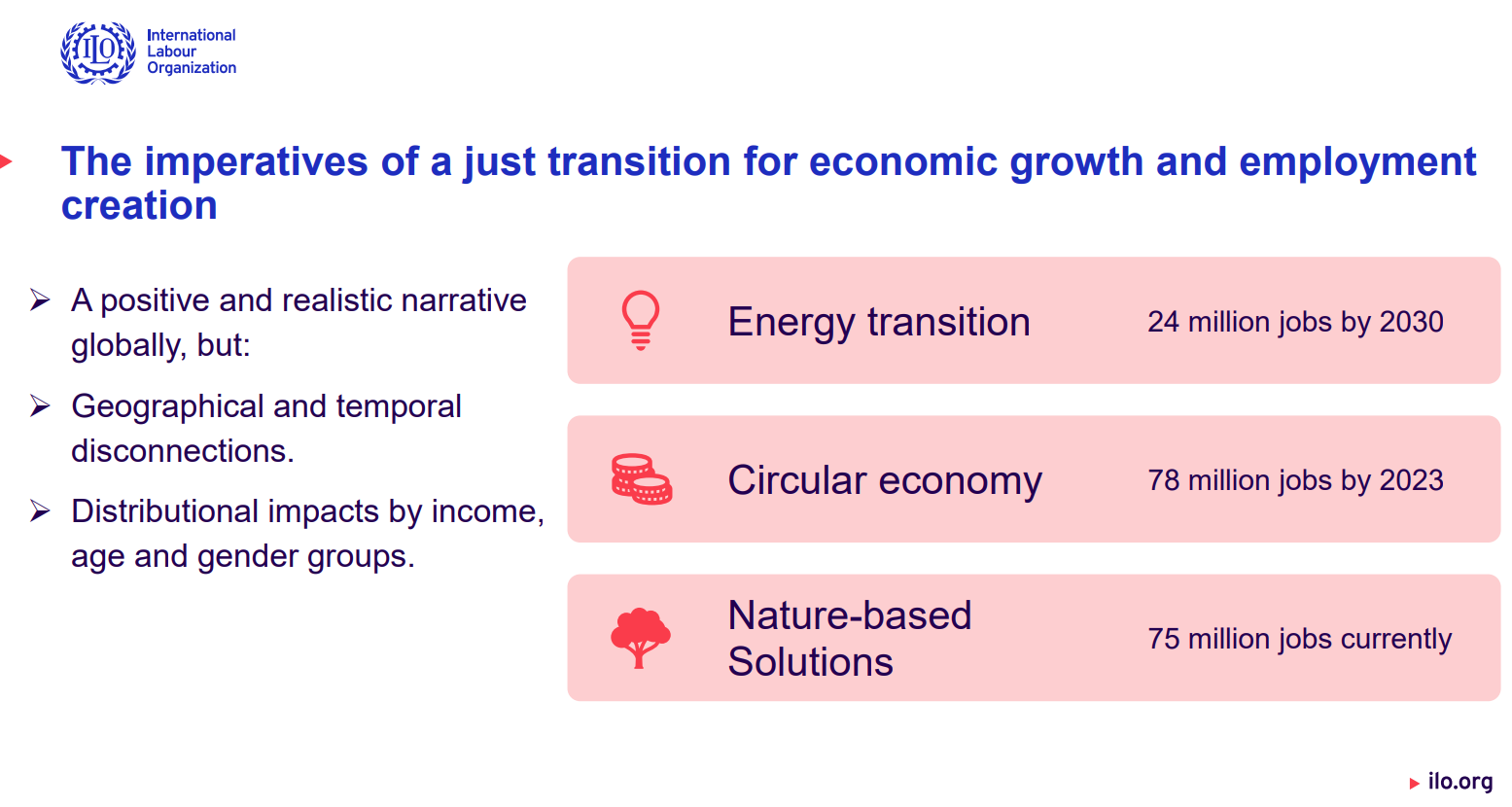
Growing evidence shows that the energy transition and the transformation of other key economic sectors will create employment opportunities that are compatible with the climate and sustainable development goals, particularly through green jobs, employment in the circular economy, and jobs through nature-based solutions (NbS). The ILO finds that a combined shift to low-carbon and circular economies may result in the creation of some 100 million jobs by 2030, as compared to a business-as-usual scenario, and an additional 20 to 34 million jobs through NbS. However, without a corresponding set of supporting social and economic policy measures, 78 million jobs may be destroyed, relocated or redefined, particularly likely in carbon-intensive and polluting sectors, with varying effects across geographic locations, income, age, and gender groups (ILC.111/Report VI).
Green Jobs
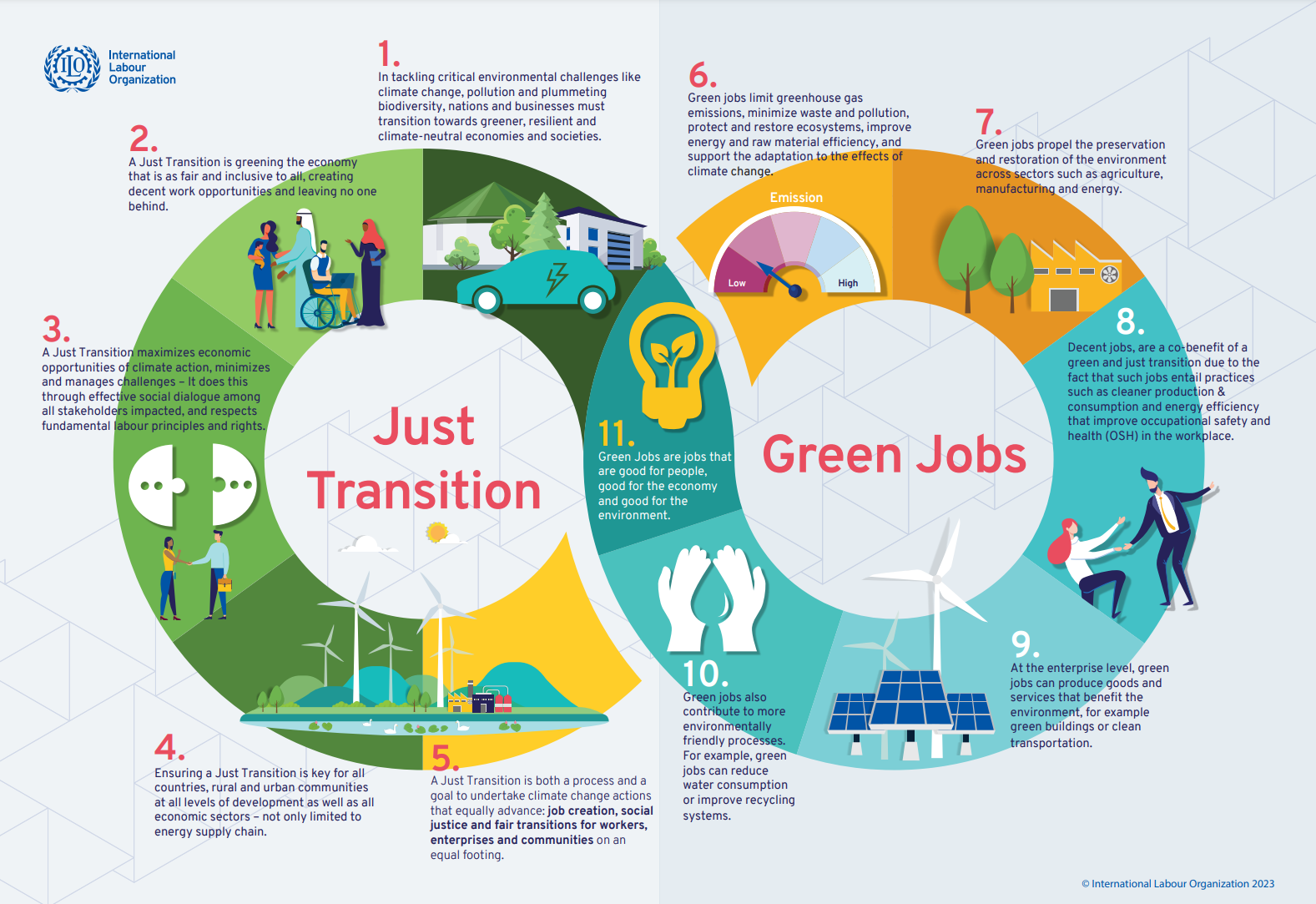
The term “green jobs” refers to “decent jobs that contribute to preserve or restore the environment, be they in traditional sectors such as manufacturing and construction, or in new, emerging green sectors such as renewable energy and energy efficiency.” Green jobs help improve energy and raw materials efficiency; limit greenhouse gas emissions; minimize waste and pollution; protect and restore ecosystems; and support adaptation to the effects of climate change (ILO, 2022). The creation, financial support, and institutionalization of green jobs are essential for achieving a just transition, as these will ideally replace jobs lost in the process of transitioning to greener economies.
While green jobs are expected to be a source of employment across all countries, the employment effects of greening the economy vary depending on specific contexts. Sectors with the greatest employment potential are renewable energy, environmental goods and services, including water and waste management; construction; agriculture; manufacturing; transportation; tourism and extractive industries. On the other hand, poverty, low incomes and informal employment, which can force people into environmentally detrimental activities; weak enforcement of regulations; and weak markets for green goods and services represent constraints on green jobs growth.
Jobs in the Circular Economy
While green jobs contribute to preserving or restoring the environment, circular jobs contribute to closing material cycles, by extending their lifetime and creating renewed value from resources that would otherwise be lost from the economy, by providing circular products and services. The imperative to transition towards more sustainable, circular and just economies and societies has never been more urgent for reducing the environmental pressures of production and consumption, to reduce social inequalities and generate much-needed employment.
Between 121 to 142 million people are employed in the circular economy, according to the first comprehensive global baseline launched in Geneva in December 2025. Transitioning to greater circularity is just or job-rich by default, therefore social dialogue with employers and workers, alongside investments that can leverage untapped potential to scale up circularity are essential to integrating decent work into the circular economy.
A crucial part of mainstreaming jobs in the circular economy and green jobs is the development of necessary skills for workers of all ages to allow them to enter or move within a changing job market. As the international agenda pushes for more concrete climate action, green technology and innovation ramp up and green productivity and green markets growth, the demand for skills for green jobs increases across supply chains (ILO, 2018).
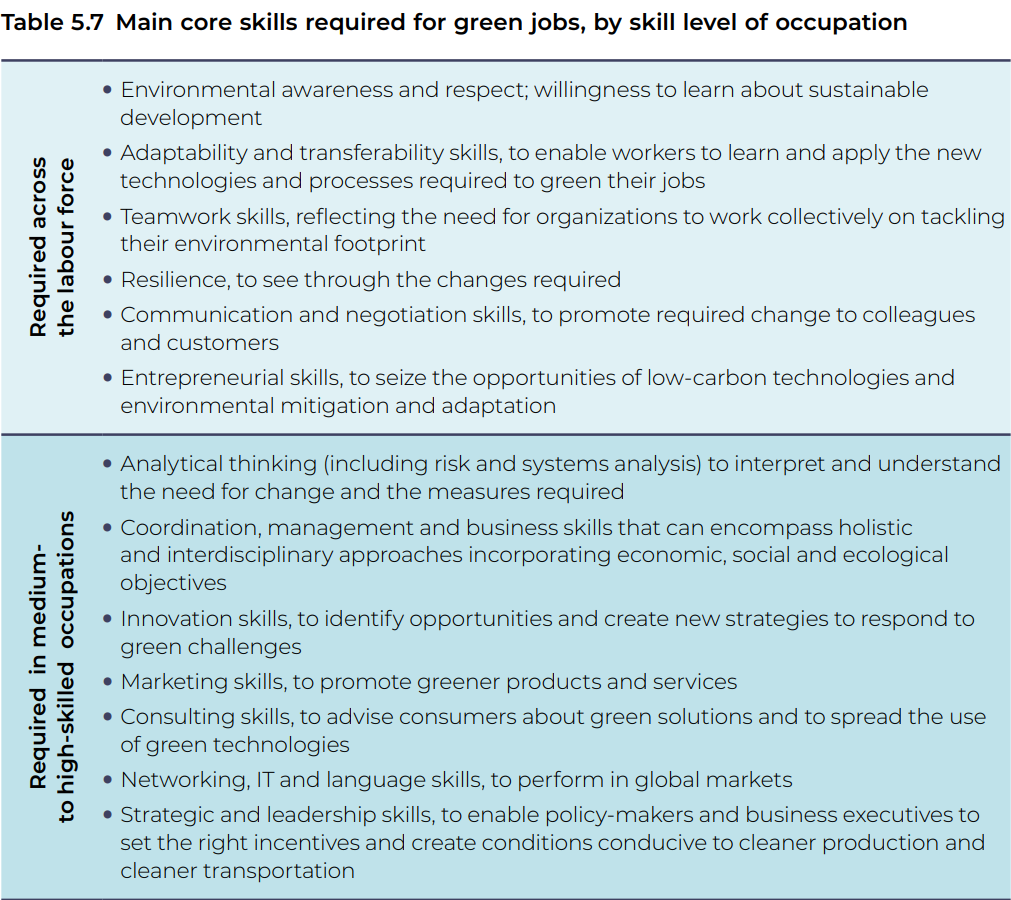
New occupations tend to emerge at higher skill levels, whereas lower-skilled occupations tend to require just more environmental awareness or simple adaptations to work processes.
Jobs through Nature-based Solutions
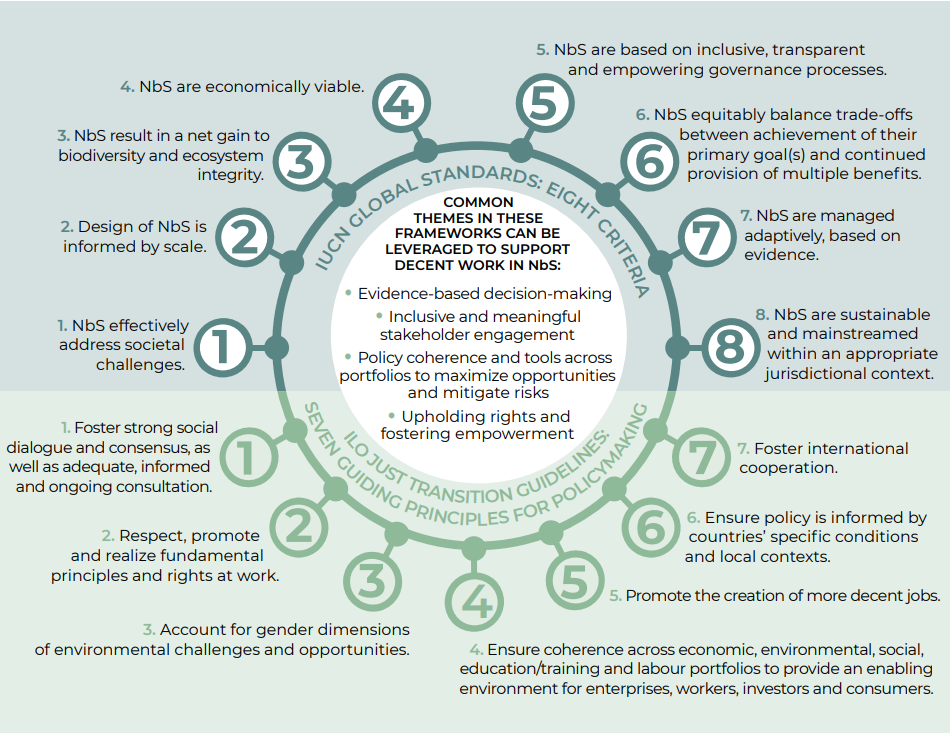
Nature-based solutions play an important role in the transition to greener economies by creating employment that protects biodiversity and contributes to the sustainable management of natural and cultural resources (ILO, UNEP, IUCN 2022). On the other hand, the enactment of NbS can be detrimental to formal and informal jobs. As such, planning and careful policy-making that can contribute to greening the economy in a way that promotes decent work outcomes, green jobs and enterprises that implement NbS, with a human and labour rights approach at the core.
Currently, over 60 million people work globally in activities categorized as NbS, which are actions to protect, conserve, restore, sustainably use and manage natural or modified terrestrial, freshwater, coastal and marine ecosystems (WCC-2016-Res-069 & UNEP/EA.5/Res.5). However, according to a report by the International Union for Conservation of Nature (IUCN), the UN Environment Programme (UNEP) and the ILO (2024), investing in nature-based solutions (NbS) could create up to 32 million new jobs by 2030. Through targeted investments, the greatest gains would be in Africa, Latin America and the Arab States, where the number of people working in NbS could go from the current level of 2.5 million to over 13 million by 2030.
While employment estimates currently focus on NbS for environmental challenges like climate mitigation and biodiversity loss as well as land degradation, there is untapped potential for more “green-grey” infrastructure which integrates both the built and nature-based infrastructure (NbI), offering an opportunity to channel a significant amount into nature and drive decent work creation and more climate resilient infrastructure.
As NbS enters into policy and is adopted by projects, the IUCN has developed the Global Standard for Nature-based Solutions to help guide actions on the ground by equipping users with a robust framework for designing and verifying NbS that yield the outcomes desired, including aspects on labour in the transition to environmentally sustainable economies and societies.
Advancing Just Transition in Global Climate Change Response
The concept of a just transition has also taken root in international agreements, meetings, declarations, and reports addressing climate change, including the Paris Agreement, successive Conferences of the Parties (COPs) of the UN Framework Convention on Climate Change (UNFCCC), and the reports of the Intergovernmental Panel on Climate Change (IPCC). Since the concept has emerged in global climate discussions, practitioners and policymakers have faced a significant challenge: translating high-level principles into actionable strategies with limited access to comprehensive, practical resources. This section provides an outlook of how just transition is addressed in various international climate change fora and efforts.
UN Framework Convention on Climate Change & Paris Agreement
In the historic Paris Agreement of 2015, parties to the UNFCCC pledged to strengthen the global response to the threat of climate change, in the context of sustainable development and efforts to eradicate poverty, while taking into account the imperatives of a just transition of the workforce and the creation of decent work and quality jobs in accordance with nationally defined development priorities.
The 2015 Paris Agreement was the first binding agreement under the UN climate change regime to formally recognize just transition, requesting Parties to prepare, communicate, and maintain successive Nationally Determined Contributions (NDCs) to pursue efforts to limit global temperature rise to well below 2°C and pursue efforts to limit the rise to 1.5 °C above pre-industrial levels. The employment and social dimensions of climate action are a key enabler of climate ambition and a vehicle of sustainable development. NDCs are a powerful vehicle for their delivery, while ensuring a just transition.
While there is no agreed definition of just transition under the UNFCCC, the term is widely used in COP decisions, work programmes, and UNFCCC technical documents. Moreover, key moments into advancing just transition and its operationalization in the context of UN Climate Change Conferences of the Parties have taken place since 2021:
- At COP26, held in the UK in 2021, parties adopted the Glasgow Climate Pact, which “recognized the need to ensure just transitions that promote sustainable development and eradication of poverty, and the creation of decent work and quality jobs.” Additionally, eighteen countries signed a Just Transition Declaration pledging to by supporting those countries’ economic growth, the creation of decent and sustainable green jobs and new sustainable investments as, globally, we transition to net zero.
- At COP27, held in Sharm el-Sheikh, parties agreed on the work programme on just transition pathways, which aims to assess, design and scale up pathways to achieve the goals of the Paris Agreement in a way that is just and equitable for all, and leaves no one behind. COP27 also agreed on the Sharm el-Sheikh Implementation Plan affirms that sustainable and just solutions to the climate crisis must be founded on meaningful and effective social dialogue and participation of all stakeholders, emphasizes that just and equitable transition encompasses pathways must be based on nationally defined development priorities and include social protection so as to mitigate potential impacts associated with the transition, and highlights the important role of the instruments related to social solidarity and protection in mitigating the impacts of applied measures.
- At COP28, held in Dubai in December 2023, adopted the United Arab Emirates Just Transition Work Programme (Decision 3/CMA.5). Additionally, the COP28 Gender-Responsive Just Transitions & Climate Action Partnership was endorsed by over 60 Parties. The Partnership includes a package of commitments, including actions on data, finance, and equal opportunities. Implementation will be reviewed at a second convening during COP31. COP28 also adopted the outcomes of the first Global Stocktake (GST), which:
28. Further recognizes the need for deep, rapid and sustained reductions in greenhouse gas emissions in line with 1.5 °C pathways and calls on Parties to contribute to the following global efforts, in a nationally determined manner, taking into account the Paris Agreement and their different national circumstances, pathways and approaches:
…
d. Transitioning away from fossil fuels in energy systems, in a just, orderly and equitable manner, accelerating action in this critical decade, so as to achieve net zero by 2050 in keeping with the science;(paragraph 28.d of the Global Stocktake (GST) adopted at COP28)
- At COP30 held in Belém, Brazil in November 2025, Parties established the Just Transition mechanism as part of the UAE Just Transition Work Programme. Called under the name Belém Action Mechanism for a Global Just Transition (BAM), the just transition mechanism is an institutional arrangement under the UNFCCC that aims to address the fragmentation of global efforts for just transition to a low-carbon economy. The mechanism performs three key functions: coordinating existing initiatives and addressing gaps in line with the Paris Agreement, sharing knowledge and best practices, and providing direct support to countries in the Global South through mobilizing finance and transferring technology — a key ask from civil society groups. The establishment of this mechanism represents a key step forward in making the Just Transition Work Programme more actionable.The COP 30 Presidency is also in the process of elaborating the COP 30 Presidency Roadmap for “transitioning away from fossil fuels in a just, orderly, and equitable manner”. The Roadmap aims to translate that global consensus into implementation, building on the debates initiated in Belém and recognizing initiatives and solutions being accelerated through the Action Agenda. It will map critical barriers and enabling factors, while recognizing that no single transition pathway applies to all countries and regions. The Roadmap will offer differentiated options that countries, subnational entities, and economic sectors can adapt according to their circumstances, serving as both a reference document and a catalyst for advancing this agenda.
Katowice Committee of Experts Report on Just Transition Frameworks
The Katowice Committee of Experts on the Impacts of the Implementation of Response Measures (KCI) under UNFCCC has published a report “Guidelines and policy frameworks for just transition of the workforce and the creation of decent work and quality jobs” that aims to help governments and organizations navigate the complex challenge of transitioning workers to clean energy economies without leaving anyone behind.
The need for a generic, adaptable and globally applicable framework and/or guidelines for just transition underlies the work of the Katowice Committee on Experts, under activity 6 of its workplan for 2020–2025, to compile and synthesize information on frameworks and guidelines that have been developed and used for just transition of the workforce and the creation of decent and quality jobs within and across sectors, including for training, retooling, retraining and reskilling systems and stakeholder engagement.
Guidelines and policy frameworks for just transition of the workforce and the creation of decent work and quality jobs
The report addresses the challenge of translating just transition principles into action by consolidating the most robust frameworks, checklists, and toolkits available. It aims to provide stakeholders a single resource to navigate workforce transition complexities and foster decent, quality employment opportunities, showcasing emerging approaches to impact assessment, stakeholder engagement, and measurement that have proven effective across diverse national and sectoral contexts.
Intergovernmental Panel on Climate Change
The Intergovernmental Panel on Climate Change (IPCC) in its sixth assessment report (Box TS.4) defines just transition as “a set of principles, processes and practices aimed at ensuring that no people, workers, places, sectors, countries or regions are left behind in the move from a high-carbon to a low-carbon economy.” Highlighting that implicit in a just transition is the notion of well-being, equity and justice, the IPCC noted that prioritising equity, climate justice, social justice, inclusion and just transition processes can enable adaptation and ambitious mitigation actions and climate resilient development.
Conference on Transitioning Away from Fossil Fuels
The First Conference on Transitioning Away from Fossil Fuels, co-hosted by Colombia and the Netherlands, will take place in Santa Marta, Colombia from 24 to 29 April 2026. The Conference is designed as a space for countries, subnational governments and other stakeholders that recognize the need to implement a transition away from fossil fuels in a just, orderly and equitable manner, in line with climate goals and the best available science.
The objective of the Conference is to initiate a concrete process through which a coalition of committed countries, subnational governments, and relevant stakeholders can identify and advance enabling pathways to implement a progressive transition away from fossil fuels creating sustainable societies and economies. This process will be informed by the experience and perspectives of national and subnational governments, academia, Indigenous Peoples, Peoples of African Descent, peasants, civil society, workers, the private sector, and other key actors at different stages of the transition. The Conference is:
- A sustained political platform for countries ready to deliver implementation-driven action toward an orderly phase-out of fossil fuels;
- A complementary space to the United Nations Framework Convention on Climate Change (UNFCCC), formally contributing to the COP30 Presidency’s roadmap while accelerating practical delivery;
- An innovative, horizontal dialogue that deepens democratic climate governance through meaningful and influential participation by countries and subnational governments, civil society, and other stakeholders.
This forum is not intended to serve as a negotiating body, nor does it constitute part of any formal negotiation process or initiative, and it is not intended to replace the UNFCCC. It is the first implementation-focused Conference, intended to support practical action by those already prepared to move forward. It does not seek to deliver a negotiated outcome, but rather to generate shared understanding and actionable guidance that can help accelerate a just, orderly, and equitable transition away from fossil fuels.
Financing a Just Transition
For an effective and sustainable just transition, capital and efficient risk-sharing mechanisms are necessary, making the financial sector an essential actor. According to ILO, the financial sector is instrumental in enabling this transition because it can provide capital and efficient risk-sharing mechanisms while integrating a just transition logic in the operations of the financial sector can generate positive social and environmental outcomes, minimizing and addressing potential negative consequences such as stranded assets, job losses and a declining local economy. Insurers in particular are critical actors in building resilient societies by adopting risk-management strategies that address social and environmental challenges and ensuring adequate coverage for all communities.
To support this function, various tools have been put into place:
- The Just Transition Finance Tool for banking and investing activities, developed by the ILO, together with the LSE Grantham Research Institute, provides practical guidance to financial institutions on integrating Just Transition considerations in their strategies and operations. This tool describes the concept of a Just Transition and makes the business case for financial institutions to partner with stakeholders and peers to support a just climate transition.
- Just Transition Finance: Pathways for Banking and Insurance | Launched by UNEP-FI and ILO in December 2023, this publication highlights crucial elements, emerging practices and examples of the banking and underwriting activities in promoting a just transition and serves as a guide for banks and insurance companies.
Global Cooperation on Just Transition
Various initiatives from Geneva and beyond also to advance the just transition agenda, including:
UN Global Accelerator on Jobs and Social Protection for Just Transitions
The Global Accelerator was launched in September 2021 by the UN Secretary-General to fast-track much-needed global actions to promote a job-rich recovery, as well as just ecological, technological and societal transitions to more sustainable and inclusive economies. It brings together Member States, UN agencies, international financial institutions, public development banks, social partners, civil society, and the private sector to create a virtuous cycle of sustainable development that generates economic and social returns and facilitates just transitions. The Global Accelerator operates through three complementary and mutually supportive pillars: Integrated and evidence-based national strategies and policies; Integrated financing combining domestic resources and international financial support; and, enhanced multilateral cooperation. → Global Accelerator FAQ
Green Jobs for Youth Pact
As a legacy initiative of the International Meeting of Stockholm+50 in June 2022, UNEP, ILO and UNICEF have joined forces to develop a ‘Green Jobs for Youth Pact’. ILO, UNEP, and UNICEF will work along their member states, employers, workers’ organizations and educators to tackle the youth and green jobs deficit based on three tracks: Employment and entrepreneurship, Environmental education, Empowerment and youth partnerships to make the transition to a low-carbon, circular and nature positive economy.
UNECE Group of Experts on Coal Mine Methane and Just Transition Task Force on Just Transition
The Task Force on Just Transition operating under the UNECE Group of Experts on Coal Mine Methane and Just Transition was established in March 2022 to manage better the knowledge and skills of its members and thus improve efficiency of the Group’s work in the area of just transition, which constitute the core of the Group’s mandate and activities. → Learn more
United Nations Secretary-General’s Panel on Critical Energy Transition Minerals
The Secretary-General’s Panel on Critical Energy Transition Minerals seeks to build trust between governments, local communities and industry, by addressing issues relating to equity, transparency, investment, sustainability and human rights. It builds on existing standards and initiatives, particularly the Working Group on Transforming the Extractive Industries for Sustainable Development and its flagship initiative, ‘Harnessing Critical Energy Transition Minerals for Sustainable Development,’ to strengthen and consolidate existing efforts. The Panel will develop a set of global and common voluntary principles on issues which are key to building trust between governments, communities and industry, enhancing transparency and investment, and ensuring a just and equitable management of sustainable, responsible, and reliable value chains for terrestrial critical energy transition minerals, including to support a just and equitable transition to renewable energy supply while harnessing critical energy transition minerals for sustainable development.
IEA Global Commission on People-Centred Clean Energy Transitions
The International Energy Agency people-centred clean energy transition programme supports governments to ensure their clean energy transition strategies are truly fair and inclusive, with a focus on skills, decent jobs, worker protection, social and economic development, equality, social inclusion and fairness, while engaging people as active participants. The programme builds on the work of the Global Commission on People-Centred Clean Energy Transitions, an independent panel of 30 members convened by the IEA Executive Director to produce a series of actionable recommendations in advance of COP26 in 2021.
A report produced by UNEP in 2026 – No Transition Without Justice: Strengthening Environmental Rule of Law for People and Planet – explores how environmental rule of law can support fair, inclusive and rights-based transitions towards more sustainable and resilient economies and societies. Bringing together legal, policy and governance perspectives, the report examines the role of laws, institutions, access to justice, public participation and finance in enabling transition processes that are effective, equitable and responsive to national contexts. Drawing on examples from around the world, the publication highlights emerging approaches and practical experiences that can help governments and other stakeholders strengthen the legal and institutional foundations for just transition. It is intended as a resource for policymakers, practitioners, researchers and anyone working to advance environmental governance and sustainable development.
Role of Geneva
By alphabetical order
Center for International Environmental Law (CIEL)
CIEL is committed to applying a human rights-based approach as a means to protect the peoples and communities on the frontline of climate change. In doing so, it works to design and integrate policies to safeguard rights and ecosystems and to ensure effective public participation within key climate institutions and mechanisms. CIEL also provide support and build the capacity of peoples and communities adversely affected by climate impacts and climate policies to support their direct participation in those decisions that affect their lives and livelihoods, including working with partners to develop new legal strategies to hold corporations accountable and accelerate the transition away from fossil fuels. With the Global Initiative for Economic, Social, and Cultural Rights, CIEL published “States’ Human Rights Obligations in the Context of Climate: Guidance Provided by the UN Human Rights Treaty Bodies“.
Earthjustice
Earthjustice works with partners to end the use of fossil fuels and bring about a swift and just transition to zero carbon emissions and 100% clean energy.
FIAN International
The global food crisis, rising inequality and the triple planetary crises of climate change, biodiversity loss, and pollution are stark reminders that maintaining the status quo is no longer viable. In a briefing paper, “A Just Transition to Agroecology”, FIAN International examines the concept of a just transition from the right to food and nutrition perspective. It argues that only a systemic, multisectoral and human rights-based transition can guarantee a safe, sustainable, and just future for all. A just transition must address socio-economic inequalities, including gender inequalities and transform processes of marginalization and exploitation that have always benefitted the same groups.
Forum on Trade and Environment and Sustainable Development | TESS
The Forum on Trade, Environment and Sustainable Development (TESS) is involved in trade policy action to implement the Sustainable Development Goals (SDGs). It seeks to strengthen the promotion and inclusion of international cooperation on trade policies that contribute to fostering inclusive international cooperation on trade and trade policies to advance climate mitigation and adaptation, climate-resilient development, and fair transitions. TESS experts are engaged in the publication of various papers, among which For a Trading System that Supports an Ambitious Climate Agenda, Climate-Resilient Development, and Just Transitions.
Franciscans International
A study by Franciscans International and the Lutheran World Federation examines how these communities can help safeguard human rights during the shift away from a dependency fossil fuel and extractivism, promoting inclusive and sustainable solutions. It also addresses ethical challenges in climate action, such as the risks of embracing “false solutions” like carbon trading and geoengineering that may worsen inequality. By highlighting the importance of participation, the study underscores the need for marginalized voices to be actively involved in shaping climate decisions at all levels. Ultimately, it seeks to identify barriers to a Just Transition and how faith-based organizations can help overcome them, ensuring that effective climate responses are guided by compassion, equity, and respect for both people and the planet.
Friedrich-Ebert-Stiftung Office in Geneva | FES Geneva
The Friedrich-Ebert-Stiftung (FES) office in Geneva serves as a liaison between the UN , other Geneva-based international organisations, FES country offices, and partners in developing countries to strengthen the voice of the Global South. With sustainable development (2030 Agenda) and climate change as cross-cutting issues addressed, FES Geneva tackles just transition issues in relation to human rights.
Geneva Climate Change Consultation Group | GeCCco
GeCCco gathers civil society organizations working in Geneva to bring forward the human rights issues raised by climate change and to introduce these climate change issues in the work of the Geneva-based UN Human Rights Bodies. The GeCCco also keeps a close eye on the UNFCCC processes thanks to the NGO Working Group on Human Rights and Climate Change, the oldest and main coalition on this matter, to which a number of the participating organizations are also members. Members of GeCCco work to ensure that just transition is pursued with human rights at its center.
Geneva Interfaith Forum on Climate Change, Environment and Human Rights | GIF
From its inception in 2008, the Geneva Interfaith Forum on Climate Change, Environment and Human Rights (GIF) has addressed climate change within a holistic perspective, recognising its environmental, developmental, political, economic, social and cultural implications. Furthermore, from a spiritual and ethical perspective the GIF advocates for climate justice to be central to human rights and climate change discussions, including that of just transition.
Global Initiative for Economic, Social and Cultural Rights | GI-ESCR
The Global Initiative for Economic, Social and Cultural Rights’ briefing paper on “Women’s Participation in the Renewable Energy Transition: A Human Rights Perspective” analyzes the status of women’s representation and engagement in the global push to transform our energy systems in the face of the climate emergency, while developing a human rights approach to ensure women’s meaningful participation in this process. The briefing paper provides an overview of the current trends of women’s participation in the rapidly evolving renewable energy sector, as well as normative tools and policy recommendations to use human rights law as a compass for developing energy systems that are not only renewable, but socially and gender-just.
International Federation for Human Rights | FIDH
Defending all civil, political, economic, social and cultural rights as set out in the Universal Declaration of Human Rights since 1992, FIDH has mobilized to fight impunity to hold States and business accountable for environmental degradation, advocating that a just transition away from fossil fuels must be an imperative for all climate action ahead. FIDH, in its submissions to both the Santa Marta and the COP31 roadmap, calls for: meaningful and effective participation of rightsholders and human rights defenders in phaseout action plans; reform of trade and investment agreements to serve human rights and climate objectives instead of corporate interests; tax justice reform to remedy budgetary crunches arising from the phaseout and find new, increased resources to fulfil human rights.
International Labour Organization | ILO
The International Labour Organization is the UN Agency leading the work on the just transition. Its members adopted the guidelines for a just transition towards environmentally sustainable economies and societies for all in 2015, becoming a widely recognized point of reference for all work related to the just transition. With the International Labour Conference resolution adopted in 2023 on a just transition towards environmentally sustainable economies and societies for all, the ILO has a newly reinvigorated mandate, as the only tripartite specialized UN agency representing governments, employers and workers, in advancing a just transition in the multilateral system including the United Nations climate processes. Besides mainstreaming green jobs and just transition through the Green Jobs Unit, ILO convenes various initiatives for the mainstreaming of a just transition across the world of work and for the creation of decent and sustainable green jobs, including the ILO’s Action Programme on Just Transition. ILO’s work on just transition aims to maximize opportunities for employment and income growth, advance social justice and labour rights, and minimize the risks of social disruption, including business closure and loss of business assets, jobs and livelihoods, and growing inequalities, in the context of environmental and climate change, and decarbonization. For more information on the ILO’s work on just transition, please see the ILO green jobs page. ILO has also produced a list of just transition-related policy briefs.
In 2017, together with the UN Climate Change secretariat, UNFCCC, ILO organized in Geneva the 1st Global Forum on Just Transition. The Forum situated the ILO as a convener on the issue of Just Transition and address a critical dimension of the global efforts to move towards more environmentally sustainable economies and societies.
International Organization of Employers | IOE
The International Organization of Employers (IOE) advocates for an orderly and just transition that ensures continued business development and inclusive economic growth as the transformation to net-zero emissions moves forward. IOE has been instrumental in the drafting and adoption of the ILO Guidelines for a just transition towards environmentally sustainable economies and societies for all and ensured economic, and business priorities were adequately acknowledged. IOE is actively involved in shaping the dialogue and policy development for climate change through its official observer status and membership of the Business and Industry constituency to the UNFCCC (the organisation leading the negotiations and implementation of the Paris Agreement) as well as the United Nations Environment Programme. IOE created a Just Transition Task Force to facilitate the exchange of experience, establish partnerships and build capacity. Climate and employment issues are also high on IOE’s Policy Working Group on Sustainable Development agenda.
International Institute for Sustainable Development | IISD
IISD is actively involved in the two main responses to climate change: adaptation and mitigation. It partners with countries to help them cope with a changing climate and transition to clean energy as quickly as possible. IISD is engaged to showcase how a just transition approach ensures that the affected people are considered by those making decisions. IISD is also active in its project on Advancing the Transition Away from Fossil Fuels, supporting credible roadmaps for a just, orderly, and equitable transition away from fossil fuels.
Intergovernmental Panel on Climate Change | IPCC
The Intergovernmental Panel on Climate Change (IPCC) is the United Nations body for assessing the science related to climate change. Through its assessment reports and special reports, the IPCC divulgates objective scientific information on the state of scientific, technical and socio-economic knowledge on climate change, its impacts and future risks, and options for reducing the rate at which climate change is taking place. The IPCC dedicated a chapter of the Mitigation of Climate Change section its Sixth Assessment Report to a Just Transition in the Context of Sustainable Development, stressing that engaging and empowering workers, youth, women, the poor, minorities and marginalised stakeholders in just, equitable and inclusive processes as well as integrating the views of different government agencies, businesses and NGOs is key to enabling deep and broad transitions to restore the health and well-being of the planet and the people on it.
International Organization for Migration | IOM
Since 2007, IOM has been working on migration, environment and climate change. Since 2015, it hosts a dedicated Migration, Environment and Climate Change Division (MECC) that addresses the migration, environment and climate nexus. IOM is engaged in supporting policymakers in developing labour migration policies, skills mobility partnerships and other skills programmes for migrant workers that support a green transition and that prevent the exacerbated risks for exploitation of migrant workers across climate-affected migration corridors.
International Union for Conservation of Nature | IUCN
The International Union for Conservation of Nature (IUCN) is the global authority on the status of the natural world and the measures needed to safeguard it. IUCN pioneered the concept of Nature-based Solutions 20 years ago, first developing a formal definition and then the Global Standard for Nature-based Solutions as a safeguard for their use. IUCN provides tools and on-the-ground support to help governments, communities, business and NGOs implement effective Nature-based Solutions that are ambitious, safe, sustainable, and that benefit people and the planet. IUCN World Commission on Environment Law recently issued a policy brief focusing on the international, regional, and national legal and policy developments on “Just Transition”, and particularly the importance of optimising the relevant legal instruments for accelerated and equitable climate action in the context of fossil fuels phase-out.
International Trade Union Confederation | ITUC
ITUC works actively with its affiliates in positioning the labour movement in the climate agenda – on the need for a fair, ambitious and binding agreement in the UNFCCC, on emission reduction targets and differentiated responsibilities, on financing climate policies, among others – and on developing a comprehensive strategy for a “just transition” for workers and communities to ensure we all are part of a sustainable, low-carbon economy and benefit from decent and green jobs. The Just Transition Centre was established in 2016 by the ITUC and partners. The Centre brings together workers and their unions, businesses and governments in social dialogue and stakeholder engagement with communities and civil society to ensure that labour has a seat at the table when planning for a Just Transition to a low-carbon world.
Lutheran World Federation
A study by Franciscans International and the Lutheran World Federation examines how these communities can help safeguard human rights during the shift away from a dependency fossil fuel and extractivism, promoting inclusive and sustainable solutions. It also addresses ethical challenges in climate action, such as the risks of embracing “false solutions” like carbon trading and geoengineering that may worsen inequality. By highlighting the importance of participation, the study underscores the need for marginalized voices to be actively involved in shaping climate decisions at all levels. Ultimately, it seeks to identify barriers to a Just Transition and how faith-based organizations can help overcome them, ensuring that effective climate responses are guided by compassion, equity, and respect for both people and the planet.
Office of the United Nations High Commissioner on Human Rights | OHCHR
The Office of the High Commissioner for Human Rights (OHCHR) is the leading UN entity on human rights and represent the world’s commitment to the promotion and protection of the full range of human rights and freedoms set out in the Universal Declaration of Human Rights. OHCHR is home for secretariats of international human rights treaty bodies and the UN Human Rights Council. OHCHR has collaborated with the ILO in the development of the human rights principles for a just transition and it is stressing the importance of mainstreaming of a human-rights approach across the transition towards a greener economy through various workstreams, including the Working Group on Business and Human Rights through the development of various reports.
Special Procedures of the UN Human Rights Council
Independent human rights experts with mandates to report and advise on human rights from a thematic or country-specific perspective, various UN Special Rapporteurs have worked on the mainstreaming of human rights in the just transition of various sectors. Consult the section on the work of Special Procedures mandate holders.
United Nations Trade and Development | UNCTAD
The United Nations Trade and Development (UNCTAD) works on harnessing international trade in promoting sustained growth and inclusive development includes as a key aspect, support to developing countries in taking advantages of emerging opportunities for trade associated with the protection, promotion and preservation of the environment and sustainable development objectives generally, while minimizing potential adverse impacts. This work is carried out by the Trade, Environment, Climate Change and Sustainable Development Branch of the Division on International Trade and Commodities. UN Trade and Development provides policy recommendations on trade measures to support the just transition, deep diving into how to best develop a just transition in specific sectors.
United Nations Economic Commission for Europe | UNECE
UNECE seeks to support its member States in their efforts to achieve climate goals and simultaneously ensure quality of life and decent jobs for their citizens, as well as prosperity and good perspectives for the legacy industry-oriented regions undergoing the transition. UNECE has adopted a working definition of Just Transition as an approach that seeks to ensure that the shift to a low-carbon future is fair, equitable, and inclusive – leaving no one behind. It brings together environmental sustainability with social and economic justice through an integrated set of actions aimed at advancing social progress, protecting and empowering workers, fostering environmental consciousness and responsibility, and promoting economic success. These efforts are underpinned by participatory governance and strong, accountable institutions. UNECE is addressing the concept of just transition through its Group of Experts on Coal Mine Methane and Just Transition, which recently developed a Just Transition Check List, and the Committee on Sustainable Energy, which promotes policy dialogue and cooperation among governments, energy industries and other stakeholders. → Read more
United Nations High Commissioner for Refugees | UNHCR
UNHCR leads international action to protect people forced to flee conflict and persecution and those denied a nationality. As part of its climate action, UNHCR work with forcibly displaced people to preserve and rehabilitate the environment through various activities that can be considered as green jobs. UNHCR also drives a transition to renewable energy, for example by solarizing boreholes, health centres and schools serving displaced people and their hosts. By increasing forcibly displaced people’s access to climate-smart services, we can reduce dependence on scarce natural resources which helps lessen tensions with host communities. It also tries to help forcibly displaced populations to find climate-resilient and environmentally sustainable jobs and livelihoods. In addition, UNHCR collaborates with governments, development actors, including the ILO and the World Bank Group, the private sector, researchers and academia to tackle issues related to the global underemployment of forcibly displaced and stateless populations and to advance a just transition.
United Nations Environment Programme Finance Initiative | UNEP-FI
UNEP Finance Initiative brings together a large network of banks, insurers and investors that catalyses action across the financial system to deliver more sustainable global economies. The financial sector, including insurers, plays a pivotal role in building resilient societies by adopting risk-management strategies that address social and environmental challenges and ensuring comprehensive coverage for all communities. At COP28 in December 2023, UNEP FI and the International Labour Organization released Just Transition Finance: Pathways for Banking and Insurance, the first roadmap for financiers implementing the just transition. The document provides guidance on the financial sector’s role in facilitating a just transition to low-carbon, resource-efficient, and resilient economies. It aims to assist UNEP FI members and the broader financial sector in integrating just transition practices into their operations, ensuring an equitable climate transition that leaves no one behind.
United Nations Partnership for Action on Green Economy | PAGE
The Partnership for Action on Green Economy (PAGE) is a prominent alliance of five UN agencies, funding partners, and 22 partner countries that work together to transform economies into drivers of sustainability. Through its core activities in support of national policymaking, strengthening capacity, and knowledge sharing green jobs and ensuring a just transition as countries commit to greening their economies. PAGE’s in collaboration with ILO released a mapping piece on just transition, capturing key interventions, lessons learnt, different experiences, and insights undertaken by PAGE-ILO to advance a just transition across various countries. It provides an overview of these initiatives and their progress. It includes information on national frameworks with policy and sectoral interventions implemented in PAGE member countries.
World Business Council for Sustainable Development | WBCSD
WBCSD serves as a platform for businesses to respond to sustainability challenges and is guided by the mission to accelerate the transition to a sustainable world and to help make more sustainable businesses more successful. Among the various publications WBCSD released on the topic, in 2023 it released a comprehensive compilation of insights and case studies to support energy companies in their efforts to advance a just transition to a net-zero carbon energy system.
We Mean Business Coalition
The We Mean Business Coalition catalyzes business and policy action to halve emissions by 2030 and accelerate a just transition to a net zero. Business has a key role to play in planning, implementing and advocating for a just transition to a net zero economy. This includes taking active steps to engage workers and affected stakeholders in decision-making processes through social dialogue and consultations; preparing their workforce by reskilling, upskilling and supporting redeployment; ensuring accessible and affordable products and services for a net zero future; respecting human and labor rights; advocating for just and inclusive climate policies; and co-developing solutions with workers and affected stakeholders. To support companies in navigating their just transition journey, We Mean Business Coalition, BSR, The B Team developed a Just Transition Resource Platform.
World Health Organization | WHO
To protect the health and lives of present and future generations we need a rapid, equitable phase-out of fossil fuels globally, so as not to exceed 1.5ºC of warming advised by global scientific consensus. WHO, as stressed in its COP26 Special Report on Climate Change and Health, recommends enabling a just and inclusive transition to renewable energy to save lives from air pollution, particularly from coal combustion among the key actions to prioritize health and equity in the international climate regime and sustainable development agenda.
World Wildlife Fund | WWF
WWF works to tackle the climate crisis in a variety of ways and while recognizing that to tackle climate change we need to move on from fossil fuels to a renewables-based power sector, and green our industries, WWF stresses that this rapid transformation of key sectors of the economy can have a negative social impact on workers and communities. WWF believes that environmental and social objectives should be considered together to achieve a sustainable and socially fair transition. WWF aims to ensure socially fair Just Transition plans are properly implemented and reach their clean energy transition, decarbonisation and social transformation objectives. WWF assessment of plans gives visibility on where improvements are needed for a truly Just Transition. WWF promotes synergies between social and climate goals in EU policies and plans, including integration of effective just transition measures into National Energy and Climate Plans and future Social Climate Plans.
GEN Events
This list highlight the various events organized and co-organized by the Geneva Environment Network on just transition.


Briefing on the UN Climate Change Conference (COP28)
21 November 2023



Decent Work in Nature-based Solutions
4 May 2023
Launch | ILO Environmental Sustainability Action Plans 2018-21
29 October 2020


Decent work and just transition to address climate change
12 October 2015

Green Jobs and Youth Roundtable
24 April 2012