Newsletter 18 Aug 2025
Environment: What’s Up in GENeva | 18 – 24 August 2025
The Geneva Environment Network’s weekly newsletter includes the latest information on the global environmental agenda, main events, job vacancies, as well as other useful resources and updates. Stay tuned and follow us on X (Twitter), Facebook, LinkedIn, Instagram, Bluesky, and Youtube, or visit our website regularly for additional updates.
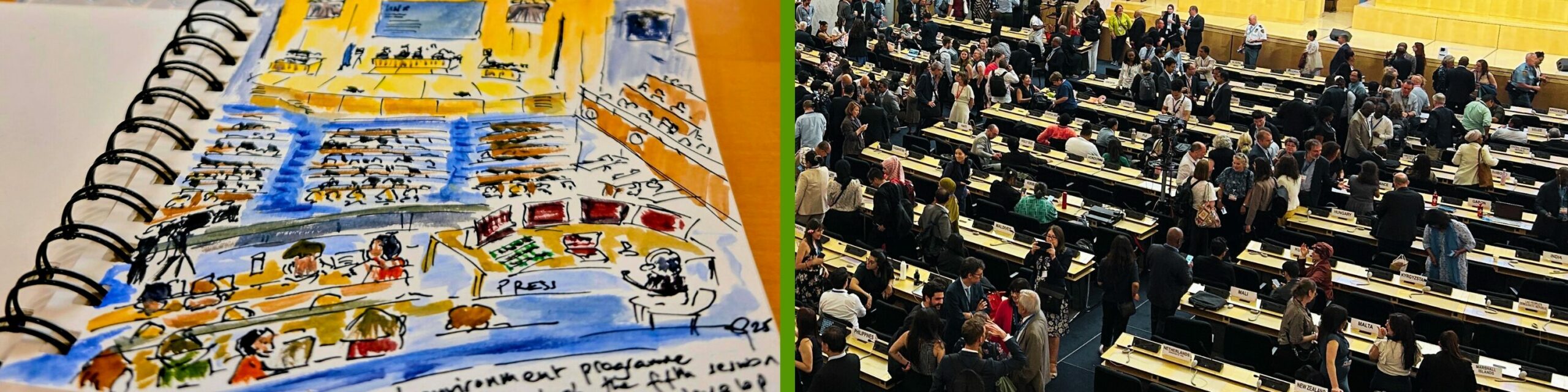
Image of the week | Snapshots of Palais des Nations Assembly Hall on the night from 14 to 15 August 2025, just after the plenary was adjourned until further notice, including a drawing by Chris Guillot, Director of AwareNearth – a non-profit organization registered in Geneva using sound and inclusive governance, science and edutainment to connect with diverse audiences and the natural world, fostering a better present and sustainable future for all.
Plastics Treaty | Failing to Reach the Goal
After ten days and nights of intense work in formal and informal settings, the resumed fifth session of the Intergovernmental Negotiating Committee to develop an international legally binding instrument on plastic pollution, including in the marine environment (INC-5.2) was adjourned at 09:11 a.m. on 15 August 2025 and will resume at a later date. This session was attended by more than 2,600 participants, including over 1,400 Member delegates from 183 countries, and close to 1,000 Observers representing over 400 organizations. In the last days, 70 Ministers and Vice-Ministers, and 30 other high-level representatives joined for informal roundtables in the margins of the session.
While disappointment was expressed in the statements of many Member States during the closing plenary and in the press releases of observers, the commitment and readiness to continue working towards a Global Plastics Treaty remains unchanged. The UN Secretary General welcomed “the determination of Member States in continuing to work to beat plastic pollution and keep engaged in the process, united in purpose, to deliver the treaty the world needs to tackle this monumental challenge to people and the environment.” The commitment and engagement of the numerous organizations that joined the Geneva session are also a demonstration that the movement to end plastic pollution goes beyond the treaty in preparation.
In the margins of the treaty, Benjamin Von Wong artwork “The Thinker’s Burden” on Place des Nations continued attracting the attention of many over toxic inaction, and made headlines on all continents, until its dismantlement on 15 August. An article by Joseph Winters in GRIST, “The art of a plastics treaty: How sculptures, collages, and poetry have influenced global talks” showcases how creative interventions are turning the conversation and convening messages. Various performances took place around the artwork, in between interviews and photoshoots, including the production of the short film “I thought about having kids”. The art installation is expected to tour Canada for the next 5-7 years, as part of a travelling climate museum exhibit. Once the tour is complete, hopefully, it can find a permanent resting place – and live permanently in Geneva.
Final statements and analyses on the outcomes of the meeting include:
- Earth Negotiations Bulletin
- UNEP | Talks on global plastic pollution treaty adjourn without consensus | 15 August 2025
- UN News | Plastic pollution treaty talks adjourn, but countries want to ‘remain at the table’: UNEP chief | 15 August 2025
- IISD | No Compromise on the Plastics Treaty – Talks Must Keep Pushing for Ambition | 15 August 2025
- IUCN | Plastics Treaty negotiations end without agreement in Geneva – yet many countries and stakeholders remain strongly engaged to end plastic pollution | 15 August 2025
- GEF | GEF CEO Statement on Plastic Pollution Treaty Negotiations | 15 August 2025
- Scientists’ Coalition for an Effective Plastics Treaty | Independent Science Ready to Support Next Steps to Achieve an Effective Plastics Treaty | 15 August 2025
- Business Coalition for a Global Plastics Treaty | Our statement on the INC-5.2 outcome | 15 August 2025
- Break Free from Plastic
- IPEN | Despite Wide Agreement on the Need to Address the Plastics Crisis, Oil States Derail Efforts for a Global Plastics Treaty | 15 August 2025
- GAIA | Ambitious Countries Stand Strong, Refuse Weak Plastics Treaty | 15 August 2025
- WWF | States must choose new path as UN plastics talks collapse with no clear way forward | 15 August 2025
- CIEL | CIEL Staff React to End of Resumed Fifth Plastics Treaty Talks & Video | 15 August 2025
- Greenpeace International | INC 5.2: “The inability to reach an agreement in Geneva must be a wake-up call for the world”, Greenpeace statement | 15 August 2025
- EIA | Petrostates torpedo Global Plastics Treaty – profits over planet as talks collapse again | 15 August 2025
- GRID-Arendal | No Treaty… Yet | 15 August 2025
- ICC | Business disappointed by failure to secure global plastics treaty | 15 August 2025
- IEN | The Global Plastics Treaty Negotiations, by Design, Result in Continued Harms to Indigenous Peoples, Waste Pickers and Trade Unions, Youth, and Affected Communities, but We Have Solutions | 15 August 2025
- Global Plastics Diplomacy Briefing
This important negotiation made the headlines of numerous media for two weeks. Articles on the outcomes from journalists who joined on-site include:
- AFP | World plastic pollution treaty talks collapse with no deal | 15 August 2025
- AP | No end in sight to plastic pollution crisis as treaty negotiations in Geneva fail | 15 August 2025
- RFI | Disappointment and anger after world fails to agree plastic pollution treaty | 15 August 2025
- Le Temps | Echec des négociations pour un accord sur le plastique à Genève | 15 August 2025
- Tribune de Genève | Traité anti-pollution plastique: les discussions de Genève échouent | 15 August 2025
- The Guardian | Plastic pollution talks fail as negotiators in Geneva reject draft treaties | 15 August 2025
- Climate Home News | Plastics treaty talks collapse without a deal after “chaotic” negotiations | 15 August 2025
- GRIST | ‘Consensus kills ambition’: UN plastics treaty talks end without an agreement | 15 August 2025
- Arete News | Back to Busan: Global plastic pollution treaty talks end in disarray | 15 August 2025
- Reuters | Plastic pollution treaty stalled as Geneva talks end without deal | 15 August 2025
- Health Policy Watch | UN Plastics Treaty Talks Fail Again After Overnight Deadlock | 15 August 2025
- Rejecting a Weak Plastics Treaty, Countries Open the Door to Stronger Climate Ambition | Neil Tangri | 15 August 2025
Environment @ 60th Session of the Human Rights Council | Ongoing Preparations
The environment is high on the agenda of the 60th session of the Human Rights Council (HRC60), taking place from 8 September to 8 October 2025, at Palais des Nations. Core themes of this session include:
- The implications for human rights of the environmentally sound management and disposal of hazardous substances and wastes is the usual main environmental theme of the Council’s September sessions, with the annual report to the HRC of the UN Special Rapporteur on toxics and human rights, Marcos Orellana, on “Guidelines on access to justice and effective remedies in the context of toxics” (A/HRC/60/34).
- The UN Special Rapporteur on the human rights to safe drinking water and sanitation, Pedro Arrojo Agudo, will present his report to the Council highlighting the water-energy nexus (A/HRC/60/30).
- Interlinkages between climate change and human rights remain prominent in this session of the Council:
- Following Human Rights Council resolution 56/8 entitled “Human rights and climate change”, the UN Secretary-General is presenting a synthesis report (A/HRC/60/52) on opportunities, best practices, actionable solutions, challenges and barriers relevant to a just transition and the full realization of human rights for all people.
- A thematic study to be presented to HRC60 (A/HRC/60/95) by the Expert Mechanism on the Right to Development examines how the right to development principles can be effectively incorporated into established and emerging climate policies to promote climate justice and bolster responses to the climate crisis.
- The annual half-day panel discussion on the rights of Indigenous Peoples in this session will be tackling the rights of Indigenous Peoples in the context of a just transition to sustainable energy systems, including in relation to critical minerals.
- Other topics that tackle environmental issues include:
- The UN Special Rapporteur on the rights of Indigenous Peoples, Albert K. Barume, dedicates his annual report to the Human Rights Council to the theme, Recognition of Indigenous Peoples.
- The UN Special Rapporteur on the situation of human rights in Cambodia, Vitit Muntarbhorn, will present his report to the Council (A/HRC/60/86), focusing on the link between natural resources and human rights in Cambodia from the angle of the right to a clean, healthy and sustainable environment.
- The Human Rights Council Advisory Committee is presenting their report to the Council (A/HRC/60/63), addresses the full life cycle of new and emerging technologies in the military domain. In the report, the Advisory Committee highlights that as these technologies evolve, addressing their environmental and human rights impacts is essential.
- Following the resolution by the Human Rights Council (A/HRC/RES/58/3), a biennial panel discussion is to be held in this session on the impact of unilateral coercive measures and overcompliance on the right to food and food security.
- The Working Group on the Rights of Peasants and other People Working in Rural Areas will be presenting their report to the Council (A/HRC/60/33).
- A draft resolution on sea level rise is under consideration by the Dominican Republic and other Member States to be tabled in this session.
→ Regular updates on key environmental issues at HRC60, side events, and further resources will be made available on our dedicated HRC60 and the environment update.
To develop more synergies among stakeholders and a better outreach on the environmental agenda of HRC60, the Geneva Environment Network and its partners are convening an information-sharing session on activities and events related to the environment. This event will discuss and share information on planned environment-related activities at and around HRC60, such as in-person and online events, publications or exhibitions, among others, and exchange on possible synergies. They will feed the GEN page on HRC60 which will provide an updated calendar of these environment-related events. → Register to participate in-person at the International Environment House I or online via Webex on Thursday, 21 August 2025, from 10:00 to 11:00 CEST. Share as well information on your activity!
This week, the Office of the High Commissioner for Human Rights (OHCHR) is holding two online consultations with civil society organizations and Indigenous Peoples’ representatives to inform the global analytical study related to biodiversity and human rights. Following the request by Human Rights Council resolution 57/28, the OHCHR is conducting a global analytical study on the implementation of a human-rights based approach into the goals and targets of the Kunming-Montreal Global Biodiversity Framework, in line with the provisions of the Convention, consistent with the considerations set out in section C of the Framework and taking into consideration the outcomes of the sixteenth meeting of the Conference of the Parties to the Convention on Biological Diversity. This study is to be submitted to the Human Rights Council at its sixty-first session, taking place from 23 February to 3 April 2026. → Register via the form to join the online consultations on 19 August 2025, from 10:00 – 11:00 CEST (in English) or from 17:00 – 18:00 CEST (in Spanish).
Glaciers Melting
Glaciers melting during the warm summer season is a natural phenomenon, yet, record temperatures experienced these years have been putting glaciers across the world under extreme pressure, generating meltdowns that could be potentially irreversible. As the International Year of Glaciers’ Preservation has surpassed its halfway mark, it remains fundamental to boost efforts to protect glaciers, as mountain regions are a key source of global freshwater and ecosystem services.
- The situation of Swiss glaciers continues to be alarming. Reports from glaciologist Matthias Huss of GLAMOS – Glacier Monitoring in Switzerland- show that the August heatwave has left glaciers almost completely naked – unprotected by the white snow.
- Last week in the United States of America, the snowmelt dammed by Alaska’s Mendenhall Glacier began releasing floodwater, triggering the evacuation of some residents in the area.
- Flash floods kill more than 300 in Pakistan and Pakistan-administered Kashmir in past days. While the exact cause of the recent floods and landslides are yet to be determined, glaciologists say that ice melt is a contributing factor.
- The Greenland ice sheet is melting at an increasing rate, a process accelerated by glacier calving, in which huge chunks of ice break free and crash into the sea, generating large waves that push warmer water to the surface. A new study now shows that this mechanism is amplifying glacial melt. Using fibre-optic technology, a research team involving scientists from ETH Zurich was able to measure the different types of waves and investigate their impact as part of the GreenFjord project.
- Artists and researchers are combining data and creative expression to document ongoing glacier melting, with coverage on 17 August 2025. Such projects aim to illustrate the rapid pace and scale of ice loss and its implications for the environment.
- New research published on 7 August 2025, finds the Perito Moreno Glacier in Patagonia, long considered stable, is now experiencing its fastest retreat in a century.
Additional news on glaciers include:
- Calving-driven fjord dynamics resolved by seafloor fibre sensing | Dominik Gräff, Bradley Paul Lipovsky, Andreas Vieli | Nature | 13 August 2025
Enjoying a Green Summer in Geneva
With the last month of Summer beginning this week, Geneva offers various opportunities to enjoy the free time and discover the city and its nature through open-air festivals and lakeside activities to exhibitions, workshops, and nature walks. Whether you’re looking to cool off in green spaces, dive into sustainability, or simply enjoy the beauty of nature in full bloom, find your inspiration for a vibrant Green Summer in Geneva. Suggestions for this week include:
- Festival OSR à Genève-Plage | From 21 to 23 August 2025 | Genève-Plage
The Orchestre de la Suisse Romande returns for its 6th edition of open-air concerts at sunset. From a classical evening to a film concert (An American in Paris) and a jazz night dedicated to Sinatra, enjoy three nights of music by the lake. - KorSonoR au Jardin botanique de Genève: concerts immersifs dans la serre tempérée | 22 to 24 August 2025 | Conservatoire et Jardin botaniques
For its 2nd edition, KorSonoR, a biennial exhibition-festival dedicated to sound and visual arts, sets up shop for 3 days at the Botanical Gardens for a series of 5 concerts and performances. - Concerts at the Scène Ella Fitzgerald | Until 22 August 2025 | Parc La Grange
Enjoy free open-air concerts in the majestic green setting of Parc La Grange, celebrating music in all its diversity throughout the summer. - Migrateurs au Défilé de l’Ecluse | 23 August 2025 | GOBG
A renowned bird migration site where, alongside local “spotters,” you can observe numerous raptors (including kites, honey buzzards, and sparrowhawks), the first storks of the season, and other delightful surprises. - Excursion Valais – Région d’Aletsch | 24 August 2025 | La Libellule
An excursion into Upper Valais, under the cover of the Aletsch forest and along the moraine of its famous grand glacier. No need to brush up on your German or perfect your Swiss accent—the beauty of this UNESCO World Heritage region will leave you speechless. - Atelier Nature : une montagne de biodiversité | Until 26 August 2025 | Château des Rubins, Megève, France
Eight workshops exploring mountain biodiversity, with a special focus on wetlands this year. Activities include hands-on experiments and learning traditional skills, encouraging reflection on humanity’s relationship with nature and the future of mountain communities. - Été 2025 au Théâtre de l’Orangerie | Until 28 August 2025 | Théâtre de l’Orangerie
A summer-long program of performances, theatre, and cultural events in the scenic setting of the Parc La Grange. - Climate Fiction, un récit sur la collection du Fonds cantonal d’art contemporain | Until 31 August 2025 2025 | Musée de Carouge
This exhibition explores the multiple oppressions and inequalities that have contributed to ecological issues. Curated under the Fonds cantonal d’art contemporain program, it offers an independent curatorial perspective on the institution’s collection, aiming to promote and highlight its works while supporting exhibition curators. - Prendre racine – Hommes et plantes en exil | Until 29 September 2025 | Cheseaux-Noréaz (VD)
A travelling exhibition focusing on the plants and skills brought over the Alps by Huguenots and Vaudois at the end of the 17th century. It also highlights their cultural techniques, silk production, and contributions to botany and agronomy, while drawing modern connections through intercultural gardens and climate change themes. - BORN IN … PPM au pont de la Machine | Until October 2025 | Quartier Libre SIG
An artistic photography project by Mary-Lou Mauricio demonstrating the increase in atmospheric CO₂ concentration since the Industrial Revolution. Participants pose with the atmospheric CO₂ concentration (in ppm) from their year of birth, creating a powerful statement against fossil fuels and climate change. Featuring portraits of both famous and anonymous individuals from Geneva, Switzerland, and beyond. - Galerie à ciel ouvert | Until 24 October 2025 | Jardin des Nations
An open-air gallery featuring over 40 works by Mark Henley and Carole Desheulles. This visual dialogue explores the intersection of geopolitical tensions and the resilience of the natural world. - Notre Biodiversité | Until 30 November 2025 | Conservatoire et Jardin botaniques de Genève
An engaging walk through the botanical gardens exploring biodiversity and our role in preserving it. Linked to the City of Geneva’s new Biodiversity Strategy, the exhibition invites visitors to reflect on this critical topic through concise outdoor installations.
Happening Abroad
- BBNJ COP Prepcom 2 | The 2nd Session of the Preparatory Commission for the Entry into Force of the BBNJ Agreement and the Convening of the First Meeting of the Conference of the Parties to the Agreement is taking place from 18 to 29 August 2025 at the UN Headquarters in New York. To prepare for the entry into force of the BBNJ Agreement, delegates will meet to settle important details to ensure smooth implementation, including rules of procedure of the COPs and subsidiary bodies, arrangements for the Secretariat (including the selection of its seat), and funding, among other issues. → Follow the live coverage on the IISD Earth Negotiations Bulletin
- World Water Week 2025 | Gathering stakeholders from all over the world in Stockholm and online, the World Water Week 2025 will take place from 24 to 28 August 2025. WWW is centered around the theme “Water for Climate Action”, emphasising how the escalating crises of climate change, environmental degradation, and biodiversity loss are deeply intertwined with water management. The Week will explore how water is not just a resource, but also a strategic pathway for stabilizing the climate, safeguarding ecosystems, and advancing equitable outcomes for vulnerable communities.
What (Else) To Read Next?
- The Minamata Convention marks eight years of global progress to make mercury history | Minamata Convention on Mercury | 14 August 2025
Since 16 August 2017, the Minamata Convention has taken significant steps to control the mercury supply sources and trade, reduce the use, emissions and releases of mercury, raise public awareness, and build the necessary institutional capacity. Together, Parties have taken action to phase out mercury-added products, including fluorescent lamps, thermometers, and mercury in cosmetics as well as to limit mercury use in industrial processes.
- Le Bioparc Genève n’a jamais recueilli autant d’animaux en détresse | Tribune de Genève | 15 August 2025
Plus de 120. C’est le nombre d’animaux abandonnés, confisqués ou blessés que le refuge de Bellevue a recueillis depuis le début de l’année. Un triste record. - Critical Minerals – Trade, Climate, and Net Zero Pathways: Scenarios and Implications for Developing Countries and Climate-Resilient Development | Forum on Trade, Environment, & the SDGs (TESS) | 14 August 2025
This briefing note and the series will help contribute to a better understanding of emerging trade and trade policy trends and dynamics and their implications within the various sectors, thereby supporting developing countries in identifying and advancing their climate and trade-related interests and priorities in international discussions.
- Summer 2025 is roasting hot: these charts show why it matters | Giorgia Guglielmi | Nature | 14 August 2025
From mid-June to early July, Western Europe experienced its highest average temperatures for this period in decades, and the hottest June on record (see ‘Warmest June ever’). Temperatures soared above 40°C, and up to 46°C in Spain and Portugal, as a result of ‘heat domes’ — caps of high pressure that trap hot air in the atmosphere over an area, causing it to stay hotter for longer. - Extreme heat can raise newborn death risk by 22 percent | Vox.com | 13 August 2025
Climate change poses unique threats to some of the most foundational human experiences: giving birth and growing up. That’s the conclusion of a recent summary report compiled by researchers at the London School of Hygiene and Tropical Medicine, which shows that climate change is exposing tens of millions of women and children to a worsening slate of physical, mental, and social risks — particularly if they live in the poorest reaches of the globe.
- Review of management and administration in the United Nations Environment Programme. Report of the Joint Inspection Unit (JIU/REP/2025/1) | Prepared by Conrod Hunte | 11 August 2025
The report provides an independent assessment of organizational arrangements and processes, regulatory frameworks and related practices concerning the management and administration of UNEP. - Découvrez les températures record de 70 lacs suisses | Tribune de Genève | 11 August 2025
Alors que depuis ce week-end, la chaleur est de retour en Suisse, elle se ressent aussi dans nos lacs. Il n’a fallu que quelques jours de canicule, début juillet, pour que leurs eaux se réchauffent comme jamais pour un début d’été. Plusieurs lacs ont battu des records de température pour la saison.
Events
See all

Virtual
Online Consultation | Global analytical study on biodiversity and human rights
19 Aug 2025 | 10:00 – 11:00
Online
OHCHR
Afterwork
Art in the Garden
20 Aug 2025 | 14:00
Botanical Conservatory and Garden Geneva
Geneva Botanic Garden
Virtual
Reducing Demand for Primary Materials Through Lower Private Car Reliance, Smaller Battery Sizes, and Increased Circularity
20 Aug 2025 | 15:30 – 17:00
Online | Zoom
UNECE
Conference
Human Rights and the Environment: Meeting on Activities Related to 60th Session of the Human Rights Council
21 Aug 2025 | 10:00 – 11:00
International Environment House I & Online | Webex
GEN

Afterwork
KorSonoR at the Geneva Botanical Garden: Immersive Concerts in the Temperate Greenhouse
22 – 24 Aug 2025
Botanical Conservatory and Garden Geneva
Geneva Botanic Garden
Jobs
See all