Event Conference
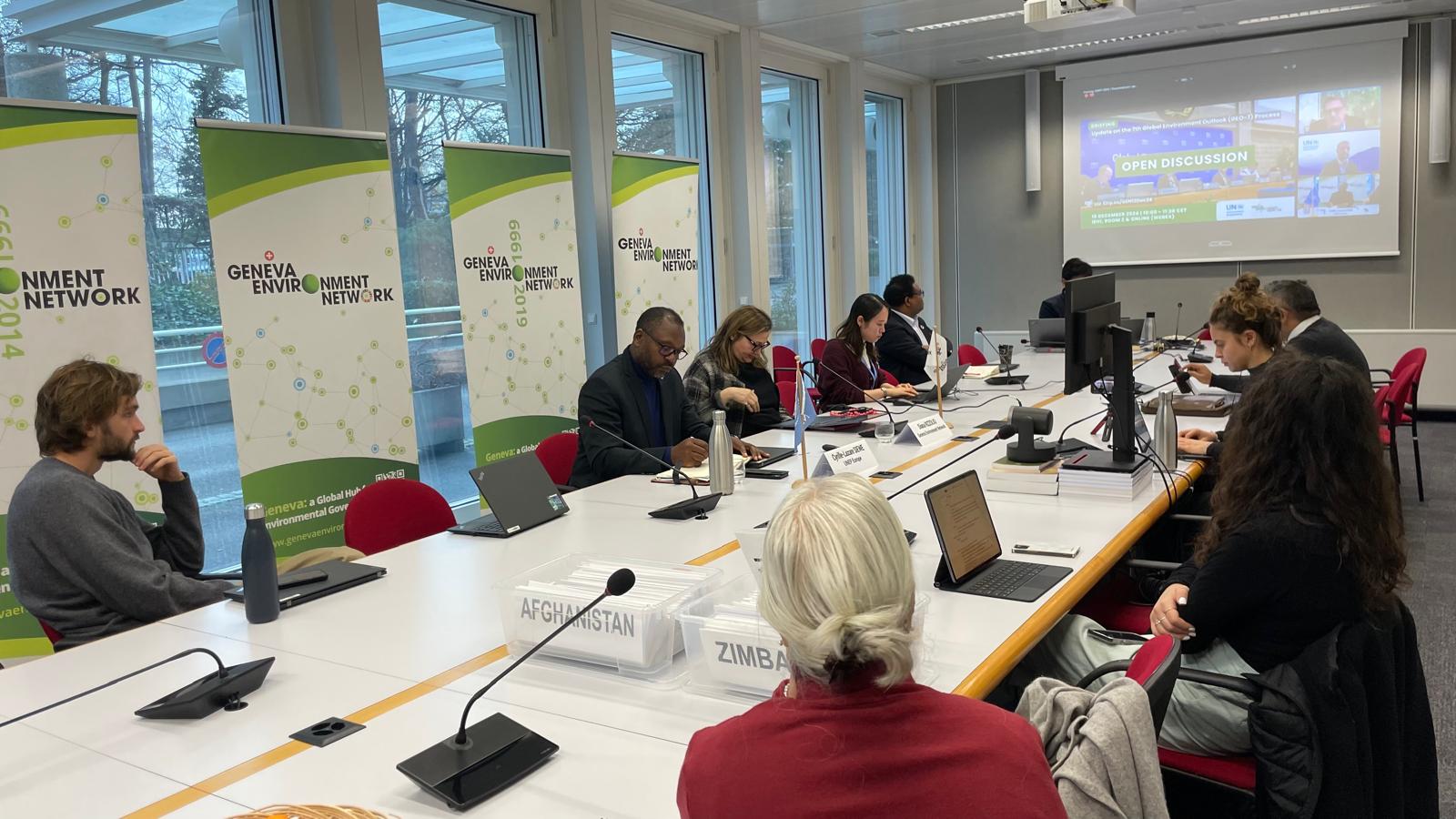
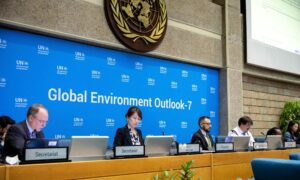
Briefing | Update on the 7th Global Environment Outlook (GEO-7) Process
13 Dec 2024
10:00 – 11:30
Venue: International Environment House I | Room 2 & Online | Webex
Organization: UNEP Europe Office, Geneva Environment Network
This event organized within the framework of the Geneva Environment Network will provide updates on the seventh Global Environment Outlook (GEO) process, mandated by a UNEA resolution adopted in 2022.

About this Event
Launched in 1995, the Global Environment Outlook (GEO) is UNEP’s flagship environmental assessment, providing periodic updates on the state, trends, and projections of the global environment. This independent assessment on the state of the environment looks also at the effectiveness of the policy response to address these environmental challenges, and possible pathways to achieve various internationally agreed environmental goals.
The fifth United Nations Environment Assembly (UNEA-5) adopted resolution UNEP/EA.5/Res.3 on the future of GEO, in March 2022. In the resolution, Member States established the objectives, core function and next steps in the GEO process as informed by two years of analysis and consultations undertaken under the auspices of the intergovernmental Steering Committee on the future of the GEO established pursuant to Environment Assembly resolution 4/23.
The seventh edition of the Global Environmental Outlook (GEO-7) continues the tradition of delivering comprehensive, science-based information critical to guiding policy and action towards sustainability to address the complex environmental challenges we face today. It will provide integrated and actionable solution pathways tailored to the needs of Member States and Stakeholders to support the global transition to a sustainable, equitable, and resilient future. GEO-7 is expected to be launched at the Seventh United Nations Environment Assembly (UNEA-7), in December 2025.
This briefing session will provide updates on the progress in the GEO-7 process, and offer an opportunity for Member States and Stakeholders in Geneva to gain insights on priorities, feedback, and engage in dialogue about the GEO-7 development to ensure it meets stakeholder needs effectively.
Speakers

Andrea ZBINDEN
Senior Policy Advisor, Focal Point for UNEP and INC Plastic Pollution, Federal Office for the Environment, Switzerland
Maarten KAPPELLE
Chief, Scientific Assessment Branch and Acting Head of GEO Secretariat, Early Warning and Assessment Division, UNEP

Ignacio SANCHEZ DIAZ
Acting Head, Global Assessment Unit, UNEP

Cyrille-Lazare SIEWE
Regional Science Policy Coordinator, Europe Office, UN Environment Programme

Diana RIZZOLIO
Coordinator, Geneva Environment Network | Moderator
Highlights
Video
Summary
Opening
Diana RIZZOLIO | Coordinator, Geneva Environment Network | Moderator
- The resolution on the future of the global environment outlook (UNEP/EA.5/Res.3) was approved by member states in March 2022 during the resumed fifth session of the United Nations Environment Assembly (UNEA-5), the highest decision-making body on the environment.
- The UNEA-5 session is considered s a landmark moment for environmental governance. This important global environmental assessment process aims to keep the world’s environmental situation under review. It supports periodic, science-based information to inform and drive collective and individual action by member states and stakeholders.
- The GEO-7 process is well underway and the report is expected to be launched during the seventh session of the United Nations Environment Assembly, which will convene in December 2025 in Nairobi.
- The work led by UNEP colleagues builds on a strong consultative and participatory process and is particularly relevant to multilateral Geneva. The findings of the GEO reports provide science-based information to support numerous processes that member states and stakeholders are leading or following in Geneva.
- Many Geneva-based multilateral processes are developing policies and actions to tackle the planetary environmental crisis. This is a recurring theme in discussions within the Geneva Environment Network.
Opening Remarks
Andrea ZBINDEN | Senior Policy Advisor, Focal Point for UNEP and INC Plastic Pollution, Federal Office for the Environment, Switzerland
- The GEO, as UNEP’s flagship assessment process, is pivotal in keeping the global environment under review. It bridges science and policy, providing policymakers with a solid foundation of scientifically sound data to make informed decisions. Comprehensive, science-based information is critical for guiding policies and actions to address the complex environmental challenges of our time.
- The GEO reports have provided invaluable insights into the state of the environment, the effectiveness of policies, and projections of future trends. They have helped Switzerland evaluate progress and set a clear direction towards achieving environmental goals.
- Looking ahead, Switzerland views GEO-7 as a critical resource for international policy processes. It offers actionable insights that align with and enhance the implementation of key frameworks, such as the Montreal Global Biodiversity Framework, the UNFCCC, and the chemicals and waste multilateral environmental agreements.
- Switzerland expects GEO-7 to serve as a bridge, highlighting intersections between biodiversity loss, climate change, and pollution. This integrated perspective can demonstrate how coordinated responses across these areas reinforce sustainable outcomes and impactful action.
- The launch of GEO-7 at the seventh United Nations Environment Assembly in December 2025 will be a key moment to accelerate global efforts towards sustainability. It will provide practical insights into achieving our shared environmental goals.
Update on GEO-7 Process | Overview
Maarten KAPPELLE | Chief, Scientific Assessment Branch and Acting Head of GEO Secretariat, Early Warning and Assessment Division, UNEP
- As stated by stakeholders in Resolution 5/3, the GEO process is an integrated environmental assessment led by scientific experts.
- The UNEP team is ensuring that this assessment meets three key criteria:
- Credibility,
- Policy relevance,
- Political legitimacy.
- This is done without compromising its independence. The GEO will also underpin UNEP’s medium-term strategy, an essential element of its work in the coming years.
- The GEO findings and insights will inform future policy decisions and negotiations. It will also guide UNEP’s programs of work for the next three years. The GEO-7 report will be more relevant and impactful than ever, providing the latest science to support environmental sustainability. It will focus particularly on solution pathways that address multiple environmental challenges.
- These challenges threaten the very foundation of life on Earth, including climate change, biodiversity loss, pollution, and land degradation, as well as other crises facing humanity. The report’s knowledge and recommendations will be critical in increasing global ambition and action to achieve the Sustainable Development Goals (SDGs) and targets by 2030.
- The report will cover everything from climate change to chemical management and much more. The strength of GEO lies in the diversity of its experts, who come from all over the world. This includes scientists, economists, modelers, experts in indigenous knowledge, behavioral and social sciences, policy research, and other fields. Alongside these disciplines, natural sciences—the traditional focus of past reports—remain central.
Update on GEO-7 Process | Presentation of Key Themes and Opportunities for Engagement
Ignacio SANCHEZ DIAZ | Acting Head, Global Assessment Unit, UNEP
- The use of GEO can be imagined through three potential situations showcasing the use of GEO:
- The Minister of Environment of Côte d’Ivoire meeting with his cabinet to discuss the interlinkages of climate change and land degradation within Africa for a meeting they are preparing at the African Union.
- A colleague from UNEP in the Asia Pacific office who is implementing a project on sustainable food systems, and trying to look for scientific evidence on how to bring transformational change to the food value chains in the region and how to present a coherent approach to decision-makers.
- A decision-maker in Latin America who is looking at how to bring transformational change to the energy sector in the region. He’s looking for evidence on financial and economic incentives for transforming the energy system to achieve environmental and climate goals.
- These situations exemplify how scientific evidence and data can bring information to decision-makers. They also exemplify how decision-makers face challenges identifying all this information from different sources. There’s a variety of sources, for specific situations, but none bring an integrated approach.
- This is where UNEP comes in and tries to support decision-makers with the Global Environment Outlook (GEO).

- Since its inception in 1995, the GEO has been extensively used at the regional, national, and local levels.
- It is estimated that there are nowadays more than two hundred GEO-style reports from all over the world.
- GEO-7 will be launched now at the seventh session of the UN Environment Assembly, scheduled for December 2025.
- GEO-7 is trying to respond to one big question, with one big story: how do we solve humanity’s most pressing environmental challenges?
- This big question raises a lot more questions :
- Climate: How are we going to phase out fossil fuels by 2050?
- Biodiversity: How are we going to reduce the environmental impact of food systems by 2050?
- Pollution: How do we create a near-zero waste and a fully circular economy by 2050?
- Finance: How are we going to redesign the economy and the finance system for a sustainable and just future?
- These issues need to be addressed in an integrated manner.
- An example of the level of integration needed is the issue of land competition. It is expected that critical energy transition minerals will increase fivefold by 2050 due to the transition to renewable energy and that by 2050, the world’s population will have increased by two billion people, which will increase food production and food demand by at least 35%. Looking at the impacts of climate change and land degradation, it is estimated that by 2050, crop yields will be reduced by 10%. At the same time, there is an international commitment in the Kunming Montreal Global Biodiversity Framework to protect at least 30% of terrestrial land, coastal, and marine ecosystems by 2030. Looking at land degradation rates, it is estimated that by 2050, 95% of the Earth’s land will be degraded. There are many angles to this, and when trying to solve specific issues, these processes should be tackled in an integrated manner.
- GEO-7 is trying to adopt an integrated approach. This is an assessment that looks at the interlinkages among the global environmental crises, looking at the interdependencies of climate change, biodiversity loss, pollution and waste, and land degradation, and how these crises impact the different environmental systems of air, land, soil, ocean, coast, and freshwater.
- GEO-7 will complement this assessment of the global state of the environment with a set of scenarios.
- GEO-7 will present a business-as-usual scenario where the negative impacts of continuing with the current trends will occur, but it will also present two target-seeking scenarios.
- GEO-7 is looking at how to achieve the environmental goals based on technological and behavioral change. These two scenarios will also present the benefits and potential implications at the environmental, social, and economic levels.
- These scenarios will also be complemented with solution pathways. The solution pathways aim to explain how to transform key human systems that are at the root causes of environmental degradation. These human systems include the economic and financial systems, the energy system, the food system, and the material/waste system—basically, how materials are extracted, used and disposed of.
- These solution pathways intend to inform decision-makers on how to bring a coherent approach to improve, develop, and implement policies to solve this global environmental crisis.
- GEO-7 will also bring some regional-specific chapters that will break down the assessment of the state of the environment. GEO-7 will break down these scenarios and solution pathways to the level of regions, and in some cases, even sub-regions.
- GEO-7 is also trying to ensure multidisciplinarity, with experts in natural sciences, social sciences, behavioral sciences, and environmental and economic modeling. For the first time, GEO-7 is also bringing indigenous and local knowledge into the report.
- Finally, the GEO-7 team is developing an interactive digital tool, designed with a user-centered approach, to support decision-makers in accessing this information and making good use of all this evidence for policy development and implementation.
- GEO-7 is an expert-led process with more than three hundred experts from all over the world in many different disciplines, ensuring gender and regional balance.
- There is still an opportunity to engage with the GEO-7 report and process through the review of the GEO-7 process, which is currently ongoing. The GEO READ platform is being used for the review process. Experts are invited either to review specific chapters related to their area of expertise or to also review the summary for policymakers.
- The summary for policymakers will be a more succinct document that will go together with the full GEO-7 report.
Update on GEO-7 Process | Importance for the Pan-European Region
Cyrille-Lazare SIEWE | Regional Science Policy Coordinator, Europe Office, UN Environment Programme
- GEO-7 can support the Pan-European Region in continuing to benefit from the region’s assets and to lead in this process.
- The most pressing environmental issues are interconnected, whether they are tackled from the climate angle, from biodiversity, pollution, or finance.
- The Pan-European Region has many assets rich biodiversity and ecosystems, abundance of natural resources, strong policy frameworks, and regional cooperation, significant technological and scientific expertise.
- International Geneva benefits in particular from a network of more than 130 agencies. This creates an environment where people can network and exchange best practices, and where science can really help with decision-making.
- There is also a very high level of public awareness and participation, as well as commitment to climate actions.
- The Paris Agreement demonstrated how Europe has been at the forefront of these conversations. European countries have truly led the discussions, whether through funding or solutions.
- Europe also hosts many protected areas and conservation initiatives, as well as a focus on sustainable urban development and cultural integration. Another key asset of the pan-European region is the contribution of indigenous knowledge. This knowledge has helped shape solutions to address climate change, biodiversity loss, and pollution.
- Policy responses and initiatives to the triple planetary crisis include:
- The European Green Deal, a comprehensive plan to achieve climate neutrality and sustainable development by 2050.
- The support of many national strategies funded by European agencies.
- These are also assisted by the knowledge and support of organizations like UNECE and OECD, which provide data that help decision-makers to make informed decisions about solutions to combat the triple crisis.
- As we move toward the finalization of GEO-7, we must remember that the SDGs provide us with targets, and the solutions under development in GEO currently align with these global targets. They also highlight the importance of an integrated approach and the central role of regional cooperation in this development.
- How are all these findings being integrated into regional plans?
- It’s important to emphasize that the current process is built on the spatial analysis provided by the region, and the pan-European region has been at the forefront of delivering data.
- This data has been critical in building the current scientific evidence. The GEO process is data-driven, and data is essential: the pan-European region is at the forefront of driving this effort.
- What are the key opportunities for collaboration, looking ahead at the GEO-7 launch in December 2025? How can we share best practices and continue building capacity to be the engine for the region and for others?
- We must continue to combine efforts in research so that we can benefit from the best practices in environmental sustainability.

- GEO provides a valuable framework to understand the key issues—what the pros and cons are, who the key actors are, and what the key messages are. It fosters collaboration and inspires decision-makers to make sustainable decisions to protect our environment. It is a resource that can guide policy decisions and inspire collaboration throughout our work. By actively integrating the findings of GEO into regional plans and fostering knowledge sharing, the region can make significant progress in addressing the triple crisis.
- It is very important that the pan-european region continues to reflect on the key pillars of intelligence and mutual reinforcement in problem-solving and policy coherence.
- GEO is the platform where actors come together from all over the world to collectively address these issues.
- There’s no planet B— the Earth is the only planet we have.
- As momentum builds, the pan-European region will continue to be the place where to share best practices and lead in finding solutions to environmental challenges.
Q&A
Q: Will this report incorporate findings from other pillars like climate change, pollution, and biodiversity? Does it aim to summarize insights from science-based panels and agencies to guide policymakers and governments in policy development?
Maarten KAPPELLE | Chief, Scientific Assessment Branch and Acting Head of GEO Secretariat, Early Warning and Assessment Division, UNEP
- The Global Environment Outlook does not want to repeat or duplicate work that has already been done.
- There are many assessment reports, from the IPCC, the IPBES, and the future science policy panel on chemicals and waste, amongst many other global assessments. There’s also the global methane assessment, the global resource outlook done by the IRP, the global land outlook, the global biodiversity outlook—there are so many of these global reports that are more specific on various topics.
- The Global Environment Outlook (GEO) is providing an assessment of assessments. This is a meta-analysis, using as input all the existing recent reports that come out of all the other science-policy panels and intergovernmental panel on climate, biodiversity, and chemicals. All this information is brought together, and cross-linkages are studied between the different triple planetary crisis.
- The GEO focuses on a holistic and integrated approach, where all these different assessments come together with one single coherent message and a set of key findings.
Q: How have the past GEO reports been used in various environmental negotiations, and how can we move these reports forward in these spaces?
Maarten KAPPELLE | Chief, Scientific Assessment Branch and Acting Head of GEO Secretariat, Early Warning and Assessment Division, UNEP
- The main messages of the sixth edition of the report, launched in 2019, came up with three fields of action that need to be tackled: biodiversity, energy in relation to climate, waste in relation to pollution.
- These key messages coming out of that GEO-6 process five years ago fed into many resolutions that have come out of UNEA, particularly since 201 as well as the plastics treaty discussions.
- The discussions at the Intergovernmental Negotiation Committee (INC) for the plastics treaty, which just met in South Korea, made use of the Global Environment Outlook, particularly the GEO-6, where waste is tackled through marine plastics, waste pollution, and the circular economy.
- The GEO information has been feeding into several policies, resolutions, and plans going forward. But it is possible to go the extra mile and make sure that the next edition, coming out in 2025, is even more impactful, more relevant, through solutions pathways.
- The theme of UNEA-7 is “Advancing Sustainable Solutions for a Resilient Planet.” The Global Environment Outlook report, launched just before the UNEA-7 kickoff, will provide solutions pathways to feed directly in the discussions happening in Nairobi.
- This timeline will hopefully make the GEO-7 report more impactful.
Ignacio SANCHEZ DIAZ | Acting Head, Global Assessment Unit, UNEP
- The GEO-7 process will not just finish with the launch of the report. Indeed, at UNEA-5, when Resolution 5/3 was approved, member states requested the delivery of “supporting services” in the areas of capacity building, knowledge generation, and support for policy-making.
- UNEP has been doing this on an ad hoc basis, engaging with member states and governments on how to develop their own national state of the environment.
- The GEO-7 process is going further: after the launch of the report, these supporting services will engage with member states at the regional and national level, to further explain the findings of the GEO-7.
- “Science to policy seminars” are currently being designed : They would be one or two-day sessions with member states, to explain the findings of the GEO-7 report, and translate them to national realities to advance environmental policies.
- The GEO team will be working with entire governments, not just with the ministers of the environment. Ministries of economy, finance, planning, or industry are part of many solutions, and fostering a coherent policy approach from different ministries is essential. The GEO-7 process is hoping to go the extra mile.
Cyrille-Lazare SIEWE | Regional Science Policy Coordinator, Europe Office, UN Environment Programme
- The GEO is built on national expertise. Experts come together to share what they have assessed as a problem, what type of solutions they have tried. It tries to bring all those together, taking into account the interconnectedness of the triple planetary crisis.
- For example of the chapter on Asia and the Pacific heavily features indigenous knowledge. The authors’ meeting was particularly intense because of this additional indigenous knowledge being used or cited as a contribution to addressing some of the issues related to the triple planetary crisis. Indigenous knowledge and continued engagement will be critical for many countries.
- The next GEO session should discuss the preliminary findings and how they can be integrated into a capacity-building tool, possibly to address some national or regional specificities.
Q: Have key learnings, messages, and recommendations from one region been effectively shared with others? How do the regions interact and collaborate with each other?
Wondy ASNAKE | Policy and Partnerships Coordinator, Europe Office, UN Environment Programme
- The environmental dimensions of the 2030 Agenda are significantly lagging, with the Secretary-General rating progress as an F. How can the GEO-7 contribute to accelerating the environmental aspects of the 2030 Agenda?
- To what extent can the findings of GEO-7 inform the development of a post-2030 agenda within the 2030–2050 framework?
- Over 50% of global trade relies on nature, involving the extraction and exchange of natural resources. How can this reality be effectively captured and integrated into current discussions?
- The original baseline for the 2030 Agenda in 2015 assumed a world population of nine billion by 2050, but projections now indicate over ten billion by 2030. What implications does this have for the energy, food, and water nexus? How can these challenges be addressed, including water scarcity and the urban-rural divide, with two-thirds of the population expected to live in cities by 2050? How should this inform the framing of the agenda beyond 2030 and toward 2050?
Maarten KAPPELLE | Chief, Scientific Assessment Branch and Acting Head of GEO Secretariat, Early Warning and Assessment Division, UNEP
- GEO-6 had regional GEOs report across UN & UNEP Regions, to provide the latest information at regional levels.
- The GEO-7 has twenty or more chapters, which tackle various themes : air and climate, oceans, lands, freshwater, biodiversity, etc. Contributors from all regions are involved : there is already a sharing of experience in writing GEO-7.
- GEO-7 also has a set of regional chapters.
- There’s also an ongoing review process, with already over 2000 reviewers from a variety of regions.
- Regarding the environmental dimension of the SDGs for 2030 :
- The GEO will provide solution pathways that will offer a range of options that can be adopted by countries, governments, member states, other stakeholders, NGOs, the private sector, civil society, to implement and take action. The GEO-7 will offer partners on the ground a palette of options.
- Regarding the post-2030 agenda:
- The GEO can inform that process. The reports provide a wealth of information that could feed the whole development process of new targets beyond 2030. The GEO is not just a report; it’s a tool that can be used. It’s a digital knowledge kit.
- Regarding the GDP conversation:
- GDP is limited to account for the impacts of trade on nature.
- GEO-7 will provide information on how economies are having an impact on the ecology, to inform the conversation beyond GDP.
- A tool is needed to look beyond just mere economic growth, the toll it is taking on the environment and humankind cannot be ignored.
- Regarding the nexus of energy, food and water in view of the global population going beyond 10 billion instead of the estimated 9 billion:
- GEO-7 also looks at nexus areas and interlinkages between energy, food, waste, and water and is trying to provide solutions to tackle the challenges of climate change, the pollution challenge, biodiversity loss, land degradation….
- The GEO is here to provide the latest knowledge on any issue related to the environment, to boost environmental sustainability, and to help society move in the right direction for stable energy, stable food, and stable water for the population that the planet will be home for in 2030.
Ignacio SANCHEZ DIAZ | Acting Head, Global Assessment Unit, UNEP
- The first part of the GEO-7 report, which is the state and trends of the environment, includes one specific chapter on the SDGs.
- This chapter assesses how the different environmental targets of the SDGs are progressing and the socioeconomic implications of these trends.
- The second part of the report includes 2 target setting scenarios.
- One scenario is based on technological change
- The other scenario is focused on behavioral change
- These are extreme scenarios : in reality, it will be a combination of behavioral and technological changes, but these scenarios were defined as such for the purpose of this modeling exercise. These two target-seeking scenarios aim to achieve different internationally agreed environmental goals, among which, the 2030 Agenda.
- These scenarios go to 2050, beyond 2030. The socioeconomic implications they will assess include basic material needs, fairness and justice, security, economic impacts, and employment.
- GEO-7 reflects that the current financial and economic system is one of the main sources of environmental degradation. The extraction of materials in a linear way, with increasing demand for raw materials, resources, food and environmental services, is putting degradation levels to an unsustainable level.
- Assessments need to be done in an integrated manner when tackling solutions pathways.
- We know we need to get rid of fossil fuels by 2050, but what GEO-7 is trying to explain in these solution pathways is how.
- GEO-7 is looking at how to internalize externalities to correct pricing, without imposing price increases on lower-income economic sectors.
- Economic principles beyond GDP metrics are needed to reduce inequalities. This will include enabling infrastructure for a circular economy and circular behavior.
- There is also a need to shift to sustainable and healthy diets and address poverty and inequalities.
- When looking into energy access, energy poverty is also essential.
Cyrille-Lazare SIEWE | Regional Science Policy Coordinator, Europe Office, UN Environment Programme
- The findings of GEO-7 and GEO-8 point to solution pathways, as they showcase the work done in the regions, with results, milestones that can be used with the toolbox to address the problem.
- The process is still ongoing: a lot of emphasis is being put on capacity building.
- The summary for decision-makers can make the solution pathway a real vehicle to use the findings of GEO-7. It can help countries strengthen their knowledge and experts to integrate findings into their decision-making tools.
- Solution Pathways come from experts across the world who use the GEO process as an opportunity to exchange knowledge, tricks, and findings. As a secretariat, this is something that will continue to be amplified.
- The conversation on GDP is crucial. GEO needs to continue to mobilize partnerships and collaboration around the nexus of energy, food, and water. These three issues will always be either part of the solution or part of the problem. They are key topics for which nature based solutions, and green and blue economy topics are central. There has been a lot of interest from UNEP recently on these topics.
- Whether they are approached through the lenses of climate change, biodiversity, or desertification, they are all the same issues. Solutions can also resonate with the nexus of energy, food, and water.
- These questions are central :
- What type of decisions will be taken regarding the type of energy uses?
- How will we treat water?
- How is waste managed?
- How is pollution affecting nature?
- These questions are all interconnected, and should bring forth nexus-based solutions which are holistic, because they discuss energy, food, and water together.
- The GEO process should strengthen our understanding of the interconnectedness of climate, nature, and pollution. Solutions, which are one of the most effective ways to proceed, will return to the center of focus. Such an approach should help member states adopt new perspectives on the assessments from GEOs, GEO Plus, and others. These assessments truly bring everyone to the table.
Photos