
Event Conference
Delivery of ICJ Advisory Opinion on Climate Justice | Live Diplomatic Screening and Commentary
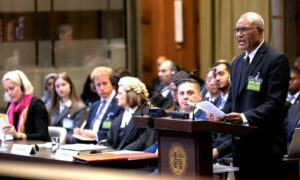
23 Jul 2025
14:30 – 17:00
Venue: International Environment House 1 | Room 3
Organization: Center for International Environmental Law, Geneva Environment Network
The Geneva Environment Network and the Center for International Environmental Law organized a diplomatic screening of the delivery of the International Court of Justice (ICJ) Advisory Opinion on States’ obligations in respect of climate change, accompanied by a commentary by experts and State representatives.
About this Event
23 July 2025 marks a historic moment, as the International Court of Justice (ICJ) delivered its advisory opinion on the obligations of States in respect to climate change.
On 29 March 2023, the United Nations General Assembly adopted a resolution requesting the International Court of Justice (ICJ) to issue an Advisory Opinion on States’ obligations in respect of climate change. The resolution requested the ICJ to clarify States’ obligations with regard to climate change, with specific attention to vulnerable States and affected peoples and individuals, including future generations. This advisory opinion by the International Court of Justice has the potential to address the obligations of States with regard to climate change, under multiple sources of law including international environmental law and human rights law.
This live screening of the delivery of the advisory opinion gathered leading experts to unpack some of its key elements and provide insights on the role of Geneva-based human rights institutions in building on the advisory opinion. This session followed the Diplomatic Screening and Commentary of the ICJ Oral Hearings on Climate Justice and its debriefing, organized by the Geneva Environment Network and partners in December 2024.
Speakers

Arnold KREILHUBER
Director, Europe Office, UN Environment Programme

Benjamin SCHACHTER
Coordinator, Environment and Climate Change Team, OHCHR

Yves LADOR
Representative of Earthjustice to the United Nations in Geneva

Francesca MINGRONE
Senior Attorney, Climate & Energy Program, Center for International Environmental Law
Highlights
Videos
Live on UN Web TV
Live from International Environment House
The livestream from the Hague takes place from 21:20-2:24:20.
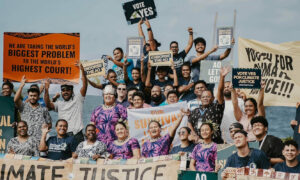
Video Message | World’s Youth for Climate Justice
Media Coverage
Summary
Welcome
Arnold KREILHUBER | Director, Europe Office, UN Environment Programme
- The International Court of Justice will be delivering its advisory opinion on the obligations of states in respect to climate change. The UN General Assembly has asked the Court a little bit over two years ago to consider states legal obligations to protect the environment from the adverse effects of climate change and the legal consequences under international law for failing to do so.
- The origin of the resolution lies in the initiative of law students from the Pacific Islands, who act to protect their rights and those of future generations. These students succeed in influencing delegations at the UN in New York, leading to the adoption of the resolution that triggered the ICJ proceedings. The ICJ receives an unprecedented number of submissions, including over 90 written statements—the highest number ever in any advisory proceeding—followed by 62 written comments, two weeks of public hearings, and oral statements from 96 states and 11 international organizations.
- The submissions by states and international organizations largely focus on five key legal areas. They focused on states obligations under the climate change treaties. They focused on the customary prohibition of significant uh transpoundary harm and the precautionary principle. They honed in on the law of the sea, human rights and the application of state responsibility. recent advisory opinions by the International Tribunal for the Law of the Sea and the Inter-American Court of Human Rights provide guidance on climate obligations within the domains of the law of the sea and human rights. however, these previous opinions do not offer a holistic legal assessment of states’ obligations in relation to climate change; today’s ICJ opinion is expected to provide such an integrated perspective. although the ICJ opinion is non-binding, it is expected to have major implications for the future of international climate action and legal frameworks. Geneva is presented as a highly relevant setting for this screening, being the main international hub for human rights.
- Geneva hosts numerous multilateral processes related to climate and environment.
- A similar event took place last December at the Palais des Nations during the ICJ’s public hearings, marking the 25th anniversary of the Geneva Environment Network. that event was followed by a special session focused on unpacking some of the legal arguments presented before the court in The Hague. Due to the success of those past events, today’s gathering is organized to mark the conclusion of the process and the release of the long-awaited opinion. This marks the first time the world’s highest court is asked to clarify the legal duties of states to protect the environment from climate change and the legal consequences of failing to meet those duties.
- The advisory opinion has the potential to reshape the global legal landscape around climate action.
Francesca MINGRONE | Senior Attorney, Climate & Energy Program, Center for International Environmental Law
- The high level of engagement by states and international organizations before the ICJ is the result of long-term buildup and collective work, including in Geneva. The process begins over two years ago in March, thanks to the initiative and leadership of Vanuatu and the international youth movement, especially Pacific Youth. this mobilization leads to the resolution requesting the advisory opinion being adopted by consensus at the UN General Assembly.
- The ICJ opinion is presented in the context of three other major legal processes.
- The first is the advisory opinion from the International Tribunal for the Law of the Sea, requested in December 2022 and delivered in May 2024, which concludes that states must take all available measures to reduce greenhouse gas emissions polluting the marine environment.
- The second is the advisory opinion delivered in July 2025 by the Inter-American Court of Human Rights, focusing on states’ human rights obligations in the climate emergency and addressing future generations, corporate accountability, defenders, the right to a healthy environment, remedy, rights of nature, and procedural rights.
- The third is a request submitted in May 2025 to the African Court on Human and Peoples’ Rights to examine state obligations related to climate change.
- These advisory opinions have authoritative legal status and must be interpreted coherently to clarify what states’ responsibilities are under international law. The ICJ request builds on two main pillars: clarifying what legal obligations states have to protect the climate system, and what the legal consequences are when they fail to meet those obligations. Emphasis is placed on the vulnerability of small island developing states, and also peoples and individuals including future generations affected by climate change.
- One central question is what law applies—whether only the Paris Agreement and the UNFCCC, or also other sources of international law.
- Under international law, states have a long-standing duty not to cause or allow foreseeable environmental harm to other states and must regulate and control activities within their territory. recent advisory opinions from ITLOS and the Inter-American Court strongly affirm these principles in the context of climate responses. expectations include that the ICJ will address loss and damage, what states must do to remedy harms, and the question of historical responsibility for those who have caused most of the crisis. equity and a just transition are seen as essential principles, especially the idea of common but differentiated responsibilities based on countries’ capacities and contributions to climate change. corporate accountability is also seen as central, including the obligation to regulate private actors such as the fossil fuel industry.
- The Inter-American Court opinion pays specific attention to the fossil fuel industry. after the oral hearings, the ICJ issues four follow-up questions to which states can respond in writing.
- These questions indicate issues that are clearly on the judges’ minds and are expected to appear in the final opinion.
- Judge Cleveland asks about obligations concerning fossil fuel production and whether mitigation commitments under the Paris Agreement are substantive or merely procedural. Judge Auresu asks about the content of the right to a healthy environment as an emerging international human right. Judge Charlesworth asks about the relationship between the Paris Agreement, the UNFCCC, and general international law, particularly regarding compensation and liability.
- Regardless of the final result, the level of attention being given to climate change is described as unprecedented. The fact that the ICJ has been asked to clarify these obligations is called a historical turning point. The leadership of Vanuatu, Pacific states, and Pacific youth is key to making this historic moment happen.
Samira BEN ALI and Nicole PONCE | World Youth for Climate Justice (Video Message)
- The ICJ is about to give out its decision on the advisory opinion on climate change and human rights, and there is strong excitement and hope. This event has been a long time coming, with six years of work, involving many people, including many in the room. The idea begins in a Vanuatu classroom and grows into a global campaign, supported by youth worldwide. many present have played a role in this journey, going to states and encouraging them to support the process because of its potential to “change and turn the tides for more climate ambitions.” This moment is described as carrying gravity because the global majority—communities and peoples—got the world to listen. The world’s highest court is now delivering an opinion on what is called “one of the most important problems of our time to address.”
- World Youth for Climate Justice remains committed to empowering youth, building capacity, and ensuring meaningful youth participation and experiences. Youth are actively engaging with their governments, contributing directly to state submissions. Youth push for inclusion of principles like intergenerational equity, recognition of present and future generations, and the nexus between human rights and the climate crisis. This is framed as not only affecting the present but also future generations, and there is strong hope that the ICJ decision will reflect that. The decision is not seen as standing alone, but as part of something much bigger.
Commentary After the Delivery
Francesca MINGRONE | Senior Attorney, Climate & Energy Program, Center for International Environmental Law
- Key points raised earlier—like the centrality of human rights, the right to a healthy environment, and reparation—are reflected in the Court’s reasoning. The Court confirms the importance of harmonizing different sources of law—beyond just the UNFCCC and Paris Agreement. wide range of treaties and principles of public international law, environmental law, and especially human rights law are found to apply. The Court explicitly recognizes the human right to a clean, healthy, and sustainable environment as part of international law.
- This recognition is essential for Geneva-based advocacy and global processes on climate, plastics, and beyond. future generations and the role of fossil fuels in the climate crisis are both addressed in the opinion. There was strong emphasis placed by the court on due diligence, described as a stringent standard due to the urgency and gravity of the climate crisis. Consequences of breaching obligations are not fully defined but grounded in existing norms: reparation, cessation, non-repetition, restoration, and compensation.
Yves LADOR | Representative of Earthjustice to the United Nations in Geneva
- Human rights and environmental law are deeply connected, and years of advocacy in the Geneva framework lead to this recognition. Past milestones like the Human Rights Council and UN General Assembly resolutions on the right to a healthy and sustainable environment already mark progress, but the ICJ opinion brings it to a new level. The court clearly states that these legal fields must be articulated together and no longer treated as separate issues.
- This moment is seen as a turning point in the global conversation and a legal confirmation of long-standing advocacy. The opinion reinforces the use of international law to face global challenges and sets a definitive position on key legal arguments. The phrase “daunting and self-inflicted process” from the court captures the seriousness and urgency of the situation.
- There is growing political resistance to climate obligations is noted across the world, with attempts to minimize responsibilities or deny the legal and physical reality of the crisis.
- Rising legal action from citizens is explained as a reaction to political inaction and denial, as the situation becomes increasingly severe and visible—through heatwaves, disasters in Texas, the Philippines, Pakistan, and more. The court’s analysis is grounded in the severity of the damage, scientific evidence, and established legal obligations. A strong message is delivered: states must stop avoiding responsibility, and obligations also apply to how private actors are regulated. The opinion presents a comprehensive and solid legal reasoning for future action.
- Hearing sentences pronounced by the ICJ that have been repeated in the framework of human rights in Geneva was important. The clarity of the court’s language is surprising and appreciated—there is no ambiguity, just a direct and powerful statement of legal duty. This is described as a very important and possibly historic moment.
Benjamin SCHACHTER | Coordinator, Environment and Climate Change Team, OHCHR
- Strong feeling of relief and validation after hearing the decision, especially following years of work mandated by the Human Rights Council on climate and human rights. The court affirms the human rights obligations of states and explicitly recognizes the right to a clean, healthy, and sustainable environment. The court could have avoided this, but instead goes here clearly and directly. Obligation to use the highest ambition possible is affirmed, referencing 1.5°C as the goal of the Paris Agreement.
- Interpretation draws on best available science and decisions from the Conference of the Parties. Compliance with climate agreements may not be enough to fulfill independent obligations under other legal regimes, including human rights law. Long-standing point is confirmed: 1.5°C is not necessarily sufficient to protect human rights. Harm is ongoing, and states have obligations to cease harm and ensure non-repetition. References to Secretary-General reports on loss and damage and just transition are supported by the opinion.
- The ICJ opinion offers a strong foundation for future work and may help build momentum toward COP30. The opinion builds on previous jurisprudence and advocacy to recognize the right to a healthy environment and address loss and damage. Clear obligations are established: to remedy, to prevent, and to act based on best available science and with highest ambition.
- The court does not limit findings to climate—addresses broader environmental protection, foreseeability, irreversible harm, and the precautionary principle. The opinion touches on measuring risk versus certainty of science—core concerns for the human rights and environment community. This is seen as a huge boost for future advocacy, with real legal weight to support next steps. The ICJ opinion is likened to law and the IPCC for science—definitive, authoritative reference point for law. The advisory opinion can now be cited across climate advocacy work. Issues the court leaves open—like attribution, causality, and compensation—are acknowledged, with a call for context-specific legal development. Future legal evolution is needed on responsibility for climate harms, using this opinion as a base.
- Links were drawn to upcoming plastics negotiations in Geneva, where ICJ’s language on state duty to regulate private actors and prevent harm is highly relevant. Climate and plastics crises are connected.
Photo Gallery


Previous Sessions
ICJ Oral Hearings on Climate Justice – Diplomatic Screening and Commentary | GEN @ 25
2 December 2024
Center for International Environmental Law, Geneva Environment Network, Geneva Human Rights Platform, Earthjustice, World’s Youth for Climate Justice

Climate Justice Hearings at the International Court of Justice: Unpacking Key Arguments and Drawing Lessons from a Human Rights Perspective
12 December 2024
World’s Youth for Climate Justice, Earthjustice, Geneva Environment Network, Geneva Human Rights Platform, Center for International Environmental Law
Links
- Advisory Opinion on Obligations of States in Respect of Climate Change | ICJ | 23 July 2025
- ICJ Oral Hearings on Climate Justice & Diplomatic Screening and Commentary | GEN @ 25 | 2 December 2024
- Climate Justice Hearings at the International Court of Justice: Unpacking Key Arguments and Drawing Lessons from a Human Rights Perspective | 12 December 2024
- Human Rights, Climate Change, and the Role of Geneva | GEN
- Human Rights and the Environment | GEN
Reactions and Opinions to the Advisory Opinion
- UN experts welcome recognition from International Court of Justice that all States must protect the climate system | OHCHR | 28 July 2025
- Historic International Court of Justice Opinion Confirms States’ Climate Obligations | IISD | 28 July 2025
- 9 hot takes on the Court’s groundbreaking opinion | Nicolas Lockhart, Sidney Austin | 24 June 2025
- IUCN welcomes International Court of Justice’s historic climate change Advisory Opinion | IUCN | 23 July 2025
- The World’s Youth Hail Historic Climate Ruling by World Court | World’s Youth for Climate Justice & Pacific Islands Students Fighting Climate Change | 23 July 2025
- The Era of Climate Impunity is Over— By Order of the World’s Highest Court | CIEL | 23 July 2025
- UN Secretary-General Antonio Guterres
- UN High Commissioner for Human Rights Volker Türk
- UN Special Rapporteur on climate change and human rights Elisa Morgera
- UN Special Rapporteur on the right to a healthy environment Astrid Puentes-Riaño
- UN Special Rapporteur on environmental defenders under Aarhus Convention Michel Forst