Event Conference
From Jeddah to Geneva | Multilateralism Addressing Antimicrobial Resistance
19 Nov 2024
10:00 – 11:30
Venue: International Environment House I, Room 2 & Online | Webex
Organization: Health Diplomacy Alliance, Geneva Environment Network
This event was organized within the framework of the World Antimicrobial Resistance Awareness Week (WAAW) – a global campaign to raise awareness and understanding of Antimicrobial Resistance (AMR) and promote best practices among One Health stakeholders to reduce the emergence and spread of drug-resistant infections. WAAW is celebrated from 18 to 24 November every year.

About this Session
Antimicrobial resistance was a critical and growing threat to human, and animal health, food security, environment, and development. AMR has been directly linked to 1.27 million global deaths and has contributed to 4.95 million deaths.
During the last 79th United Nations General Assembly, 26 September, as part of the high-level week it was adopted a High-Level Political Declaration on AMR where the urgent need for global action against AMR, including the global target to reduce the misuse of antimicrobial and sustainable financial and innovation to combat AMR globally.
As part of the ongoing efforts the Fourth Ministerial Conference on Antimicrobial Resistance will be hosted by the Kingdom of Saudi Arabia on 15-16 November in Jeddah, under the theme “From Declaration to Implementation – Accelerating Actions Through Multisectoral Partnerships for the Containment of AMR”. The conference, bringing together leaders to address urgent issues in preventing and managing AMR on a global scale, will be preceded by a side event day for non-state actors on 14 November.
This event, organized as part of the World Antimicrobial Resistance Awareness Week (WAAW) from 18 to 24 November, served as a strategic gathering to advance commitments and build on the 4th Ministerial Conference and the work on AMR from international organizations and partners in Geneva International to accelerate the commitments on AMR, foster collaboration between the Quadripartite AMR organizations, UNEP, WHO, FAO, WOAH, the private sector, academia, and civil society to promote the integrated One Heath approach and evaluate the next steps and commitments that result from the meeting in Jeddah.
Speakers
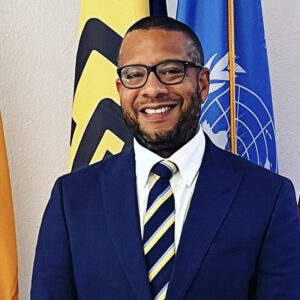
H.E. Amb. Matthew WILSON
Permanent Representative of Barbados to the United Nations Office and other international organizations in Geneva

Jacqueline ALVAREZ
Chief, Chemicals and Health Branch, UN Environment Programme

Jean Pierre NYEMAZI
Director a.i., Global Coordination and Partnership Department, AMR Division, World Health Organization

Dominique BURGEON
Director, Geneva Liaison Office, Food and Agriculture Organization

Javier YUGUEROS-MARCOS
Head of the Antimicrobial Resistance and Veterinary Products Department, World Organisation for Animal Health

Judith MOORE
Head, Access & Outcomes, Centre for Health and Healthcare, World Economic Forum

Luka ŠROT
Associate Director, Health Security, International Federation of Pharmaceutical Manufacturers and Associations

Katherine URBAÉZ
Founder and Executive Director, Health Diplomacy Alliance

Wondwosen ASNAKE KIBRET
Policy and Partnerships Coordinator, Europe Office, UN Environment Programme | Moderator
Highlights
Video
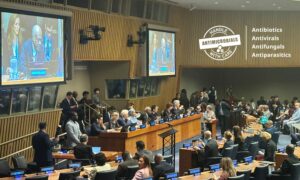
Live from International Environment House 1
Summary
Opening
H.E. Amb. Matthew WILSON | Permanent Representative of Barbados to the United Nations Office and other international organizations in Geneva
- Antimicrobial resistance (AMR) is one of the greatest global health challenges, causing 1.27 million deaths in 2019, with children under five accounting for 20% of those deaths. Without immediate and global action, AMR could result in 39 million deaths by 2050 and cost up to $3.5 trillion in health care annually by 2030.
- A comprehensive response is needed, including education on proper antibiotic use, better healthcare systems, and improved funding for new antibiotic development. The momentum to adopt the political declaration at the high-level meeting in September 2024 should be leveraged.
- This year’s World AMR Awareness Week serves as a crucial call to action to educate, advocate and act now, in order to prevent further escalation of AMR’s impact on global health and the economy.
Wondwosen ASNAKE KIBRET | Policy and Partnerships Coordinator, Europe Office, UN Environment Programme | Moderator
- AMR is a complex issue, and we need to make it not only simple but also compelling to encourage people to take action.
- The quadripartite agencies, which consist of the Food and Agriculture Organization (FAO), United Nations Environment Programme (UNEP), World Health Organization (WHO) and the World Organization for Animal Health (WOAH), are leading the One Health Alliance. The scope of its joint action plans includes:
- Strengthening the health system to address AMR issues
- Zoonotic epidemics and pandemics
- Neglected tropical diseases and vector-borne diseases
- Food safety
- AMR, the “silent pandemic”
However, AMR is no longer silent, given the prediction that bacterial AMR will lead to more than 39 million deaths by 2050.
- In the European region, bacterial AMR is associated with over half a million deaths, with its economic impact resulting in a loss of nearly $11.7 billion.
Quadripartite Perspectives
Jacqueline ALVAREZ | Chief, Chemicals and Health Branch, UN Environment Programme
- The number of deaths, economic loss, and ecosystem services challenges relating to AMR will continue to increase, and financing needs to be strengthened. The threats are rapidly growing, with three people dying per minute. We need concerted actions, based on the One Health Approach.
- The conference in Jeddah and the commitments presented show the interest and potential to act quickly on AMR, as well as progress being made.
- The report “Bracing for Superbugs: Strengthening environmental action in the One Health response to antimicrobial resistance” was launched by UNEP in Barbados in 2023, to highlight the environmental dimensions of AMR challenges from an anthropogenic sense. Environmental and AMR challenges should be tackled hand by hand.
- The report addresses three economic sectors and value chains that are critical for the agenda:
- Pharmaceuticals and other chemical manufacturing, which is essential for prevention. The report not only discusses pollution but also provides solutions and alternatives.
- Agriculture and food production, including runoff from aquaculture and excessive use of antibiotics in certain practices. Genes can be transmitted easily in the environment, allowing the bacteria to mutate and adapt to future ecosystems.
- Healthcare systems, including pharmacies, consumers, and hospitals.
- Four priority actions to prevent and tackle the environmental dimensions of AMR include:
- Enhancing environmental governance
- Generating evidence and knowledge to inform policy by improving reporting, surveillance, monitoring, and research.
- Raising awareness: While AMR is becoming a more familiar topic, better understanding is needed of its causes, especially pollution.
- Scaling up preventative actions: UNEP focuses on addressing key value chains affecting AMR in the environment, rather than focusing on one specific actor or step.
- In 2016 the UNGA held a high-level meeting on AMR, where Member states adopted a declaration that addressed environmental and human health dimensions, supported by evidence.
- UNEP is focusing on preventing and reducing the release of antimicrobials into the environment. As part of World AMR Awareness Week, we are also trying to address the drivers and challenges of AMR.
- In some cases, cultural, social and economic aspects guide the focus of action, which might focus on quick solutions and responses rather than prevention, as seen during the COVID-19 pandemic. We are working to address the economic sectors that drive AMR. Although progress can be slow, they are the agents of change that can help shift approaches to tackle this issue, and we must take action now.
Jean Pierre NYEMAZI | Director a.i., Global Coordination and Partnership Department, AMR Division, World Health Organization
- A milestone of WHO’s work on AMR was the 2015 Global Action Plan, which other quadripartite organizations later endorsed. The plan governs our global work and serves as the base for country national action plans.
- WHO acknowledges the necessity of a multi-sectoral approach in addressing this issue: working in silos will never be effective in combating AMR. The quadripartite organizations have a strategic framework approved in 2022 that governs our collaborative work.
- The death toll and economic losses associated with AMR are already unbearable. Death due to bacterial-resistant infections is one the most pressing issues, and the last World Health Assembly in May 2024 approved the strategic and operational priorities to address bacterial AMR until 2035 (WHA77.6).
- WHO’s work addresses the lack of access to antibiotics or antimicrobials, which is the cause of most deaths. In addition to incentivizing drug manufacturing and innovation aspects, we also work to fix the supply chains that are preventing people’s access to drugs.
- We are working together with other sectors, including animal health and agrifood, to harmonize our drug utilization policies and preserve drug efficacy.
- WHO is also working on data generation and use, by engaging in capacity building of countries to report quality data and use them to improve their systems. Diagnostics is key in addressing AMR.
- Raising awareness is a key priority shared among the quadripartite organizations, with a specific focus on policymakers, youth, media, and affected communities, whom we refer to as AMR survivors. The task force of AMR survivors has been sharing their voices, making their perspectives available to all. There is also a quadripartite working group on youth engagement for AMR, and their involvement is crucial as AMR will become an even bigger issue for future generations.
- We need to take bigger and more tangible actions every year. At the 4th Global High-Level Ministerial Conference on Antimicrobial Resistance, a Troika System was created to ensure the continuity of political commitments. Some issues, like the COVID-19 pandemic, are raised at a high political level and get forgotten, but this should not be the case with AMR.
- The Declaration has been sufficiently served, and the focus should now be on implementation, especially regarding financing. We must ensure that we have the means to bring about tangible outcomes, using the tools and political willingness.
Dominique BURGEON | Director, Geneva Liaison Office, Food and Agriculture Organization
- 2024 is a historic year for AMR, with the UNGA high-level meeting and fourth ministerial conference on AMR taking place, in addition to the ongoing negotiation on the pandemic instrument to position One Health as an important approach.
- Awareness and advocacy need to be scaled up. FAO has been committed to supporting member countries in protecting the health of animals, farmers, and consumers while ensuring food security, nutrition, and sustainable production. Transformation of the agrifood system is critical.
- FAO Strategic Framework 2022-31 sets out 20 program priority areas, mentioning the importance of the One Health approach in addressing AMR and bacterial infectious diseases.
- FAO has launched the ‘Reduce the Need for Antimicrobials on Farms for Sustainable Agrifood Systems Transformation (RENOFARM)’ initiative, which aims to prevent and respond to AMR from the farm level, working closely with farmers. The farm-level support is guided by the Farm 5Gs:
- Good Health Services: Ensuring access to good health services, including guidance on prudent AMU.
- Good Production Practices: Implementing good production and husbandry practices across all farm production value chains, optimal farm biosecurity and hygiene measures, prudent AMU and efficient farm waste management.
- Good Alternatives: Embracing alternative approaches, such as vaccines, biosecurity measures, alternative feeds, feed additives, integrated pest management (IPM), and biological control methods.
- Good Incentives: Promoting economic and productivity outcomes at the farm level through measures like regulatory frameworks, quality control mechanisms, and bolstering functional supply chains.
- Good Connection: Strengthening the connection of farmers to reduce their dependence on antimicrobials involves enhancing their access to crucial resources and support.
- The initiative has been growing rapidly since its launch in April 2024, and currently has over 240 members from civil society organizations, academics, and research centers, with 34 countries joined to provide and receive support to build agrifood systems that are productive but less reliant on antimicrobials, as well as have their national action plans regularly updated and monitored.
- The initiative takes a whole-of-farm approach to ensure the supply of healthier and safer food for human consumption, deriving not only from animals but also from plant sources. We also strengthen surveillance on antimicrobial residues in food, agriculture, and the environment.
- RENOFARM is also supporting countries to access quality antimicrobials and professional advice from animal health experts.
- The International FAO Antimicrobial Monitoring (InFARM) system, launched in 2024, is working to support countries in developing and strengthening operational surveillance on AMR. In collaboration with the WHO Global Antimicrobial Resistance and Use Surveillance System (GLASS) and the WOAH Animal antimicrobial use Global Database (ANIMUSE), and utilizing the FAO Assessment Tool for Laboratories and AMR Surveillance Systems (ATLASS), we support laboratory capacity for detecting AMR and ensure equitable access to diagnostics for effective treatments.
- Tailoring action to the local level is critical in awareness raising. FAO Farmer Field Schools (FFS) have initially been used in integrated pest management, and are now working on training for appropriate and prudent AMR use.
- Despite efforts, knowledge gaps remain, especially in the food value chain. To address these gaps, we need to promote the development of operational research projects, scale up training, and promote reduced use of antimicrobials.
- The quadripartite joint secretariat on AMR plays a crucial role in facilitating alignment across partners, and the AMR Multi-Partner Trust Fund provides technical and financial assistance. The AMR Multi-Stakeholder Partnership Platform, hosted by the FAO, is a collaboration between 250 members from government, civil society, academia, and the private sector.
Javier YUGUEROS-MARCOS | Head of the Antimicrobial Resistance and Veterinary Products Department, World Organisation for Animal Health
- The World Organisation for Animal Health (WOAH), founded in 1924 by 28 countries, now has 183 members. Its primary role is to develop international standards for animal health and welfare, while building capacity for their implementation. WOAH works closely with FAO, particularly at the farm level, and has been part of the quadripartite since its inception.
- WOAH follows a strategy based on four main pillars, which is inspired by the WHO Global Action Plan on AMR, adopted in 2015 and subsequently endorsed by our General Assembly in 2016:
- Awareness and understanding,
- Strengthening knowledge through surveillance and research,
- Supporting good governance,
- Encouraging the implementation of international standards.
- WOAH developed two main resources on international standards: one on terrestrial animals and one on aquatic animals, which include five chapters dedicated to AMR, addressing topics like responsible use, how to monitor antimicrobial use, how to do surveillance on AMR, and risk analysis in terms of responsible use.
- For WOAH, the responsible antimicrobial use in animals should be for veterinary medical purposes — prevention, control, and treatment. Non-veterinary use, such as using antimicrobials as growth promoters, is not considered responsible use.
- Through our global database, ANIMUSE, WOAH has tracked antimicrobial use for over ten years, showing significant progress: over 70% of WOAH members no longer use antimicrobials as growth promoters. However, 11% still use high-priority antimicrobials for this purpose, and 34% allow growth promoters without conducting risk analysis.
- WOAH is committed to achieving the UN political declaration’s goal of responsible antimicrobial use in agriculture by 2030, according to CODEX standards and our standards.
- Currently, WOAH covers 60% of the global animal biomass through ANIMUSE, with data from 150-160 countries since 2015, though only 35-40 countries regularly publish national reports. To improve data sharing, WOAH is focusing on capacity-building in selected countries.
- Companion animals are becoming more significant, especially in emerging economies. With over a billion companion animals worldwide, WOAH is raising awareness among veterinarians and improving surveillance, particularly as resistance rates in companion animals are concerning.
- WOAH’s main priorities include:
- Prevention;
- Strengthening surveillance;
- Establishing functional, effective cross-sectoral dialogue mechanisms; and
- Investment in animal health systems, ensuring access to high-quality veterinary services and products, including vaccines, diagnostics, and medicines.
- The economic impact of AMR is also a critical concern. A joint report by WOAH and the World Bank warns that, if AMR in animals reaches 5% prevalence without action, by 2050, the resulting losses could affect the nutritional needs of over two billion people worldwide. The urgency of addressing AMR is clear – action is needed now, whether for moral, health, or economic reasons.
- Relevant resources by WOAH include: Animal welfare: a vital asset for a more sustainable world, Animal health and welfare: cornerstones of sustainable animal farming
Stakeholder Perspectives
Judith MOORE | Head, Access & Outcomes, Centre for Health and Healthcare, World Economic Forum
- Strengthening diagnostics, vaccines, and surveillance systems is important in tackling AMR.
- One of the key plans of the World Economic Forum (WEF) in addressing AMR is the soon-to-be-launched Unified Coalition for the AMR Response (U-CARES).
- WEF’s mission is to improve the state of the world through collaboration across its 10 thematic centers. The Center for Health and Healthcare focuses on issues such as health equity, value-based care, climate and health, and AMR.
- Tackling AMR requires integrating efforts across all centers to address intersecting industries and issues like geopolitical contexts, food security, advanced manufacturing and gender equity.
- WEF’s engagement with AMR began 10 years ago with a risk report and has since evolved into projects addressing payment mechanisms and investor engagement. The Global Future Councils on AMR was established to encourage global One Health action to address the interrelatedness between human health, animal health, food, and the environment.
- The WEF initiative on the road to 2029 will focus on four key engagement tracks:
- Innovation and access, including antibiotics, diagnostics, vaccines, and sustainable financing mechanisms.
- Public-private partnerships within national action plans.
- Advocacy and awareness, recognizing that AMR is often not well understood outside the health sector.
- AMR within agrifood systems.
- The second term of the Global Future Councils will focus on sustainable financing, collaboration with independent panels, and aligning sectoral efforts. Our core mission is to adopt an action-oriented approach, engaging industries to prioritize AMR and health equity through compelling economic arguments.
Luka ŠROT | Associate Director, Health Security, International Federation of Pharmaceutical Manufacturers and Associations
- This year has been pivotal for AMR, marked by significant meetings such as the ministerial meeting in Jeddah and the high-level meeting in New York.
- Concrete and potentially impactful proposals have emerged, such as the proposal for an independent panel, or the revision of the global action plan.
- There is a clearer understanding of the long-term projections regarding the burden of AMR and its potential damage by 2050.
- Short- and medium-term actions are gaining momentum. There is a proposal to hold the next high-level meeting in five years, with two additional AMR ministerial meetings in the interim: one in 2026, hosted by Nigeria, and another in 2028, with the location yet to be determined.
- The Jeddah commitments also underscore regional initiatives and global synergy. The current emphasis is on exploring concrete solutions and measuring progress over the next five years.
- 2024 has been pivotal for AMR, but it has been nearly a decade since the first high-level meeting, which catalyzed many initiatives. Early-stage R&D mechanisms such as CARB-X and GARDP have supported innovation, the private sector endorsed the Davos Declaration (2016), and the AMR Industry Alliance (2017) was created, targeting key areas including research, access, appropriate use, and environmental impact of manufacturing.
- Regarding R&D and access challenges, the pipeline of antimicrobials in development is declining. Although there have been G7 and G20 discussions on incentivizing investment through push and pull mechanisms, progress has been slow.
- In response to funding gaps, the industry established the AMR Action Fund in 2020. However, while this fund helps ensure some products reach the market, it doesn’t address the fundamental issue of insufficient incentives for developing new antimicrobials.
- This interplay between innovation and access to existing and new or future products has been a major focus. Most antibiotics on the WHO Essential Medicines List are decades-old generics, but fragile supply chains and manufacturing concentration exacerbate challenges in access. Key actions to address this could include regulatory harmonization and procurement mechanisms to support access (e.g., SECURE project). In HIV treatment, treatment coverage rose from 20% to over 70% in 15 years.
- For new products, implementation of pull incentives is important, particularly by G7, EU, and G20 countries. These models must balance demand visibility and oversight. Progress is seen in a novel antibiotic launched in 2019, supported by a partnership between GARDP, CHAI, and the developer, which included a voluntary licensing agreement and technology transfer to improve access.
- Interconnected solutions are needed for both access and innovation. Strengthening the supply chain for existing antibiotics, diversifying manufacturing, and recognizing the value of these products are critical. Appropriate models for new product access and development must be implemented to ensure that we do not run out of options.
Katherine URBAÉZ | Founder and Executive Director, Health Diplomacy Alliance
- One Health is central to the Health Diplomacy Alliance, as it illustrates cooperation and collaboration.
- The High-Level Meeting in New York produced a 15-page political declaration with 106 points of action. While ambitious, implementing each action is challenging.There are 4 critical areas for focus:
- Policy, Regulation, and Capacity Building:
- Prioritize waste management and environmental regulations.
- Address antimicrobial use in agriculture.
- Strengthen interventions and prevention measures from a health perspective, such as healthcare-associated infections (HAIs) and water, sanitation, and hygiene (WASH) practices.
2. Finance and Resource Mobilization:
- Support antimicrobial access and innovation funds.
- Enhance coordinated financial mechanisms, including funding for National AMR Plans.
3. Research, Development, and Innovation:
- Promote science and policy research through health diplomacy.
- Foster public-private partnerships for research and development, as well as technology transfer at local and regional levels.
- Advocate for sustainable production to mitigate environmental risks.
4. Surveillance, Monitoring, and Data Sharing:
- Build national surveillance capacity and improve reporting.
- Enhance sectoral collaboration and data-sharing frameworks.
- Strengthen participation in AMR country self-assessments.
- In Jeddah, 16 vision points were discussed, with a strong focus on regional efforts. A key outcome was the establishment of the troika, which would be a continuing process to follow up on commitments. To maintain political momentum, we must navigate geopolitical challenges and competing priorities.
- The Health Diplomacy Alliance plans to establish an independent evidence panel by 2025. The panel will not prescribe policies but will define its scope, governance structure, and data requirements. Financing remains a critical challenge, and civil society has a vital role in mobilizing resources for consultations and the panel’s establishment.
- To ensure accountability, “checkpoints” are proposed to monitor and evaluate progress on AMR commitments from now until 2029. This process must include civil society, youth, communities, and AMR survivors.
- Health diplomacy is essential for tackling and monitoring these issues. The Health Diplomacy Alliance is committed to supporting the work of the quadripartite collaboration, particularly in establishing the panel and addressing future challenges.
Open Discussion
Dr. Mariam Jashi | CEO, Global Sepsis Alliance | Former Member of Parliament and Deputy Health Minister of Georgia
- The Global Sepsis Alliance applauds the historic progress made by the global health community in positioning AMR in high-level political discussions. However, sepsis, a major cause of death, has not received sufficient attention in key meetings, including the UN General Assembly and the Jeddah commitment.
- Antimicrobial resistance is responsible for 4.95 million annual deaths, with sepsis accounting for 36% of these, representing a significant cause of mortality among children, women, and men.
- AMR advocacy, policy dialogue, and actions must incorporate sepsis-related dialogue.
- In September 2024, the Global Sepsis Alliance launched the first global strategy for sepsis: the 2030 Global Agenda for Sepsis. It highlights critical linkages between sepsis and AMR, which must consistently be positioned in multilateral discussions and the global health agenda.
Q&A
Q: What is FAO doing in terms of antibiotic resistance in fish, bees and their products?
Dominique BURGEON: Antibiotic use in fisheries and beekeeping are topics on FAO’s agenda as part of the One Health corporate work done in the context of AMR. In particular, FAO’s Fisheries Division and the division working on beekeeping are involved.
Q: How is the quadripartite agreement helping countries prioritize interventions given resource constraints?
Jean Pierre NYEMAZI: One way to address this is by drafting national plans. Most countries now have national action plans, but there is a lack of funding and implementation. The quadripartite has undertaken a study to identify priority interventions across the One Health sectors, and the WHO is developing prioritization tools, costing tools, and impact estimation tools to help. The WHO emphasizes ownership at the local level, and advocates for countries to convene stakeholder groups to work on these priorities, with the quadripartite supporting capacity building and the use of these tools.
Q: What is the relationship of WOAH with the pharmaceutical industry?
Javier YUGUEROS-MARCOS: WOAH has a memorandum of understanding with the association that gathers the main pharmaceutical industries in the animal health space, which is one of its 70 memoranda of understanding with various partners. WOAH also collaborated with associations representing poultry production, the meat secretariat, the egg council, and others, focusing on information exchange and the transformation of international standards into actions on the ground. The aim is to strengthen this dialogue, especially in addressing gaps identified in implementing standards, such as the gap involving the use of antimicrobials as growth promoters.
Q: What is UNEP doing in terms of wastewater and its link with AMR?
Aitziber ECHEVERRIA | AMR Coordinator, Chemicals and Health Branch, UNEP: UNEP has been working on wastewater across several aspects, particularly focusing on pollutants. While we primarily focus on prevention, once waste is present, UNEP works on helping different settings with treatment solutions, ensuring the AMR perspective is well-integrated. The work is in progress, and responses should be tailored to meet the needs of various countries.
Q: AMR is a major concern in wastewater treatment, particularly in domestic systems designed in the 1980s without considering AMR. Pharmaceutical wastewater, due to its processing and nature, presents additional challenges. How do we advance treatment processes? Are we looking into biotechnologies that could help reduce the criteria for wastewater discharge?
Aitziber ECHEVERRIA: We are trying to work closely with manufacturing sites, through the AMR Industry Alliance and their standards, to strengthen regulations. In countries without wastewater treatment infrastructure, their specific needs and priorities must be considered.
Closing Remarks
Judith MOORE: Partnering, action, and implementation are critical. We know what needs to be done, and we have five years to do it, so we need to consider how we can work together to achieve our goals.
Javier YUGUEROS-MARCOS: AMR is a global problem. However, there should be caution when linking the presence of farms to the emergence of resistance without robust evidence. These elements should be monitored and researched, without making causality claims without evidence which risks fostering a blame-and-shame culture.
Dominique BURGEON: One week of World AMR Awareness Week is not enough, every week should focus on this issue. The community has achieved a lot compared to a few years ago, but we are still at the beginning, and efforts must be scaled up at all levels to ensure progress.
Katherine URBAÉZ: The “Act Now” message from AMR Awareness Week Highlights the critical role of multilateralism. Being in Geneva International, it is crucial to continue the conversation on AMR.
Luka ŠROT: AMR awareness should not just be a week; it should be a state of mind. We need to ensure it remains a high priority on the global agenda. The International Federation of Pharmaceutical Manufacturers and Associations (IFPMA) has developed recent publications on pipeline and access issues.
Aitziber ECHEVERRIA: Coordinated, multi-sectoral, and sector-specific interventions with prevention at their core are essential.
Jean Pierre NYEMAZI: It is possible to save lives, safeguard economies, and protect the environment. We need to stay encouraged and act now.
Photo Gallery


Documents
- Presentations made during the event
- 4th Global High-Level Ministerial Conference on Antimicrobial Resistance
- Jeddah Commitments
- AMR – Sustaining Political Commitment to Safeguard Public Health: A Policy Roadmap | Policy Brief | Health Diplomacy Alliance