Event Conference
Global Water Bankruptcy | Stakeholder Briefing and Dialogue with Prof. Kaveh Madani
26 Mar 2026
14:00 – 15:30
Venue: International Environment House II & Online | Webex
Organization: United Nations University Institute for Water, Environment and Health, Geneva Environment Network
This briefing and dialogue with Professor Kaveh Madani, 2026 Stockholm Water Prize Laureate, was an opportunity to present the key findings of the report "Global Water Bankruptcy: Living Beyond Our Hydrological Means in the Post-Crisis Era" and examine their implications for international policy and governance.

About this Event
Water underpins sustainable development, human well-being, and planetary integrity. As water systems deteriorate, risks cascade across food, energy, health, and urban stability. Water insecurity is therefore not a sectoral issue, but a systemic risk multiplier linking ecosystem loss, human mobility, and social and economic instability.
The recent flagship report Global Water Bankruptcy: Living Beyond Our Hydrological Means in the Post-Crisis Era of the United Nations University Institute for Water, Environment and Health (UNU-INWEH), states that the world has entered the era of “water bankruptcy”, a persistent post-crisis condition in which long-term water use has exceeded renewable inflows and safe depletion limits, degrading water systems beyond realistic recovery. Decades of systematically over-drawing their freshwater “capital,” depleting groundwater reserves, reducing environmental flows, degrading water quality, and eroding natural storage in soils, glaciers, and wetlands, have pushed many river basins and aquifers beyond the point where they can be restored without disproportionate social, economic, or environmental costs.
Crucially, the report frames water not only as a growing source of risk, but also as a strategic opportunity in a fragmented world. It argues that serious investment in water can unlock progress across climate, biodiversity, land, food, and health, and serve as a practical platform for cooperation within and between societies.
The event featured Professor Kaveh Madani, Director of UNU-INWEH and a distinguished environmental scientist, educator, and leader internationally recognized for integrating game theory and decision analysis into conventional water resources management models. His work challenged the assumption of perfect cooperation in human-water systems and showed why technically optimal solutions often fail when they do not reflect real-world incentives, competing interests and institutional constraints. By bringing human behaviour into water modelling, he helped open new pathways for understanding water conflict, improving governance and fostering cooperation in regions where trust is scarce.
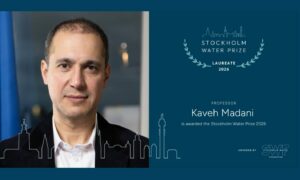
Professor Kaveh Madani has been named the 2026 Stockholm Water Prize Laureate. The announcement was made at the World Water Day ceremony at UNESCO Headquarters in Paris, on 18 March 2026. The prize will be formally presented by H.M. King Carl XVI Gustaf of Sweden during World Water Week in Stockholm in August 2026. Often described as the ‘Nobel Prize of Water’, the Stockholm Water Prize is the most prestigious water award and honours outstanding contributions to the sustainable use and protection of water resources. Professor Madani’s selection is also a historic milestone for the global water community: at 44, he is the youngest laureate in the prize’s history, as well as the first UN official and the first former politician to receive the honour. The official Stockholm Water Prize citation recognizes Professor Madani for his “unique combination of groundbreaking research on water resources management with policy, diplomacy and global outreach, often under personal risk and political complexity“.
Leading experts and diplomats also joined this briefing and dialogue to present the key findings of the report and examine their implications for international policy and governance.
The event was followed by a networking opportunity with light refreshments.
Speakers
Lead Author
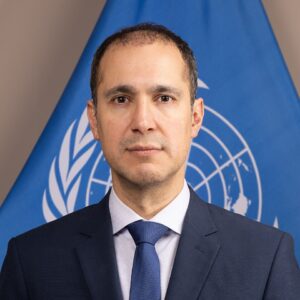
Kaveh MADANI
Director, UN University Institute for Water, Environment and Health (UNU-INWEH)
Opening Remarks
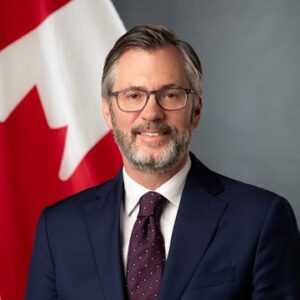
H.E. Amb. Peter MACDOUGALL
Permanent Representative of Canada to the United Nations Office in Geneva and to the Conference on Disarmament
Discussants

Therese ARNESEN
Human Rights Officer, OHCHR

Maikel LIEUW-KIE-SONG
Senior Specialist, Employment-Intensive Investments, Employment Investments Branch, ILO

Paul SMITH
Senior Consultant, Climate, UNEP Finance Initiative

Yves LADOR
Geneva Representative, Earthjustice
Closing Remarks

Andrea AEBY
Counsellor, Permanent Mission of Switzerland to the United Nations Office and other international organizations in Geneva
Highlights
Video
Live from International Environment House
Summary
Opening of the Event
Diana D. Rizzolio, Coordinator, Geneva Environment Network (GEN)
The event was opened by Diana D. Rizzolio, who welcomed participants joining both in person and online at the International Environment House in Geneva. The briefing was introduced as an opportunity to unpack the key findings of the report Global Water Bankruptcy: Living Beyond Hydrological Means in the Post‑Crisis Era and to examine their implications for international policy and governance. The discussion was framed as particularly timely in the context of multiple ongoing global crises and upcoming UN water‑related processes.
Emphasis was placed on Geneva’s role as a multilateral hub and on the value of convening diverse stakeholders from across the UN system, Member States, international organizations, academia, finance, labor, and civil society. The importance of maintaining inclusive, respectful, and safe spaces for dialogue under UN‑led convenings was recalled. It was also noted that participation remained strong despite several concurrent international meetings taking place elsewhere. The opening set the stage for a dialogue combining scientific evidence, policy reflection, and cross‑sectoral perspectives.
Opening Remarks
H.E. Ambassador Peter MacDougall, Permanent Representative of Canada to the United Nations Office in Geneva and to the Conference on Disarmament
In his opening remarks, Ambassador Peter MacDougall recalled Canada’s long‑standing role as host and supporter of the United Nations University Institute for Water, Environment and Health (UNU‑INWEH) since its establishment in 1996, marking the institute’s thirtieth anniversary. He highlighted how sustained support from Canada has enabled UNU‑INWEH to advance research, policy innovation, capacity development, and knowledge sharing at the nexus of water, environment, and health, particularly for Member States in the Global South.
The Ambassador emphasized the institute’s growing network of partnerships across the UN system, governments, academia, the private sector, and civil society, and acknowledged Professor Kaveh Madani’s leadership in further diversifying and strengthening these collaborations. He also noted Canada’s recent announcement to develop its first national water security strategy through the Canada Water Agency, in collaboration with federal, provincial, territorial, and Indigenous partners, and expressed interest in drawing on UNU‑INWEH’s expertise in this process.
Ambassador MacDougall congratulated Professor Madani on being named the 2026 Stockholm Water Prize Laureate and underlined the importance of the report Global Water Bankruptcy in highlighting the scale and urgency of global freshwater challenges. He introduced the subsequent exchange with Professor Madani as an opportunity to better understand the concept of water bankruptcy and its implications for international policy, governance, and cooperation.
Dialogue
H.E. Peter MacDougall, Ambassador Peter MacDougall: You warn that the world has entered an era of water bankruptcy. So let me start with a basic question. What is water bankruptcy?”
Professor Kaveh Madani, Director of UNU-INWEH:
Water bankruptcy refers to a condition in which water expenditure exceeds available resources over an extended period. The concept mirrors financial bankruptcy. Renewable water resources—surface water, soil moisture, green water, and snow—function as a checking account that is naturally recharged every year, though increasingly less so in many places. Groundwater and glaciers constitute a savings account inherited from previous generations.
Across many regions, the checking account has been depleted, and reliance has shifted to the savings account without allowing for recharge. This has resulted in long‑term insolvency. Water bankruptcy, however, is not defined by overuse alone. It also involves irreversibility. Natural systems can absorb pressure for a period, but once elasticity is lost, recovery becomes impossible. Drying wetlands, shrinking reservoirs, land subsidence, soil salinization, species extinction, and melting glaciers signal damage that systems can no longer reverse. Insolvency combined with irreversibility defines water bankruptcy.
How is water bankruptcy different from water stress or a water crisis?
Water stress describes a situation where pressure on water resources is high but still within limits that systems can tolerate. Water crisis implies a temporary deviation from normal conditions—often managed through short‑term mitigation to bring systems back to their previous state.
Water bankruptcy differs fundamentally. A crisis is, by definition, temporary. The global water situation has continued to deteriorate for decades, yet has repeatedly been labeled a crisis. This framing no longer reflects reality. Water bankruptcy describes a chronic condition in which returning to historical baselines is no longer possible.
Continuing to treat this condition as a crisis delays action and encourages nostalgia for past conditions. Accepting bankruptcy enables a shift from mitigation alone toward mitigation combined with adaptation. Water bankruptcy is not determined by whether a country is water‑rich or water‑poor, but by how water is managed. Wealth does not prevent bankruptcy, and scarcity does not guarantee it.
Does entering an era of global water bankruptcy mean that everywhere is bankrupt, including places such as Switzerland or Canada?
Global water bankruptcy does not mean that every country, basin, or aquifer is bankrupt. It means that an increasing number of water systems worldwide are losing their ability to recover.
Manifestations vary by region and context. In some places, quantity fails; in others, quality renders water unusable. Cities have reached day‑zero conditions. Reservoirs have dropped to historical lows. Excessive groundwater withdrawal has caused land subsidence. Wetlands have dried up. Glaciers have retreated. These failures appear in water‑rich and water‑poor regions alike.
Resource availability, financial means, or scientific capacity alone do not guarantee resilience. Once physical limits are crossed, systems may continue to degrade despite strong institutions or technologies. These localized failures also carry global consequences, as water systems are interconnected with food production, trade, and economic stability worldwide.
Given the irreversible damage described, why take action now, and does using the term ‘bankruptcy’ risk removing hope?
Irreversibility does not justify inaction. Without intervention, conditions continue to worsen. Acknowledging the severity of the situation enables action to prevent systemic collapse, even if full recovery is impossible.
The term “bankruptcy” must be used carefully. Not every system should be labeled bankrupt, and overuse would risk the same desensitization experienced with the term “water crisis.” When used responsibly, however, the term forces honesty and accelerates decision‑making. Bankruptcy signals that returning to the old normal is no longer feasible and that delaying action increases long‑term costs.
Accepting bankruptcy opens pathways for adaptation while preventing further irreversible damage. Humanity retains the capacity to limit future losses if reality is confronted directly.
You have described water bankruptcy as a strategic opportunity. Could this be explained further?
Water is one of the few issues that transcends political ideology, geography, and income level. National security concerns—employment, food security, energy stability, and social cohesion—are directly linked to water.
Seventy percent of freshwater globally is managed by farmers, most of whom live in developing economies. Solutions that disregard livelihoods are neither responsible nor viable. At the same time, investment in water offers multiple returns. Protecting wetlands supports climate adaptation. Improving soil health contributes to mitigation. Supporting farmers strengthens food security, biodiversity protection, and resilience simultaneously.
Water also represents a pathway to rebuild trust with the Global South, as it addresses immediate and tangible needs. Investment in water can serve as a medium for poverty alleviation, gender equity, peacebuilding, and sustainable development.
Based on engagement with Member States, how is water currently prioritized on the international agenda?
Engagement increases when water is framed around livelihoods and agriculture, particularly in the Global South. However, decision‑making power often rests with donors rather than affected communities.
Technology and finance remain essential, but insufficient on their own. Desalination, reuse, deeper groundwater extraction, and water transfers will continue, yet without economic diversification and livelihood alternatives, pressure on water merely shifts. In many regions, water‑dependent agriculture provides employment rather than efficiency.
Water investment should not be treated solely as an environmental expenditure. Designing investment to advance food security, employment, energy systems, and economic transition simultaneously increases effectiveness and political feasibility. Without such integration, responses will continue to address symptoms rather than structural causes.
Reflections
Therese Arnesen, Human Rights Officer at OHCHR
It was emphasized that the findings of the Global Water Bankruptcy report strongly resonate with evidence emerging from international human rights mechanisms, including the Special Rapporteur on the rights to water and sanitation, treaty bodies monitoring economic, social and cultural rights, and the Universal Periodic Review. The report was welcomed for clearly illustrating how water‑related impacts disproportionately affect people in vulnerable situations and those systematically left behind.
Attention was drawn to the convergence between the rights to water and sanitation and the right to a clean, healthy, and sustainable environment. It was stressed that water‑related degradation disproportionately affects small‑scale food producers, indigenous peoples, rural communities, people living in informal settlements, and people living in poverty. Particular emphasis was placed on the impacts on women and girls, including the time spent collecting water, lack of access to sanitation during menstruation, limitations on education and employment opportunities, and diminished participation in public life.
Access to safe drinking water and sanitation was presented as fundamental to dignity and intrinsically linked to the rights to health, food, housing, education, and an adequate standard of living. The ongoing lack of access for more than two billion people was framed not only as an infrastructure gap but as a consequence of governance and policy choices. A human‑rights‑based approach to water governance was highlighted as essential, grounded in meaningful participation, accountability, transparency, non‑discrimination, and intergenerational equity. The role of businesses was also emphasized, recalling responsibilities under the UN Guiding Principles on Business and Human Rights, particularly in water‑intensive sectors.
Maikel Lieuw‑Kie‑Song, Senior Specialist on Employment‑Intensive Investments, Employment Investments Branch, International Labor Organization (ILO)
Reflections focused on the human and employment dimensions of water bankruptcy, highlighting the close connection between water, ecosystems, and livelihoods. It was noted that approximately 1.2 billion people worldwide depend directly on ecosystem services for their employment, many of which are water‑related. This underscores the significance of water not only as a humanitarian and environmental issue but also as a core economic and political concern.
The discussion raised questions regarding the concept of decoupling economies from water. While productivity gains may reduce labor requirements in sectors such as agriculture, this does not necessarily reduce overall water use, as output often increases. Moreover, decoupling GDP or employment from water consumption does not automatically result in water efficiency gains. These dynamics were identified as context‑specific and highly dependent on sectoral and national circumstances.
The introduction of the concept of water bankruptcy was noted to naturally raise questions around water valuation and pricing. It was suggested that if water were valued differently and more fully reflected its economic importance, incentives for investment in water systems and natural capital could increase. Nature‑based solutions were highlighted as a potential avenue for investment that could generate employment and support livelihoods. The relevance of just transition principles was emphasized, particularly in relation to restoration of watersheds and wetlands, raising questions about who bears the costs of transition and how affected communities are supported through inclusive social dialogue.
Paul Smith, Senior Consultant on Climate at the UNEP Finance Initiative (UNEP FI)
From the finance perspective, it was explained that UNEP Finance Initiative works with private financial institutions, including banks, insurers, and investors, to align financial systems with sustainability goals. The framing of water challenges as “bankruptcy” was strongly welcomed, as it closely resonates with financial concepts of risk, materiality, and systemic failure.
It was highlighted that water‑related risks are increasingly recognized by the financial sector as major threats to economic stability. Recent analyses were cited demonstrating that surface water scarcity, drought, and related impacts could place a significant share of GDP at risk across regions, with particularly high exposure in agriculture, food systems, real estate, and infrastructure. Risks associated with groundwater depletion, land subsidence, and flooding were also emphasized, including impacts on housing, historical buildings, and urban systems.
The role of data was identified as critical for enabling financial institutions to assess and manage water risks. While data gaps remain, it was emphasized that action cannot be delayed until perfect information is available. Integrating water risks into stress testing, adaptation planning, and transition strategies was identified as increasingly important. Dialogue between financial institutions, policymakers, businesses, and communities was highlighted as essential to address water as a public good while creating incentives for investment in water resilience and natural capital.
Yves Lador, Geneva Representative of Earthjustice
From a civil society perspective, the report was highlighted as contributing to the establishment of a more shared and factual diagnostic of global water realities. It was emphasized that the concept of water bankruptcy does not replace existing concepts such as water scarcity or crisis, but rather applies to specific situations characterized by ongoing losses and degraded carrying capacity.
Attention was drawn to the need for a broader paradigm shift in understanding water systems, moving away from static approaches toward dynamic, ecosystem‑based perspectives that account for flows, feedbacks, and interdependencies within the global hydrological cycle. Particular emphasis was placed on the importance of recognizing irreversibility, noting that while some environmental changes may not be geophysically irreversible, they are effectively irreversible within human timescales and therefore have profound societal implications.
The distinction between bankruptcy and collapse was emphasized, with bankruptcy understood as a condition requiring fundamentally different governance and management approaches, rather than signaling the end of possible action. Persistent fragmentation in water governance at national and international levels was highlighted as a major challenge, with calls for institutional reform, improved transparency, ecosystem‑based management, and integration of water considerations across policy domains.
Closing Remarks
Andrea Aeby, Counsellor at the Permanent Mission of Switzerland to the United Nations Office and other international organizations in Geneva
In closing, strong appreciation was expressed for the clarity, data, and policy relevance of the report. Particular emphasis was placed on the report’s effort to link scientific evidence with practical recommendations for decision‑makers and journalists.
It was highlighted that Geneva plays a central role in global water governance, hosting a wide range of organizations addressing water from environmental, human rights, development, trade, and peace perspectives. Switzerland reaffirmed its commitment to maintaining water as a priority on the international agenda and underscored the importance of continued dialogue across the UN system, including in the context of forthcoming UN water‑related processes.
Photo Gallery


