
Event Conference
Navigating Global Sustainability Standards in the Mining Sector | Geneva Dialogues on Mineral and Metal Resources | UNECE Resource Management Week Side Event
30 Apr 2026
13:40 – 14:45
Venue: Palais des Nations, Room XVI
Organization: Geneva Environment Network, United Nations Economic Commission for Europe
This side event to the UNECE Resource Management Week 2026, organized within the framework of the Geneva Dialogues on Minerals and Metals, featured leading experts discussing global sustainability standards in the mining sector.

About the Event
Driven by the energy transition, digitalization and major infrastructure development, demand for minerals and metals is raising. This has intensified pressure to ensure that sourcing is responsible and sustainable. Yet governments, particularly in the Global South, face challenges assessing and integrating the growing number of private standards into public policy.
Sustainability Standards and Initiatives are frameworks, systems, schemes or programmes that help actors across minerals and metals supply chains strengthen and meet their sustainability performance. Unlike public instruments, such as laws or treaties, the Sustainability Standards and Initiatives are typically led by the private sector or multi-stakeholder partnerships.
Over the past two decades, their number has doubled. Today, more than 100 such initiatives operate in the minerals and metals sector. This diversity fosters innovation and flexibility, but it also creates a complex and fragmented landscape that can confuse stakeholders and dilute impact.
Building on three United Nations Environment Assembly resolutions (6/5, 5/12, and 4/19) and as part of their 2024 Memorandum of Understanding, the United Nations Environment Programme (UNEP) and the Intergovernmental Forum on Mining, Minerals, Metals and Sustainable Development (IGF) compiled a comprehensive Stocktake of Sustainability Standards and Initiatives for Minerals and Metals. The aim is to clarify how these initiatives interact with laws, regulations and policy commitments, and how they might enhance environmental governance rather than compete with or undermine it.
The Stocktake report Stocktake of Sustainability Standards and Initiatives for Minerals and Metals: Leveraging Synergies Between Sustainability Standards and Initiatives and Public Instruments to Enhance Environmental Governance, released in December 2025, identifies over 100 Sustainability Standards and Initiatives operating across the minerals and metals value chains. While the Sustainability Standards and Initiatives are increasingly used to promote environmental and social performance, the study finds that their rapid proliferation has created a fragmented and often confusing landscape for governments, companies and communities.
The report underscores that well-designed Sustainability Standards and Initiatives can complement—but cannot replace—strong public regulation. Credible and transparent initiatives have the potential to raise sustainability ambition, improve access to environmental data, support compliance and bring diverse stakeholders into decision-making. At the same time, the review warns that fragmentation, high compliance costs and limited relevance to producer-country contexts—particularly in the Global South—remain significant barriers to their effectiveness.
This side event to the UNECE Resource Management Week 2026, organized within the framework of the Geneva Dialogues on Minerals and Metals, brought together leading experts to discuss the findings of the Stocktake and explore how stakeholders can navigate the evolving landscape of sustainability standards and initiatives.
About the Geneva Dialogues on Minerals and Metals
The topic of sustainable management of minerals has never been so high on the global political environment agenda and the reason is that minerals are essential for the future. The energy transition, infrastructure and digitalization processes, among others, represent greener solutions. However, unsustainable extraction, manufacturing, use and disposal of resources is having important detrimental impacts on people and the planet. With an expected 500 per cent increase in the demand for minerals (from 2018 production levels), environmental challenges are going to be even more acute.
Various actors in Geneva are engaged in ensuring enhanced action to support the environmental sustainability management of minerals and metals along their full lifecycle. As Geneva is at the center of numerous debates and negotiations in the fields of science, health, human rights, development, trade and green finance, employment, peacebuilding and security, disaster risk reduction, humanitarian response, nature conservation, chemicals and pollution, as well as new technologies and innovation, the dialogues can be a conducive platform to explore interlinkages between these topics and mineral and metal resources governance.
The dialogues are organized by the Geneva Environment Network in partnership with Switzerland, Senegal, UNEP/GRID-Geneva, UNECE, the International Institute for Sustainable Development (IISD), the Intergovernmental Forum on Mining, Minerals, Metals and Sustainable Development (IGF), The Forum on Trade, Environment, & the SDGs (TESS) and the World Resources Forum.

UNECE Resource Management Week 2026
The UNECE Resource Management Week 2026 takes place from 27 April to 1 May 2026 in Geneva. It will comprise the 17th session of the Expert Group on Resource Management (EGRM), the 21st session of the Group of Experts on Coal Mine Methane and Just Transition (GoE CMMJT) and the 13th session of the Group of Experts on Gas (GEG). It will bring together policymakers, industry leaders, technical experts, academia, civil society, and youth to demonstrate how sustainable resource management advances the global energy transition, climate action, circular economy, and the Sustainable Development Goals (SDGs).
Speakers

Dario LIGUTI
Director, Energy, Housing & Land Management Division, United Nations Economic Commission for Europe

Martine ROHN-BROSSARD
Deputy Head, International Affairs Division, Swiss Federal Office for the Environment



Kristi DISNEY BRUCKNER
Law & Policy Director, Initiative for Responsible Mining Assurance (IRMA) (Video Message)

Carolyn DEERE BIRKBECK
Executive Director, Forum on Trade, Environment & the SDGs (TESS), Geneva Graduate Institute

Highlights
Summary
Noelia GARCIA NEBRA | Head of Sustainability & Partnerships, ISO | Moderator
- This session is organized within the framework of the Geneva Dialogues on Minerals and Metals. There are many actors in Geneva who are very active in this space and who are working to enhance action in support of environmentally sustainable management of minerals and metals across their full life cycle.
- This discussion will be guided by the findings of the Stocktake of Sustainability Standards and Initiatives for Minerals and Metals. Leveraging synergies between sustainability standards and initiatives and public instruments to enhance environmental governance, prepared by the United Nations Environment Programme (UNEP) and the Intergovernmental Forum on Mining Minerals (IGF).
- The report seeks to clarify how these initiatives interact with laws, regulations, and policy commitments – and how they might enhance environmental governance rather than compete with one another.
- There has been a rapid increase in demand for minerals and metals, and this continues to grow. This rapid growth has also resulted in a rapid expansion of standards and programs. These address real needs – such as trust in supply chains, governance gaps, and clear signals for stakeholders. There must be a reason why all these initiatives, programs, and standards are being developed.
- At the same time, this expansion has created fragmentation. This brings complexity and higher compliance costs. The main challenge is how we bring more coherence into this space – how we ensure alignment between requirements, interoperability, and ideally harmonization or mutual recognition, as well as consistency in data.
- The report also highlights that well-designed instruments, initiatives, and frameworks can complement regulation. This brings to mind the WTO TBT principles of transparency, non-discrimination, and coherence – principles that are key to ensuring the effective development of international standards.
- We must ensure that the development of these instruments, initiatives, and standards is inclusive. Developing countries and producer countries should be at the table, and their voices must be heard. They should also be supported through capacity building and implementation support to ensure these systems are fair and workable.
- My final reflection relates to the World Bank Development Report “Standards for Development”, which stresses the importance of using existing national quality infrastructure. These are the institutions that ensure trust and accountability – such as those responsible for accreditation, testing, and conformity assessment. It is important to leverage this existing infrastructure rather than creating parallel systems.
Welcome
Dario LIGUTI | Director, Energy, Housing & Land Management Division, UNECE
- The UNECE Resource Management Week is a series of meetings bringing together three groups of experts: one on coal mining, methane, and just transitions, another on gas, and a broader and ongoing group, the Expert Group on Resource Management.
- This week is dedicated to energy and natural resources. This includes not only energy sources, but also minerals and metals, and the entire value chain – from extraction and processing to refining, as well as circular economy considerations.
- These meetings are chaired by member states’ representatives and attended by MS from beyond the UNECE region, as the challenges we discuss are not limited to one region – they are global in nature. In addition, experts from the private sector play a crucial role. This is where investment decisions are made, where capital is mobilized, and where implementation happens in practice. We also benefit from contributions by academia, consultants, think tanks, and other international organizations.
- The shared objective across all these actors is to support the sustainable use of resources. To achieve this, as already mentioned, sustainability standards are essential. There is a well-known principle: what you don’t measure, you don’t know. This applies directly to sustainability.
- In this context, the work of UNECE and its expert groups does not focus on developing standards as such, but rather on methodologies that support their application. This includes frameworks such as the United Nations Framework Classification for Resources and the United Nations Resource Management System. These provide the underlying structure and the enabling conditions that allow sustainability standards to be measured, monitored, and implemented in practice.
- We are therefore very pleased to host this side event as a way to connect our ongoing discussions with partners on how sustainability can be applied across sectors, commodities, and countries, and to explore how different standards relate to these activities.
Opening Remarks
Martine ROHN-BROSSARD | Deputy Head, International Affairs Division, Swiss Federal Office for the Environment
- Switzerland has been supporting this work for many years, and we do so because we believe it is very important to strengthen governance in the minerals and metals sector.
- In 2019, a resolution was passed at the United Nations Environment Assembly (UNEA), marking the first time environmental discussions had fully engaged with the mining and industry dimension. At the beginning, it was often seen as two separate worlds – environment on one side, mining and industry on the other. We felt that bringing these communities together was essential. We need these metals and materials to implement the Sustainable Development Goals (SDGs), for example.
- In the context of the energy transition, metals and minerals are critical. However, we must be careful not to solve one crisis while creating another. Addressing climate change must not lead to new pressures or crises related to mineral resources.
- In the current global context, multilateral cooperation is challenging, but it remains the only way forward. The only way to go ahead is to work all together to develop standards, exchange good practices, and to bring the theme of the sustainability of minerals and metals forward.
- As highlighted in the report, there are already many standards and initiatives, but the landscape is highly fragmented and we must align these to have the impact needed.
- Finally, I would like to mention the next Geneva Dialogue on Minerals and Metals on 13 May focusing on sand and sustainable development. It will also be held here in Geneva and will continue this important discussion.
Stocktake of Sustainability Standards and Initiatives for Minerals and Metals and the Role of International Organizations
Jonathan HAMISI | Senior Policy Advisor, IGF
- I will present some of the key findings from the report prepared by UNEP and the IGF on sustainability standards and initiatives. The objective of this report was to understand how sustainability standards and initiatives can support public governance, rather than substitute it.
- This work builds on UNEA resolutions 6/5, 5/12, and 4/19. It is also part of the work the IGF is undertaking as part of the MoU signed with UNEP in 2024 at the IGF AGM.
- It responds to a clear reality: demand for minerals is increasing rapidly, driven by the energy transition and industrialization. At the same time, governments face growing pressure to ensure responsible sourcing. As a result, the governance landscape is becoming more complex, not simpler.
- The aim of the report was to:
- Clarify how sustainability standards and initiatives (SSIs) interact with laws and regulations.
- Identify how they can enhance environmental governance.
- Importantly, the report does not assess or rank individual standards. Instead, it looks at how the system functions as a whole. From the IGF perspective, this is about helping governments navigate that complexity and make informed choices.
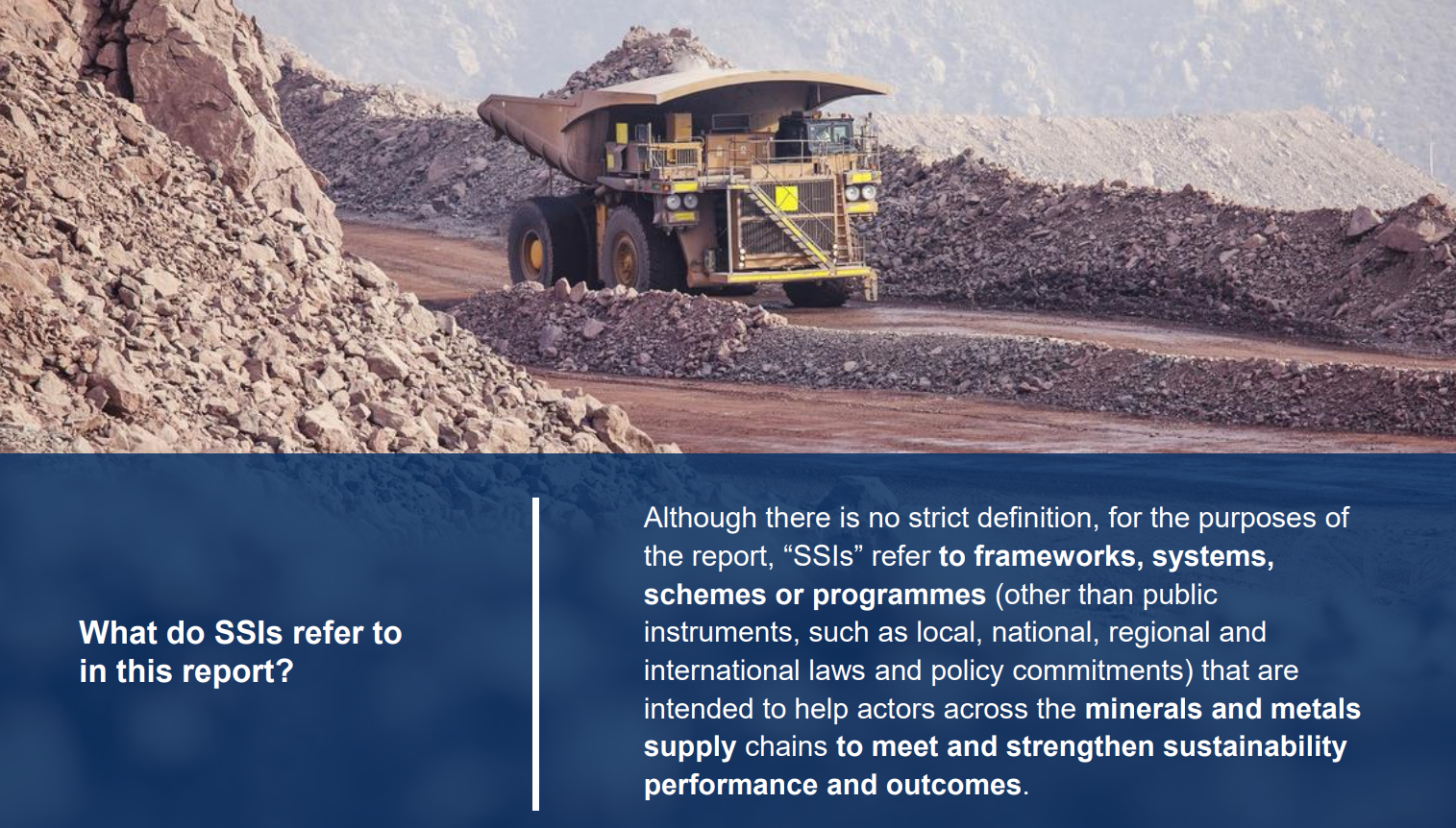
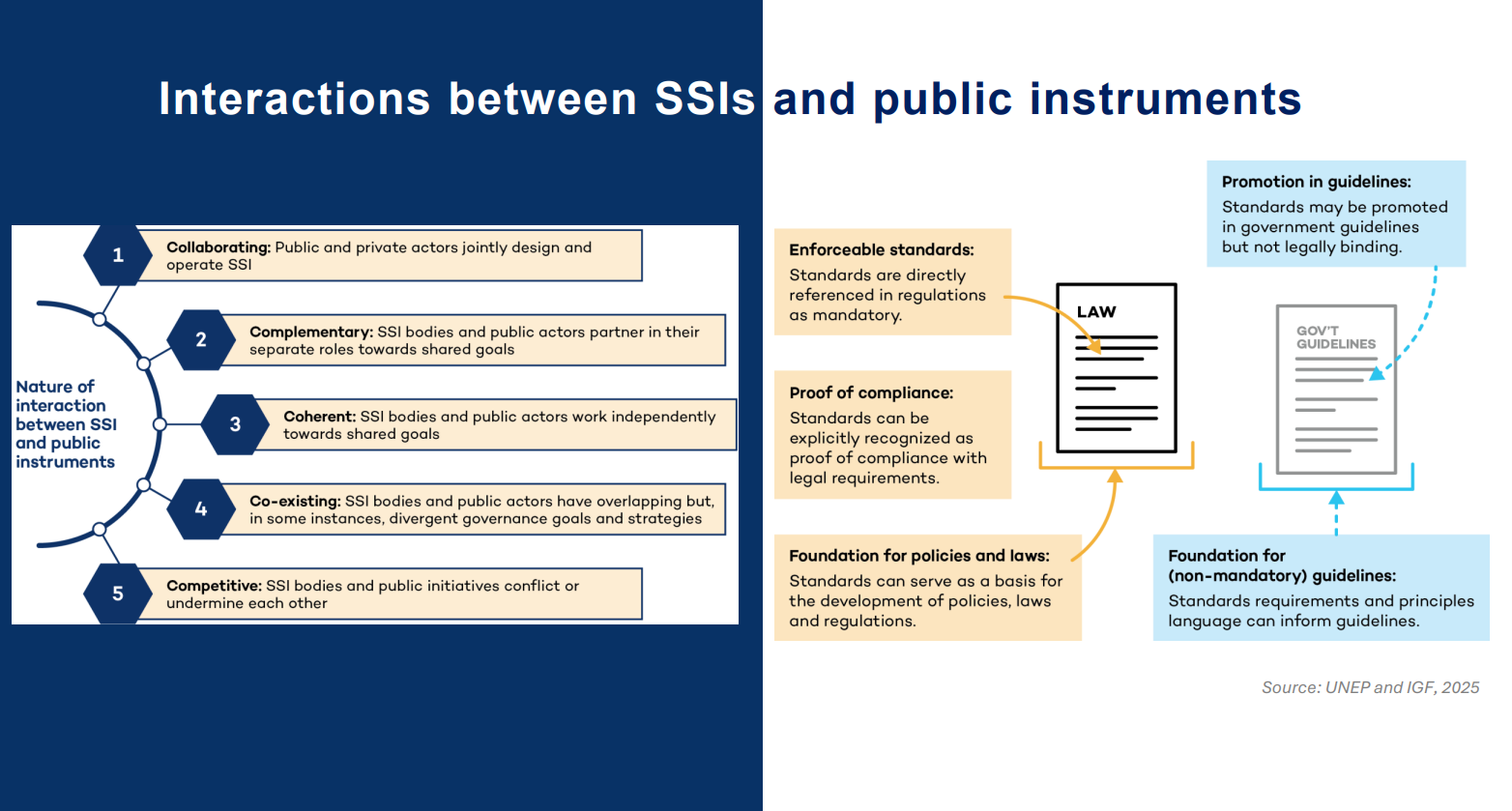
- They are sustainability standards and initiatives are frameworks, schemes, or programs designed to improve sustainability performance across supply chains. They are often voluntary and typically led by the private sector or multistakeholder initiatives. A key point is that they operate alongside public regulation – they do not replace it.
- One of the most important findings of the report is the rapid growth of these initiatives.
- Their number has doubled over the past two decades, the numbers peaked at the end of the 1990s and at the beginning of the 2000s.
- Today, there are over a hundred operating in the minerals and metals sector alone. If you include downstream supply chains, there are even more.
- This creates a fragmented and complex landscape, with interactions that can be complementary, but also sometimes conflicting.
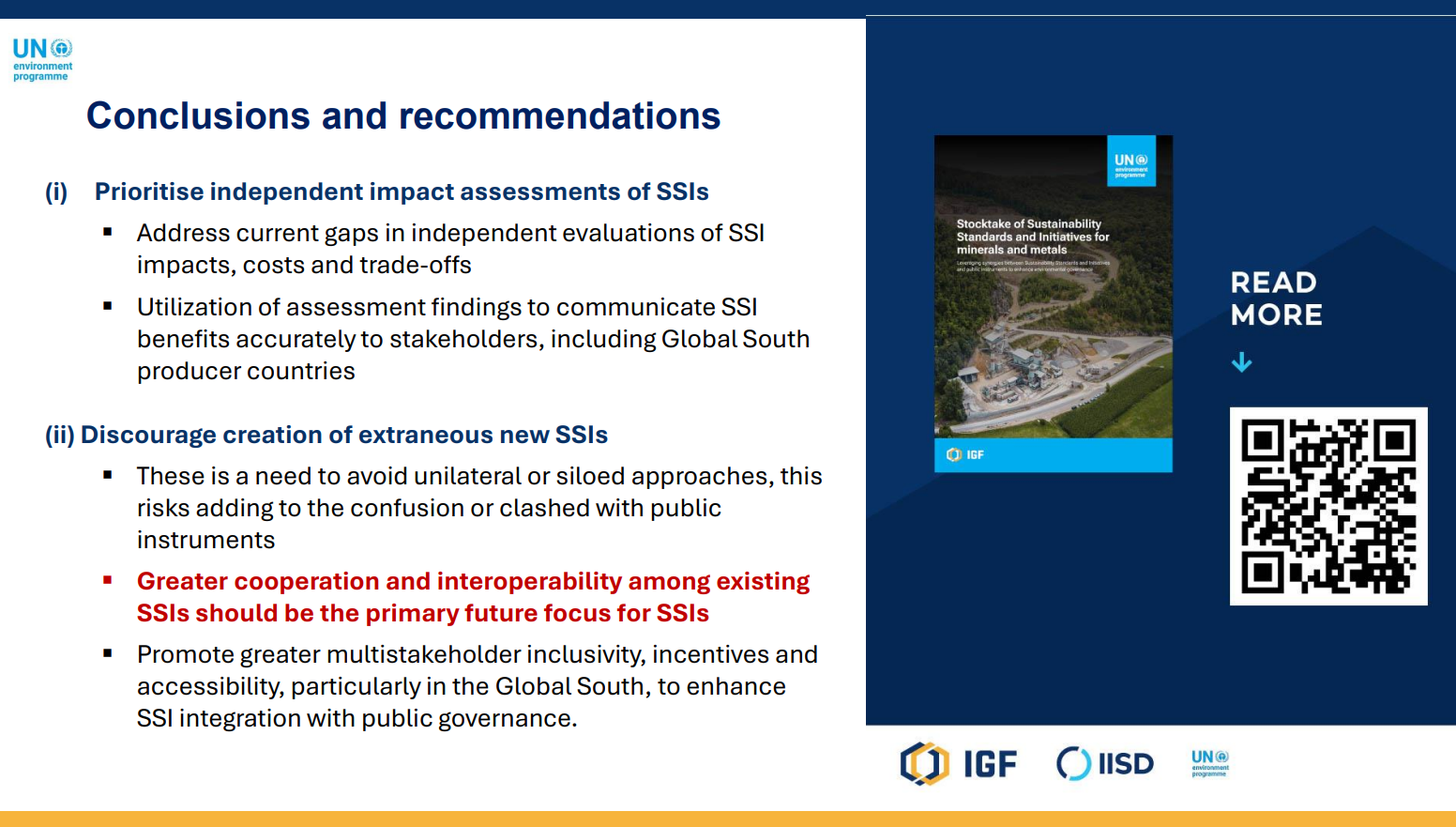
- The message here is quite clear: more standards do not automatically lead to better outcomes. Without alignment, they can create confusion rather than clarity.
- In terms of how these standards interact with public instruments, there is broad consensus that they cannot replace government regulation. However, they can support policy implementation, improve transparency and data availability, and act as a bridge between practice and regulation.
- In a survey conducted for the report, nearly 90% of government officials indicated that they are considering integrating these initiatives into national frameworks, but around 65% also said they would need more support –particularly technical assistance and capacity building. There is strong interest, but also clear capacity gaps.
- These initiatives cover a wide range of topics, including environmental management, labor conditions, human rights, community engagement, governance, and supply chain due diligence.
- From a government perspective, this breadth can be useful because it shows where they may support policy objectives.
- At the same time, coverage is not always consistent. Some issues are well addressed, while others – such as cumulative environmental impacts, gender equality, indigenous peoples’ rights, or downstream supply chain governance –receive less attention.
- There is often more focus on areas linked to productivity and performance.
- The key question is not just whether a standard exists, but whether it is credible, appropriate to the context, and aligned with national policy objectives.
- Looking at opportunities and challenges, the report finds that these initiatives can raise ambition beyond legal minimums, support compliance and monitoring, and enable multistakeholder engagement.
- At the same time, there are clear challenges, including fragmentation, overlap, and sometimes conflict between standards.
- They can increase compliance costs, and in some cases, they are not well adapted to producing countries.
- There is also a risk of greenwashing.
- Another important point is that they tend to work better for large-scale operations, with less attention given to artisanal and small-scale mining.
- Overall, these initiatives can be powerful tools for sustainability, but only if they are credible, transparent, inclusive, aligned, and grounded in local realities. Otherwise, they risk weakening public oversight. One of the main issues identified in the report is the lack of alignment between different initiatives.
- The report also identifies key elements for what makes a robust initiative, including governance, scope, performance, assurance, and review mechanisms. These can help governments assess credibility and alignment in practice.
Elisa TONDA | Chief, Resources and Markets Branch, UNEP
- Attention and consideration around the role that sustainability standards and initiatives can play in shaping expectations for transforming the mineral value chain is growing globally.
- This report, which was launched fairly recently, has already generated a lot of interest with the interlocutors we work with.This dialogue can continue in various directions.
- On one side, both UNEP and IGF colleagues have seen increasing demand – particularly from mineral resource-rich countries –to transform recommendations of the report into practice. The report outlines ways in which public policies can connect with sustainability standards and initiatives, but the key question now is: what comes next?
- In the work we are doing with countries – this year focusing particularly on countries in Africa, and next year expanding to Latin America – we are trying to translate these recommendations into more concrete guidance.
- We are developing something like a “playbook” to help countries apply the report’s recommendations in their own national context.
- This includes assessing where their legal and regulatory frameworks currently stand and identifying opportunities to build stronger connections with sustainability standards and initiatives.
- At the same time, we need to recognize that the landscape of sustainability standards is not static. It is evolving rapidly and countries are experiencing this as well. Part of this work is also about helping them navigate a complex and constantly changing environment.
- In parallel, there are also opportunities to bring the findings of the report into broader global and intergovernmental processes.
- One important example is the task force that was launched following the United Nations Environment Assembly. This task force builds on the recommendations of a panel of experts established by the United Nations Secretary-General, focusing on critical minerals for the energy transition. Across the UN system, we are working together to advance these recommendations.
- One of the key areas of work within this process is how to strengthen circular economy approaches and material efficiency across the mineral value chain. In this context, we have already begun engaging with existing sustainability standards to explore how they can help clarify expectations and guide the transition – particularly for the private sector – towards more circular models. We are also working closely with partners such as the International Resource Panel on this.
- A third track relates to the resolutions adopted at UNEA. As others mentioned, several resolutions were approved in December, including one specifically addressing this topic. This resolution creates space for further dialogue among member states and stakeholders, based on priorities identified during consultations
- The community here in Geneva has been very active in those discussions, and there will soon be opportunities to contribute further – particularly by providing input on priorities for future dialogue. I would strongly encourage all of you who are interested in advancing the recommendations of this report to engage in that process as soon as we will be seeking your input.
Navigating Global Sustainability Standards in the Mining Sector | Panel Discussion
Clovis FREIRE | Chief, Extractive Commodities Section, UN Trade and Development
- Two key aspects to highlight from the report are, first, the number of sustainability standards and initiatives and how fragmented the landscape is, and second, the observation that many of these standards tend to focus more on downstream issues and are often less relevant to producing countries.
- This is important because, for many resource-rich developing countries, the key issue is structural transformation – how to move from dependence on raw material exports towards more diversified, knowledge-intensive activities. This includes not only processing but also manufacturing further along the value chain, and broader economic diversification.
- Well-designed sustainability standards can support investment and innovation, but this is not automatic. It requires coordinated efforts.
- The United Nations Secretary-General established a panel on critical energy transition minerals. This panel identified seven principles and five actionable recommendations. One of these recommendations focuses on developing a global framework for traceability, transparency, and accountability across the entire critical minerals value chain – from mining to processing, manufacturing, use, and recycling.
- To take this forward, a UN task force on critical minerals has been established. Within this task force, there is a technical cluster working specifically on this recommendation. We have already formed a network of experts, and consultations will begin next week.
- The purpose of this exercise is not to create another standard. It is about improving coherence, interoperability, and proportionality. It is also about bringing in a development perspective, which is fundamental. Sustainability is not only about environmental aspects, but it also includes social and economic dimensions, including structural transformation.
- We understand that traceability, transparency, and data are not just about compliance. They are also about productive capacities. Who controls data, standards, and certification systems shapes who learns, who innovates, who can access markets, and who ultimately captures value. This is a much broader issue.
- The consultations we are launching aim to create a space – not just for technical discussions – but for bringing in the perspective of producing countries, in a way that is more balanced with the perspective of consuming countries.
- Of course, this distinction between producers and consumers is not always clear-cut. As countries diversify, they increasingly play both roles. But it is still important to ensure that upstream perspectives are properly reflected.
- We will also look at issues such as cost, feasibility, and sequencing, and ensure that sustainability frameworks are compatible with national policies.
- Sustainability standards are increasingly shaping who upgrades, who captures value, and who participates in global value chains. This work – particularly under recommendation two – is about ensuring that sustainability governance supports diversification and sustainable development across all three pillars: economic, social, and environmental, rather than locking countries into purely extractive roles.
Carolyn DEERE BIRKBECK | Executive Director, Forum on Trade, Environment & SDGs (TESS), Geneva Graduate Institute
- In the work on trade and sustainability, we consistently find a need to think about how we can couple environmental ambition, which is urgent and necessary, with fairness and with the consideration of development aspirations and priorities to ensure effectiveness. Coupling environmental ambitions and fairness and development is vital to effectiveness in the sense of action and cooperation that is durable over time.
- We need quick wins and we also need an ongoing basis for cooperation, so we think a lot about effectiveness as being key. It’s also key because the crises we face are urgent. While creating new standards can be a good standard, what makes it valuable is for it to be something that drives and sustains change over time.
- We have a very fragmented landscape, but for us at TESS, our entry point into this is that minerals move through complex international supply chains. Standards have been applied across those supply chains. This is fundamentally a trade issue – how do importers and exporters and the range of governments working across those supply chains, cooperate and coordinate with each other around this.
- We think that a reflection on where trade and trade cooperation fit into this is indispensable. The nexus of environmental standards and their proliferation and fragmentation in trade is not new.
- This has been an issue in the World Trade Organization (WTO) for years. It has always been a concern about both the proliferation of government regulation and fragmentation of those requirements, but also about non-state requirements and voluntary standards.
- For many countries, voluntary standards end up setting de facto market conditions. It affects access to financing, access to different kinds of partnerships, access to certain markets and so on. Therefore, even though we might think of them as voluntary, in the minds of many governments, these are the standards that their companies face and the requirements that they face in order to engage internationally.
- There’s certainly a set of public laws, regulations, and requirements. Some of them integrate some of these voluntary standards, but even those standards that stand alone don’t escape the scrutiny of governments. This is certainly true in the trade space where governments are concerned about their capacity to participate in their supply chains – especially those who are looking to generate greater value from that participation, who see their participation as a key to development and so on and most of whom understand the importance of meeting new ESG requirements and sustainability standards that may place a range of constraints in doing so. This is something in the trade world that has been very tense for quite some time.
- When we think about the mining sector, we have to think about fitting that into a wider discourse that’s also underway in terms of circular economy standards, standards about packaging, agriculture or e-waste – it is not a standalone issue. We can learn from wider trade discussions.
- This is a multilayered complexity: the complexity of the sustainability standards,the complexity of how governments are trying to use their trade arrangements, and their official policy to promote and drive higher sustainability standards.
- Increasingly, we also have trade agreements, arrangements, and partnerships that refer to environmental and social impact assessments, that refer to supply chain due diligence, responsible sourcing, implicitly to some of these standards that refer to the importance of implementing ESG commitments tied to extractive industries and more broad clauses around natural resource development.
- There are over 60 trade agreements that refer explicitly to sustainability initiatives in mineral supply chains, certification schemes, due diligence standards and so on.
- There are also some environmental cooperation clauses in trade agreements that specifically refer to the importance of technology transfer, capacity building for environmental management, information sharing, and so on.
- We also have a proliferation of mini deals and partnerships around critical minerals that – while not referencing trade explicitly – set some implicit norms around mining standards, traceability, and responsible sourcing.
- There’s a lot going on in the trade space as well that we need to think about.
- We need to remember that we have principles in place, such as the principles in the UN Secretary General’s initiative of critical minerals, but we also have trade principles. The TBT agreement has principles around transparency and non-discrimination and coherence for regulatory practices. There’s a long legacy of existing work, for example, the WTO thinking about how governments can better cooperate around interoperability of standards and work to think about how they can create a dialogue on equivalence, on mutual recognition, and technical guidance around these to improve transparency and inclusiveness.
- A core point when we’re thinking about sustainability standards is to not just think about compliance with certain environmental standards, but to think about how we can use those to drive the development outcomes, the value addition, and development progress in many countries. For them, it’s vital in terms of thinking about these sectors over time. We need to think about how we can use not only the sustainability initiatives, but also trade cooperation to drive that progress over time.
Kristi DISNEY BRUCKNER | Law & Policy Director, Initiative for Responsible Mining Assurance (IRMA) (Video Message)
- IRMA has prioritized the need for rule of law and engagement with government since our inception. As a voluntary standard, we know that our work is no substitute for the essential role of governments to establish, monitor, and enforce rule of law.
- We rely on governments as an essential stakeholder and partner to guide our relevance and impact across jurisdictions.
- Governments also reference IRMA in law and policy frameworks, and our standards serve as a useful benchmark for governments when reviewing and updating legal frameworks.
- IRMA hosts a voluntary, standard, and third-party assurance system for industrial-scale mines. We found that confidence in IRMA across sectors is based on our governance model.
- IRMA is equally governed by mining companies, purchasing companies, affected communities, NGOs, labor organizations, and the investor and finance sector.
- A series of dialogues spanning more than 10 years across continents and across sectors, including government, civil society, academia, the private sector, all informed the IRMA standard for responsible mining.
- The IRMA standard integrates over 65 existing international frameworks, such as the OECD due diligence guidance, and International Labor Organization (ILO) conventions. This helps us avoid duplication with existing frameworks and share through third-party audit reports, experience implementing international frameworks at the mine site level.
- Companies are also required, as the very first requirement in the IRMA standard, to implement their domestic legal framework.
- There are currently 112 companies and 136 mine sites engaged in IRMA across 39 countries and 49 types of materials. Over 50% of global lithium production comes from sites in the IRMA system. This is also the case for 37% of global platinum production. and 25% of global production for both nickel and cobalt.
- Company engagement in IRMIS spans from small micro-cap enterprises to large multinational companies.
- We work with companies on a path of continuous improvement to meet the holistic set of requirements in the IRMA standard for responsible mining.
- We also have a chain of custody standard that tracks IRMA-audited materials from the mine site to end users.
- We rely on engagement with governments to inform our standards, and we respond to what we hear. We heard from governments and other stakeholders that promoting the best environmental and social practices in the exploration stage of mining is a challenge. Exploration can be complex and there’s so much pressure in this phase of mining to proceed efficiently while protecting a range of environmental and social rights.
- We’ve integrated mineral exploration requirements into the updated draft of the IRMA standard, spanning from requirements for desk-based exploration activity and early exploration to more advanced exploration that may involve major drilling and infrastructure development. This is just one example of how we are listening and adapting. We look forward to continuing to hear from you on this and other aspects of the IRMA standard.
- In a world of many standards for the mining sector, we welcome the reports of UNEP and IGF on their stocktake of sustainability standards and initiatives for minerals and metals.
- We agree with the authors that voluntary standards must enhance the role of governments to responsibly manage their mining sectors. It must not compete with or undermine it.
- The criteria presented in the stock take report will help governments and others navigate a complex standards landscape.
- We are pleased to collaborate with UNEP, IGF, UN Trade and Development, and many government leaders around the world, including many participating in this dialogue today to identify and implement best practices in the mining sector. This isn’t possible without the leadership of governments.
Discussion
Q: It was mentioned that there is this incredible growth in the number of standards, a lot of which have come from a time when we were thinking in a much more linear economy way. Is there a process by which those standards are updated? Should there be a lens through which we approach them with circular economy thinking? How can we do that within today’s context of a much more extreme climate crisis?
Jonathan HAMISI | Senior Policy Advisor, IGF
- I will give an example to illustrate this. If you are in a supermarket and you want to buy milk, you know the brand of milk and you look at the farm where it comes from. If it’s the farm you walk by every day and you know the farmer treats its cows properly, that standard changes the perception of the consumer.
- Looking into the circular economy also changed the perception of the consumer. If the product was produced in a way that complies with a certain number of standards, when there is “fair” something marked on the packaging, then consumers are more likely to consider buying it. It ultimately changes the perception of the consumer but also improves environmental performance, social performance, and governance performance.
- The number of standards has started to disaggregate multiple parts of the supply chain and that’s how we ended up having this many.
- Initially, you might only look at the farm and the farmers. Then you ask: what about the machinery? Where do the materials for that machinery come from? Then you put a standard on the machinery and its materials, so each step introduces new standards. That’s how we’ve ended up with so many standards – because they now exist across multiple layers of the supply chain.
- The key issue now is alignment. Whether we’re talking about circular or linear models, the challenge is ensuring standards align with each other and with national regulations. Otherwise, they can conflict and create confusion
Carolyn DEERE BIRKBECK | Executive Director, Forum on Trade, Environment & SDGs (TESS), Geneva Graduate Institute
- You can have sustainability standards around certain product value chains. You can have circularity standards for a certain set of products. You can have standards around how we use waste. Actually, any company may at once be subject to mining standards, to product standards, or sector standards, depending on the energy transition. That makes all this even more complicated. It could be subject at the same time to decarbonization standards.
- When I look at this there are all of these different standards leading to confusion and fragmentation on how to do things in the mining sector.
- One of the things we face consistently is how to integrate them when things are both specific to a sector or context . We need to think in a holistic way, and we don’t quite have the software for it.
Intervention from the floor
From the International Council on Mining and Metals (ICMM) side, there is a growing awareness that there are too many standards. I would like to mention the ICMM’s initiative – the Consolidated Mining Standard Initiative (CMSI), where quite a few of the mining industry’s bodies have got together and they’ve been consulting with a lot of stakeholders to find the commonalities and get rid of some of the duplication.
Intervention from the floor
Sustainability has often been interpreted mainly as environmental, but it must include all three pillars – environmental, social, and economic. Another issue is how we handle materials coming back into the systems. Materials that were acceptable years ago may now pose health risks. In a circular economy, we need standards that also address reused or secondary materials, not just primary extraction.
Intervention from the floor
Reflection on the sustainability of the mining sector and the oil and gas sector. I am from the oil and gas sector, based in Houston, Texas. I would like to see more cooperation and collaboration between these two sectors. The only place where we are often together is in that label of fossil industries – that is not very nice as a label. There are areas we could learn from each other. For example, in mining, waste is visible and measurable. In oil and gas, emissions are less visible – you don’t see the effects. We need more shared frameworks and tools to measure and manage these impacts across sectors.
Closing
Elisabeth TUERK | Director, Economic Cooperation and Trade, UNECE
- If we think about it, the issue is not so much having the standards on sustainability but how to make this fragmented universe of standards work together and how these standards can be credible, efficient and operate at scale. It’s a real call for cooperation and the SG’s Task Force and the different work streams previously mentioned by Clovis are really a perfect example for that.
- At UNECE’s trade division, we’re very happy to contribute to the task team through our UN Transparency Protocol (UNTP). This Protocol will be the public infrastructure for trust and sustainable data exchange across supply chains.
- This comes back to the issue that we need to look at the whole supply chain.
- This UNTP, which is being developed by UNECE, is not another certification scheme, audit programme, or traceability platform – it is a tool that gives you the common language and interoperability trust framework that we need to make the sustainability claims that we hope this ESS will generate, so that we need them to move along the value chain and to be credible.
- Standards define what good performance looks like, and we’ve seen this through how standards grow in the chart earlier.
- Then we have insurance systems, and this World Bank report calls for this quality infrastructure.
- The third pillar would be this Transparency Protocol that helps communicate trusted evidence digitally.
- If we have a call for action, it would be that the ESS community picks up this UNTP that is being developed and that you really use it, because it can help you in three different ways:
- It can help you ensure interoperability across standards because we create that vocabulary that makes the standards comparable.
- It can help ensure that data can be reused because we don’t want all the economic actors to input the data 15 times for 15 different standards. Our framework will allow us to share the data across the different standards.
- It will help avoid greenwashing because we need to make sure that the claims of the standards are trustworthy, which our UNTP can help with.
- The call to action is simple: let’s use it.
Video
Photo Gallery


