Event Virtual
Road to Busan | Global Producer Responsibility for Plastic Pollution

This event, organized within the framework of the Geneva Beat Plastic Pollution Dialogues, presented and discussed a research paper highlighting how brand names can be used to hold plastic companies accountable for items found polluting the environment.

About this Event
This event discussed the findings of a research that has used data from a 5-year (2018–2022) worldwide (84 countries) program to identify brands found on plastic items in the environment through 1576 audit events.
The authors found that 50% of items were unbranded, calling for mandated producer reporting. The top five brands accounted for 24% of the total branded count, and 56 companies accounted for more than 50%. There was a clear and strong log-log linear relationship production (%) = pollution (%) between companies’ annual production of plastic and their branded plastic pollution, with food and beverage companies being disproportionately large polluters. Phasing out single-use and short-lived plastic products by the largest polluters would greatly reduce global plastic pollution.
Leading experts speaking at this event presented the results of the research “Global producer responsibility for plastic pollution” published in Science Advances and discuss how the findings can help the development of the legally binding treaty that member states are currently developing, ahead of the next round of negotiation that will take place in the Republic of Korea, from 25 November to 1st December 2024.
Geneva Beat Plastic Pollution Dialogues

The world is facing a plastic crisis, the status quo is not an option. Plastic pollution is a serious issue of global concern which requires an urgent and international response involving all relevant actors at different levels. Many initiatives, projects and governance responses and options have been developed to tackle this major environmental problem, but we are still unable to cope with the amount of plastic we generate. In addition, there is a lack of coordination which can better lead to a more effective and efficient response.
Various actors in Geneva are engaged in rethinking the way we manufacture, use, trade and manage plastics. The Geneva Beat Plastic Pollution Dialogues aim at outreaching and creating synergies among these actors, highlighting efforts made by intergovernmental organizations, governments, businesses, the scientific community, civil society and individuals in the hope of informing and creating synergies and coordinated actions. The dialogues highlight what the different stakeholders in Geneva and beyond have achieved at all levels, and present the latest research and governance options.
Following the landmark resolution adopted at UNEA-5 to end plastic pollution and building on the outcomes of the first two series, the third series of dialogues will encourage increased engagement of the Geneva community with future negotiations on the matter.
Speakers
By order of intervention.

H.E. Amb. Tormod Cappelen ENDRESEN
Permanent Representative of Norway to the UN Office and other international organizations in Geneva

Win COWGER
Research Director, Moore Institute for Plastic Pollution Research and Visiting Scholar at University of California, Riverside

Neil TANGRI
Science and Policy Director, GAIA (Global Alliance for Incinerator Alternatives) | Senior Fellow, Goldman School of Public Policy, University of California, Berkeley

Jodie ROUSSELL
Global Public Affairs Lead, Packaging & Sustainability, Nestlé

Sarah PAIJI YOO
CEO and Founder, Blueland

Rahyang NUSANTARA
Deputy Director, Dietplastik Indonesia

Frankie ORONA
Executive Director, Society of Native Nations

Wendy KERNER
Environmental Attorney, Kresch Legal Services

Anna HIRAI
Global ESG Analyst and Circular Economy Lead, Investment Stewardship Team, Legal & General Investment Management

Asha CHALLENGER
Antigua and Barbuda Plastics INC National Focal Point | Permanent Mission of Antigua and Barbuda to the UN

Melissa WANG
Honorary Research Fellow, University of Exeter | Senior Scientist, Greenpeace International | Moderator
Highlights
Summary
Opening Remarks
H.E. Amb. Tormod Cappelen ENDRESEN | Permanent Representative of Norway to the UN Office and other international organizations in Geneva
- It is important to keep the momentum up on this quite tight timeline to ensure that in Busan the ministers around the table know that there is a clear expectation for a binding agreement.
- I am pretty optimistic that we will be able to deliver an agreement in Busan. Even as divided as the world is today and despite the various interests to be reconciled, the problem of plastic pollution calls us all to action.
- To tackle these issues, we need to rely on expert advice. Circularity must be reflected in the text of the treaty as the problem needs to be tackled at its roots and throughout the life cycle.
- What we hear from science is that the treaty must set us on a path to achieve the following five outcomes:
- Plastic production and consumption cannot exceed sustainable levels
- The safe circularity of plastic products must be maximised
- The end-of-life management of plastic waste must be environmentally sound
- Emissions and releases of plastics must be minimised
- Equally ambitious means of implementation must be developed
- Polluters must be held responsible for their activities and products also when these become waste. Extended producer responsibility (EPR) schemes, fit to national circumstances, are part of the solution.
- Norway and the High Ambition Coalition have called for legally binding measures across the entire life cycle of plastics to end plastic pollution by 2040.
- On the issue of producer responsibility, the HAC underscores that common global rules and economic tools are vital to drive the private sector to scale and speed up reliable investments.
- They are part of the solution and private sector action can only be leveraged substantially when we have common rules across jurisdictions.
- Norway is of the view that EPR modalities should be further developed on a sectoral and/or product basis. Our proposal on establishing dedicated programmes of work would be a good way to ensure relevant sector, industry and expert input in these efforts and in developing guidance in sectors such as packaging, textiles, agriculture and fisheries, to name a few.
- Since 2014, Norway has pushed for stronger global commitment to address marine plastic litter and plastic pollution, with a new global agreement as the most effective solution.
- Norway also participates in the WTO Dialogue on Plastic Pollution and Environmentally Sustainable Plastics Trade. We believe this initiative can complement the UN process with a contribution from the Multilateral Trading System.
- We aim to conclude the negotiations of a historic agreement to end plastic pollution by the end of the year. We can get there with a combination of ambition, realism and hard work.
Presentation of the Study
Win COWGER | Research Director, Moore Institute for Plastic Pollution Research and Visiting Scholar at University of California, Riverside
Q: What motivated this research and the key scientific facts and findings?
- Plastic pollution starts with oil extraction which is turned into polymers, transformed into products sold to consumers, and can make its way into the environment at any step along the way.
- Our study aimed to develop a new tool to improve producer accountability using brands to identify producers who are creating the majority of the pollution.
- We found that 52% of plastic waste was unbranded suggesting a great need to improve traceability of products. We identified the largest polluters and determined that only 56 companies are responsible for more than 50% of plastic pollution.
- There was a 1:1 relationship between plastic pollution and plastic production with the food and beverage sector disproportionately higher polluters than the household and retail sector. These facts underscore the importance of reducing plastic production and reuse schemes in tackling plastic pollution.
[For a broader understanding of the speaker intervention, you may consult slides 20 – 31 in the presentation.]
Neil TANGRI | Science and Policy Director, GAIA (Global Alliance for Incinerator Alternatives) | Senior Fellow, Goldman School of Public Policy, University of California, Berkeley
Q: What policy implications do you see emerging from this research?
- Our study suggests that the surest way to reduce plastic pollution in the environment is to reduce the production and use of plastic.
- Voluntary commitments by many brand owners have failed to reduce overall plastic consumption, and no company is on track to meet its commitment.
- Meanwhile, the petrochemical industry continues to invest hundreds of billions of dollars in expanding plastic production at 3.5% to 4.5% per year. This has led to calls for legally-binding caps on plastic polymer production (known as PPP) under the new global plastics treaty currently being negotiated. This is the most ambitious of the provisions being negotiated; it has solid support from several dozen countries but is opposed by industry.
[For a broader understanding of the speaker intervention, you may consult slides 34 – 41 in the presentation.]
Melissa WANG | Honorary Research Fellow, University of Exeter | Senior Scientist, Greenpeace International | Moderator
- More production, more consumption by companies means more pollution as these are related in one-to-one correlation. Addressing global plastic pollution effectively requires legally binding provisions. Capping and facing down on primary plastic polymers as well as facing out single-use and short-lived plastic products.
- Strong transparency provisions and implementation are crucial for enhancing traceability and accountability of polluter.
- Food and beverage companies, particularly those specializing in single use plastic products, are disproportionately large polluters. The top five companies were responsible for at least a quarter of the branded plastic pollution. EPR plays a role but by itself it is insufficient to eliminate plastic pollution or to provide the financing needed.
Panel Discussion
Jodie ROUSSELL | Global Public Affairs Lead, Packaging & Sustainability, Nestlé
Q: Nestlé has been listed as one of the top polluting companies in this research. Recent reports also suggest that Nestlé is far behind your own virgin plastic packaging reduction target. What is Nestlé’s plan to achieve substantial reduction in plastic use in your operation and meet your 30 by 25 target? You have been included in a national delegation to participate in the INC intersessional work, a privilege that none of the other non-member state speakers here may enjoy. Will you publicly support a legally mandated reduction in primary polymer production and plastic products as well as targets for reuse?
- The elements the report calls for in the conclusion are perfectly aligned with what Nestlé is calling for. We acknowledge the key role that Break Free from Plastics as an organization plays in raising awareness of the problem of plastic pollution and its possible solutions.
- More than public support and plans alone, we at Nestlé have been acting on the issue of plastic end-of-life management for several years, following the development in 2017 where we joined the Ellen MacArthur foundation’s global commitment.
The study makes six requests, on which Nestlé is taking action.
- Reduction of plastics in products by consumer goods brands.
BFFP published in their 2023 Global Brand Audit report that Nestlé reduced its use of plastic packaging from 1.5 million tons in 2019 to 896,000 tons in 2023 with baseline restatement. This means only a 15% reduction in plastic Packaging, but we have reduced in terms of thousands of tons a significant volume. - Phasing out non-essential and avoidable single-use products.
Nestlé voluntarily launched its own negative list of materials that were targeted for phase-out. We have also phased out a number of avoidable products like straws, spoons and forks as well as unnecessary plastic overwraps. - Safe and sustainable product designs.
Nestlé’s developed industry-leading standards and printing inks as well as recycling compatible packaging designs, we participated in the development of the Golden Design Rules For Packaging at the Consumer Goods Forum that about 100 companies are using today to redesign their packaging and ensure it has value for the recycling ecosystem. We have been implementing redesigns of our packaging since then. - Increasing, reusability and repairability.
We have several businesses that sell coffee machines and we aim that all machines will be repairable. Nespresso operates a takeback and repair business model we refurbish and sell secondhand machines. Today, those secondhand machines can be purchased in 10 countries and 60% of our coffee machines are made with recycled plastic. - Recyclability
Nestlé has been working to redesign many of the types of food and beverage packaging used by working closely with our packaging suppliers. As of the end of 2023, 83% of our plastic packaging and 92% of all of our packaging – glass metal paper – was designed for recycling. Nestlé also invested in over 220 waste collection projects globally and in many countries, we collect more packaging than we put on the market through our voluntary collection programs in countries where national legislation for waste management is not yet in force. We also have redesigned how we communicate to the consumer by leveraging the back of food packaging rolling out clear and nationally appropriate guidance on what responsible end-of-life management looks like depending on the infrastructure. - Consider equally important investing in non-plastic Alternatives with proven better safety and environmental profiles
Five years ago, Nestlé established the Nestlé Institute of Packaging Sciences with 50 researchers looking at monomaterials, recyclable packaging, paper packaging and reuse and refill systems. We have been exploring paper options where paper can protect food from spoilage and contamination and we developed over 20 pilots in 12 countries for reuse and refill systems. Through those experiences in reuse and refill, we identified a number of enabling conditions that policymakers can put in place to enable a reuse and refill system to scale up.
Comments on the report methodology and findings
- The methodology of the report excludes companies that do not disclose data on their plastic footprint and who do not take voluntary action. It focuses on companies who voluntarily commit to plastics reduction and circularity targets. The group is committing to work to change portfolios, reduce plastics use and drive recycling and though some companies have increased their use many others, including our company, have invested significantly and made reductions while calling for new government regulation.
- Data conclusions can be confusing as it does not show change over time with collection events from a fuve-year period all grouped together and not separated by year, which would show the results of reduction in plastics use. Even Break Free From Plastic has observed fewer and fewer pieces of Nestlé packaging collected in its audits. In 2020, we were in the top five list in 18 countries and in 2023 only in five. The study’s average of 3% of pieces for Nestle’s performance might distract the reader from the actual scale of what’s being collected. In 2023, there were 41 country audits Nestlé packaging was found in 33 of these countries and in only five countries was Nestlé listed in the top five: 16 pieces in Australia; 21 pieces in Chile, and 5 pieces in Canada. This represented 6%, 5% and 4% of all that are collected with a brand.
- The absence of brands on 52% of the material collected is a strong justification to require well-designed and mandatory extended producer responsibility legislation for all goods put on the market produced domestically or imported by their manufacturers or importers. This would ensure a fair financing of collection and end-of-life systems by all market participants.
We need systems, solutions, government policies and laws, harmonized design standards for consumer goods packaging and consumer engagement for both reuse and recycling systems. No one actor can do this alone. Nestlé cares about the communities we work in and we are determined to be part of the solution, not part of the problem.
Sarah PAIJI YOO | CEO and Founder, Blueland
Q: What motivated you to start Blueland? How did you design your zero-waste single-use plastic-free business model based on reuse and refill? How effective has your company been in reducing plastic use and pollution? What support would such a company need to scale up reuse refill in the global North markets?
- Blueland is a refillable cleaning products company. The company was born from the personal mission to do my part in eliminating single-use plastic for my family’s home life. In the personal attempt to go completely zero waste with my family, even with a newborn at home, I realized how challenging this was. Plastic packaging is impossible to avoid, and even as a well-intentioned consumer, I felt like I had no choice. The only options that companies were providing were products packaged in cheap single-use plastic. That is when I realized that this could and should all be bigger than making plastic-free choices just for my own family. That is when the idea for Blueland was born, with the mission of providing options free of single-use plastic packaging for everyone.
- It turned out to be an impactful place to start. Packaging is the largest category of both new plastic production and plastic waste. Single-use plastic packaging makes up 48% of new plastic production, and packaging also makes up 40% of all plastic waste.
- Blueland’s initial mission has been to reimagine cleaning products, a category where many products are up to 90% water and come in a new plastic bottle each time. Our plan was to remove the water, creating dry concentrated tablets packaged in paper instead of plastic.
- It was an incredibly long and difficult journey. We heard so many “no’s” along the way from investors, industry veterans, cleaning product manufacturers, and marketers, saying that this was going to be impossible. Over 40 patents granted later and another 30 pending, we launched our first set of products, which were hand soaps and cleaning sprays. To use, you simply fill up a bottle that you already have at home with tap water and drop in a tablet.
- Blueland is the first and leading brand ever to promise truly zero single-use plastic across a range of cleaning products, from hand soap and cleaning sprays to laundry and dishwasher detergent, and now even body wash and face wash. Blueland was born from a simple yet profound belief that we can no longer afford the environmental and human health costs of single-use plastics.
- Since our inception, every product in Blueland’s portfolio has been 100% free of single-use plastics. At various junctures, we had the option to halt our efforts and declare an achievement of 80% or 90% reduction in plastic usage as satisfactory. However, we were committed to achieving a complete elimination of single-use plastic, striving for 100%. Similarly, we could have opted to utilize recycled plastic as an alternative to eliminating plastic entirely. Nonetheless, we remained steadfast in our pursuit of reaching a 100% reduction in single-use plastic.
- We have been motivated to keep the standards high bacause only 5% of plastic is actually recycled. rRcycled plastic sounds great, but packaging made from recycled plastic can still end up polluting our oceans and environment and end up as microplastics in our bodies.
- While the projects that Nestlé and other corporations speak of sound impressive, us as consumers and policymakers, should be demanding more. Companies like this generate over 100 billion in revenue and over 10 billion in profits. They can certainly afford to have a handful of impressive-sounding innovation projects, but as the research shows, Nestlé is still one of five companies responsible for nearly 25% of all branded plastic pollution. As much as these companies sound like they are doing a lot, I believe they are certainly not doing enough. With the current state of climate and plastic pollution, we do not have the luxury to settle for incremental and performative actions. We need to set truly ambitious goals and then actually hit them.
- As the study presented today underlines, big corporations are often setting outstanding goals but not actually hitting them. Blueland is living proof that it is possible for businesses to do much better. If a five-year-old company like ours can find a path forward without any single-use plastic, then these solutions are neither too complicated nor too expensive for larger corporations. By committing to sustainability, we not only protect our planet but also build trust and loyalty with our consumers.
Rahyang NUSANTARA | Deputy Director, Dietplastik Indonesia
Q: How has your work in Indonesia to implement large-scale reuse models demonstrated to be a viable alternative to single-use plastic? What do you need to scale up your work to an even greater extent in your country/region?
- Indonesia faces one of the key challenges contributing to plastic pollution: the widespread use of sachets and other single-use plastics. While these plastics are popular due to their convenience and affordability, they come at a significant environmental cost. Transitioning towards reuse and refill systems can be an effective solutions.
- For instance, in Greater Jakarta, 33.5 tons of plastic waste from cosmetics products have been avoided just from three small startups last year with a limited surface area. If this was enforced nationwide we could significantly reduce the amount of plastic waste, especially sachets.
- Dietplastik Indonesia, a nonprofit working on advocacy to promote single-use plastic bans and reuse systems, is co-convening the Reuse Special Interest Groups, a groundbreaking initiative that unites stakeholders from startups, medium and small entreprises (MSMEs), and civil society from Indonesia to promote reuse and refill solutions. One of our key victories is collectively influencing our Food and Drug Authority (FDA) to enable reuse and refill models for cosmetics. The FDA’s recent regulations specify overseeing the production and distribution of cosmetics by encouraging the distribution of cosmetics products like shampoo, body wash, and hand wash through refill stations. These regulations also prioritize sustainability by reducing single-use plastic waste and promoting refillable containers.
- In Indonesia, reuse and refill initiatives have successfully reduced waste through collaboration with small communities, grassroots communities, and event-based reuse systems. The work with micro-retailers in promoting reuse and refill models, underlines the potential of daily essentials that generate minimal waste. I believe this collective effort will showcase how the community can drive solutions and change in combating plastic pollution as well as climate change mitigation.
- The reuse business in Indonesia has significant potential for growth in reducing the accumulation of single-use plastic waste in the environment. There are some opportunities to scale up reuse work to an even greater extent in Indonesia. One is blended financing and shared infrastructure, especially washing facilities and reverse logistics, to meet cost-efficiency opportunities. If this can happen, prices can be cheaper and more competitive with single-use plastics. Another opportunity is to develop procurement systems, at least for government procurement, to acknowledge reuse and refill businesses within government activities.
- Stakeholders’ commitments, including producers and other Fast-Moving Consumer Goods (FMCGs) manufacturers, need to strengthen their commitment to significantly reducing single-use plastic through reuse, to comply with our regulations on the waste reduction roadmap as well as FDA standards on refilling cosmetics. We also have discussions on upcoming regulations on processed foods. Some FMCGs in Indonesia are starting to explore reuse and refill for their initiatives.
- I also want to appreciate Nestlé, who already collaborated with one of the Indonesian startups to distribute one of its products in reusable containers and returnable containers. Unfortunately, the pilot phase only lasted for a few months. We are expecting more. We need more time to explore how the return rate can be increased and how consumers can increase their desire for reuse systems. In my perspective, and this is also my appreciation to Nestlé, what they built in Indonesia with one of the reuse startups is the actual reality of the reuse system model. This is the story that we want to expand and use to influence our government and other FMCGs, showing the reuse system that we want and solutions that can significantly reduce single-use plastic pollution.
Frankie ORONA | Executive Director, Society of Native Nations
Q: What kind of plastic pollution impacts are you seeing in your community? What has your community done to address it? What can the INC process do to help your community’s needs (e.g. strong provision on polymer production reduction, without this indigenous people won’t be able to address the pollution and impacts on their community and land)?
- Many Indigenous frontline communities globally are bearing the brunt of the plastic pollution crisis.
- In Texas, the petrochemical industry is a major source of plastic production. The extraction of fossil fuels and the chemicals for plastic feedstock pollutes our air, water, and land. This pollution contains toxic substances linked to cancer, organ damage, and chronic lung diseases. Children, elders, and pregnant women are particularly vulnerable to these adverse health effects. The pollution does not stop within our communities but flows into our rivers and streams, eventually reaching the Gulf of Mexico, where it wreaks havoc on marine ecosystems, harming wildlife and disrupting the delicate balance of life. This environmental degradation directly affects many who rely on the rivers and the Gulf for sustenance and livelihoods. It also negatively impacts the culture, spirituality, and way of life of Indigenous People, who have inherent rights to a healthy and sustainable future for all generations yet to come.
- Indigenous communities have not been passive victims in this crisis. Our communities have organized, protested, and advocated for change. We have demanded accountability from petrochemical industries, plastic product producers, and local and national governments, policymakers, pushing for stronger regulation and a ban on all toxic chemicals and single-use plastics. We demand a just transition that leads to safeguards for human health and the environment. We have worked tirelessly to educate our communities about the dangers of plastic pollution and to promote sustainable alternatives.
- The global plastic treaty is a crucial opportunity to address this crisis at its source. We have called on the INC to ensure equitable inclusion and participation by Indigenous frontline environmental justice communities. This will help ensuring an ambitious treaty with strong provisions on polymer production reduction and true reuse systems free of plastics and toxic chemicals. Without such a treaty, we will continue to perpetuate the cycle of poverty, adverse health impacts, and environmental harm in our communities that have endured this hardship for generations.
- We must recognize that product producers are equally responsible as plastic producers for this crisis. Product producers drive the demand for plastic and must share the responsibility for the pollution it creates. Global producer responsibility is a framework that holds plastic and product producers accountable for the entire life cycle of plastic products, from extraction to waste management. This is a matter of human rights, environmental justice, and a just transition to a sustainable future with safeguards for human health and the environment over profits.
- The plastic pollution crisis is a human rights violation that disproportionately affects marginalized communities, including Indigenous frontline and fence-line communities. We demand holistic life cycle solutions that address plastic pollution at every stage, from extraction to disposal. We demand a just transition that protects the rights and livelihoods of workers and communities, and we demand an immediate reduction in polymer production to curb the devastating impacts of plastic pollution on our health, environment, and future.
- We call on the INC, states, and all civil society to stand with us and create a treaty prioritizing people and the planet over profit. We urge states to include strong provisions on global producer responsibility, polymer production reduction, and a just transition for a sustainable future with safeguards for human health and the environment. Together, we can create a world where plastic pollution is no longer a threat to our communities and our planet. We refuse to continue being sacrificed by industry and by governments. We are tired of seeing and feeling the pain from loss within our communities. We are not separate from our environment; we are one and the same. We all have a responsibility to keep all creation in balance if we want to ensure a healthy, sustainable world for all future generations.
Wendy KERNER | Environmental Attorney, Kresch Legal Services
Q: In recent years, there has been a marked increase in lawsuits against plastic polluting companies. What is behind this increase in lawsuits? What EW strategies to create systemic changes in the plastic pollution space through the legal system and laws? How do lawsuits support efforts of the plastics treaty and vice-versa?
- The mission of our Legal Environmental Advocacy Force (LEAF) is to use legal pathways to preserve and restore the natural environment and protect public health from corporations that are polluting profit. We are particularly engaged when it comes to environmental justice communities and children.
- We are suing the plastic industry as corporations that have been producing millions of tons of plastics for decades and the resulting waste cannot be managed. Recycling is not a solution since it is not economically viable and creates massive amounts of microplastics discharged into waterways.
- Corporations continue to overwhelm us with plastic that is ubiquitous in the environment and corporate lobbyists are making backroom deals and slipping dark money into the pockets of politicians and decision-makers, including those at the treaty negotiations. It has been found that chemical and beverage corporations had various representatives at INC-3 and they spent more than 85 million on lobbying in 2022.
- Lawsuits against plastics corporations are also addressing the harms caused to humans, with research continuing to find increasing concentrations of plastics in all human organs.
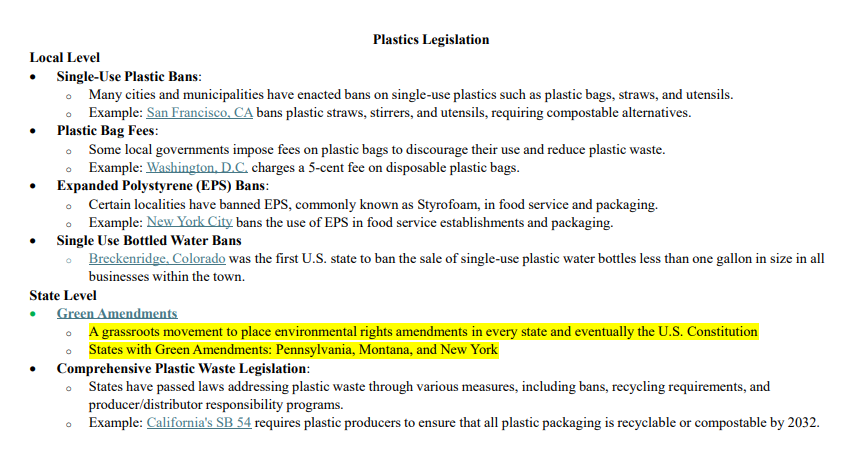
- Legislation and litigation are being used to help shift the status quo.
Examples of legislation include:
- The examples, taken from the United States context, vary between local and state levels, but it is important to also notice that pro-plastic legislation occurs in various States.

Examples of litigation include:
- Governmental agency suits – which are typically nonprofits that are suing agencies for failing to enforce laws or pushing for more stringent regulations;
- Citizen suits – they can be filed under federal laws, such as the Clean Water Act;
- Consumer protection cases – addressing consumers who have been influenced to purchase products because of misleading labels and advertising of greenwashing;
- Tort claims – filed when plastic corporations act or fail to act, causing harm to individuals and whole communities.
- Despite the variety of tort claims listed in these cases, companies are trying to put the onus on the litterbox. Consumers can be held accountable to an extent, as the legal term “reasonably foreseeable” refers to when harms are reasonably foreseeable so that a party can be held responsible. When the plastic industry produces 4 million metric tons of plastic a year, it is reasonably foreseeable that this waste is going to leach into the environment.
- Greenwashing can be shown through the example of Coca-Cola, which pledged to increase its reusable bottles by 25% by 2030. However, the amount of reusable containers it produces has stayed the same since 2021.
- In 2018, Nestlé’s CEO stated that its ambition was to achieve 100% recyclable or reusable packaging by 2025. In 2022 Nestlé tweaked the language of its plastic goals and pledged to “mostly use plastic designed for recycling by 2025” instead of the original promise to use the recyclable or reusable packaging. Most of this plastic is not getting recycled anyway and these corporations know it is not economically viable.
How litigation supports the treaty negotiations:
- Increasing public awareness;
- Pressure on policymakers to take regulatory action, underscoring the gaps in existing regulations and highlighting the need for these international treaties;
- Holding manufacturers accountable, highlighting the need for corporate responsibility in environmental matters;
- Setting precedents through these cases in environmental law such as negligence and failure to warn the public of the harms of plastics. This can shine a light on the regulatory gaps and negotiators can use these legal precedents as leverage to argue for more robust international agreements.
Anna HIRAI | Global ESG Analyst and Circular Economy Lead, Investment Stewardship Team, Legal & General Investment Management
Q: The market has seen significant movement in the investor community in the plastic industry. For instance, 185 investors with a combined 10 trillion USD in assets have signed a statement calling for companies to take drastic action on plastic. What motivated the creation of the statement? Its timing overlaps with the increase in plastics-related lawsuits, is there a connection among these?
- Legal & General Investment Management is the asset management division of Legal & General Group, a FTSE 100 company based in London, UK. We have just under 1.2 trillion pounds in assets under management, and we invest globally.
- The reason we engage on plastic pollution is that we believe linear businesses will be prone to a range of risks – such as increased raw material costs, price volatility, regulatory risks, increased momentum in plastic-related litigation, and reputation risk. As responsible investors, we are concerned that companies that do not proactively address these risks may face higher costs or lose business opportunities. Putting long-term value creation and investment returns that risk. For us, responsible investing is about good business sense.
- We invest in thousands of companies across markets and sectors, including the fast-moving consumer goods (FMCGs) companies named in this paper. If one company pollutes, we would pick up that negative impact in the rest of the portfolio. Our aim as a universal owner is to improve market standards and best practices across a range of financially material themes, including climate and nature. In addition to one-on-one engagement with our investee companies, we try to achieve these objectives by also voting at shareholder meetings, engaging with policymakers, and collaborating with like-minded investors and other stakeholders such as NGOs, academia, and industry groups.
- We found it valuable to take part in collaborative initiatives organized by, for example, VBDO (the Dutch Association of Investors for Sustainable Development), Principles for Responsible Investment, and CDP. In collaboration with VBDO, last year the investment community published a statement and wrote to FMCG companies mentioned in this paper. The letter set out our expectations for these companies, asking them to support ambitious plastic policy, deliberate absolute reduction of single-use plastic packaging, and address harmful chemicals. These FMCG companies have a significant plastic footprint but are not necessarily the laggards in terms of their targets and initiatives. We think they have the potential to bring the rest of the market along if they move in the right direction.
- While we undertake engagement with these companies, we also believe that to raise market standards, we need to engage across the value chain. Our value added as a universal owner is being able to speak with companies on both the supply and demand sides of the plastic value chain.
- During the last round of negotiations (INC-4), there was evidence of the petrochemical industry lobbying to oppose the inclusion of polymer production in the treaty. We are increasingly addressing corporate lobbying on key issues and asking companies to be more transparent. This was the context of the collective statement published two weeks ago by Planet Tracker and co-signed by us and about 70 other investor signatories. The statement was specifically addressed to petrochemical companies, urging them to take stronger action towards plastic circularity. Given the systemic nature of the crisis, we hope all companies in the value chain will be included in the treaty to level the playing field.
- Another way to ensure corporate accountability is to improve data availability and quality. The investment community can lend its support here. As a universal owner, we welcomed and have strongly advocated for the recommendations of the Task Force on Nature-related Financial Disclosures (TNFD). Disclosure is still patchy and insufficient. If mandated, this would allow us to gather comparable and consistent plastic data from these companies.
- Our role as a responsible investor and stewards of clients’ assets is to effectively engage with all parties in the value chain, driving improvements in market standards and holding companies accountable when they fail to meet our expectations.
- LGIM published its Nature Framework earlier this year, and will soon publish the Circular Economy Policy to set out some of our expectations for companies and our priorities going forward.
Asha CHALLENGER | Antigua and Barbuda Plastics INC National Focal Point | Permanent Mission of Antigua and Barbuda to the UN
Q: Could you reflect on what speakers have shared today? From your perspective as vice chair/member state, what holds the greatest relevance to the INC? How can the various stakeholders’ caucuses most effectively contribute to the INC work and the establishment of an effective plastics treaty?
- These discussions are useful and needed to share our ideas and understand each other’s positions as we move ahead to INC-5 in Busan and help us move along towards delivering an effective, ambitious, and future-proof agreement for our communities and future generations.
- We need an agreement that addresses the full lifecycle of plastics. Every aspect of plastic production causes pollution and challenges, and we must address these if we want to move towards a sustainable use of plastics. We have to tighten the tap and break our unsustainable dependence on plastic and the harmful chemicals they contains. Additionally, we must clean up and address the decades of legacy plastics we are currently contending with.
- The report, as well as all scientific papers that support the work of negotiators, are essential. Throughout the INC process, delegates have highlighted the need for scientific backing to make sound and informed decisions.
- We welcome these reports and this extensive work across all areas of the globe and reporting back on the findings in terms of the brand audits. This is very interesting and useful, highlighting that circularity is one of the answers to the problem of ending plastic pollution as we mandated in UNEA resolution 5/14. Learning that 50% of the plastic is not branded mandates calling for more transparency: we need to understand where pollution is coming from, who produces it, and what is in it. We will try to address and ensure that the agreement tackles this.
- Extended producer responsibility is a way to reduce the waste burden on communities and governments. No government can adequately carry this burden, especially in smaller communities where EPR seems to be more of a circular collection scheme. For larger benefits, smaller communities and smaller developing states like Antigua and Barbuda, we are still hoping for a greater understanding of how these can specifically address some of the most burdensome costs of plastic pollution.
- We also welcome the discussion of other policy inputs, like single-use plastic bans. Antigua and Barbuda has implemented such bans successfully. The agreement has proposals on other policy inputs, such as a reduction in subsidies and the introduction of fees and taxes. We need to think these measures can be instrumental to fully operationalizing the polluter pays principle.
- We thank Nestlé for being part of this discussion and hearing some of the criticisms and challenges from communities. Efforts undertaken are appreciated, nonetheless, we need more from producers overall and we need to tackle the greenwashing that sometimes permeates the media. We look forward to working with Nestlé and other producers to build this out as we implement and develop the treaty.
- Reuse and refill systems are a key aspect of solving the challenge. This is something that small and developing countries are looking to implement and thus best experiences are a welcomed roadmap.
- Plastic pollution is a human rights crisis, and we have no time to waste. We must ensure that health and environmental safety are paramount as we implement and develop the treaty.
- There are opportunities to implement and thread through the human rights aspect at every part of the process. We look forward to more involvement from other marginalized communities as we truly understand the full impact of plastic pollution.
- As the broad composition of today’s panel shows, we need multi-stakeholder action in this treaty. Governments cannot be alone in this process; active involvement from all communities, producers, scientists, and academia is needed.
- There are many aspects of transparency, including branding and what is in the products. We need to ensure this is fully incorporated into the process.
- We welcome scientific support and more reports to bring backing and support for the solutions we are trying to reach.
Q&A
Q: What potential legal risks are you seeing for companies that continue to use single-use plastic packaging and what kinds of legal repercussions you anticipate for companies that don’t reduce plastic use as the science recommends?
Wendy KERNER: Scientific and technological research progresses and allows to detect not only microplastics which are smaller than 5 millimeters but also nanoplastics, which are breaking the blood-brain barrier invading our bodies. Not only are there going to be property damage type pollution claims, it is very likely that the more research unveils health-related risks, the more the claims related to micro and nanoplastics.
Q: The plastics treaty is not likely to contain language addressing reduction in plastic production and will more likely be a first step in creating a Conference of the Parties type of process that will go on for decades. When do you think reductions in plastic production will effectively be implemented and enforced, as for example trade sanctions?
Asha CHALLENGER: Some countries are committed to working for a most ambitious treaty that addresses the full life cycle approach and that can ratchet up ambition as needed. There is a lot of work to be done and Antigua and Barbuda is committed to doing as much as we can to bring us the treaty we need. Time is scarce but there are ways to ensure that we learn from past lessons and avoid a lengthy mechanism. There is a strong coalition of SIDS, a High Ambition Coalition and the signatories of the Bridge to Busan Declaration on Primary Plastic Polymers, evidencing that States are working hard to secure the treaty we want.
We hope to get something we can build out and that will not take decades. The legal process or the treaty-making process on its own takes a long time but we do not have much time. Antigua and Barbuda highlighted that time is scarce, especially when the impact of legacy plastics on our communities must be addressed. I can commit to us pushing and encouraging as much as possible to address the full lifecycle of plastics as needed.
Closing
Melissa WANG
- Plastics: more production, more consumption, more pollution. Reduction is crucial for an effective plastics treaty.
- Reuse is a fashion and innovation. Reuse serves as a viable business model with proven success and enormous potential in both the Global South and the Global North, which should be encouraged with better enabling environment.
- Stakeholders across sectors are collectively calling on polluters to shoulder their responsibility and fundamentally shift their business operation to a truly sustainable one anchored on reduction and reuse. If not, risking reputational, legal and capital loss.
The INC intercessional expert group work has recently started and we hope the perspectives provided here will inspire discussion and solutions leading us to a successful INC-5.