Event Conference
Road to the First International Conference of the Global Framework on Chemicals | Accelerating Action for Safe and Sustainable Chemicals Management
01 Sep 2026
14:00 – 15:30
Venue: International Environment House I, Room 3 & Online | Webex
Organization: Global Framework on Chemicals, Geneva Environment Network
Organized on the road to the first International Conference of the Global Framework on Chemicals, this event will focus on accelerating action for safe and sustainable chemicals management.
About this Event
The Global Framework on Chemicals, adopted in September 2023 at the Fifth International Conference on Chemicals Management (ICCM5), will convene its first International Conference from 16 to 20 November 2026 in Geneva.
In preparation for this important milestone, this information session explored how governments, industry, international organizations and other stakeholders can work together to accelerate action and how the first International Conference can help drive the next phase of global action.
Accelerating action requires more than implementing existing commitments. It requires creating the enabling conditions that allow safer and more sustainable chemicals, products and value chains to become the norm. This also includes shifting from managing pollution after it occurs to preventing harm by design, supporting innovation in green and sustainable chemistry, strengthening policies and regulations, improving collaboration across sectors and value chains, and aligning investment with scalable solutions.
The discussion examined how the first International Conference can strengthen collaboration, align priorities and catalyse the next phase of implementation under the Global Framework on Chemicals. Participants also received practical information on the conference programme, key documents, partnership opportunities and registration to support meaningful engagement in the Conference.

Road to the First International Conference of the Global Framework on Chemicals Series
Member States have adopted agreements that set common goals and targets to tackle the triple planetary crisis, including the Global Framework on Chemicals – For a Planet Free of Harm from Chemicals and Waste (GFC), adopted in Bonn in September 2023 and supported by a Secretariat hosted in Geneva. This Framework provides the essential building blocks for a future in which humanity benefits from chemicals in a safe and sustainable manner, while avoiding their negative impacts.
In preparation to the First International Conference of the Global Framework on Chemicals, to be held in Geneva from 16 to 20 November 2026, the Global Framework on Chemicals secretariat and the Geneva Environment Network are hosting a series of events providing an outlook on key aspects of the Conference, offering member states and stakeholders opportunities to share perspectives and expectations.

Speakers
By order of intervention.

Vanessa ALIAGA ARAUJO
Vice President, Global Framework on Chemicals Bureau & Second Secretary, Permanent Mission of Peru to the United Nations Office and other international organizations in Geneva
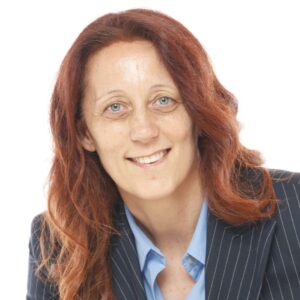
Elisa TONDA
Chief, Industry Innovation Branch, UNEP

Kay WILLIAMS
Head, Global Framework on Chemicals
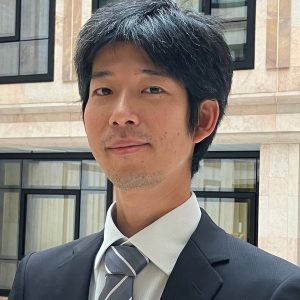
Motoo KANEKO
First Secretary, Permanent Mission of Japan to the United Nations Office and other international organizations in Geneva

Lies HEYLEN
Director of Global Product Safety at LyondellBasell | ICCA Representative
Bob DIDERICH
Head of Division, Environment, Health and Safety, OECD | IOMC

Gohar KHOJAYAN
Co-Chair, IPEN & Communications Specialist, Armenian Women for Health and Healthy Environment
Jonas PASQUIER
Minister, Global Affairs, Permanent Mission of Switzerland to the UN Office and other international organizations in Geneva

Tapiwa NXELE
Technical Project Manager, UNEP | Moderator
Highlights
Video
Summary
Opening Remarks
Vanessa ALIAGA ARAUJO | Vice President, Global Framework on Chemicals Bureau & Second Secretary, Permanent Mission of Peru to the United Nations Office and other international organizations in Geneva
- Chemicals are fundamental to virtually every aspect of modern society and to countless economic activities. At the same time, because of their importance, the inadequate management of chemicals has significant consequences not only for human health, but for ecosystems and for entire communities.
- The scale and the complexity of the challenge require us to work across sectors and throughout the entire life cycle of chemicals. That is why the adoption of the GFC in 2023 marked an important milestone. It demonstrated that collective recognition of the sound management of chemicals and waste is not only an environmental priority, but also a matter of human health, sustainable development, economic resilience and social justice.
- We must transition from commitment to implementation. That is where the first international conference on the GFC, to be held here in Geneva in November, will be an opportunity to take stock of progress, to identify gaps, to strengthen cooperation and, most importantly, to accelerate action where it is absolutely most needed.
- We need to move beyond addressing harm after it occurs and increasingly focus on preventing harm. This means strengthening science, strengthening knowledge, promoting circularity and resource efficiency, improving information transparency across the entire value chain, and ensuring that technological and industrial innovation contributes to safer outcomes.
- Implementation needs to be inclusive. Many developing countries continue to face significant challenges in addressing and accessing the financial resources, the technology and the knowledge needed to develop institutional capacities.
- The GFC must help bridge these gaps. The GFC’s success will ultimately be measured not only by the commitments that we adopt at the international conference, but by whether those commitments can be implemented tangibly on the ground.
- The GFC Fund and other efforts to mobilize resources will be particularly important. We need predictable, accessible and additional support to enable countries to strengthen their national capacities and to implement meaningful action.
- As one of the Bureau Vice Presidents representing the Latin America and Caribbean region, I would also like to emphasize the importance of ensuring that regional perspectives remain fully reflected throughout the process.
- The Latin America region has diverse national realities, but we share common challenges. At the same time, we have experiences and expertise and innovative solutions that we can contribute to this global discussion.
- The first international conference should be a space not only for reporting progress, but for building partnerships and for identifying practical solutions, because governments cannot achieve this objective alone.
- The framework will require meaningful engagement from industry, from international organizations, from the scientific and academic communities, civil society and, of course, other stakeholders.
- Today’s program reflects precisely this spirit, and the first international conference is not an end point. It is simply the beginning of this new phase of implementation.
Elisa TONDA | Chief, Industry Innovation Branch, UNEP
- In just a few months, representatives of governments, the private sector, non-governmental and intergovernmental organizations, youth and academia will come together in Geneva for the first international conference of the Global Framework on Chemicals.
- This conference is a major opportunity to take stock of where we are, assess the progress that has been made, but also to identify where we go next.
- This conference is taking place at a moment when the transition towards safer and more sustainable management of chemicals and waste is already underway across industries and countries.
- We are seeing growing interest in safer products, greener innovation, more sustainable production systems, and at the same time, significant challenges remain.
- Chemicals play a vital role in modern life and are found in almost every single product that we are using. And yet, the risks and exposures continue to affect people and the environment in ways that are not managed equally across sectors and across value chains.
- As global chemical production continues to grow, the need for action becomes more urgent.
- We need to think differently about how we are going to address the challenge. For many years, we have developed solutions that have helped us focus on managing the pollution after it has occurred. The next step is to prevent harm before it happens.
- This means designing safety and sustainability into chemicals, materials and products from the very beginning. This means moving from linear systems that create waste towards circular systems that keep resources in use for longer.
- This also means moving from isolated efforts to coordinated efforts across entire value chains.
- Many solutions already exist. Innovation in green chemistry, innovation in safer alternatives, and circular approaches are already helping companies reduce risk while building more sustainable, more resilient businesses around the world.
- Organizations are demonstrating that safety, sustainability and economic success can go hand in hand.
- Solutions alone, however, are not enough to achieve change at the scale needed. Collaboration is essential.
- Governments have a critical role to play in creating clear policies, regulations and incentives that encourage innovation and investment. Businesses have a vital role to play in embedding safer practices in the products they design, produce and sell.
- Financial institutions can help direct investment towards solutions that deliver long-term environmental, social and economic benefits.
- Researchers and scientists provide the knowledge and evidence needed to guide decisions. Civil society, workers, Indigenous Peoples, communities and consumers ensure that the transition delivers benefits for people while maintaining transparency and accountability.
- No single stakeholder can achieve that transformation alone. And the success of the Global Framework on Chemicals depends on all of us working together, learning from one another and building partnerships that turn commitments into practical action.
- This is precisely the spirit of collaboration that will gather us all at the first international conference in November.
- Participants will discuss how to better track progress, strengthen accountability and share information. They will explore how policies and markets can support safer-by-design approaches.
- They will examine how investment can be mobilized to scale up solutions, and they will consider how cooperation across sectors such as agriculture, construction, electronics and textiles can accelerate the transition that we need.
- The conference will focus on implementation, because the question is no longer whether safer and more sustainable approaches are possible. The question is how we work together to make them the norm everywhere, at that scale.
- Together we can build a future where chemicals support human well-being and economic development without causing harm to people and the environment.
Keynote Presentation | Accelerating Action for Safe and Sustainable Chemicals Management
Kay WILLIAMS | Head, Global Framework on Chemicals
- The Global Framework on Chemicals was adopted in 2023 in Bonn. It is an unusual framework in that it is multisectoral and multistakeholder, open to all participants who qualify and who will be able to come to the conference and participate.
- We have five strategic objectives and 28 targets. This year has been exceptionally busy for people in our community. We have been working extremely hard to raise capacities through our focal point network. There has been an intersessional process on measurability that has resulted in a proposal to go forward to the international conference in terms of indicators to populate the already adopted measurability structure.
- We have been active on the GFC Fund. The Bureau meeting has been overseeing all this to make sure that we are getting the good steers and direction of travel. We will have another webinar coming up towards the end of October and also some regional stakeholder meetings so that you will be able to ask questions once the papers and documents are released online.
Progress
- The Secretariat has been working with different sources of information to provide a very high-level indicative overview of progress towards meeting our targets under the framework. There are quite a lot of targets, and this assessment will be able to give you more information in the working documents. It starts to show some signals of whether we are fairly less advanced, partially advanced, or more advanced to meeting the targets, which will be coming for achievement in 2030. Some are 2035, but most are 2030.
- We have developed these scorecards for each of the strategic objectives.
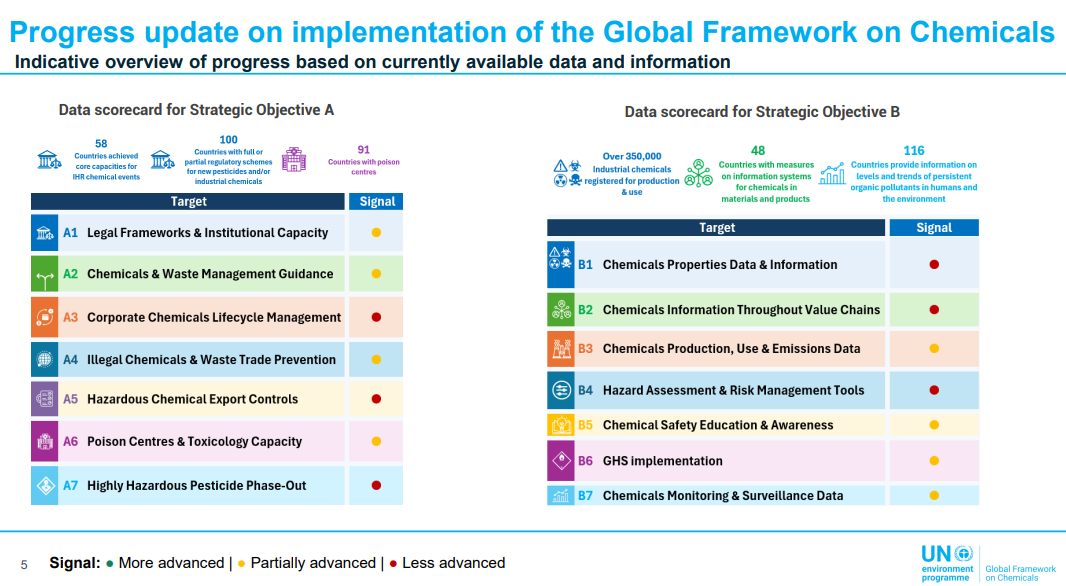
- For Strategic Objective A, which speaks about legal frameworks and institutional strengthening, we can see there is a bit of a mixed picture. There is progress in a number of areas, but there are still some areas which are less advanced and which the conference itself may decide to prioritize and move forward.
- Strategic Objective B is on data. Again, this is starting to look at the data available. Is it not only available but is accessible? Where is the data? How do we actually access and use it? And also, what about the tools that people can use to be able to put in place the measures that are necessary to manage chemicals in a safe and sustainable way?
- This overview that has been produced is not a comprehensive assessment. It is just indicative.
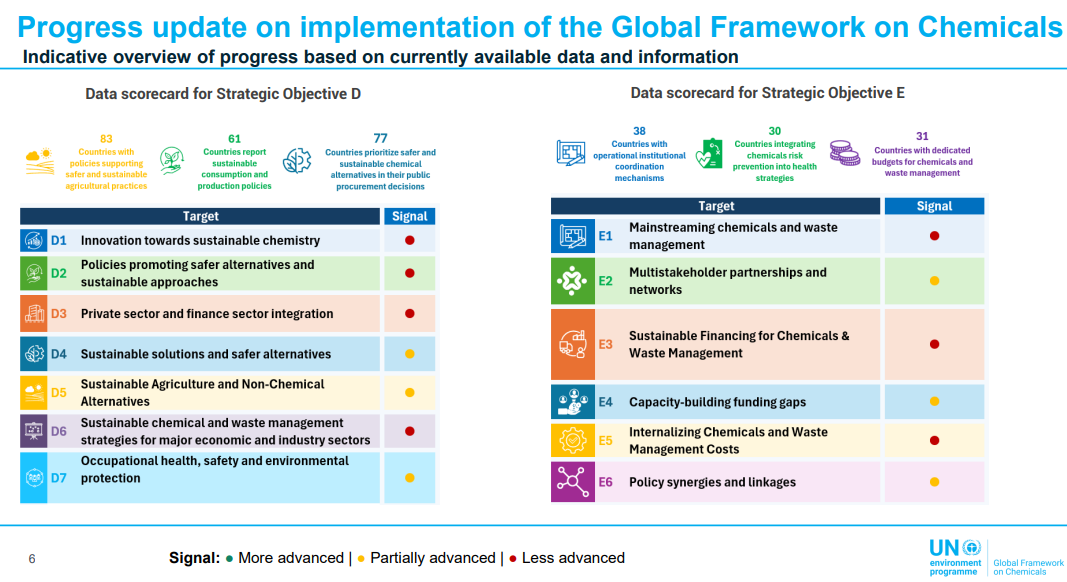
- For Strategic Objective D, we still have more reds and yellows. There is still a long way to go. We have been working very hard engaging businesses and bringing them along with us. We have many new stakeholders along the value chain that are engaging with us and taking action and working towards some of the measures that we need to transform certain sectors.
- Looking at our partnerships and approach towards resource mobilization, they have raised a few red flags, but we are also making some progress in those areas.
- In terms of the architecture and the implementation, we have been looking at supporting capacities at the national level. This is extremely important to be able to demonstrate progress on the ground.
- Working closely with the IOMC participating organizations, we have been working on the concept of global implementation programs, both for national legal frameworks but also to work with high-impact sectors such as textiles, electronics, healthcare and construction.
- There has been a lot of work going on trying to populate the measurability framework that was adopted in 2023.
- Looking at the financing architecture, we do have an operational fund. It has completed two rounds of funding and the money is now going out of the door and starting to make an impact, which is great.
- We have also developed a draft agenda action plan and have been putting that into play in some of the assessments that we have been doing.
- Collaboration and partnership. We are expanding the stakeholder network that we have so that we are reaching those stakeholders that have the levers for change.
First International Conference
- This is a milestone year for us. We do not have long until we, in fact, move forward to 2030 and achieve our targets.
- Registration for those who are self-financing is still open and it will close on 30 September 2026.
- The focus areas of the conference are: tracking progress, accelerating action and investing for impact.
Schedule
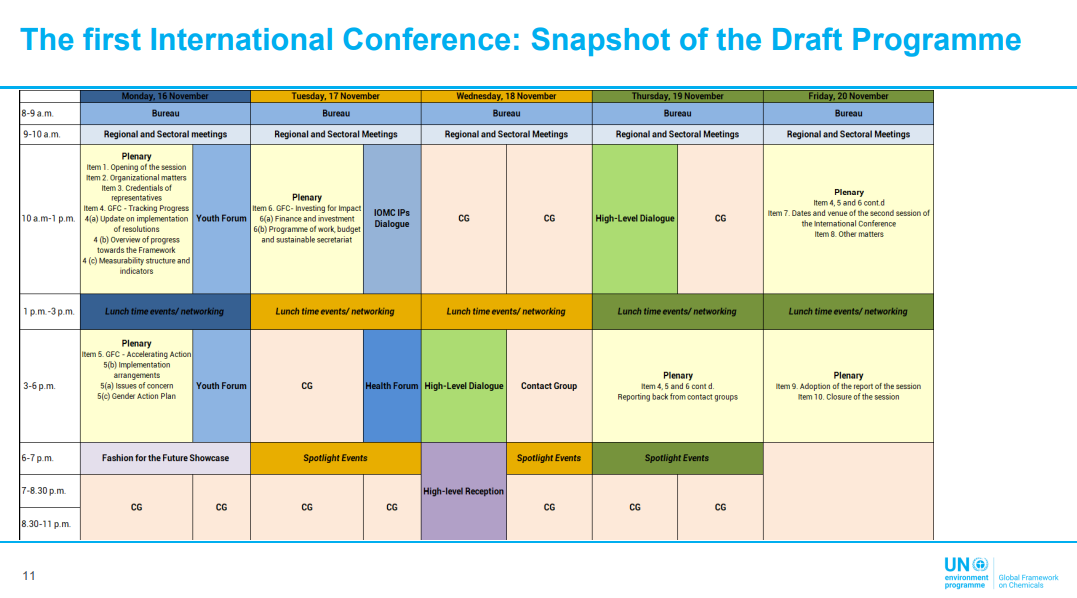
- A lot of activity will happen alongside the main discussions and negotiations, including:
- Youth Forum
- Health Forum
- Labour Forum
- IOMC participating organizations dedicated half day to talk about the work that has been progressed, particularly on cross-cutting themes such as chemical footprinting, green and sustainable chemistry, and also transparency and traceability along the value chain.
- High-Level Dialogue that will be open to all.
- Closed-door dinner for high-level delegates
- Closed session for those high-level delegates.
- Invitations are going out now. We have a very interesting program and a lot of interest from businesses, foundations, and governments wanting to come to that session. So that should be very exciting.
Desired Outcomes
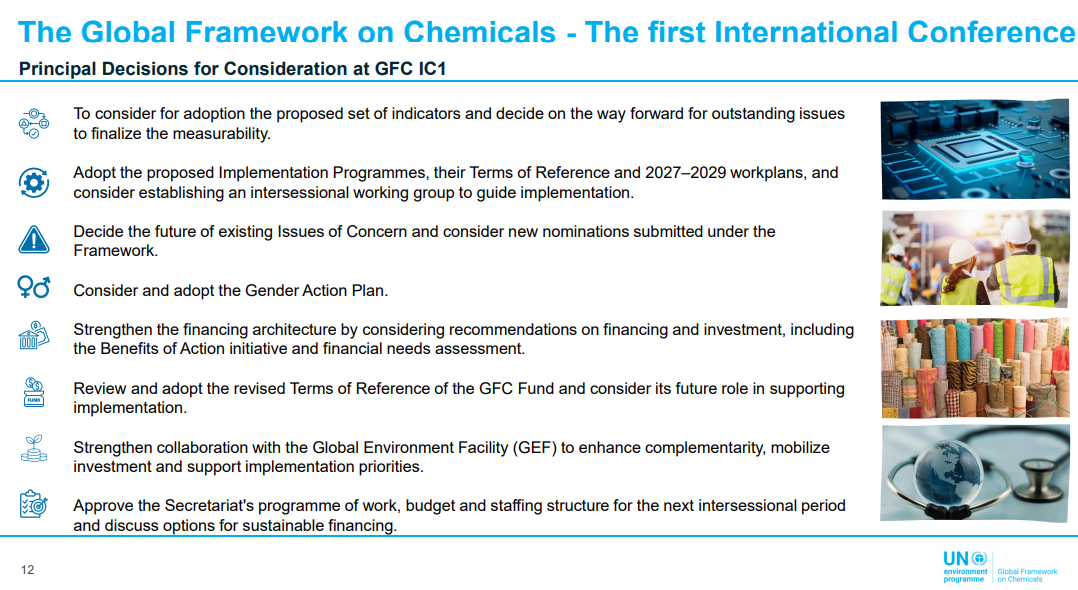
- Measurability structure | While it has been adopted, within that, it is important to look at the indicators that we want to use to assess progress. The intersessional working group has been working very hard since 2024 to try and put in place these indicators, and these will be coming forward for consideration and adoption.
- Implementation programs that we have been using as the mechanism to structure our work, and the terms of reference and work plans for the high-level implementation programs will be put forward in a working document for consideration and potential adoption.
- Issues of Concern | It was decided in 2023 to look at the fate and the future of existing issues of concern, and the IOMC participating organizations have been considering what to do with those existing issues of concern and putting forward recommendations. Alongside that, we have also received four new nominations that have been submitted under the framework for consideration.
- Gender Action Plan, currently under draft
- Strengthening the financial architecture, looking at finance and investment, including a scoping study on the benefits of action, which has looked at the methodology to see how we can, why it is important to take action and how much money that can save countries and regions and the global environment, to put forward the rationale for taking forward policies and legislation and any activities that are needed.
- GFC Fund | There are terms of reference to be reviewed. It is a very important time for the fund. A decision also may need to be taken on whether to extend the fund so that we can get all that money out to the countries where it should be deployed and implemented to raise capacities.
- Global Environment Facility | a very important financial mechanism, looking at how we can complement our funding with the GEF.
Tracking Progress
- In the measurability framework, a lot of work has begun on this framework in terms of populating it,
- We have also got two high-level indicators, the methodology of which has been worked on by experts, and the conference will be deciding and hopefully adopting a number of indicators to assess progress as we go towards 2030 and also look at whether the components of the high-level indicators just become aware of the methodologies that will be used to assess progress.
- In terms of our implementation programs, we have two high-level programs: the legal frameworks and institutional capacities, the sector programs, the economic and industry sector programs, and we have four sectors underneath there: electronics, healthcare, textiles and construction that we will be looking at.
- There will be some information about Implementation Program 3. The IOMC has been preparing some documents to support that particular program.
- A little bit more about the new issues of concern that will be coming up in November.
- There are four nominations. They have gone out for an initial consultation. One is looking at the special issues related to children’s health and chemicals. The second one is about broadening the scope of lead beyond the current issue of concern, which is focused specifically on lead in paint.
- Pharmaceutical pollution again has come in, and that is looking at broadening the scope, which is currently focused on environmentally persistent pharmaceutical pollutants. The new nomination is looking at it as more of a wider context.
- There is a proposal about new approach methodologies that help to reduce animal testing in terms of testing chemicals.
- I have touched on the benefits to action and value chain transition. This was a requirement, so this will be a very interesting scoping study, and the conference will be asked to see whether it would like to take it forward and do the full actual study itself.
- If the methodology is agreeable to the international conference, then activity will continue in that area.
- Similarly, there has been some good work looking along the cotton value chain at the investment and financial flows, and again the conference will be asked to see whether we should continue that work to other sectors.
- The GFC fund has done two rounds of funding. It is coming up for a decision on the second round of projects, which will be happening this month.
- It is very important that the terms of reference are considered and that, in fact, decisions are made on potentially whether to extend the fund.
Overview of the Programme
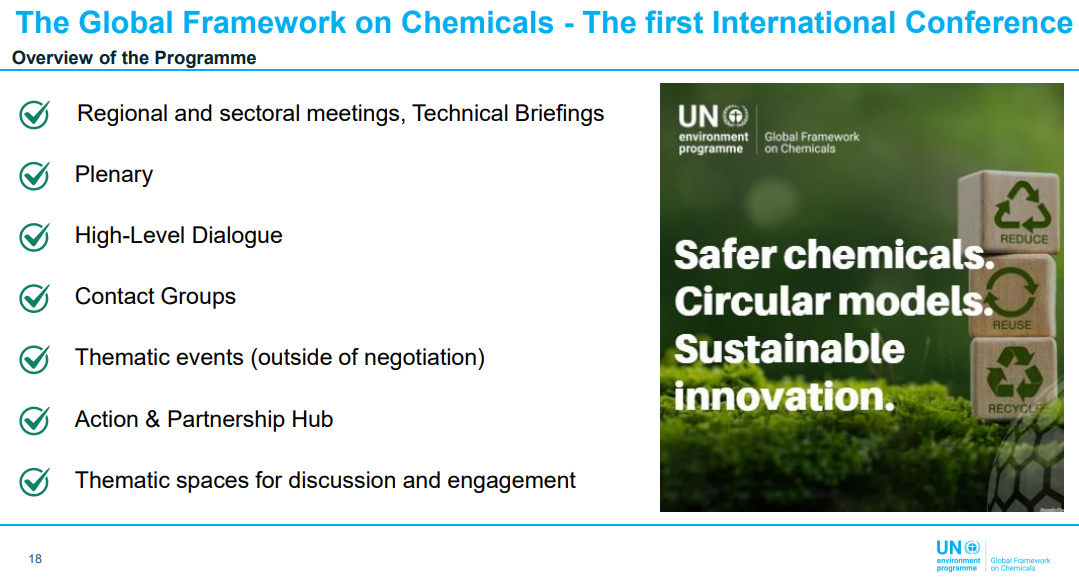
Spotlight Sessions
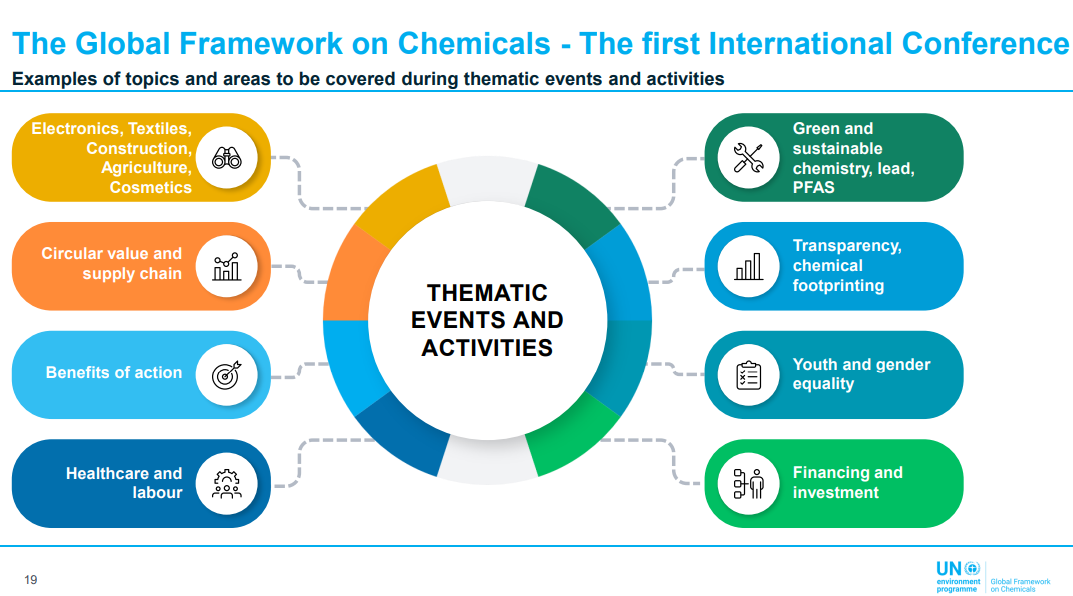
Logistic information
Panel Discussion | Accelerating Action: Preventing Harm by Design Across Sectors and Value Chains
Tapiwa NXELE | Technical Project Manager, UNEP | Moderator
- We have heard how fundamental chemicals are for our ecosystems and our communities, and we have heard compelling cases for collaboration and on accelerating the transition from managing chemical pollution after it occurs towards preventing harm by design, and for doing so across sectors and across entire value chains.
- Solutions and innovations already exist. So, we have safer alternatives already. There are advances in green and sustainable chemistry. There are circular approaches that exist, and there is growing experience on safer-by-design approaches.
- But their existence does not necessarily lead to adoption or scale-up at the speed that we are looking to have this happening. What are the solutions? What form will these solutions take for them to actually grow in the way that we want them to grow?
- That goes beyond just any one actor, and it raises questions about policies. It raises questions about the incentives that we need. What governments need to put in place, how industry can design these chemicals and the materials and products that we need, and how international organizations and civil society can help ensure that this transition takes place in the way that we want it to, and how workers and communities and civil society and others can be part of that discussion as well.
Gohar KHOJAYAN | Co-Chair, IPEN & Communications Specialist, Armenian Women for Health and Healthy Environment
- I am speaking on behalf of the International Pollutants Elimination Network, working across more than 130 countries. IPEN is committed to the GFC, contributing research and information on threats to human health and the environment from previous data that existed, as well as with organizations working on the ground.
- When we talk about chemical management, the conversation gets dropped into analysis, but as IPEN always emphasizes, it is about human rights, dignity and capital.
- Speaking about rights and human health, we must shift our approach. We must transition from managing toxic exposure to actively protecting human life.
- How is it done? We think that one essential step is clear: we cannot protect communities if we keep them in the dark.
- For decades, the chemical industry has hidden behind the shield of confidential business information. They keep secret the very ingredients that end up in our consumer products, our workplaces, our air and our water. This must, of course, stop.
- True chemical safety requires unconditional transparency across the entire life cycle of a product. Workers have a fundamental right to a safe and healthy working environment, including knowing exactly what they are handling every single day, and they also have the right to refuse dangerous work.
- Safe products must be available to consumers. Frontline communities have a right to know exactly what is being emitted into their backyard.
- But transparency is not only the first step. The right to know must be paired with action. This means upholding workers’ rights and ensuring communities have access to participation and justice.
- Furthermore, we have to change the way we test and decide if a chemical is allowed to be produced and used.
- Today, in most regions, chemicals are assumed innocent until proven guilty. Public regulatory bodies, independent scientists and civil society that is underfunded spend years proving that a substance causes, for instance, cancer or reproductive harm before any action is taken.
- Meanwhile, the general public bears the health risks and industry reaps billions in profit.
- We need to change the rules of the market. The responsibility must shift to chemical producers. They must show clear evidence of safety before any chemical is approved for use in workplaces or in consumer products.
- At the same time, we must enforce the polluter pays principle. If a chemical causes harm, the industry must be held legally and financially liable for the health and societal costs and, of course, the environmental remediation.
- The blame cannot be put on the public.
- Most importantly, our regulatory protection must be designed around the most vulnerable, not the most powerful: those who bear the highest toxic burdens, affected workers, agricultural laborers, Indigenous Peoples, women and low-income frontline communities.
- Therefore, we should judge a policy’s success on one simple question: is it actually improving the health and lives of the most impacted?
- Putting people at the center of chemical management requires shifting power away from chemical lobbies and handing it back to the public.
- We cannot achieve a healthy, toxic-free future through minor regulatory adjustments. We achieve it by demanding transparency, prevention, forcing industry accountability and protecting the most vulnerable first.
Motoo KANEKO | First Secretary, Permanent Mission of Japan to the United Nations Office and other international organizations in Geneva
- Suitable policy measures vary with each country’s circumstances, but one common and essential element for desirable change is ensuring cooperation among a wide range of actors. This is clearly reflected in the Global Framework on Chemicals, which builds on a multisectoral and multistakeholder approach.
- The Japanese government has led the development of the National Plan of Action for the implementation of the GFC, which serves as the basis for relevant policies and activities. While the plan focuses primarily on national policies and projects, it also describes the expected roles of local governments, businesses, citizens, and private organizations.
- The plan was developed with the involvement of various ministries, including those responsible for the environment, health, the economy, agriculture, and other sectors. This multisectoral engagement aims to ensure efficient implementation, as well as proper development, review, and revision of the plan.
- Furthermore, a policy dialogue has been established in which a wide range of stakeholders participate, including citizens, local governments, academia, business associations, and labor organizations. It has been advancing discussions to support the plan’s development and effective implementation.
- Such stakeholder engagement improves the transparency of policymaking and builds a foundation for each actor to identify its role and to drive actions on the ground.
- As for promoting innovation and investment, an appropriate mix of policy measures is important. In addition to regulatory measures, other policy tools should be considered, such as information disclosure and policies related to procurement, finance, and investment.
- As an example, the Japanese Ministry of the Environment launched a dialogue this year with chemical companies, investors, and financial organizations. This dialogue examines how companies’ activities for sustainable chemicals management can be connected to the evaluation of corporate value, investment and financing decisions, and better communication with investors and financial organizations.
- Through such public-private dialogue, it is essential to foster an enabling environment in which companies’ advanced initiatives are properly evaluated and financed, and investment for sustainable chemistry can expand.
- International and regional cooperation are essential. Since current supply chains and value chains extend beyond national borders, Japan, as a regional focal point for the Asia-Pacific, is working on supporting the promotion of the Global Framework in the region and is holding webinars and conducting initiatives to facilitate information sharing and capacity building.
- A better understanding of the GFC and the lessons through such activities will help drive sound chemicals management throughout the life cycle.
Tapiwa NXELE | Technical Project Manager, UNEP | Moderator
- We heard very interesting points there about the value of cooperation, collaboration, and dialogues that come in different forms. We had some examples of initiatives and systems, including transparency, visibility of policymaking, and policy tools related to procurement, finance, and investment. This also touches on what we heard earlier from the interventions, touching on transparency, visibility, and how valuable and important that is.
- It would be good to see how we can translate some of these policy solutions we have heard into products, into supply chains, and into business practices.
- Safer alternatives and green chemistry solutions already exist. What practical changes are needed to make safer and more sustainable chemicals, materials, and products the norm, and how can we shift that from being the exception?
Lies HEYLEN | Director of Global Product Safety at LyondellBasell | ICCA Representative
- Green chemistry and solutions align with the ambitions that we formulated under the GFC, and that is to guide our products, including processes, so that the whole portfolio moves towards sustainable solutions. It is also reflecting what the industry is already doing and is in a transformation together with its members, ICCA members, but also value chain partners.
- Safe and sustainable by design is not just about developing a less hazardous molecule. It is also about improving manufacturing processes, reducing emissions, supporting circularity, resource efficiency improvements, strengthening product stewardship, and ensuring the safe use of the chemical throughout its life.
- Education is so important, and it would be fantastic if we could make safe and sustainable by design an integral part of modernized education and as a core training, not just as an add-on, so that our future chemists, innovators, engineers, designers, and so on, they can really have that as part of their DNA. That would be a fantastic step forward if we could achieve that.
- In the industry, we are already considering that safe and sustainable by design is really an excellent trigger for innovation; we are embedding it more and more into our existing stage-gate processes, where it is no longer used as a final check-the-box on compliance, but really as the key criteria to do the innovation.
- We need to have hazard exposure data, life cycle impacts, we consider circularity, the performance, obviously, of the material, but also the resource efficiency. At the beginning of an innovation or an R&D project, that immediately brings us as well to one of the barriers, because safe and sustainable by design brings us a little bit into uncharted waters, and we need to have data.
- Early data is very difficult to get early in the design process. So, we need to make decisions without having a comprehensive set of hazard or exposure data or life cycle data.
- What we need is predictive tools and digital modeling, where possible. We need to have that brainpower. So, we need shared data platforms, but also exchange on scientific methodologies to help the innovators to come to better decisions sooner in the process.
- Safe and sustainable-by-design methods should really remain practical, science-based, and adaptable, and allow for a transparent trade-off at the beginning of a research process.
- It is not just the chemical producer who will decide what a success is from a sustainability or from a safer solution side, but it is all downstream users, the retailers, investors, policymakers, researchers – they will all influence what a successful solution is.
- That means as well that we need to have that information flow. So, the alignment with the value chain, but also the information flow across the value chain in such ways that it is useful and practical. That is where capacity building is becoming very important, equally important.
- The safe and sustainable by design principles in innovation also mean we need to make sure that people can understand what they see. But also, in many parts of the world, it is still the strengthening of fundamental chemicals management that is the most effective way to improve overall safety and the safe use of the chemicals.
- The Global Framework can also play a fantastic role in that. If we have alignment across the value chain, we have better data at the early stage; we know what we could do on the innovation side.
- We really need this because it takes time, effort, and investment to understand what the policy frameworks are, what are the priorities long-term, so that we can direct research, capital, and talent.
- Again, in this whole journey towards safe and sustainable solutions, we may have to make trade-offs, and then we need to have signals where it matters: which priority matters most.
- That is, in a nutshell, what the industry is looking for, but also what the industry is doing right now.
Tapiwa NXELE | Technical Project Manager, UNEP | Moderator
- How does it require stronger collaboration across governments, industry, workers, academia, and civil society? Where do you see the greatest opportunities to strengthen collaboration across sectors and across value chains?
Bob DIDERICH |Head of Division, Environment, Health and Safety, OECD | IOMC
- For the first part of your question about collaboration, Elisa perfectly outlined what is the role of the different stakeholders in the value chains, from the chemical industry needing to develop the safer alternatives, provide information on the safer alternatives, product manufacturers needing to integrate these alternatives and change production processes, and so on, all the way to recyclers and waste management companies that need to know what chemicals and materials are in the garments and how to recycle them safely.
- For the second part of the question: where do I see the greatest opportunities to improve this collaboration between the different stakeholders? I see two big topics.
- Traceability | Companies that put products on the market very often do not know what chemicals are in these products. So having systems that allow any actor in any part of the value chain to know the inputs and outputs in terms of chemical contents in the processes and products sounds to me to be one of the prerequisites of moving towards safer alternatives. This is not straightforward; as of today, not even OECD countries have solved. There are certain new initiatives, like the product passports in the European Union, that try to address the issue. But we are very far from having systems that have actually proven their practicality. That is one of the areas that we really need to work on in the future.
- Development or the strengthening of sustainability reporting and the development of standards for sustainability attributes | This means more sustainable chemicals; we want them to be safer. We know what that means. We know what it means to be safer. But we also want them to be more carbon neutral. We want them to be more energy efficient. We want them to use less water, and so on and so forth. This information needs to flow up and down the supply chain to give the different actors a way to choose the better solutions for themselves. We need to standardize this information flow, to agree on how we measure the different attributes of sustainability.
- Collaboration between innovators and regulators must be institutionalized | To achieve that, regulators need to create trusted environments where innovators and regulators can exchange, because neither are currently wired to do so.
Innovators do not want to make regulators aware of what they are working on, and regulators do not want to say anything that is not covered by legislation. So as soon as we move to new chemical solutions that are borderline covered by regulation, things start to become difficult.
One aspect of making sure that new sustainable solutions do come on the market is to make sure that we have an environment where regulators and innovators can talk to each other at very early stages, so that we can develop the tools that make sure that these new, innovative chemical solutions that are coming on the market are indeed safer and do not get caught by regulation after industry has invested many millions of euros in the development and production of the solution.
Tapiwa NXELE | Technical Project Manager, UNEP | Moderator
- Many safe alternatives and sustainable chemistry solutions already exist, but what is preventing these innovations from being adopted at scale, and how can those barriers be overcome?
Lies HEYLEN | Director of Global Product Safety at LyondellBasell | ICCA Representative
- There is not one chemical for one application. There is a multitude of chemicals that go in a multitude of applications, sometimes in different applications serving different purposes.
- The global value chain is very complex and it is necessary to find the right balance again in what is truly needed, how it can be produced at scale, and how to make customers and consumers accept that as a solution.
- If you have to start making a trade-off between the environmental aspect, the life cycle, the hazard, the affordability, and equality, you have losers. Ultimately, we will get there, but we need to have that journey and we need to understand where those trade-offs are. That is what is making it so complex.
- If you want to substitute a well-established chemical with alternatives, our company has been working on solutions for some of our chemicals, and we see that instead of having a single solution for a large number of customers and technologies and so on, we end up with a multitude.
- This could mean reduced efficiency and costs going up. Who is going to pay for it? That is what is making it so complex to get into those global, complex value chains and find the right balance so that market pull that creates a deliberate market, for example by public procurement or by imposing certain target levels in materials, could create that demand. Or giving incentives, tax incentives, not necessarily on production but on the uptake of the solution, could help to create that market.
- This regulatory coherence: different regions, different countries may need different solutions, but at least we should have aligned definitions, aligned or workable pathways, transition pathways. Again, the word transition: we will get there. It is a journey, but how to get there across jurisdictions, reducing that fragmentation, is really important.
- Innovation is costing money. Nobody is doing this for free. But you need to invest in that whole value chain. It is not just at one end, not at the beginning or at the end. It is all those actors in that value chain. That whole chain needs investment.
- It is the tools, the data, the capacity building. We need to invest in that, make sure that we understand where we are going, and accept that, for example, we are applying new approach methods which are deviating from established OECD methods potentially, but allow them to be used so that you can start using the predictive tools and so on.
- Producers, consumers, customers, policymakers, investors, all of civil society will dictate and all have a role in turning that innovation into impact.
- It is complex, and taking it step by step and working on those four elements, for me, would be a game changer.
Tapiwa NXELE | Technical Project Manager, UNEP | Moderator
- What unique role can civil society play in accelerating the shift from managing chemical pollution to preventing harm, and where can it have the greatest impact?
Gohar KHOJAYAN | Co-Chair, IPEN & Communications Specialist, Armenian Women for Health and Healthy Environment
- This question gets to the very heart of why networks like IPEN exist.
- For decades, international policy focused on managing chemical pollution. This approach accepts toxic pollution as inevitable, and it focuses on finding safer ways to dispose of waste, setting acceptable so-called limits of exposure, or cleaning up contamination after the damage is done.
- But management is a failing strategy. It is reactive. It is expensive. It ends up harming the health of local communities.
- We must shift the entire global paradigm towards prevention. This means removing toxic risks at the design stage, not after.
- Government agencies are often slowed down by bureaucracy. Industry is driven by profit, and CSOs are uniquely positioned to bridge this gap. We are the only actors with the independence, the grassroots connection, and the clear focus needed to speed up this transition.
- Sharing independent science has the greatest impact on true harm prevention. This helps ensure that policy decisions are based on data, not just industry influence.
- Public agencies frequently experience intense pressure from commercial interests during this decision-making process. This happens when the chemistry industry dictates the science, stops legislation, weakens safety standards, and civil society helps correct this imbalance by providing independent data.
- Our impact is greatest when we expose the gaps between industry claims and reality. CSOs conduct independent citizen science, fund non-industry testing, track toxic chemicals in consumer goods, and conduct biomonitoring by delivering independent facts directly to the public.
- Civil society encourages regulators to stop managing risks and start banning hazardous chemical classes entirely. The global campaign to eliminate lead paint is a clear example. Our approach of basing action on local data has supported regulations in over 30 countries.
- Second, civil society acts as a vital bridge. We connect local needs with global platforms. The GFC relies on civil society to keep the focus on real people, based on the needs that come from a wide range of local groups. It is pushed forward by the hard work of activists who see the real-world impacts.
- Our impact here is greatest when we push for global policies based on the precautionary principle. This principle means that we do not wait for the harm to happen. We should take action even before we have 100% scientific proof.
- Civil society helps global platforms focus on stopping toxic production at the source rather than just organizing how we dispose of waste. This is at the core of IPEN’s call for banning PFAS as a class.
- And finally, civil society has the unique power to bypass slow legislative processes. We can drive harm prevention by targeting corporate supply chains directly and promoting non-chemical alternatives.
- For example, governments can take decades to pass a single chemical ban. In contrast, civil society can change corporate behavior rapidly by organizing public campaigns and educating consumers.
- When CSOs expose the presence of hazardous chemicals in everyday items like electronics, clothing, and food packaging, they create massive reputational risks for brands. This public pressure forces retailers and manufacturers to adopt phase-out policies long before governments require them to do so.
- By shifting market demand towards green chemistry and safe, non-toxic alternatives, civil society fundamentally drives the market to prevent harm at the design stage.
- The work by Pesticide Action Network, IPEN, labor unions, and others to document and provide evidence for the need to phase out HHPs and replace them with safe approaches such as agroecology shows the success of this model.
- And just to conclude, civil society is not a participant in chemical management but the vital driving force for harm prevention. We do not accept the narrative that toxic pollution is the price of economic progress.
- By holding industry accountable, making science open and independent, and demanding prevention over management, civil society can shift the boundaries of what is politically possible.
- Indeed, IPEN appreciates the nature of the GFC, which is multistakeholder, participatory, open, collaborative, and with great potential to drive a people-centered transition together.
Tapiwa NXELE | Technical Project Manager, UNEP | Moderator
- How can partnerships such as the IOMC help avoid fragmented efforts, and how can it support more integrated implementation?
Bob DIDERICH |Head of Division, Environment, Health and Safety, OECD | IOMC
- This can be explained through the example of legal frameworks for managing chemicals, which is one of the implementation programs to be discussed at the First Conference.
- Setting up an efficient and effective legal framework for managing chemicals is actually a whole-of-government approach. Several building blocks make up an efficient and effective chemicals management system, such as the management of specific types of products, such as pesticides; the management of industrial and consumer chemicals; or horizontal issues like classification and labeling through the GHS, occupational health and safety, or consumer safety, but also safety of facilities.
- Prevention of chemical accidents, integrated pollution prevention and control, and then overlaying issues like enforcement, for example through customs controls.
- Each of these building blocks is very often under the responsibility of different governmental actors and different stakeholders.
- Through the participating organizations of the IOMC, we cover, as part of their individual mandates, most of those building blocks. We have the opportunity to collaborate and coordinate our actions to help countries analyze their chemical management system, identify priorities for further development, and help them address gaps that they have identified.
- It also means that we can bring the right stakeholders to the table, or in this instance, to the international conference.
- We also know that coordination and collaboration between, for example, international organizations, or on the other side, between different branches of government or agencies, is not straightforward and costs a lot of effort.
- The IOMC is not the only one struggling with this. Governments are doing so as well.
- The Secretariat has developed training for national focal points to help them make sure that the right parts of governments that are concerned with different building blocks of an effective and efficient chemicals management system are engaged in the process, and even, if possible, participate in the conference.
- The IOMC participating organizations have managed, or are trying to establish, what we also expect from each government, meaning having a coordinating mechanism in place that allows them to implement a whole-of-government approach towards chemicals management.
- It is just one model, but it is important that we demonstrate also at the level of international organizations that we can do so and that we can be successful.
Tapiwa NXELE | Technical Project Manager, UNEP | Moderator
- Looking really ahead to the First International Conference, what outcomes would help accelerate implementation of the GFC and create lasting momentum beyond the Conference?
Motoo KANEKO | First Secretary, Permanent Mission of Japan to the United Nations Office and other international organizations in Geneva
- Every agenda item is important, including indicators, issues of concern, and adoption of implementation programs. We expect fruitful outcomes on each of these matters.
- As for Japan’s focus, we are especially interested in the following two issues: setting progress management indicators that are manageable and realistic; and further strengthening chemical substance management through the promotion of multi-stakeholder involvement from industry and others, utilizing various policy measures.
- Our second interest includes progress on Implementation Program 2 and related activities. In this regard, the Japanese Government and relevant stakeholders from Japan have actively engaged in the work of the Open-Ended Ad Hoc Group on Measurability and Indicators and relevant work streams.
- Under Implementation Program 2, in particular, we hope to see progress across the value chain by building linkages among the following elements, namely chemical substance management by companies, information transparency and disclosure, innovation for sustainable chemistry, conflict evaluation, and finance and investment.
- To connect these activities to continuous implementation, it is crucial to take a broad view of resource mobilization. This includes promoting private-sector investment by mainstreaming the sound management of chemicals and waste in relevant sectoral plans and budgets, and utilizing financial mechanisms, including the GEF Fund and the GFC, depending on their respective laws.
- The adoption of documents is an important outcome. Adopted indicators and implementation programs should be linked to concrete activities, capacity building, and implementation by each country and each stakeholder.
- We expect that fruitful discussions and outcomes on the agenda items mentioned earlier will accelerate implementation of the Global Framework on Chemicals and create lasting momentum beyond the conference as they draw wider attention.
- Japan will continue to contribute to the implementation of the GFC actively and consistently.
Tapiwa NXELE | Technical Project Manager, UNEP | Moderator
- We started hearing about the connection between human health and the rights that we have, and how that connects with the environment: that there is a right to know paired with a need for action.
- A common theme touched by various speakers is the importance of collaboration and cooperation, and the different forms in which we have this is taking place.
- We also touched on how we can connect policy with action, and a key theme that came out here was transparency and traceability. This is going to be one of the key discussion points taking place at the international conference. It is also one of the implementation programs that we have under that framework.
- We also looked at the need for practical solutions to identify gaps and trade-offs. We need to reduce the fragmentation as a way to overcome this challenge.
- There are examples of chemical substance transparency, chemistry innovation, finance and investment. These are three key levers that we have to have there for that kind of change to happen.
- The fourth lever is collaboration and partnership.
Closing Remarks
Jonas PASQUIER | Minister, Global Affairs, Permanent Mission of Switzerland to the UN Office and other international organizations in Geneva
- One of the central questions of the GFC is: How can we move from managing harm to preventing it in the first place?
- This shift towards prevention by design requires action across the entire value chain. It means, first, creating the right conditions for innovation and, second, ensuring that safety and sustainability are considered from the very beginning.
- We all have a role to play for these shifts to happen. Governments, on the one hand, can provide enabling policy and regulatory frameworks, while industry, investors, science, and civil society, where we heard many examples today, can contribute to developing, financing, and scaling up solutions.
- It is an all-hands-on-deck approach that Switzerland strongly supports and that we want to bring into practice also here in Geneva.
- Switzerland will continue to support that as a host country of the GFC Secretariat and of many key institutions of the chemicals and waste governance clusters. We will also do that, hopefully together with you, as host of the upcoming conference of the GFC, notably the first international conference of the Global Framework on Chemicals.
- This conference should help us identify concrete opportunities to accelerate actions in support of the 28 targets of the GFC.
- We are committed to doing that. Let us not only meet in Geneva with challenges on our minds. These are important, but we should also come with solutions in our hands.
- We heard a handful, and more than a handful, today, and I felt a willingness to work together to make those solutions not only action in some niches, but really the new norm.
Photo Gallery
Photo credits © Global Framework on Chemicals


