
Event Conference
Special Rapporteur on Toxics: Overcoming Barriers to Justice in Toxics Cases | HRC60 Side Event

16 Sep 2025
13:00 – 14:00
Venue: Palais des Nations, Room VIII
Organization: Special Procedures of the UN Human Rights Council
In the framework of the 60th Regular Session of the Human Rights Council (HRC60), taking place in Geneva from 8 September to 8 October 2025, the Special Rapporteur on the implications for human rights of the environmentally sound management and disposal of hazardous substances, convened a side event to reflect on the thematic report presented by the Special Rapporteur entitled “Guidelines on access to justice and effective remedies in the context of toxics” (A/HRC/60/34). This event is co-sponsored by the Permanent Mission of Côte d'Ivoire and the Geneva Environment Network .

About this Event
Impunity is aggravating the increasing toxification of our planet and the resulting infringements of human rights, such as the rights to life, health and a clean, healthy and sustainable environment. Individuals and groups exposed to hazardous substances and wastes suffer from reproductive injustices, neurological impairments, and various types of cancer, among other serious health conditions.
However, in their struggle for justice and remedies, victims often encounter heavy obstacles that result in delays or denial in accessing their rights. Obstacles such as an unreasonable burden of proof, an inadequate statute of limitations, and financial barriers entrench impunity, exacerbate environmental injustices and undermine the preventive, restorative and compensatory functions of legal systems.
With contributions from States Members of the United Nations, international organizations, non-governmental organizations, Indigenous Peoples, and academics, the UN Special Rapporteur on toxics and human rights developed a set of guidelines to overcome obstacles in access to justice and effective remedies in the context of toxics (A/HRC/60/34).
Leading experts who joined the side event of the UN Special Rapporteur will examine standards and sharing experiences and barriers/good practices around access to justice in the context of toxics. They discussed the ways in which countries applying guidelines can guarantee and strengthen access to justice in the context of toxics and next steps.
Environment @ HRC60
The 60th Regular Session of the Human Rights Council (HRC60) is taking place in Geneva from 8 September to 8 October 2025. Consult this regularly-updated page that highlighted the environmental-related activities of this session.

Speakers
Ahou Rosine KANGAH
Minister-Counsellor, Chargée d’Affaires, Permanent Mission of Côte d'Ivoire to the UN Office and other international organizations in Geneva

Marcos ORELLANA
UN Special Rapporteur on toxics and human rights

Marco KEINER
Director, Environment Division, UN Economic Commission for Europe

Ana Maria SUAREZ FRANCO
Secretary General, FIAN International
Marianna BOLSHAKOVA
Legal Adviser, UN Environment Programme

Diana RIZZOLIO
Coordinator, Geneva Environment Network | Moderator
Highlights
Video
Live from Palais des Nations
Summary
Opening
Ahou Rosine KANGAH | Minister-Counsellor, Chargée d’Affaires, Permanent Mission of Côte d’Ivoire to the UN Office and other international organizations in Geneva
- The Probo Koala toxic waste case of 2006 is a national tragedy that leaves a deep wound in Côte d’Ivoire’s memory. Severe health and environmental consequences are recorded, while impunity and barriers to justice are exposed.
- Such tragedies are not isolated. Communities worldwide are reported to face similar harm. Common obstacles are overwhelming evidentiary burdens,inadequate statutes of limitations, and prohibitive litigation costs. These obstacles are seen to fuel injustice, deepen suffering, and undermine trust in institutions.
- The thematic report is a major step forward. Its recommendations are viewed as benchmarks for strengthening accountability, combating impunity, and ensuring the effectiveness of fundamental rights, including the right to life, health, and a clean, healthy, and sustainable environment.
- This event is an opportunity for experiences to be shared, concrete solutions to be identified, and ways of implementing the Special Rapporteur’s recommendations to be explored. The fight against toxic waste is a collective struggle.
that progress requires: the action of States,the support of international organizations, the engagement of civil society, and the expertise of the academic world. - Only through united efforts can justice be brought to victims and the recurrence of tragedies prevented.
Keynote Presentation
Marcos ORELLANA | UN Special Rapporteur on toxics and human rights
- In my last report to the Human Rights Council (A/HRC/60/34), I focus on the elaboration of guidelines that serve as tools for overcoming a crisis of accountability regarding exposure suffered by countless individuals and groups worldwide in connection with hazardous substances and wastes.
- The planet is facing a triple planetary crisis of climate change, ecosystems and biodiversity loss, and toxic pollution. Impunity faced by victims of toxic pollution is aggravating the increasing toxification of the planet. For millions of people worldwide, exposure to toxics is equated with fear, anxiety, illness, disabilities, or premature and painful death.In the efforts to secure remedies for such violations, numerous obstacles are encountered.
- The report presented to the Council is structured in three main parts, which discuss:
- Elaborating on human rights standards concerning access to justice and effective remedies. Human rights law already recognizes that access to justice and, effective remedies are a crosscutting and key pillar of the human rights
framework. Remedies should be adequate, timely, accessible and enforceable to make a cornerstone of the system. Examples from jurisprudence of global and regional human rights monitoring mechanisms and courts:
-
- In the case Cáceres et al. v. Paraguay, the Human Rights Committee finds that, in addition to violations of the right to life, an effective remedy is not granted because investigations are slow and do not lead to redress.
- In cases of asbestos exposure in Switzerland, the European Court of Human Rights holds that a person who could not have known the harm resulting from exposure cannot be deprived of a remedy under statutes of limitation, which is found to violate the right to a fair trial.
- In Inhabitants of La Oroya v. Peru, the Inter-American Court of Human Rights found a violation of the right to remedy, since a constitutional court judgment is not implemented for many years.
- In the case of toxic dumping by Trafigura in Côte d’Ivoire, the African Court on Human and Peoples’ Rights, although the African Charter does not explicitly include a right to remedy, reinforcement of such rights is provided through the Bamako Convention on hazardous waste, which prohibits toxic waste imports into Africa.
- There is a strong basis for access to justice and access and effective remedies when applied in the context of toxics, but barriers and obstacles are creating a gap between international standards and the lived realities of victims and families. Among the barriers are:
-
- Inadequate laws: Environmental laws have often minimized and managed risks without adopting a human rights approach. Where domestic laws are inadequate, it results in legalized poisoning of people with human rights infringements.
- Limited standing: In many jurisdictions, standing to go to court is restricted to direct victims, depriving civil society and communities of the ability to bring collective actions despite the diffuse interests at stake in toxic-related cases.
- Latency periods: The long latency between exposure and illness creates uncertainty and fear for exposed communities. Statutes of limitation obstruct effective remedies in such contexts.
- Human rights treaties are being established not for states but for people under their jurisdiction, giving them a collective nature. Remedies to serve not only to restore victims but also to deter violations and strengthen the legal order. A broad range of remedies, tailored to each situation, is beyond compensation and cleanup.
Other obstacles include a lack of access to information, difficulties with the burden of proof, financial costs, undue delays, linguistic barriers, misapplication of forum non conveniens, and corporate restructuring or divestment.
Good practices and innovations are :
- In Cordella v. Italy and La Oroya v. Peru, the European Court of Human Rights and the Inter-American Court establish that once exposure to hazardous substances is proven, victims are not required to prove direct causal links to illness; proof of exposure to the hazardous substance itself is sufficient.
- Application of the precautionary principle is important.
- Expanded legal standing, transboundary justice, recognition of legacy pollution, specialized courts, and tailored remedies are best practices.
The report distills 24 guidelines for consideration by the Human Rights Council, aimed at strengthening legal systems and judicial practices in cases involving toxics.
Panel Discussion
Marianna BOLSHAKOVA | Legal Adviser, UN Environment Programme
- The 24 guidelines draw the attention of Member States to issues of major importance for environmental law. UNEP has supported and promoted the environmental rule of law for decades at both national and international levels.
- Close collaboration is carried out with the OHCHR to promote recognition of the linkages between the environment and human rights. Joint work has contributed to the recognition by the General Assembly of the right to a healthy environment.
- Over the last years, UNEP has developed detailed assessments on the status and trends in environmental rule of law. A first report was published in 2019, followed by an updated assessment in 2023. These assessments strongly support many conclusions and guidelines in the Special Rapporteur’s report. These are linked to all 24 guidelines, specifically on standing; enabling environments and defenders; and specialized tribunals and judicial training.
- Standing (Guideline 6): A growing number of countries specifically provide open standing in environmental cases, allowing any legal person to bring an action to protect the environment, whether directly affected or not. Open standing enables environmental NGOs and civil society groups—those best placed to identify violations—to seek protection and remedies. By 2021, at least 45 states adopted laws or procedures on open standing in environmental cases. In some states, provisions are included in framework environmental statutes; in others, they are provided in constitutions or established through judicial precedent. In addition, 24 states give NGOs special standing rights and expand definitions of “concerned” or “interested” parties, particularly for public interest or citizen suits.
Regional treaties also promote expanded standing. Under the Aarhus Convention, numerous compliance committee findings address the issue. More recently, the Escazú Agreement explicitly obliges states (Article 3) to provide broad active standing in defense of the environment. Despite progress, much work remains, and the guideline promoting expanded standing at the national level is strongly welcomed. - Enabling environment and defenders (Guideline 7). States are called upon to guarantee conditions free from threats, violence, and harassment. Threats to defenders are increasing in frequency and severity. UNEP’s 2019 and 2023 reports document intimidation, killings, assaults, criminalization, defamation, and other attacks designed to create chilling effects. Between 2012 and 2021, at least 1,733 environmental defenders in 61 countries are murdered—an average of one killing every two days. In 2021 alone, 200 defenders are killed. Many of these deaths are connected with the protection of ecosystems and the rights of indigenous peoples. Explicit legal protections for defenders reinforce rights to participate and protest in defense of the environment. Around 48 states (25% of UN members) enact specific protections, either through domestic law or ratification of treaties. Some domestic frameworks grant registered organizations special status and defense measures. Yet laws alone are not sufficient, as enforcement is inconsistent. Among the ten countries with the highest numbers of defender killings, half already have laws in place. To address this gap, training is essential for local authorities, enforcement agencies, and private security actors. Courts also play a key role in ensuring enforcement and prosecuting offenses against defenders.
- Specialized tribunals and judicial training (Guidelines 12 and 13). Environmental matters are described as highly technical, often requiring expertise that proponents of projects possess more than judges or governments. Specialized knowledge is therefore considered critical for judges and all parties involved. Specialized tribunals are highlighted as offering key benefits: faster resolution of cases, better-quality decisions, prioritization of environmental matters, and the advantage of judges with specific training and accumulated experience. There currently are 2,116 specialized tribunals across 67 countries. These take diverse forms, such as special courts, environmental benches, or hybrid arrangements. However, challenges remain, including a lack of government support, competing priorities, limited IT infrastructure, and weak enforcement. Such issues can lead to slow appointments, failure to reach quorum, and reluctance by plaintiffs to file cases. The importance of ensuring that judges—whether in specialized tribunals or general courts—receive adequate training is strongly stressed.
As of 2020, 39 countries have judicial training institutes, including environmental law in their curricula. UNEP actively promotes this, cooperating with other UN agencies, global judicial networks, and regional institutions such as the EU Forum of Judges for the Environment. Yet far more training is recognized as needed, especially at national and subnational levels.
- Standing (Guideline 6): A growing number of countries specifically provide open standing in environmental cases, allowing any legal person to bring an action to protect the environment, whether directly affected or not. Open standing enables environmental NGOs and civil society groups—those best placed to identify violations—to seek protection and remedies. By 2021, at least 45 states adopted laws or procedures on open standing in environmental cases. In some states, provisions are included in framework environmental statutes; in others, they are provided in constitutions or established through judicial precedent. In addition, 24 states give NGOs special standing rights and expand definitions of “concerned” or “interested” parties, particularly for public interest or citizen suits.
Ana Maria SUAREZ FRANCO | Secretary General, FIAN International
- The situation on the field is concerning. Denunciations are received every month, not only from affected communities but also from accompanying social movements. Whereas in the past, exposure mainly concerned peasants and indigenous peoples, today everyone is considered exposed. It is stated that hardly any family is free from illnesses such as cancer or brain diseases, many of which are most likely linked to the contamination of the planet.
- While existing human rights instruments are valuable, additional reports such as the one by the Special Rapporteur on human rights and toxics are essential for highlighting new challenges and guiding states in confronting them. In this way, international human rights law is strengthened as a living framework that evolves with society. The guidelines are a significant step forward that also contributes to ongoing negotiations, including those relating to a binding treaty on transnational corporations (TNCs).
Three cases show the pertinence of the recommendations:
- Sri Lanka: Communities of farmers now suffer from chronic kidney diseases, most likely linked to long-term exposure to pesticides. Many individuals depend on dialysis, requiring treatment several times per week.
- Honduras: Women fishers working on climate-related challenges are also impacted by toxic substances from the agro-industry. The case illustrates the “triple planetary crisis” destroying both ecosystems and livelihoods.
- Ecuador: A banana company blocks access to water and spreads pesticides, with serious impacts on communities, particularly women.
- Latency periods are critical issues. In many cases, such as kidney disease, harm is not perceived immediately. Legal systems that count limitation periods from the moment of exposure rather than from the moment harm is recognized deny victims access to justice. The report’s recommendation to begin limitation periods when damage is perceived by victims is crucial.
- Burden of proof is another key challenge. In all three cases, authorities and courts typically dismiss claims by stating that victims cannot prove a direct link between exposure and illness. The report’s recommendation to reverse or dynamically allocate the burden of proof is described as essential for ensuring equality of arms in legal proceedings. This allows courts to assign proof responsibilities to the party most capable of providing evidence, thereby enabling access to justice and effective remedies.
- Access to science and documentation is also underlined. Many communities lack documentation or scientific data, leading to cases being dismissed. The report’s recommendation that judges be empowered to request scientific studies—whether epidemiological research or community-based citizen science—is critical for fairness.
- Legal standing with particular attention to gender: Women are often unable to access courts directly, as they are the primary caregivers for sick relatives harmed by hazardous substances. Mechanisms are therefore needed for women to be represented by NGOs or other actors, alongside gender-responsive measures. The importance of representation for future generations is also important, since many harmful effects of toxics and pesticides may only manifest decades later. Precautionary principles are therefore are vital to safeguard the rights of those not yet born.
- The evidence presented in the report reinforces civil society’s longstanding demands for reversing the burden of proof, rejecting the misuse of forum non conveniens, and recognizing extraterritorial obligations of states for corporations domiciled within their jurisdiction. The report adds valuable new elements, such as ensuring enabling environments for human rights defenders and addressing the problem of SLAPPs (strategic lawsuits against public participation). Gaps in judicial specialization also need attention.
- The report is a timely contribution that strengthens the work of civil society and states committed to advancing corporate accountability and human rights. The findings will directly inform the upcoming treaty negotiations in October.
Marco KEINER | Director, Environment Division, UN Economic Commission for Europe (UNECE)
- Toxic pollution is a serious and growing global threat to human rights, whether occurring on a global scale, in local neighborhoods, or in pollution hotspots. Pollution and waste are central elements of the triple planetary crisis, with severe consequences for health and human rights. Communities in vulnerable situations are exposed, facing illnesses such as cancer, neurological damage, and reproductive harm. Yet those most affected often struggle to access justice because of legal, financial, procedural, and systemic barriers.
- The United Nations Economic Commission for Europe (UNECE) is servicing multiple policy and legal instruments designed to enhance access to justice in environmental and toxics cases. Examples include:
-
- Environmental Performance Reviews (EPR), which advise governments on removing barriers to public participation and legal recourse.
- Committees under the Industrial Accidents Convention and the Protocol on Water and Health, ensure that affected individuals receive access to information, decision-making, and remedies.
- Among these instruments, most important ones are the Aarhus Convention (Convention on Access to Information, Public Participation in Decision-Making and Access to Justice in Environmental Matters) and its Protocol on Pollutant Release and Transfer Registers. These treaties are open to accession by all UN Member States and play a unique role in advancing access to justice in toxics cases. The Aarhus framework enable individuals and legal entities to challenge refusals of information, or the legality of acts, omissions, and decisions relating to hazardous chemicals and waste. Review procedures are expected to be fair, effective, affordable, and timely, including urgent actions to stop harm when needed. This is particularly important for marginalized groups, as evidence shows that contamination disproportionately burdens communities already facing poverty, discrimination, and exclusion.
The Special Rapporteur’s report is timely, underlining the barriers communities face in seeking justice. In response, inputs from the Aarhus Convention Task Force on Access to Justice are highlighted, including practical measures to strengthen access:
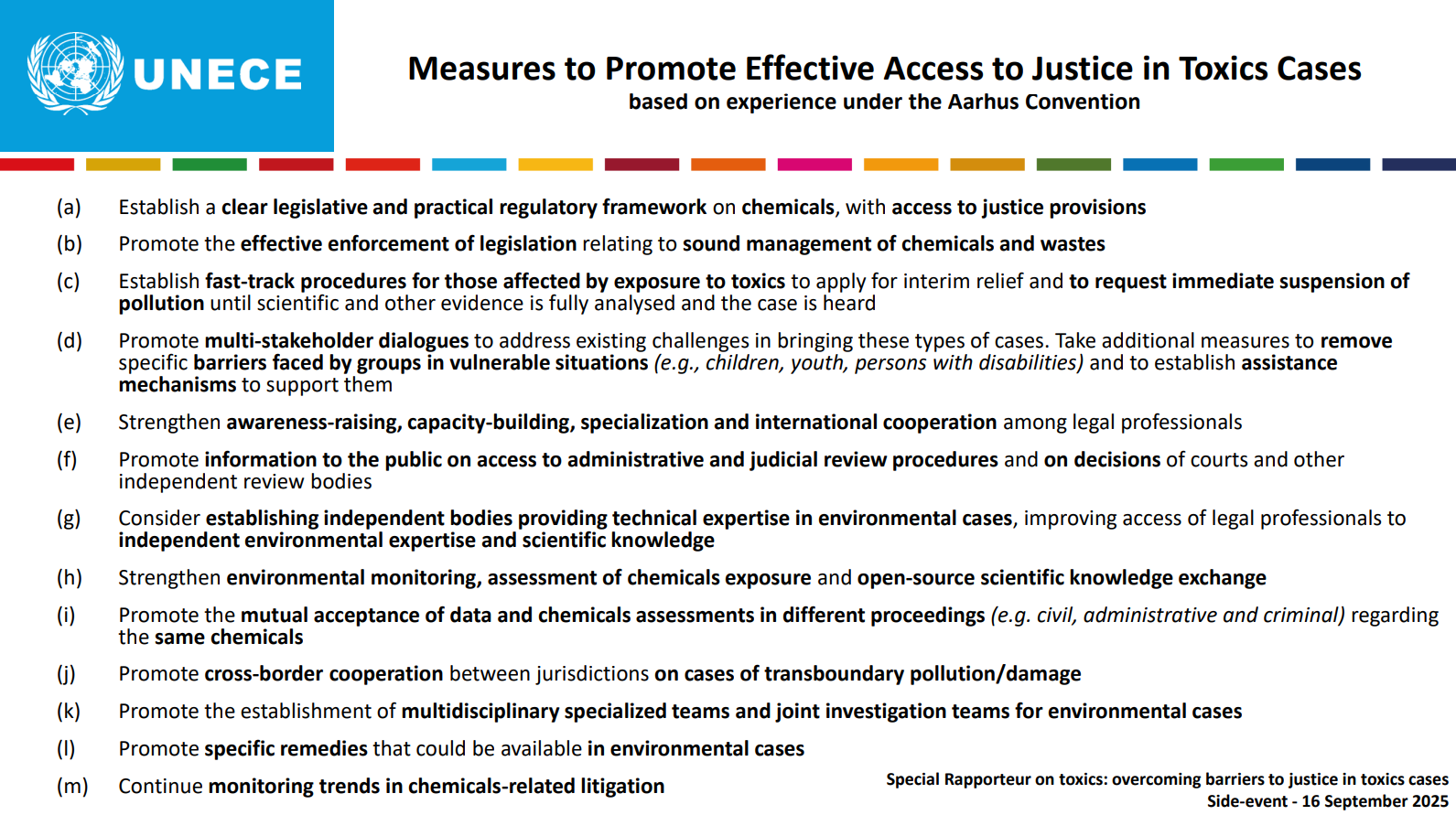
These measures are a strong catalogue of options for advancing justice in toxics cases.
- The work of the Aarhus Convention and its Protocol is providing an important platform for governments, experts, and the public to share practices on strengthening justice systems. This work is directly contributing to Sustainable Development Goal (SDG) target 16.3, which concerns equal access to justice. UNECE is committed to promoting international standards, enhancing cooperation, and working with the Special Rapporteur to ensure stronger access to justice in environmental matters.
Q&A
Yves Lador, Earthjustice | The report highlights the critical articulation between toxics and human rights. Linkages are made clear, showing how human rights standards can be interpreted in light of new challenges. The 24 guidelines are tactical, focused, and highly useful—potentially referred to in future as the “Orellana Guidelines.”
- Has the International Court of Justice’s recent advisory opinion on climate change obligations, which references pollution experience, echoed in the crafting or implementation of the guidelines?
- Will the guidelines be presented at the upcoming Meeting of the Parties to the Aarhus Convention, given their relevance for implementation of Aarhus and the Escazú Agreement?
Cecilia ATHERTON, Panama | Challenges such as rural chemical exposure, harmful residues, and weak waste management systems are pressing human rights and environmental issues. Examples include:
- A pollution hotspot in a central river basin, affecting nearly 300,000 people.
- Contamination of a river and lake due to organic and industrial waste, which has depleted oxygen levels in water.
The value of remedies that go beyond compensation, including prevention, remediation, and guarantees of non-repetition. Indigenous peoples are particularly vulnerable. The guidelines are practical tools for strengthening accountability and protecting communities, and we are ready for continued dialogue and cooperation.
Closing Remarks
Marcos ORELLANA, UN Special Rapporteur on toxics and human rights
- The report was finalized before the ICJ advisory opinion was issued, and therefore does not reflect it. However, reference is made to the Inter-American Court of Human Rights advisory opinion, which was included, stressing the importance of basing remedies on best available science as well as local, traditional, and Indigenous knowledge. The ICJ opinion, though focused on climate change, is recognized as having broader implications for environmental protection—notably, the right to a clean, healthy, and sustainable environment as essential to realizing other fundamental rights such as the right to life. This reasoning is directly applicable to toxic cases.
- Regarding the Aarhus Convention, I appreciate its Task Force on Access to Justice contribution. Attendance at the Meeting of the Parties is uncertain, though valuable.
- The toxification of the planet cannot be overcome “one case at a time.” Multiple levels of action are required, including prevention, bridging the gap between science and policy, and embedding a human rights–based approach in environmental law and multilateral agreements. Accountability is a key pillar, since impunity aggravates injustice and undermines institutions.
Photo Gallery


Documents
Links
- Environment @ 60th Session of the UN Human Rights Council | GEN
- A/HRC/60/34 | Guidelines on access to justice and effective remedies in the context of toxics | Report of the UN Special Rapporteur on toxics and human rights
- Environmental law and governance | UNEP
- Human Rights, Hazardous Substances, and the Role of Geneva | GEN
Photo Credits
Luka Tomac/Friends of the Earth International