
Event Conference
The Threats of Deep-Sea Mining | Geneva Rights and Environment Talks | Dialogues on Mineral and Metal Resources
13 Mar 2025
10:30 – 11:30
Venue: Palais des Nations | Room H-307-2 & Online | Webex
Organization: Geneva Human Rights, Biodiversity and Land Task Force, Special Procedures of the UN Human Rights Council, Earthjustice, Geneva Environment Network
On the sidelines of the 58th session of the Human Rights Council, the Geneva Rights and Environment Talks harnessed the opportunity of this moment of the year to reflect on the challenges posed by the rapid decline of nature and biodiversity, and on how Geneva contributes to bringing together the actors working towards ensuring the right to a clean, healthy, and sustainable environment is upheld for all. The event was also part of the Geneva Dialogues on Mineral and Metal Resources, a series of events to explore interlinkages between the various multilateral debates and negotiations addressing sustainable mineral and metal resources governance in Geneva and beyond.

About this Event
There is growing interest in the mineral deposits of the seabed. However, research suggests that deep-sea mining – the process of extracting and often excavating mineral deposits from the deep seabed – could have harmful and unknown consequences for marine biodiversity and ocean ecosystems.
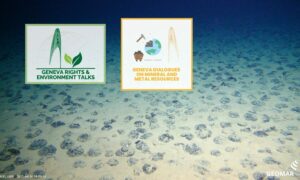
The seabed, at ocean depths greater than 200m covering about two-thirds of the total seafloor, remains largely unknown territory, and the abyssal depths are home to a vital part of the ocean’s ecosystems. Deep-sea habitats host indeed most of the approximately 1 million ocean species. Their abundant biodiversity underpins the carbon cycle and provides provisioning, supporting, regulating and cultural ecosystem services. The deep sea is also the planet’s largest carbon sink. Parts of the dark seabed of the Pacific Ocean are covered with polymetallic nodules, containing metals such as manganese and cobalt, that are potential sources of critical minerals. Researchers have recently discovered that such nodules produce oxygen without sunlight, known as dark oxygen.
Deep-sea ecosystems, which are poorly understood, are especially vulnerable to mining activities which destroy the seafloor, potentially releasing stored carbon and disrupting the ocean’s carbon sequestration processes. The energy-intensive nature of mining operations contributes to significant greenhouse gas emissions.
Indigenous Peoples, subsistence fishers and small island developing States are also particularly vulnerable to the impacts of deep-sea mining, as they are heavily reliant on marine resources for food and livelihoods.
The proposed extraction of deep-sea critical minerals poses therefore serious environmental, climate and human rights concerns, as highlighted by the UN Special Rapporteur on the right to a healthy environment, in her report to the 58th session of the Human Rights Council (A/HRC/58/59). Considering the potential for severe and irreversible damage, 32 countries have also agreed to a moratorium on deep-seabed mining.
Leading experts joining the panel of this event will stress the risks of deep-sea mining and the violations of fundamental rights it can imply and highlight the effective protection instruments addressing the threats.
About the Geneva Rights and Environment Talks
In the face of the three interrelated environmental crises — climate change, loss of biodiversity, and pollution — the recognition of the right to a clean, healthy, and sustainable environment by the UN Human Rights Council and the UN General Assembly is an important milestone that puts environmental issues at the forefront of the human rights agenda.
The Special Rapporteur on the human right to a healthy environment reports to the Human Rights Council during its March session on issues related to their mandate. The Geneva Rights and Environment Talks harnessed the opportunity of this moment of the year to reflect on the challenges posed by the rapid decline of nature and biodiversity and the intertwined human rights implications. The talks are also an opportunity to discuss how Geneva contributes to bringing together the actors working towards ensuring the right to a clean, healthy, and sustainable environment is upheld for all.

About the Geneva Dialogues on Minerals and Metals
The topic of sustainable management of minerals has never been so high on the global political environment agenda and the reason is that minerals are essential for the future. The energy transition, infrastructure and digitalization processes, among others, represent greener solutions. However, unsustainable extraction, manufacturing, use and disposal of resources is having important detrimental impacts on people and the planet. With an expected 500 per cent increase in the demand for minerals (from 2018 production levels), environmental challenges are going to be even more acute.
Various actors in Geneva are engaged in ensuring enhanced action to support the environmental sustainability management of minerals and metals along their full lifecycle. As Geneva is at the center of numerous debates and negotiations in the fields of science, health, human rights, development, trade and green finance, employment, peacebuilding and security, disaster risk reduction, humanitarian response, nature conservation, chemicals and pollution, as well as new technologies and innovation, the dialogues can be a conducive platform to explore interlinkages between these topics and mineral and metal resources governance.
The dialogues are organized by the Geneva Environment Network in partnership with Switzerland, Senegal, UNEP/GRID-Geneva, UNECE, the International Institute for Sustainable Development (IISD), the Intergovernmental Forum on Mining, Minerals, Metals and Sustainable Development (IGF), The Forum on Trade, Environment, & the SDGs (TESS) and the World Resources Forum.
Speakers
By order of intervention

Astrid PUENTES RIAÑO
UN Special Rapporteur on the human right to a clean, healthy and sustainable environment
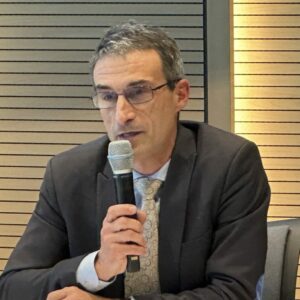
Régis FARRET
Counsellor, Sustainable Development, Permanent Mission of France to the United Nations Office and other international organizations in Geneva
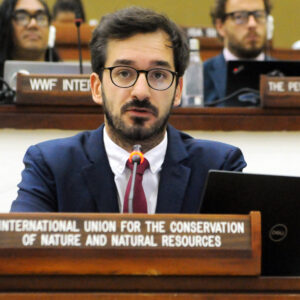
Clément CHAZOT
Marine Programme Officer, Ocean Team, IUCN
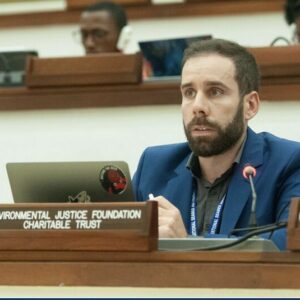
Martin WEBELER
Deep-Sea Mining Campaign Lead, Environmental Justice Foundation

Cecilia ATHERTON
Attaché, Permanent Mission of the Republic of Panama to the United Nations Office and other international organizations in Geneva

Bruna CAMPOS
Senior Campaigner, Offshore Oil & Gas, CIEL

Benjamin SCHACHTER
Coordinator, Environment and Climate Change Team, UN Office of the High Commissioner for Human Rights

Diana RIZZOLIO
Coordinator, Geneva Environment Network

Yves LADOR
Representative in Geneva, Earthjustice | Moderator
Highlights
Video
Live from Palais des Nations.
Summary
Human Rights Implications of Deep-Sea Mining
Astrid PUENTES RIAÑO | UN Special Rapporteur on the human right to a clean, healthy and sustainable environment
- The report on Ocean and Human Rights was written to emphasize the need for a comprehensive and holistic perspective on the ocean. It stresses that the ocean should be viewed as a single, interconnected biome rather than as separate bodies of water or isolated natural resources. This shift in perspective is critical for ensuring effective protection and governance.
- A key insight from the report is the need to question the necessity of deep-sea mining. Major global companies, including those producing electric vehicles, have stated that deep-sea mining is not required to meet mineral demands. This challenges the assumption that extracting minerals from the ocean is essential for technological development. A statement issued with the UN Special Rapporteur on climate change reinforced that the first step in addressing deep-sea mining is to assess whether the materials are truly needed and for what purpose.
- The importance of a human rights-based approach to ocean governance is highlighted, including its integration into legal frameworks and institutions such as the International Seabed Authority (ISA). Ensuring that human rights considerations are embedded in decisions about deep-sea mining and other ocean-related policies is essential.
- The leadership of states in addressing deep-sea mining is acknowledged, with 32 states now supporting precautionary measures. Notably, the Norwegian government announced in December that it would halt the issuance of deep-sea mining licenses for the year, a decision that was recognized in a statement in January. While much of the focus is on calling out harmful policies, positive actions taken by governments should also be acknowledged and encouraged.
Towards the UN Ocean Conference | Deep-Sea Mining @ UNOC3
Régis FARRET | Counsellor, Sustainable Development, Permanent Mission of France to the United Nations Office and other international organizations in Geneva
- France has an ambitious stance on deep-sea mining, recognizing that scientific knowledge of the deep-seabed remains incomplete, particularly regarding the potential irreversible environmental consequences. France supports taking the necessary time to negotiate a robust legal framework that is transparent and considers the interests of Indigenous peoples and local communities.
- France advocates for a precautionary pause or moratorium on deep-sea mining, considering it urgent and mandatory. Currently, 32 countries have expressed support for this approach, with many joining the “Friends of the Deep” coalition. However, given that powerful actors are pushing for exploitation, more international support is needed to strengthen this position at the ISA.
- The upcoming UN Ocean Conference (UNOC3), co-organized by France and Costa Rica, will specifically address deep-sea mining during its first panel. The conference, taking place from June 9 to 13 in Nice, will focus on high-level political mobilization and concrete commitments. Events leading up to UNOC3 will include a science congress and a Blue Economy and Finance Forum, which will involve stakeholders from maritime industries and financial sectors.
- UNOC3 aims to align with existing multilateral processes, such as the Agreement under the United Nations Convention on the Law of the Sea on the Conservation and Sustainable Use of Marine Biological Diversity of Areas beyond National Jurisdiction (BBNJ Agreement) on biodiversity in the high seas and the WTO agreement on harmful fisheries subsidies. The conference will also feature scientific discussions, voluntary commitments from states, and concrete outputs addressing ocean-related challenges, including the need for more knowledge and a deep-sea mining moratorium.
- The mobilization of governments, scientists, and stakeholders is essential, and participation in UNOC3 is encouraged as part of these efforts.
Panel Discussion
Protection of Deep-Ocean Ecosystems and Biodiversity | Clément CHAZOT | Marine Programme Officer, Ocean Team, IUCN
- The ocean plays a crucial role in addressing the triple planetary crisis while providing invaluable ecosystem services, including chemical regulation, food security for billions, and support for human health, cultural values, and well-being. Deep-sea ecosystems are a key part of this global system, as highlighted earlier in the panel. They have unique characteristics—they are vast, largely unexplored, and home to incredible biodiversity. Additionally, they feature biophysical properties that support key planetary processes. However, they are also highly complex, meaning any disturbances to these ecosystems could have far-reaching global repercussions. The ocean already faces multiple threats, including ocean warming and acidification, and now a new risk is emerging: deep-sea mining.
- Despite the lack of universally agreed regulations, sufficient scientific knowledge, and broad social acceptance, some actors are pushing for deep-sea mining to begin soon. This raises serious concerns, as the potential environmental risks are significant. Mining could lead to habitat loss, fragmentation, or modification, disrupting the delicate balance of deep-sea ecosystems. The microbial equilibriums that exist in these environments could be disturbed, affecting fundamental ecological processes. Moreover, deep-sea mining may impact ecosystem services, including fisheries and marine food webs that are essential to societies worldwide.
- There are also concerns about direct physical impacts such as smothering caused by sediment plumes, which could bury or suffocate marine life. Pollution from mining activities—through light, noise, and vibrations—could introduce additional stressors to these fragile ecosystems. Furthermore, the cumulative nature of these impacts remains uncertain, as the interactions between multiple stressors are not yet well understood. This uncertainty underscores the need for extreme caution before proceeding with any mining activities.
- The limited scientific knowledge of deep-sea environments further complicates responsible decision-making. A recent study assessed how much information exists to guide environmental management for deep-sea mining. The results indicate that major knowledge gaps persist, particularly regarding habitats targeted for mining. A visual representation of the data shows that most areas remain either completely unstudied or poorly understood. While research is progressing, the overwhelming dominance of knowledge gaps makes it impossible to effectively assess the environmental risks of deep-sea mining at this stage. IUCN believes that instead of rushing toward exploitation, efforts should be focused on increasing independent scientific research and securing funding to enhance understanding of these ecosystems—only then should discussions on mineral resource management take place. This position has been reinforced by a statement signed by over 900 marine scientists and policy experts warning about the risks of deep-sea mining.
- A concrete example of mining risks is the scaly-foot snail, listed as endangered by the IUCN in 2019 due to potential mining threats. This species is found in only three Indian Ocean ecosystems meaning its survival is directly at risk from mining in these areas. The deep-sea holds immense potential for scientific discoveries—this species, for instance, possesses heat-resistant properties that could have valuable applications. More broadly, marine genetic resources from the deep ocean have already contributed to significant advancements, such as enzymes from deep-sea bacteria being used in COVID-19 rapid tests. These examples highlight why deep-sea ecosystems should be studied and preserved rather than exploited in ways that could permanently damage them.
- Beyond environmental concerns, deep-sea mining also has implications for human rights. The degradation of deep-sea ecosystems would affect the critical services they provide, which in turn could impact human well-being. A recent IUCN report on this topic identified key themes related to these risks, and the ISA should give them due consideration as it works on regulatory frameworks. Currently, the ISA has overlooked many of these aspects, despite the fact that UNCLOS defines seabed mineral resources as the “common heritage of humankind.” This principle means that these resources should be managed for the benefit of all, yet there is concern that current approaches are not upholding this responsibility. The ISA must also ensure alignment with recent global agreements, such as the BBNJ treaty, which strengthens protections for marine biodiversity in areas beyond national jurisdiction.
- A clean, healthy, and sustainable deep ocean is not just an environmental issue—it is a fundamental human right that must be protected for the benefit of present and future generations. Without the necessary scientific knowledge, regulatory safeguards, and broad public acceptance, deep-sea mining should not proceed. Until these conditions are met, IUCN continues to support a moratorium, as reflected in Resolution 122.
Why We Don’t Need These Minerals for the Green Transition | Martin WEBELER | Deep-Sea Mining Campaign Lead, Environmental Justice Foundation
- This intervention aims to discuss whether minerals from the deep-seabed are needed for the green transition, as this is the narrative used by proponents of deep-sea mining and especially by deep-sea mining companies.
- The Environmental Justice Foundation published a report in 2024 addressing the question of deep-sea mining. It concludes that the expansion of mining activities into deep-sea areas is a false solution. Scientists, including the European Academy Science advisory Council, also come to this same conclusion.
- The report addresses different dimensions: the future demand for critical minerals, the handling of resources and the impact that circular economy strategies can have on supply and demand.
- The four polymetallic nodules that are the most sought after are nickel, manganese, cobalt and copper. Deep-sea mining proponents say that all the minerals that are needed for the green transition can be found in the deep-sea.
- It is hard to have exact estimates of future demand: they depend on different assumptions underlying these estimates, assumed recycling capabilities, the overall size of EV fleet, and implications of policy shifts that can significantly impact how many resources will be needed. Estimates for nickel that we need range from 24 to 100 million tons of nickel.
- Many of these estimates are based on a linear economy or a business as usual model, which could also be described as a “take make waste” model. Currently we produce 65 million tons of electronic waste per year. The UN estimates that by 2030 we will produce 75 million tons of electronic waste per year. As a perspective, 65 million tons of e-waste put into garbage trucks would form a line that goes across the entire Equator, which is what we currently produce every year. Only a fraction of that is recycled. We are handling our resources in a very unsustainable way.
- Currently we (referring to Western societies) are using the resources of 1.7 Earth per year. Deep-sea mining would perpetuate the systemic inequalities, as deep-sea mining companies primarily come from western societies. Additionally, deep-sea mining poses a significant threat to food security and disregards cultural and spiritual values of local communities.
- An alternative to this is circular economy, which comes with the reduction in mineral demand. According to the study commissioned by WWF, we can reduce the mineral demand for the future by 58% if we implement certain measures that drive the circular economy. Increasing recovery rates of the already existing technologies, reworking how we use our mobility system are also important factors.
- The trend is moving towards supporting battery technologies that don’t need nickel, cobalt or manganese, which have increased their market share recently (eg LFP batteries). We need to develop less mineral dependent battery technologies.
- Cooperation and working together with companies is also important. For instance, BMW committed to a moratorium in deep-sea mining, saying they wouldn’t use minerals from the deep-sea. The issue of deep-sea mining has been integrated as a building block in EJF’s biodiversity strategy. The aim is rather to utilize the potential of recycling to close material cycles and reduce the need for primary raw materials. Communication to suppliers is also important to exclude raw materials from the deep-sea for the products. an increasing number of companies have committed to a moratorium in deep-sea mining.
Making Oceans Off-Limits to Offshore Oil and Gas | Bruna CAMPOS | Senior Campaigner, Offshore Oil & Gas, CIEL
- Deep-sea mining is not a new practice. The oil and gas industry has been extracting from the deep-sea for a long time. A lot of scientific research that explains the impact extraction has on the deep-sea already exists.
- Aim of this intervention is to highlight the link between extractivism, so extracting any type of material resource from the deep-sea, and how that impacts human rights and rights of the people who are dependent on ocean resources.
- Even if the extraction is done in the deep-sea, it has impacts on the coastal communities. The impact of oil and gas on the ocean is beyond climate change and greenhouse gas emissions, but also adversely affects biodiversity. Oil and gas drilling can release waste water from offshore oil and gas platforms during production, which causes contamination and degrades the food web around the platforms and can lead to an ecosystem collapse.
- Impacts are cumulative: not only the deep-sea is impacted, but also what is above the water column.
- It is important to look at scientific research that has already looked into those types of impacts.
- Gas flaring can cause light pollution, disturbs fishes, turtles, birds and other species. The whole ecosystem faces the consequences of an activity, and it also impacts humans and communities in the end. Communities are deeply affected and have a really hard time recovering, as it takes a long time for ecosystems to come back and sometimes they never do.
- Additionally to the link with human rights, it also causes a huge economic loss for economies that are dependent on these natural resources.
- Now we are drilling into the deep-sea without properly understanding the impacts that it has. The issue with starting extractivism activities in the deep-sea is that there is a lack of understanding of what will happen. Having a precautionary approach is recommended, just as to wonder whether we actually need the minerals before starting mining as this will have a tremendous impact on the marine environment and neighboring communities.
Panama Ocean Protection Policy & the Deep-Sea Mining Moratorium | Cecilia ATHERTON | Attaché, Permanent Mission of the Republic of Panama to the United Nations Office and other international organizations in Geneva
- Panama has joined 30 other countries in the alliance for a moratorium on deep-sea mining, stating that we cannot endorse the mining of an area that is biodiversity home of thousands of yet to be identified species and complex ecological interactions that remain largely unexplored.
- This happened following the request received in June 2021 by the International Seabed Authority (ISA) from one of their members booking a treaty provision known as the two-year rule, which allows any Member State whose national intends to apply for the approval of a plan of work for exploitation of minerals in the deep-sea to request the ISA Council to finalise and adopt the necessary regulations within two years. If the council fails to complete these regulations in time, and the application is submitted, the Council still has to consider and provisionally approve the application despite the absence of a mining code and of exploitation regulations. This request has raised concerns about the potential environmental and social impacts as there is still no enforceable mining code for deep-sea exploitation.
- The deep-sea ecosystem takes over a million years to form and is teeming with life both in the water column and on the seabed. Conducting extractive activities without fully understanding this role of marine biodiversity could have irreversible consequences.
- Panama reaffirms its unwavering commitment to the 30×30 alliance and to ocean protection, conservation as well as its contribution to achieve sustainable development goals. Panama has been one of the first countries in the Eastern tropical Pacific to achieve 30% protection of its marine areas through the expansion of the Cordillera de Coiba marine protected area in 2022.
- Mining companies are currently focused on the deep-sea floor, yet there is still no evaluation.
- Panama considers itself as a leader in ocean governance, currently protecting 56% of its jurisdictional waters, of which 37% are in absolute protection. Marine protected areas will be further increased in the coming months. Panama was the first Latin American country to have a comprehensive law protecting the coral reef, banned the capture of marine mammals for captivity in 2022, successfully included over 100 species of sharks and rays listed in the CITES Annex I, ratified the BBNJ Treaty, and is in the process of ratifying the WTO Fisheries Subsidies agreement.
- During the 30th session of the International Seabed authority, taking place in Jamaica from 17 to 28 March, the Panama delegation will continue advocating for the protection of nature, especially in the field of deep-sea mining.
Rights-based Approach to the Threats of Deep-Sea Mining | Benjamin SCHACHTER | Coordinator, Environment and Climate Change Team, UN Office of the High Commissioner for Human Rights
- The office has produced a brief document on key human rights considerations related to deep-seabed mining, the main results of which will be presented here.
- All biomes are interconnected and essential. Their preservation is essential for the effective enjoyment of the right to a clean, healthy and sustainable environment.
- We know very little about the deep-sea and how it links with all of the other biomes. Yet there are economic actors, capitalising on a claim that this will help address a different environmental crisis, seeking to urgently exploit it.
- We can’t replace one form of extractivism by another and not change anything about consumer behaviour, inequality in the world, and expect to have good results. We know very little about the results of unchecked exploration of the deep-sea and what its impacts would be, including on human rights.
- States should commit not to proceed with plans for deep-sea mineral extraction until such a time as adequate safeguards including sufficient scientific knowledge exists to ensure such activities can be carried out in a way that respects, protects and fulfills human rights, including the right to a clean, healthy and sustainable environment.
- The value of the environment to people is not only economic, but also something that cannot be quantified: it’s the inherent value of nature which is so important to many people all around the world.
- The Kunming-Montreal Global Biodiversity Framework (KMGBF) emphasises the need to be in harmony with nature. deep-sea mining, particularly under current circumstances, doesn’t appear as an activity that can be done in harmony with nature.
- We may not even need the resources from the deep-seabed for the just transition, we don’t even know what the demand curve looks like and the modeling assumptions vary a lot.
- The rights of future generations and the rights of Indigenous Peoples need to be considered as well as the need for accountability for businesses. There are duty bearers, including states, but businesses also have duties and responsibilities, especially when we’re talking about the common heritage of mankind and areas beyond national jurisdiction.
- Therefore, we need to create accountability and a governmental framework that includes both businesses and states: human rights should guide this framework, it needs to be participatory, and any decision making in this context should be informed by the best available science. The framework needs to be consistent with other processes.
- The CBD COP stated that before deep-sea mining takes place, the impacts on the marine environment and biodiversity should be sufficiently researched and risks understood so that deep-sea mining does not cause harmful effects to the marine environment and biodiversity. It should also be ensured that rules, regulations and procedures are put in place by the international seabed authority in accordance with the best available science and the traditional knowledge of indigenous peoples and local communities with their free prior informed consent.
- It is important to include the human rights element in all the discussions happening around this topic in order to avoid a situation where we move forward rashly and perhaps for the wrong reasons, as this could have extremely deleterious effects on the effective enjoyment of the right to a clean, healthy and sustainable environment.
- To approach the topic of critical energy transition minerals, we have to start with human rights.
Closing
Yves LADOR Representative in Geneva, Earthjustice | Moderator
- It is rather a recent discovery that there are also corals in darker and much colder waters. How it works, what its resources are, and how it relates to the coral reefs we usually know that are much closer to the surface is still a big unknown. Not knowing this makes it harder to assess the consequences of incidents such as oil and gas leaks.
- There is a need for a demystification of some of the arguments we hear for the exportation of deep-sea.
Astrid PUENTES RIAÑO UN Special Rapporteur on the human right to a clean, healthy and sustainable environment
- Demand for energy and resources is very unequal. Today, 10% of the world’s population is responsible for over 50% of the emissions. In these 10%, it’s even about 1% of the population in the world that is responsible for 25% of climate emissions.
- It is not only about climate emissions, it’s also about land, energy, transport, etc.
- We have to demystify the idea of development: for whom – as well as the idea of illimited growth. The planet has boundaries and we need to integrate this in the frameworks. We can’t continue thinking about always increasing wealth without considering the human rights impacts it has as well as the impacts on the planet. This explains the necessity to link environmental topics such as deep-sea mining with human rights and accountability.
- The right to a clean, healthy and sustainable environment is a tool that can be used. It links to access to information, public participation, and access to justice. These are independent rights that are being violated when rushing deep-sea mining.
- The precautionary principle can also be used as a tool, notably by the ISA and other institutions such that they can comply with their mandates.
- Decisions have to be made with adequate information, public participation, and access to justice, including and starting from States.
- Elisa Morgera, the Special Rapporteur on climate change is also doing a lot of work on the ocean. Together with the Special Rapporteur on a clean, healthy and sustainable environment, they are working on a policy brief on the precautionary principle in deep-sea mining, hopefully to be released in the next few months.
Photo Gallery


Documents
- Presentations made during the event
- Key human rights considerations on the impact of seabed mining | OHCHR
Links
- Environment @ 58th Session of the UN Human Rights Council
- Geneva Rights and Environment Talks
- Geneva Dialogues on Mineral and Metal Resources
- Deep Sea Mining | UNEP | 6 May 2024
- Critical minerals and the green transition: do we need to mine the deep seas? | Environmental Justice Foundation | 9 January 2024
Photo Credit
Polymetallic nodules on the deep seabed in the CCZ. Photo by GEOMAR.