Événement Virtuel
Road to Busan | Behind the Plastic Curtain
12 Nov 2024
15:00 – 16:30
Lieu: Online | Webex
Organisation: International Pollutants Elimination Network, Geneva Environment Network
This event is co-organized by the International Pollutants Elimination Network and the Geneva Environment Network within the framework of the Geneva Beat Plastic Pollution Dialogues Road to Busan event series ahead of the fifth session of the Intergovernmental Negotiating Committee to develop an international legally binding instrument on plastic pollution, including in the marine environment (INC-5), scheduled to take place from 25 November to 1 December 2024 in Busan, Republic of Korea.

About this Event
As the INC for plastics treaty comes to its final meeting, technological fixes for plastics overproduction are being promoted by the plastic industry and by fossil fuel-producing countries. Notably, recycling with a track record of failures over several decades is still being promoted as a solution in the plastics treaty through compulsory recycled content. Countries that have set plastic recycling targets have been struggling to meet them due to the lack of a market for recycled plastics. Chemical recycling is being used to promote a different type of recycling which effectively only creates an accounting system where very little recycling is in place through the adoption of a mass balance approach. Finally, the plastics industry has been applying the credits model for offsetting their production through a new creative form of greenwashing.
Despite evidence of these solutions not working or having limited success, governments continue to rely on them, ill-advised by the industries that have the status quo at interest. Investigative journalists have been covering these failures and have inspired action by public authorities. For example, in a landmark lawsuit filed in September 2024, the California attorney general accused ExxonMobil of “deceptively” promoting chemical recycling as a solution for the plastics crisis after investigative reporters have shown that not more than 10% of recycled plastic content.
This event discussed the evidence on the limitations of chemical recycling, and other alleged solutions. It provided decision-makers tools to orient them in making informed decisions in the finalization of the agreement towards an effective plastics treaty.
Geneva Beat Plastic Pollution Dialogues

The world is facing a plastic crisis, the status quo is not an option. Plastic pollution is a serious issue of global concern which requires an urgent and international response involving all relevant actors at different levels. Many initiatives, projects and governance responses and options have been developed to tackle this major environmental problem, but we are still unable to cope with the amount of plastic we generate. In addition, there is a lack of coordination which can better lead to a more effective and efficient response.
Various actors in Geneva are engaged in rethinking the way we manufacture, use, trade and manage plastics. The Geneva Beat Plastic Pollution Dialogues aim at outreaching and creating synergies among these actors, highlighting efforts made by intergovernmental organizations, governments, businesses, the scientific community, civil society and individuals in the hope of informing and creating synergies and coordinated actions. The dialogues highlight what the different stakeholders in Geneva and beyond have achieved at all levels, and present the latest research and governance options.
Following the landmark resolution adopted at UNEA-5 to end plastic pollution and building on the outcomes of the first two series, the third series of dialogues will encourage increased engagement of the Geneva community with future negotiations on the matter.
Speakers
By order of intervention.

Yuyun ISMAWATI
Senior Advisor and Co-Founder, Nexus for Health, Environment and Development Foundation (Nexus3) & Co-Chair, IPEN

Lisa SONG
Journalist, ProPublica

Attila KÁLMÁN
Journalist, Investigate Europe

Lee BELL
Technical and Policy Advisor, IPEN
Aileen LUCERO
Ecowaste coalition Philippines

Santos VIRGILIO
Technical Advisor, Ministry of Environment, Angola

Bethanie CARNEY ALMROTH
Professor at Gothenburg University | Member of the Steering Committee of the Scientists’ Coalition for an Effective Plastics Treaty

Lia ESQUILLO
Director of Programs, IPEN | Moderator
Highlights
Video
Live on Webex.
Summary
Opening
Yuyun ISMAWATI | Senior Advisor and Co-Founder, Nexus for Health, Environment and Development Foundation (Nexus3) & Co-Chair, IPEN
- Plastics presents technical challenges, including misinterpretations, and misinformation.
- Many things are happening behind the plastics curtain including aspects related to plastics production and plastic recycling from a technical perspective, including the political dynamics behind corporate actions and initiatives.
- I have witnessed many different implementations of circular economy practices for plastics, including efforts to recycle plastics into fuel or refuse-derived fuel.
- One example is the chemical recycling pilot project launched in Indonesia. Initially, there was a lot of excitement, but the facility was quietly shut down without any official announcement, leaving many collectors and waste collectors frustrated. Ultimately, the materials that were supposed to feed the factory were burned instead.
- Many of these kinds of projects are implemented in developing countries with promises of solving the plastic pollution crisis. The industry often uses terms like « plastic consumption » and « circular economy » to frame the issue, but in practice, we often see that what is claimed in the media or press releases does not reflect genuine, effective interventions on the ground.
- There are projects introduced by global FMCGs (fast-moving consumer goods companies) aimed at recycling plastics and earning plastic credits. However, I know from personal experience that one such facility resulted in at least two deaths. The project’s operations released significant emissions and toxic chemicals, but they were still awarded plastic credits. This is not a legitimate or sustainable way to address plastic waste.
- I hope that through today’s discussion, we can explore how to push industries to be more sincere in tackling the issue of plastic pollution. We also need to focus on reducing plastic production and eliminating harmful chemicals of concern, which do not just emerge during extraction but persist in our daily lives long after plastic is produced.
- I wish to see stronger and more ambitious negotiations moving forward in addressing the full plastics lifecycle.
Presentation: The Delusion of Advanced Plastic Recycling Using Pyrolysis
Lisa SONG: Journalist, ProPublica
- ProPublica is a national newsroom based in the United States whose mission is to conduct investigative reporting on a range of topics. The common theme in all of our stories is accountability. We aim to show how individuals, institutions, or entities have caused harm to people, communities, or the environment.
- Chemical recycling became a topic of focus for my investigations because of the growing number of reports and promotional content about it, while I deemed it to be a very complex and somewhat misleading issue.
- Pyrolysis is the most common type of chemical recycling. It intrigued my research because of a phenomenon called « mass balance, » an accounting system used in the industry.
- Mass balance allows a company to take a plastic product with less than 1% recycled plastic and, through mass balance, market it as containing 20% or 30% recycled content.
- Many companies were advertising products made from pyrolysis, claiming they contained recycled plastic. But when I contacted these companies to try to purchase the products or see them in stores, there was no real evidence that they were available to the public. For example, I wrote about a plastic cup made by ExxonMobil in collaboration with two other companies, but when I went to local stores, I could not get any information on how many of these cups were actually made or where I could find them.
Lessons Learned:
- Pyrolysis is very inefficient. Less than 50% of the plastic waste that enters the pyrolysis process becomes new plastic.
- Mass balance: when waste plastic is processed through pyrolysis the resulting products created contain minimal recycled material.
- The public has a very limited understanding of how plastic recycling works. Many people think that when a product says it contains 20% recycled plastic, it means that much of the product is made from recycled materials. But the mass balance system makes it much more complicated.
- The story gained widespread attention. Many readers were shocked to learn about mass balance and chemical recycling for the first time.
- In August 2024, the US Environmental Protection Authority (EPA) made its first federal decision regarding mass balance. Europe is ahead of the U.S. in regulating mass balance, but this decision was a step in the right direction.
- In California, the state Attorney General launched a lawsuit against ExxonMobil, accusing the company of misleading the public about plastic recycling. As part of the investigation, they subpoenaed internal records from ExxonMobil, which revealed that their pyrolysis process produced plastic with less than 0.1% recycled content—far lower than the 10% maximum I had originally reported. This was a critical finding because it showed that the actual recycled content in these products is almost nonexistent.
- In October, I published another story about a new bill introduced in the U.S. Congress, which was partly written by the American Chemistry Council, a prominent plastics industry lobby group. The bill proposed expanding and supporting chemical recycling, including mandating the use of mass balance in plastic recycling products. Given the results of the recent election, it seems likely that many of these provisions will be passed.
- The future of chemical recycling is uncertain, and with the political landscape shifting, there could be a lot of developments over the next few years.
Presentation: Wasteland – Europe’s Plastic Waste Disaster
Attila KÁLMÁN | Journalist, Investigate Europe
- « Wasteland » was an investigation published by Investigate Europe nearly two years ago. Presented data might not be the most recent, but the trends are still largely the same today.
- Investigate Europe aims to hold European institutions accountable and put together the European puzzle, which was the goal with our plastics investigation.
- The investigation aimed to unveil what happens to all the plastic waste in Europe, which was important in the face of the EU economy becoming circular in just a few years narrative. The narrative claimed Europe’s economy would become a closed loop, with everything being recycled. But, as we discovered, that was not really happening, especially with plastics.
- Between 2019 and 2039, two-thirds of all plastics ever produced globally will be produced in just these two decades. If we are producing this much plastic—most of which is plastic packaging—it is an illusion to think that all of this will be recycled.
- The EU often presents itself as a leader in the green transition and circular economy, but when you look at how dire the plastic situation is in Europe, you can imagine how much worse the situation is globally.
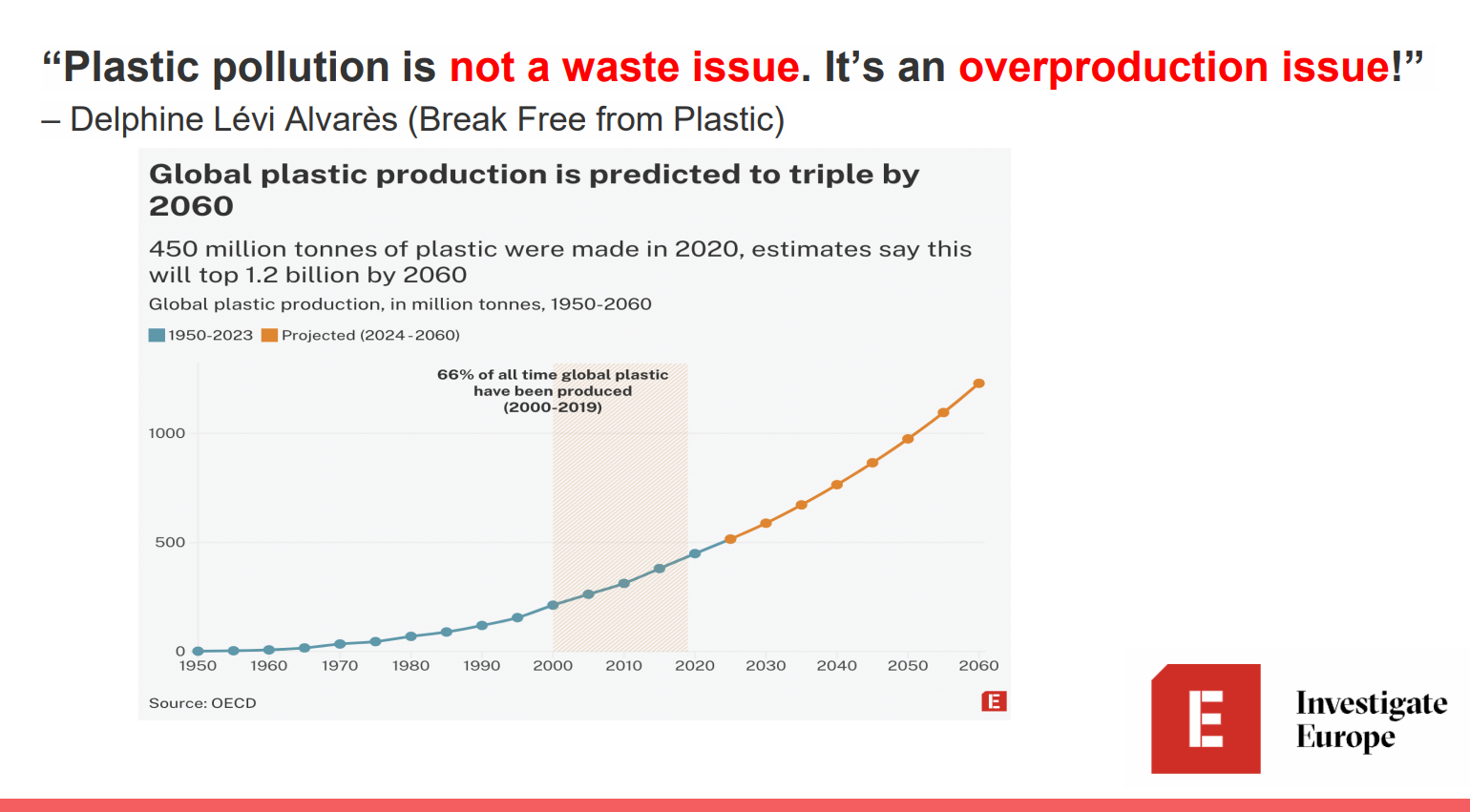
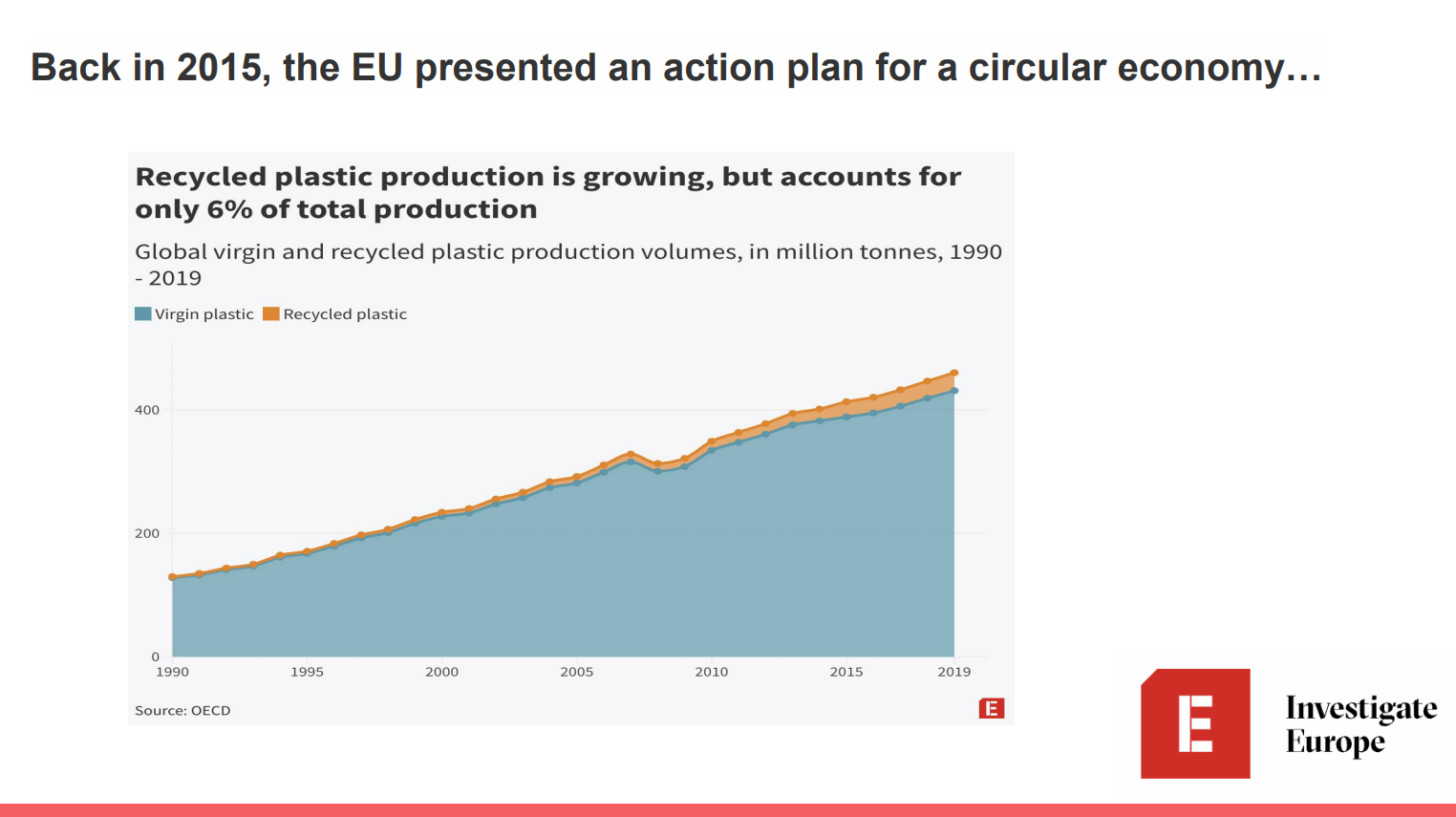
- While recycled plastic production is indeed growing, the production of virgin plastic is outpacing it.
- In 2019, only about 10% of all plastic production was recycled plastics because virgin plastic is much cheaper to produce.
- European policies and tax incentives also do not support recycling enough. For companies, it is just more cost-effective to produce new plastic rather than recycling it.
- Recycling plastics is complex. Some types of plastic are very expensive to recycle, and the main issue lies with plastic packaging. Although there are regulations that require packaging to be made from a single type of plastic, there are no significant penalties for non-compliance. When you have mixed plastic packaging, it becomes almost impossible to recycle, as different plastics have different melting points and other issues during the recycling process.
- When recycling plastic, additives must be added, and after a while, recycling is no longer viable. In the end, only downcycling—turning plastic into lower-quality materials—becomes possible, and that process is more expensive than producing virgin plastic.
- Plastic packaging is extremely problematic for its single use feature. In Europe, the average per capita plastic packaging waste is around 35 kg per year 2070 half-liter PET bottles per person annually.
- Even though Europe has set recycling targets for 2025 and 2030, we are nowhere near meeting them. In 2020, around 60% of plastic waste in Europe was not recycled.

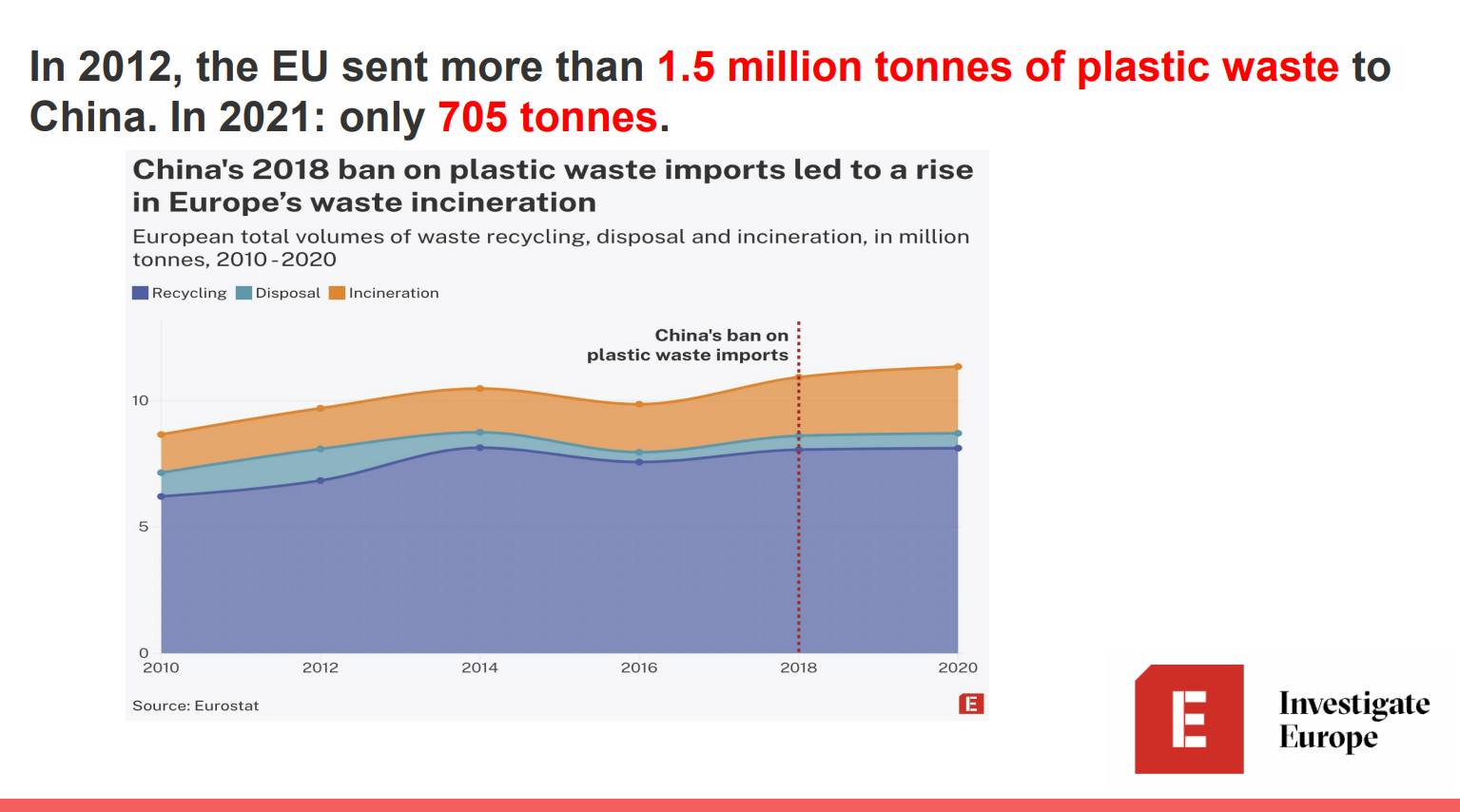
- In 2018, China – Europe’s plastic waste top exportation location- banned imports of plastic waste. While there is still some illegal export of waste, the quantities have decreased significantly.
- The largest share of European plastic waste exports now goes to Türkiye. This is a serious issue because Türkiye has struggled with waste management, and much of the waste that was meant to be recycled was instead burned in the open air.
- As plastic waste continued to pile up, after the ban, incineration rates in Europe increased significantly. For example, in Poland, plans are in place to build nearly 40 new incinerators over the next 10 years. While modern incinerators have sophisticated filters that reduce pollution, the real problem is that incinerating plastic waste only creates more demand for virgin plastic. This creates a vicious cycle: as plastic waste is burned, new plastic made from fossil fuels must be produced, contributing to more CO2 emissions.
Panel Discussion
Lee BELL | Techincal and Policy Advisor, IPEN
- In 2021, IPEN & International Pellet Watch developed Plastic Waste Management Hazards. Waste-To-Energy, Chemical Recycling, And Plastic Fuels. The report explores issues like incineration and waste-to-energy, chemical recycling and plastic-to-fuel development.
- The research highlighted the lack of information related to chemical recycling in terms of yields—specifically, the amount of useful material recovered through processes like pyrolysis.
- There was a lot of media attention, investment announcements, and hype, but very little reliable data or statistical analysis.
- Other research conducted since 2021 confirmed that the amount of material that can be fed from chemical recycling into petroleum crackers or steam crackers is very low—around 0.1% to a maximum of 2% of the material post-pyrolysis can actually be used for new products.
- Plastics cannot be circular due to two main problems: their toxicity and immiscibility.
- Plastics require chemical additives to meet the performance standards demanded by the marketplace. These additives make plastics toxic, and they also complicate recycling. Different types of plastics do not mix well in mechanical recycling because they have different melting points and do not bond together properly, leading to low-quality end products with limited applications. These issues also apply to chemical recycling. The toxicity of plastics, due to these chemical additives, is a major hurdle.
- Some of the main problems with plastic waste management include incineration, dumping, landfill, and exporting waste for recycling or converting it into fuel. One of the recent concerns with fuel conversion is that some chemical fuels derived from plastics are extremely toxic. These fuels have a high-risk ratio for public exposure—around a 1 to 1.2 risk ratio—meaning anyone exposed to these chemicals is likely to suffer from serious health issues, including cancer. In fact, the US EPA has prevented certain chemical fuels from being produced because of these risks. This highlights the fundamental issues we face when trying to convert plastic waste into other materials as part of the waste management process.
- The plastic additives market is huge—currently valued at $50 billion and projected to reach $80 billion by 2030. The increase in the use of these additives is directly tied to the rise in plastic production. There are about 16,000 chemicals used in plastic manufacturing, and over 4,000 of those are hazardous to human health. Many others have not been fully researched. These additives are a problem in both mechanical and chemical recycling.
- In mechanical recycling, toxic chemical additives can contaminate products made from recycled plastics, such as children’s toys or kitchenware, where people are more likely to be exposed to harmful chemicals.
- In chemical recycling, the contamination rates of products like pyrolysis oil are extremely high, making it difficult to use these materials in a meaningful way. To process pyrolysis oil in steam crackers, vast amounts of virgin petrochemical feedstock must be added to dilute these contaminants. This makes it impossible for the process to be truly circular or sustainable.
- The plastic recycling stream is toxic at every stage, from production to waste exports. Millions of tons of plastic waste are still being exported, creating contamination and exposure issues for workers handling the materials. Consumers are also at risk, particularly when recycled plastics are used in products like toys, games, and kitchenware, which can be contaminated with banned chemical substances.
- Even in recycling facilities, workers are exposed to hazardous materials, and large amounts of hazardous waste are generated in the process. A major issue with chemical recycling is that, by definition, it aims to remove toxic chemicals to create a pure monomer or polymer. But much of the material, especially chemical additives, ends up in a hazardous waste stream that is difficult to manage.
- A recent report by Professor Quicker for the Swiss government on chemical recycling pointed out that if chemical recycling facilities are established in developing countries that lack the capacity to manage hazardous waste, we will simply create a new magnet for plastic waste exports, leading to an even greater hazardous waste problem.
- Refuse-derived fuel (RDF) is often considered one of the last resorts in plastic waste management. RDF is produced by pelletizing or baling plastic waste and burning it in cement kilns, incinerators, and industrial boilers.
- There is nothing circular or sustainable about burning plastic waste. Using RDF as a fuel source does not solve the underlying problem; it only perpetuates the demand for more plastic production.
- Despite the claims that burning RDF can reduce carbon emissions, the high plastic content in these fuels actually makes it a counterproductive solution to climate change. We believe the Basel Convention should classify RDF as a hazardous waste and restrict its transboundary movement. Ultimately, we would like to see RDF phased out altogether.
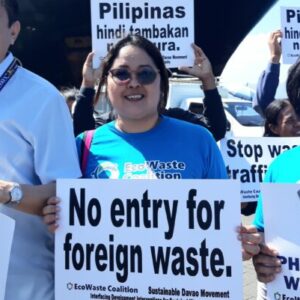
Aileen LUCERO | Ecowaste Coalition Philippines
- The Philippines is often singled out as one of the top sources of plastic pollution. We are frequently dubbed the « Sachet Economy » due to our heavy reliance on small, single-use plastic packaging. This massive plastic waste leads to significant environmental degradation, affecting marine ecosystems and public health.
- The Philippines is considered one of the main contributors to marine plastic pollution, with over 500,000 tons of plastic waste entering the seas and oceans annually. As a country, we consume about 3 million tons of plastic each year, with sachets accounting for around 52% of that total. However, what is truly lacking in the Philippines is corporate accountability and transparency.
- As a non-plastic manufacturing country, The Philippines does not produce most of this plastic. They are produced by major manufacturers, many of which are based in the Global North.
- This reveals a toxic double standard in trade practices: some products that are banned in the Global North due to their harmful impacts on public health, human rights, animals, and the environment, are still being produced and exported to countries like the Philippines.
- Despite the Global North positioning itself as a leader in sustainability, safety, and environmental protection, its efforts are often confined to its own borders. There is little to no consideration of the external impact these practices have on countries in the Global South, where much of the waste ends up.
- The global conversation often pushes advanced solutions like chemical recycling, mass balance approaches, and recycled content mandates as the primary answers. However, these solutions do not always translate well to our context. While the Global North continues business as usual, we in the Global South are burdened with their waste.
- We do not want quick fixes like RDF, waste-to-energy, chemical recycling, plastic offsetting, or plastic discards. These are not genuine solutions. We cannot burn, bury, or recycle our way out of this problem.
- We need global solutions. Plastic pollution is a global issue, and the Global South should not bear this burden alone. We need international support and funding for waste management solutions that work in our context—solutions that go beyond simply exporting waste.
- We must aim for a truly ambitious global treaty that addresses these inequalities. A treaty that puts health and the environment at the forefront of every country’s actions—not one that benefits only the plastic-producing countries.
- It is time to stop the rise in plastic production. We need real solutions, and we need them now.
Santos VIRGILIO | Technical Advisor, Ministry of Environment, Angola
- Most African countries are not producers of plastic products; we are merely recipients. However, all African countries are already suffering the consequences of plastic waste.
- When it comes to the international negotiations for a legally binding instrument on plastic pollution, we need a better understanding of what is meant by a full life cycle approach. We strongly agree with the resolution that the issue cannot simply be addressed by focusing on the end of plastic life, but we must address the full life cycle, starting from the primary plastic polymers. Another crucial issue that needs proper attention is product design and supply chains.
- African countries advocate for a robust instrument, but this cannot be achieved without providing the means for implementation, i.e. financial resources. We are advocating for the creation of a standalone fund, modeled after the Montreal Protocol, because the issues we face are similar—global in nature—and countries like those in Africa need resources to address these challenges effectively.
- African countries are very much aware of the risks associated with plastic recycling. We are often promised that chemical recycling is safe, but this is a risky assumption. It is like believing you can swallow poison simply because you think you have the antidote. We do not want to take that risk. For those who claim that chemical recycling is safe, we remain cautious and skeptical.
- Another issue we are raising is the illegal trafficking of plastic waste, which is often hidden under the guise of recycling. While people push for recycling, we must also address the illegal trade in plastic and plastic waste, which remains a serious problem.
- Lastly, the issue of legacy plastic pollution must also be addressed in the new instrument. This is a major concern for African countries, and we believe it should be part of any meaningful global framework.
- We come to these negotiations with a spirit of collaboration, but we must ensure that all these issues—financial support, the full life cycle approach, addressing legacy plastic pollution, and tackling illegal waste trafficking—are adequately addressed. If we work together in a cooperative spirit, we can create a robust and effective instrument to tackle plastic pollution worldwide.
Bethanie CARNEY ALMROTH | Professor at Gothenburg University | Member of the Steering Committee of the Scientists’ Coalition for an Effective Plastics Treaty
- Packaging is the most common use of plastics, and it remains a major contributor to plastic pollution.
- The flows of petrochemical products through various value chains is highly complex, with low transparency and significant knowledge gaps. We do not fully understand all the plastics being produced, where they are going, or where they are ending up.
- The global plastic waste flows | While the EU has implemented regulations to ban the export of mixed plastic waste to non-OECD countries, there is still a large black market, and we have very little data on where all this plastic waste is going. There are few or no regulations controlling the import of secondary or recycled plastic pellets. Furthermore, there is very little reporting on the chemicals present in these recycled products, except for substances of very high concern—such as those listed under REACH regulations.
- The recently released PlastChem report provides a state of the chemicals used in plastics. There are currently 16,000 chemicals involved in plastics production and plastic products. This number continues to grow with each new report. Out of these, more than 4,200 chemicals are known to have hazardous properties. Additionally, more than 10,000 chemicals lack available hazard data.
- The types of toxicity associated with plastics that we know have hazardous properties include: Aquatic toxicity, Specific target organ toxicity, Carcinogenicity, Mutagenicity, Reproductive toxicity, Endocrine disruption, Persistent, bioaccumulative, and toxic (PBT) characteristics, Cumulative, mobile, and toxic chemicals.
- All of these chemicals are being used in plastics production. There is a significant lack of transparency and traceability regarding how these chemicals are used, where they are applied, and how they move through product value chains.
- A recent study collected recycled plastic pellets from small-scale mechanical recycling facilities in 13 different countries, mostly in the Global South. Mechanical recycling is the most common form of recycling, as it requires the least energy and is the most accessible. It involves collecting plastic, sorting, chipping, and melting it down to make new pellets. The study found that these plastics contain known additives—such as flame retardants, phthalates (plastic softeners), and pigments— and a range of other chemicals.
- We used two different chemical analytical techniques: target screening and non-target screening. We found was troubling. In addition to the expected additives, we detected pesticides, pharmaceuticals, PCBs, and other chemicals that shouldn’t be present in plastics used for consumer products.
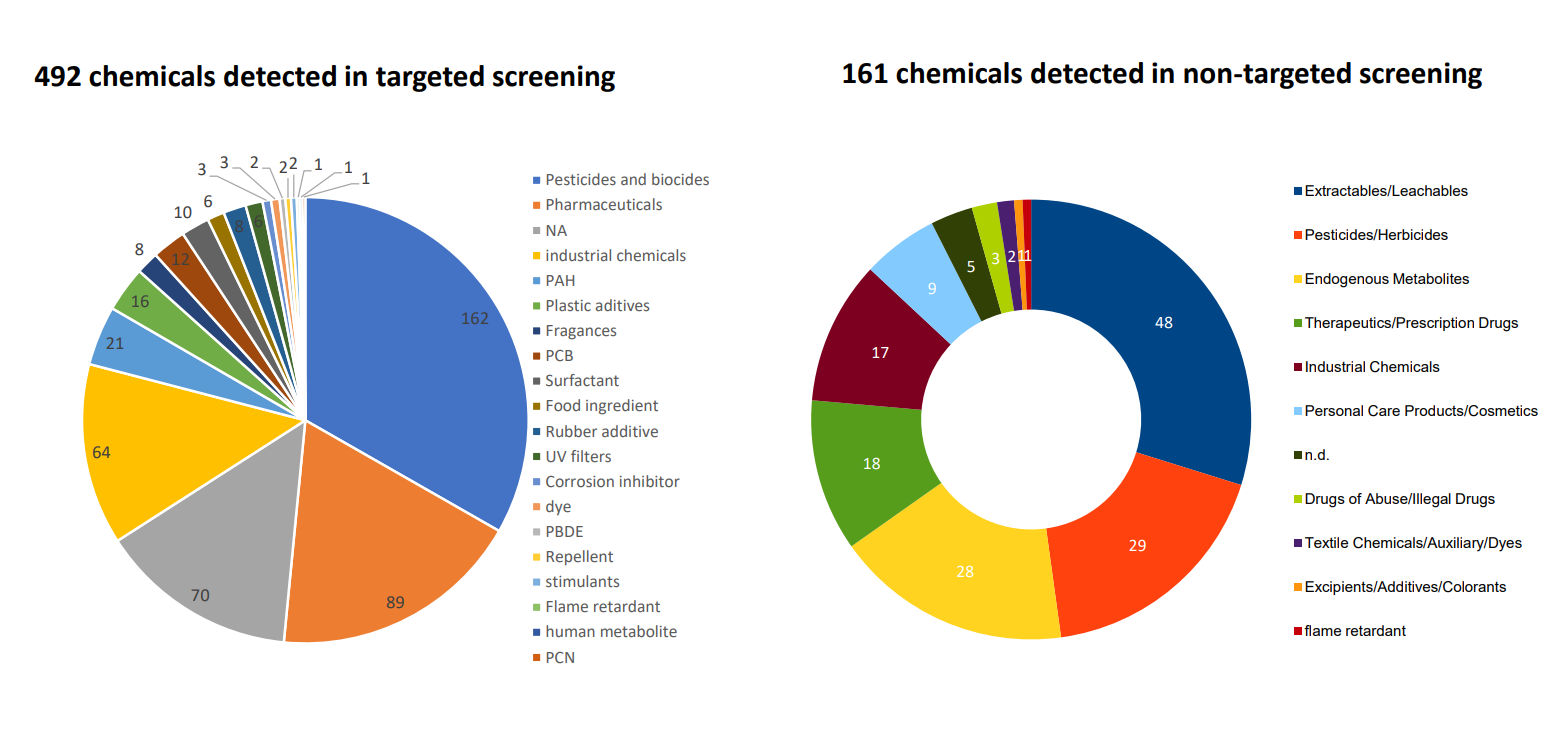
- There is a significant problem with contamination. Chemicals can leach into plastics during their life cycle, either during their use phase or when they enter the waste stream. These chemicals are then present in the recycled products, which means they will end up in whatever new products are made from these recycled plastics.
- We are currently conducting toxicity testing on these recycled materials, and early results suggest impacts such as inhibited algal growth and disrupted lipid metabolism in fish. We know these plastics contain hundreds of chemicals—sometimes at very low doses—but when combined, they create problematic mixtures.
- If we are going to recycle plastics effectively, we must improve the current system. The way we are doing it now is not working: it allows the circulation of toxic chemicals through what is supposed to be a “circular” system. To make recycling safer and more sustainable, we need to:
- Reduce the number and types of chemicals used in plastic products, especially hazardous ones. We need to apply the principles of chemical simplification.
- Increase reporting, transparency, and traceability throughout the entire life cycle of plastics, so we know what chemicals are present and where they’re going. This may require sector-specific waste streams to avoid mixing harmful chemicals.
- Implement more monitoring, testing, and quality control of recycled plastics to ensure they’re safe for reuse.
- Provide economic incentives for safer recycling practices. We must prioritize reduction, reuse, refill, and remanufacturing—recycling should be a last resort.
- Ensure a just transition for those affected by the plastic life cycle, including waste pickers and workers in recycling plants, where toxic chemicals and micro-nanoparticles are often released. This poses risks not only for workers but also for consumers who use products made from recycled plastics.
- While recycling can be part of the solution, we must do it in a way that reduces harm to both human health and the environment. Under business-as-usual, recycling will simply perpetuate the toxic cycle.
Q&A
Q: Plastic has been overproduced, and much of the chemical recycling promoted by plastic manufacturers is actually unfeasible. So, is it meaningful for companies to promote circular recycling and post-consumer recycled (PCR) plastic products, or is this just a self-deceptive, collusive scam?
Lee BELL: My blunt assessment of the plastics industry’s promotion of chemical recycling is that it mirrors the same tactics used in the 1980s. Back then, when there were discussions about placing limits on single-use plastics in the U.S., the American Chemistry Council and other lobbying groups pushed for mechanical recycling as the solution. Their goal was to avoid tighter regulations on plastic production, and as a result, the industry wasn’t regulated, leading to decades of overproduction.
Now we are seeing round two of this propaganda as we move toward the plastic treaty. The petrochemical industry and its associations are simply trying to gamble that promoting chemical recycling and similar measures will prevent any serious regulation on their production limits. They know their days are numbered in terms of fossil fuels and carbon liabilities, and they are betting everything on plastics and petrochemical products to maintain their profits.
Q: Are there any plastic chemicals that are not hazardous? Are there safe chemicals used in materials like PP (Polypropylene) or PE (Polyethylene)?
Bethanie CARNEY ALMROTH: According to the PlastChem report, around 160 chemicals were identified as not hazardous, but those assessments were based on incomplete data. In fact, over 10,000 chemicals used in plastics lack sufficient data, and more than 4,000 are identified as hazardous. So, the answer is that, based on the data we have, it is difficult to say that any of the chemicals in plastics are « safe » in a meaningful sense.
There are some chemicals that are assessed as non-hazardous, but those evaluations are often incomplete or insufficient. So, while some chemicals may be less toxic, we do not have enough reliable data to confidently say any are completely safe at this point.
Q: Is there any use for the « mass balance » approach in plastic recycling?
Lisa SONG: Mass balance is an interesting topic. There are different types of mass balance, some less extreme than others. In Europe, there has been some regulation around mass balance, deciding which forms are acceptable and which are not. In the U.S., though, we are far from having the ability to regulate mass balance properly—most people here don’t even know what it is, let alone understand chemical recycling.
Mass balance is essentially a way to account for the inputs and outputs of a recycling system, particularly in chemical recycling. After publishing my piece on pyrolysis, I received a lot of feedback from people who thought mass balance was just greenwashing. The challenge is that chemical recycling is heavily reliant on mass balance—especially the extreme forms of it, like free attribution. There are other forms of chemical recycling that may depend less on mass balance, so it will be interesting to see how that evolves.
For example, Eastman Chemical Company uses a different form of chemical recycling, which is less dependent on mass balance, but even they have used some of the more aggressive forms in their processes. Whether that’s due to technical limitations or just a marketing preference is still unclear.
Frankie ORONA | Society of Native Nations: I really do not like the term « safer plastics » because they do not believe plastics can be made without toxic chemicals.
Bethanie CARNEY ALMROTH: It is difficult, if not impossible, to designate any plastic as truly « safe, » given the lack of data and the potential unknowns about how plastics behave over time. Plastics can last much longer than human lifespans, and we have no certainty about their long-term impacts.
Instead of calling them « safe, » it is more realistic to think about plastics as being « potentially safer » or « less harmful. » The goal should be to reduce the use of toxic chemicals, ensure that plastics undergo rigorous pre-market testing, and establish clear standards across markets and countries.
As always, reduction should be the first step—following the waste hierarchy, we should be aiming to reduce, reuse, and refill before resorting to recycling. So, instead of focusing on « safe » plastics, we should focus on eliminating toxic chemicals and reducing plastic use overall.
Q&A
Q: Plastic has been overproduced, and much of the chemical recycling promoted by plastic manufacturers is actually unfeasible. So, is it meaningful for companies to promote circular recycling and post-consumer recycled (PCR) plastic products, or is this just a self-deceptive, collusive scam?
Lee BELL
- My blunt assessment of the plastics industry’s promotion of chemical recycling is that it mirrors the same tactics used in the 1980s. Back then, when there were discussions about placing limits on single-use plastics in the U.S., the American Chemistry Council and other lobbying groups pushed for mechanical recycling as the solution. Their goal was to avoid tighter regulations on plastic production, and as a result, the industry wasn’t regulated, leading to decades of overproduction.
- Now we are seeing round two of this propaganda as we move toward the plastic treaty. The petrochemical industry and its associations are simply trying to gamble that promoting chemical recycling and similar measures will prevent any serious regulation on their production limits. They know their days are numbered in terms of fossil fuels and carbon liabilities, and they are betting everything on plastics and petrochemical products to maintain their profits.
Q: Are there any plastic chemicals that are not hazardous? Are there safe chemicals used in materials like PP (Polypropylene) or PE (Polyethylene)?
Bethanie CARNEY ALMROTH
- According to the PlastChem report, around 160 chemicals were identified as not hazardous, but those assessments were based on incomplete data. In fact, over 10,000 chemicals used in plastics lack sufficient data, and more than 4,000 are identified as hazardous. So, the answer is that, based on the data we have, it is difficult to say that any of the chemicals in plastics are « safe » in a meaningful sense.
- There are some chemicals that are assessed as non-hazardous, but those evaluations are often incomplete or insufficient. So, while some chemicals may be less toxic, we do not have enough reliable data to confidently say any are completely safe at this point.
Q: Is there any use for the « mass balance » approach in plastic recycling?
Lisa SONG
- Mass balance is an interesting topic. There are different types of mass balance, some less extreme than others. In Europe, there has been some regulation around mass balance, deciding which forms are acceptable and which are not. In the U.S., though, we are far from having the ability to regulate mass balance properly—most people here don’t even know what it is, let alone understand chemical recycling.
- Mass balance is essentially a way to account for the inputs and outputs of a recycling system, particularly in chemical recycling. After publishing my piece on pyrolysis, I received a lot of feedback from people who thought mass balance was just greenwashing. The challenge is that chemical recycling is heavily reliant on mass balance—especially the extreme forms of it, like free attribution. There are other forms of chemical recycling that may depend less on mass balance, so it will be interesting to see how that evolves.
- For example, Eastman Chemical Company uses a different form of chemical recycling, which is less dependent on mass balance, but even they have used some of the more aggressive forms in their processes. Whether that’s due to technical limitations or just a marketing preference is still unclear.
Frankie ORONA | Society of Native Nations: I really do not like the term « safer plastics » because they do not believe plastics can be made without toxic chemicals.
Bethanie CARNEY ALMROTH
- It is difficult, if not impossible, to designate any plastic as truly « safe, » given the lack of data and the potential unknowns about how plastics behave over time. Plastics can last much longer than human lifespans, and we have no certainty about their long-term impacts.
- Instead of calling them « safe, » it is more realistic to think about plastics as being « potentially safer » or « less harmful. » The goal should be to reduce the use of toxic chemicals, ensure that plastics undergo rigorous pre-market testing, and establish clear standards across markets and countries.
- As always, reduction should be the first step—following the waste hierarchy, we should be aiming to reduce, reuse, and refill before resorting to recycling. So, instead of focusing on « safe » plastics, we should focus on eliminating toxic chemicals and reducing plastic use overall.
Q: Hazard-based vs. risk-based classification—why prefer a hazard-based classification over a risk-based one?
Bethanie CARNEY ALMROTH
- A hazard-based assessment allows you to identify whether a chemical or material has hazardous properties, and then regulate it based on those properties alone. In contrast, a risk-based approach considers both the hazard and the likelihood of exposure. The challenge with risk-based assessments is that they often rely on post-market data, which means exposure has already occurred before the regulation happens.
- This creates delays in policy decisions because we are constantly catching up. The more data you need for a risk-based approach, the longer it takes to make regulatory decisions, which can allow chemicals to remain on the market, causing harm.
- A hazard-based approach, on the other hand, could prevent exposure before it happens, and would ideally be group-based, looking at chemicals with similar hazardous properties rather than regulating one chemical at a time. This is essential because there are over 350,000 chemicals registered for global production, and it could take a decade to regulate each one individually. We just don’t have that kind of time.
Q: What is the motivation behind chemical recyclers? Is it just greenwashing, or are they trying to continue plastic production, even though it does not seem to be economical?
Lee BELL
- It is not economical. In a study of chemical recycling facilities in the U.S., we found that 11 plants were constructed, but very few of them are actually operating. Since we conducted the study, two of those plants have shut down due to economic issues, and others are likely facing similar challenges.
- The issue is that chemical recycling struggles to compete with virgin plastic, which is much cheaper. While the price of virgin plastic fluctuates with oil prices, it’s still much more economical than recycled plastic. Many of the chemical recycling companies are looking for investment, and they want to show they have a solution to plastic pollution, but the reality is that most of these technologies don’t scale up as effectively as the industry claims.
- So, while some companies may have good intentions, the market conditions make it very hard for chemical recycling to become a profitable, sustainable solution. As a result, many of these companies are stuck in the start-up phase, partnering with the plastics industry to create the illusion that they’re solving the plastic waste problem, when in reality, they’re struggling to deliver meaningful results.
Closing
Lia ESQUILLO | Director of Programs, IPEN | Moderator
As we move closer to finalizing the plastics treaty, I hope today’s session has equipped you with valuable insights to inform your work. We need bold, informed decision-making to address the root causes of plastic pollution, such as overproduction and toxic chemicals, and to commit to real, sustainable solutions.
Documents
Links
- Road to Busan | Plastic Pollution INC-5 | GEN
- Plastic Waste Management | Plastics and the Environment Series | GEN
- Quick Views on INC-5 | IPEN | 28 October 2024
- The Plastics Industry’s Wish List for a Second Trump Administration | ProPublica | 23 October 2024
- ExxonMobil Accused of “Deceptively” Promoting Chemical Recycling as a Solution for the Plastics Crisis | ProPublica | 27 September 2024
- Biden EPA Rejects Plastics Industry’s Fuzzy Math That Misleads Customers About Recycled Content | ProPublica | 29 August 2024
- The Delusion of Advanced Chemical Recycling and Pyrolysis | ProPublica | 5 June 2024
- Chemical Recycling: A Dangerous Deception | Beyond Plastics & IPEN | October 2023
- Wasteland | Investigate Europe | April 2023
- Plastic Waste Management Hazards. Waste-To-Energy, Chemical Recycling, And Plastic Fuels | IPEN & International Pellet Watch | 2021
More on the Road to Busan Series
Road to Busan | Strengthening the Health Aspects of the Future Plastics Treaty
14 November 2024 | 14:00 – 15:30 CET | IEH 1
Road to Busan | Launch and Panel Discussion | Analysis of Governments’ Authority to Mitigate Micro- and Nanoplastic Releases to Inform the Global Plastics Treaty Negotiations
06 November 2024 | 14:00 – 15:30 CET | Online
Road to Busan | Plastics Treaty Talks: Designing an Effective Treaty
07 November 2024 | 16:00–17:30 CET | Online