Event Conference
Road to Busan | Strengthening the Health Aspects of the Future Plastics Treaty
14 Nov 2024
14:00 – 15:30
Venue: International Environment House 1 | Room 2 & Online | Webex
Organization: World Health Organization, Switzerland, Health Care Without Harm, International Pollutants Elimination Network, Geneva Environment Network
This event was co-organized by the World Health Organization (WHO), Switzerland, Health Care Without Harm, the International Pollutants Eliminations Network (IPEN) and the Geneva Environment Network within the framework of the Geneva Beat Plastic Pollution Dialogues Road to Busan event series ahead of the fifth session of the Intergovernmental Negotiating Committee to develop an international legally binding instrument on plastic pollution, including in the marine environment (INC-5), scheduled to take place from 25 November to 1 December 2024 in Busan, Republic of Korea.

About this Event
The work of the Intergovernmental Negotiating Committee developing the international legally binding instrument on plastic pollution is drawing to an end. A final session is planned from 25 November–1 December 2024 in Busan, Republic of Korea.
Health is central to the new treaty’s objectives but has received limited attention in the formulation of both control and implementation measures.
Recalling the World Health Assembly Resolution 76.17 (WHA 76.17) which calls on Member States to “support WHO in scaling up work on plastics and health to enable better information on the potential human health impacts associated with plastic, including plastic pollution, and with the aim of strengthening the public health aspects, including under the work of the Intergovernmental Negotiating Committee to develop an international legally binding instrument on plastic pollution” and requests the WHO to “actively contribute, in accordance with its mandate, to the work of the Intergovernmental Negotiating Committee”, this session discussed the state of play ahead of the fifth and final INC session and health aspects of the treaty under discussion.
Geneva Beat Plastic Pollution Dialogues

The world is facing a plastic crisis, the status quo is not an option. Plastic pollution is a serious issue of global concern which requires an urgent and international response involving all relevant actors at different levels. Many initiatives, projects and governance responses and options have been developed to tackle this major environmental problem, but we are still unable to cope with the amount of plastic we generate. In addition, there is a lack of coordination which can better lead to a more effective and efficient response.
Various actors in Geneva are engaged in rethinking the way we manufacture, use, trade and manage plastics. The Geneva Beat Plastic Pollution Dialogues aim at outreaching and creating synergies among these actors, highlighting efforts made by intergovernmental organizations, governments, businesses, the scientific community, civil society and individuals in the hope of informing and creating synergies and coordinated actions. The dialogues highlight what the different stakeholders in Geneva and beyond have achieved at all levels, and present the latest research and governance options.
Following the landmark resolution adopted at UNEA-5 to end plastic pollution and building on the outcomes of the first two series, the third series of dialogues will encourage increased engagement of the Geneva community with future negotiations on the matter.
Speakers

Bernardo ROCA-REY
Deputy Permanent Representative and Chargé d'affaires a.i. & Minister-Counsellor, Permanent Mission of Peru to the international organizations in Geneva

Amanda FINGER
Senior Policy advisor, Federal Office for the Environment, Switzerland

Lesley ONYON
Head, Chemical Safety and Health Unit, WHO

Melchior KUO
Manager, Innovation and Vaccine Policy, International Federation of Pharmaceutical Manufacturers and Associations (IFPMA)

Sarah DUNLOP
Head, Plastics and Human Health, Minderoo Foundation & The University of Western Australia

Ludwig L. ALBORNOZ
Head, Department of Pathology and Laboratory Medicine, Fundacion Valle del Lili

Rico EURIPIDOU
Health Care Without Harm

Albert MAGALANG
Chief, Climate Change Division, Department of Environment and Natural Resources, Philippines

Yuyun ISMAWATI
Senior Advisor and Co-Founder, Nexus for Health, Environment and Development Foundation (Nexus3) | Co-Chair, IPEN

Damaris CARNAL
Deputy Head of Section, International Affairs Division, Federal Office of Public Health, Switzerland | Moderator
Highlights
Video
Summary
Welcome and Introduction
Amanda FINGER | Senior Policy Advisor, Federal Office for the Environment, Switzerland
- Plastic pollution poses a multifaceted challenge that requires collective action to protect both the environment and human health. Ahead of INC-5, the chair has published a non-paper proposed as the negotiation basis. This document aims to guide member states by focusing on essential elements to support the conclusion of negotiations in Busan.
- In preparation for the negotiations, Switzerland, Ethiopia, Ghana, and WHO have developed an information document on plastic pollution and health. This document seeks to provide INC participants with comprehensive information on the potential human health impacts of plastics and plastic pollution. Its goal is to enhance the treaty’s public health dimensions. Delegations interested in supporting this initiative can contact any of the contributing delegations. Although member states cannot currently publish such information on the INC website, this will become possible once the INC convenes.
- All member states and their delegations are encouraged to support a health-protective treaty to end plastic pollution
Damaris CARNAL | Deputy Head of Section, International Affairs Division, Federal Office of Public Health, Switzerland | Moderator
- Developing this document marked a significant first joint action between the Ministries of Environment and Health. It became evident that health aspects were insufficiently addressed in the treaty, whether in the zero draft, draft compilation, or the current chair’s paper.
- While protecting human health from plastic pollution is a core treaty objective, its integration into all relevant obligations throughout the plastic lifecycle has not been fully recognized.
- To address this, collaboration between the Ministry of Environment and the Ministry of Health aimed to elevate the profile of health in the treaty. The reason health aspects were not sufficiently considered in the negotiation process was that, as often happens, health and environmental communities tend to work in silos, due to both practical and resource reasons. Efforts to apply a One Health approach and foster partnerships were prioritized.
- The Ministry of Health emphasizes the need for health considerations to extend beyond a single article in the treaty. A comprehensive approach should embed health in the treaty’s objective and link it to the reduction of unsustainable plastic production. Safeguards must ensure plastic products are safe for health, incorporating transparency requirements, phasing out harmful chemicals, and mandating private sector disclosure obligations. These points are reflected in the document under discussion.
Opening Remarks
Bernardo ROCA-REY | Deputy Permanent Representative and Chargé d’affaires a.i. & Minister-Counsellor, Permanent Mission of Peru to the international organizations in Geneva
- Strengthening the health aspects of the treaty is critical at this pivotal stage.
- Peru has a long-standing commitment to addressing plastic pollution, both domestically and in multilateral fora. Alongside Rwanda and with the support of a coalition of countries, Peru co-launched the historic UNEA Resolution 5/14, initiating the process to develop a legally binding instrument under the INC framework. As the chair of the first three INC sessions and a member of the bureau, Peru has consistently advocated for integrating health considerations into the treaty.
- Efforts also include submitting World Health Assembly Resolution 76.17 to highlight the health impacts of chemicals, waste, and pollution.
- The treaty must address health concerns in a cross-cutting manner, making the protection of human health and the environment a central objective. Beyond reducing plastic pollution, it offers an opportunity to regulate harmful chemicals in plastics and mitigate health impacts.
- The treaty should establish binding obligations on key issues, including plastic products and chemicals of concern, across the plastic lifecycle. Concrete provisions should regulate hazardous chemicals, including mechanisms to list and prohibit specific chemicals and groups, promote chemical simplification, and phase out harmful substances in plastic production and use.
- The initial draft by Peruvian Chair Ambassador Gustavo Meza-Cuadra included ambitious language on health-related issues.
- Plastics are used widely across sectors, offering benefits but also posing significant risks when mismanaged. Over 16,000 chemicals are used in plastic production, many of which are hazardous to health and the environment. Microplastics are now present in human bloodstreams, though their full impact remains uncertain, with likely adverse effects. Despite growing evidence of harm, further research is needed to clarify risks, particularly regarding links between plastic pollution, chemical components, and health impacts.
- WHO expertise is critical in developing criteria and methodologies to evaluate and prioritize problematic and avoidable plastic products. Expanding public awareness about the health, human rights, and environmental risks of plastic pollution is essential. This treaty must capitalize on the growing political will to tackle pollution as a defining global challenge. Peru remains committed to advocating for a health-focused, ambitious INC process that effectively addresses the plastic crisis.
Perspectives on Why We Need to Strengthen Health in the Treaty
Lesley ONYON | Head, Chemical Safety and Health Unit, WHO
- The WHO’s contributions to the INC process and efforts to strengthen the public health aspects of the proposed treaty are guided by three core principles, aimed at strengthening the public health aspects of the proposed treaty. The WHO has held several dialogues with the health sector, made submissions to each of the INCs, and hosted a number of information sessions with member states and strong representation and interest from the health community.
1. Need to pursue the highest attainable standard of human and environmental health, as a core objective of the treaty.
- This principle emphasizes making health a core objective of the treaty, supported by the World Health Assembly resolution adopted last year. The resolution, supported by the 194 Member States, gives a strong mandate to the WHO on the impacts of chemicals, plastics, waste, and pollution. It highlights the interconnectedness of health and the environment, as reflected in One Health initiatives.
- WHO also recognizes the Human Right to health and a clean, healthy, and sustainable environment. There’s an overarching imperative to upstream efforts on determinants of health rather than focusing solely on end-of-pipe solutions. The importance of information and transparent decision-making based on the best available evidence is central to the mandate of WHO, as is the role of existing expert bodies, the guidance we help produce, and the associated expert processes
- One Health initiatives further underline the need for integrated efforts addressing pollution and climate change.
2. Recognize that plastic pollution creates or contributes to health hazards, risks, and exposure at all stages of its lifecycle, including nanoplastics, microplastics, and also the chemicals found within plastics:
- Plastic pollution, including the effects of nanoplastics, microplastics, and chemical additives, contributes to the triple planetary crisis of climate change, biodiversity loss, and pollution.
- Vulnerable populations, such as children, workers in informal sectors, and healthcare patients, are disproportionately affected.
- Scientific evidence on the health impacts of plastics, particularly from harmful chemicals, is growing.
- This is not just a waste issue.
- Addressing single-use plastics provides notable co-benefits.
- For instance, plastic cigarette butts—the most littered plastic items globally—offer no health or environmental benefit and should be eliminated.
3. We need to ensure access to safe and effective health products that are of good quality, affordable, accessible, and appropriate to those who need them.
- Plastics play a critical role in healthcare. There are over ten thousand types of medical devices in existence, ranging from syringes to nuclear medicine scanners.
- While plastics are critical to healthcare, we also recognize that they can be detrimental to health.
- Over 30% of healthcare waste is plastic, often mismanaged due to inadequate segregation and disposal facilities.
- The COVID-19 pandemic underscored this issue, with increased healthcare waste surpassing available handling capacity.
- Innovations in reducing, recycling, and reusing plastics in healthcare are essential.
- While some healthcare systems have adopted effective practices, scaling these innovations globally remains a priority.
- The treaty must balance the promotion of such solutions with equitable access to medical products.
Melchior KUO | Manager, Innovation and Vaccine Policy, International Federation of Pharmaceutical Manufacturers and Associations (IFPMA)
- The healthcare sector faces critical challenges in balancing the indispensable role of plastics with the urgent need to address their environmental and health impacts.
- The plastics treaty provides a crucial opportunity to develop targeted solutions that account for the complexities of this sector.
- The IFPMA, together with the Global Self-Care Federation and the International Generics and Biosimilars Association, has published a statement on the industry’s position towards the plastics treaty.
- Plastics are fundamental in healthcare, ensuring patient safety and access to medicines.
- In biopharmaceutical manufacturing, plastics are integral to polymer matrices that enable the controlled release and dosage of drugs.
- In manufacturing, the use of bio bags has significantly enhanced scalability in production, as evidenced during the COVID-19 pandemic, where rapid medicine production relied heavily on plastic technology.
- Medical technologies such as joint replacements, catheters, heart surgery tubes, and artificial corneas depend on plastics for their functionality.
- Additionally, plastics are used as biocompatible coatings on metallic devices to prevent corrosion and ensure patient safety.
- There is a need to reduce unnecessary plastic use wherever possible. Various actors, all throughout the healthcare value chain, must contribute to this reduction.
- Efforts to reduce unnecessary plastic use are underway, such as transitioning to cardboard for secondary packaging, which does not come into direct contact with medicines.
- However, the healthcare industry is unique, with its prime objective being to protect patient health, which implies stringent regulations aimed at making sure the products are safe, at sufficient quality, and available at scale when needed
- These stringent regulations in the healthcare industry present significant challenges to implementing changes.
- Modifications to secondary packaging often require five years, while changes to primary packaging can take over a decade.
- Regulatory frameworks, including FDA guidance that prohibits the use of secondary plastics in primary packaging, prioritize patient safety by ensuring consistent quality across batches but restrict the adoption of recycled materials.
- The public health world and the environment world often work in silos. Breaking down silos between public health and environmental regulations is essential to address these barriers effectively.
- The sector also faces limitations in accessing alternatives at a sufficient scale. Suppliers must be incentivized to develop and provide viable solutions.
- The pharmaceutical industry, while a key player, is not the largest consumer of plastics and cannot independently drive systemic market changes.
- In some cases, like catheters or devices requiring specific materials, alternatives may not be technically feasible, highlighting the need for nuanced approaches in the treaty.
- To support the healthcare sector’s transition, the treaty must include extended compliance periods to allow time for research, development, and implementation of alternatives without compromising access to essential medicines.
- For scenarios where no feasible, safe alternatives exist at scale and quality, exemptions must be considered.
- These measures should be globally harmonized to avoid inefficiencies in international supply chains and ensure a coordinated response.
- The plastics treaty is a unique opportunity to unite the entire healthcare value chain, fostering collaboration to develop targeted, effective solutions.
- By incentivizing change in areas where it is most needed and feasible, the treaty can strike a balance between reducing environmental impacts and safeguarding public health.
Sarah DUNLOP | Head, Plastics and Human Health, Minderoo Foundation & The University of Western Australia
Health must be a key component of the global plastics treaty for four key reasons:
1. Plastics harm human health throughout their lifecycle.
- The production, recycling, and disposal of plastics release harmful pollutants, including greenhouse gases, particulate air pollution, and chemicals.
- These are linked to a range of health issues such as cancers, infertility, premature births, cardiovascular disease, and lung disease.
- Communities living near oil wells, petrochemical plants, and waste dumps, often low-income and people of color, face disproportionate health risks due to the intense production of plastic and the inability to manage its waste.
- Specific health impacts include nausea, respiratory disease, blood disorders, cardiovascular and kidney disease from fracking; blood cancers, irregular menstruation, anemia, immunosuppression, pre-term birth, and low birth weight from ethane crackers; and an increased risk of leukemia, lung cancer, asthma, respiratory infections, and cardiovascular disease from petrochemical plants.
- Disposal practices, such as e-waste and uncontrolled incineration, lead to adverse birth outcomes, thyroid dysfunction, and exposure to highly toxic chemicals, increasing cancer rates and carcinogenic risks.
- Plastics also harm health during everyday use, affecting the general population, including children, with exposure to chemicals like BPA, phthalates, flame retardants, and PFAS.
- These chemicals have been linked to reduced sperm counts, cancers, sperm damage in men, endometriosis, polycystic ovarian syndrome in women, miscarriage, low birth weight, IQ loss, asthma, obesity, high blood pressure, type 2 diabetes, and cardiovascular disease.
- The growing concern is microplastics and nanoplastics, which break down into smaller particles and are expected to have health consequences, though their full effects remain unknown.
2. Plastic is not cheap and it comes with a heavy cost to health.
- The global costs associated with plastic reduction, due to injuries and health damage from particulate emissions, chemicals, and gases, amount to nearly $600 billion.
- In the U.S. alone, costs reach $675 billion due to mortality from chemicals such as DEHP plasticizer, IQ loss from PBDE flame retardants, and heart disease from BPA.
- These figures are underestimates, as they only account for a limited number of chemicals and health outcomes in specific countries, leaving many costs unquantified.
- The true price of plastic is being paid by human health, which bears the hidden burden of plastic production and waste management.
3. Health harms from plastic will worsen as production increases.
- As plastic production continues to rise globally, the associated health risks will significantly increase.
- The continuing expansion of plastic use will compound the negative health outcomes that have already been observed, making it urgent to strengthen health protections within the global plastics treaty.
4. Protection for future generations is essential
- The treaty must also be strengthened for the sake of future generations.
- Future generations will be born into a world with unavoidable plastic exposure from conception onward, with little ability to escape these toxins and no control over the plastic they are exposed to.
- This exposure will affect their health throughout their lives.
- This highlights the need for a legally binding treaty that ensures better protection against plastic-related health hazards.
- The global plastics treaty must prioritize human health due to the vast and growing risks associated with plastic production, use, and disposal. This priority must extend to future generations, ensuring that they are protected from the environmental and health impacts of plastics that continue to harm societies globally.
Case Study – How to Reduce Plastic Pollution in Hospital Settings
Ludwig L. ALBORNOZ | Head, Department of Pathology and Laboratory Medicine, Fundacion Valle del Lili
- Fundación Valle del Lili, a hospital located in Cali, Colombia, has been at the forefront of reducing plastic use.
- The hospital is a university-affiliated academic institution with nearly 800 beds, offering both inpatient and outpatient services. Operational activities such as pharmacy, sterilization, laundry, and patient care are essential to hospital functions. The facility manages a significant inventory of plastics used in these operations.
- The hospital adopted a sustainability-focused approach with distinct criteria: procurement coherence, adherence to organizational policies, educational programs, active inspections, and reactive environmental safety events.
- Key strategies included avoiding restricted substances and choosing sustainable alternatives. For instance, latex was replaced with alternatives, reusable packaging was prioritized, and local or regional products were favored. Reusable and re-sterilizable products were emphasized over single-use options, and products from traceable brands were preferred.
- The hospital achieved significant reductions in plastic use and waste generation over a five-year period:
- Waste reduction: by transitioning from disposable to reusable surgical devices, such as staple removers and stainless steel trocars, the hospital avoided 7.2 tons of waste over a five-year period.
- Face mask usage was reduced by over 200,000 units, saving almost $300,000 and preventing over 4.7 tons of waste. PVC-free silicone reusable masks, which can be sterilized and reused 20 to 100 times, replaced PVC-DHP masks. At the end of their lifecycle, these masks are recycled.
- Reusable stainless steel trocars, used in abdominal surgery, saved almost 41,000 units over five years, leading to savings of over $3.2 million and a reduction of more than 5 tons in solid waste disposal.
- A greener approach to operational practices resulted in a total savings of 161 tons per year in solid waste from various hospital sectors, including laundry, labs, sterilization, pharmacy, wards, and surgical suites.
- The hospital’s solid waste residue indicator, at 0.6 kg per bed per day, is well below the reference value published in the relevant literature.
- Read more about the case study
What Needs to Be Done to Strengthen the Health Aspect in the Plastic Treaty
Rico EURIPIDOU | Health Care Without Harm
- Globally, healthcare facilities contribute to up to 16 million tons of waste annually, and over one-third, approximately 6 million tons, is plastic waste. In Africa, up to 75% of hospital waste is general plastic waste, most of it being non-essential single-use plastics. At least 80% could have been recycled, and over 90% was not managed properly.
- In the Global North, less than 10% of plastics have ever been recycled, showing how recycling is not the solution to the plastics crisis. Mismanaged plastic waste are often leaking into oceans.
- The global medical plastics market is projected to increase from $26 billion to $41 billion over the next five years. This growth is primarily driven by the demand for single-use medical devices. PVC, the most problematic of plastics in terms of its health and environmental impacts, remains the most widely used medical plastic.
- One reason for this increase is the perception that these plastics can improve infection prevention and control. However, this notion has been challenged by medical experts and healthcare professionals, supported by peer-reviewed evidence in medical literature.
- Healthcare Without Harm and its partners offer toolkits, reports, and case studies showcasing how healthcare facilities in 85 countries are innovating to detoxify and reduce plastics, providing evidence and solutions tailored to various facility types and processes for Plastics INC negotiators.
- Awareness in the healthcare sector that plastics, especially single-use plastics, are non-essential in healthcare is increasing. There should not be blanket bans on plastics.
- We are leading the effort to bring attention to an open letter signed by over 80 million health professionals from 75 countries, urging participants of the Plastics Treaty to recognize that plastics are not essential in healthcare.
Albert MAGALANG | Chief, Climate Change Division, Department of Environment and Natural Resources, Philippines
- INC-5 will be a decisive moment to protect human health and nature from plastic pollution. The Philippines supports efforts to phase out or reduce chemicals and polymers of concern, in line with UNEA Resolution 5/14, which emphasizes the importance of preventing risks to human health and the environment caused by plastic pollution.
- Based on scientific reports, over 16,000 chemicals were added to plastics, of which only 980 chemicals are regulated under international treaties. An additional 4,200 chemicals with known hazards, including cancers, genetic mutations, and reproductive harm, are not globally regulated. About 10,000 chemicals used in plastics have no hazard data.
- At INC-5, member states must ensure treaty provisions to eliminate harmful plastics and phase out harmful chemicals. A global list and criteria for identifying harmful products and chemicals must be established, prioritizing those most dangerous to human health and the environment.
- High-level criteria to be approved at INC-5, including those with high probability of danger to the environment during their lifecycle, should guide future treaty improvements and ensure the flexibility to address emerging evidence of harm.
- The treaty must include legally binding obligations to ban and phase out plastic products containing harmful chemicals. Immediate global action is crucial for protecting human health and the environment.
Yuyun ISMAWATI | Senior Advisor and Co-Founder, Nexus for Health, Environment and Development Foundation (Nexus3) | Co-Chair, IPEN
- IPEN recently released a map showcasing 137 globally conducted studies by organizations on chemicals in plastics, highlighting their environmental impact and providing policy recommendations to governments.
- A global, legally binding treaty is essential to address plastic overproduction, with targets like the EU’s proposed 40% reduction by 2040. The types of plastics to be reduced, with specific targets and timelines should be discussed.
- Another critical action is the elimination of toxic chemicals used in plastics throughout their lifecycle. These chemicals must be regulated across all stages, including identifying safer alternatives. Disclosure by the industry is crucial, as these substances eventually impact the environment.
- A toxic-free circular economy is essential, and we must ban the recycling of plastics containing hazardous chemicals. This can be achieved by following scientific reports and research that identify chemicals of concern, which should be discussed at plastic treaty negotiations.
- The safety of children’s products should also be ensured. Studies have found harmful chemicals in high concentrations in children’s products and kitchen utensils. Proposals for higher recycled content in products are dangerous and must be avoided.
- It is crucial to increase the capacity of the health sector. Ministries of Health must enhance their knowledge and capacity to understand the links between chemicals, health, and non-communicable diseases. There is a need for medical professionals to understand the causal relationship between chemical exposure and diseases like cancer. These links should be incorporated in the International Code of Diseases, and biomonitoring methodologies must be promoted to make these tools affordable and accessible.
- Transparency and traceability of chemicals throughout the value chain are necessary. Strong political support and industry willingness to disclose ingredients are critical. Pollution control measures, such as those implemented under TRI or PRTR systems, must be adopted globally to aid recyclers and ensure transparency.
Lesley ONYON | Head, Chemical Safety and Health Unit, WHO
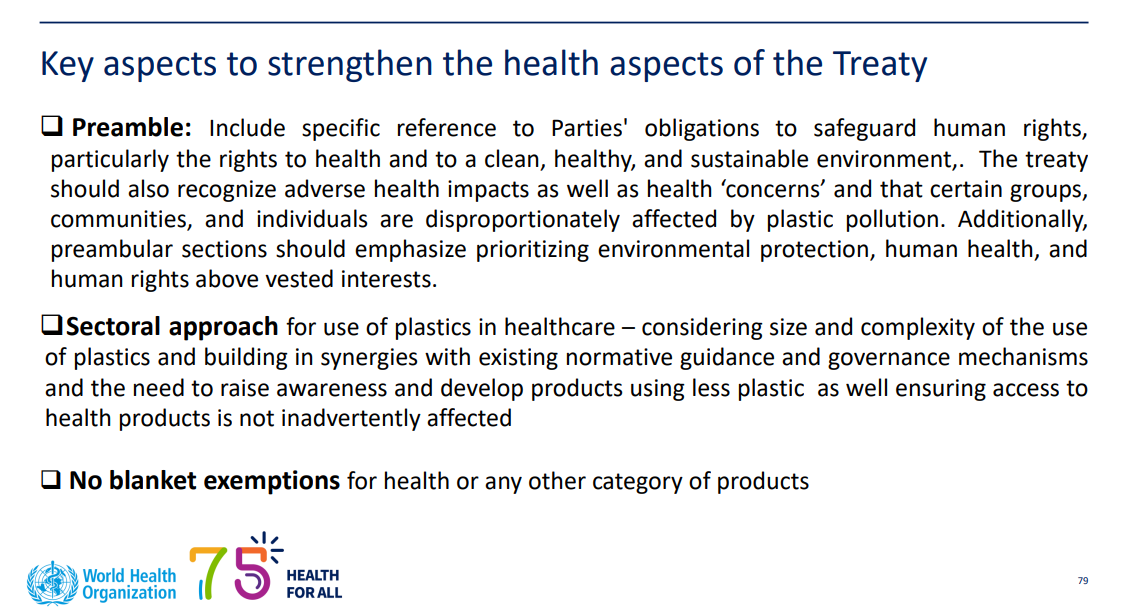
- A key aspect to strengthen the health aspects of the treaty is the improvement of the preamble, especially regarding references to health and the obligation to safeguard human rights, particularly in relation to health and a clean, healthy, and sustainable environment.
- The treaty should also recognize the adverse health effects of plastics and the fact that certain groups are disproportionately affected. We would like to see references to prioritizing environmental protection, human health, and human rights above vested interests.
- Additionally, we advocate for a sectoral approach to the use of plastics in healthcare. The complexity of the use of plastics and the need to build synergies with existing guidance and governance mechanisms must be considered. There needs to be space in the treaty for the time needed to implement these innovations and safeguard health. However, we should not allow blanket exemptions for health reasons or any other categories of products; instead, the treaty should incentivize the innovation needed.
Closing remarks
Sarah DUNLOP: We see the harm not only from health but from multiple perspectives. Vested interests are driving the maintenance of the status quo, and we need to find a way to break through to benefit all.
Ludwig L. ALBORNOZ: The current way of doing business as usual is unsustainable. There is a need for the health sector to be recognized as part of the solution, and to avoid artificial distinction between human health and global health.
Rico EURIPIDOU: Listen to the voices of healthcare professionals. They are the most trusted voices in society, and we have an imperative to listen to them.
Melchior KUO: It is important to incentivize change across the entire healthcare sector and globally across all sectors, and this can be driven through the plastics treaty. When focusing on change, it is crucial to ensure there are alternatives available for a smooth transition.
Yuyun ISMAWATI: It is essential for negotiators to consider health aspects in every article. Health should be prioritized at the top because it is linked to production articles and chemicals of concern. Health issues should be addressed more prominently in the negotiations, particularly in highlighting the harmful effects of recycled plastics, emissions, releases, microplastics or nanoplastics, as well as the chemicals involved in production processes.I hope health issues are emphasized more strongly at INC-5, and I trust delegates will listen to the science.
Albert MAGALANG: Addressing the health concerns is challenging but these should be reflected in the text of the treaty. We have already started discussions on the inclusion of health in the treaty, but this should be pushed more aggressively. The approved text should highlight the elimination of harmful plastics, pushing harder for the inclusion of provisions to ban and phase out the most harmful plastic products and chemicals. There is an opportunity now for member states to work on creating global lists and criteria to identify plastic products and chemicals of concern that should be banned and phased out.
Interventions From the Audience
Kamelia Kemileva | Co-Director, Global Cities Hub – Geneva
The statement was delivered on behalf of the Local and Subnational Governments Coalition to End Plastic Pollution
- Local governments are indeed unusual stakeholders. While they’re part of the “whole of government” pyramid, they typically have less decision-making power and fewer resources than central governments.
- Yet, when it comes to plastic pollution, they are the first affected and the first responders—responsible for organizing waste collection, recycling, and pollution prevention directly on the ground. In this way, they are effectively at the top of the pyramid in combating plastic pollution.
- It’s in everyone’s interest to support the full inclusion of local and subnational governments in the Treaty. Without their involvement, this Treaty risks becoming a “dead letter”—with ambitious commitments but limited on-the-ground impact.
- Our Coalition’s recommendation is rooted in our ongoing contributions to major global environmental agreements—such as the Paris Agreement and the Kunming-Montréal Biodiversity Framework. Integrating local governments into the Plastic Pollution Treaty will strengthen the effectiveness of these multilateral agreements on the ground, creating a more cohesive approach to tackling environmental challenges.
- We have submitted to the Chair and all negotiating States key additions to the negotiation text that highlight the role of subnational and local governements, ensuring the Treaty’s ambitious goals translate into impactful local action.
- A letter has also been sent to the Chair.
Photo Gallery


Documents
- Presentations made during the event
- Information document from Georgia, Ghana, Ethiopia and Switzerland on ensuring a health approach within the international legally binding instrument on plastic pollution, including in the marine environment
(version 14 November 2024) - Member State Information Session: Health aspects of the proposed treaty to end plastic pollution | WHO | 1 November 2024
- Ensuring a health approach within the international legally binding instrument on plastic pollution, including in the marine environment | Draft Paper | WHO | 26 October 2024
- Invitation