
Newsletter 19 Jan 2026
Environment: What’s Up in GENeva | 19 – 25 January 2026
The Geneva Environment Network’s weekly newsletter includes the latest information on the global environmental agenda, main events, job vacancies, as well as other useful resources and updates. The Geneva Environment Network is not responsible for the content of any linked site or any link contained in a linked site. Stay tuned and follow us on X (Twitter), Facebook, LinkedIn, Instagram, Bluesky, and Youtube, or visit our website regularly for additional updates.
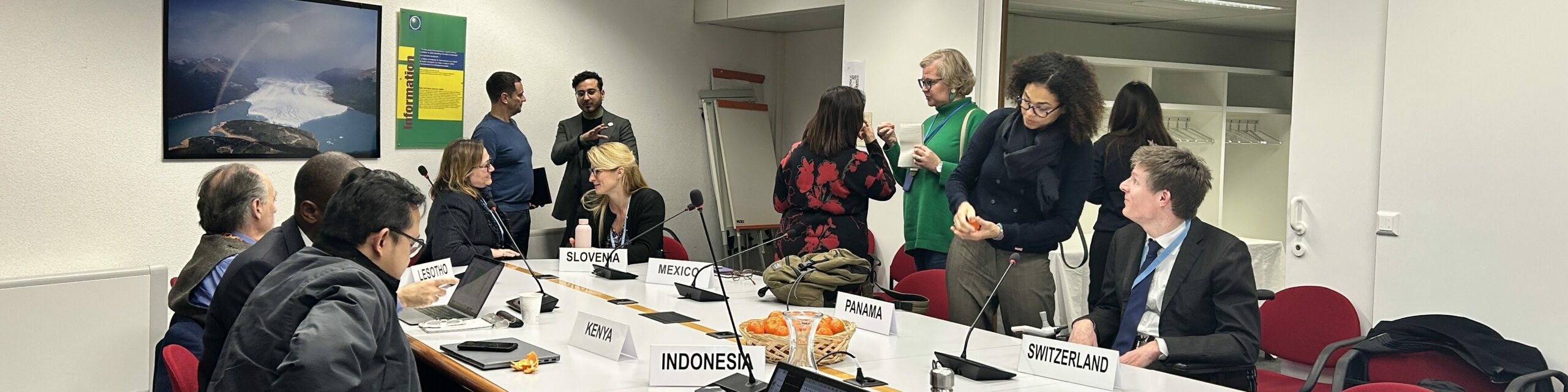
Image of the week | Delegates engaging in discussions following the closure of the Briefing on the Preparations for the First Plenary Session of the Intergovernmental Science-Policy Panel on Chemicals, Waste and Pollution (ISP-CWP P1), at the International Environment House, on 14 January 2026. The first plenary of the ISP-CWP will take place in Geneva from 2 to 6 February and constitutes a milestone moment, as it is the first time the governing and decision-making body of the panel will come together since its establishment in Punta del Este, Uruguay, in June 2025.
Environment in Global Risks Report 2026
The World Economic Forum’s Global Risks Report 2026, released last week, identifies geoeconomic confrontation as the most significant global risk for the year, followed by interstate conflict, extreme weather, societal polarization and misinformation and disinformation. Published annually just days before the Forum’s Annual Meeting in Davos, the Global Risks Report provides a concise snapshot of the most significant risks facing the world. Now in its 21st edition, the report is based on an annual survey of over 1,300 global leaders and risk experts. It analyses risks across three timeframes: immediate (2026), short-to-medium term (the next two years), and long term (the next 10 years).
Environmental risks have been among the most highly ranked in recent years. However, this year they are being reprioritized in the short term, relative to perceived more pressing non-environmental threats. In the near term, armed conflict, the weaponization of economic tools and societal fragmentation are colliding. As these immediate risks intensify, longer-term challenges from technological acceleration to environmental decline are also creating knock-on effects. Over the 10-year period, environmental risks remain the most severe, with extreme weather, biodiversity loss, and critical change to Earth systems, on the top of the list of long-term threats. Natural resource shortages are in sixth place, and pollution is in tenth (ninth in the outlook for the next two years), while extreme weather events continue to be the world’s most severe long-term risk for the third year in a row. Three-quarters of respondents expect a turbulent or stormy environmental outlook, the most pessimistic across any category. → Read more in WEF press release
Responding to the Global Risks Report 2026, WWF International calls on decision makers to prioritize action to address systemic climate and nature threats. As environmental concerns dominate long-term risks, system-wide changes are urgently needed.
With misinformation and disinformation continuing to rank among the world’s most severe global risks, the upcoming event “Challenges and Solutions to Prevent Disinformation in Environmental Policy Making,” co‑convened with the Geneva Environment Network on 30 January 2026, will highlight on how false and misleading information undermines environmental policy and public understanding. The session will present concrete examples of disinformation tactics across the triple planetary crisis, and explore practical strategies to counter these challenges, including policies on conflict‑of‑interest, enhanced transparency, and evidence‑based decision‑making. → Register to join in person at the International Environment House or join online on Webex
Environment @ World Economic Forum Annual Meeting 2026
This week, from 19 to 23 January 2026, leaders from governments, business and civil society organizations are convening in the Swiss town of Davos for the 56th Annual Meeting of the World Economic Forum. Held under the theme ‘A Spirit of Dialogue‘, and a programme structured around five global challenges, including “How can we build prosperity within planetary boundaries?”, the environment will feature prominently in the official agenda as well as parallel discussions taking place in Davos. The United Nations is strongly represented at the Forum’s annual meeting, with the participation of UN Secretary‑General António Guterres, heads of agencies, and senior officials from Geneva‑based organizations, including WTO Director‑General Ngozi Okonjo‑Iweala, WHO Director‑General Tedros Adhanom Ghebreyesus, and ITU Secretary‑General Doreen Bogdan‑Martin.
On 20 January 2026, the House of Switzerland will also be hosting the Geneva Day under the theme “Making Multilateralism Work for Humanity in a New Era“, underscoring challenges and opportunities and laying out avenues for action for a “Multilateralism 2.0” that truly works for all in this new era. Many sessions will be livestreamed or recorded, while sessions organized under the Open Forum format are accessible to everybody and free of charge, upon registration. → Learn more on What to expect, who’s coming and how to follow, consult our dedicated webpage for a list of environment-related sessions and a guide to side events by Richard Mort of The Human API
In addition to the Global Risks Outlook, the WEF Annual Meeting takes place against the backdrop of last week’s additional release of publications and events:
- The United Nations Secretary-General António Guterres attended an event in London on Saturday to commemorate the 80th anniversary of the General Assembly, where he highlighted that powerful forces are lining up to undermine global cooperation, and stressed that “humanity is strongest when we stand as one”. He described 2025 as a “profoundly challenging” year marked by cuts to aid, widening inequalities, escalating climate chaos, crackdowns on civil society, impunity for attacks on journalists, and threats to UN staff. Fossil fuel profits soared even as the planet broke heat records, while online algorithms amplified falsehoods and hatred. The Secretary-General called for a “robust, responsive and well‑resourced” multilateral system to confront interconnected global crises. He highlighted the newly enacted High Seas Treaty that entered into force on Saturday as a model of modern, inclusive, science‑based diplomacy. Such “quiet victories” of cooperation, he said, often go unnoticed but are vital. “If we wish to secure more such victories, we must ensure the full respect of international law and defend multilateralism, strengthening it for our times.”
- The World Economic Forum’s flagship report on youth perspectives “Youth Pulse 2026: Insights From the Next Generation for a Changing World” issued last week draws on insights from nearly 4,600 young people from 489 locations worldwide and summarizes how young people are not only navigating uncertainty but are actively reimagining systems and solutions for the future, including leading a generation-wide movement for climate resilience – turning awareness into action, and values into systems change.
- The “Global Cooperation Barometer 2026” provides a comprehensive assessment of global cooperation across five pillars: trade and capital, innovation and technology, climate and natural capital, health and wellness, and peace and security. Drawing on 41 indicators, the third edition of the report highlights where cooperation is persisting, where it is weakening and how it is being reconfigured in response to shifting economic, political and technological realities.
- Recent analysis from Oxfam finds that the richest 1% have exhausted their annual carbon budget – the amount of CO2 that can be emitted while staying within 1.5 degrees of warming – only ten days into the year, while the richest 0.1% already used up their carbon limit on 3 January. To stay within the 1.5 degrees limit, the richest 1% would have to slash their emissions by 97% by 2030. Meanwhile, those who have done the least to cause the climate crisis – including communities in poorer and climate-vulnerable countries, Indigenous groups, women and girls – will be the worst impacted.
Preparations for the 61st Session of the Human Rights Council
The 61st Regular Session of the Human Rights Council (HRC61) is taking place in Geneva from 23 February to 2 April 2026. With the environment high on the agenda at this session of the Council, various preparations are taking place ahead of the session, including upcoming important deadlines for NGOs:
- Side Events | Registration of requests for NGO Side Events for HRC 61 will be available from 19 January 2026, 12:00 CET, until 26 January 2026, 12:00 CET. NGOs in consultative status with ECOSOC may submit requests for NGO Side Events through the online registration platform.
- Written Statements | Registration periods of NGO Written Statements for HRC61 through the online registration platform are as follows:
- General Debates under all Agenda Items: from 19 January, 12:00 CET until 26 January, 12:00 CET
- Other debates under Agenda Items 1, 2, 3 and 4 (excluding General Debates): from 26 January, 12:00 CET until 2 February, 12:00 CET
- Other debates under Agenda Items 6, 7, 9 and 10 (excluding General Debates): from 2 February, 12:00 CET until 9 February at 12:00 CET
→ Regular updates on key environmental issues at HRC61, side events, and further resources will be made available on our dedicated HRC61 and the environment update.
To strengthen coordination among stakeholders and enhance outreach on the environmental agenda of HRC61, the Geneva Environment Network and its partners are convening an information-sharing session focused on activities and events related to the environment. This event will provide a platform to discuss and share information on planned environment-related activities at and around HRC61, such as in-person and online events, publications or exhibitions, among others, and exchange on opportunities for synergies and collaboration. Insights gathered during the session will feed the GEN page on HRC61 which will serve as a central hub offering an up‑to‑date calendar of all environment‑related activities of HRC61. → Register to participate in-person at the International Environment House I or online via Webex on Tuesday, 27 January 2026, from 10:00 to 11:00 CET. Share as well information on your activity!
Other upcoming deadlines for calls for submissions by human rights mechanisms include:
- The UN Special Rapporteur on the human rights to safe drinking water and sanitation, Pedro Arrojo Agudo, will undertake an official visit to Egypt from 8 to 17 February, at the invitation of the Government. The Special Rapporteur invites all interested individuals and organizations to provide input on the priority issues listed below to assist him in preparing for the visit. The deadline for submission is 19 January 2026. → Submit your input
- The UN Special Rapporteur on climate change and human rights, Elisa Morgera, in her upcoming report to the Council in 2026, will seek to synthesize and analyze a varied body of evidence (from across the natural and social sciences, including Indigenous science, traditional knowledge and other knowledge systems) of the actual and potential contributions of transforming food systems to climate change mitigation, adaptation, prevention and responses to loss and damage, and human rights protection, taking an integrated approach to land- and ocean-based food systems. The deadline for submission is 30 January 2026. → Submit your input
- The Office of the High Commissioner for Human Rights is preparing a second report addressing the challenges and barriers to the full realization and enjoyment of the human rights of the people of the Marshall Islands, stemming from the State’s nuclear legacy. The deadline for submission is 31 January 2026. → Submit your input
Relevant news include:
- Webinar: Advancing the conservation and sustainable use of biodiversity to support the full enjoyment of all human rights, including the right to health and the right to a clean, healthy and sustainable environment | UN Biodiversity | 21 January 2026 | 16:30 – 17:30 CET
The Secretariat is convening an information webinar to support the implementation of the Kunming-Montreal Global Biodiversity Framework, and is aimed at strengthening the understanding of the important connection between biodiversity, health and human rights from the perspective of diverse stakeholders and rights-holders. - Mexico: UN experts demand truth and justice three years after enforced disappearance of rights defenders Ricardo Lagunes and Antonio Díaz | UN WG on Enforced or Involuntary Disappearances, UN WG on Business and Human Rights, UN Special Rapporteur on right to healthy environment, UN SR on the rights of Indigenous Peoples, UN SR on human rights defenders, UN SR on right to freedom of opinion and expression, UN SR on rights to peaceful assembly and of association | 15 January 2026
On the third anniversary of the enforced disappearance of Ricardo Lagunes and Antonio Díaz, UN experts demanded immediate answers about the fate and whereabouts of the two Mexican human rights defenders. - Venezuela: Accountability and democracy cannot be built on violations of international law, warn UN experts | Various UN Special Procedures mandate holders | 15 January 2026
UN experts said that the only way to restore democracy in Venezuela following the recent violation of its sovereignty and years of authoritarian rule, is to respect the will of the Venezuelan people, ensure accountability and self-determination, and guarantee the sovereign and sustainable use of their natural resources in line with international law.
Extreme Heat, Warming Seas, Rising Energy Risks
Last week, the World Meteorological Organization confirmed that 2025 was one of the three warmest years on record, despite the cooling effect of La Niña phenomenon. The past 11 years have been the 11 warmest on record, and ocean heating continues unabated. As stated by WMO Secretary-General Celeste Saulo, “The year 2025 started and ended with a cooling La Niña and yet it was still one of the warmest years on record globally because of the accumulation of heat-trapping greenhouse gases in our atmosphere. High land and ocean temperatures helped fuel extreme weather – heatwaves, heavy rainfall and intense tropical cyclones, underlining the vital need for early warning systems.” WMO will provide full details of key climate change indicators, including greenhouse gases, surface temperatures, ocean heat, sea level rise, glacier retreat and sea ice extent, in its State of the Global Climate 2025 report to be issued in March 2026. This will also give details of high-impact events. → Read more in WMO press release and Copernicus Global Climate Highlights 2025
The situation of ocean heat is equally worrying as a separate study published in Advances in Atmospheric Sciences found that ocean temperatures were also among the highest on record in 2025, reflecting the long-term accumulation of heat within the climate system.
According to another recent report, the third edition of the WMO–IRENA Climate-driven Global Renewable Energy Resources and Energy Demand Review, co-developed by WMO and the International Renewable Energy Agency (IRENA), 2024 — the warmest year on record — brought pronounced regional shifts in solar, wind and hydropower potential, alongside a 4% increase in climate-driven global energy demand compared with the 1991–2020 average. These climate-driven changes are occurring as global renewable energy capacity surpassed 4,400 gigawatts (GW), amplifying the interaction between climate conditions and energy systems at an unprecedented scale. The findings underscore the urgency of integrating climate intelligence into energy planning as countries work to deliver on the COP28 UAE Consensus, which calls for tripling renewable energy capacity and doubling energy efficiency by 2030.
Reactions to the Entry into Force of the High Seas Treaty
The High Seas Treaty — formally known as the Biodiversity Beyond National Jurisdiction (BBNJ) Agreement, the world’s first legally binding agreement to protect marine biodiversity in areas beyond national jurisdiction — officially entered into force on 17 January 2026, marking a historic moment for global ocean governance. Covering nearly half the planet’s surface and more than two-thirds of the world’s ocean surface, representing over 90 per cent of Earth’s habitat by volume, the treaty creates a long‑awaited framework for establishing marine protected areas, conducting environmental impact assessments, regulating access to marine genetic resources, and supporting capacity‑building for developing countries.
Governments, civil society organizations, and ocean experts have widely hailed this milestone as a “new era” for the global commons, a “Beacon of Hope” for the Ocean, “a monument to multilateralism”, emphasizing that protecting the high seas is essential not only for marine wildlife but also for the stability of the planet’s climate and life‑support systems. Recent reactions include:
- WWF: Entry into force of High Seas Treaty ushers in new era of ocean governance | WWF | 17 January 2026
- With High Seas Treaty in Force, Ocean Life Gains New Hope | Pew | 17 January 2026
- High Seas Treaty enters into force, a historic leap for ocean protection | ifaw | 17 January 2026
- Historic High Seas Treaty enters into force, launching a new era of global ocean governance | High Seas Alliance | 16 January 2026
- Global Ocean Treaty takes effect as artists worldwide press for action | Greenpeace | 16 January 2026
- Game-changing international ocean treaty comes into force | UN News | 15 January 2026
- IUCN Director General’s statement on the entry into force of the High Seas Agreement | IUCN | 15 January 2026
Enjoying a Green Winter in Geneva
During the cold winter days, Geneva offers plenty of opportunities to enjoy your free time indoors or in heated outdoors. This week, suggestions to enjoy a Green Winter in Geneva include:
- Geneva Lux Festival | 16 January – 1 February 2026 | City of Geneva
Geneva Lux is a free light festival that has been illuminating the city of Geneva for twelve years during winter. It attracts a diverse audience of locals, families, commuters, and tourists. This year’s edition expands into the Old Town, featuring around twenty artworks and performances. New site-specific creations offer a unique immersive experience. - Fresque des obstacles à la transition | 20 January 2026 | Maison de l’Avenir
The obstacle course to transition is an educational tool that can be used to address both theoretical and practical topics. Its purpose is to make participants aware that in order to bring about widespread societal change, it is necessary to collectively address the many phenomena (neuropsychological, sociological, political, etc.) that can hinder change. - An object, a sound, a story: discovering dream painting | 21 January 2026 | Musée d’ethnographie de Genève
Contemporary Aboriginal artists, let’s go with Japara, an aboriginal child, who learns about aboriginal art from the painter Marwai. After observing the objects of the Australian Aboriginal collection, we will discover Japara’s story followed by a moment of listening to Aboriginal music. - Mineral Echo | From 21 January to 7 February 2026 | Théâtre du Grütli
Based on testimonies from female mountaineers, this performance weaves a dialogue between mountaineering, feminism, and ecology. Two women, bound by a fragile solidarity, set out to place a memorial plaque to commemorate a glacier that has just disappeared. - Atelier d’écriture et scène ouverte EcoSlam | 23 January 2026 | Maison de l’Avenir
The EcoSlam Collective uses slam poetry as a tool to transform ecological crises into creative outpourings. Ecological crises affect us all, but it can be difficult to feel justified in expressing our opinions on these issues. As a popular and accessible art form, slam poetry is a wonderful way to convey our thoughts and emotions on these topics. - Orchestre des Nations 15th Anniversary | 24 January 2026 | Victoria Hall
The Orchestre des Nations celebrates its 15th anniversary with Shostakovich’s Symphony No. 5, featuring pianist Matei Varga. - Les volcans bouillonnants et imprévisibles | 25 January 2026 | Musée d’histoire des sciences
Volcanoes rumble, smoke, and light up the sky with incandescent eruptions. Their activity is as spectacular as it is dangerous. For scientific research, volcanologists have ventured dangerously close—among them Haroun Tazieff, Katia and Maurice Krafft. This exhilarating lecture will lift you into ash clouds, race you alongside lava flows, and plunge you into the mysterious heart of volcanoes to uncover what lies within. - Black Movie Festival | 16 – 25 January 2026 | Various Movie Theatres in Geneva
The Black Movie Festival returns to theaters for its 27th edition! This is another opportunity to visit Asia, Africa, Latin America, and Europe through a selection of the best films by contemporary directors. There will be around a hundred films, both feature-length and short, including bold independent productions for adults and children alike, which fall outside the mainstream. - Festival TEV 5ème édition | 25 January – 31 January 2026 | Saint Julien en Genevois
What better way to grasp environmental challenges than to immerse yourself in the topic? Conferences, film screenings, and other thematic workshops will take place around the Citizen Environmental Transition. - Give us Back the Beauty, Exhibition by Bernard Garo | Until 6 February 2026 | Galerie Renaissance
This exhibition brings together recent paintings on paper, works created on 19th-century Dufour topographic maps, and large-scale photographic compositions capturing glaciers in transition. Together, they trace a visual and emotional cartography of the planet’s changing ice — from serenity and energy to fragmentation and disappearance. - Libre comme le Rhône – de Robert Hainard | Until 29 March 2026 | Quartier Libre
The exhibition invites visitors to travel back in time along the river, from the last wild landscapes before the major developments of the Rhône to the major energy decisions taken during the 20th century, right up to the emergence of environmental awareness. This exhibition shows how, in a small cantonal area, electricity needs, landscape transformations, and the desire to protect nature have intertwined. - Exhibition “Quel froid!” | Until 30 August 2026 | Maison Tavel
Explores the theme of winter in Geneva and beyond, bringing together traditions, artists’ perspectives, and visual archives. Visitors are guided through popular practices, urban scenes, and majestic landscapes, from Lake Geneva to the Alps.
What (Else) to Read Next?
- Global report identifies critical habitats for migratory sharks and rays | IUCN | 14 January 2026
A report released by the IUCN Species Survival Commission (SSC) Shark Specialist Group, with support from the German Federal Ministry for the Environment, Nature Conservation, Climate Action and Nuclear Safety and the Convention on the Conservation of Migratory Species of Wild Animals (CMS) identifies more than 750 Important Shark and Ray Areas (ISRAs) worldwide, providing the clearest picture to date of the habitats essential for the survival of threatened migratory sharks and rays.
- Cheaper drinks will see a rise in noncommunicable diseases and injuries | WHO | 13 January
In two new global reports the World Health Organization is calling on governments to significantly strengthen taxes on sugary drinks and alcoholic beverages. The reports warn that weak tax systems are allowing harmful products to remain cheap while health systems face mounting financial pressure from preventable noncommunicable diseases and injuries. - Operation Thunder 2025: 134 participating countries make record seizure of protected plants, animals and timber | CITES | 13 January 2026
From 15 September to 15 October 2025, law enforcement agencies comprising police, customs, border security and forestry and wildlife authorities from 134 countries made a total of 4,640 seizures during Operation Thunder 2025. This record number of seizures included tens of thousands of protected animals and plants and tens of thousands of cubic metres of illegally logged timber, and more than 30 tonnes of species classified as endangered under CITES. - US Retreat from Global Climate Cooperation Threatens Rights | Human Rights Watch | 12 January 2026
Addressing greenhouse gas emissions, rising temperatures, and climate-driven disasters requires global cooperation, shared scientific understanding, and collective accountability through reporting and public scrutiny. Withdrawing from multilateral climate institutions weakens progress on these efforts and is likely to have severe human rights consequences. - New EU-wide protections against PFAS in drinking water come into effect | European Commission | 12 January 2026
Under new rules entered into application on 12 January 2025, Member States must monitor, in a harmonized way, per- and polyfluoroalkyl substances (PFAS) levels in drinking water to ensure compliance with the new EU limit values under the recast Drinking Water Directive. - New report calls for stronger public role in building domestic supply chains and inclusive workforce | ILO | 11 January 2026
A new IRENA–ILO report (Renewable Energy and Jobs – Annual Review 2025) finds global renewable energy jobs reached 16.6 million in 2024 but growth slowed. It calls for stronger public action to build domestic supply chains and ensure a more inclusive workforce. - High-performance living plant collections require a globally integrated data ecosystem to meet twenty-first-century challenges | Samuel F. Brockington, Patricia Malcolm, Anthony S. Aiello et al. | Nature Plants | 9 January 2026
This Perspective critically examines data management practices of living collections supporting scientific research and conservation, from institutional to global levels. It identifies the renewed demands on living collections, highlighting exemplar global data infrastructures, defines data challenges inherent to living collections and exploring how current systems fall short in enabling a connected global system.
Events
See all
Body Meeting
Fourth Resumed Meeting of the Intergovernmental Working Group (IGWG) on the WHO Pandemic Agreement
20 – 22 Jan 2026
WHO Headquarters
WHO

Body Meeting
The EU Methane Regulation: Global Implications, Benefits and Challenges
20 Jan 2026 | 10:00 – 13:00
Palais des Nations, Room H-207-208-209 & Online
UNECE
Conference
Participation in the UNFCCC’s First Global Stocktake: Innovation and Continuity in Climate Governance
20 Jan 2026 | 12:30 – 13:30
Maison de la Paix | Room S11 & Online
IHEID

Virtual
Responsible Business Practices Webinar Series
20 Jan 2026 | 16:00 – 16:40
Online
Gold Standard Foundation

Afterwork
Fresque des obstacles à la transition
20 Jan 2026 | 17:00 – 21:00
Maison de l'avenir
City of Geneva
Virtual
Demonstrate the impact of climate adaptation and resilience investments: A new toolkit for banks, insurers and investors
21 Jan 2026 | 14:00 – 15:00
Online | BrightTalk
UNEP FI
Virtual
Incorporating scalable physics and uncertainty into AI weather prediction
21 Jan 2026 | 17:00 – 18:00
Online
ITU


Virtual
Informational Webinar with Observers Ahead of INC-5.3
22 Jan 2026 | 12:00 – 13:50
Online | Zoom
INC Plastic Pollution

Conference
Ecological Threats and Resilience: Mapping Today’s Fragility Hotspots
22 Jan 2026 | 12:30 – 14:00
Geneva Centre for Security Policy & Online
GCSP, IEP
Virtual
Multilateralism & Cities in 2026 – What to expect?
22 Jan 2026 | 14:00 – 15:00
Online | Zoom
Global Cities Hub - Geneva
Virtual
The First WMO AI Webinar – Good Practices of ECCC and KMA
22 Jan 2026 | 14:00 – 15:00
Online | Zoom
WMO

Virtual
Gender Action Plan under the Global Framework on Chemicals: Overview, Data Collection, and Next Steps
22 Jan 2026 | 15:00 – 16:00
Online | Webex
GFC
Jobs
See all




Professional
Maître Asisstant-e, Section des Sciences de la Terre et de l’Environment
25 Jan 2026
UNIGE