Newsletter 19 May 2025
Environment: What’s Up in GENeva | 19 – 25 May 2025

The Geneva Environment Network’s weekly newsletter includes the latest information on the global environmental agenda, main events, job vacancies, as well as other useful resources and updates. Stay tuned and follow us on X (Twitter), Facebook, LinkedIn, Instagram, Bluesky, and Youtube, or visit our website regularly for additional updates.
Image of the week | Partial lowering of the Rhône River from 16 to 27 May 2025 to clear sediments deposited in the reservoir of the Verbois dam. Carried out every 3 to 4 years under the supervision of the French and Swiss authorities, this operation aims to prevent the risk of flooding and to promote the sediment continuity necessary for the life of the Rhone River downstream of Geneva. The process raises concerns for wildlife conservationists at each edition. Swimming, fishing, boating, and sports are banned along the river until 6 June 2025. © AAPPMA du Bas-Bugey
Human Rights in the Lifecycle of Renewable Energy and Critical Minerals
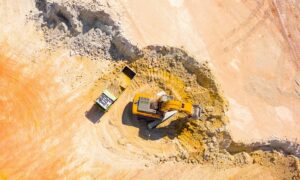
Though minerals and metals play a central role in the global economy, and are often described as essential for the future, their unsustainable extraction, manufacturing, use and disposal have important detrimental impacts on both people and the planet. Various stakeholders in Geneva are engaged in ensuring enhanced action to support the environmental sustainability management of minerals and metals along their full lifecycle, with numerous discussions, including on human rights implications, continuing to emerge in Geneva and beyond, including:
-
Expert Conversation on Human Rights and Life Cycle of Renewable Energy and Critical Minerals | This week, the UN Special Rapporteur on the promotion and protection of human rights in the context of climate change is holding an Expert Conversation in light of her upcoming report to the UN General Assembly. The report seeks to synthesize and analyze a varied body of evidence of the positive and negative human rights impacts of different sources, scales and stages to renewable energy development, throughout their full life cycle, including the extraction and re-use of critical minerals. It will also seek to clarify States’ international human rights obligations, individually and as part of international cooperation, as well as business responsibility, to support a just transition while enhancing the protection of everyone’s human right to a healthy environment and the prevention of foreseeable negative human rights impacts of certain climate mitigation approaches. The report will identify good practices, strategies and policies at all levels that contribute to the promotion and protection of all human rights and poverty alleviation throughout the life cycle of renewable energy and critical minerals. Though the call for inputs (available on the UN Special Rapporteur’s webpage) is now closed, this expert conversation aims to inform and build upon the submissions received. → Register on Indico an join on 21 May 2025 from 10:30 to 12:30 CEST in Room V at Palais des Nations.
- Precautionary Principle and Deep-Sea Bed Mining | Though much of the seabed remains unknown to us — as a matter of fact, 99.999% of the ocean floor is still unexplored — growing interests over the possible economic gains from mining minerals from the seabed, including those needed for technologies towards energy transition, is also increasingly mounting concerns over the environmental and human rights harm such an industry may cause.
- As Jessica Battle, expert on Global Ocean Policy and Governance and the lead of the Deep Seabed Mining Initiative at WWF International, highlighted in an interview at the New Scientist, “Until the deep sea is better mapped and understood, only then can decisions around opening this industry be taken in good faith.” To date, 33 countries, in addition to the numerous legislators, parliamentarians, civil society, Indigenous Peoples in the Pacific, scientists, and businesses, have now signed a call for a moratorium to oppose deep sea-mining.
- The UN Special Rapporteurs on environment and human rights, Astrid Puentes Riaño, and on climate change and human rights, Elisa Morgera, have recently published earlier this month a policy brief, on “The precautionary principle and deep-seabed mining: A State obligation under international law that must be urgently respected.” In light of ongoing deliberations at the International Seabed Authority (ISA) on deep-seabed mining, the policy brief aims to clarify the legal and scientific bases for the urgent application of the precautionary principle and the main measures States must take in accordance with their obligations under international human rights and environmental law. The report concludes that States must urgently decide to implement a precautionary pause or moratorium on deep-seabed mining activities, at Part II of the ISA 30th Session taking place at the end of June 2025, to prevent irreversible harm to the marine environment, the climate system, and the full enjoyment of human rights, including the right to a clean, healthy and sustainable environment.
- Making digitalization work for inclusive and sustainable development | Last week, at the 8th session of the UNCTAD Intergovernmental Group of Experts on E-commerce and the Digital Economy, delegates discussed how the sustainable development gains from digitalization can be ensured over its lifecycle, looking particularly, among others, at critical minerals linked to the digital transformation process and waste management. They agreed on a Policy recommendation “Making digitalization work for inclusive and sustainable development“, acknowledging the environmental footprint of the digitalization process and the need for a circular economy, as examined in the Digital Economy Report 2024. The Intergovernmental Group of Experts on E-commerce and the Digital Economy calls on all stakeholders to work towards enhancing the understanding of the environmental footprint of digitalization and welcomes relevant initiatives in this regard. Among the recommendations, they encourage the adoption of policies for responsible management of digitalization-related waste, including by strengthening the enforcement of the Basel Convention on the Control of Transboundary Movements of Hazardous Wastes.
- Geneva Platform for Resilient Value Chains | The Geneva Platform for Resilient Value Chains (GPRVC) recently brought together – confidentially – 30 representatives from diverse countries, companies and organizations to share perspectives on China’s role in global clean energy supply chains (Solar PV, Wind, Critical Minerals, Batteries, EVs) and explored compromise solutions that would help meet countries’ divergent objectives.
- Copper the “new strategic raw material” | As highlighted earlier this month in the UNCTAD Global Trade Update (May 2025): Focus on critical minerals – copper in the new green and digital economy, copper is essential for electric vehicles, renewable energy systems, data centers, AI infrastructure and smart grids. Global copper demand is expected to grow by over 40% by 2040, but supply isn’t keeping pace. Meeting this demand may require 80 new mines and $250 billion in investment by 2030. Recycling is becoming a key part of the solution. Investing in recycling and processing capacity can reduce import dependence, support value-added trade and advance a more circular, sustainable economy.
- Global Critical Minerals Outlook 2025 | The 2025 edition of the International Energy Agency’s annual Global Critical Minerals Outlook to be released on 21 May includes a detailed assessment of the latest market and investment trends, along with their implications for critical mineral security. The 2025 Outlook also explores key issues such as mineral supply chains for emerging battery technologies, recent innovations in mining, refining and recycling, policy mechanisms to support diversification, and strategic minerals for applications beyond the energy sector.
Geneva Driving Biodiversity Action | Celebrating Nature
This week, biodiversity is high on the international agenda, with two key observations reminding us of the importance of biodiversity in supporting the health of people and of our planet’s ecosystems, and the Swiss national Nature Festival.
-
The International Day for Biological Diversity is celebrated every year on 22 May, commemorating the adoption of the text of the Convention on Biological Diversity (CBD) in 1992. The 2025 edition theme “Harmony with nature and sustainable development” focuses the world’s attention on the linkages between the 2030 Agenda and its Sustainable Development Goals (SDGs) and the Goals and Targets of the Kunming-Montreal Global Biodiversity Framework (KMGBF) as two universal agendas that must be pursued in tandem in the spirit of the recently adopted Pact for the Future. To celebrate the Day and the importance of advancing action to tackle biodiversity loss, the key findings of two landmark scientific reports adopted and launched at the 11th Intergovernmental Platform on Biodiversity and Ecosystem Services (IPBES) Plenary in Windhoek, Namibia, in December 2024 — the Nexus Report and the Tranformative Change Report — will be presented to international Geneva at the International Biodiversity Day Celebration 2025, showcasing how multilateral Geneva creates interlinkages and drives transformative change in harmony with nature and sustainable development. Leading authors and experts from key Geneva-based UN institutions and processes invited to join the panel of this event will present the findings of the reports and reflect on how the multilateral system can meet the interconnected challenges that result from the accelerated speed and scale of environmental change and rising inequalities identifies in the assessments. → Register on Indico to join in Room III at Palais des Nations on 22 May 2025 from 13:15 CEST.
-
World Bee Day, celebrated each year on 20 May to raise awareness of the importance of bees as pollinators, the threats they face and their contribution to sustainable development, is observed this year under the theme “Bee inspired by nature to nourish us all“. Building momentum for the International Day of Biological Diversity, the Food and Agriculture Organization of the United Nations (FAO), the Conservatory and Botanical Garden of the City of Geneva, the Permanent Mission of Slovenia, Permanent Mission of Ethiopia, Permanent Mission of Switzerland, and the United Nations Office at Geneva (UNOG) with the support of the Geneva Environment Network will host a special in-person celebration Bees for Biodiversity, engaging both the international and local public to emphasize the importance of bees and other pollinators in securing food systems, eliminating global hunger, and protecting biodiversity and the environment. → Register to join the celebration on Tuesday, 20 May 2025, from 15:00 to 16:30 CEST at the Amarante Restaurant, Conservatory and Botanical Garden of the City of Geneva.
- Fête de la Nature 2025 | À l’écoute de la nature, takes place from 21 to 25 May 2025. The 14th edition of the Festival of Nature invites us to pause and truly listen to the natural world. Dedicated to the often-overlooked sounds of nature muffled by human activity, the event encourages deeper observation, respect, and connection through soundscapes and sensory experiences.
- Consult our International Day for Biological Diversity 2025 dedicated page to discover more activities taking place around Geneva to celebrate Biodiversity.
Preparing for the First Meeting of the Open-Ended Working Group for the Global Framework on Chemicals
The Global Framework on Chemicals – For a Planet Free of Harm from Chemicals and Waste (GFC), adopted in September 2023 at the fifth International Conference on Chemicals Management (ICCM5), seeks to protect both the planet and human health, advocating for strong governance mechanisms and enforcing international standards. Providing agreed goals and targets to tackle the pollution and waste crisis, alongside the other international agreed deals for the crisis of climate change – Paris Agreement – and the crisis of nature, land and biodiversity loss – Kunming-Montreal Biodiversity Framework.
The first meeting of the Open-Ended Working Group (OEWG) for the GFC will be held from 24–27 June 2025 in Punta del Este, Uruguay, gathering all stakeholders committed to sustainable global chemicals management, particularly professionals representing governments, industry, health and labour, business and industry associations, academia, and non-governmental associations. The meeting is held back-to-back with the resumed third session of the ad hoc Open-Ended Working Group of the science-policy panel to contribute further to the safe and sustainable management of chemicals and waste, in preparation of which a briefing will be held on 29 May 2025. In preparation of the GFC OEWG meeting, the GFC Secretariat and the Geneva Environment Network are organizing a briefing to provide the latest information on the meeting and other important moments taking place in parallel to the meeting. → Register to join us in person at the International Environment House I or on Webex on 20 May 2025 from 13:00 CEST
Nota Bene Registration for self-funded registrants to attend the meeting was extended to Friday 30 May 2025. For details on how to register please refer to the Information for participants document.
This week, other events will provide updates on sectoral preparations to GFC OEWG:
- WHO Global Chemicals and Health Network meeting to assist sharing health sector relevant information and issues during the upcoming first meeting of the Open-Ended Working Group (OEWG) on the Global Framework on Chemicals | 20 May 2025 | 13:30 CEST | Zoom
- Strengthening Workers’ Health and Safety in Chemicals and Waste Management | Organized by the GFC Secretariat, the Green Growth Knowledge Partnership, and the International Labour Organization (ILO), this discussion will spotlight real-world strategies to protect workers’ health—especially in vulnerable and informal sectors | 21 May 2025 | 14:00-15.30 CEST | Zoom
Environment @ 78th World Health Assembly
The Seventy-eight World Health Assembly (WHA78) — the decision-making body of the World Health Organization that meets annually in Geneva — kicks off on Monday, 19 May 2025. This year, the WHA is held under the theme “One World for Health” and is expected to conclude on 27 May 2025. WHO’s sustainable financing is a key priority of this Health Assembly, and a highly anticipated moment will be the consideration of the Pandemic Agreement, a landmark proposal developed over three years of intense negotiations by the Intergovernmental Negotiating Body.
The packed agenda of approximately 75 items and sub-items and more than 40 resolutions/decisions expected to be approved covers a diverse range of topics in WHO’s Programme of Work. Those related to the environment include:
- Agreement on pandemic prevention, preparedness and response
- Antimicrobial resistance
- The impact of chemicals, waste and pollution on human health
- Updated road map for an enhanced global response to the adverse health effects of air pollution
- Climate and health by the finalization of the Draft Global Action Plan on Climate Change and Health, following the dedicated Resolution on climate change and health adopted at WHA77, as well as the WHO’s Fourteenth General Programme of work for the period 2025-2028 (GPW14) with the response to climate change being selected as one of its six key strategic objectives.
With the environment high on the agenda, various official WHA78 side events and parallel events will tackle environmental issues this week:
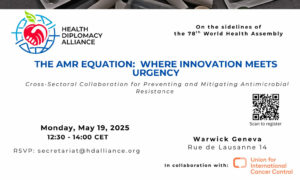
- The AMR Equation: Where Innovation Meets Urgency: Cross-Sectoral Collaboration for Preventing and Mitigating Antimicrobial Resistance | Health Diplomacy Alliance, Union for International Cancer Control | 19 May 2025 | 12:30-14:00 CEST | Hotel Warwick
- Advancing Health and Climate Discussions Towards COP30: A Dialogue with the Baku Continuity Coalition | Official Side Event | Brazil, Egypt, United Kingdom | 19 May 2025 | 12:30-13: 50 CEST | Palais des Nations, Room VII
- Biosecurity: A Priority in the Era of Pandemics and AI | PAN, Independent Panel for Pandemic Preparedness and Response (IPPPR) | 21 May 2025 | 07:00-09:00 CEST | Hôtel Royal Genève
- Mobilising action on AMR for better cancer care – collaboration with the NCD community is key | 21 May 2025 | 08:00-09:30 CEST | UICC, CARB-X, GARD-P | By invitation only
- Temperatures rising: Preparing and protecting for extreme heat | Wellcome Trust, The Rockefeller Foundation, Global Heat Health Information Network | 21 May 2025 | 09:00-10:30 CEST | Intercontinental Hotel, Ballroom C & Online
- Future-proofing healthcare: Innovations to support people and planet | Foreign Policy, Bupa | 21 May 2025 | 08:30-10:00 CEST | By invitation only
- Protecting people and planet: Supporting implementation of the future plastics treaty | Geneva Health Week | Geneva Graduate Institute’s Global Health Centre, TESS Forum, University of Portsmouth’s Revolution Plastics Institute | 21 May 2025 | 12:30-14:00 CEST | Maison de la Paix, Auditorium Ivan Pictet
- Unlocking Scale Pathways for Climate and Health Solutions | PATH, Global Innovation Fund (GIF) | 21 May 2025 | 16:00-18:00 CEST | Lisbonne Seminar Room, InterContinental | By invitation only
- Health is the Driver for Intergenerational Climate Action | Governments of Norway, the Philippines, Denmark, and the Republic of Korea, and supported by WHO’s Asia-Pacific Centre for Environment and Health, the WHO European Centre for Environment and Health, and WHO | 21 May 2025 | 18:00-19:30 CEST | Campus Biotech
- Planetary health: A contribution through cooperation, research and art | Medicus Mundi Spain | 21 May 2025 | 18:00-20:00 CEST | Warwick Hotel
- From risk to readiness: Harnessing weather and climate information for health | The Rockefeller Foundation, Wellcome, WHO-WMO Joint Climate & Health Programme | 21 May 2025 | 18:00-20:30 CEST | Restaurant Vieux Bois | Waitlist
- Break the Fossil Fuel Influence: Launching a Health-led Call for Fossil-Free Communications | Global Climate and Health Alliance | 22 May 2025 | 08:00-09:30 CEST | Geneva Press Club – To RSVP contact: shweta.narayan@climateandhealthalliance.org
- Adapting to climate change to end infectious diseases: needs, best practices, innovations and resources | Medicines for Malaria Venture (MVV), France, Rwanda, AMREF Health Africa, UNITAID | 22 May 2025 | 19:30-20:50 CEST | Palais des Nations, Room VII
- Making the health investment case for clean air | Clean Air Fund | 23 May 2025 | 12:30-14:00 CEST | Vieux Bois Restaurant
→ Consult our 78th World Health Assembly dedicated webpage for a list of side and parallel events relevant to the environment.
On the sidelines of the World Health Assembly, the Geneva Health Forum 2025 taking place from 20 to 23 May 2025 at Campus Biotech, provide a platform conveying the perspectives of scientists, healthcare professionals and field actors on the main challenges and opportunities for global health, exploring key themes, including Climate Change and Health on 21 May 2025:
- Scaling Impact: Climate & Health Solutions That Drive Change to be held from 09:00 to 10:30 CEST, will bring together leading actors to move beyond discussion and into action, showcasing concrete solutions from the field and highlighting urgent challenges that demand collective response, building momentum by connecting communities of practice and sparking collaboration. Through storytelling, real-world cases, and a commitment tree to foster ongoing partnerships, we invite you to help scale what works and co-create the future of climate-resilient health systems.
- Climate Change and Health: Adaptation and Resilience in a Changing World, organized by the Vanke School of Public Health and Tsinghua University and taking place from 14:00 to 15:30 CEST, brings together global experts to advance international cooperation on climate health, moving beyond crisis response toward proactive resilience-building. Key themes include climate health ethics, planetary health, and the interconnected well-being of human populations and the planet itself.
Approaching World Environment Day and the Plastics Treaty Negotiation
The countdown continues, with now less than three weeks to World Environment Day, calling this year for collective action to tackle plastic pollution, exactly two months before delegates meet in Geneva for the resumed negotiations towards a global treaty to end plastic pollution. Save the date for Geneva World Environment Day Celebration taking place at the International Environment House on the morning of 5 June 2025 → Register to attend in person.
Beating plastic pollution continues high on the agenda of International Geneva, with various events taking place this week to continue to build momentum towards these milestones, including in the margins of the World Health Assembly:
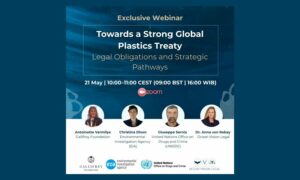
- Towards a Strong Global Plastics Treaty: Legal Obligations and Strategic Pathways | The session will center marine plastic pollution as a critical case study — highlighting how existing obligations under international law already require States to act, including the 2024 ITLOS Advisory Opinion, and what this means for the ambition, design, and enforceability of the treaty currently under negotiation. → Register on Zoom to participate in the session organized by the Gallifrey Foundation with the Environmental Investigation Agency, the UN Office on Drugs and Crime and Ocean Vision Legal on 21 May 2025 from 10:00 to 11:00 CEST
- Protecting people and planet: Supporting implementation of the future plastics treaty | Organized by Geneva Graduate Institute’s Global Health Centre, TESS Forum, University of Portsmouth’s Revolution Plastics Institute as part of Geneva Health Week, this event will answer questions about human health as a central issue for the plastics treaty, the range and depth of multisectoral cooperation that will be needed to implement the treaty, and how health sector stakeholders can support implementation of the treaty. → Join either in person at Maison de la Paix, Auditorium Ivan Pictet or online on 21 May 2025 from 12:30 to 14:00 CEST.
Other events taking place this week include:
- Financing a Just Transition in the Plastic Value Chain | The Global Partnership on Plastic Pollution and Marine Litter webinar, co-hosted by GRID-Arendal, and International Alliance of Waste Pickers, will explore financial solutions for a just transition in the plastics economy, with a focus on the informal waste sector. It will highlight key financing mechanisms to bridge financial gaps for informal waste workers. → Join on Zoom on 20 May 2025 at 14:00 CEST.
Additional news on plastics include:
- Last week, the Beat Plastic Pollution Dialogue “Health on the Negotiating Table: Stakeholder Reflections on the Plastics Treaty Draft” provided an overview of the alarming related health damages of exposure to plastics and stressed the need to emphasize the health impacts of plastics and the health sector’s contribution in the Plastics Treaty.
- Rallying for an ambitious global plastics treaty | One Earth | 16 May 2025
One Earth Journal Volume 8, Issue 5 is fully focused on the Plastics Treaty, with various articles looking at different aspects. From the editorial team: Hope deflated last November when negotiations towards a global plastics treaty stalled without an agreement. Parties reconvene in August, but is a legally binding agreement that addresses all aspects of the plastic cycle still possible? - Plastics: Exposing Their Climate Impacts, What we know, what need to know, & recommendations for research and policy | The Plastics and Climate Project, the Environmental Law Institute, Monterey Bay Aquarium and University of Wollongong | May 2025
This report is the first to systematically map out three ways in which plastics affect the climate: 1. through greenhouse gases emissions across their lifecycle; 2. disrupting key ecosystem processes essential to sequestering carbon, and; 3. affecting how the Earth reflects and absorbs energy. → Learn more in the press release - Health impacts of exposure to synthetic chemicals in food | Jane Muncke, Mathilde Touvier, Leonardo Trasande & Martin Scheringer | Nature Medicine | 16 May 2025
A sustainable transition of the food system must address the health impacts of synthetic chemicals in food; we discuss existing solutions that do justice to the complexity of the issue while avoiding regrettable substitutions and rebound effects. - Starch-based bioplastic may be as toxic as petroleum-based plastic, study finds | The Guardian | 13 May 2025
Starch-based bioplastic that is said to be biodegradable and sustainable is potentially as toxic as petroleum-based plastic, and can cause similar health problems, new peer-reviewed research finds. - The Big Plastic Count | Greenpeace Switzerland | 13 May 2025
The national campaign The Big Plastic Count rallied 4,498 households and 595 schoolchildren, finding that food and beverage packaging accounted for the vast majority of the plastic waste counted. 91% of those who took part in the final survey felt that it was the primary responsibility of brands and retailers to offer plastic-free solutions. - New Fellowships to Address Ocean Plastic Pollution | Pew Charitable Trusts | 7 May 2025
Scientists forecast that the amount of plastic entering the ocean—approximately 11 million metric tons each year—could triple by 2040. To help find solutions, The Pew Charitable Trusts and Gerstner Philanthropies are launching fellowships to support innovative research exploring ways to reduce marine plastic pollution.
Important to note that the deadline for registration to attend INC-5.2 is 6 June 2025, 23:59 EAT (22:59 CEST), while the INC Secretariat has announced that there will be no on-site registration.
Consultative Workshop and Science-Policy Dialogue on Solar Radiation Modification
Under the joint leadership of the United Nations Environment Programme and the World Meteorological Organization a hybrid Consultative Workshop and Science Policy Dialogue on Solar Radiation Modification (SRM) is hosted on 19 and 20 May 2025 at the WMO Headquarters. The aim is to foster a shared understanding of the status of SRM science and research and to facilitate Science-Policy dialogues for a collective inquiry on this topic based on the updated science information. The two-day workshop, supported by the International Science Council (ISC) and World Climate Research Programme (WCRP) will therefore include knowledge sharing sessions followed by a facilitated Science-Policy Dialogue. The Workshop will bring together key experts, researchers and practitioners working on SRM as well as UNEP Member States and Major Groups of Stakeholders. → Consult the provisional agenda and learn more about Climate-Altering Technologies and Measures.
Enjoying a Green Spring in Geneva
Suggestions for a Green Spring in Geneva this week include:
- Atelier p’tits chefs: Une recette végétale géniale | 21 May 2025 | Swiss Food Academy
Discover how fast food can be healthy in this fun cooking workshop for kids aged 6 to 12! Guided by May’s guest chef Victor, little cooks will create a delicious veggie kebab using crunchy seasonal produce and flavor-packed marinated vegetables. A tasty intro to sustainable eating! - L’extraordinaire voyage de la tomate | 21 May 2025 | Conservatoire et Jardin Botaniques
Children will explore the origins of the tomato and learn how to grow and care for their own plants through hands-on gardening. This playful, educational workshop is part of the Green Workshops series at the Geneva Botanical Gardens, where kids engage with nature through themed investigations, sensory experiences, and botanical discoveries led by garden mediators, scientists, and Uni3 volunteers. - Vive le lierre! | 21 May 2025 | Conservatoire et Jardin Botaniques
Join us for a walk in the botanical garden with an ornithologist from the Museum to learn everything about ivy. Though often misunderstood, ivy is loved by birds and insects. Discover its true value during this informative and nature-filled stroll. - Le contrat de performance énergétique : un outil de garantie et de financement de la transition énergétique | 22 May 2025 | Uni Carl-Vogt
This conference will discuss how energy performance contracts can act as tools for guaranteeing and financing the energy transition. - Notre Biodiversité : Balade discussion | 22 May 2025 | Conservatoire et Jardin Botaniques
Join experts for a walk through the “Notre Biodiversité” trail, where you’ll engage in a discussion on Geneva’s new Municipal Biodiversity Strategy and how we can preserve biodiversity in our daily lives, cities, and globally. - Balade à la rencontre du castor | 23 May 2025 | Ville de Carouge
Join a free evening walk in Carouge to explore the beaver trail while discovering local wildlife, native trees, rare plants, insects, birds, and ecological networks. The walk, suitable for all levels except for some uphill sections, will include interactive stops for observing nature. - Notre Biodiversité: Jeu de memory | 23 to 30 May 2025 | Conservatoire et Jardin Botaniques
Explore Geneva’s Municipal Biodiversity Strategy through a fun and educational memory game. In this interactive activity, visitors match “before-and-after” images representing actions that help protect biodiversity, both individually and institutionally. Each successful match reveals key insights into how we can make a difference. - Les chants de La Laire au fil des saisons | 24 May 2025 | La Laire
Join the final outing of this four-part series to experience the peak of migratory bird songs along the Laire River. From Avusy to Sézegnin, and back through the vineyard, participants will try to identify as many bird calls as possible. The walk offers an immersive opportunity to enjoy nature’s symphony. - Qui chante par ici? A la découverte des oiseaux du parc des Evaux | 24 May 2025 | Parc des Evaux
This fun adventure is designed for children aged 6 to 12, offering the chance to discover the birds of Parc des Evaux. Participants will learn how to recognize bird songs and spot these hidden singers in the trees. The workshop is held in collaboration with the Fondation des Evaux. - Les reptiles du Moulin de Vert | 24 May 2025 | Réserve naturelle du Moulin de Vert
Early in the morning, participants will have the opportunity to observe fascinating reptiles basking in the sun at the beautiful Moulin de Vert nature reserve. As budding naturalists, they will move quietly and carefully, hoping to spot these discreet cold-blooded creatures. - Festival Explore Demain 2025 | Until 25 May 2025 | Various locations
Explore Demain is a Geneva-based festival that brings together specialists, artists and citizens to dream, share and shape a common future. Join this Immersive and participatory festival, taking over emblematic locations to discuss concrete solutions. You will have on the program: exhibitions, debates, concerts and workshops to tackle current issues and envision a sustainable future. - Kidical Mass 2025 | 25 May 2025 | Quai Wilson
Kidical Mass returns to Geneva in 2025! This family-friendly event invites children and their families to reclaim the streets by bike, scooter, or rollerblades. The goal is twofold: to offer a fun, community-focused moment and to advocate for safer cycling infrastructure for all ages. This global movement gathered 200,000 participants in over 1,000 cities in 2024, and now it’s Geneva’s turn! Join us for a safer, happier, and more accessible city for everyone. - La vie de la rivière | 25 May 2025 | Centre Nature du Vallon de l’Allondon
Come explore the river and discover its inhabitants! You probably already know a few fish, but what do they eat? Who are those beautiful dragonflies around the river? Are there birds that come to feed here? By observing the Allondon River, you’ll understand the importance and strength of this ecosystem for nature. - Dessiner comme Robert Hainard | 25 May 2025 | Réserve naturelle du Moulin de Vert
Join us for a visit to the Moulin de Vert, a place dear to Robert Hainard! This natural reserve was a source of inspiration for the famous Geneva-based artist and naturalist. Let’s explore the area, observe the nature around us, and try to capture our impressions and observations with pencil and paper. - Art et évolution | Until 31 May 2025 | Conservatory and Botanical Garden
Showcasing artistic interpretations of evolutionary concepts by school groups, the exhibition features their creative works alongside reflections on their learning process. Explore this unique blend of science and art in the passage under Route de Lausanne. - Dialogues insolites entre le Muséum d’histoire naturelle de Genève et le Conservatoire botanique de Genève | Until 29 June 2025 | Conservatoire et Jardin botaniques
Discover the fascinating interactions between the plant and animal worlds through a unique exhibition showcasing historical specimens and scientific connections. Learn how creatures like the sphinx moth, tattooed armadillo, and Darwin’s orchid have contributed to scientific advancements, and explore the legacy of renowned Geneva naturalists.
What (Else) to Read Next?
- U.S. finance CEOs challenged for leaving climate pacts by Democratic lawmakers | Reuters | 16 May 2025
Democratic lawmakers harshly criticized the chief executives of BlackRock (BLK.N), opens new tab, JPMorgan (JPM.N), opens new tab and other top finance companies for leaving several global coalitions devoted to combating climate change, urging them to uphold their previous commitments and policy targets designed to reduce greenhouse gas emissions. - Delivering on forest governance in a transactional world | Tulip | 15 May 2025
Fern commissioned Tulip, a Geneva-based consultancy, to interrogate external perceptions of the EU’s international forest policy. The report was timed to inform the next five-year cycle of EU action on protecting tropical forests. - Leak: EU to target clean-up of ‘forever chemicals’ in water strategy | Euronews | 15 May 2025
The European Commission plans to support large scale efforts to clean up forever chemicals as part of its upcoming water resilience strategy, acknowledging the widespread threat of water pollution and the need for technological innovation to address it.
- Shifting environmental pollution abroad contributes to lower emissions in democracies | Thomas Bernauer, Tobias Böhmelt ,Ella Henninger | Plos Climate | 14 May 2025
Many studies suggest that democracies have, on average, a better environmental protection record than authoritarian states. But this debate is far from resolved. Hence, we take a closer look at an overlooked factor that may shed new light on the ambiguous claims and findings of the democracy-environment nexus: pollution offshoring.
- Europe ‘lagging’ behind on human rights by not recognising right to healthy environment, experts say | Euronews | 14 May 2025
The Council of Europe has just adopted an international treaty, the Convention on the Protection of the Environment through Criminal Law, which will help member countries to tackle serious environmental crime. It is the first international legally binding instrument to address environmental crime, covering a broad range of criminal acts that aggravate the triple planetary crisis of climate change, pollution and biodiversity loss. However, legal experts say the Committee missed the chance to legally protect the right to a clean, healthy and sustainable environment for all in Europe. - Decades of Deceit: The Case Against Major Fossil Fuel Companies for Climate Fraud and Damages| Delta Merner, Kathy Mulvey, Laura Peterson, Seth Shulman | Union of Concerned Scientists | 14 May 2025
For decades, major fossil fuel companies possessed detailed and accurate knowledge about the dangers their products pose to the global climate and understood that climate action would threaten their business models. Yet they planned, funded, and continue to engage in a campaign to profit from the planet’s destruction by deceiving the public and blocking climate action.
- A historic course correction: How the world’s shipping sector is setting sail for net zero | UN News | 14 May 2025
Long overlooked as a major contributor to global greenhouse gas emissions, the shipping industry is now at the forefront of a unique display of international cooperation. The shift signals that even the world’s largest transport sector can be steered toward climate accountability. - Dominica: UN expert recommends human rights approach for advancing climate resilience | OHCHR | 14 May 2025
Dominica’s efforts towards climate resilience have been remarkable, says the UN Special Rapporteur on human rights and climate change, urging the Government and the international community to rely on the human rights approach to consolidate achievements, recognize local innovations and civil society’s contributions, and understand who was left behind from climate response and disaster recovery. - 2025 Global Report on Internal Displacement | IDMC | 13 May 2025
Issues such as poverty, inequality, instability and climate change drive movements year after year, adding newly displaced people to those already living in displacement and forcing many IDPs to move again, increasing their vulnerabilities with each new flight. - L’obsolescence programmée est-elle née à Genève? | Tribune de Genève | 12 May 2025
Le phénomène d’obsolescence programmée ne serait pas nouveau. Selon certaines sources, il remonterait au début du siècle passé. Et il aurait un lien avec Genève. - Coping with change in a warming Mediterranean | WWF | 12 May 2025
More than a quarter of the Mediterranean’s species don’t exist anywhere else. But the Med is in trouble. Its incredible biodiversity is already under huge stress from overfishing, pollution and coastal development. And now climate change is ratcheting up the pressure. - State of the Climate in Africa 2024 | World Meteorological Organization | 12 May 2025
The World Meteorological Organization’s latest State of the Climate in Africa 2024 report reveals that extreme weather and climate change are intensifying hunger, insecurity, and displacement across Africa, impacting every facet of socio-economic development. Read more on UN News
- UN expert on the right to healthy environment to visit Singapore | OHCHR | 12 May 2025
During her 10-day visit, UN Special Rapporteur on the right to a clean, healthy and sustainable environment, Astrid Puentes Riaño, will examine main environmental issues linked with the right to a healthy environment, such as air quality, waste management and biodiversity – including ocean and marine management. This is the first visit of the Special Rapporteur since she was appointed in May 2024 and the first country visit from a Special Procedures’ mandate holder to Singapore in almost 10 years. - Heat extremes in southern Africa might continue even if net-zero emissions are achieved | The Conversation | 11 May 2025
Human emissions of greenhouse gases have caused rapid global warming. This has made high-impact, heat extreme events around the globe more and more intense over the past 70 years. Heat extremes, such as heatwaves, can cause severe damage to infrastructure by damaging bridges and railways. They also harm ecosystems, and can lead to loss of life. - Planetary Boundaries: designing (fair?) limits to assess performance at the country level | Hy Dao, Damien Friot | Frontiers in Sustainable Resource Management | 26 March 2025
To operationalize the Planetary Boundaries, these must be translated to lower scales, such as countries, suitable for action. This article reviews the allocation principles and methods enabling the quantification of fair limits and ultimately the assessment of performance at the country level.
Events
See all

Conference
Geneva Health Week 2025
18 – 21 May 2025
Maison de la Paix & Online
Geneva Global Health Platform
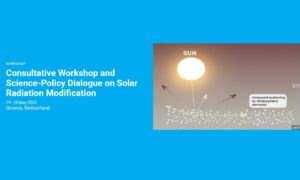
Consultative Workshop and Science-Policy Dialogue on Solar Radiation Modification
19 – 20 May 2025
UNEP, WMO
Body Meeting
29th Session of the Group of Experts on Assessment of Climate Change Impacts and Adaptation for Inland Transport
19 – 20 May 2025
Palais des Nations | Room III
UNECE
Conference
The AMR Equation: Where innovation meets urgency
19 May 2025 | 12:30 – 14:00
Warwick Hotel
Health Diplomacy Alliance

Body Meeting
Dialogue on Plastics Pollution and Environmentally Sustainable Plastics Trade (DPP)
19 May 2025 | 15:00
WTO | Room S1 & Online | Zoom
WTO


Conference
Briefing on the first meeting of the Open-Ended Working Group for the Global Framework on Chemicals
20 May 2025 | 13:00 – 14:30
International Environment House I, Room 2 & Online | Webex
GFC, GEN
Virtual
Meeting of the Global Chemicals and Health Network | Part 1
20 May 2025 | 13:30 – 15:00
Online | Zoom
WHO
Conference
World Bee Day 2025: Bees for Biodiversity
20 May 2025 | 15:00 – 16:30
Botanical Conservatory and Garden Geneva | Amarante Restaurant
FAO, Switzerland, Geneva Botanic Garden, Ethiopia, Slovenia, UNOG, GEN

Local
Fête de la nature 2025 | À l’écoute de la nature
21 – 25 May 2025
Various Locations
Association de la Fête de la Nature
Conference
Scaling Impact: Climate & Health Solutions That Drive Change
21 May 2025 | 09:00 – 10:30
Auditorium, Campus Biotech
GHF
Virtual
Towards a Strong Global Plastics Treaty: Legal Obligations and Strategic Pathways
21 May 2025 | 10:00 – 11:00
Online | Zoom
Gallifrey Foundation
Consultation
Expert Conversation on Human Rights in the Life Cycle of Renewable Energy and Critical Minerals
21 May 2025 | 10:30 – 12:30
Palais des Nations, Room V
Special Procedures of the UN Human Rights Council, GEN
Conference
Protecting People and Planet: Supporting Implementation of the Future Plastics Treaty
21 May 2025 | 12:30 – 14:00
Maison de la Paix | Auditorium Ivan Pictet
TESS, Geneva Global Health Platform
Conference
International Tea Day Celebrations in Geneva | Tea for Better Lives
21 May 2025 | 13:00 – 15:00
Palais des Nations | Building H Auditorium & Online
FAO, Sri Lanka, UNOG
Virtual
Virtual meeting on the Strategic Plan
21 May 2025 | 13:00 – 15:00
Online | Zoom
Ramsar Convention
Conference
Climate Change and Health: Adaptation and Resilience in a Changing World | GHF2025 Satellite Symposium
21 May 2025 | 14:00 – 15:30
Campus Biotech
GHF
Virtual
Strengthening Workers’ Health and Safety in Chemicals and Waste Management
21 May 2025 | 14:00 – 15:30
Online | Zoom
GFC, ILO, GGKP
Virtual
Advancing the Transition Away From Fossil Fuels in Third-Generation National Climate Plans
21 May 2025 | 14:00
Online | Zoom
IISD, UNDP
Virtual
9th Bonn Dialogue on Environment and Health | Nature-based Solutions and Health
22 May 2025 | 10:00 – 12:00
Online | Zoom
WHO, UNECE, UNEP

Local
Objectifs climatiques cantonaux: utopie ou futur désirable ?
22 May 2025 | 12:15 – 13:30
Salle communale de Plainpalais
EXPLORE Genève
Conference
International Biodiversity Day Celebration 2025 | Multilateral Geneva Creating Interlinkages and Driving Transformative Change in Harmony with Nature and Sustainable Development
22 May 2025 | 13:15 – 15:00
Palais des Nations, Room III
GEN, CBD, IPBES, Switzerland

Local
Une journée cantonale du climat a Genève?
22 May 2025 | 14:00 – 17:00
Salle communale de Plainpalais
Republic and State of Geneva
Body Meeting
Negotiating Group on Rules (Fisheries Subsidies) – Focused Thematic Session – Information Session on the AFS and Ratification Experiences
22 May 2025 | 15:00
WTO | Room D
WTO
Conference
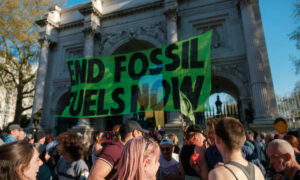
Urgence écologique et crise démocratique: l’impossible réponse?
22 May 2025 | 19:45 – 21:00
Salle communale de Plainpalais
EXPLORE Genève
Body Meeting
Negotiating Group on Rules (Fisheries Subsidies) – Focused Thematic Session – Information Session on the Fisheries Funding Mechanism
23 May 2025 | 15:00
WTO | Room D
WTO
Local
Climathon Genève 2025
24 May 2025 | 13:30 – 18:00
Salle communale de Plainpalais
Impact Hub Geneva, City of Carouge
Jobs
See all



Intern
Environment, Water Management, International Law, International Relations Intern
23 May 2025
Water Convention


Updates
See all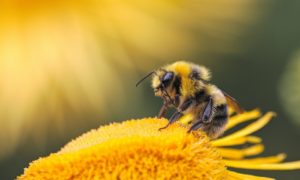
04 May 2026
World Bee Day
16 Apr 2026
International Day for Biological Diversity


09 Apr 2026
One Health and the Role of Geneva