
Newsletter 02 Feb 2026
Environment: What’s Up in GENeva | 2 – 8 February 2026
The Geneva Environment Network’s weekly newsletter includes the latest information on the global environmental agenda, main events, job vacancies, as well as other useful resources and updates. The Geneva Environment Network is not responsible for the content of any linked site or any link contained in a linked site. Stay tuned and follow us on X (Twitter), Facebook, LinkedIn, Instagram, Bluesky, and Youtube, or visit our website regularly for additional updates.
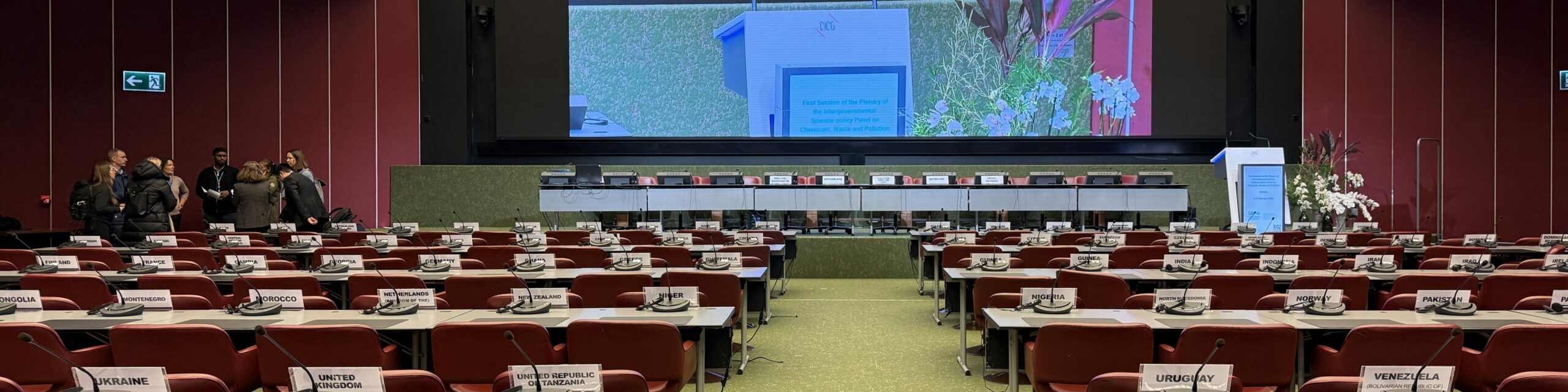
Image of the week | Secretariat meeting informally in plenary room, in preparation of the first Plenary session of the Intergovernmental Science-Policy Panel on Chemicals, Waste and Pollution (ISP-CWP), convening in Geneva this week.
Member States Meet in Geneva to Launch the Work of the New Science‑Policy Panel on Chemicals, Waste and Pollution
Established in June 2025 in Punta del Este, Uruguay, the Intergovernmental Science-Policy Panel on Chemicals, Waste and Pollution aims to strengthen the science‑policy interface by assessing scientific knowledge, identifying evidence‑based policy options, and catalyzing solutions to global challenges related to chemicals, waste, and pollution. It will provide authoritative, policy-relevant scientific advice to support sound management and prevention, taking into account different national circumstances, development priorities, and capacities. Its goal is to help protect human health and safeguard the environment for present and future generations.
Following a day of regional and stakeholder meetings on Sunday, 1 February, the first Plenary session of the Panel (ISP‑CWP P1) convenes this week, from 2 to 6 February 2026 at the Geneva International Conference Centre (CICG). At ISP‑CWP P1, the Panel Member States are expected to elect its Bureau, including the Chair and Vice-Chairs, designate the physical location of the venue of the Panel, adopt the rules of procedure, the work programme, and plans for potential intersessional work. → Learn more in the UNOG Press Briefing held on 30 January 2026
To prepare and follow the upcoming first plenary session of the ISP-CWP:
- Access all ISP-CWP P1 pre-session documents
- Rewatch the sessions organized in the framework of the Road to the First ISP-CWP Plenary Session Series, including the briefing on preparations
- Follow the negotiations through the Earth Negotiations Bulletin live coverage, the Geneva Environment Network X account, and a dedicated update for highlights.
- Consult position papers released by stakeholders:
- CIEL | The New Chemicals, Waste, and Pollution Panel Faces Its First Test in Geneva | 28 January 2026
- IPEN | Quick Views, First Plenary ISP-CWP | January 2026
- IPCP | IPCP Policy Brief: Multilateralism as the basis for the ISP-CWP’s work | 30 January 2026
- Science Community | A Call to Action: Engaging with the Intergovernmental Science-Policy Panel on Chemicals, Waste and Pollution | Environmental Science & Technology | 30 January 2026
- The UN Institute for Training and Research (UNITAR) launched a new platform that provides resources and introduces the new supporting document on Engaging the Scientific Community and Other Relevant Stakeholders: Supporting Document for the ISP-CWP National Focal Point
International Seabed Authority Secretary-General Visits Geneva
On the occasion of the visit to Geneva of the Secretary-General of the International Seabed Authority (ISA), Leticia Carvalho, a special event “The International Seabed Authority: Governing the Common Heritage of Humankind, Protecting the Marine Environment, and Regulating Deep-Sea Mining”, organized within the framework of the Geneva Dialogues on Minerals and Metals, will take place on Wednesday 4 February 2026. The event will provide information, perspectives and expectations on the first part of the 31st Session, to be held from 9 to 20 March 2026 in Kingston, Jamaica. → Register on Indico to attend in person at the Centre administrative de Varembé (CAV), Varembé 1, or on Webex to participate online on 4 February 2026, at 13:00 CET.
Established in 1994 under the United Nations Convention on the Law of the Sea (UNCLOS), the ISA is the organization through which States Parties to UNCLOS organize and control all mineral‑resources‑related activities in the Area for the benefit of humankind as a whole, with a mandate to ensure the effective protection of the marine environment from harmful effects arising from deep‑seabed activities. At a time when increasing demand for critical raw materials is shaping global discussions and geopolitical interests, the ISA’s role is more important than ever in safeguarding and managing deep‑seabed resources and upholding both the legal principle and moral responsibility to ensure these resources are used not for the few, but for the benefit of present and future generations.
Plastics Treaty Negotiation Resumes in Geneva to Address Organizational Matters
The third part of the fifth session of the Intergovernmental Negotiating Committee to develop an international legally binding instrument on plastic pollution, including in the marine environment (INC-5.3), is taking place at CICG in Geneva on 7 February 2026. The resumed session will be preceded by regional consultations on the same day. → Follow the live webcast of the Plenary on UN Web TV and the live coverage of the Earth Negotiations Bulletin.
Following the resignation of the former INC Chair, the Bureau of the INC, at its meeting held on 30 October 2025, agreed that a one-day resumed session should be convened for organizational and administrative purposes, addressing the election of officers, including the position of Chair. Accordingly, no substantive negotiations will be held during this resumed session.
Plastics remain a priority across Geneva’s multilateral processes. Last week, WTO members participating in the Dialogue on Plastics Pollution and Environmentally Sustainable Plastics Trade (DPP) focused their discussions on a revised draft ministerial statement for the 14th Ministerial Conference (MC14), scheduled to take place next March in Cameroon. Launched in 2020, the DPP now includes 83 co‑sponsors representing nearly 90% of the global plastics trade.
Environment @ 158th session of the WHO Executive Board
The 158th session of the World Health Organization Executive Board is taking place from 2 to 7 February 2026 at the WHO Headquarters. The meeting comes at a challenging moment for the Organization. As WHO Director‑General Dr. Tedros Adhanom Ghebreyesus noted, several areas of work remain underfunded, including emergency preparedness, antimicrobial resistance (AMR), health financing, climate resilience, and the determinants of health and risk factors. → Consult all documents and follow the livestream
WHO EB158 will advance discussions on the environment, specifically on:
- The Draft updated global action plan on antimicrobial resistance. Pursuant to decision WHA78(15) (2025), WHO Director-General will submit to the Board for consideration and further submission to the Seventy-ninth World Health Assembly the draft updated global action plan on antimicrobial resistance, developed by the Secretariat in collaboration with the Quadripartite alliance and in consultation with Member States and other stakeholders. The Board will be invited to note the report and consider a draft decision.
- The Draft global plan of action for the health of Indigenous Peoples. Pursuant to resolution WHA76.16 (2023), the Director-General will submit a report containing an update on the development of the draft global plan of action for the health of Indigenous Peoples. The Board will be invited to note the report and consider a draft decision. The draft global plan of action sets five priority areas for action, including “addressing the impacts of climate change, biodiversity loss, pollution and environmental degradation on the health of Indigenous Peoples and promoting resilient health systems, sustainable livelihoods and community well-being.”
In preparation for the Executive Board meeting, the Geneva Global Health Hub (G2H2) hosted a series of policy debates from 19 to 23 January 2026, including some addressing environmental-related issues.
IPBES12 Plenary to Discuss Landmark Business and Biodiversity Report
The twelfth session of the Plenary of the Intergovernmental Science-Policy Platform on Biodiversity and Ecosystem Services (#IPBES12), often described as the “IPCC for biodiversity”, is convening this week, from 3 to 8 February 2026 in Manchester, United Kingdom, preceded by a Stakeholder Day on 2 February 2026. Geneva experts will join the meeting, where members will be discussing and expected to approve the IPBES methodological assessment of the impact and dependence of business on biodiversity and nature’s contributions to people (known as the “Business and Biodiversity Report”). Resulting from almost three years of work by 80 of the world’s leading experts from science and the private sector, as well as from Indigenous Peoples and local communities – drawn from 35 countries – the Report aims to provide information and options that can be used by businesses and financial institutions to drive better outcomes for biodiversity and nature’s contributions to people. The report is expected to be launched on 9 February 2026. IPBES-12 will also consider progress on the planned methodological assessment of integrated biodiversity-inclusive spatial planning and ecological connectivity and the second global assessment of biodiversity and ecosystem services. In addition, delegates will reflect on proposals for an additional assessment through 2030, with potential focus on biodiversity-interlinkages with pollution, poverty, cities, or climate change. → Read IPBES Media Release, Watch the Opening Ceremony, consult the documents and follow the Earth Negotiations Bulletin Live Coverage
Launch of the Updated UNECE Industrial Accident Notification System
A United Nations Global Seminar on Early Warning, Pollution Remediation and Environmental Liability that convened last week, called for urgent action to strengthen multi-hazard early warning systems (MHEWS) to better address technological and Natech (natural hazard-triggered technological) disasters. Participants emphasized the need to integrate these risks into national and regional early warning architectures to enhance preparedness and response, advance the Sendai Framework and support the UN Secretary‑General’s Early Warnings for All Initiative. Senior officials from UNECE, WMO and UNDRR highlighted the role of multilateral environmental agreements, historical lessons and the importance of addressing data gaps. → Learn more in the UNECE press release and find highlights of the first day of the seminar on the GEN X account
A key milestone was the launch of the upgraded UNECE Industrial Accidents Notification (IAN) System, a secure platform enabling real‑time information exchange and transboundary cooperation to strengthen preparedness and response to technological and Natech disasters. Originally established by the Conference of the Parties to the Industrial Accidents Convention in 2000, the system has been modernized by UNECE, in cooperation with the UN Economic and Social Commission for Western Asia, for enhanced usability, strengthened security and new communication features, including tools for real-time coordination among nationally designated Points of Contact.
Outcomes of the Dakar High-level Preparatory Meeting for the 2026 UN Water Conference
The Dakar High-level Preparatory Meeting for the 2026 UN Water Conference took place from 26 to 27 January 2026, paving the way for the UN Water Conference 2026, co-hosted by the United Arab Emirates and Senegal, and to be convened in the United Arab Emirates from 2 to 4 December 2026. The two-day meeting brought together more than 1,600 participants from over 120 countries, mobilizing governments and a wide range of stakeholders to advance the Conference’s substantive preparations and strengthen alignment across the international community around key global water priorities. The programme featured six roundtable “kick-off” discussions for each of the Conference’s six Interactive Dialogues, adopted by consensus last July at the UN General Assembly, and whose themes could help build a bridge between political commitments and their practical implementation.
To capture the outcomes of the Dakar meeting, the co-hosts of the 2026 UN Water Conference will put together a summary, which will include a ‘Roadmap from Senegal to the UAE.’ The outcomes will contribute to the in-depth review of SDG 6 by the UN High-level Political Forum on Sustainable Development (HLPF) in July, the meetings of the Conferences of the Parties to the three Rio Conventions – the UN Framework Convention on Climate Change (UNFCCC), the UN Convention to Combat Desertification (UNCCD), and the Convention on Biological Diversity (CBD), and high-level events held in preparation for the 2026 UN Water Conference, including the Fourth Dushanbe Water Action Decade Conference.
Resources on the outcomes of the conference include:
- UAE and Republic of Senegal Conclude High-Level Meeting with Collective Roadmap For 2026 UN Water Conference | UAE | 29 January 2026
- Co-Chairs for 2026 UN Water Conference Interactive Dialogues Announced | IISD SDG Knowledge Hub | 28 January 2026
- Dakar High Level Preparatory Meeting Newsletter No. 3 | 28 January 2026
- UN envoy: ‘Water must be put at the top of the political agenda’ | Swissinfo | 27 January 2026
- UNU, UNESCO, UNITAR and UN-Water Launch Academic Hub to Strengthen Science–Policy Engagement for the 2026 UN Water Conference | 27 January 2026
- New UN-Water GLAAS findings: stronger WASH systems needed for safe drinking-water, sanitation and hygiene for all | WHO | 26 January 2026
Update on PFAS, the Forever Chemicals
Often referred to as ‘forever chemicals,’ per- and polyfluoroalkyl substances (PFAS) are toxic, man-made, hazardous chemicals that have dangerous effects on the environment and our health, and require coordinated, evidence‑based action across sectors. Various reports were issued last week, reminding us that decision makers need to take action. These include:
- PFAS in groundwater: the invisible path to our drinking water | IGRAG (under auspices of UNESCO-IHP and WMO) | 27 January 2026
Groundwater provides drinking water to over 2 billion people worldwide, and is under threat from PFAS contamination. The problem is known, is very widespread and the consequences are dire, according to a newly released policy brief. Urgent action is needed. IGRAC’s new series of groundwater explainer videos, takes a deep dive into the world of PFAS substances. - How to Apply the Polluter-Pays Principle to the PFAS Pollution Crisis | EEB, OPOPA, ClientEarth, and CIEL | 29 January 2026
The report clarifies who should pay (polluters and contributors), for what (past, present, and future PFAS pollution), and how much (all direct and indirect costs), while highlighting the need for strong enforcement and PFAS phase-out measures. - New study confirms huge and growing costs of PFAS pollution | EU Directorate for the Environment | 29 January 2026
Current levels of ‘forever chemicals’ pollution could cost the EU approximately €440 billion by 2050. A study commissioned by the European Commission assesses the cost of pollution from PFAS in the European Economic Area. The Commission is committed to taking the necessary action to protect these groups but also to prevent possible wider societal consequences, while ensuring a balanced approach until alternatives to PFAS can be implemented in key industrial applications. - PFAS and Planetary Boundaries: Global Challenges for Waste Management and Policy Solutions | Roland Weber, Lautaro Girones | Environmental Science & Technology | 27 January 2026
Drawing on lessons from the Basel and Stockholm Conventions, the authors outline a governance approach centered on class-based regulation, application of the essential-use concept with time-bounded derogations, and strict enforcement of BAT/BEP for remaining uses. Accountability should be strengthened through extended producer responsibility, polluter-pays mechanisms, and product labeling and traceability, supported by equity-focused finance and technology partnerships, with progress assessed through three complementary indicators. - European apples contaminated with cocktails of pesticides (PFAS, neurotoxins and other highly toxic substances) | PAN-Europe | 29 January 2026
Jointly with 13 partner organizations in 13 European countries, PAN-Europe has analyzed pesticide residues in 59 samples of locally produced apples. More than one out of 2 apples (64%) contain at least one PFAS pesticide residue. Eight different PFAS pesticides were detected across all apple samples. There was no country where PFAS pesticides were not detected in at least one sample.
Enjoying a Green Winter in Geneva
During the cold winter days, Geneva offers plenty of opportunities to enjoy your free time indoors or in heated outdoors. This week, suggestions to enjoy a Green Winter in Geneva include:
- Winter themes natural cosmetics discovery workshop for adults | 2 February 2026 | Espace de quartier des Eaux-Vives
During this workshop, made up of three sessions, you will create several must-have winter cosmetic products using natural and organic ingredients that are gentle on the skin and respectful of the environment. - Jury Night – Circular Economy Incubator | 3 February 2026 | Maison de l’Avenir
Discover the future of the circular economy! During this event, project leaders will have the opportunity to pitch their ideas and showcase their solutions in order to be selected to join the 2026 cohort of the circular economy–focused startup incubator run by Impact Hub Geneva. - Les Roues de l’Avenir Film Screening | 3 February 2026 | Bibliothèque de la Servette
Through the journey of a group of young people and the words of experts, this documentary analyzes the economic, sociological, and health aspects of everyday bicycle use. - Discovering palm trees from Ghana to our greenhouses | 4 February 2026 | Conservatoire et Jardin botaniques de Genève
Dive into the fascinating world of palm trees through an immersive, multidisciplinary approach, and follow the captivating journey of a seed—collected during one of our missions in Ghana as part of our Multipalms project— through to its meticulous cultivation in our greenhouses. - How learning and action can shape a more sustainable society | 4 February 2026 | Maison de l’Avenir
The conclusions of the three-year LEVERS action-research project will serve as the foundation for a shared reflection, leading to a call to action jointly drafted by teachers, policymakers, and researchers. - Mercredi Family – En Pierre, en bois, en metal | 4 February 2026 | Musée d’Art et d’Histoire
At the MAH, objects are made from all kinds of materials. Come and learn how to classify them according to their origin: the mineral, plant, or animal world — or even other categories. Will you be able to recognize them? For children aged 6 and up, accompanied by an adult. - Discovering big trees – Panda Club Outing | 4 February 2025 | WWF Geneva | Muséum d’histoire naturelle
Did you know that there are several extraordinary trees in Geneva? If you love big trees and would like to learn how to identify remarkable ones, this activity will allow you to discover a few of them on a walk through the city. - Festival Antigel | From 5 to 18 February 2026 | Multiple Locations
Every winter since 2011, Antigel has transformed Geneva and its surrounding areas into an extraordinary space for cultural and artistic exploration. A true laboratory for cultural innovation, it reflects its time by showcasing cult and emerging artists and highlighting the diversity and challenges of the Canton of Geneva in all its realities. - Give us Back the Beauty, Exhibition by Bernard Garo | Until 6 February 2026 | Grand-Rue 6, 1204 Genève
Give Us Back the Beauty is a solo exhibition by Swiss artist Bernard Garo, presented by Galerie Renaissance. Through painting, photography, and film, Garo explores humanity’s fragile relationship with nature, using materials such as pigments, sediments, and glacier water. The exhibition brings together works on paper, historic maps, and large-scale glacier photographs, revealing transformation not as loss, but as resilience; and beauty as something still possible. - Water Meetings | 6 February 2026 | ASL, Maison de la Rivière, University of Lausanne and HEPIA | HEPIA
This event is aimed at institutions, associations, NGOs whose activities are linked to water and the general public. The ASL will be presenting the results of the Léman Plastic Action study, a model of the flow of plastics into Lake Geneva and possible solutions to curb this pollution. - Mineral Echo | Until 7 February 2026 | Théâtre du Grütli
Based on testimonies from female mountaineers, this performance weaves a dialogue between mountaineering, feminism, and ecology. Two women, bound by a fragile solidarity, set out to place a memorial plaque to commemorate a glacier that has just disappeared. - Les Séismes, attention les secousses ! | 8 February 2026 | Musée d’histoire des sciences
Our planet is tectonically active. Continents drift, sometimes colliding with one another. Oceans form, only to be swallowed again. Earthquakes are a direct consequence of these processes. In science, measuring instruments have helped us better understand the Earth’s internal structure. While earthquakes propagate along the surface of the crust, their waves also travel through the planet’s interior! The first known seismometer was created in China around 130 AD. - Libre comme le Rhône – de Robert Hainard | Until 29 March 2026 | Quartier Libre
The exhibition invites visitors to travel back in time along the river, from the last wild landscapes before the major developments of the Rhône to the major energy decisions taken during the 20th century, right up to the emergence of environmental awareness. This exhibition shows how, in a small cantonal area, electricity needs, landscape transformations, and the desire to protect nature have intertwined. - Exhibition “Quel froid!” | Until 30 August 2026 | Maison Tavel
Explores the theme of winter in Geneva and beyond, bringing together traditions, artists’ perspectives, and visual archives. Visitors are guided through popular practices, urban scenes, and majestic landscapes, from Lake Geneva to the Alps.
What (Else) to Read Next?
- Climate Litigation Victory at the District Court of the Hague of the People of Bonaire with Implications Beyond the Netherlands | The Hague District Court | 28 January 2026
This judgment builds on a growing body of precedents, including by the European Court of Human Rights / Cour européenne des droits de l’homme and the Cour internationale de Justice (CIJ) climate ruling confirming States’ legal obligations to design and implement policies that reduce emissions in line with the objective of limiting global warming to 1.5°C.
- UNECE launches new study calling for systemic efficiency to accelerate a resilient, affordable, and just energy transition | UNECE | 27 January 2026
A new UNECE publication “Energy efficiency and decarbonization measures in end-use sectors” calls for rethinking how countries design their energy systems: from “Which energy efficiency technologies should be deployed?” to “How to design the system, so that proven measures scale, persist, and stay affordable?”
- Geneva Policy Outlook 2026 | Geneva Graduate Institute | 27 January 2026
Global cooperation is being reshaped by crisis and constraint. The Geneva Policy Outlook 2026 argues that Geneva’s future depends on adaptation, innovation, and renewed partnerships to secure its relevance and shape a new world order. - Our fish: diversity breeds diversity | Swiss Federal Office for the Environment | 27 January 2026
Switzerland—a hotspot for fish diversity! The latest research shows just how remarkable the wealth of native species is, some of which are unique in the world. At the same time, it is clear that many species are threatened or have already disappeared. New knowledge about our fish paves the way for more targeted and effective protection. - Geopolitical Risk is Undermining Global Pandemic Preparedness | Health Policy Watch | 27 January 2026
Global pandemic preparedness is becoming “increasingly fragile at a time of growing biosecurity and geopolitical risk”, according to the International Pandemic Preparedness Secretariat (IPPS), which launched its Fifth Implementation Report of the 100 Days Mission on Tuesday. - France: UN experts alarmed by farmers’ arrests and growing criminalisation of peasant movements | OHCHR | 26 January 2026
UN experts expressed deep concern regarding the escalating use of police custody and criminal proceedings against farmers and agricultural trade union leaders in France, following the arrest of 52 people during peaceful protests in Paris this month.
Events
See all
Body Meeting
First Session of the Plenary of the Intergovernmental Science-Policy Panel on Chemicals, Waste and Pollution (ISP-CWP P1)
02 – 06 Feb 2026
CICG
ISP-CWP
Body Meeting
8th Meeting of the Hydrological Coordination Panel (HCP-8)
02 – 04 Feb 2026
WMO Headquarters
WMO


Conference
Criminalistique environnementale ou la recherche de la mise en œuvre du principe du pollueur payeur
02 Feb 2026 | 17:30 – 19:00
UNIGE Sciences II Building
UNIGE
Body Meeting
64th session of the Implementation Committee
03 – 06 Feb 2026
Palaist des Nations, Room VIII
EIA Convention
Afterwork
Jury Night – Circular Economy Incubator
03 Feb 2026 | 18:00
Maison de l'Avenir
Impact Hub Geneva

Conference
The International Seabed Authority: Governing the Common Heritage of Humankind, Protecting the Marine Environment, and Regulating Deep-Sea Mining
04 Feb 2026 | 13:00 – 14:00
CAV, Varembé 1
ISA, GEN

Body Meeting
144th Session of the Executive Committe (EXCOM 144)
04 Feb 2026 | 15:00 – 18:00
Palais des Nations, Room IX
UNECE
Virtual
4th Meeting of the Informal Task Force on E-Mobility
05 Feb 2026 | 14:00 – 16:00
Online
UNECE

Conference
Géopolitique de la transition énergétique
06 Feb 2026 | 14:30 – 16:00
Théâtre de l’Espérance
UNIGE

Jobs
See all
Updates
See all

18 Feb 2026
Geneva Dialogues on Mineral and Metal Resources
23 Jan 2026
Wetlands and the Role of Geneva


23 Aug 2026