Newsletter 20 Oct 2025
Environment: What’s Up in GENeva | 20 – 26 October 2025
The Geneva Environment Network’s weekly newsletter includes the latest information on the global environmental agenda, main events, job vacancies, as well as other useful resources and updates. The Geneva Environment Network is not responsible for the content of any linked site or any link contained in a linked site. Stay tuned and follow us on X (Twitter), Facebook, LinkedIn, Instagram, Bluesky, and Youtube, or visit our website regularly for additional updates.
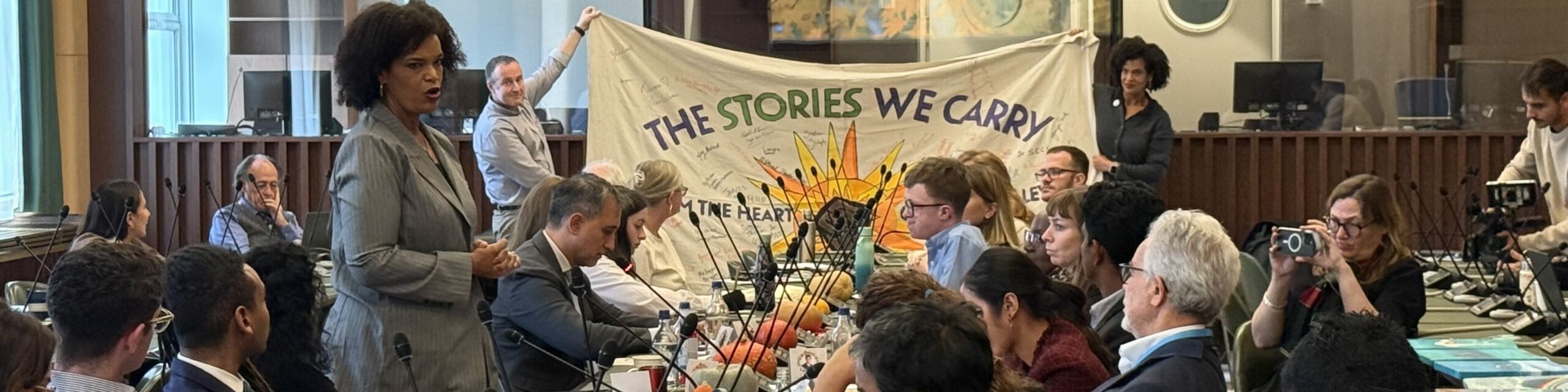
Image of the week | In preparation for the upcoming UN Climate Change Conference in Belém COP30, participants from diverse backgrounds came together on 14 October 2025 for an ethical dialogue on the climate crisis — also known as the Global Ethical Stocktake. Convened as a side event to the Fifth session of the Forum on Human Rights, Democracy and the Rule of Law held under the theme “Democracy and Climate Change: Focusing on Solutions,” the gathering offered a space for heartfelt reflections, varied perspectives and shared emotions and commitments to climate justice and democratic resilience.
UNCTAD 16 | UN’s Flagship Conference on Trade and development
The 16th United Nations Conference on Trade and Development (UNCTAD16) is taking place at Palais des Nations from 20 to 23 October 2025, hosted by the government of Switzerland, under the theme “Shaping the future: Driving economic transformation for equitable, inclusive and sustainable development”. Held every four years since 1964, at the level of heads of state and government, ministers, and global thought leaders, the quadrennial conferences refine the organization’s mandate in response to new developments in the global economy. At UNCTAD16, heads of State and Government, Ministers of Trade and Economy, Nobel Laureates, leaders of international organizations, representatives of civil society and renowned experts will engage in high-level dialogues on global trends and policy perspectives on trade, investment, development and the digital economy. Alongside the negotiations, the conference will feature a general debate, ministerial meetings of country groups, ministerial roundtables, forums, parallel events and exhibitions. → Full programme
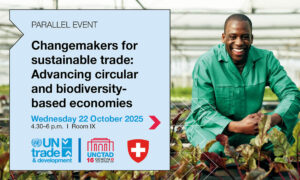
The UN Trade and Development will host, with the support of the Geneva Environment Network, the parallel event Changemakers for Sustainable Trade — Advancing circular and biodiversity-based economies. The discussions will showcase how UNCTAD’s BioTrade initiative and the Sustainable Manufacturing and Environmental Pollution (SMEP) programme have empowered changemakers and promoted sustainable trade. Across developing countries, local producers, circular economy innovators, and biodiversity-based enterprises are indeed leading the charge toward a more sustainable future for trade. Their work proves that environmental stewardship and economic growth can go hand in hand — creating jobs, boosting incomes, and building climate resilience. Yet they often face fragmented markets, scaling challenges, and limited inclusion in global trade and policy dialogues. The event takes place on 22 October 2025 from 16:30 to 18:00 CEST in Palais des Nations, room IX. Participation is opened to accredited participants to UNCTAD16 and UN badge holders. The event will be followed by a reception offered by GIZ, opened to the participants.
Other events of interest for the environmental community at UNCTAD16 include:
- Plenary session with the United Nations Secretary-General on 22 October 2025,from 15:00 – 16:30 CEST → Follow the livestream
- The Global Commodities Forum 2025 — a free, public platform to debate critical issues at the intersection of commodities and development — will take place on 22 October 2025 in the Assembly Hall. Focusing on Critical Energy Transition Minerals, discussions will explore global solutions to ensure that the growing demand for critical energy transition minerals supports both reliable, resilient supply chains and sustainable development in producing countries.
- The 5th UNCTAD Youth Forum will take place on 23 October 2025 from 11:30 – 13:00 CEST in the Assembly Hall. It will feature panel discussions and presentations of UNCTAD Youth Action Hubs to reflect how young people – with their energy, creative spirit and instinct for innovation – have the potential to be powerful agents of change and find solutions to build a more inclusive and sustainable future.
It is also noteworthy that this week, the inaugural edition of the Forum on Trade, Environment & the SDGs (TESS) Annual Conference on Trade, Climate, and Sustainable Development (TCSD), is taking place on 23–24 October 2025 at the Geneva Graduate Institute. Focusing on the themes of climate action, resilience, and justice, the conference will bring together leading experts from around the world to discuss, identify, and forge pathways for effective, inclusive international action and cooperation on trade, climate, and sustainable development. Participation in the conference is by invitation only. While the event is designed to be an in-person gathering, there will be some opportunities for online participation, such as in public panels and certain roundtables.
Extraordinary Session of the World Meteorological Congress | WMO @ 75
The Extraordinary Session of the World Meteorological Congress — the general assembly and supreme body of the World Meteorological Organization — is taking place from 20 to 23 October 2025 at WMO Headquarters, back-to-back with the Extraordinary Session of the Executive Council on 24 October 2025. The extraordinary session has been convened primarily to advance the Early Warnings for All (EW4All) initiative, along with other urgent strategic priorities that cannot wait until the next regular Congress in 2027. The session takes place as the WMO celebrates its 75th anniversary, while WMO traces its origins to the International Meteorological Organization, established in 1873. → Access more information and related documents and follow via the livestream.
Highlights include:
- On the morning of 20 October, the Extraordinary Congress kicks off with a High-Level Event on the Early Warnings for All Initiative at the World Trade Organization. Marking the halfway point of the initiative, launched by the UN Secretary General in 2022, and the entry of the initiative into its second phase, the event will feature ministerial speakers and a Call to Action on Early Warnings for All. The event will emphasize Pillar 2 – hazard monitoring and forecasting and provide an opportunity to bridge global policy commitments with local realities. Heads of State, Heads of Government and Ministers, UN, private sector, and financial institutions will discuss their commitment to and results of the EW4All initiative. → Follow the livestream
- On 21 October, discussions will turn to the role of artificial intelligence (AI) in weather forecasting, exploring ways to bridge the digital divide between developed and developing nations. → Follow the livestream
- The Congress will culminate on 22 October with a special address by UN Secretary-General António Guterres, marking WMO 75th anniversary milestone and reaffirming global commitment to early warning systems for all. → The dialogue will be livestreamed. Accredited UN media have access to WMO headquarters.
Ahead of the extraordinary congress news and highlights issued by WMO include:
- WMO Greenhouse Gas Bulletin – No. 21 highlights how continued emissions of CO2 from human activities and an upsurge from wildfires were responsible, as well as reduced CO2 absorption by “sinks” such as land ecosystems and the ocean – in what threatens to be a vicious climate cycle. → Read the press release
- WMO Bulletin Vol. 74 (2) – 2025 features various articles on WMO work, the future and the importance of meteorological science and more. In this issue, Forecasting the Future: The Role of Artificial Intelligence in Transforming Weather Prediction and Policy explores the evolving role of AI and how WMO can empower Members to seize the benefits and avoid the pitfalls of this technology which is not a distant dream but a reality. Forecasting the Future, Now: How the ANDeL Project is Advancing Early Warnings with Deep Learning demonstrates that technology can be a game-changer for resource-limited National Meteorological Hydrological Services. While Governance and Artificial Intelligence, the Key to an Integrated End-to-End Approach to Early Warnings for All highlights China’s success in using AI and issues a call to Members for cooperation to build a solid scientific foundation for risk-informed decisions.
- Open Call: Early to Mid-Career Professionals for the WMO Scientific Advisory Panel (SAP) | WMO invites applications from early to mid-career professionals to join its SAP — a body that provides forward-looking scientific and strategic advice on emerging challenges and opportunities related to weather, climate, water, and related environmental and social sciences. Applications should be submitted by 26 November 2025.
Countdown to Minamata Convention COP-6
Last week, a series of online events leading up to the 6th session of the Conference of the Parties to the Minamata Convention on Mercury (COP-6) provided an informal platform for Parties and observers to discuss challenges, exchange insights, and highlight progress in technology, research, and policy related to mercury. These sessions aimed to inform and inspire both the Parties and the broader global community served by the Minamata Convention.
The Geneva Environment Network hosted three Minamata COP-6 online events co-organized with various partners, highlighting:
- A new approach to the global mercury trade and use in ASGM in order to strengthen the Minamata Convention on Mercury → Rewatch the session and find related resources
- Ways to bridge science and policy as seen in the example of the Minamata Convention on Mercury in view of the upcoming Minamata COP-6 and the first session of the Plenary of the Intergovernmental Science-Policy Panel on Chemicals, Waste and Pollution (ISP-CWP P1), both to take place in Geneva.→ Rewatch the session and find related resources
- The need to strengthen the convention with a human rights-based approach, including a discussion on a mercury-use ban in ASGM, to protect the rights of Indigenous Peoples. → Rewatch the session and find related resources
Recent news released as we approach COP-6 include:
- In a letter made public last week, two UN Special Rapporteurs and a group of experts expressed concerns about insufficient compliance with a Colombia 2016 Constitutional Court ruling that recognized the Atrato River as a legal entity with rights to protection and restoration, warning that mercury contamination from illegal gold mining in the Atrato River basin has created a “serious and ongoing human rights crisis,” threatening the health and survival of Indigenous and Afro-descendant communities who depend on the river for food, water and culture. → Read the full article on Associated Press
- A new study by IPEN found that contamination by mercury used in small-scale gold mining has resulted in high mercury levels in Indigenous women in communities downstream from gold mining operations in Peru and Nicaragua. The study found that almost all women tested (99%) had body levels of mercury above the safety threshold recommended recently by experts, and most (88%) had levels above the current US EPA safety levels. → Read the press release
- A new report “Poisonous metal: Methylmercury in shark tissue samples from the European market” by ElasmOcean e.V., Gallifrey Foundation, and Stop Finning Deutschland e.V. found that beyond ecological impacts, shark meat consumption raises significant public health concerns due to contamination with methylmercury (MeHg), a potent neurotoxin that bioaccumulates in marine predators.
-
Register for the Minamata COP-6 Special Event From Science to Action: Protecting the Amazon from Mercury Pollution to be held on Sunday 2 November 2025, 18:00-20:00 CET in CICG. This event is open to the public and will highlight the work of Fernando Trujillo, renowned conservation scientist and NatGeo Rolex Explorer of the Year, and other leading voices. The Amazon basin is home to extraordinary biodiversity and to communities whose lives are deeply tied to the river. Yet illegal gold mining and mercury pollution pose serious threats to both ecosystems and human health. The event will include the screening of Amazon, the New Minamata film. The documentary reveals how mercury contamination threatens the inhabitants of Amazonia with the shadow of the Minamata Disease.
International Lead Poisoning Prevention Week 2025
The thirteenth International Lead Poisoning Prevention Week (ILPPW), held from 19-25 October 2025 focuses this year on “No safe level: act now to end lead exposure.” The campaign highlights the urgent need to protect children’s health from the unacceptable risks of lead exposure. Building on the global success of phasing out leaded petrol, it also celebrates progress in limiting lead in paints – especially those found in homes, schools, and playgrounds where children are most vulnerable.
Lead has gained renewed attention in global environmental, health, and research forums in recent months. At the 78th World Health Assembly in May, Member States adopted resolution WHA78.27 reaffirming the health sector’s commitment to tackling lead exposure. The resolution also recognized the efforts of the Global Alliance to Eliminate Lead Paint—a voluntary partnership led by UNEP and WHO—which has mobilized over 100 partners to prevent childhood exposure and reduce occupational risks. Momentum continues at the national level, with new regulations being passed, draft rules advancing, and key government authorities engaged. → Consult the latest newsletter of the alliance
IUCN World Conservation Congress Outcomes
The 2025 IUCN World Conservation Congress concluded in Abu Dhabi, United Arab Emirates, on 15 October 2025. With over 10,000 on-site and online attendees from government, civil society, Indigenous Peoples’ Organizations, academia, and business and more than 1000 events held, the Congress set the vision for nature conservation for the next 20 years. → IUCN Press Release
At the Congress, Members:
- Adopted 148 Resolutions, including the first-ever global policy on synthetic biology and nature conservation, a motion to recognize ecocide as a crime, and motions to strengthen governance and inclusion and the first motion (Motion 042) across the entire global multilateral system to explicitly address fossil fuel production as a threat to nature.
- Approved the 20-year Strategic Vision and a new programme for the next four-year period.
- Adopted Nature 2030: One nature, one future. The IUCN Programme 2026-2029 as the roadmap, along with accountable deliverables, to drive global conservation action over the next 4 years. With a local to global remit it will support on-the-ground impact through mobilizing and directing resources to where they are needed, equipping frontline conservationists with the necessary capacity, knowledge and tools, enhancing collaboration by bringing key actors together, guiding and supporting local and global environmental policy and advancing nature-based education.
- Confirmed Her Excellency Razan Khalifa Al Mubarak will serve a second term as the Union’s President alongside newly elected members of the IUCN Commissions and Council.
- Unveiled high-impact announcements and pledges to bolster global conservation efforts. The Abu Dhabi Call to Action calls on the global community, under IUCN’s leadership, to accelerate urgent and practical action across five key areas: reaffirming nature as the foundation of well-being, strengthening multilateralism, ensuring justice and inclusion, advancing knowledge and innovation, and scaling up resources for nature and climate action.
- Welcomed over 100 new Members into its Union during the Congress – including six states Armenia, Tajikistan, Marshall Islands, Gabon, Tuvalu, and Zimbabwe.
Advancing the Human Rights and Environment Agenda
Several moments are taking place this week in Geneva and beyond that tackle the interlinkages between the human rights and the environment:
- The open-ended intergovernmental working group on transnational corporations (TNCs) and other business enterprises (OBEs) with respect to human rights (OEIGWG) continues its work at its eleventh session to elaborate an international legally binding instrument to regulate, in international human rights law, the activities of transnational corporations and other business enterprises. The meeting, taking place from 20 to 24 October 2025, at Palais des Nations, Room XVI, will continue the State-led negotiations on Articles 12 to 24 of the the updated draft legally binding instrument with the textual proposals submitted by States during the ninth and tenth sessions of the OEIGWG, as well as present the summary report on the first, second and third intersessional thematic consultations on Articles 4 to 11 and the Chair’s suggested redrafting of selected provisions. The Chair’s proposed roadmap for 2026 is also expected to be adopted at this meeting.
- Various civil society organizations have urged States, in its environmental analysis of the current draft, to “seize the coming round of negotiations on a UN legally binding instrument on business and human rights as an opportunity to anchor the right to a clean, healthy and sustainable environment in the text.”
- FIAN International, in its press release, calls on all state delegations to adopt bold, human-rights-centered positions that close accountability gaps and guarantee effective remedy for affected people and communities.
- A side event on “The need for legally binding treaty in the context of the global rush for critical minerals“, organized by Centre Europe – tiers monde, is taking place on 22 October, 13:00-14:30 CEST at Palais des Nations, Room VII.
- As the 80th session of the UN General Assembly (UNGA 80) continues in New York, various UN Special Procedures mandate holders have presented or are expected to present their reports to the Assembly, including those related to the environment:
- The report of the UN Special Rapporteur on climate change and human rights, Elisa Morgera, contains a synthesis of evidence of the positive and negative human rights impacts of renewable energy development and its reliance on minerals (A/80/188). It clarifies States’ obligations and the responsibilities of other actors to support a human rights-based approach to the energy transition. → Read the press release
- In his report, the UN Special Rapporteur on toxics and human rights, Marcos Orellana, examines the human rights implications of toxics released by military activities (A/80/174). The report documents sources of exposure and their impacts on human and environmental health, and highlights the need for robust legal standards and measures to prevent, mitigate and remediate the harm caused by military contamination, in line with the human rights obligations of States. → Consult the Geneva Toxic Free Talk at HRC60 discussing the report.
- The UN Special Rapporteur on the right to a healthy environment, Astrid Puentes, in her report (A/80/187), analyzes the challenges and shortcomings in the regulation and implementation of environmental impact assessments (EIA), strategic environmental impact assessments (SEA), in light of the obligation to protect human rights including the human right to a clean, healthy and sustainable environment. → Read the press release
- The UN Special Rapporteur on the human rights to safe drinking water and sanitation, Pedro Arrojo Agudo, in his report (A/80/117), advocates that freshwater and aquatic ecosystems should be recognized as common goods and vital assets for the survival, coexistence and cohesion of human societies. This recognition is essential together with human rights, particularly those related to drinking water and sanitation. Therefore, it is imperative to promote a human rights-based approach to the democratic governance of freshwater and aquatic ecosystems. → Read the press release
- The UN Special Rapporteur on the situation of human rights defenders, Mary Lawlor, in her report (A/80/114), examines contributions by human rights defenders to addressing climate change and achieving a just transition, despite the risks they face, and urges States to take radical action on climate change to avoid a human rights catastrophe. → Read the press release
- The UN Special Rapporteur on the right to development, Surya Deva, in his report to UNGA 80 (A/80/206), elaborates on why States and other actors must finance only inclusive, sustainable and participatory development — in line with the model of “planet-centred participatory development” — in the face of emerging “world disorders” including economic, environmental and institutional.
- The growing dominance of transnational corporations and industrial agribusiness in global food systems poses an escalating threat to food security, rural livelihoods, and human rights also featured in several reports. The UN Special Rapporteur on the right to food, Michael Fakhri, in his report (A/80/213), examines how a relatively small number of corporations have amassed so much power over our food systems and outlines what is to be done to: curtail corporate power; ensure food markets are fair and stable; and hold corporations accountable for human rights violations in food systems.
- The Working Group on the rights of peasants and other people working in rural areas, in its report (A/80/180), examines the central role of peasants and rural workers in global food systems and highlights the importance of their meaningful participation in decision-making processes that have an impact on their lives, environments and livelihoods. → Read the press release
- The UN Special Rapporteur on the right to adequate housing, Balakrishnan Rajagopal, in his report (A/80/351), argues that land is central to the right to adequate housing and it is necessary to move away from the idea of land as a commodified asset for investors to speculate over or as a State asset that can ignore the rights of those living on it, especially in the face of climate and environmental crises.
More Updates on Climate Action Ahead of COP30
As we approach the UN Climate Change Conference in Belém, new reports and statements are being issued, including: a call for rights-based climate governance that transcends short-term politics, the need to integrate human rights in the just transition, the Global Multidimensional Poverty Index linking poverty with climate hazards, postponement of net-zero shipping talks to 2026, a report underscoring the 1.5 °C goal’s urgency, findings that banks have earned $26 billion financing deforestation, a new Nature at COP30 advocacy toolkit for businesses, and a Global Tipping Points study warning that both catastrophic and positive climate thresholds are already activating. Together, these developments highlight the need for integrated, long-term action as we prepare for COP30.
- At the opening of the Fifth session of the Forum on Human Rights, Democracy and the Rule of Law, the UN High Commissioner for Human Rights, Volker Türk, stressed that effective climate action goes hand in hand with the full enjoyment of human rights, and concluded, “We need fact-based governance focused on solutions, not distractions. […] We need governance that looks beyond short-term electoral cycles and power grabs and commits to change that is for the benefit of people, planet and generations to come”.
- Various UN Special Rapporteurs, in their reports to UNGA 80, addressed the need to ensure human rights in the just transition. The UN Special Rapporteur on climate change and human rights, Elisa Morgera, underscored in her report that “human rights are vital to ensuring that the energy transition benefits both people and the planet,” urging States to act to address inequities in energy production, extraction and access. The UN Special Rapporteur on human rights defenders, Mary Lawlor, urged States in her report to end the consistent pattern of repression and attacks against climate activists and human rights defenders calling for climate action.
- 2025 Global Multidimensional Poverty Index (MPI) | UNDP | 17 October 2025
The latest MPI report, for the first time, overlays data on climate hazards and multidimensional poverty to assess how exposed poor people are to environmental shocks. The report highlights that most people in poverty are exposed to at least one climate hazard; many confront several at the same time. By the end of this century, the countries projected to face the steepest temperature increases are those already burdened with higher levels of multidimensional poverty. - IMO net-zero shipping talks to resume in 2026 | IMO | 17 October 2025
The International Maritime Organization (IMO) has agreed to adjourn the extraordinary session of the Marine Environment Protection Committee (MEPC), which was convened from 14 to 17 October 2025 to consider the adoption of draft amendments to MARPOL Annex VI, including the IMO Net-Zero Framework. The extraordinary session will be reconvened in 12 months’ time. - Ten Years of the Paris Agreement: The Present and Future of Extreme Heat | World Weather Attribution | 16 October 2025
The report analyzes heat conditions across past and future warming scenarios to show why the Paris goal of 1.5°C is crucial — and why aiming for the highest possible ambition in the upcoming NDCs, to be discussed at COP30 in Brazil in November, is essential for every country to achieve what the Paris Agreement set out in its preamble. - Banks make $26 billion in a decade of financing deforesting companies | Global Witness | 14 October 2025
New analysis ahead of COP30 in Brazil reveals how efforts to end deforestation are undermined by climate-wrecking profits, as banks in the US, EU and UK make over $10 billion in income since the Paris climate agreement by financing companies involved in deforestation.
- Nature at COP30 – Advocacy Toolkit for Business | We Mean Business Coalition | 13 October 2025
This toolkit aims to provide a practical, tailored resource to support businesses in their efforts to speak up for and take actions that scale a more integrated nature and climate agenda in the run-up to and at COP30. - Global Tipping Points Report 2025 | University of Exeter | 13 October 2025
The Earth’s climate and nature are already passing tipping points as global warming approaches 1.5°C, beyond which further tipping points could lead to catastrophic risk, making it therefore urgent for leaders and humanity to prevent overshooting 1.5°C. Positive tipping points — occurring when reinforcing feedbacks in a system overwhelm balancing feedbacks, triggering self-propelling change towards a more sustainable state — must be identified and triggered to accelerate to net zero.
Happening Abroad
Convention on Biological Diversity (CBD) SBSTTA-27 and SB8J-1 | The twenty-seventh meeting of the Subsidiary Body on Scientific, Technical and Technological Advice (SBSTTA-27) will be held from 20 to 24 October 2025, back-to-back with the First meeting of the Subsidiary Body on Article 8(j) and Other Provisions of the Convention on Biological Diversity Related to Indigenous Peoples and Local Communities (SB8J-1), from 27 to 30 October 2025 in Panamá City, Panamá. SBSTTA-27 will address scientific, technical, and technological aspects of biodiversity conservation, while SB8J-1 will focus on matters of relevance to Indigenous Peoples and local communities. → Follow the live coverage by the Earth Negotiations Bulletin
Enjoying a Green Autumn in Geneva, Turning Back the Clock
Every year, on the last Sunday of October — this year on 26 October 2025 — most European countries transition from Central European Summer Time (CEST) back to Central European Time (CET), marking the end of daylight saving and the beginning of shorter days. As nature changes colors, and Geneva and neighbouring France schools are closed for holidays, we invite you to explore activities to enjoy a Green Autumn in Geneva, including this week:
- Geneva Rando Welcome Session | 21 October 2025 | Genève rando | Maison internationale des associations
Your steps count! New members (and anyone who’s curious), come and find out about how the association works, the planned hikes and activities and ask your questions in a friendly atmosphere. - Atelier Création Spécial Halloween | 21 October 2025 | La Bonbonnière | La Bonbonnière Chocolaterie – L’École du Chocolat
After an introduction to the history of chocolate and La Bonbonnière Genève chocolate shop, you will taste some of the house’s signature creations. Then, accompanied by the team, you will use your creativity to make a monstrously delicious creation for Halloween. - Chocolate workshop for children – Monstre en chocolat | 22 October 2025 | La Bonbonnière | La Bonbonnière Chocolaterie – L’École du Chocolat
Toque on their head, apron around their neck, in their apprentice chocolatier outfit, children will discover what is behind delicious chocolates. The professionals at La Bonbonnière will tell them in a fun way the history and stages of chocolate making while having them taste different chocolate vintages in order to awaken their palate to the subtle aromas of chocolate. Finally, the children will learn some notions of chocolate making and use their creativity to make a chocolate that is as delicious as it is cute. - Atelier cosmétique pour enfant: fabrication Savon Halloween | 22 October 2025 | L’art du cosmetique au naturel | Espace de quartier Eaux-Vives
During this Halloween-themed workshop, children make their own original silver-colored soap with a sweet candy scent. For fun, fragrant, and gentle cleaning! - Fashion Reborn | 22 October 2025 | Green Earth Action Foundation | Association Histoire sans Chute
Join for an interactive workshop where fashion meets sustainability. Learn hands-on techniques to upcycle old clothes and materials into fresh, creative designs giving new life to what was once discarded. - Les secrets du monde fongique | 22 October 2025 | Conservatoire et Jardin botaniques
Did you know that the Botanical Garden is home to much more than just plants? Among its discreet inhabitants are numerous species of fungi, fascinating organisms that are often overlooked but essential. During this tour, you will explore species visible in autumn that produce fruiting bodies that can be seen with the naked eye and are commonly referred to as mushrooms. - Exposition photo au Jardin des Nations | Until 24 October 2025 | Jardin des Nations
For its fourth season, the Jardin des Nations will transform into an open-air gallery. More than 40 photographs by British documentary photographer Mark Henley and French author-photographer Carole Desheulles will offer a visual dialogue between geopolitical tensions and the vitality of the natural world. - Les Nuits Magiques du Salève | 24 and 25 October 2025 | Magic Green’ Art | Salève
Come and discover magical, artistic, participatory, and eco-friendly events that highlight human contact, creativity, and connection with nature. - Festival Salamandre | From 24 to 26 October 2025 | Festival Salamandre | Espace Beausobre (Morges)
This year, the Festival Salamandre will immerse you in the theme of water. From lakes to rivers to the ocean depths, this 23rd edition is entitled “Metamorphoses.” At the Beausobre site in Morges, 9,000 to 10,000 visitors, enthusiasts and curious minds of all ages, will gather. The festival offers an event that encourages people to love, learn about, and respect nature in a spirit that is friendly, curious, and respectful of the environment. - Excursion Champignons | 26 October 2025 | La libellule | Salève
They are neither animals nor plants. They can be associated with mold, disease, nuclear explosions, or fermentation. Let’s learn about these strange living organisms. - BORN IN … PPM au pont de la Machine | Until 26 October 2025 | SIG | Quartier Libre SIG
An artistic photography project by Mary-Lou Mauricio demonstrating the increase in atmospheric CO₂ concentration since the industrial revolution. Participants pose with the atmospheric CO₂ concentration (in ppm) from their year of birth, creating a powerful statement against fossil fuels and climate change. - Notre Biodiversité | Until 30 November 2025 | Conservatoire et Jardin botaniques
In line with the new Municipal Biodiversity Strategy of the City of Geneva an itinerary through the heart of our garden invites us, through short texts printed on sails, to question ourselves on this burning subject and to reflect on our roles as citizens, public authorities, scientific institutions such as ours and civil society. - Léman : L’éveil d’un peuple | Until 14 December 2025 | Association pour la Sauvegarde du Léman | Espace Léman
Through a wealth of documents, testimonials, objects, and audiovisual archive footage, the exhibition “Léman, l’éveil d’un peuple” traces the decisive action taken by associations, scientists, fishermen, journalists, and institutions that helped turn the tide. The exhibition also aims to remind us that each and every one of us can play a part in bringing about change.
What (Else) to Read Next?
- New Report Warns of Escalating Marine Geoengineering Experiments, Urges Upholding Precaution | CIEL | 16 October 2025
A new report, ‘A Gathering Storm: How Marine Geoengineering Threatens All Ocean Basins‘, charts potential locations for high-risk marine geoengineering experiments, illustrating the alarming scale of proposed interventions. The report shows that proposals for open-ocean experiments are growing despite significant scientific, legal, and ethical barriers. - Triple investments in forests by 2030 to reap multiple benefits, says UN | UNEP | 14 October 2025
Two UNEP reports find that the tropical forests most at risk from loss are also the most vital to people. Annual investment in forests will need to triple by 2030, grow sixfold by 2050, and shift towards protecting high-risk forests. “High-risk forests, high-value returns: A co-benefits assessment for decision-makers,” quantifies the wide-ranging benefits of protecting 391 million hectares of high-risk tropical forests. It finds that these forests, covering roughly the size of European Union, deliver outsized returns for society. “2025 State of Finance for Forests: Unlock. Unleash. Realizing forest potential requires tripling investment in forests by 2030,” identifies for the first time the scale of the financial gap hindering sustainable forest management, despite commitments made under international agreements. - Guidelines on the Right to Peaceful Environmental Protest and Civil Disobedience | Michel Forst, UN Special Rapporteur on Environmental Defenders under the Aarhus Convention | October 2025
These Guidelines provide Guiding Principles and Operational Principles for the implementation of this call for action. They aim to assist Aarhus Parties and other UN Member States to ensure the effective protection of environmental defenders who engage in peaceful environmental protest, including civil disobedience. - New policy guidance will help strengthen “source-to-sea” water governance across sectors and countries | UNECE | 14 October 2025
Around 80% of marine pollution originates on land — from agriculture, cities, and industries — and is carried downstream into the ocean, with far reaching impacts. Incorporating holistic “source-to-sea management” in transboundary water cooperation is therefore pivotal to tackling the complex challenges that span land, freshwater, coastal and marine ecosystems. To support this, the new Guidance Note for the Implementation of Source-to-Sea Management in Transboundary Basins offers a practical pathway for countries to overcome divides between sectors and jointly manage shared waters from source to sea. - One in Six Bacterial Infections Is Antibiotic Resistant; Calls for Stronger Real-Time Pandemic Risk Surveillance | Health Policy Watch | 14 October 2025
One in six laboratory-confirmed, common bacterial infections were resistant to antibiotic treatments in 2023, rising to one in three reported infections in WHO’s South-East Asia and Eastern Mediterranean Regions, according to a new report. Between 2018 and 2023, antibiotic resistance rose in over 40% of pathogen-antibiotic combinations monitored, with an average annual increase of 5–15%, according to the Global antibiotic resistance surveillance report 2025.
Events
See all

Body Meeting
Eleventh Session of the Open-Ended Intergovernmental Working Group on Transnational Corporations and Other Business Enterprises with Respect to Human Rights
20 – 24 Oct 2025
Palais des Nations | Room XVI
HRC
Body Meeting
16th United Nations Conference on Trade and Development (UNCTAD16)
20 – 23 Oct 2025
Palais des Nations
UNCTAD
Body Meeting
Extraordinary session of the World Meteorological Congress (Cg-Ext(2025))
20 – 23 Oct 2025
WMO Headquarters
WMO
Virtual
When rivers meet neural nets: The promise and limits of Machine Learning in hydrology
20 Oct 2025 | 16:00 – 17:00
Online | AI for Good Neural Network
ITU
Virtual
E-waste Challenge MOOC Live Event: E-waste and Children Health (English)
21 Oct 2025 | 10:00 – 11:00
Online | Webex
BRS, WHO
Body Meeting
23rd session of the Steering Committee of the Transport Health and Environment Pan-European Programme
22 – 24 Oct 2025
Palais des Nations | Room VII
UNECE

Virtual
Webinar – ZDHC x ITC – Fostering Sustainable Chemicals Management in the T&C sector
22 Oct 2025 | 12:00 – 13:30
Online
ITC
Conference
Changemakers for Sustainable Trade — Advancing circular and biodiversity-based economies | UNCTAD16 Parallel Event
22 Oct 2025 | 16:30 – 18:00
Palais des Nations | Room IX
UNCTAD, GEN
Conference
TESS Annual Conference on Trade, Climate, and Sustainable Development (TCSD) 2025 – Trade Cooperation Pathways for Climate Action, Resilience, and Justice
23 – 24 Oct 2025
Maison de la Paix
TESS


Body Meeting
Extraordinary session of the Executive Council (EC‑Ext(2025))
24 Oct 2025 | 09:00 – 17:00
WMO Headquarters
WMO
Jobs
See all


Intern
Sustainable Fiscal Policy and Public Finance Intern
24 Oct 2025
UNEP Industry Innovation Branch